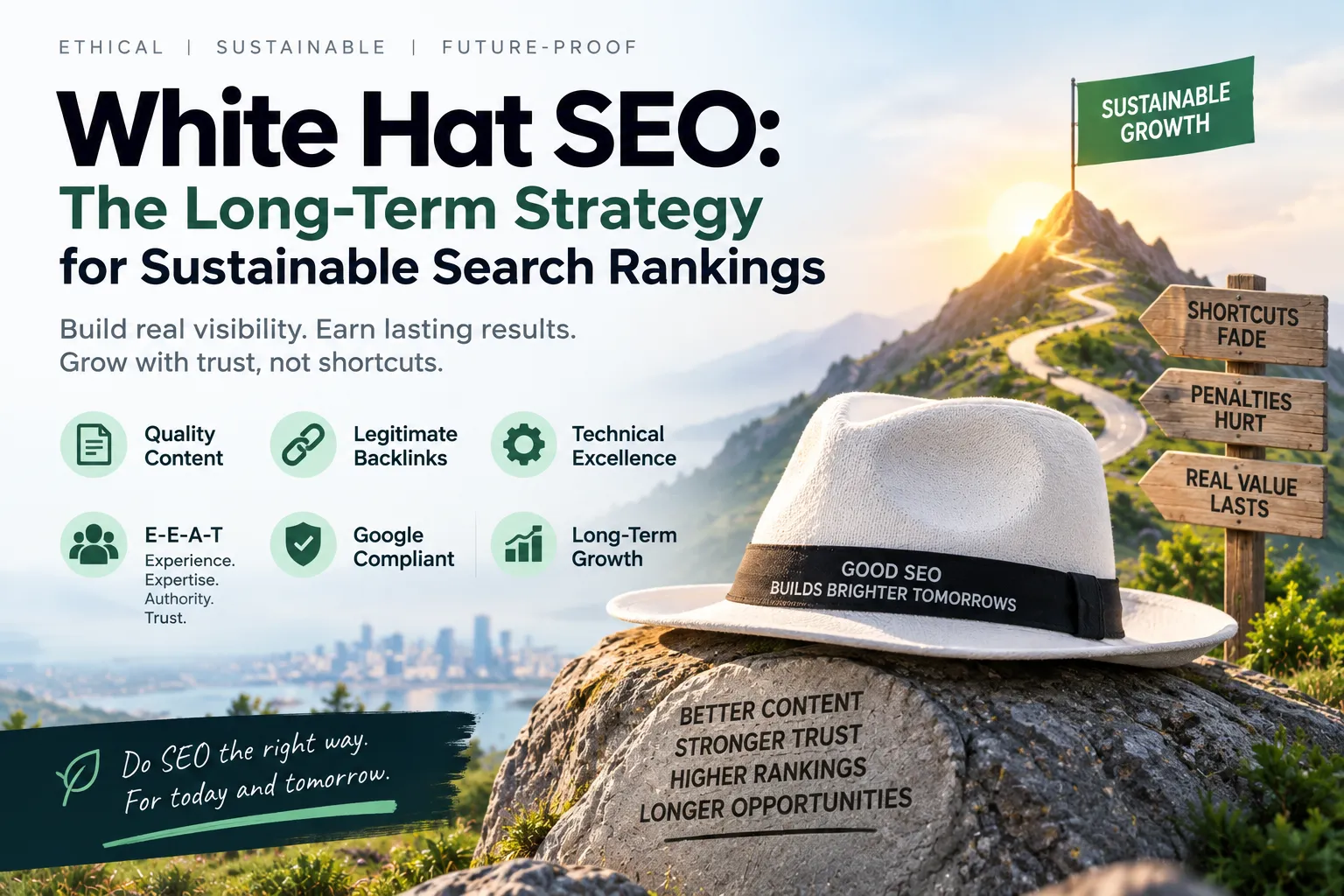
White hat SEO is search optimisation based on following search engine guidelines and delivering genuine user value. It means earning rankings through merit: creating content that answers real questions, building authority legitimately, and following the rules in Google Search Central documentation.

The core distinction is how you gain visibility. White hat focuses on ranking because your content deserves to rank. Black hat exploits algorithmic gaps through keyword stuffing, cloaking, link buying, or hidden content. Grey hat sits in the middle: tactics that aren’t explicitly forbidden but aren’t quite aligned with stated guidelines either, such as large-scale guest posting networks or reciprocal link exchanges. All three may deliver traffic, but only a white hat protects your business long term.
Google’s algorithm rewards white hat practices because they solve Google’s own problem: returning results users actually trust. When you follow E-E-A-T principles (Experience, Expertise, Authoritativeness, Trustworthiness), you are not gaming the system; you are building the thing search engines were designed to find.
Search engine optimisation doesn’t have to be a gamble. While black hat tactics promise quick wins, they carry severe risk. White hat SEO follows search engine guidelines, creates genuine value for users, and earns rankings through merit rather than manipulation.
This strategy takes longer than black hat shortcuts. You won’t see major traffic jumps in four weeks. But within 3 to 12 months, depending on your niche’s competitiveness, you’ll build an organic presence that survives algorithm updates, requires minimal maintenance, and compounds over time. You also eliminate the constant fear of manual penalties or algorithmic devaluation that haunts black hat practitioners.
The term “white hat” traces back to early hacker culture, where white hats were the ethical security researchers and black hats were the malicious ones. SEO borrowed the metaphor. ‘White hat’ means you’re optimising inside the rules that Google Search Central documentation outlines explicitly. They ask you to create original content, build authority through legitimate means, and prioritise user experience over rankings.
What makes the white hat different from the other approaches isn’t just what you avoid. It’s what you commit to: original research, expert perspective, transparent practices, and a genuine answer to what your audience is searching for.
Key Takeaways
- White hat SEO follows search engine guidelines and prioritises user value. It earns rankings through merit (quality content, technical excellence, legitimate backlinks) rather than exploiting algorithmic loopholes. This approach aligns with how Google’s algorithm actually works: by rewarding sites that serve searchers well.
- White hat takes longer but is future-proof. Expect measurable results in 3–6 months for competitive keywords and 6–12 months for highly saturated niches. Black hat offers quick wins but carries severe penalty risk (manual actions, deindexing). A white hat protects your investment.
- Content quality is non-negotiable. Your pages must answer user questions comprehensively, demonstrate original research or first-hand expertise, and be updated regularly. Thin content, keyword stuffing and duplicate material trigger algorithmic downgrades under Google’s Helpful Content updates (September 2023, March 2024).
- Authority is earned, not bought. Backlinks must come from genuine sources: media coverage, industry partnerships, resource citations and natural references. Guest posting works only when you contribute expert, on-topic articles to reputable publications. Link buying, PBNs and coordinated schemes are violations.
- Technical foundations are essential. Your site must be fast (Core Web Vitals), mobile-first, crawlable and secure (HTTPS). These are not ranking bonuses; their absence prevents ranking entirely.
- E-E-A-T signals matter more than ever. Google now explicitly weighs experience, Expertise, Authoritativeness, and Trustworthiness. First-hand knowledge, author credentials, original data and transparent sourcing outrank content farms and derivative AI output.
- You can compete with Black Hat in the long run. White Hat SEO creates a sustainable competitive advantage. One year in, a white hat site with solid fundamentals will outrank a black hat site that faced penalties. Two years in, there is no contest.
Core Principles of White Hat SEO
White hat SEO rests on five non-negotiable practices:
- Adheres to Google Search Central guidelines – You follow the rules Google publishes explicitly. No cloaking, no keyword stuffing, no manipulative redirects, no link schemes.
- Prioritises human user experience – Every decision starts with the reader, not the algorithm. Does this page answer the question? Is it fast? Can it be used on mobile? Would a user bookmark this?
- Builds authority through legitimate means – You earn links because publications and people genuinely want to reference your work. You acquire citations by doing original research, publishing tools that solve real problems, or stating something true others have missed.
- Creates original, valuable content – You do the work to develop a unique perspective. You cite sources accurately. You replace thin, templated content with depth that compounds your expertise over time.
- Earns backlinks naturally – Links come as a side effect of creating something worth linking to, not through outreach farms, reciprocal agreements, or paid placements. When you do reach out, you offer genuine value first.
Why Search Engines Reward White Hat Methods
Search engines succeed when they return results users trust and find useful. If Google filled the first page with keyword-stuffed pages and bought links, users would stop using Google. The algorithm’s business model depends on quality.
White hat practices align perfectly with that incentive. When you prioritise original research, user experience, and earned authority, you are making the exact signal a ranking algorithm should amplify. Google doesn’t reward white hat because it is nice; it rewards white hat because white hat pages are the ones users click, stay on, and share.
There is also a penalty-risk calculus. Black hat tactics carry severe consequences: manual actions that de-index entire sites, algorithmic devaluation that drops your search visibility by 70–90%, or permanent reputation damage. Recovery takes months to years, if it happens at all. White Hat tactics carry minimal penalty risk. If an update shifts the landscape, you adapt by doing better work, not by undoing violations.
The timeline trade-off is real. Black Hat tactics may deliver rankings in days to weeks; white hat typically needs 3–6 months for competitive keywords. But White Hat rankings do hold. Black hat rankings evaporate the moment Google’s algorithm tightens, or a reviewer audits your backlink profile.
How White Hat SEO Differs from Black Hat and Grey Hat
Understanding where White Hat sits on the spectrum clarifies why the approach matters. Three distinct models exist.
| Aspect | White Hat | Grey Hat | Black Hat |
|---|---|---|---|
| Guideline Compliance | Full adherence to Search Central policies | Partial or deliberately ambiguous interpretation | Deliberate violation of published guidelines |
| User Intent | Primary and central to every decision | Secondary concern; SEO benefit weighted equally | Ignored; content designed for bot, not human |
| Link Building | Earned through merit (PR, partnerships, natural citations) | Purchased, traded, or reciprocal in bulk | Spam, PBNs, link wheels, or comment spam |
| Content Quality | High-quality, original, research-backed | Thin, near-duplicate, or template-driven with SEO overlay | Keyword-stuffed, cloaked, or auto-generated |
| Penalty Risk | Minimal to none | Moderate; rising under modern updates | Very high; manual action or algorithmic devaluation likely |
| Timeline to Results | 3–12 months depending on competition | 1–6 months before diminishing returns or penalty | Days to weeks of inflated metrics before collapse |
White Hat operates within published rules. A white-hat strategy assumes Google’s guidelines exist for a reason and follows them.
Grey Hat occupies the boundary. Examples include buying links from high-authority but general-purpose directories, running guest post campaigns at scale without vetting editor quality, or using AI-generated content with thin original additions. These tactics may not violate a literal rule but exploit loopholes or stretch intent. Penalty risk is moderate because algorithmic updates increasingly target the behaviour these tactics represent.
Black Hat knowingly violates rules. Black Hat tactics include buying links from link networks, cloaking content to show different text to bots than to users, and using private blog networks (PBNs) to artificially inflate authority. Black Hat delivers rapid short-term gains (days to weeks) but collapses when Google detects the manipulation. Recovery requires months of cleanup.
The 2024 algorithm landscape narrows the grey zone. First-hand experience, original research, and authentic expertise are now explicit ranking factors. Tactics that rely on scalable but low-effort content generation or purchased authority no longer outweigh human-quality signals.
Content Strategy Under White Hat SEO
Content is where white hat SEO lives. Rankings follow from publishing pages that are more useful, more thorough, and more trustworthy than what already ranks. That requires a deliberate strategy, not one-off posts.
Creating Content That Ranks and Serves Users
Start by identifying the questions your audience is actually asking. Use Google Search Console to see which queries bring visitors to your site. Check “People Also Ask” boxes in Google search results. Read the comments on competitor articles and industry forums. You are looking for patterns: gaps where users search for something but don’t find a satisfying answer.
Once you know the question, write the answer. Write it for the person, not the search engine. Assume they are scanning on a mobile phone during a work break. They don’t have time for flowery prose. Give them the answer in the first paragraph. Then provide the context, evidence, and depth that justify why they should trust you.
Depth matters. A 1,200-word article beats a 400-word one when both answer the same question, because the longer piece can address follow-up questions, show examples, and acknowledge nuance. But bloat kills ranking. Every sentence should either answer the user’s question or support an answer. Delete anything else.
Use real data, case studies, and examples. If you claim something works, show it working on your own site or a client site. If you cite research, link to it. If you quote someone, name them. That transparency is what E-E-A-T actually measures.
Content Freshness and Update Cycles
Publish new content, but also refresh old content. Google’s algorithm favours pages that are updated regularly, especially for topics where information changes. A blog post you wrote two years ago that still ranks may be losing positions to a competitor who updated their version last month.
Schedule quarterly reviews of your top-performing articles. Check whether statistics are current, links still work, new research has emerged, and a product or process has changed. Add an “updated” date to the page and move the publication date forward. These refresh cycles signal to Google that you maintain accuracy.
Don’t rewrite from scratch every time. A minor update (fixing a broken link, adding a new case study, updating a statistic) with a timestamp refresh is often enough. Major rewrites come when the underlying information shifts significantly.
Topical Authority and Pillar-Cluster Models
White hat SEO compounds when you build topical authority. This means becoming known for depth in a specific area, not for scattered blog posts across unrelated topics.
A pillar-cluster model structures this. You create one comprehensive pillar page that covers a broad topic at a high level (e.g., “SEO fundamentals”). Then you write cluster articles that explore subtopics in depth (e.g., “on-page SEO”, “technical SEO”, “link building”). Each cluster article links back to the pillar. Google sees this structure as evidence that you have genuine authority in the subject.
Over time, this model generates more backlinks. Cluster articles get cited individually, driving authority to the pillar. The pillar becomes a resource that other sites reference, earning more links. After 12-18 months of consistent pillar-cluster publishing in one niche, topical authority becomes visible: your site ranks for a much broader set of keywords related to that topic, even ones you never explicitly targeted.
Building Authority Through Legitimate Link Acquisition
Backlinks are Google’s primary signal of authority. A link from another site is a vote that your content is worth referencing. But not all links are equal. A link from a spam site is worthless or worse. A link from a topically relevant, authoritative site carries significant weight.
White hat link building focuses on earning links from legitimate sources. This process is slower than buying links, but it compounds over time and carries no penalty risk.
Earning Backlinks Naturally
The simplest way to earn links is to create something that is worth linking to. For example, if you publish original research, journalists, researchers, and industry analysts will cite it. If you build a free tool that solves a real problem, developers and marketers will link to it. If you are the first to document a solution to a common problem, people who are solving that problem will reference your post.
Create assets specifically designed to earn links. These might include original surveys and research reports, downloadable templates or tools, original data visualisations, or unique interviews with experts in your field. These assets solve a problem or answer a question that existing resources don’t.
Promote these assets, but promote them honestly. Share them with relevant communities. If your research is about marketing trends, send it to marketing journalists. If your template solves an e-commerce problem, share it in e-commerce forums. You are not buying anything; you are telling people that something useful exists.
Monitor brand mentions and competitor content. Use tools like Google Alerts or a service like Mention to find places where your company, products, or research are mentioned without a link. Reach out politely and ask if they would link to your page alongside the mention. This “unlinked mention recovery” converts existing awareness into actual links.
Guest Posting Done Right
Guest posting is considered White Hat when done correctly. It becomes Grey Hat when done at scale without vetting.
When you guest post, you are borrowing an audience’s trust. That trust is only valuable if you earn it with genuine, expert content. Write a post that the publication’s readers would want to read, even if your name wasn’t on it. Your bio and a single link back are the reward.
Target publications that are relevant to your expertise and where your audience actually reads. A fintech company guest posting on a blockchain news site makes sense. Posting the same article across 50 mediocre business blogs does not; it looks like a link scheme.
Publish 3-4 guest posts per quarter if you are actively building authority. More than that becomes promotional and loses impact. Quality over volume.
Broken Link Reclamation and Resource Page Linkage
Broken link reclamation works by finding when a site links to a broken external page, then offering your content as a replacement.
First, identify resource pages and roundup articles in your niche. These pages link to 10-20 external sources. Check those external links with a tool like Check My Links (Chrome extension) or Broken Link Checker to find which ones are broken. Then reach out to the site owner and suggest your page as a replacement.
Resource page linkage is similar: you identify pages that link to resources in your area of expertise, and you ask the owner to consider your page as an additional resource.
Both tactics are white hat because they deliver genuine value. The site owner gets a useful resource; you get a relevant backlink. No manipulation is involved.
Technical SEO Foundations for White Hat Success
Technical SEO is invisible to users but critical to rankings. It removes barriers that would prevent Google from understanding and ranking your content.
Site Structure and Crawlability
Your site structure should be logical and shallow. Don’t bury important pages under eight levels of subdirectories. Aim for a structure where every page is clickable within 2-3 clicks from the homepage. Google’s crawlers have a limited budget; the easier you make it to find and understand your site, the better.
Use internal linking deliberately. Link from high-authority pages (usually the homepage) to important category and pillar pages. Link from those pages to relevant cluster content. Use descriptive anchor text that tells Google what the linked page is about.
Mobile-first indexing means Google crawls and indexes the mobile version of your site first. Make sure your site looks good, works well, and loads quickly on mobile devices. This is not optional.
Structured Data and Schema Markup
Structured data tells Google exactly what information is on your page. Use Schema.org markup to identify articles, author credentials, publication dates, product information, reviews, and other entities.
The most important schemas for content are Article and NewsArticle (for blog posts), BreadcrumbList (for navigation), and Author (for credibility). E-commerce sites should use a product schema with pricing, availability, and review ratings.
Test your markup with Google’s Rich Results Test. Incorrect or incomplete markup provides no benefit and can hurt if it contradicts the visible content.
Security and User Trust Signals
Your site must be HTTPS. Google explicitly ranks HTTPS sites higher. It’s also a trust signal; visitors see a lock icon in the address bar.
Minimise intrusive ads. Full-page popups, auto-playing video, and overlays that prevent reading content are penalised under Google’s Core Web Vitals. Ads are fine; ads that block content are not.

Page speed matters. Aim for Largest Contentful Paint (LCP) under 2.5 seconds, First Input Delay (FID) under 100 milliseconds, and Cumulative Layout Shift (CLS) under 0.1. These Core Web Vitals are ranking factors. Use Google PageSpeed Insights to diagnose slow pages.
Avoiding Common White Hat Pitfalls
White hat SEO is straightforward in principle but easy to drift from in practice. These are the most common mistakes.
Over-Optimisation and Keyword Stuffing

Your target keyword should appear naturally in your content. It should be in the H1, somewhere in the first 100 words, and a handful of times throughout the article. But if you are forcing it into every other sentence, you are keyword stuffing.
Read your draft aloud. If you stumble because the phrasing is awkward to support a keyword, rewrite. Choose clarity over search engine signals. Users notice keyword stuffing, and it makes content hard to read.
The same principle applies to H2 and H3 headings. Use them to structure your content logically, not to cram in as many keyword variations as possible.
Thin Content and Duplicate Material
Thin content is pages that provide minimal value to users. A product page with only the manufacturer’s description and a price is thin. A blog post that summarizes five other blog posts without adding original insight is thin.
Google’s Helpful Content Update explicitly targets thin content, especially thin AI-generated content. If you publish it, you will lose rankings.
Duplicate content doesn’t necessarily mean copying another site; it can also mean duplicating your own content across multiple pages. If you have 10 pages that cover the same topic with only minor variations, consolidate them into one comprehensive page. Then link to that page from related pages.
Check your site for duplication using tools like Copyscape or SEMrush Site Audit. Fix duplicates by consolidating pages, adding canonical tags, or setting one version as the preferred version in Google Search Console.
Aggressive Link-Building Campaigns
Reaching out to dozens of sites in a week to ask for links looks like a link scheme. If Google detects unnatural link patterns, it will devalue those links or apply a manual penalty.
Earn links gradually. Aim for 2-5 legitimate new backlinks per month. If you are getting 20 links per week, something is wrong: either you are buying them, you are using a link network, or your content is so good that you should probably be charging for it.
When you do outreach, personalise each message. Reference something specific about the site or the content. Explain why linking to your resource would genuinely benefit their audience. If you don’t get a response, don’t follow up repeatedly. Respect their time.
White Hat SEO for E-Commerce and Local Businesses
White Hat principles apply across industries, but e-commerce and local businesses face specific challenges.
Product Pages and Category Optimisation
Each product page should be unique. Don’t publish the manufacturer’s description verbatim across your site; you will face duplicate content penalties.
Write original descriptions that highlight benefits, include usage examples, and anticipate common questions. If you sell shoes, don’t just say “comfortable running shoes”; explain what makes them comfortable, who they are for, and why a customer should choose them over competitors.
Category pages should provide enough value to rank independently. A shoe category page should explain different shoe types, link to relevant products, and include relevant information (e.g., sizing guides, care instructions, and brand overviews).
User-generated reviews and Q&A sections add original content and build trust. Customers provide real insight into product quality and use cases that you cannot.
Local SEO Fundamentals
For local businesses, your Google Business Profile is critical. Keep it complete and accurate: business name, address, phone number (NAP), hours of operation, photos, and regular posts. Google rewards active profiles with better local search visibility.
Build local citations by listing your business on directories relevant to your industry and location. Ensure your NAP is consistent across all listings; inconsistency confuses Google and hurts local rankings.
Earn local backlinks by partnering with local organisations, sponsoring community events, or becoming a resource for local media. Local news coverage generates relevant backlinks and builds trust.
Encourage customers to leave Google reviews. Reviews improve local search visibility and provide social proof. Respond to reviews professionally, whether positive or negative.

Measuring White Hat SEO Performance
SEO success is not just about rankings. You need to measure the business outcomes that rankings drive.
Key Metrics Beyond Rankings
Track organic traffic using Google Analytics. Monitor which pages drive the most traffic, how long visitors stay, and what actions they take (email signups, purchases, contact form submissions).
Monitor keyword rankings, but don’t obsess over exact positions. A page ranking 5th vs 8th for one keyword is less important than overall organic traffic growth and conversion impact.
Measure conversion rate by channel. Organic traffic is valuable, but high-traffic pages that convert at 0.5% are less valuable than lower-traffic pages that convert at 5%.
Track backlinks with a tool like Digimetrics.ai, Ahrefs or SEMrush. Monitor new links, lost links, and the authority of linking domains. Quality matters more than quantity; 10 links from authoritative sites beat 100 links from low-authority domains.
Tools and Reporting
Google Search Console is free and essential. It shows which keywords bring clicks to your site, click-through rates, average ranking positions, and technical issues Google detects.
Google Analytics 4 (the current version) tracks user behaviour: where visitors come from, what they click, and what actions they take.
Digimetrics.ai, SEMrush, Ahrefs, and Moz offer deeper analysis: competitive keyword research, backlink audits, content gap analysis, and rank tracking. All three offer free basic plans; paid plans cost $100-400/month depending on feature set.
Set up a monthly reporting template. Track organic traffic, top-performing pages, new backlinks, and conversion metrics. Review this data quarterly to identify trends and adjust strategy.
Setting Realistic Timelines
In competitive niches, expect 3-6 months before you see measurable traffic growth. Highly competitive niches (finance, health, law) may need 6-12 months.
New sites start from zero authority. Building authority takes time. Don’t panic if you publish 10 good articles and see no traffic in month one. SEO compounds; early articles get traffic months after publication as they accumulate backlinks and authority.
Set quarterly milestones: target the number of articles published, backlinks earned, and top-performing pages. Hitting these milestones puts you on track for long-term success.
White Hat SEO in 2026: Evolving Algorithm Landscape
Google’s algorithm evolves continuously. Understanding current changes helps you anticipate what white hat looks like today.
Impact of Google’s Helpful Content Update
Google introduced the Helpful Content Update in September 2023 and expanded it in March 2024. The update explicitly targets content created primarily to rank in search results rather than to help users.
Pages ranked down by this update typically have these traits: they prioritise search keywords over clarity, cover topics without original insight or research, are near-duplicates of other pages, or use clickbait titles with thin substance.
Pages that benefit from this update typically have clear author credentials, original research or data, transparent sourcing, and evidence of first-hand expertise.
If the Helpful Content Update affected you, please focus on improving your content quality rather than adjusting keywords. Audit low-performing pages and ask: Would someone read the content if it didn’t rank in Google? Does it teach them something new? If the answer is no, rewrite it with genuine insight.
AI-Generated Content and Authenticity Signals
AI-generated content is not automatically penalised. Google’s position is clear: what matters is whether content helps users, regardless of how it was created.
However, AI content created without human review, editing, or original perspective is often thin and unhelpful. That content loses ranking, not because it is AI, but because it is thin.
AI content created with human expertise and review can be white hat. If you use AI to draft a blog post but you edit it heavily, add original data, fact-check every claim, and ensure it reflects your genuine expertise, that content is helpful and white hat.
The signal that Google measures is not “is this AI” but “does the content reflect human expertise and original insight?” AI can help you scale that work, but you still need to do the work yourself.
First-Hand Experience as a Ranking Factor
Google’s algorithm now explicitly values first-hand experience. A page written by someone who has actually used a product ranks higher than a page written by someone summarising other reviews.
This favours content from practitioners: developers writing about development, marketers writing about marketing, and patients writing about health experiences. It disadvantages content written by generalist writers without direct experience in their subject.
If you are building a site around expertise you have, lean into that. Describe your process, your mistakes, and your results. Readers trust expertise backed by experience.
If you are covering a topic outside your direct experience, be transparent about that. Build expertise by interviewing practitioners, analysing case studies, and acknowledging what you don’t know.
Summary and Action Plan
White hat SEO is the only sustainable approach to search visibility. It takes longer than black hat tactics, but it compounds over time and carries minimal penalty risk.
Start with these actions this week:
- Audit your current content – Identify thin pages, duplicate content, or pages that prioritise keywords over clarity. Mark them for rewrite or consolidation.
- Identify your first pillar topic – Choose one area where you have genuine expertise. This will be your topical authority focus for the next 12 months.
- Plan your first cluster – Write 3-5 articles that explore subtopics of your pillar. Link them back to the pillar page.
- Set up Google Search Console and Google Analytics 4 – These tools are free and essential for monitoring progress.
- Audit your site’s technical health – Run it through Google PageSpeed Insights, test the mobile experience, and ensure HTTPS is enabled site-wide.
Over the next 3-6 months:
- Publish one original piece of content per week.
- Build 2-5 legitimate backlinks per month through partnerships, guest posts, and natural outreach.
- Update underperforming pages with fresh research and examples.
- Monitor your top keywords and pages in Search Console.
Over 12 months, this disciplined approach will build an organic presence that survives algorithm updates, compounds in value, and requires minimal maintenance once it is established.
Frequently Asked Questions
How long does white hat SEO take to show results?
Expect 3–6 months to see measurable traffic growth on competitive keywords. Less competitive niches may rank within 1–3 months. Highly competitive niches (finance, law, health) may need 6–12 months. Timelines depend on current competition, domain authority, and content quality.
Can I do white hat SEO on a new domain?
Yes, but new domains start from zero authority. You will likely see slower initial growth than an established domain. Publishing consistent, high-quality content and earning backlinks from relevant sites can accelerate growth, even on new domains.
Is guest posting white hat or grey hat?
Guest posting is white hat when you publish original, expert content on reputable publications. It becomes Grey Hat when done at scale without vetting publication quality or when used primarily as a link-building tactic rather than an audience-building tactic.
Can AI be used in white hat SEO?
Yes. AI can help with research, drafting, and editing. Content created with AI input is white hat if you add human expertise, original perspective, fact-check thoroughly, and ensure it genuinely helps readers. AI-generated content without human insight or review is thin and will lose rankings.
What’s the difference between white hat and ethical SEO?

The terms are functionally identical. “Ethical SEO” emphasises the moral dimension; “white hat” emphasises guideline compliance. Both mean optimising within Google’s stated rules while prioritising user value.
How do I recover from a Google penalty?
First, identify the penalty by checking Google Search Console for manual actions or by analysing traffic drops alongside algorithm update timelines. Then audit the problem: broken links (for link penalties), thin content (for quality penalties), or cloaking (for cloaking penalties). Address the root cause, not just the symptoms. Remove or disavow bad backlinks, rewrite thin content, or remove cloaked elements. Submit a reconsideration request through Search Console. Recovery takes weeks to months.
Should I disavow all my old backlinks?
No. Disavow only backlinks that are clearly low-quality, spammy, or from penalised domains. Most backlinks have no negative impact. Aggressive disavowing can actually hurt your site because you are telling Google to ignore legitimate votes of confidence.
Is link buying ever acceptable?
No. Buying links violates Google’s guidelines and carries manual penalty risk. This includes buying from link networks, paying for directory listings, or trading reciprocal links at scale. Earn links through legitimate means: original content, partnerships, media coverage, and natural outreach.
What is E-E-A-T, and how do I demonstrate it?
E-E-A-T stands for Experience, Expertise, Authoritativeness, and Trustworthiness. Demonstrate it through author credentials and bios, original research and data, transparent sourcing, customer testimonials and reviews, and publication history. Show that you have first-hand experience in your subject matter.
How often should I update my content?
Review top-performing articles quarterly. Update them when statistics become outdated, links break, new research emerges, or a process has changed. Add an updated date to signal freshness to Google. Major rewrites come when underlying information shifts significantly.