| AI Summary
AI-generated marketing content includes text, images and video produced with generative AI tools. Singapore businesses can use it to draft messages, explore ideas and adapt approved content for different channels. People remain responsible for product knowledge, source checks, customer privacy and publishing decisions. A small pilot helps teams measure whether AI reduces the full production workload while maintaining quality. |
AI-generated marketing content is promotional material created with generative AI, including blog drafts, social captions, emails, images and videos. An effective process has three parts: automate routine production, verify facts and visuals, and keep strategy, sensitive claims and final approval under human control.
Key Takeaways
- A task’s risk should determine how much review it receives.
- Production costs include briefing, editing and corrections, alongside tool fees.
- Published research on writing productivity does not prove that AI will increase sales.
- Approved source material helps prevent invented prices, features and customer stories.
- One channel and a named reviewer give a small team a manageable starting point.
AI-generated marketing content can help a busy team turn one approved message into several assets. A Singapore retailer might need a launch email, Instagram caption and product page within the same week.
The workload becomes harder when each draft introduces a different promise. One version might invent free delivery. Another might describe a feature the product does not have.
A practical process prevents those errors before publication. The aim is to give AI a defined production job while keeping people responsible for what the business says.
What AI-Generated Marketing Content Includes
Generative AI creates material in response to instructions, often called prompts. Marketing teams can provide a brief, approved facts and examples, then request a draft or variation.
Common outputs include:
| Format | Marketing example | Main review need |
| Text | Blog outline, email or caption | Facts, tone and offer details |
| Images | Campaign concept or illustrated scene | Product accuracy and misleading details |
| Video | Short explainer or storyboard | Spoken claims, visuals and captions |
| Adaptations | An approved article turned into social posts | Meaning and channel requirements |
AI assistance can be small or extensive. A marketer might use it to shorten a paragraph, develop an outline or draft an entire email. Those tasks need different levels of checking.
A draft built from approved product information has fewer unknowns than an article built from an open-ended request. Neither should reach customers without review.
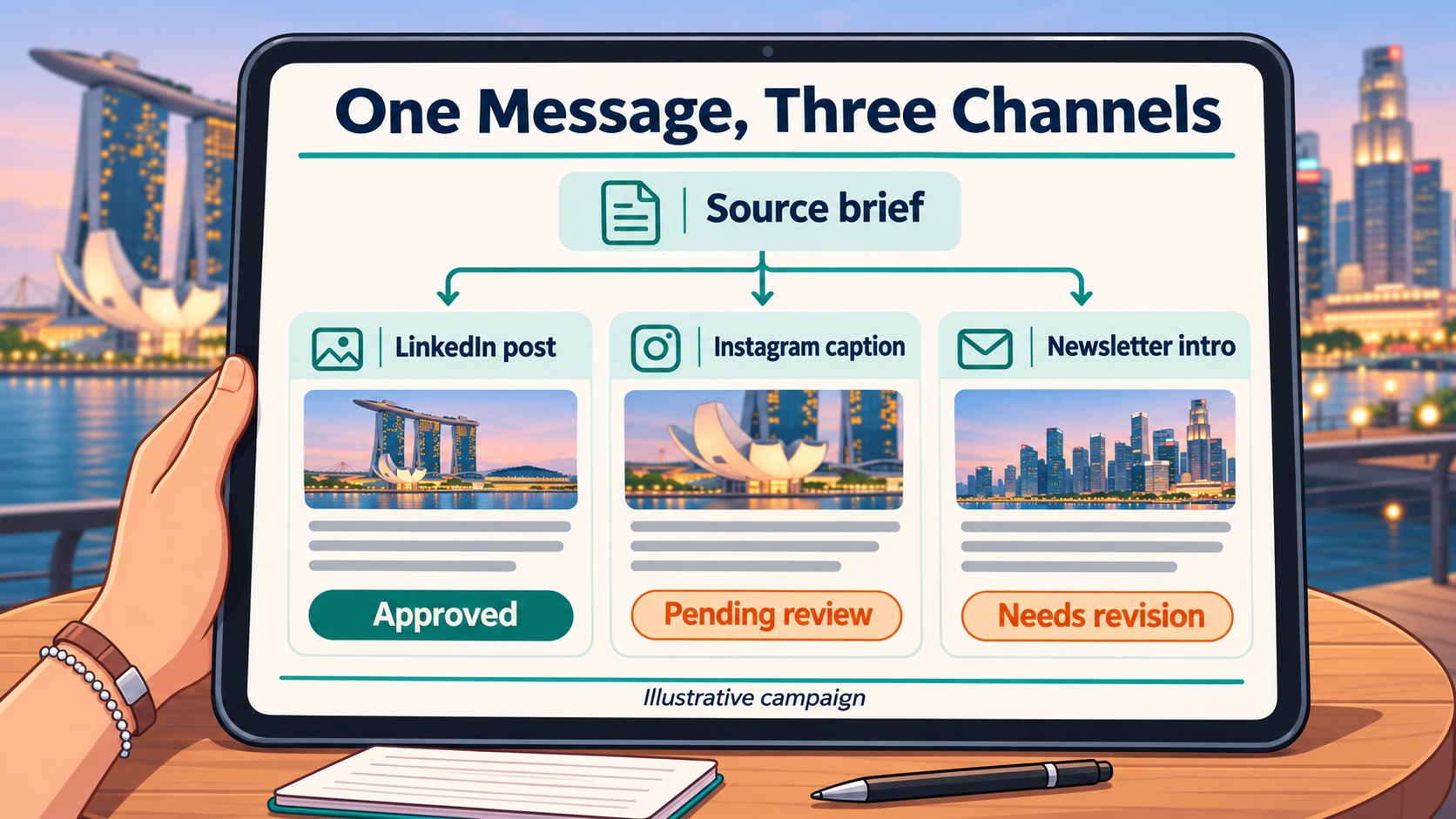
One message can serve several channels
A campaign should keep the same offer across every format. Channel differences affect presentation, but the price, terms and product details should agree.
A business promoting a workshop might need:
- A LinkedIn post explaining who should attend.
- An Instagram caption highlighting the topic.
- A newsletter introduction linking to registration.
- A landing page with dates, fees and booking details.
A planned social media content marketing process gives each asset a purpose. AI can adapt the approved message once those decisions are settled.
What the Research Shows About AI Content
AI can improve some writing tasks, but research findings need context.
A 2023 experiment by MIT researchers Shakked Noy and Whitney Zhang involved 453 college-educated professionals completing work-related writing tasks. Participants given access to ChatGPT completed tasks in 40% less time on average, while assessed output quality rose by 18%. The published study abstract describes professional writing tasks, not a live advertising campaign.
Those findings support testing AI for drafting. They do not establish a likely increase in website traffic, leads or revenue for a Singapore business.
Writing quality and campaign performance are different
A well-written advertisement can still reach the wrong audience. A strong email can still promote an offer customers do not want.
Campaign results depend on several connected choices:
- The audience receiving the message.
- The offer and its price.
- The channel and timing.
- The landing page experience.
- The action requested from the reader.
AI output should therefore pass two tests. An editor checks whether the asset is accurate and readable. Campaign measurement checks whether it helps customers take the intended action.
A team should keep those results separate. Faster drafting is a production benefit. More qualified enquiries are a business result. One does not prove the other.
What to Automate and What to Keep Human
The simplest starting point is a task list. Each task needs an answer to one question: what could happen if the output contains an error?
A poor headline suggestion wastes editing time. An incorrect safety claim could mislead a customer. Those consequences should shape the workflow.
| Task | AI’s role | Human responsibility |
| Headline variations | Suggest different approaches | Select accurate, relevant wording |
| Approved content adaptations | Draft shorter versions | Preserve meaning and context |
| Article outlines | Organise questions and sections | Set the angle and check coverage |
| Research summaries | Summarise supplied sources | Verify the original evidence |
| Product descriptions | Draft from approved specifications | Confirm every feature and limitation |
| Prices and promotions | Format approved details | Own prices, terms and dates |
| Testimonials and case studies | Edit authorised source material | Confirm authenticity and permission |
| Sensitive claims | Help organise approved information | Provide qualified review and approval |
Routine production can receive lighter review
AI is well suited to producing options from material the business already trusts. A marketer could provide an approved event description and request five subject lines. The reviewer then checks that none invents urgency, availability or a discount.
Light review still includes meaning. A shorter caption can accidentally remove a condition, such as “selected items” or “for new customers”.
Strategy and promises need human ownership
People should decide which customer problem the campaign addresses and which evidence supports the offer. Product guarantees, delivery promises and comparisons also need an accountable owner. AI can help express an approved claim, but the business must supply its substance.
A small team can assign these responsibilities without adding layers of administration. One marketer may draft and edit, while the product owner confirms technical details before publication.
How Google Treats AI-Generated Marketing Content
Google does not impose a blanket ban on AI-assisted pages. Its generative AI content documentation recognises that AI can help with research and structure, while warning against generating pages without adding value. AI use alone does not establish quality or guarantee rankings.
A page still needs to answer the reader’s question. A service article should explain the service accurately. A product comparison should help someone understand real differences.
Mass production can create search problems
Google’s scaled content abuse policy targets large amounts of content created primarily to manipulate rankings while offering little value. The policy applies regardless of how the pages were produced.
A business should question a plan to publish dozens of similar pages with only neighbourhood names changed. Each page needs a reason to exist, such as genuine service differences or location-specific information. A keyword list alone does not supply that reason.
Helpful pages need business knowledge
Google’s people-first content criteria encourage original information, substantial answers and evidence of experience. A practical editorial review can ask:
- Does the opening answer the main question?
- Does the page explain something customers regularly misunderstand?
- Are examples based on actual processes or labelled illustrations?
- Can a reader check important claims?
- Does the page help someone make a decision?
An equipment supplier, for example, could explain which measurements customers need before requesting a quote. That detail comes from knowing the buying process. A strong content marketing plan gathers that knowledge before drafting begins.
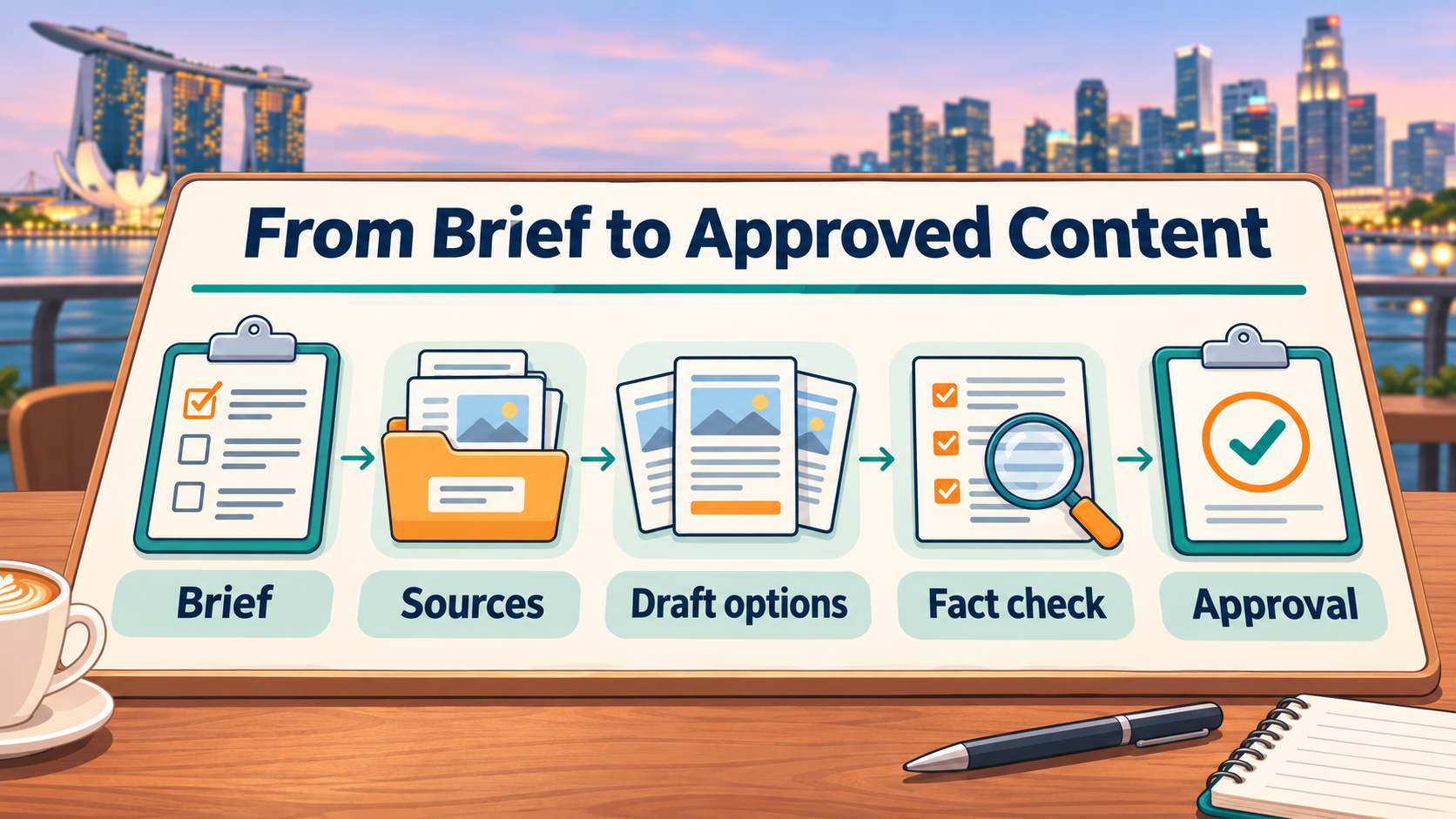
A Five-Step Workflow for AI-Generated Marketing Content
A repeatable workflow gives each draft the same basic controls. The process can stay short enough for a single marketer to use.
1. A brief defines the job
A good brief names the audience, channel, goal and source material. It also states what the tool must leave out.
A hypothetical catering business could supply:
| Brief item | Example |
| Audience | Office managers arranging team lunches |
| Asset | Email promoting a lunch menu |
| Goal | Menu enquiries |
| Approved facts | Menu, minimum order and delivery areas |
| Tone | Friendly and direct |
| Limits | No invented discounts or customer quotes |
| Missing information | Flag for the editor |
The structure of a marketing prompt should reflect those decisions. A longer prompt is worthwhile only when its details help control the output.
2. Approved sources supply the facts
A source pack can include product specifications, service terms, authorised case studies and current campaign details. Each document should have an owner and review date. Old pricing should not sit beside current pricing without an explanation.
A source pack also reduces repeated work. The marketer can reuse approved facts across formats while checking whether they still apply to the next campaign.
3. Variations explore different approaches
Several drafts can help the editor compare openings or calls to action. Each variation should change something deliberate.
An email test might compare an opening about convenience with one about menu choice. Both versions must preserve the same offer.
Unrestricted requests for “more persuasive” copy can invite stronger promises. Specific instructions give the reviewer a better starting point.
4. Verification checks every claim
A fact-check pass should separate sourced statements from suggestions. A simple record helps:
| Draft statement | Source to check | Action |
| “Available across Singapore” | Delivery-area list | Narrow wording if needed |
| “Ready within two days” | Current service terms | Confirm conditions |
| “Customers prefer this option” | Relevant customer evidence | Remove without support |
| “From S$50” | Approved price list | Check exclusions |
AI systems can produce confident false statements, including invented references. The NIST generative AI risk profile identifies this risk as confabulation. A fluent answer still needs evidence.
5. Editing and approval finish the asset
The final edit should remove vague language, explain unfamiliar terms and check the next action.
A sentence such as “Our solutions transform business efficiency” leaves the reader with little detail. “The booking form collects delivery details before checkout” explains an actual function.
Professional copywriting turns verified information into language customers understand. The named approver then checks the complete asset, including its image, links and destination page.
Singapore Checks for Data, Language and Trust
Singapore teams need a process that accounts for customer information and local communication. A tool’s ability to accept a document does not establish permission to upload it. Customer records and confidential business material need separate consideration.
Customer data needs protection before prompting
Singapore’s data protection obligations cover how organisations collect, use, disclose and protect personal data. AI-assisted marketing remains subject to applicable obligations. A practical starting rule is to use fictional examples or approved non-personal material whenever customer information is unnecessary.
Before introducing a tool, the business should establish:
- Which information staff may upload.
- Who can access prompts and outputs.
- How the provider retains and uses submitted data.
- Which settings or contracts apply.
- Who handles privacy questions.
Removing a name may leave other identifying details in a document. A complaint containing an address, order number and incident description still needs careful handling.
Local language needs a capable reviewer
Singapore audiences may use English, Mandarin, Malay, Tamil or a mix of languages. A direct translation can preserve words while losing the intended tone. A reviewer who understands the language and audience should check translated offers, product descriptions and subtitles.
Singlish also needs judgement. Forced local expressions can make a message sound unnatural. Customer language, channel expectations and the brand’s established voice provide a better basis for tone.
Disclosure should help customers understand the content
A disclosure decision should consider whether AI use changes what the audience believes it is seeing. A synthetic spokesperson or fictional product scene raises different questions from spelling assistance.
Singapore’s Model AI Governance Framework for Generative AI provides a broader framework for responsible deployment, including transparency concerns. It should not be presented as a universal advertising disclosure rule.
A business policy can distinguish routine editing from realistic synthetic people, voices or demonstrations. Platform requirements also need checking for the particular asset.
How to Choose Tools Without Adding Work
The best starting point is a defined task and an example of acceptable output.
A team comparing AI tools for digital marketing should give shortlisted tools the same brief. The comparison should include the time needed to correct the result.
| Tool check | Practical question |
| Output quality | How much rewriting does the draft need? |
| Source handling | Can the reviewer inspect supporting material? |
| Data controls | Are the available terms and settings suitable? |
| Collaboration | Can staff manage versions and approvals? |
| Export options | Can the asset enter the existing workflow? |
| Full cost | What do subscriptions and review time cost? |
A broad list of generative AI tools can help identify options. A purchase decision should follow a task-based trial.
Visual tools need separate checks
Generated product images can introduce false details. A bag may gain an extra pocket. Food packaging may display invented wording. A video may show a product working in an unsupported way.
The review should cover:
- Product shape, labels and visible features.
- Text inside the image.
- People, hands and facial details.
- Spoken claims and subtitles.
- Whether the scene could mislead a buyer.
Actual product photographs are often the better source when appearance forms part of the buying decision. Generated scenes can serve concept work when their purpose is understood.
A Small Pilot Can Test the Full Workflow
A pilot should answer a specific operational question. “Can AI help?” is too broad. “Can AI reduce the total time needed for approved newsletter introductions?” is measurable.
A four-to-six-week trial can be a practical starting period. That duration is a planning suggestion, not a research benchmark. The team needs enough comparable assets to assess its workload.
A baseline makes the comparison meaningful
The team should record the current process before introducing AI. Briefing, writing, editing and approval time all belong in the baseline.
A fair comparison keeps the audience, asset type and campaign purpose reasonably similar. A major promotion should not be compared with an ordinary update without noting the difference.
Production and business results need separate measures
A compact scorecard can track:
| Measure | What it reveals |
| Total minutes per approved asset | Whether the full process saves time |
| Revision rounds | Whether drafts create extra review |
| Factual corrections | Where verification needs attention |
| Qualified enquiries | Whether responses match the campaign goal |
| Conversion rate | How often the intended action occurs |
| Complaints or withdrawals | Whether communication creates problems |
A hypothetical manual process might take 90 minutes per asset. An AI-assisted process taking 65 minutes, including review, saves 25 minutes.
Across 12 assets, that equals 300 minutes, or five hours. Those figures illustrate the calculation; they are not client results.
Expansion should follow the evidence
A team can expand a successful workflow to a similar task. A newsletter introduction pilot does not establish that AI can handle technical product pages without further testing.
Poor results also provide direction. Long editing times may point to weak source material, an unsuitable task or inadequate instructions.
A recurring error should lead to a process change before the next batch.
A Final Publishing Check Prevents Avoidable Errors
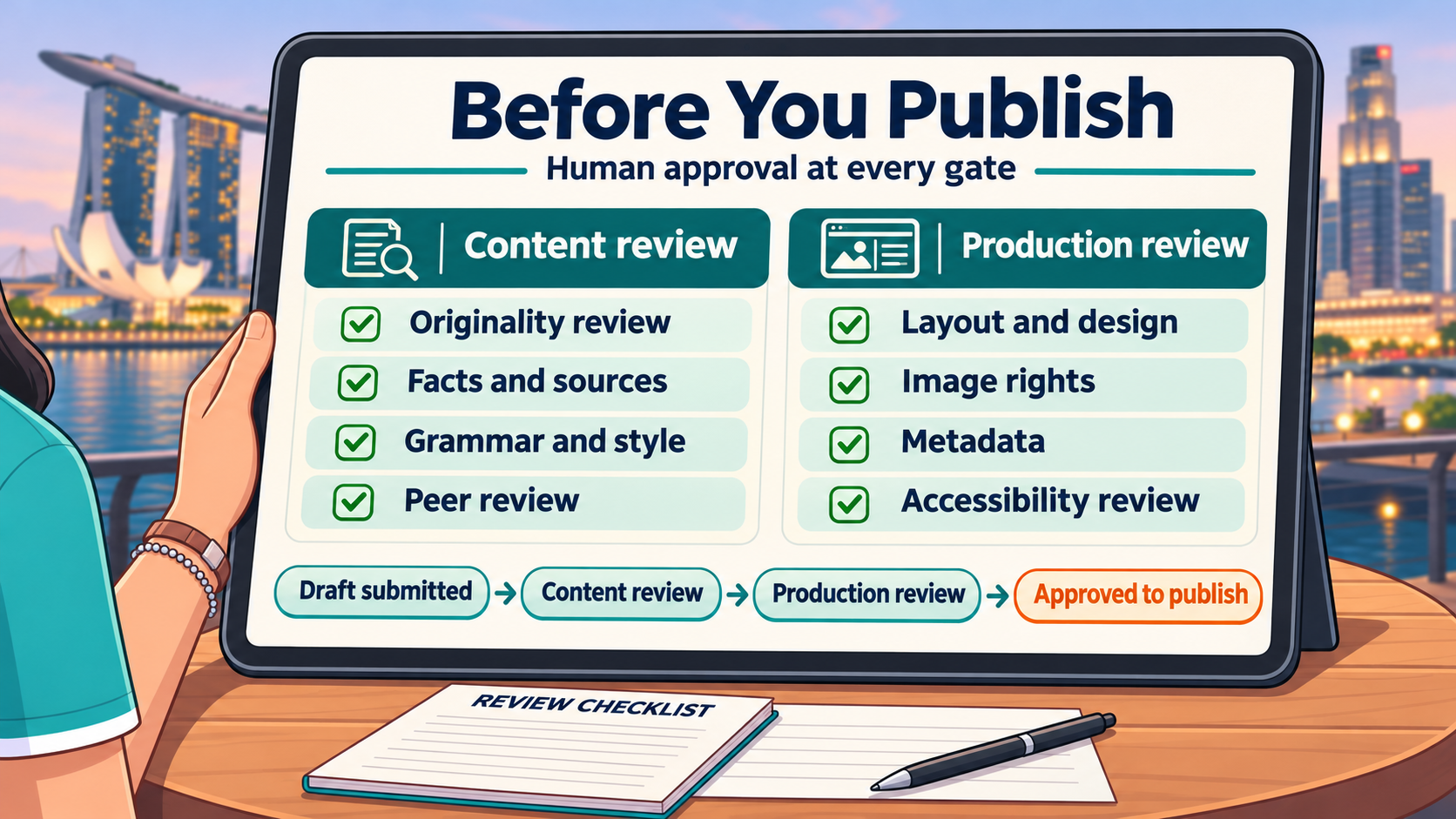
The publishing check covers the finished asset, not the text alone.
A campaign can contain accurate copy but still send readers to an expired promotion. A correct product description can appear beside an image showing the wrong model.
The final reviewer should confirm:
- Every factual claim has support.
- Prices, dates and conditions agree across assets.
- Links reach the intended destination.
- Images and captions match the offer.
- Mobile readers can understand the content.
- A named person has approved publication.
A record of the approved version helps the team investigate later questions. Sensitive or time-limited content also needs an owner who can remove or revise it when circumstances change.
A Human-Led Process for AI-Generated Marketing Content
AI-generated marketing content can reduce drafting work when the business supplies reliable facts and a defined task. Quality depends on the complete process: briefing, verification, editing, approval and measurement. A small pilot gives the team evidence about where AI helps and where it creates more work.
At MediaOne, we connect content marketing with SEO, social media and business goals. Our team can help you plan content around customer questions and the actions each page should support. A conversation with us can identify the production task to test first and the review steps it needs.
FAQs About AI-Generated Marketing Content
Can AI-generated marketing content replace customer interviews?
Customer interviews provide experiences and details a tool cannot establish independently. AI can help organise authorised interview notes or suggest follow-up questions. Published quotations must reflect what the customer actually said, with the required permission.
A named human author or editor should accurately reflect responsibility for the published work. AI assistance can be explained separately where relevant. An invented expert profile or false byline would misrepresent who produced and reviewed the content.
How should teams handle an AI draft that resembles another brand’s copy?
The draft needs a fresh approach based on the business’s own information. Close paraphrasing can preserve another brand’s distinctive expression. An originality checker may flag similarities, but its result does not establish permission or resolve every rights issue.
Can an AI detector prove who wrote a marketing article?
A detector score cannot establish authorship on its own. Revision records, source notes and documented approvals provide stronger evidence of how an asset was produced. Editorial review should assess accuracy, originality and reader value.
What happens when the AI provider changes its model?
A model change can alter tone, formatting or instruction-following. The team should rerun a small set of representative briefs before applying the changed tool across a campaign. Previously successful prompts still need their outputs checked.