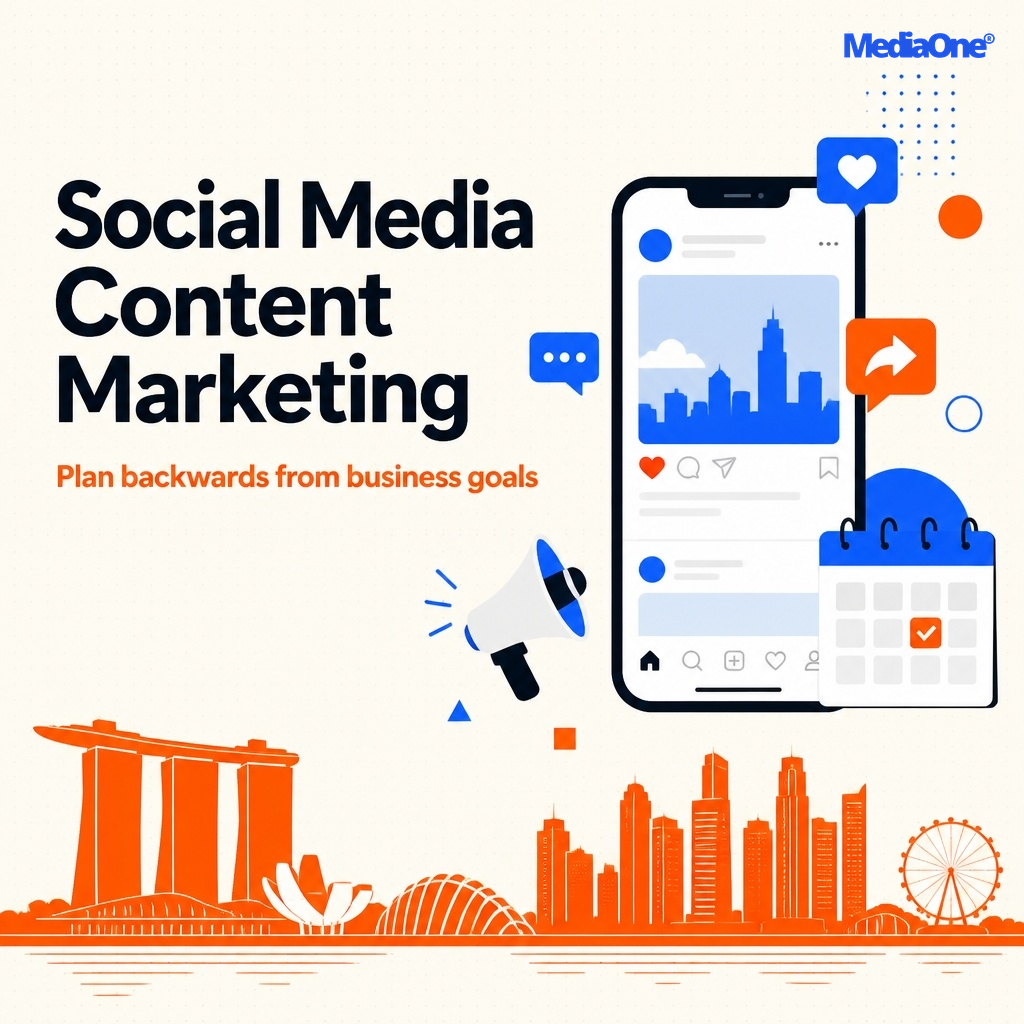


Many brand posts receive little attention because planning starts from the calendar. Teams set a posting schedule first and decide what each piece should achieve later, if at all. This guide argues the reverse. Plan social media content marketing backwards from a business goal. Match each piece to the native format and audience intent of a few well-chosen platforms, then measure it against that goal rather than vanity numbers.
This guide is for marketing managers, founders and social leads at Singapore SMEs and mid-sized brands. It covers a platform-fit scoring checklist, a funnel-based way to choose content types, a monthly measurement routine, and practical ways to get more from a small team.
Key Takeaways
- Plan backwards from a business goal and pick one primary KPI per campaign before choosing formats.
- A smaller set of well-chosen platforms usually beats a thin presence on every network.
- Score each platform from 1 to 5 on audience match, format fit, user intent and resourcing. The thresholds in this guide are the author’s own suggested framework, not an industry benchmark. Give a dedicated plan to any platform scoring 16 or more out of 20.
- Post at a sustainable cadence. Most active brands on X post one to five times per day.
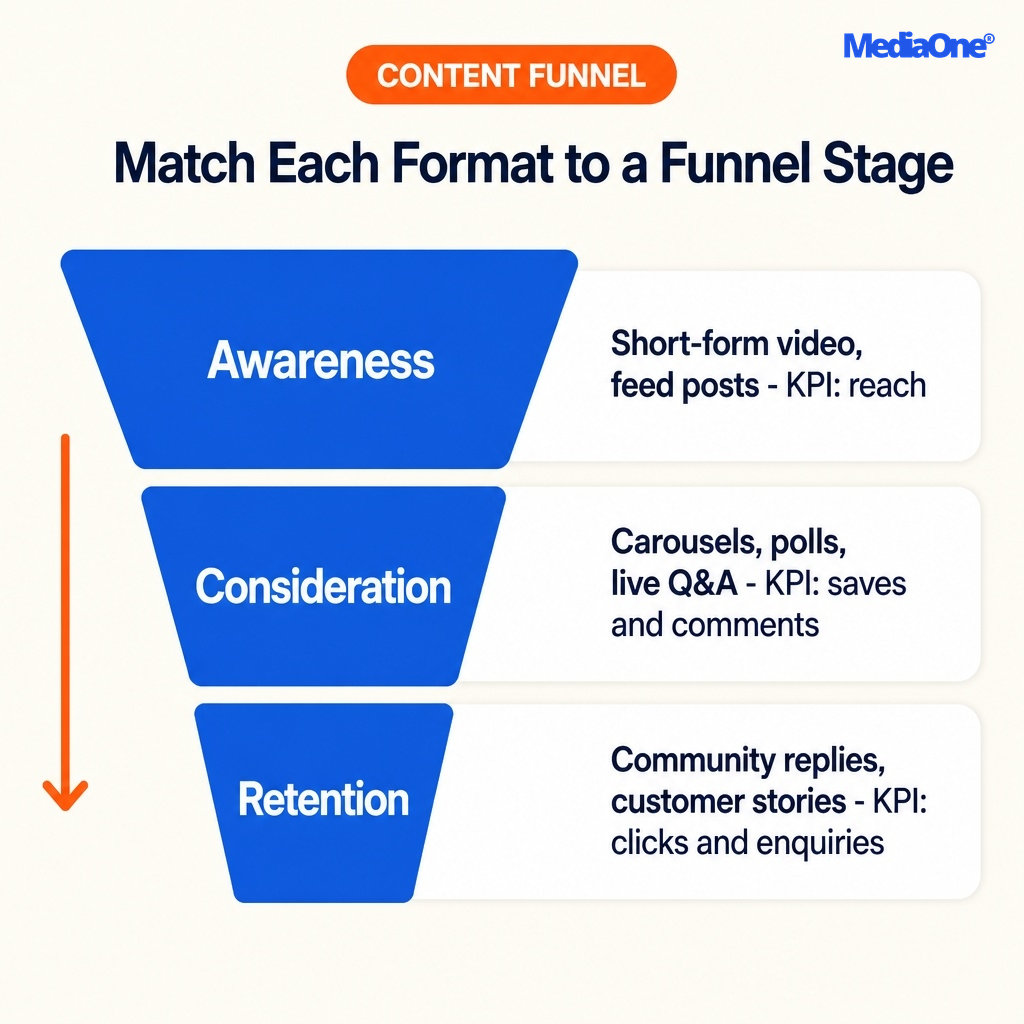
- Match each format to a funnel stage: awareness, consideration or retention.
- Keep content human. Use user-generated content with clear permission, and review what works every month.
Most brand posts fail because they start from the calendar. Posts go out three times a week, fill the slots with whatever is at hand, and the numbers stay flat. Start instead from a business goal, such as generating enquiries, shortening the sales cycle or keeping existing customers. Only then choose formats, platforms and a cadence. A clear marketing strategy turns that goal into a plan, and the best plans treat blog posts and other content as a single content strategy.
Attention is spread across more platforms and formats than most teams can sustain. A smaller set of channels, each matched to its audience and native format, usually outperforms a thin presence across all media platforms. Content marketing helps a brand keep that focus.
Social media marketing is the practice of using platforms such as Facebook, Instagram, LinkedIn and TikTok to build awareness, conversation and customer relationships. Paid social buys reach through ads. Organic social covers the posts, replies and creator-style content a brand earns through its own presence.
Social sits at the top and middle of the marketing mix. Search captures people already looking for an answer, email holds a relationship the brand owns, and the website converts interest into enquiries. Social creates the first impression and keeps people engaged, then hands over to channels that close the sale.
Social Media Content Defined: Types of Content and Why They Matter
Social media content definition and types
Social media content is any material a brand publishes on a platform to earn attention or action. It includes static posts, short-form video, stories, live streams, carousels, polls and replies in comment threads. Each format has a different job, so match the format to the goal rather than posting whatever is easiest to create. Good social media content marketing starts with this format-to-goal match.
|
Content type |
Primary job |
Typical format |
|
Organic feed posts |
Awareness |
Single image or text post |
|
Short-form video |
Awareness |
Vertical video under 60 seconds |
|
Stories |
Consideration |
Temporary vertical frames |
|
Live streams |
Consideration |
Real-time video with Q&A |
|
Carousels |
Consideration |
Multi-slide swipe post |
|
Polls |
Consideration |
Interactive question |
|
Community replies |
Retention |
Comments and direct responses |
Humorous content can lift engagement, but only when it is deliberately crafted, as Content Marketing Institute’s trend research suggests. Treat jokes as a format with a purpose, not a reflex.

Content supports both reach and trust. Platforms favour posts that hold attention, and audiences decide whether to believe a brand based on what it publishes. Salesforce reports that 81% of people believe social media increases brand accountability. Every post is therefore a public promise that people will check. A sound content strategy treats each post as a commitment the brand must be able to keep.
The audience is also very large. Salesforce puts social media users worldwide at over 5 billion, so competition for attention is intense. Generic content tends to disappear into that volume. Specific, useful blog posts and social posts are how a brand stands out and builds brand awareness over time.

Measurable benefits: reach, engagement and referral traffic
Social media earns its place in a budget only when each benefit maps to a number you can check.
- Reach is the count of unique accounts that see a post.
- Engagement is the share of those viewers who react, comment, save or share.
- Referral traffic is the number of website visits from social platforms, which your analytics tool reports directly.
A digital marketing team should report these three figures, and a clear marketing strategy makes them easier to act on.
Read these three as a chain. Strong reach with weak engagement means the hook is not earning attention. Healthy engagement with no referral traffic means the audience likes the content but has no reason to click through.
Set a baseline before judging any campaign. Pull average reach, engagement rate and referral sessions for your last eight to twelve posts. Then compare each new post against that average. For example, if your baseline reach is 1,200 accounts and a new post reaches 1,800, that post has outperformed the average by half. Insert your own baseline figures here, not a generic benchmark. This works better than chasing a single viral spike, even for a team with no paid tools.
Trust and brand accountability
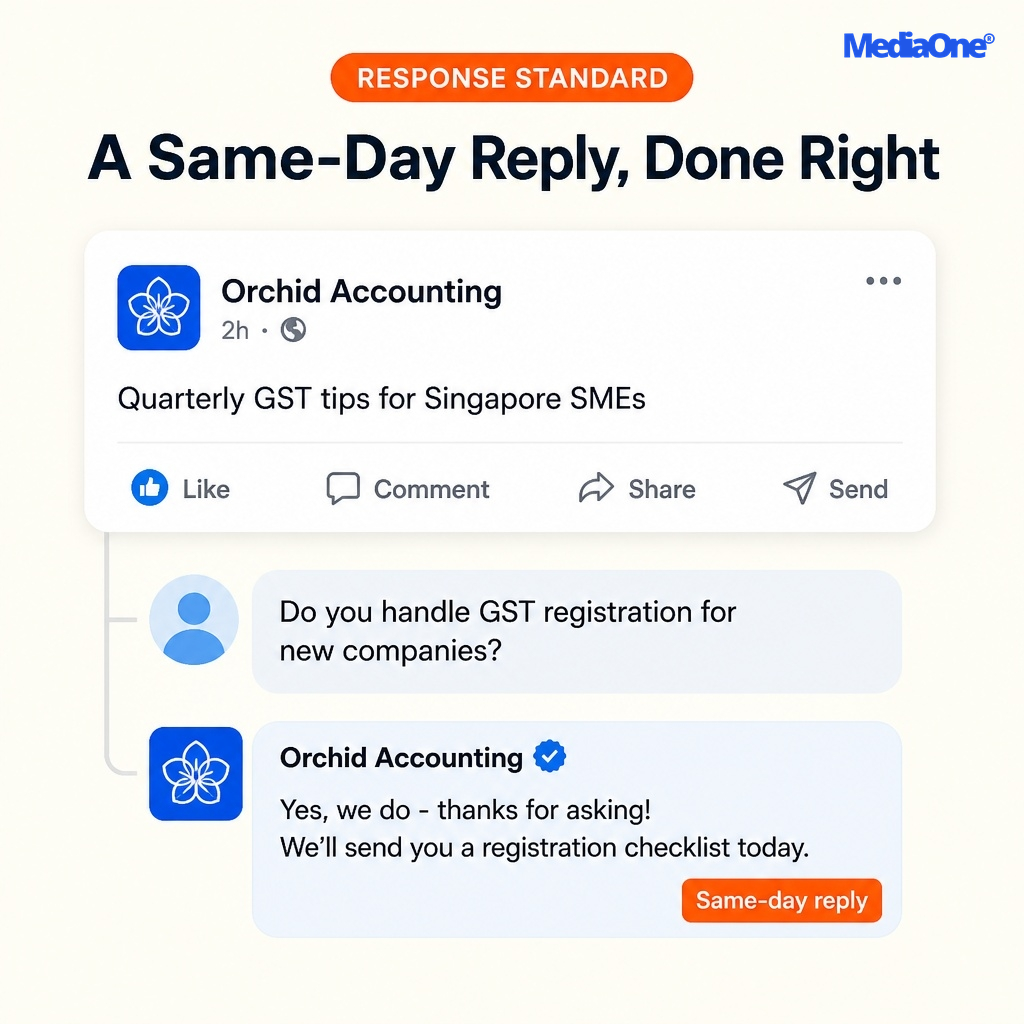
A brand presence on social media raises the level of scrutiny. Customers ask questions in public, read the replies and judge how you respond. According to Salesforce, 81% of people believe social media increases brand accountability. A slow or evasive reply to a complaint is visible to everyone.
Set a response standard before you need one. Decide who monitors comments and messages, how quickly they reply (a same-day acknowledgement is a sensible default for most Singapore teams), and when a query moves to email or phone. Publish short, plain-language replies to recurring complaints rather than deleting them. Visible, calm responses build more trust than a polished feed that never admits a problem. They also help the brand’s reputation hold up under pressure.
Platform size can mislead. Facebook reports about 3.07 billion active users and 1.98 billion ad reach, according to Salesforce. Yet Pew Research Centre finds that only about a third of US teens use Facebook, so a large Facebook presence may still miss your audience. If your buyers are under 25, a big Facebook following can reach an older, less active group than you expect.
Use the Platform-Fit Scoring Checklist, a suggested internal method rather than an industry standard. Rate each network from 1 to 5 on audience match, format fit, user intent and resourcing. The maximum total is 20. A platform scoring 16 or more earns a dedicated plan. Platforms below 12 should be dropped or reviewed each quarter. A large user count does not change the score if your buyers are not there.
Step 1: Setting goals and objectives
Start with a business goal, not a post idea, such as “grow enquiries from SME owners by 20 per cent this half”. Choose one primary KPI that shows whether content is moving that goal. Secondary metrics can stay on the dashboard, but one number should decide whether the campaign worked.
A Singapore accounting firm wants more consultation bookings. Its primary KPI is booked consultations from social referral traffic, tracked with UTM-tagged links. UTM tags are short codes added to a link so analytics software can show which post sent a visitor. Impressions and follower counts are context, not proof of success.
Step 2: Identifying your target audience
Build audience profiles from data you already own, starting with your CRM and website analytics. Then add platform insights such as age bands, locations and top-performing categories. Write each profile as one short paragraph covering the buyer’s role, the question they are trying to answer and the platform where they spend time. Two or three profiles per business is usually enough.
Step 3: Competitor analysis
Run this audit once a quarter for three to five direct competitors:
- List the platforms where each competitor posts consistently (more than four times a month).
- Note which formats earn the most engagement: short video, carousels, text posts or live sessions.
- Record the topics that recur and the ones they ignore.
- Identify one gap per competitor, such as a question their audience asks that nobody answers well.
- Check how they handle language and tone, especially if they post in English alongside Mandarin, Malay or Tamil.
The output is not a list to copy. It is a set of gaps you can fill with a sharper angle.
Step 4: Choosing the right platforms
Score each candidate platform from 1 to 5 on audience match, format fit, user intent (discovery, research or entertainment) and resourcing (time to produce and respond). Platforms scoring 16 or more get a dedicated content plan. Those below 12 are dropped or reviewed quarterly.
|
Platform |
Audience match |
Format fit |
User intent |
Resourcing |
Total |
|
|
5 |
4 |
4 |
3 |
16 |
|
|
4 |
4 |
3 |
3 |
14 |
|
TikTok |
3 |
2 |
2 |
2 |
9 |
These scores are an example for a B2B services firm. Replace them with your own ratings after the Step 3 audit. Each platform must clear the threshold, so “be everywhere” is never the default.
Step 5: Setting a posting cadence
Sprout Social’s benchmark shows most brands post no more than once per day, which is a reasonable starting point. Treat this as a suggestion, not a benchmark, and set cadence per platform based on what your team can sustain without losing quality. On X, most active brands post one to five times per day, according to DailyStory. For a small team, three strong posts a week on one platform will outperform seven weak posts across four.
Platform-Specific Content Strategies
Instagram and TikTok: short-form visual and video content. Both platforms reward content that earns attention in the first two or three seconds. Put the hook in the opening frame, state the payoff early and cut quickly. Use Reels or TikTok for discovery, and Instagram carousels for saved, step-by-step material such as checklists and how-tos. If a video must work without sound, add on-screen text, because many viewers scroll with audio off.
LinkedIn: thought leadership and company page engagement. Many Singapore B2B buyers research suppliers on LinkedIn, so it earns its place for professional services, software and industrial brands. Four in five LinkedIn members play a role in business decisions at their companies. Employee-driven content outperforms company pages, emphasising personal expertise and authentic presence. Write as one practitioner talking to another, name a specific lesson from your own work, and avoid generic “excited to announce” openings.
Facebook and YouTube: community and long-form value. Facebook suits community groups, local events and older audiences. With only about a third of US teens using Facebook, it is a weak base for a youth strategy. Check the current Meta-reported user figures before you rely on any headline number.
YouTube is the stronger choice for long-form explanation and search-driven discovery. Maersk’s YouTube channel shows that practical videos answering operational questions can outperform polished brand films. Its B2B video lessons are worth studying before you commission a series.
Pinterest, Snapchat and X: niche and fast-moving channels.
- Pinterest fits visual planning categories such as home, food, fashion and events. Pins behave like evergreen search results, so skip it if your product is not visually browsed.
- Snapchat suits younger consumer audiences with time-limited, casual content. Skip it if your buyers are older or your team cannot sustain frequent low-polish posts.
- X moves quickly and rewards timely commentary. Multiple posts a day are common here, but only if someone monitors replies. Skip it if you cannot staff real-time responses.
Creating Content People Want: Formats, Hooks and Visual Storytelling
Social-first formats for Gen Z and younger audiences
Gen Z audiences respond to content that looks native to the platform where they find it. A cut-down TV spot uploaded to TikTok is usually scrolled past, because it signals an advert before the first second ends. Content Marketing Institute has made the case for social-first strategies built on this native feel. Employee-driven content outperforms company pages, emphasising personal expertise and authentic presence.
Native content has a few traits. It uses vertical video with captions, a conversational voiceover, and a staff member or creator speaking to camera. It opens with a human moment in the first two seconds. Teams building a digital marketing plan should design formats with this native feel from the start, because it supports both content strategy and brand awareness.
Before you publish, ask one question: could a viewer tell the piece was made for that app? If not, reshape it.
Writing for character limits and scanning behaviour
Most people scan rather than read. Lead with the outcome, the surprise or the question, then use the remaining space for proof. Three techniques help:
- Front-load the hook: put the benefit or tension in the first 60 to 80 characters, because that is what shows before the text truncates.
- Cut connective words: remove filler such as “in order to” or “it is important that”.
- Make descriptions stand alone: captions should still make sense if the visual fails to load on a slow mobile connection.
Tighter copy carries more impact. Content Marketing Institute makes this point for character-limited posts.
Visual storytelling trends for 2026
Visuals should carry information the text cannot. Good examples include a product demo, a before-and-after comparison, a process map or a trend chart. Test each visual before you commission it. If the caption could say the same thing alone, the image is decoration. Replace it with something that shows a fact, a step or a result.
Content Marketing Institute’s annual trend reviews point the same way: demonstrative visuals outperform generic brand imagery. Build each visual around one takeaway, and keep overlay text short enough to read on a phone in a few seconds. Media marketing teams should apply the same test to every frame they create.
Hashtags now do less discovery work than they once did. On Instagram and TikTok, search and recommendation feeds carry more of the load, and long tag lists add clutter without adding reach.
Use three to five specific hashtags where the platform rewards them, such as a branded tag plus one or two niche topic tags. Where hashtags do little, or you have no clear topic to tag, skip them. Put the effort into the caption and first line instead, because those drive search and saves across your social media platforms. To learn how AI-powered search changes discovery, read our guide to getting your brand recommended by ChatGPT, Gemini and Perplexity.
Plan Backwards From Goals and Keep Content Human
Social media content marketing works when you plan backwards from a business goal, not forwards from a posting calendar. Choose fewer channels, and score them honestly with the Platform-Fit Checklist.
Start this week with three steps:
- Write one KPI for your next campaign, linked to a business outcome such as enquiries or sign-ups, to build brand awareness.
- Score each current platform from 1 to 5 on audience match, format fit, user intent and resourcing. Keep those scoring 16 or more, and park those below 12.
- Review one published post against its goal. Keep the format if it moved the metric, and retire it if not.
For measurement, read our guide to why data tracking makes or breaks performance, and set up conversion tracking so every referral click maps to an outcome.
Frequently Asked Questions
There is no single right number, but Sprout Social’s benchmark shows most brands post no more than once per day, which is a reasonable starting point. Set your cadence by what your team can sustain with quality, then check whether engagement holds.
Score each platform on audience match, format fit, user intent and realistic time commitment, using the author’s own 20-point working framework rather than an established industry benchmark. A platform scoring 16 or more earns a dedicated plan. Anything below 12 should be dropped or revisited each quarter. Most B2B teams in Singapore find LinkedIn strongest, while consumer discovery favours Instagram, TikTok and YouTube.
Social media marketing is the wider practice of using social platforms to reach audiences, including paid advertising. Social media content marketing is the subset focused on creating useful, organic posts, videos and conversations that build trust over time.
Open with a strong hook in the first second or line. Then match the format to the platform, such as short vertical video on TikTok or Reels, and carousels on Instagram. The hook and format sections of this guide cover both in detail.
Is user-generated content worth the effort?
Yes, when you handle it well. Customer and employee content carries credibility that brand-made posts often lack. Before you repost, get written permission and credit the creator, especially where people appear in photos.

Match metrics to goals. Use reach for awareness, saves and comments for consideration, and clicks or enquiries for conversion. Review performance monthly, compare each format against your own baseline, and decide whether to repeat, adjust or stop it. Confirm your baseline numbers before you compare results.