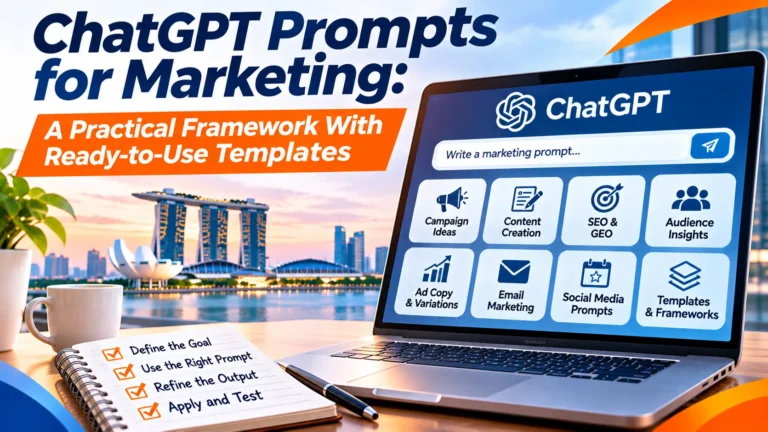
Marketers often have folders of ChatGPT prompts, yet the copy still reads as generic. The problem is usually the brief. A usable prompt states the audience, goal, constraints and success measure.
Here are three copy-paste prompts you can use today:
- Social post: Act as a social media copywriter for a business in Singapore. Write three posts for busy working professionals in Singapore. Keep each within the platform’s character limit, open with a hook that speaks to a common workday frustration, and end with one clear call to action.
- Email: Write a five-email welcome sequence for a Singapore business, starting from the sign-up incentive the subscriber just claimed and moving toward a first purchase. Give a subject line, preview line and one call to action for each email, with each message building on the one before it.
- Headline: Rewrite this homepage headline for working professionals in Singapore. Make the offer the centrepiece of the message. Give 8 options under 12 words, in English only.
Collections such as OptiMonk‘s list of 34 ChatGPT prompts for marketing are easy to find. This article focuses on the brief behind each prompt, checked with the Brief-Before-Prompt Scorecard, a five-field checklist. Each field is scored 0 or 1, and every section below shows a before-and-after case scored on that checklist.
Key Takeaways
- Prompt quality depends mostly on the brief: audience, objective, constraints, output format and a quality test.
- Score each prompt on the five Scorecard fields, 0 or 1 each. Send any score under 4 back for revision.
- Headline changes move conversion more than CTA tweaks, so the Objective and Quality test fields matter most.
- Check every AI-drafted claim and statistic before publishing.
Why a Good Prompt Matters More Than the Tool
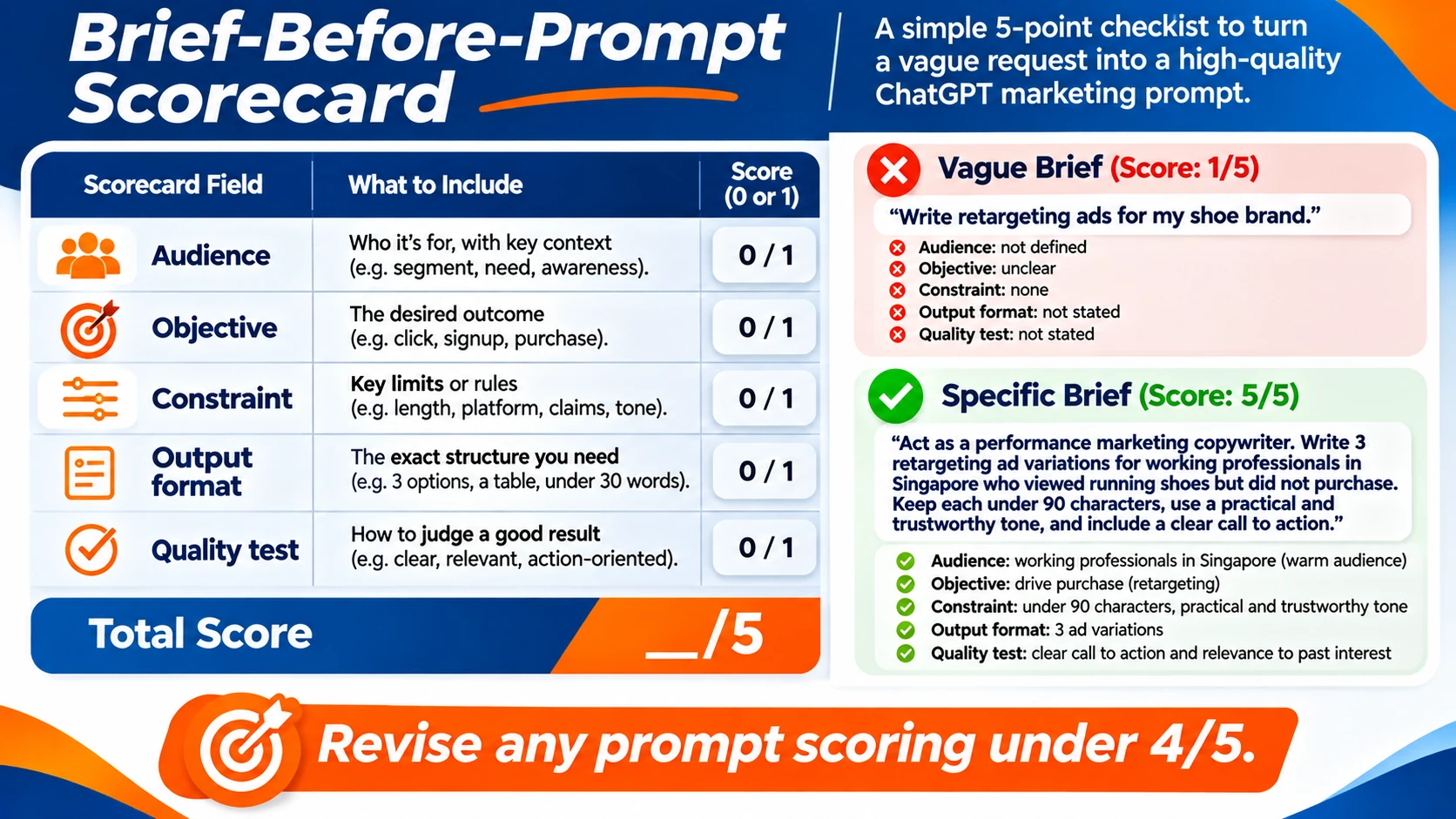
Most marketers already have access to ChatGPT, so the tool is rarely the constraint. The gap between a useful draft and a wasted afternoon usually lies in the brief. A vague request such as “write retargeting ads for my shoe brand” gives the model little to work with, so it returns generic copy.
A good prompt reads like a brief for a freelance strategist, naming the audience, goal, constraints and format. The Brief-Before-Prompt Scorecard turns that brief into a checklist. Before any prompt is sent, check five fields: Audience, Objective, Constraint, Output format and Quality test. Score each field 0 if missing or 1 if specific.
Actually, the most useful habit is reusing a small set of prompts for each campaign type. Teams that run paid social campaigns can apply the same Scorecard to every product launch, keeping briefs consistent and making results easier to compare. Business owners who create content in-house can use the same method to keep their social media and content briefs consistent across channels.
Where generic prompts fall short
Generic prompts force the model to guess the audience, offer and success measure. Guesses produce safe, average language that rarely converts. Vague ChatGPT prompts tend to produce the same result.
The four ingredients of an effective prompt
Every marketing prompt should describe:
- Audience: who is reading, and what they already know.
- Goal: the action you want, such as a click, signup or purchase.
- Constraints: length, language, platform rules and claims you cannot make.
- Output format: the exact structure you need back, with examples of the tone you want, and include a sample of the finished copy where it helps.
Building Effective Prompts: Role, Context, Format and Tone
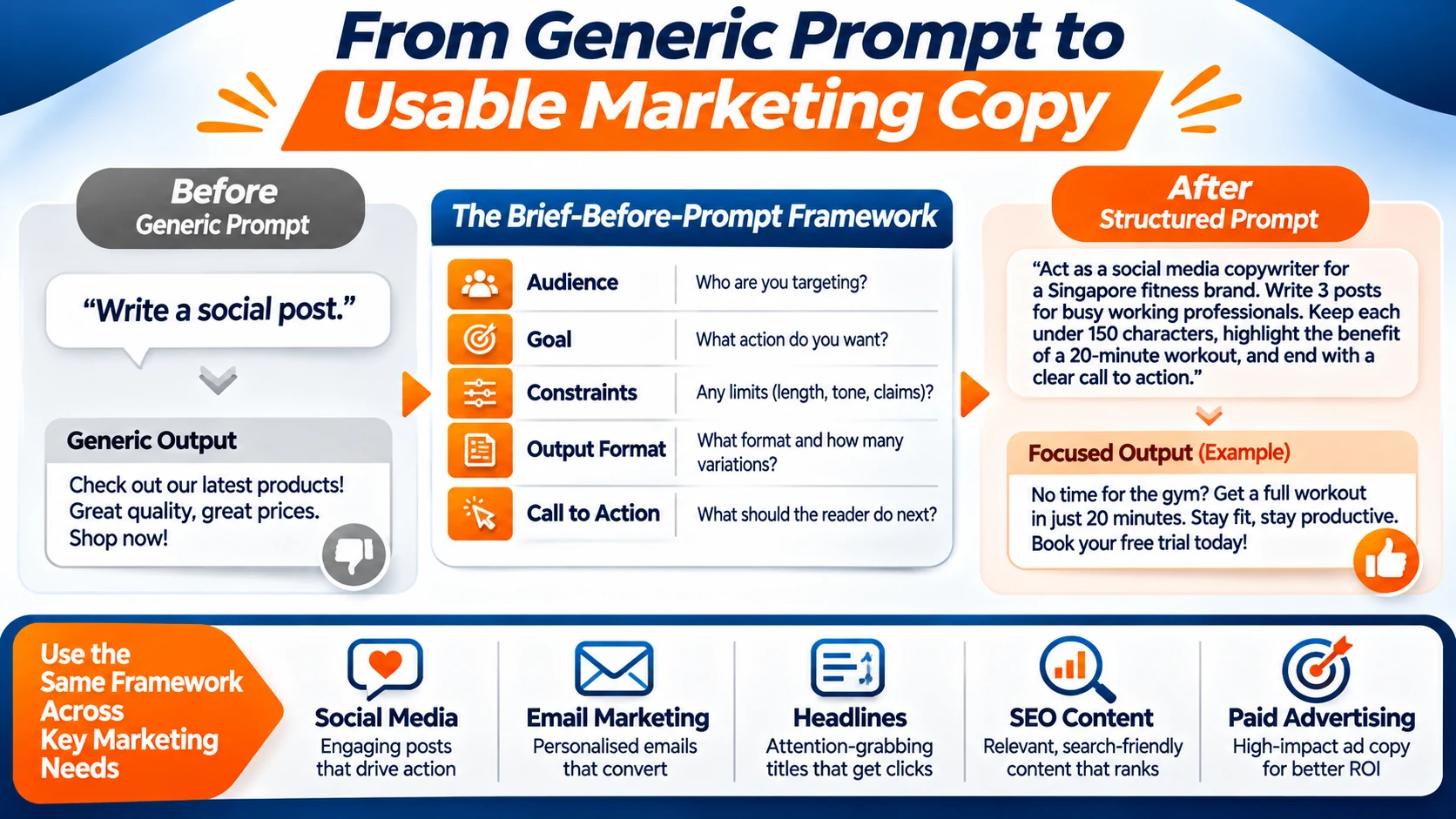
A prompt works when it gives the model the brief a human strategist would need. Role, format and tone are the three levers that turn a loose request into usable ChatGPT prompts for content marketing, including copy for social media posts. Actually, the same discipline applies regardless of the channel, so treat each prompt as a short creative brief.
Assigning a role and why it changes the output
Before: “Write a welcome email for my clothing store.” After: “Act as a retail email strategist for a Singapore fashion brand. Create a welcome email for first-time shoppers who signed up for a 10% discount. ” The second returns a focused email a team can use without rewriting, and the same framing works for any product line. Ask for several ideas per brief so you can compare directions before committing to one marketing strategy.
Specifying format so output is usable as-is
State the exact shape you need, such as the number of headlines, character limits, or a table with named columns. Before: “Give me some headlines.” After: “Include five numbered headlines, each under 30 characters.” Ask the model to describe the format in one line first, so you can confirm the structure before the full draft is produced, especially when drafting a blog post.
Setting tone, voice and banned words
Name the register and list words the brand never uses. Before: “Make it sound friendly.” After: “Use a warm, plain English register for a Singapore audience over 40. Avoid slang, exclamation marks and superlatives such as ‘best ever’. Keep sales language factual.”
Prompts for Audience Research and Content Strategy
Start with the people you want to reach, not the tool. Feed ChatGPT real pain points from sales calls, reviews and support tickets, then ask it to describe pre-purchase objections grouped by stage of the buying journey. Many business owners find that the objections they hear most often in sales calls are the ones worth addressing first.
For content strategy, ask ChatGPT to create a monthly calendar around three to five topic clusters, each with one pillar page and several supporting articles. Name the clusters you already rank for, so the output builds on existing authority. Clusters that draw on your social media comments often reveal questions that search data alone can miss.
Keyword clustering and search-intent prompts
Ask ChatGPT to group a keyword list by intent: informational, commercial or transactional. Treat the groupings as hypotheses and check them against real search results and Search Console data, since the model cannot see live search volume or rankings. A good prompt names the list, the business and the intent types to use.
SEO prompts for on-page optimisation and meta descriptions
Search prompts work best when they specify the page, the keyword and the length limit. Use these two templates:
- Title and subheadings: Suggest a title tag under 60 characters and three subheadings for this page. Use the target keyword naturally, without repeating it, so that each heading reads as a clear, useful promise to the reader.
Check each output against the page before publishing. Our digital marketing services team applies the same check when it briefs content for clients.
Prompts for Campaigns: Social, Email and Paid Advertising
Campaign prompts only work when the brief is complete. “Write a social post” returns something generic. Naming the platform, audience and call-to-action returns copy you can publish after light editing.
Social posts: platform, hook and call-to-action
Social copy changes sharply by platform. A LinkedIn post can run longer and be more formal, while a TikTok caption needs a hook in the first few words. Use this block and fill in the brackets:
Act as a social media copywriter for a business in Singapore. Write three posts for your target audience. Each post should stay within the character limit for the platform, be written in the language your audience uses, open with a hook in the first line, and end with one clear call to action. Give the three hooks separately so you can A/B test them. Share examples of past posts that performed well so the copy matches your brand voice.
Email and retargeting sequences
The Techpresso template asks ChatGPT for a five-email welcome sequence for a named business, from a signup incentive toward a first purchase. For each email, give a subject line, a preview line and one specific call to action. Create a sequence like this to help business owners move new subscribers toward a first purchase.
For retargeting, use three stages: a light reminder for browsers, an answer to their main objection, and a closer for people who nearly bought, with a single offer.
Ad copy variants and testing matrices
Ask for ten ad variants across three angles: price, proof and urgency. For each variant, give one headline within the platform’s character limit, one primary text and one call to action. Make only claims you can prove, because advertising claims must be truthful and provable.
Use this paid ad template: “Write ten ad variants for the product aimed at the target audience. Cover three angles: price, proof and urgency. For each, give a headline under the stated character limit, primary text, and one call to action. Use only claims the business can substantiate.”
Why the headline tests come first?
Headlines carry more weight than buttons. The headline-versus-CTA comparison is covered in the website conversion section below, so spend your prompt effort on the headline first. Pasting a few examples of headlines that already worked for your brand helps the model match your tone.
Using ChatGPT to Improve Website Conversion
Headline and CTA work shows prompt quality most clearly. The Techpresso source reports that a headline change can swing conversion rates by 30% or more, while CTA changes typically move them 5 to 10%. These are vendor-reported figures from a sample that may not match your own traffic, so treat them as a reason to test rather than a guaranteed result. Run your own tests.
Before and after: a headline prompt
Before: “Improve my homepage headline” returns vague options such as “Your Business, Better.” After, using the Scorecard: “Rewrite this headline for a Singapore SME owner comparing marketing agencies. Offer: a free 30-minute audit. Give 8 options under 12 words, English only.” The second brief scores 5 out of 5 on the Scorecard, because each field is specific.
Headline and CTA rewrites with a testing plan
Give ChatGPT the current headline, audience, offer and success test. Test one variable at a time: run the strongest two headlines against your current one, and change the CTA only after a headline winner is clear.
Prompt-driven audits and what to verify manually
Ask ChatGPT to flag unclear claims, missing proof and form friction, and treat the output as a checklist, not a verdict. Verify every claim against your own data, and confirm superlatives such as “best” or “No. 1” can be substantiated before they go live. Use these ChatGPT prompts to help your digital marketing team spot gaps, and include examples of what good ideas look like in your brief. Ask ChatGPT to describe each product’s key benefit in one sentence, then check those descriptions against your actual product specifications.
Checking, Governing and Improving Your Prompts
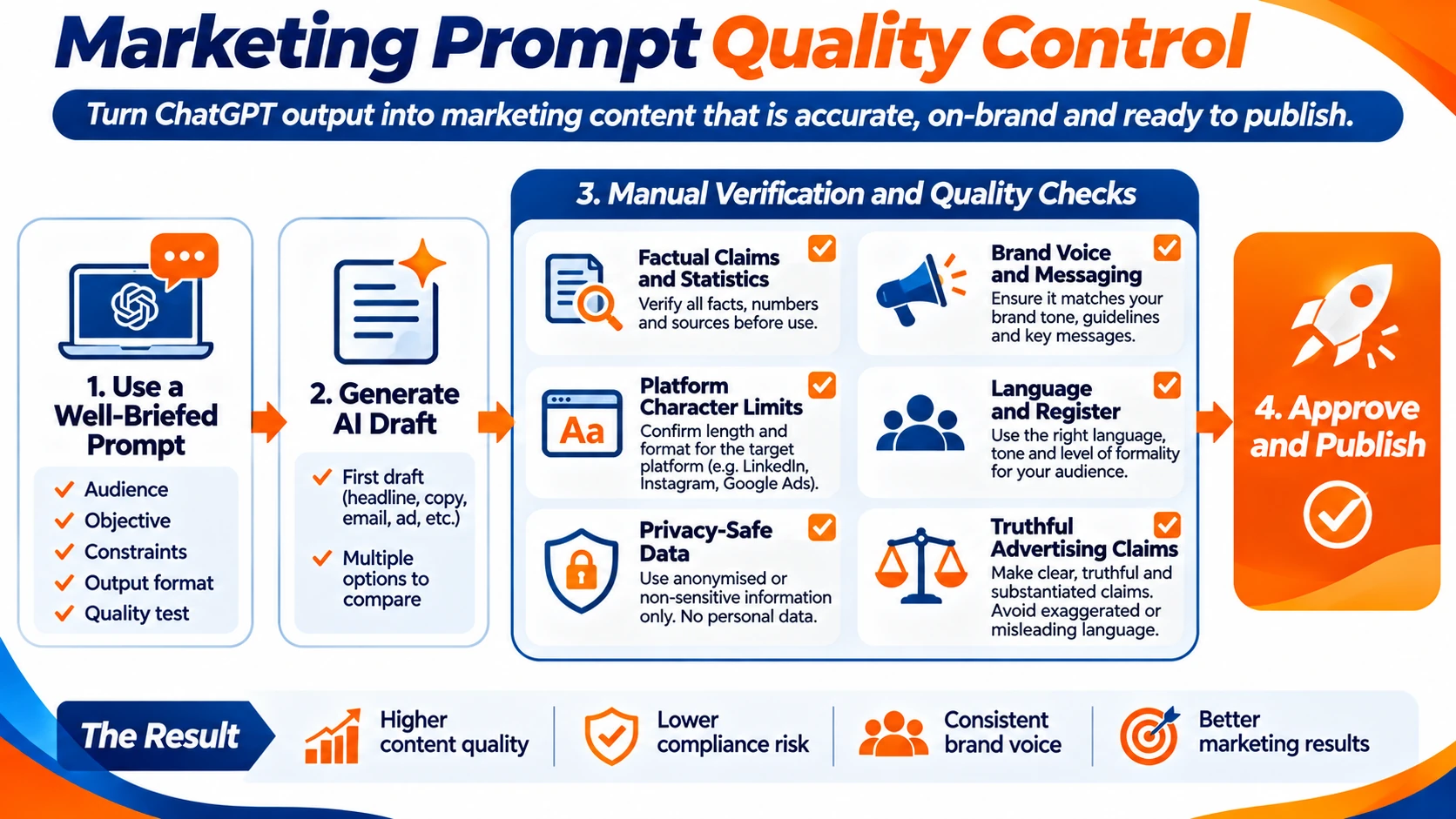
Before AI-generated marketing copy goes live, check every number, date and product claim against your own records, and check the draft against the brand voice guide. Substantiate every superlative, such as “best” or “guaranteed”, before publishing. Remove any customer data from the prompts used to create the content.
To improve prompts, log each failure. When a blog post headline underperforms, check whether the Audience or Quality test field was vague, then tighten it in the shared template. Review each prompt against actual sales results and content performance, not how polished the output reads. Track how each prompt performs across your social media channels, too. Keep a shared library of working ChatGPT prompts so that every team member can help improve them, and use it to describe what worked so colleagues can reuse it and get better results.
Common failure modes and fixes
| Symptom | Likely cause | Fix |
|---|---|---|
| Generic, interchangeable copy | Audience field is vague | Name the segment, its stage and its main objection |
| Invented statistics | No source data supplied | Paste verified figures or remove the claim |
| Wrong language or register | Language not specified | State the language and register |
| Copy too long for the platform | No character limit given | Add the limit for each channel |
Keeping customer data and claims compliant
Never paste names, contact details or purchase histories into a prompt. Use anonymised segment descriptions instead. Substantiate every product claim before publication, as advertising claims must be truthful under the Advertising Standards Authority of Singapore’s Code of Practice. Anyone who signs off a claim should confirm it is backed by evidence, and a better-documented claim is far easier to defend.
Conclusion
A good prompt is a brief, and a brief is only as good as its context. Score each prompt against the Brief-Before-Prompt Scorecard, and revise any that score under 4 out of 5 before sending them to ChatGPT. Good prompt sets carry a clear name, so the whole team can find and reuse them.
Keep a shared library of tested ChatGPT prompts, and check every AI-generated claim against real data before publishing. Marketing teams that do this well treat ChatGPT as a drafting partner, not a source of facts.
For help turning a tested brief into a full campaign, see our digital marketing services.
Frequently Asked Questions
Do I need a paid ChatGPT plan to use these prompts?
No. Every prompt in this article works on the free tier, though free-tier limits change over time, so check them before relying on them. ChatGPT Plus costs $20 a month for higher limits, but confirm current pricing on the official page. The Brief-Before-Prompt Scorecard matters far more than your plan.
How long should a marketing prompt be?
Long enough to score 4 or 5 on the Scorecard. Cover the audience, objective, constraints, output format and a quality test. Extra length helps only when each sentence adds a fact the model cannot guess.
Can ChatGPT replace a copywriter or strategist?
No. It drafts variants quickly, but someone must set the objective, judge which headlines are worth testing and check claims. Treat the output as a first draft.
How do I stop ChatGPT from making up statistics?
Paste verified figures into the prompt, tell the model to use only those facts, and have it write “source needed” where evidence is missing. Check every number against its original source before publishing.
How often should I refresh my prompt library?
Review it quarterly and whenever a platform changes its limits, ad formats or policies. Retire prompts that consistently need heavy editing.