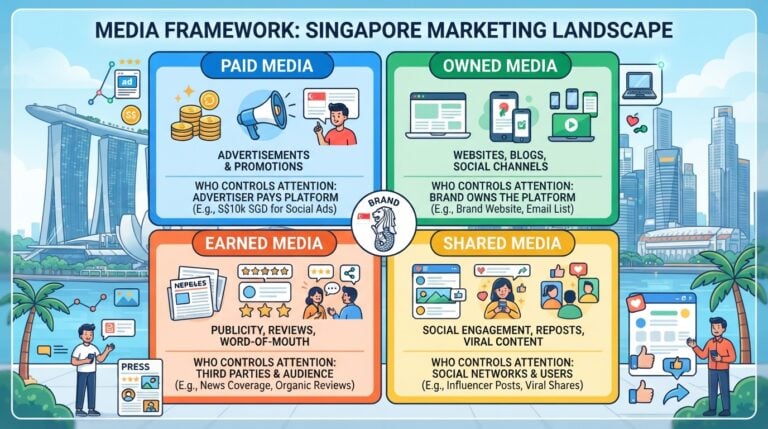
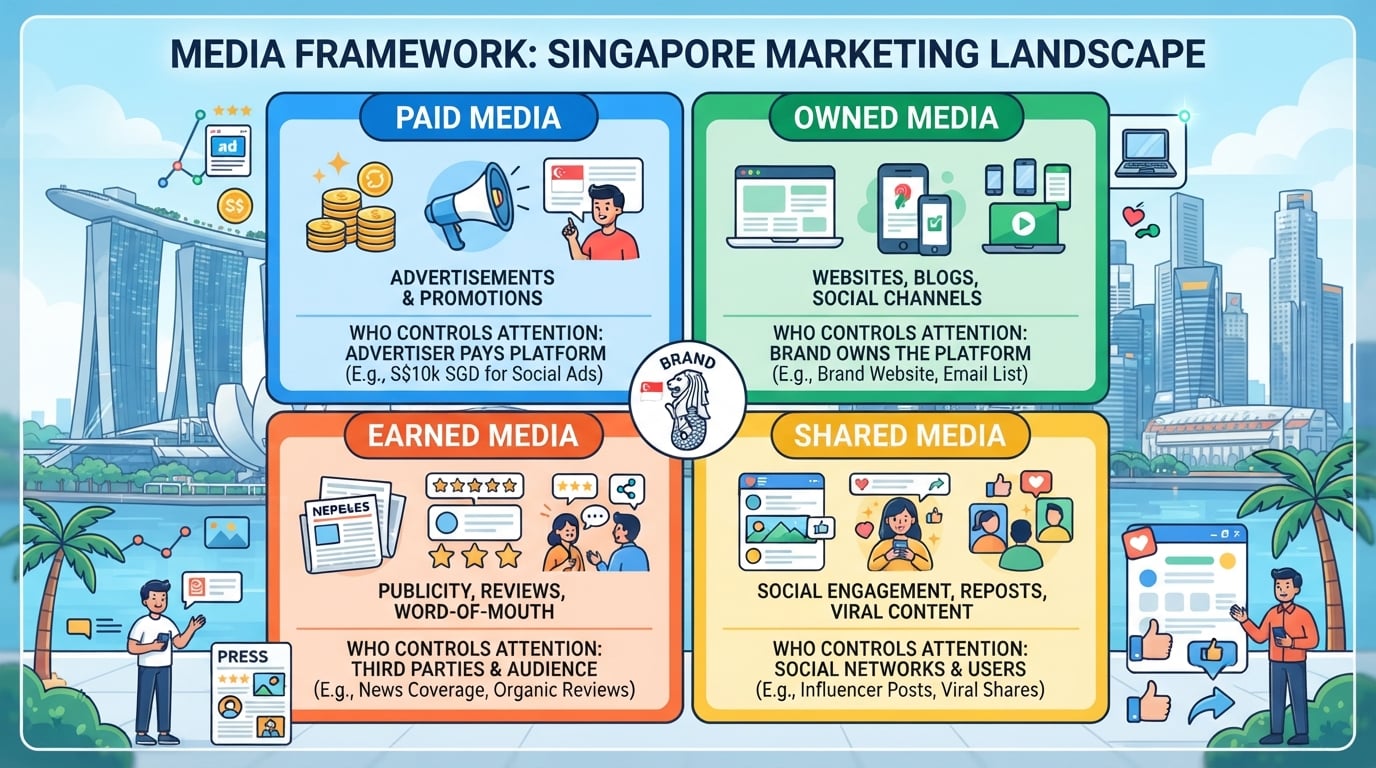
Forms of digital marketing can be grouped into four main media categories: paid, earned, shared, and owned. Each serves a different purpose in reaching audiences, building brand awareness, and encouraging customers to take action.
Understanding these four forms helps businesses develop a more coordinated digital marketing strategy. Rather than relying entirely on paid advertisements or organic social media, companies can combine different channels to attract potential customers, establish credibility, and generate conversions.
For businesses in Singapore, this approach is particularly relevant as consumers increasingly use digital channels to discover products, research services, and make purchasing decisions.
Key Takeaways
- The four main forms of digital marketing are paid, earned, shared and owned media, commonly associated with the PESO framework.
- Paid media helps businesses reach targeted audiences, while earned media builds third-party credibility.
- Shared media encourages audience participation and content distribution, while owned media provides channels that businesses control.
- Combining the four forms can support different stages of the customer journey, from initial awareness to purchase.
- Businesses should measure each channel using relevant performance indicators rather than relying on a fixed budget allocation.
- A coordinated strategy allows businesses to evaluate performance across multiple channels and identify opportunities for improvement.
Understanding the Four Core Forms of Digital Marketing
The four forms of digital marketing are commonly explained through the PESO framework, which stands for Paid, Earned, Shared, and Owned media.
According to Gini Dietrich’s explanation of the PESO Model, the framework brings together paid, earned, shared and owned media to help organisations coordinate their marketing and communications activities.
Each category has a different relationship with the audience, and businesses can combine them to support their marketing objectives.
1. Paid Media
Paid media refers to promotional exposure that businesses purchase through advertising platforms or other paid placements.
Examples include:
- Google Search advertisements
- Paid Social advertisements
- Display advertising
- Sponsored articles and content placements
- Paid influencer partnerships
- Video advertisements on platforms such as Youtube and Tiktok
For example, a Singapore-based retailer could run Google Ads campaigns targeting people searching for specific products or services. The advertisements can direct interested users to relevant product pages or landing pages.
Paid media gives businesses greater control over targeting, campaign budgets, placements and advertising messages. However, visibility generally depends on continued advertising expenditure and platform availability.
According to Google Ads’ explanation of Quality Score, Quality Score is a diagnostic tool that helps advertisers assess the quality of their advertisements relative to other advertisers. Google clarifies that Quality Score is not an input in the ad auction. Businesses should therefore evaluate actual campaign performance using indicators such as cost per acquisition, conversion rate and return on advertising spend rather than assuming that a higher Quality Score automatically lowers advertising costs.
2. Earned Media
Earned media refers to exposure a business receives through independent third-party recognition rather than purchasing advertising space.
Examples include:
- Independent customer reviews
- Editorial media coverage
- Organic brand mentions
- Unpaid recommendations
- Industry recognition
- Genuine editorial backlinks
For example, a Singapore restaurant might receive coverage from a local food publication after a journalist independently reviews its menu and dining experience.
Unlike paid advertising, earned media depends on the willingness of other people or organisations to mention, recommend or feature a business.
It can strengthen brand credibility because the exposure comes from an independent source. However, businesses cannot guarantee favourable coverage or control how third parties discuss their products and services.
Earned media can also contribute to a brand’s online visibility and reputation. However, businesses should not assume that every review, media mention or social share directly improves organic search rankings. According to Google Search Central’s guide to ranking systems, Google uses multiple automated systems and signals to assess web pages and determine which results are most relevant and useful to users. Its documentation also describes link analysis and a reviews system among its ranking systems. Businesses should therefore focus on earning genuine recognition and creating useful content rather than treating publicity as a guaranteed ranking technique.
Shared media refers to content distributed, discussed or circulated through social networks and online communities.
Examples include:
- Social media shares and reposts
- Customer-generated content
- Online community discussions
- Shared videos and infographics
- Organic social media engagement
- Discussions about products and services
For example, a Singapore home renovation company could publish photographs of completed projects on Facebook and Instagram. The company could also develop social media content around these photographs, encouraging customers to share them with friends or discuss their renovation experiences in relevant online communities.
Shared media allows businesses to extend the reach of their content through audience participation. However, the extent of distribution depends on audience interest, platform features and content relevance.
Some businesses also use social ecommerce to turn social media interactions into direct purchasing opportunities.
The potential reach of these channels is significant in Singapore. According to We Are Social’s Digital 2025: Singapore report, the country had approximately 5.16 million social media user identities in January 2025, equivalent to 88.2% of its population. The report notes that these figures represent user identities and should not necessarily be interpreted as unique individuals.
This shows the potential of social media as a distribution channel for businesses seeking to reach Singapore audiences. However, audience size alone does not guarantee engagement, leads or sales.
4. Owned Media
Owned media refers to digital channels and communication assets that a business controls and manages.
Examples include:
- Company websites
- Business blogs
- Email newsletters
- Landing pages
- Online resource centres
- Downloadable guides
- Company-managed content libraries
For example, a Singapore financial services company could publish an educational guide explaining different financial planning options, using SEO content to address relevant customer questions and attract organic traffic.
Owned media gives businesses greater control over their content, messaging, presentation and customer experience. However, owning a website or email list does not automatically guarantee visitors, subscribers or engagement. Businesses should also explore ways to increase website traffic through relevant content, search visibility and other acquisition channels.
How to Measure the Performance of Each Media Type
Measuring digital marketing performance requires more than looking at website traffic or social media engagement.
Each media category has different objectives and should be evaluated using appropriate indicators.
| Media type | Relevant performance indicators |
|---|---|
| Paid | Cost per click, conversion rate, cost per acquisition and return on ad spend |
| Earned | Media mentions, quality backlinks, referral traffic and review sentiment |
| Shared | Shares, comments, engagement rate and referral visits |
| Owned | Organic traffic, returning visitors, email subscriptions and lead conversions |
Businesses can use tools such as Google Analytics 4, Google Search Console and advertising platform reporting to monitor relevant results.
It is also important to understand that the same customer may interact with several channels before converting. Businesses should therefore avoid assuming that the final interaction was the only factor contributing to the purchase.
How the Four Forms of Digital Marketing Work Together
The four forms are most useful when businesses coordinate them rather than treating them as completely separate activities.
A paid campaign might introduce a potential customer to a business. The customer could then visit its website, read independent reviews and encounter recommendations shared by other users before making a purchase.
The customer journey is not always linear. Some people discover brands through social media, while others begin with a search engine, recommendation or direct visit to a company’s website.
Mapping the Four Forms to the Customer Journey
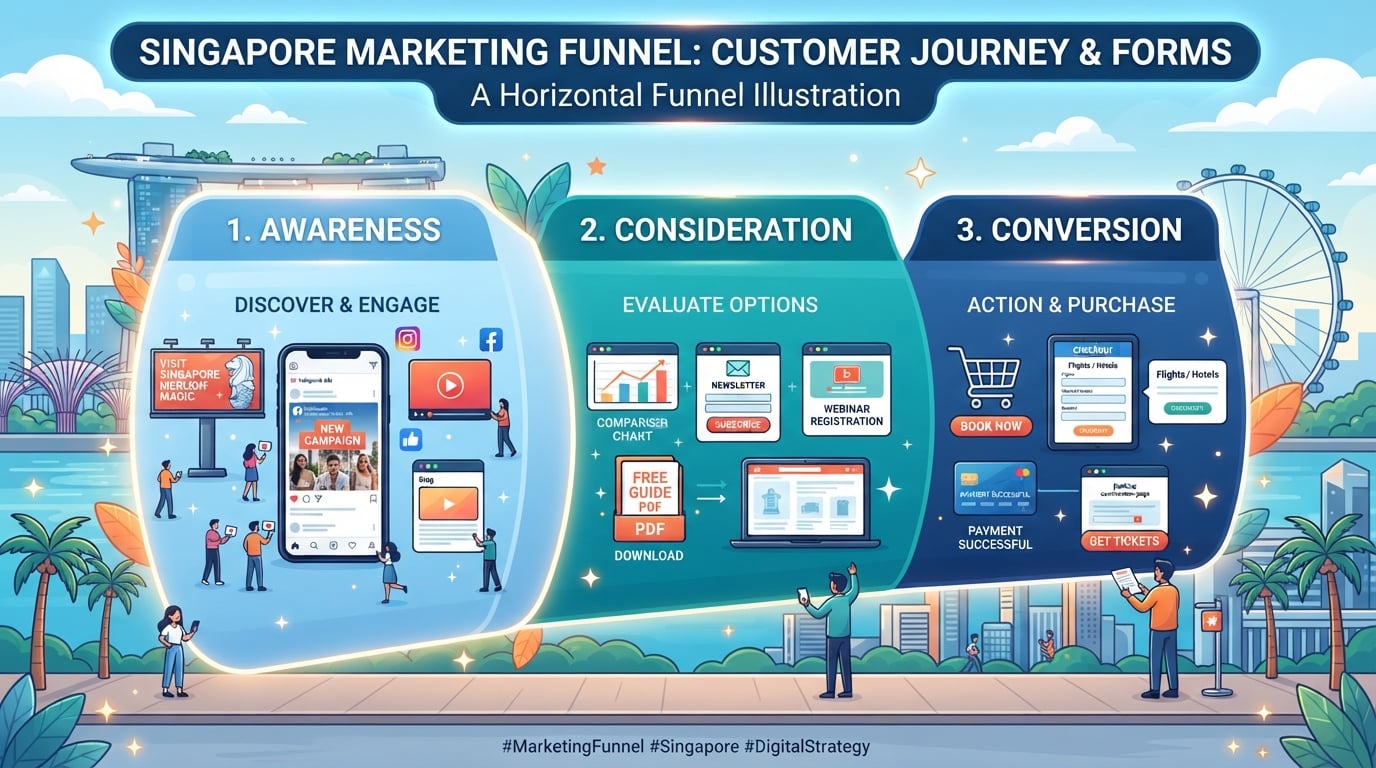
The customer journey can be broadly divided into awareness, consideration and conversion.
Awareness
At this stage, potential customers discover a business, product or service. Paid advertising can introduce the brand to targeted audiences, while shared media can extend the distribution of useful or interesting content.
Consideration
In the consideration stage, buyers evaluate their options and decide whether to make a purchase. They may visit company websites, compare product information, read customer reviews and examine independent recommendations. Owned content and earned media can help provide information that supports this evaluation.
Conversion
At this stage, potential customers take an action, such as making a purchase, requesting a quotation or booking an appointment. Owned media often plays an important role through product pages, enquiry forms, booking systems and landing pages. Paid advertising can also direct interested users to these conversion points. The role of each media category can overlap across different stages, depending on the product, audience and buying process.
A Singapore Business Example: How the Four Forms Work Together
Consider a hypothetical renovation company operating in Singapore that wants to attract homeowners planning to renovate their HDB flats. Instead of depending on one marketing channel, the company could combine the four forms as follows.
Step 1: Use paid media to attract potential customers
The company launches Google Search advertising targeting relevant searches, such as HDB renovation contractors in Singapore. The advertisements direct users to a dedicated landing page containing information about renovation services.
Step 2: Use owned media to provide useful information
The landing page links to the company’s website, where visitors can explore renovation packages, project photographs, service information and renovation guides. The company could also publish an article explaining factors that influence HDB renovation costs. This gives potential customers more information before requesting a quotation.
Step 3: Build credibility through earned media
Potential customers may look for independent customer reviews, recommendations and editorial coverage. Genuine feedback from previous customers can help them evaluate the company’s service quality and reliability.
Step 4: Extend reach through shared media
The company publishes completed renovation projects and customer-approved photographs on its social media accounts. Customers who find the content useful or interesting may share it with friends, family members or other homeowners. These activities can introduce the business to additional audiences.
The example demonstrates how each media category can contribute to the same business objective. However, the company should evaluate actual campaign results rather than assume that every customer will follow the same sequence.
Singapore Consumer Behaviour and Its Implications for Digital Marketing
Understanding local consumer behaviour can help businesses decide how to use different digital marketing channels and respond to emerging digital marketing trends.
Singapore’s online shopping environment provides useful context for these decisions.
According to the Singapore Department of Statistics’ Household Expenditure Survey 2023, 82% of Singapore households made online purchases in 2023, compared with 60% in 2017/18. These findings demonstrate the growing role of online shopping in household expenditure.
The UOB ASEAN Consumer Sentiment Study 2025 also provides insight into purchasing behaviour in Singapore. Its survey of 1,000 Singapore respondents found that:
- 55% bought more products on sale or at a discount
- 44% took more time deciding on new purchases
- 40% bought more house-brand, value-for-money or unbranded products
These findings provide useful context for businesses developing their marketing strategies.
For example, paid advertisements can introduce promotional offers, while owned media can provide detailed product information. Earned media can help establish credibility, and shared media can extend the reach of useful content.
The findings should not be interpreted as evidence that one particular media category performs better than another. Instead, they highlight the importance of understanding customer needs, purchasing considerations and the information consumers use when evaluating products.
How to Choose the Right Digital Marketing Mix
There is no universal budget allocation that works for every business. The appropriate mix depends on factors such as marketing objectives, target audiences, industry competition, available resources and campaign performance.
Businesses can use the following considerations when deciding where to invest.
1. Identify your marketing objectives
Determine whether the immediate priority is brand awareness, website traffic, lead generation, sales or customer retention. Different objectives require different combinations of media channels.
2. Evaluate your existing digital assets
Review your website, landing pages, social media accounts, email database and existing customer reviews. A business with an outdated website may need to improve its owned media infrastructure before investing heavily in advertising.
3. Understand your target audience
Identify where potential customers search for information, which platforms they use and what influences their purchasing decisions. This can help businesses prioritise relevant channels instead of spreading resources across platforms without a clear purpose.
4. Test and measure performance
Start with measurable campaigns and review their results. Compare the quality of leads, conversion rates, customer acquisition costs and revenue generated by different channels.
5. Adjust the mix based on results
Reallocate resources when performance data identifies stronger opportunities.
For example, a business may increase investment in a paid search campaign that generates qualified leads while improving website content to address common customer questions.
The objective is to develop a marketing mix that supports business outcomes rather than follow arbitrary percentages.
Common Mistakes When Using Different Forms of Digital Marketing
Even businesses using multiple digital channels can struggle to achieve consistent results.
Some common mistakes include:
1. Relying entirely on paid advertising
Paid advertising can generate visibility, but businesses should also develop useful content, maintain their websites and build customer relationships.
2. Treating social media engagement as sales
A post receiving many likes or shares does not necessarily mean it generates qualified leads or revenue.
3. Ignoring customer reviews
Independent feedback can influence how potential customers evaluate a business. Companies should monitor reviews and respond professionally to customer concerns.
4. Publishing content without a clear purpose
Content should address audience needs and support a defined marketing objective. Publishing frequently without a strategy may produce activity without meaningful results.
5. Using the same message across every channel
Different channels serve different purposes. An advertising headline, an educational website guide and a customer community discussion may require different formats and messaging.
Bringing the Forms of Digital Marketing Together
The four forms of digital marketing, paid, earned, shared and owned media, each play an important role in reaching and engaging potential customers. When used together, they help businesses build brand awareness, establish credibility and generate conversions.
The right combination depends on your business goals, target audience and available resources. By measuring performance and adjusting your strategy, you can create a more effective digital marketing approach that supports long-term growth.
Frequently Asked Questions
What are the main forms of digital marketing?
The four core forms are earned, owned, paid and shared media. They work best together.
Which form should a small business start with?
Start with owned media, such as a website and email list, because you control it. Add paid search once you know which offer converts.
How do earned and paid media differ?
Paid media buys attention, so reach stops when the budget does. Earned media cannot be bought and is harder to control.
How is AI changing digital marketing?
AI is changing search answers and campaign optimisation. Use it for testing, not as a replacement for direct audience relationships.
How do I measure the return on digital marketing?
Track cost per acquisition and revenue per channel against each form’s spend, using several measures together.