TL;DR: Social Ecommerce in Singapore at a Glance
- Social ecommerce means selling inside a social platform, from discovery through payment to fulfilment, without necessarily sending the buyer to a separate website.
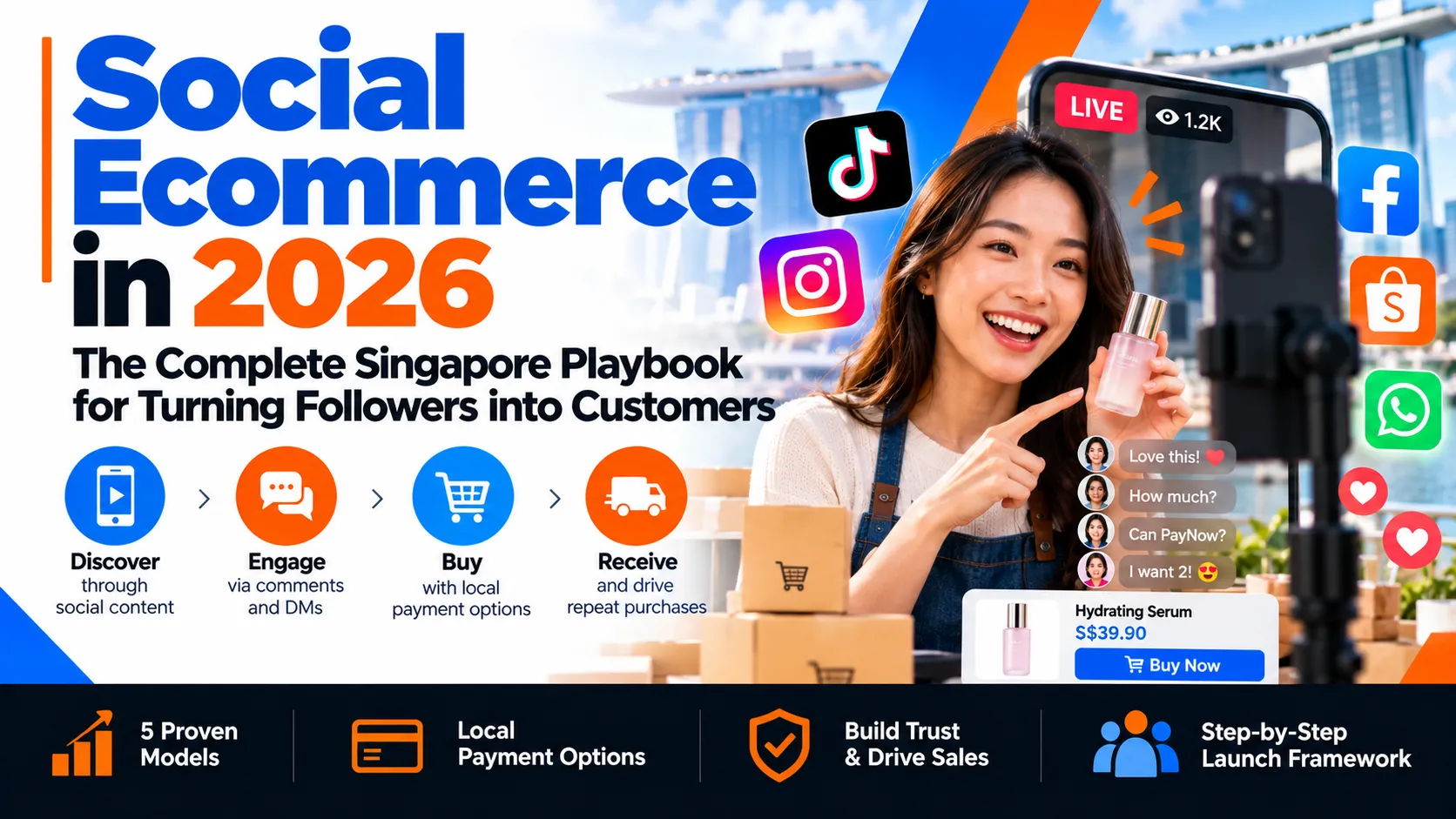
- Five models convert reliably in Singapore in 2026: live selling, DM-to-order, catalogue and shoppable posts, community-led group buys, and creator affiliate selling.
- PayNow, PayLah! and WhatsApp checkout are the payment rails most Singapore buyers actually trust. Card-only checkouts lose sales.
- Trust is the bottleneck: reviews, live video, clear returns and a visible UEN do more for conversion than discounts.
- You can run a launch in seven steps without needing a full website before the first sale.
Singapore’s retail landscape has shifted. The brands winning in 2026 are not the ones with the biggest advertising budgets but the ones that can turn a TikTok comment into a PayNow transfer in under five minutes. Social ecommerce has moved from an experimental side channel to a core revenue engine, and local businesses of every size are racing to catch up.

This playbook is written for Singaporean sellers: the home-based baker running Instagram DMs from a Sengkang flat, the Punggol seafood seller clearing stock on TikTok Live, and the established retailer wondering why foot traffic keeps falling while followers keep growing. You will get a working definition of social ecommerce, the five models that actually convert here, a step-by-step launch framework, and the local payment, trust, and regulatory details that decide whether a follower becomes a customer.

What Is Social Ecommerce?
Social e-commerce is the sale of goods or services that begins and often completes inside a social platform. In the same app, users can discover, converse, pay, and receive post-purchase support.
That last clause is what separates social ecommerce from social media marketing. A sponsored post that sends traffic to an external store is marketing. A TikTok Live where viewers tap a product link, pay by PayNow and receive a tracking number is social ecommerce.
In Singapore, the practical definition matters because it determines what you build. If your sales happen inside the app, your priorities are content cadence, response speed and in-app payment. If your social presence funnels to a website, your priorities are landing page conversion and retargeting. Most Singapore sellers in 2026 run both, with social as the acquisition layer and a store as the catalogue of record.
Why Social Ecommerce Works Differently in Singapore
Singapore compresses the usual social commerce timeline. High smartphone penetration, near-universal adoption of instant bank transfers, and a dense, delivery-friendly geography mean the gap between “I saw it” and “I paid for it” is measured in seconds, not days.
Three local characteristics shape the channel:
- Small market, fast word of mouth. A bad experience travels quickly through WhatsApp groups and Telegram channels. Reputation compounds faster here than in larger markets.
- Trust-based buying. Singapore consumers are comfortable paying strangers via PayNow, but only after they see evidence of a real business: previous orders, live video, a physical address, or a registered entity.
- Live selling culture. TikTok Live and Facebook Live commerce have become a mainstream retail format, not a niche experiment, particularly for fresh produce, fashion and beauty.
As a result, social ecommerce in Singapore rewards operators who show up consistently and respond quickly far more than it rewards polished branding alone.
The Five Social Ecommerce Models That Convert in Singapore
Each model below suits a different stage of business. You can run more than one, but don’t launch more than two at once.
| Model | Best for | Where it runs | Typical conversion driver |
|---|---|---|---|
| Live selling | Fresh produce, fashion, beauty, limited stock | TikTok Live, Facebook Live | Urgency and real-time demonstration |
| DM-to-order | Bakers, custom gifts, made-to-order goods | Instagram DMs, WhatsApp | Personal service and fast replies |
| Catalogue and shoppable posts | Established retailers with a defined SKU range | Instagram Shop, Facebook Shop, TikTok Shop | Browseability and saved payment details |
| Community-led group buys | Neighbourhood sellers, bulk purchases | WhatsApp, Telegram, Facebook Groups | Familiarity and shared delivery costs |
| Creator affiliate selling | Brands with a marketing budget | TikTok, Instagram, YouTube | Borrowed trust and reach |
1. Live Selling
Live selling works because it compresses the buying decision. The viewer sees the product in use, hears the price, watches stock disappear and pays before the stream ends.
In Singapore, the format is strongest for perishables and anything where freshness or condition matters. Sellers typically run fixed weekly slots so audiences build a habit. Operationally, you need a second person to handle order capture and payment while the host keeps talking. Solo hosts who stop to chase payments lose the room.
2. DM-to-Order
DM-to-order is the lowest-setup model and the most common entry point for home-based businesses. The customer messages, you confirm stock, send a PayNow number or QR code, and arrange delivery or self-collection.
Its weakness is scale. Every order consumes human attention, and response time directly affects conversion. Sellers who automate the first reply, with a saved response covering price, lead time and payment, handle roughly twice the volume before quality drops.
3. Catalogue and Shoppable Posts
This model suits businesses with a stable product range. You publish a catalogue once, tag products in posts and stories, and let buyers check out without a conversation.
The trade-off is platform dependency. Catalogue features, fees and eligibility rules change, and your reach is rented rather than owned. Treat the catalogue as a channel, not the business.
4. Community-Led Group Buys
Group buys turn an existing audience into a distribution network. A WhatsApp or Telegram group agrees on a bulk order, which lowers unit cost and delivery charges.
This model is unusually strong in Singapore’s HDB heartlands, where neighbours already share delivery logistics. The seller’s job shifts from promotion to coordination: cut-off times, payment collection and a single delivery point.

5. Creator Affiliate Selling
Affiliate selling outsources reach to creators who already hold an audience’s attention. In Singapore, mid-tier creators with tight, local followings often outperform large generalist accounts on conversion, even when total views are lower.

Commission structures vary, so the practical guide is to pay on completed, non-refunded orders rather than clicks.
The Singapore Payment Stack: What Buyers Actually Use
Payment is where most cross-border social commerce advice fails for Singapore sellers. Recommendations built around card checkout or Western wallets miss how locals prefer to pay.
| Payment method | Why buyers use it | Where it fits |
|---|---|---|
| PayNow | Instant, familiar, no card details needed | DM orders, group buys, live selling |
| PayLah! | Tied to a bank app many already have open | Repeat customers, small baskets |
| Bank transfer | Zero fees, high trust for larger amounts | High-value or bulk orders |
| Card and in-app checkout | Convenience and saved details | Catalogue and shoppable posts |
| Cash on delivery | Reassurance for first-time buyers | Local delivery, low-value first orders |
Three operational rules follow from this:
- Always offer at least two payment methods. The PayNow Plus card covers most buyers. A single method turns away the rest.
- Send a payment reference format. Ask buyers to include their order number in the transfer note. Otherwise, reconciling payments in a DM inbox becomes unmanageable past a few dozen orders a week.
- Confirm payment visibly. A short “payment received, order confirmed” message reduces follow-up queries and builds the trust that produces repeat purchases.
Trust Signals That Decide Whether a Follower Buys
Conversion in social ecommerce is a trust problem before it is a pricing problem. Singapore buyers are willing to transact with small sellers, but they look for evidence first.
The signals that move the needle, roughly in order of impact:
- Live video and real-time proof. Showing the actual product, not stock imagery, is the strongest single signal.
- Visible transaction history. Screenshots of past orders, reviews and repeat-buyer comments.
- Clear returns and dispute handling. A stated policy, even a simple one, removes the fear of being stuck with a bad purchase.
- Registered business details. A UEN or business name on the profile reassures buyers and meets consumer protection expectations.
- Consistent response times. Slow replies read as a risk. A published response window sets expectations and reduces anxiety.
A Seven-Step Framework to Launch Social Ecommerce in Singapore
Work through these in order. Each step produces something you can use immediately.
- Pick one platform and one model. Match the model table above to your product type and start with a single channel.
- Define your product range and price points. Keep the launch range small enough to describe in one live session or a handful of posts.
- Set up payments. Open PayNow or PayLah! collection, and decide whether to add card checkout. Write your payment reference format.
- Publish trust evidence. Post past work, samples, reviews or a behind-the-scenes video before you start selling hard.
- Set a content cadence you can sustain. Two to three posts a week, plus one live slot, beats daily posting followed by silence.
- Document your fulfilment process. Include delivery windows, self-collection points, packaging, and a cut-off time for same-day dispatch.
- Review weekly and cut what does not work. Track which model and which content format produced orders, then drop the rest.
Social Ecommerce Metrics Worth Tracking
Most sellers track followers. Followers are a vanity metric in social commerce because they do not pay for anything.
Track these instead:
- Enquiry-to-order rate. How many conversations become paid orders. This metric exposes pricing and trust problems.
- Response time. Median time from first message to first reply. Under 15 minutes is the practical target during selling hours.
- Repeat purchase rate. The clearest sign that trust has been established is the repeat purchase rate.
- Order value by model. Live selling, DM orders and group buys often produce very different basket sizes, and the difference should drive where you spend time.
- Refund and dispute rate. A rising rate points to product description problems rather than difficult customers.
Common Mistakes Singapore Sellers Make
- Running five platforms at once. Reach spreads thin and response times collapse. Start with one.
- Treating social as free advertising. It is a sales channel with operating costs: time, content and payment fees.
- Hiding behind a logo. Buyers transact with people. A face, a voice and a name convert better than a brand mark.
- Ignoring payment friction. A buyer who has to download an app or enter card details mid-scroll often does not complete the purchase.
- No written policy on returns or delays. Ambiguity costs more in lost trust than a clear, modest policy ever will. Singapore businesses are also expected to provide consumers accurate information under the Consumer Protection (Fair Trading) Act, so vague claims carry regulatory and commercial risk.
- Chasing follower count. A small, engaged local following will outsell a large, passive one.
Frequently Asked Questions
Social ecommerce is selling directly inside social platforms such as Instagram, TikTok, Facebook and WhatsApp. The customer discovers the product, asks questions, pays and receives updates without leaving the app or visiting a separate website.
PayNow and PayLah! dominate because they are instant, familiar and require no card details. Card and in-app checkout are well-suited for catalogue shopping, while bank transfers are still common for larger or bulk orders. Offering at least two methods is the practical minimum.

Yes. Many Singapore sellers operate entirely through Instagram DMs, WhatsApp and TikTok Live. A website becomes useful when your product range grows, when you need a searchable catalogue, or when you want to own the customer relationship rather than rent it from a platform.
It depends on your product. TikTok suits live selling and demonstration-led categories. Instagram suits visual products and DM-based ordering. WhatsApp and Telegram excel at group buys and repeat customers. Most sellers should master one before adding a second.
How long does it take to get the first sale?
With a defined product, a working payment method and an existing audience, the first sale often comes within the first live session or the first week of consistent posting. Without an audience, expect several weeks of content and outreach before conversion starts.
Not necessarily at the start, but sole proprietorships and companies that carry on business in Singapore must be registered with the Accounting and Corporate Regulatory Authority. As noted above, displaying a UEN also serves as a trust signal for buyers.
How do I handle returns and disputes as a small seller?
Publish a simple written policy covering the return window, condition requirements and who pays for return delivery. Respond quickly and resolve in writing so there is a record. A clear policy prevents far more disputes than it creates. Where a dispute cannot be settled directly, consumers in Singapore can seek mediation through the Consumers Association of Singapore.
Is collecting customer details through DMs covered by data protection rules?
Yes. Personal data collected through social platforms, including names, phone numbers and addresses, is covered by the Personal Data Protection Act, which sets out consent, purpose limitation and care obligations. Sellers should collect only what is needed for fulfilment and avoid sharing buyer lists between platforms.
What happens if a buyer pays by PayNow and then disputes the order?
Unlike card payments, the buyer cannot reverse PayNow transfers, which is why trust evidence matters so much in this channel. Sellers should keep order records, written payment confirmations, and delivery proof, since these are the documents relied on if a complaint escalates to a consumer body.
Yes. Income earned from selling goods or services, whether through a registered business or as an individual, is generally taxable, and the Inland Revenue Authority of Singapore sets out how individual income tax applies. Sellers unsure of their position should seek advice from a qualified tax professional.
Where to Go From Here
Social ecommerce in Singapore rewards operators, not observers. The model you choose matters less than how consistently you run it.
Pick one platform and one model from the table above this week. Set up the PayNow collection. Publish one piece of trust evidence. Run your first live session or open your DMs for orders. Then measure the enquiry-to-order rate and response time, and let those two numbers tell you what to improve next.