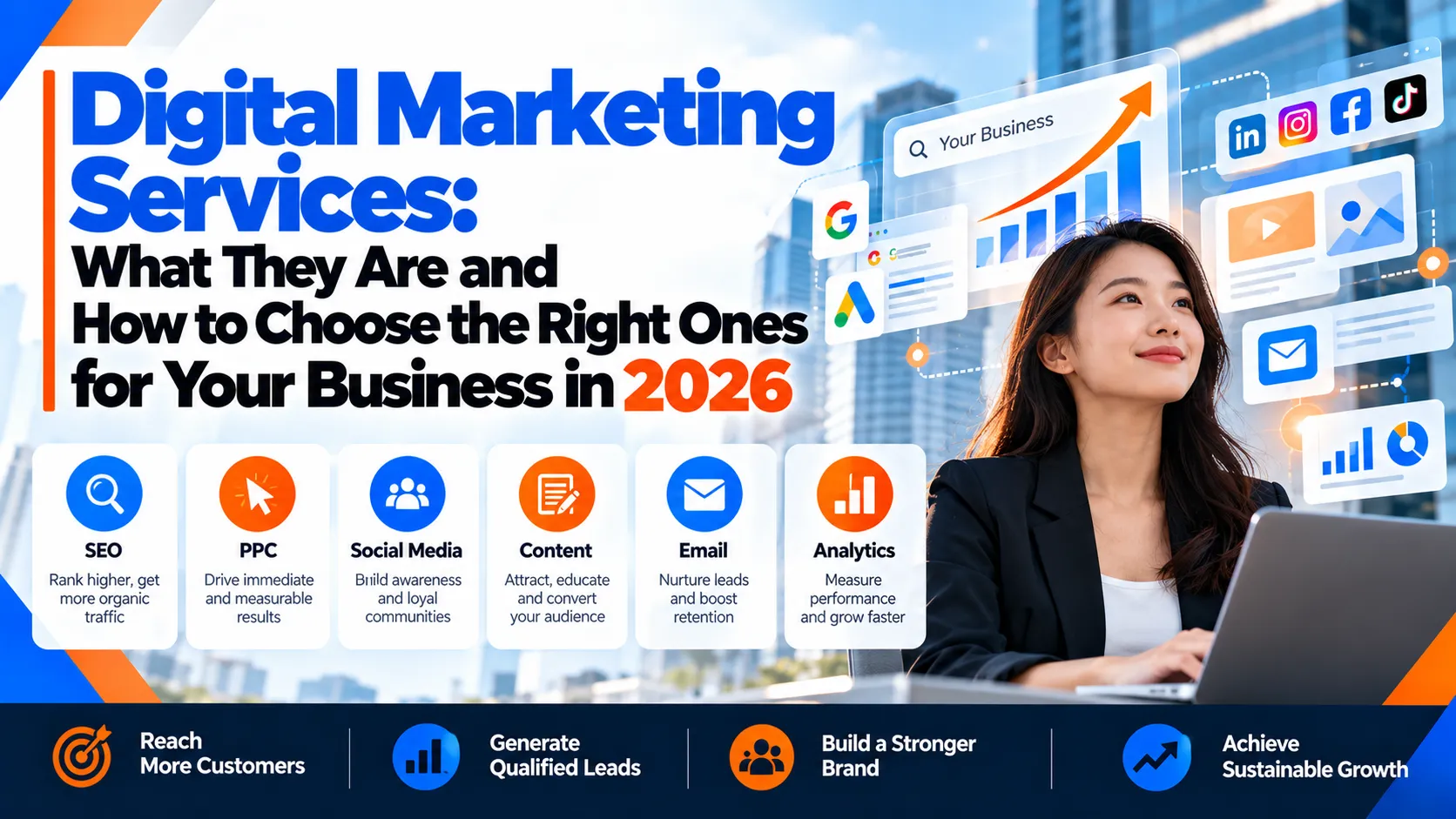
Digital marketing services are the specialised activities a business outsources to reach, engage and convert customers across online channels. They span search engine optimisation, paid advertising, social media management, content creation, email automation and analytics. Most organisations today don’t buy a single service in isolation; they purchase a mix tailored to their growth stage, budget, and competitive position.

This guide addresses both the informational question (what do these services actually cover?) and the commercial one (how do I pick the right partner?). Readers will learn what each service delivers, how to spot a trustworthy provider, what pitfalls sink most buying decisions, and how the shift toward AI-assisted delivery has reshaped pricing and capability in 2026.
Key Takeaways
- Digital marketing services span six core disciplines: SEO, PPC, social media, content, email and analytics. Research suggests integrated service approaches yield stronger results than single-channel vendors.
- Start-ups should prioritise either SEO or PPC, depending on their revenue model. Mid-market firms typically need two to three specialist services. Enterprises often benefit from bundled agency platforms with modular add-ons.
- Red flags in agency proposals include guaranteed rankings, vague reporting and pressure to commit long-term before discovery. Request case studies tied to metrics that match your industry.
- Pricing ranges from SGD 2,700–10,800 per month for SME retainers to SGD 67,500+ per month for enterprise integrated services. Verify current rates with providers, as pricing varies by market and scope.
- AI has changed how agencies price and deliver services. Routine tasks (report automation, ad copywriting, and keyword research) now cost less, while strategic work (audience research, competitive analysis, and creative direction) commands higher fees.
- Set success metrics, governance and escalation paths before signing. Digital marketing relationships typically fail because of misaligned expectations, not poor execution.
What Digital Marketing Services Actually Cover
Digital marketing services are not one thing. They are a suite of interconnected channels, techniques, and tools designed to reach, engage, and convert people across the web, social platforms, email, and search engines. Understanding what’s inside that suite is the first step toward choosing what you actually need.
The Core Disciplines
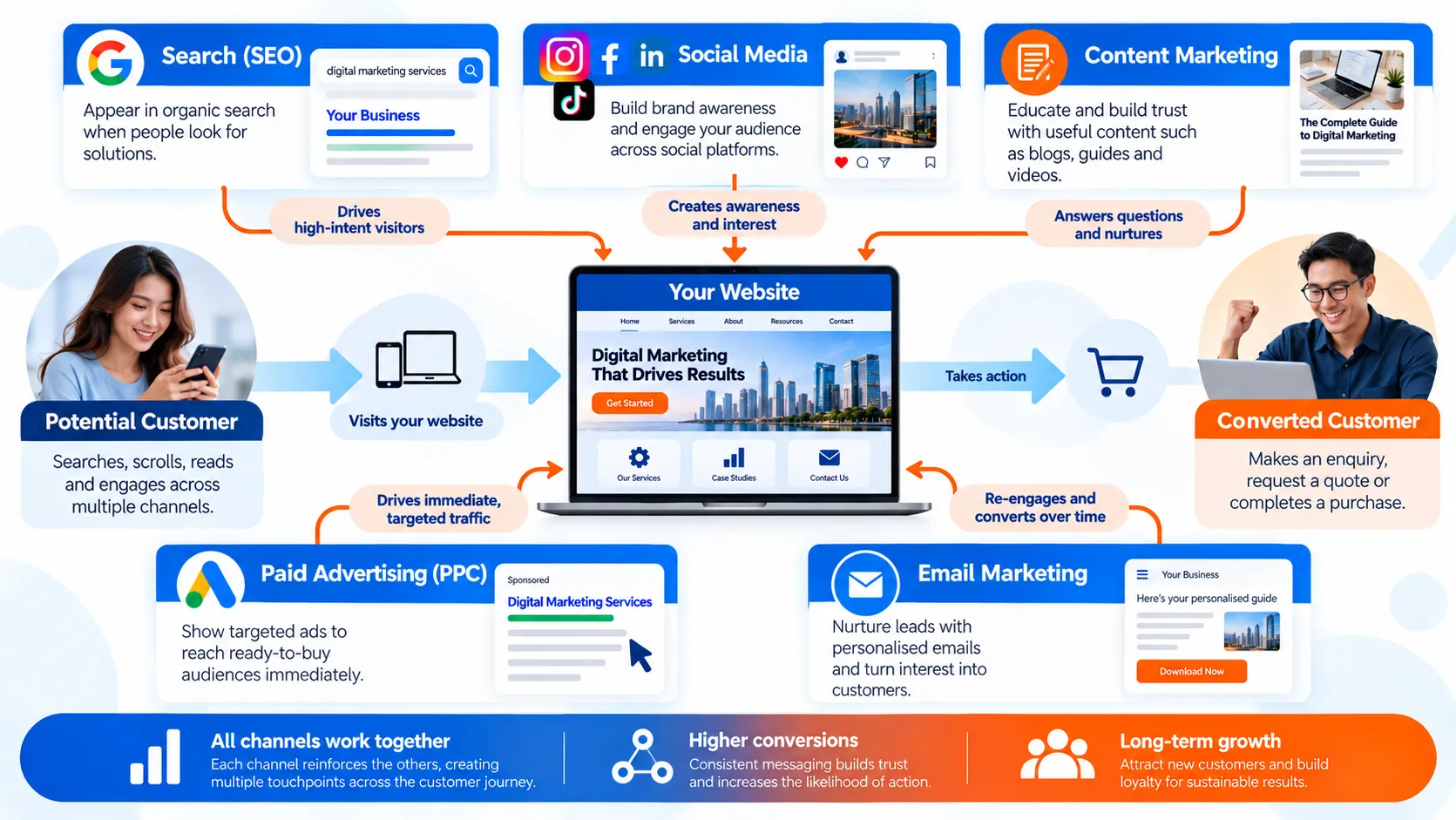
Most comprehensive digital marketing providers structure their work around six core pillars.
Search Engine Optimisation (SEO) focuses on improving your website’s ranking in organic search results. This includes technical site optimisation, keyword research, content creation aligned to search intent and building authority through backlinks. Unlike paid search, results typically take three to six months to compound, but they cost less per click once established. Results vary by competition and baseline visibility.
Pay-Per-Click (PPC) advertising, primarily through Google Ads and Bing, puts your ads directly in front of people actively searching for what you sell. You pay only when someone clicks. It delivers traffic immediately and is measurable to the penny, but costs rise quickly if your conversion rate is low.
Social media marketing covers strategy, content creation, community management and paid social campaigns on platforms like LinkedIn, Instagram, Facebook and TikTok. This discipline sits between brand awareness and direct conversion, building trust and audience loyalty that other channels can later monetise.
Content marketing involves creating written, video or interactive assets such as blog posts, whitepapers, case studies and guides that answer questions your audience is asking. It supports SEO, establishes you as an authority, and captures intent early in the customer journey, when people are researching rather than ready to buy.
Email marketing automation nurtures prospects through triggered sequences based on their behaviour. Prospects who downloaded a whitepaper receive a different email journey than those who visited a pricing page. Open rates and click-through rates are trackable, and the cost per contact is very low.
Marketing analytics and data services connect the other five disciplines. Without this layer, you cannot determine whether your SEO investment or social spend is actually driving revenue. Good agencies audit your analytics setup, establish conversion tracking and report on how different channels work together.
These six disciplines are distinct, each with its timeline, skillset and measurement approach. They also overlap significantly. An SEO-optimised blog post is shared on social media, driving traffic back to your site. A PPC campaign landing page reinforces messaging that your content pillar has already established. Email sequences nurture people who arrived through any of the other channels.
Why Integrated Services Often Outperform Single-Channel Approaches
A business that hires only an SEO agency gets better rankings but has no strategy for converting the traffic it receives. A business running only paid social builds an audience that vanishes when the budget stops. Integrated approaches work differently.
Agencies increasingly offer modular services, allowing you to combine disciplines rather than lock into a single channel. A prospect who sees your social media post, reads one of your blog articles a week later, then searches for your product by name and clicks your Google Ads result is far more likely to convert than someone who encounters only one touchpoint. They are also more likely to remember you. Each touchpoint reduces purchase friction.
Integrated services also eliminate costly gaps. A single-channel provider has no incentive to build a strategy that sends their audience elsewhere. An integrated team optimises for your revenue, not for channel-specific metrics. They ask whether SEO and content should drive qualified leads into an email sequence before you ever meet a sales representative. They ask whether your PPC landing pages match the promise your social ads make. They look for overlap and waste instead of separating work by channel.
For agencies, integration improves efficiency. Creative developed for a social campaign can seed a content pillar. Keyword research done for SEO informs email subject lines and social copy. Conversion data from one channel guides testing in another. This approach lowers their cost to serve you, which they usually pass through as better pricing.
The limitation of bundled services is real. They only work if the agency has depth in each discipline. A generalist who has one person working across five channels will underperform compared to specialists in each channel. The best model is a team of specialists in each channel, led by a strategist who coordinates across them.
The Difference Between Agency Services and In-House Tools
When you buy digital marketing services, you are not always buying human work. You are increasingly buying a mix of human expertise and software platforms that you could theoretically use yourself.
Many agencies resell tools. A social media agency might manage your Instagram using Meta Business Suite or Hootsuite, both tools you can buy directly. A PPC agency manages your Google Ads account using Google Ads Editor, which you can also access directly. In these cases, the agency’s value isn’t the software itself; it is the strategy, setup, account optimisation, and monitoring that require knowledge and time.
Other services are genuinely bespoke. You cannot buy custom content strategy, brand positioning workshops, competitive analysis and audience research as software. Neither can daily optimisation work: a human checks campaign performance each day, tests ad copy variations, and shifts budgets based on real data. These services command premium pricing because they require senior expertise.
The line blurs with managed services. An agency might offer managed SEO using a combination of their own work (content writing, link strategy) and third-party tools (rank tracking software, keyword research platforms). You could hire a freelancer for some work and buy the software separately. The question then becomes whether the bundled service is more cost-effective than the DIY route.
For most small businesses, the answer is yes. Buying individual tools requires you to set each one up correctly, integrate them, interpret the data and act on it. This work carries a hidden cost. A managed service flattens that overhead. You get a single point of contact, a holistic strategy and someone held accountable for results.
For larger organisations, the calculation is different. If you have an in-house marketing team, they may already own software licences. Buying an agency service then becomes a matter of adding specialist expertise for specific channels, for example, hiring a PPC agency to run Google Ads alongside your in-house content team. This hybrid model is increasingly common in mid-market and enterprise firms.
AI-assisted delivery has reshaped this landscape in 2026. Agencies now use AI writing tools, predictive analytics platforms and automation software to reduce the human effort required for routine work such as initial drafts, bidding optimisation and report generation. This lowers the per-unit cost of managed services but also raises the bar for what qualifies as senior expertise. Agencies that have not rebuilt their delivery model around AI increasingly compete on price rather than quality.
How Digital Marketing Services Differ Across Business Sizes
The digital marketing service you buy depends on your company size, revenue stage and in-house capability.
Start-Ups and SMEs: Where to Start Without Breaking the Budget
Early-stage businesses have limited budgets and often no in-house marketing infrastructure. Your priority is finding two high-impact channels, not six mediocre ones.
If your revenue model is transactional (e-commerce, SaaS with self-serve trials), prioritise PPC. You can test messaging, validate product-market fit and generate revenue quickly. Start with Google Shopping or search ads.
If your revenue model is relationship-driven (B2B services, enterprise SaaS, consulting), prioritise SEO and content marketing. These establish authority and attract inbound leads that sales can nurture. Although the payoff takes longer, the cost per lead is lower once established.
Most start-ups add email marketing automation once they can capture leads. This nurtures prospects at minimal cost.
Expect to spend SGD 2,700–5,400 per month for a focused, competent SME retainer. Verify current pricing with providers, as rates vary by market, scope and agency reputation.
Mid-Market Companies: Scaling Specialist Services Together
Mid-market firms typically have some in-house capability but insufficient scale to justify full internal teams across all channels.
The winning model is usually two to three specialist agencies: one for SEO and content, one for PPC, and one for social media (optional depending on your audience). Coordinate them through a fractional chief marketing officer or an internal marketing director who owns strategy and reporting.
This hybrid approach gives you deep expertise in each channel without the overhead of hiring full-time employees. Expect to spend SGD 13,500–40,500 per month across two to three agencies, depending on scope and location.
Enterprise-Level: Integrated Service Suites vs. Best-of-Breed Vendors
Enterprise buyers typically choose one of two paths.
Some consolidate with a single large agency or marketing platform that offers all six disciplines in-house. This simplifies governance and budgeting. Disadvantages include less specialisation per channel and potential conflicts of interest, as the agency has little incentive to recommend channels that compete with its own services.
Others assemble a best-of-breed stack: specialists in each channel plus a separate analytics or reporting layer. This requires more management but often delivers better channel performance.
Pricing at this level is typically SGD 67,500 or more per month and is often structured around dedicated team allocation rather than hourly rates. Request detailed SOWs (statements of work) that specify who works on your account, how many hours they dedicate, and what deliverables you receive each month.
How to Evaluate a Digital Marketing Service Provider
Audit Their Track Record Without Falling for Vanity Metrics
Ask for case studies tied to metrics that matter to your business. Avoid providers who lead with vanity metrics like impressions, reach or social media followers. These prove nothing about business impact.
Instead, ask for examples where they drove:
- Qualified lead volume (with conversion rate to customer)
- Revenue from digital channels (with attribution method)
- Customer acquisition cost trends (with timeline to impact)
- Return on ad spend in paid channels
For each case study, ask what the baseline was before they started, the timeline to results, and their fee. If they cannot answer these questions, they are not measuring what matters.
Red Flags in Proposal Language and Guarantees
Any vendor promising specific rankings should be questioned. Search results depend on algorithm factors beyond any single service provider’s control. Google and other search engines explicitly prohibit guaranteeing rankings.
Similarly, avoid providers who guarantee a specific ROI or revenue number. Digital marketing results depend on many factors outside the agency’s scope: your product quality, sales team capability, customer service and market conditions.

Watch for vague reporting language. Red flags include “we’ll provide monthly updates”, “metrics dashboard access”, or “quarterly business reviews” without specifying what metrics or how frequently you will see data. Ask for a sample report before signing.
Pressure to commit long-term before a discovery phase is another warning sign. A reputable provider will spend two to four weeks understanding your business, competitive landscape and existing systems before proposing a strategy. If they pitch a solution in the first call, they are selling a template, not a strategy.
The Right Questions to Ask About Process and Reporting
Before signing, confirm:
- How often will you review performance data (weekly, bi-weekly, monthly)?
- What are the three to five key performance indicators (KPIs) you will track? (These should match your business goals, not the agency’s preference.)
- Who is your day-to-day contact, and what is their guaranteed response time?
- How does the agency handle underperformance? What threshold triggers a strategy review?
- What happens if you want to leave the agency? What is the notice period, and what is the process for handing over accounts?
Checking Credentials: Certifications That Matter
Industry certifications do not guarantee quality, but they indicate baseline knowledge. In digital marketing, meaningful credentials include:
- Google Ads and Google Analytics certifications (freely available, roughly annual renewal)
- HubSpot Platform or Academy certifications (indicate familiarity with marketing automation)
- Relevant degree or bootcamp completion in digital marketing (not required but helpful)
Verify certifications directly with Google, HubSpot, or the training provider, rather than relying on the agency’s word. Also ask whether their team members hold current certifications or outdated ones.
Regulatory compliance matters in Singapore. Ensure your provider understands PDPC (Personal Data Protection Act) obligations around data handling and customer consent. They should document how they manage your customer data and report on it when you ask.
Common Pitfalls When Buying Digital Marketing Services
Scope creep without documented process: Agencies agree to a project scope but gradually add work outside of it. Prevent this by documenting what is included in your retainer, what costs extra, and what requires separate approval.
Poor attribution and reporting: The agency reports on channel-specific metrics (SEO traffic, PPC conversions) but cannot show how different channels work together or which one actually drove the customer. Ask how they attribute revenue and whether they use tools like Google Analytics 4 or platform-native attribution.
Misaligned success metrics: You want customers; the agency is optimising for clicks or rankings. Agree on KPIs in writing before work begins.
Underestimating setup and transition time: If you are switching providers, expect four to six weeks for knowledge transfer, data migration and account setup before new work gains momentum. Do not expect results in week one.
Insufficient communication during low-activity periods: Some agencies go silent between reporting cycles. Agree on the communication cadence upfront, including what happens in months when spending is lower, or results are slower.
Digital Marketing Services in the Era of AI and Automation
AI has restructured how agencies price and deliver work in 2026. Routine tasks now cost significantly less because AI reduces human effort. AI has partially or fully automated tasks like report automation, initial ad copy drafting and keyword research.
Strategic work commands higher fees. These activities require judgement, industry knowledge and creativity: audience segmentation, competitive analysis, content strategy, creative direction and optimisation based on unexpected data patterns.
Choose providers who are transparent about where they use AI and where they apply human expertise. A reputable agency will tell you their content writers use AI drafting tools, but a senior strategist edits and approves everything. They will explain that their bid optimisation is partly automated and partly human-reviewed.
Avoid providers who claim to be “fully AI-powered” or who have eliminated human involvement entirely. At every stage, digital marketing requires judgement calls that algorithms cannot reliably make.
How Digital Marketing Services Differ Across Business Sizes
The digital marketing service you buy depends on what your organisation can actually absorb, afford and operate. A start-up needs fast wins on a limited budget. A mid-market firm can afford specialists across multiple channels but lacks internal structures to manage five vendors. An enterprise can dictate service terms but often pays for integration work that smaller agencies never encounter. Budget, time-to-value and internal capability shift what “the right service” means at each stage.
Start-Ups and SMEs: Where to Start Without Breaking the Budget
Early-stage businesses cannot afford to hire an in-house team of six marketers. Most start-ups operate on SGD 2,700 to SGD 13,500 per month for all marketing activity, which rules out a full-service agency retainer. Instead, SMEs typically buy à la carte: one specialist for SEO, a fractional social media operator, or a freelance copywriter who doubles as a content strategist.
The most cost-efficient move for a start-up is often a single high-leverage channel. If you sell B2B software, SEO usually pays dividends faster than Instagram. If you run an e-commerce store, paid search (PPC) and email sequencing often return cash within weeks. One focused service, measured obsessively, beats spreading your budget across five channels where no single effort reaches critical mass.
Start-ups also benefit from platform-native tooling: HubSpot’s free tier for email and basic customer relationship management, Digimetrics.ai for do-it-yourself SEO audits, and Buffer for social scheduling. These tools replace agency fees for work that does not yet require a strategist. Once you have traction and predictable revenue, typically after 18 to 24 months, you can graduate to fractional agency support or hire a part-time in-house marketer.

Key decision point for SMEs: Buy one or two services that address your clearest bottleneck, not your preferred channel. Avoid the temptation to hire a “full-service” agency that spreads your budget too thin.
Mid-Market Companies: Scaling Specialist Services Together
Mid-market organisations typically spend SGD 40,500 to SGD 202,500 on marketing annually and have at least one full-time in-house marketer or marketing manager. This is the stage where you move from “one person doing everything” to “one person coordinating specialists.” You have enough budget to hire agencies across two to four channels at once and sufficient complexity to justify it.
A mid-market software company might retain a specialist PPC agency (SGD 4,050 per month), a content and SEO partner (SGD 6,750 per month), and a social media manager (SGD 2,700 per month). Each vendor brings depth to their discipline. Each is responsible for one specific outcome. Your in-house marketer acts as an integration layer, ensuring campaigns align, reporting rolls up monthly, and no vendor works in isolation.
At this scale, the hidden cost is coordination. Three vendors mean three separate reporting dashboards, three sets of credentials to manage, three invoice cycles, and quarterly business reviews with each. Many mid-market teams hire a fractional “marketing operations” resource, often a consultant, just to prevent vendor management chaos.
At this stage, many mid-market firms ask: “Should we consolidate to a full-service agency instead?” The honest answer is no. Consolidate only if your complexity is genuinely low and you value simplicity over specialisation. Most mid-market companies find that a single agency’s PPC is solid, but their SEO is mediocre. Specialist vendors almost always outperform generalists, as long as you have the bandwidth to orchestrate them.
Key decision point for mid-market: Hire specialists for your two to three highest-impact channels, and assign someone internally to keep them aligned. Only consolidate to a “one-stop shop” agency if your in-house resources cannot support coordination work.
Enterprise-Level: Integrated Service Suites vs. Best-of-Breed Vendors
Enterprise organisations spend SGD 337,500 to SGD 2.7 million plus annually on digital marketing services. They have large in-house teams and mature processes. At this level, the conversation shifts: not “Can we afford specialist vendors?” but “can we integrate best-of-breed vendors without drowning in complexity?”
Many enterprises contract with one large integrated agency because it simplifies procurement, reduces contract negotiation, and provides a single commercial relationship. The agency’s internal structure mirrors the client’s: separate teams for search, social, media buying and content. One purchase order covers everything. One annual review meeting replaces twelve separate meetings.
However, integrated agencies typically charge a 15 to 25 per cent premium for the integration work: you pay for coordination services that do not directly generate value. An enterprise with sufficient internal programme management capacity often finds that hiring best-of-breed specialists and managing them in-house saves money and frequently delivers better results.
At enterprise scale, these factors decide the choice. First, your internal team’s appetite for vendor management. Second, your risk tolerance for contract complexity. Third, your need for seamless service handoffs. If your marketing technology stack is heavily integrated, for example with Salesforce-driven marketing automation, you may need a vendor who understands that ecosystem. If your campaigns are largely independent, best-of-breed specialists can work in parallel with minimal friction.
Enterprise also sees the rise of “lead orchestrator” contracts, where one firm, often a consultancy or management-services partner, is hired to recruit and manage three to five specialist vendors on your behalf. This shifts vendor management risk away from your in-house team. Costs typically range from SGD 20,250 to SGD 40,500 per month depending on scope.
Key decision point for enterprise: If your in-house team can manage five vendors without burnout, and your technology stack allows independent tooling, specialist agencies outperform a single integrated vendor. If coordination overhead is already high, consolidate to one large partner or hire a vendor-management firm.
| Scale | Typical Spend | Service Model | Internal Team Size | Coordination Complexity |
|---|---|---|---|---|
| Start-Up or SME | SGD 2,700–SGD 13,500 per month | One to two freelancers or à la carte services | Zero to one person | Low; one person manages everything |
| Mid-Market | SGD 40,500–SGD 202,500 per year | Two to four specialist agencies | One to three people | Medium; requires internal coordination |
| Enterprise | SGD 337,500–SGD 2.7M+ per year | Best-of-breed specialists or integrated partner | Five to 15 people | High; may require vendor-management layer |
The Digital Marketing Service Stack: Which Disciplines Deliver ROI
Not all digital marketing services contribute equally to your bottom line. Understanding which disciplines solve which problems and which ones compound returns when working together is the difference between a functioning marketing operation and one that wastes money across disconnected channels.
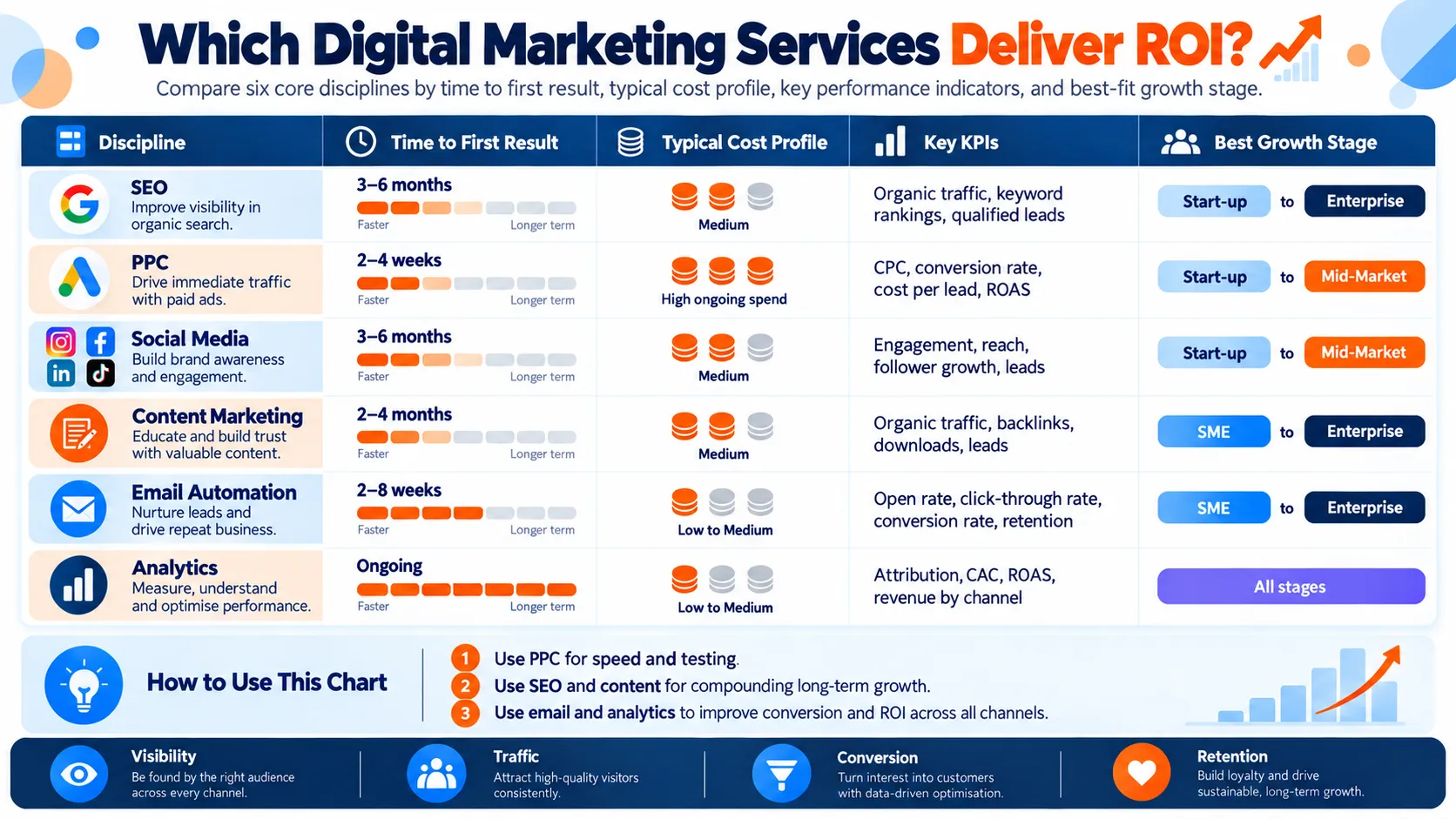
Digital marketing services address one of four outcomes: visibility (being found), traffic (attracting qualified visitors), conversion (turning them into customers), and retention (keeping them). A well-assembled stack covers all four in proportion to your business model.
Search Engine Optimisation (SEO) Services: Long-Term Organic Visibility
SEO services earn their keep through volume and persistence, not speed. A competent SEO team restructures your website architecture. They build topical authority through content. They acquire high-quality backlinks and optimise pages for search intent. The payoff compounds: organic traffic typically grows for 6-12 months before flattening, then remains stable with ongoing maintenance.
Where SEO excels: low cost-per-acquisition over time, traffic that does not stop when you stop paying, and credibility. Organic results rank higher in user trust than paid ads. Where it fails: you need 6 or more months before meaningful return on investment, and results depend heavily on your industry’s competitive landscape. A software-as-a-service company might rank for high-intent keywords in 4-5 months; a local tradesperson might see traction in 8 weeks.
Ask any SEO provider promising first-page rankings in weeks. Search results depend on algorithm factors beyond any single service provider’s control, and promises of specific rankings are unreliable.
Expected investment: retainer-based, typically SGD 2,000-8,000 per month for small to medium enterprises, scaling to SGD 8,000-35,000 for larger enterprises or highly competitive sectors. One-off audits typically cost SGD 3,000-12,000. (Note: rates vary by provider and market; verify current pricing with local Singapore agencies.)
Pay-Per-Click Advertising (PPC): Immediate, Measurable Traffic
PPC (Google Ads, Microsoft Ads, and LinkedIn advertising) delivers traffic on day one. You bid on keywords or audience segments, and your ads appear when someone searches or browses. You pay only when they click.
The advantage is clear: attribution is granular and immediate. You know exactly how much a customer acquisition costs. You can test offers, landing pages and copy at speed. The disadvantage: costs can escalate rapidly in competitive industries, and the moment you stop paying, traffic stops.
PPC works best for:
- High-intent keywords where someone is actively searching to buy.
- Time-sensitive promotions or campaigns.
- Testing whether a market will buy before investing in organic SEO.
- Immediate lead generation for business-to-business services.
PPC often underperforms when keyword competition is extreme. Financial services, insurance and luxury goods often cost SGD 30 or more per click. PPC also struggles when your conversion rate is too low to sustain the spend. A business acquiring customers at SGD 8 each cannot afford a SGD 20-per-click market.
Expected investment: highly variable, and budget flexibility is an asset. A typical retainer for PPC management is SGD 800-3,000 per month in management fees, plus ad spend, which you control. Mature accounts often run paid media budgets of SGD 5,000-75,000 or more monthly, depending on industry and scale.
Social Media Marketing: Building Communities and Audience Trust
Social media services typically cover account management, content creation, community engagement and paid social advertising. The goal is twofold: build an audience that trusts your brand and use that audience for both organic reach and retargeted paid campaigns.
Social media marketing relies on volume. A single post rarely drives meaningful return on investment; consistency and relationship-building do. Expect 3-6 months before you see measurable engagement growth and 6-12 months before followers convert into customers at a material rate.
Where social media wins: brand awareness, customer service responsiveness, audience research about what your customers care about, and cost-effective retargeting of website visitors. Paid social campaigns often deliver lower cost-per-click than search, particularly for direct-to-consumer businesses or if you have a specific audience demographic.
Where it underperforms: if your product isn’t inherently shareable, such as complex B2B software, or if your audience doesn’t use that platform. Business-to-business companies often see better returns on LinkedIn than Instagram; direct-to-consumer retailers see the reverse.
Expected investment: in-house management plus freelance creators, SGD 2,500-4,500 per month. Full-service agency management costs SGD 4,000-15,000 per month, plus media spend for paid campaigns, typically SGD 1,500-7,500 monthly for small to medium enterprises.
Content Marketing: Establishing Authority and Capturing Intent
Content marketing creates assets such as blog posts, guides, whitepapers and videos that rank in search, attract inbound links and educate prospects before they become leads.
The mechanism is indirect but powerful. A well-researched article on your industry’s most common problem captures search traffic. It positions you as knowledgeable and generates inbound leads without active selling. Over 12-18 months, a library of 50-100 content pieces builds compounding organic traffic.
Content marketing serves double duty. It feeds your SEO strategy, creating new entry points in search results. It also supports your sales team by ensuring prospects arrive already informed about your offering. This is particularly effective in business-to-business, where sales cycles are long, and buyers want evidence of expertise before engaging sales.
The friction is real: content marketing requires either skilled in-house writers or expensive freelance talent. Mediocre content damages credibility more than no content. Expect 2-3 months before the first piece gains meaningful traction in search.
Expected investment: SGD 3,000-8,000 per month for quality content creation and SEO optimisation. Many businesses outsource regular content production and strategy to agencies, paying SGD 5,500-23,000 monthly.
Email Marketing Automation: Converting Engaged Prospects
Email remains the highest-return channel for most businesses. An email sent to someone who has already engaged with your brand, such as a website visitor, webinar attendee or free-trial user, has an open rate of 20-40% and click-through rate of 2-5%, depending on your industry. Organic social media reach often falls below 1% by comparison.
Email marketing services automate sequences: welcome series for new subscribers, educational drip campaigns for prospects, cart-abandonment sequences for e-commerce, and re-engagement campaigns for inactive customers. You front-load the work by designing sequences, writing copy, and segmenting lists. Execution then runs automatically.
Email marketing compounds returns when paired with strong lead generation elsewhere. If your SEO or PPC delivers 100 new signups monthly, a well-crafted email sequence can convert 5-10% of them into customers without any additional spend.
Expected investment: platform fees such as Mailchimp, HubSpot or ActiveCampaign range from free to SGD 300 or more per month depending on list size and features. Outsourcing strategy and copywriting costs SGD 1,500-4,500 per month.
Marketing Analytics and Data Services: Proving What Actually Works
Analytics services connect all your channels, attribute revenue to specific campaigns and identify which services are earning their cost. Without this layer, you cannot tell whether your PPC spend delivers more value than your SEO investment or whether your social media audience is actually driving sales.
Analytics providers integrate data from your website, email platform, advertising accounts and customer relationship management system. They then produce dashboards showing traffic sources, conversion rates, cost-per-acquisition and lifetime customer value. This is outcome reporting, not vanity reporting: revenue per channel, return on ad spend and payback period matter; impressions and follower counts do not.
The strategic payoff is reallocation. Once you see which channels and campaigns drive the highest-value customers, you can shift the budget away from underperformers and reinvest in winners. Companies that do this systematically often outpace competitors over 12 months.
Expected investment: platform costs such as Google Analytics 4 (free), but premium platforms like Mixpanel or Amplitude run SGD 750-4,500 or more monthly. Analysis services cost SGD 1,500-7,500 monthly for regular reporting and strategy recommendations.
Table: ROI Timeline and Budget Summary by Discipline
| Discipline | Time to ROI | Monthly Retainer (SME) | Time Sensitivity | Best For |
|---|---|---|---|---|
| SEO | 6-12 months | SGD 2,000-8,000 | Low | Long-term organic traffic, competitive keywords |
| PPC | 2-4 weeks | SGD 800-3,000 (fees) plus ad spend | High | Immediate leads, seasonal campaigns |
| Social Media | 6-12 months | SGD 4,000-15,000 | Medium | Brand awareness, audience building, retargeting |
| Content Marketing | 2-3 months per piece | SGD 3,000-8,000 | Low | Authority, inbound links, sales-cycle support |
| Email Automation | 1-2 months | SGD 1,500-4,500 | Medium | Converting warm leads, retention |
| Analytics | Ongoing | SGD 750-4,500 | Medium | Budget allocation, ROI clarity |
The core insight: disciplines with longer return-on-investment timescales, such as SEO, content, and social media, are best started early and run continuously. Channels with fast payoff, such as PPC and email, scale best once you have warm audiences. The highest-performing stacks blend both types.
How to Evaluate a Digital Marketing Service Provider
Choosing a digital marketing partner is a significant decision. A poor fit costs time, budget and momentum. Yet many companies treat the evaluation process as a checkbox exercise: read the website, take a meeting, and compare proposals. This section provides a framework for identifying capable providers and recognising the warning signs that many prospects miss.
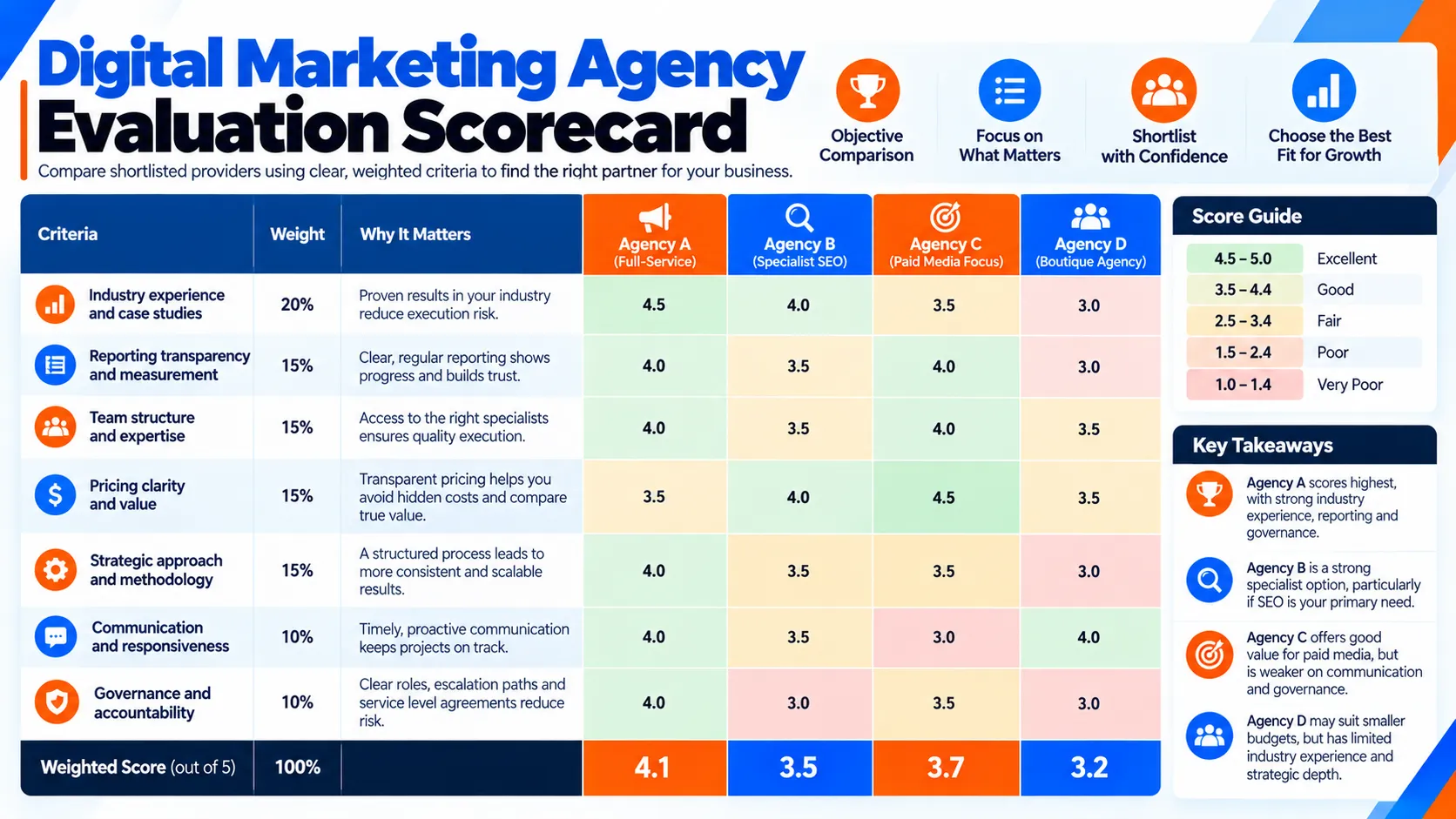
Audit Their Track Record Without Falling for Vanity Metrics
Portfolio reviews are essential, but the metrics agencies showcase are often misleading. A case study claiming a “300% traffic increase” may represent growth from 100 visits to 400. A client claiming “5x ROI” might have spent £10,000 to earn £50,000 on a high-margin product that your business doesn’t sell.
Start by asking for case studies in your sector and business model. If the agency works exclusively with B2C e-commerce and you run a B2B SaaS company, their approach will not transfer. Request the baseline metrics from before the engagement started, not just the final numbers. A 50% increase on a low base differs significantly from 15% growth on an already-performing channel.
Look for proof of attribution. The strongest agencies show the actual conversion path: which campaigns touched which customers and what growth they drove beyond what would have happened without intervention. If they only show “we posted this, and sales went up”, they cannot prove causation.
Ask specifically about client retention and why clients left. If an agency works with 50 clients and only 3 remain after 18 months, that signals a problem. Tenure matters because complex digital work compounds over time. Quick wins are easier to achieve than sustainable growth.
Request references from clients in similar revenue ranges and industries. Call them directly. Ask not just “Were they good?” but “Did they deliver on what they promised?” and “Do you feel you paid fairly for the outcome?”
Red Flags in Proposal Language and Guarantees
Certain phrases in service proposals reveal inexperience or overconfidence. Any guarantee of a specific ranking position is a red flag. Search algorithms shift constantly, and no ethical provider can promise a fixed outcome. Question any vendor promising specific rankings, since search results depend on algorithm factors beyond any single provider’s control.
Similarly, guaranteed ROI or traffic targets are warning signs. A provider claiming “we will increase your leads by 40%” before conducting a full audit is either selling false confidence or has performed this exact engagement many times with identical businesses (unlikely). Strong providers tie success to effort and market conditions, not fixed outcomes.
Watch for vague deliverables. Proposals should list exactly what work will be done. “20 pieces of original content” is actionable; “content creation services as needed” is not. If proposals use phrases like “strategy and optimisation” without specifying what they measure, they may lack a proper system.
Avoid providers who propose all spending through their tools or platforms. A reputable agency recommends the best-of-breed tools (Google Ads, Meta Ads, SEMrush, and HubSpot) and uses them for you. If they insist you pay a markup to use proprietary software, they are adding a margin between you and the actual work.
Red flag language includes phrases like “unlimited revisions” or “as many campaigns as you want.” These indicate either vague scoping or a model designed to exhaust your budget. Reputable providers define scope clearly and charge for additions beyond the initial agreement.
Check proposal length and specificity. A four-page proposal for a six-month engagement is usually a template. A 20-page proposal tailored to your business, with your challenges named, your competitors referenced and a detailed work plan, suggests real diagnostic thinking.
The Right Questions to Ask About Process and Reporting
Before signing, ask these questions in writing and request written answers. They reveal how structured the provider is.
1. How do you determine success metrics, and who decides?
A strong answer: “We audit your business model, current conversion funnel, and goals in week one. We then propose 3-5 KPIs that align with your revenue targets. You approve these in writing before we begin work.”
2. How often will we review performance, and what will the report show?
Look for weekly or biweekly check-ins for active campaigns; monthly strategy reviews; detailed dashboards showing conversion-stage metrics (cost per qualified lead, landing-page bounce rate, email open-to-click rate), not just vanity metrics like impressions and clicks.
3. What happens if a campaign underperforms?
A strong answer includes: “We pause underperforming ad segments within 7 days. We conduct a root-cause audit: is the audience wrong, the message wrong, or the landing page the problem? We test a refined version before deciding to scale or stop.”
4. Do you have a formal escalation process if we disagree on direction?
A structured provider says: “Yes. If we recommend a change and you disagree, we document both views and run a small test to gather data. We then decide based on results, not opinion.”

5. Who is my main point of contact, and what is your team structure?
Avoid: “Your account manager is your main contact” without clarity on expertise. Seek: “Your account manager owns the relationship; they escalate technical questions to our specialists. Here is the team: [names, roles, experience].”
6. How do you handle knowledge transfer?
A thorough answer: “We document all processes and decisions in a shared workspace you can access. We conduct monthly training sessions, so your team understands what we are doing. We provide a handover plan if you transition services later.”
7. What data will we own, and what can we take with us if we leave?
The correct answer is: “You own all creative assets, all conversion data and all audience insights.” If you leave, we export your campaigns, audience lists and historical performance in standard formats within 10 business days.”
Checking Credentials: Certifications That Matter
Certifications do not guarantee competence, but they signal investment in skill maintenance. The ones that carry weight are:
Google Partner and Google Ads Certification (both company-level and individual): Verifiable via the Google Partners directory. Companies must pass an audit and maintain performance standards.
HubSpot Partner Program (Platform, Solutions or Agency tier): Indicates depth in inbound marketing, CRM and automation. Request they show their current badge.
IAB UK certifications in digital marketing, display, search or video: Managed by the UK Internet Advertising Bureau. Look for practitioners holding individual certifications, not just the agency.
Google Analytics certification and Google Tag Manager certification: These are free but require genuine technical understanding. A team with multiple certified analytics practitioners is a positive sign.
HubSpot Academy or Google Skillshop badges: Free but valuable. If an agency has team members with 10 or more badges, it is prioritising continuous learning.
Verify any major credential on the issuing body’s website before it factors into your decision. Avoid relying on self-awarded badges or certifications from the agency’s own training programme.
Sector-specific credentials matter too. If you work in financial services, ask whether the provider holds certifications in financial advertising compliance. If you work in healthcare, ask about data protection or GDPR-specific training.
The strongest signal is a combination: a Google Partner agency with multiple employees holding Google Ads, Analytics and HubSpot certifications; references from similar companies; and a documented process. An agency with certifications but unclear process is riskier than a smaller team with no badges but a clear methodology and strong client retention.
Common Pitfalls When Buying Digital Marketing Services
Most failed agency relationships fail not because the agency was incompetent, but because the buyer and provider never agreed on what success meant, who owned which decisions, or what would happen when results stalled. The pitfalls below recur most often, and each is avoidable with clear contractual and conversational moves at the start.
Buying on price alone. The cheapest proposal is rarely the cheapest outcome. An agency charging £1,200 per month for “full SEO” is spreading a single strategist across dozens of accounts. Calculate cost per outcome (cost per qualified lead, cost per acquired customer), not cost per month. Compare providers on that basis instead.
Committing long-term before a discovery phase. Twelve-month lock-ins signed before anyone has audited your analytics, funnel or competitive position transfer all risk to you. Request a paid 30-to-60-day discovery or pilot with defined deliverables and a break clause. Providers confident in their process accept this; those who refuse are signalling uncertainty.
Accepting reports you cannot act on. A monthly PDF of impressions, reach, and follower counts is decoration, not management information. Insist on reports that tie spend to pipeline: cost per qualified lead, channel-level return on ad spend and landing-page conversion rate. If a KPI cannot be acted on, remove it from the dashboard.
Treating the agency as a supplier rather than a partner. Vendors who never access sales data, customer feedback or product roadmaps optimise for the only thing they can see: clicks. Share commercial context, and they can prioritise channels that generate revenue, not just traffic.
Skipping the internal readiness check. An agency can’t fix a website that takes 8 seconds to load, a sales team that ignores inbound leads, or a product page with no pricing. Before hiring, audit your conversion path. If there are issues, please address them first; otherwise, the retainer may cover a problem that the agency did not create.
No exit provisions. Agree in advance how accounts, data, creative assets and audience lists will transfer if the relationship ends, and in what format and timeframe. Agencies that make leaving difficult make it necessary to leave.
The connecting thread across all six pitfalls is to define the commercial outcome, decision rights, and exit strategy before the work begins. Everything else is execution.
Singapore Regulatory Context
When evaluating digital marketing providers in Singapore, consider the regulatory landscape that shapes service delivery and data handling.
Personal Data Protection Act (PDPA): All digital marketing activities involving customer data must comply with PDPA requirements. Your provider should demonstrate processes for consent management, data minimisation and subject access requests. Ask whether they have documented PDPA policies and conduct regular audits.
Consumer Protection (Fair Trading) Act: Digital marketing claims must be accurate and not misleading. If your provider makes claims about results, conversion rates or ROI, ensure that they substantiate these claims. CASE (Consumers Association of Singapore) provides guidance on fair trading in digital services.
CCCS Competition Rules: The Competition and Consumer Commission of Singapore monitors anti-competitive practices. Avoid providers who lock you into exclusive tool arrangements or penalty clauses for early termination, as these may breach competition principles.
Data Localisation: Some Singapore businesses operate under data residency requirements. Confirm whether your provider stores campaign data, audience insights and analytics on Singapore servers or internationally, as the location may affect compliance obligations.
Reputable providers in Singapore openly discuss these requirements and show evidence of compliance. If a provider dismisses regulatory questions, that is a red flag.
Digital Marketing Services in the Era of AI and Automation
AI has changed what agencies charge for, not whether they are needed. The tasks that dominated junior agency time five years ago (keyword list building, first-draft ad copy, monthly report assembly, basic bid adjustments) are now largely automated or AI-assisted. This has compressed the price of those tasks and, at the same time, increased the value of work that still requires human judgement.
What became cheaper: routine content production at the first-draft stage, ad copy variations for testing, keyword clustering and research, reporting assembly, and basic bid management. Agencies that spent most of a retainer on these activities now need to justify their fees differently. Many have restructured around senior strategists supported by tooling rather than teams of junior staff.
What became more valuable: audience and market research, positioning and messaging strategy, creative direction, first-party data strategy, measurement and attribution design, and the ability to distinguish between usable AI output and plausible-sounding noise. Human expertise still determines whether a campaign succeeds in these areas.
What to ask a provider about AI in 2026: How do you use AI in delivery, and how do you disclose it? Where does human review sit in the workflow? What happens to your data when it passes through their tooling? How has their pricing changed as a result? A provider who cannot answer these questions concretely either isn’t using AI (and is therefore overcharging for manual work) or is using it without governance (and exposing your brand to risk).
The practical implication for buyers is a shift in how to read a proposal. A line item for “content creation” no longer tells you whether you are paying for a strategist’s judgement or a prompt and a spellcheck. Scoped deliverables should now specify the level of human involvement: who briefs, who reviews, who signs off. That question is the single most useful filter for separating 2026-era agencies from those still pricing 2019 work.
One caution against over-rotation: AI outputs are fast and cheap, but search engines and audiences both penalise generic, unedited content. Agencies producing durable results in 2026 combine AI efficiency with human oversight. Ask directly how much content your contract receives human review before publication. That answer reveals whether you are buying automation, strategic work, or something in between.
Frequently Asked Questions
What does digital marketing cost?
Pricing depends on scope, geography and provider reputation. A full-service SME retainer in Singapore typically ranges from SGD 2,700 to SGD 5,400 per month. Mid-market specialist services range from SGD 13,500 to SGD 40,500 per month across two to three agencies. Enterprise integrated services start at SGD 67,500 per month. Request quotes from three to five providers and compare their deliverables, not just their fees. Be wary of prices significantly below or above the market range, as they often indicate either low quality or unnecessary overhead.
Can an agency guarantee my rankings in Google search results?
No. Google’s algorithm depends on hundreds of factors, many of which are outside any service provider’s control. In fact, Google explicitly prohibits agencies from guaranteeing specific rankings. If an agency promises this, it’s either misrepresenting its capabilities or using outdated tactics that risk your site’s visibility. Instead, ask what improvements they have achieved for similar clients and expect a realistic timeline of three to six months for significant results to compound.
What is the difference between SEO and PPC?
SEO targets organic search results and takes months to compound but costs less per click once established. PPC puts your ads directly in front of active searchers and delivers traffic immediately, but costs rise quickly if your conversion rate is low. Most businesses benefit from a mix: PPC for rapid validation and short-term revenue, and SEO for sustainable, long-term traffic.
How do I know if an agency is actually good at what they claim?
Ask for case studies tied to metrics that matter to your business. Request names of clients in your industry who can serve as references. Look for specifics: not “we increased traffic” but “we increased qualified leads by 35 per cent in six months, which led to 12 new customers at a cost of SGD 500 per customer”. Check their team’s certifications and how often they publish original research or insights in industry publications. Watch whether they ask detailed questions about your business before pitching solutions.
What happens if the agency underperforms?
Agree on performance thresholds and review cadence before signing. Typical arrangements include a 30-, 60-, or 90-day performance window, after which either party can request a strategy review or exit. Document what underperformance looks like: specific KPI targets, timeline and the process for addressing it. If they miss targets repeatedly and cannot explain why, you have grounds to look for a new partner.
Is it better to hire one full-service agency or multiple specialists?
It depends on your size and in-house capability. Start-ups and SMEs usually benefit from a single competent agency focused on one or two high-impact channels. Mid-market firms typically do better with two to three specialist agencies coordinated by an internal marketing lead. Large enterprises often assemble best-of-breed specialists for each channel. Ask each potential partner how they would structure your engagement and why.
How long should I wait before seeing results?
Timeline varies by discipline. PPC delivers traffic in days to weeks. Content and SEO take three to six months to show material results. Email automation shows engagement within weeks, but conversion benefits compound over months. Agree on channel-specific timelines and realistic expectations before signing. Be sceptical of anyone who promises faster results than industry norms.
What should I ask about in a discovery call?
Ask about their process for understanding your business: How do they research your competitors? How do they audit your existing systems and data? Do they look at your sales process and customer journey? A reputable provider will spend two to four weeks in discovery before proposing a strategy. If they pitch a solution on the first call, they are not tailoring it to your situation.
What does “attribution” mean, and why does it matter?
Attribution is the process of determining which marketing touchpoint deserves credit for a customer conversion. Someone might see a social media ad, read a blog post, then click a Google ad before buying. Attribution asks which channel should get the credit. This matters because it shows which channels are actually driving revenue and which are just visible. Without good attribution, you cannot effectively optimise your budget. Ask potential agencies how they attribute revenue and whether they use tools like Google Analytics 4.
Should I move to a new agency or try to improve the current relationship?
If underperformance stems from misaligned expectations or poor communication, a candid conversation and contract amendment can fix it. If the agency fundamentally lacks capability in your key channels or refuses to adopt your success metrics, it is time to move. Plan a transition carefully: agree on a handover period (usually four to six weeks), document all account access and data, and brief the new agency on what has been tried and what has not worked. Do not expect performance gains immediately after switching.