
| AI Summary
This guide explains 10 practical local SEO strategies to help Singapore businesses improve visibility in nearby searches. It covers Google Business Profile optimisation, customer reviews, NAP consistency, local citations, location-specific content, schema markup and common ranking issues. It also explains how distance, relevance and prominence influence local rankings, with practical steps for strengthening the signals businesses can control. |
If you run a local business, these local SEO tips can help you appear more prominently when nearby customers search for your products or services. Strong local visibility can lead to more calls, enquiries, bookings and store visits.

Unlike traditional SEO, which aims for national or global rankings, local SEO optimises your visibility for searches tied to geography. Examples include “plumber near me”, “best coffee shop in Tiong Bahru” or “dentist open now”. People typing these searches are ready to buy, visit or call. They convert faster than broad, national searches.
The challenge is that Google’s local ranking system works differently from general web ranking. Three factors shape results: distance from the searcher, relevance to what they are searching for and your online prominence. Your business address matters. Your review count matters. How you complete your profile matters.
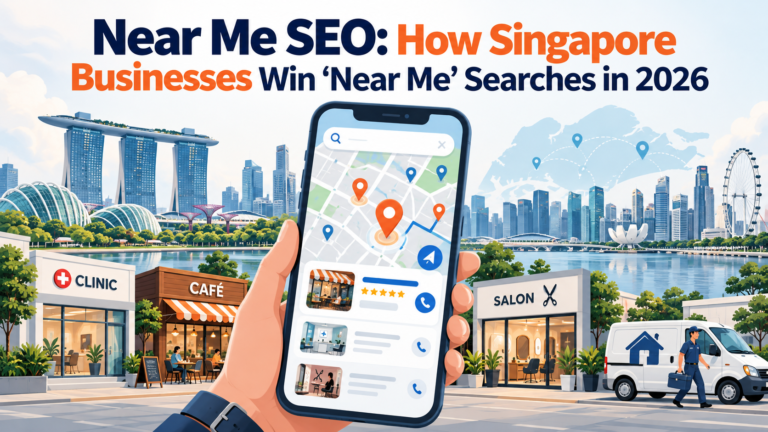
This guide covers ten concrete steps to claim your online presence, earn trust signals, build local authority and appear in the Google Local Pack, the map box that displays above traditional search results. Each strategy is actionable within a week or a month. None require expensive tools. Most cost only time.
Why Local SEO Matters for Small Businesses
Local search is no longer secondary. It is where your customers search first, and where they expect to find you.
People now search with location-specific intent by default. A decade ago, most searches were broad: “pizza” or “accountant”. Today, the default is immediate and location-focused: “pizza near me”, “accountant open now” or “best dentist in my area”. Mobile phones and voice assistants have made location-aware search the norm. Even on desktop, Google infers your location and prioritises local results.
For small businesses, this is an advantage. You do not need to compete nationally. You compete within a 5-10 km radius where geography works in your favour. Results vary by market saturation, industry type and your existing online presence, but a local business that ranks well in its area captures more qualified leads than one that does not. People searching are already nearby and ready to act.
How local search drives foot traffic and phone enquiries
Local search converts faster than any other channel. A person typing “plumber near me” is not browsing for information. They need a plumber now. The same applies to restaurants, salons, gyms and repair services.
Appearing in the top three map results significantly increases the likelihood of a shop visit or phone enquiry compared to ranking on page two. The impact is immediate and trackable. You can see it in Google Search Console location data, in foot traffic patterns from analytics tools, or even from your point-of-sale system. A dentist who improves their local ranking often reports an uptick in appointment bookings within weeks. A retail shop sees more walk-ins. A service business gets more inbound calls.
This is why local SEO delivers a faster return on investment than organic SEO for broader markets. Your audience is smaller but far more qualified.
Google’s local ranking algorithm: distance, relevance and prominence
Google ranks local results using three main signals it has disclosed publicly. Understanding these signals shapes every local SEO tactic that follows.
Distance is the geographical distance between the searcher and your business. If you search “coffee shop near me” whilst in Tampines, results closer to your location rank higher than excellent coffee shops across the island. You cannot overcome distance, but you can ensure you are found within your relevant service area.
Relevance measures how well your business matches what the searcher is looking for. A search for “vegan cafe” should return cafes that actually serve vegan food. Relevance comes from your business category, the keywords on your website and Google Business Profile, customer reviews that mention specific services, and schema markup that tells Google what you offer. A business that clearly communicates what it does ranks higher than one that is vague.
Prominence is your online reputation and authority in your area. It reflects the number and quality of reviews, citations (mentions of your business on other websites), backlinks from local sources and how well-known your business is. A salon with 200 reviews ranks higher than a new salon with 10 reviews. A business mentioned in local news or sponsored by the community ranks higher than one with no local authority.
These three signals interact. A less well-known business close to the searcher can outrank a more prominent business farther away. A highly relevant and prominent business can rank even if slightly further away. Your task in local SEO is to strengthen all three.
Distance is fixed, but relevance and prominence are within your control.
Claim and Optimise Your Google Business Profile
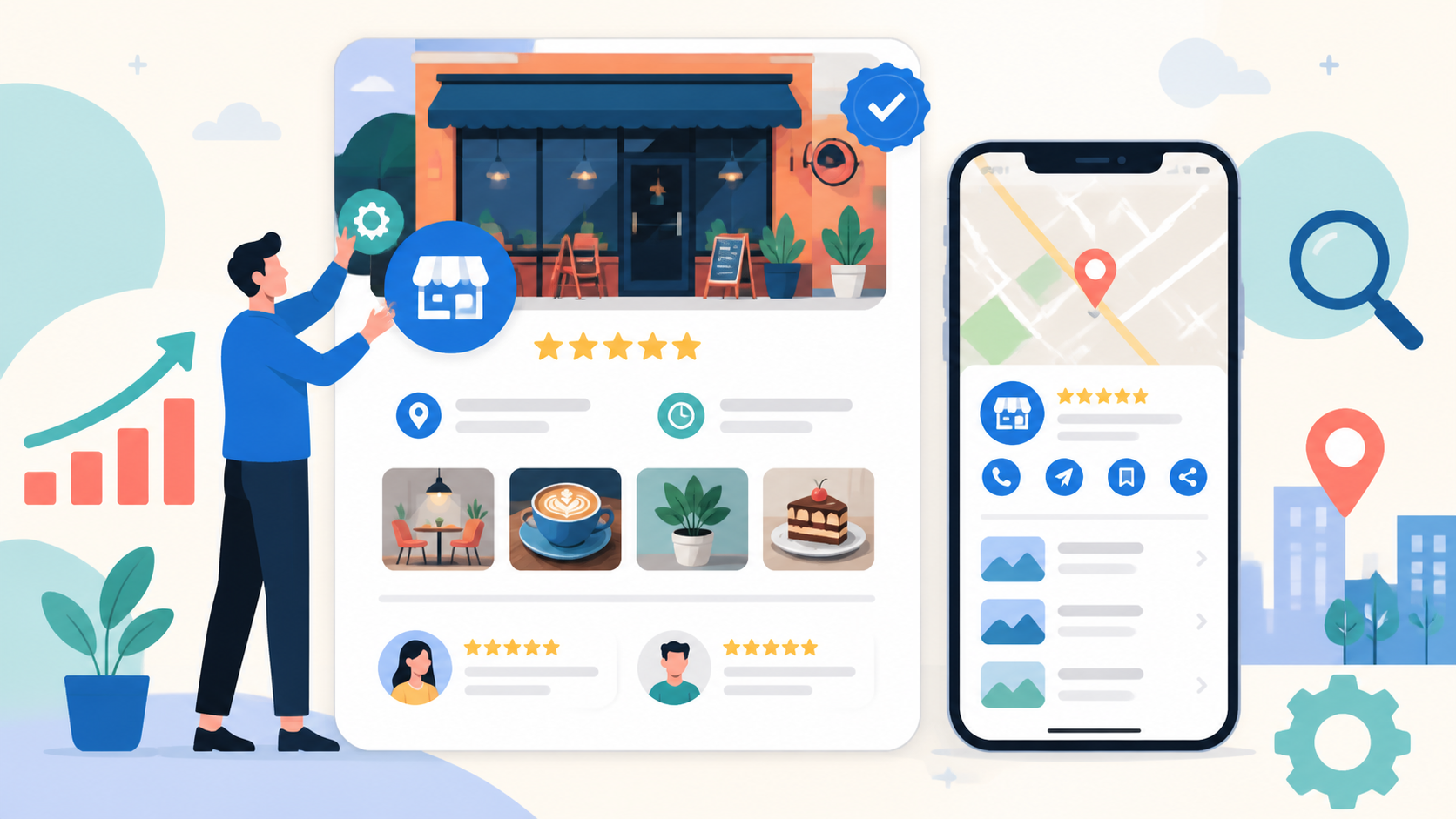
Optimising your Google Business Profile is one of the most important local SEO tips for improving visibility in nearby searches. Google uses information from your profile to display businesses in local search results and Google Maps. An incomplete or inaccurate profile can limit your visibility.
Setting up your profile
Go to the Google Business Profile home and sign in with your Google account. Click “Create or manage your business” and enter your business name exactly as it appears in legal documents and on your storefront. This consistency matters. If your profile says “Joe’s Plumbing” but your shop sign reads “Joe’s Plumbing Services”, Google may penalise you for Name, Address, Phone (NAP) inconsistency later.

Add your address next. If you operate from a physical location where customers visit, provide the full street address. If you are a service-area business like electricians, cleaners or consultants, you can hide your address from the public listing whilst telling Google where you are based. Google will send a postcard to verify ownership. Verification typically takes 7 to 10 business days, though timing may vary by region. Keep watch for it.
Once verified, add your phone number, website URL and business category. Choose the single category that best describes what you do. If you offer multiple services, pick the one that generates most of your revenue.
Completing all profile sections
Incomplete profiles rank lower. A completed profile with all key sections filled significantly improves your visibility.
Opening hours: Enter hours for every day of the week, including holidays and special closures. If you are closed Sundays, indicate that clearly.
Service areas: If you travel to customers, define the postcodes or neighbourhoods you cover. A plumber in Tampines serving Bedok, Changi and surrounding areas should list all of them. This helps Google match searches from those areas to your business.
Photos and videos: Upload at least 10 high-quality images showing your storefront, team, services in action and customer environments. Images with recognisable local landmarks convert better. Update these quarterly. Add videos of your team or a service walkthrough.
Write a business description in plain language, 120 to 160 words. Write for your customer, not search engines. “We provide emergency plumbing 24/7 in Tampines and serve domestic and commercial clients” works better than keyword stuffing.
Responding to customer reviews
Reviews directly affect trust and ranking. Respond to every review, positive or negative, within 48 hours. Keep responses brief, professional and under 250 words.
For positive reviews, thank the reviewer by name and mention a specific detail they noted. Example: “Thanks Sarah for mentioning how quickly our team arrived. That’s the standard we aim for every time.” This shows you are a real business and encourages others to leave reviews.
For negative reviews, do not get defensive. Acknowledge the complaint, apologise if warranted and invite the reviewer to resolve it offline. Example: “We are sorry to hear about your experience with the installation. We would like to make this right. Please contact us directly at [phone] so we can discuss this further.” Moving conversations offline stops public argument and often results in review updates or deletion.
Build reviews consistently. Many businesses aim for 5 to 10 reviews per month initially, then maintain 3 to 5 per month. Recency and depth matter more than quantity. One detailed, specific review outweighs five generic “Great service!” reviews in Google’s ranking model.
Flag any reviews that violate Google’s policies, such as spam, illegal content or irrelevant reviews about other businesses. Use the flag icon next to each review.
Build Citations and NAP Consistency Across the Web
A citation is a mention of your business name, address and phone number on another website. Citations are ranking signals. They tell Google your business is real, established and trusted.
Unlike backlinks, you do not need the citation to be a hyperlink. A simple text mention in a directory, review site or industry listing counts. The more consistent your Name, Address, Phone (NAP) information across citations, the more trustworthy Google considers your business.

Focus on directories with high authority in Singapore’s market:
| Directory | Coverage | Authority | Best For |
|---|---|---|---|
| Google Business Profile | National, mobile-first | Highest | All local businesses |
| Yelp Singapore | Restaurants, services | High | Hospitality, beauty, repairs |
| Carousell | Classifieds, local services | High | Retailers, service providers |
| Burpple | Food and dining | Medium-High | Restaurants, cafes |
| HungryGoWhere | Food and dining | Medium-High | Restaurants, cafes |
| Singapore Business Registry | Corporate registrations | High (B2B) | Professional services |
| Local industry directories | Niche-specific (e.g., medical, legal) | Variable | Regulated professions |
Citations in these directories signal authority to Google. Prioritise the top three, then expand to niche directories relevant to your industry.
Auditing your existing citations
Search your business name, address and phone number on Google. Note where your business already appears. Check if NAP details are consistent.
Common problems include:
- Outdated phone numbers from old listings
- Abbreviations in one place (“St” vs “Street”) and full versions in another
- Inconsistent business names (“Joe’s Plumbing” vs “Joseph’s Plumbing”)
- Wrong address formats (“123 Main St” vs “123 Main Street, Singapore 123456”)
Fix these immediately. One typo across five directories compounds your problem. Google sees conflicting information and ranks you lower as a result.
Then build new citations in directories where you are not listed. Prioritise high-authority, Singapore-focused directories over obscure ones.
Create Location-Specific Content That Ranks
One of the most effective local SEO tips is to create useful content for the neighbourhoods and service areas your business serves. Location-specific pages help search engines understand where you operate while giving potential customers information relevant to their area.

Writing neighbourhood guides and local landing pages
Create one landing page or blog post for each neighbourhood you serve. A plumber serving Tampines, Bedok and Changi should create separate pages for each area.
Each page should include:
- A clear heading: “Plumbing Services in Tampines” or “Emergency Plumber in Bedok”
- 200 to 300 words describing your service in that neighbourhood
- Local landmarks, transport links or neighbourhood details that show you know the area
- A call-to-action: phone number, contact form or appointment booking link
- Schema markup with your service area and location
These pages do two things. They help Google understand you serve specific areas. They also convert better because customers see themselves in the content.
Embedding local keywords naturally in service pages
Use location modifiers in your existing service pages. Instead of just “plumbing repair”, use “emergency plumbing repair in Orchard” or “24-hour plumber near Tanglin”.
Do not keyword-stuff. Write naturally. “We provide emergency plumbing services to homes and businesses across Orchard and surrounding areas” works. “Plumbing Orchard, plumbing Orchard, plumbing Orchard” does not.
Using schema markup to tell Google about your location
Schema markup is code that tells Google what information on your page means. LocalBusiness schema tells Google your business name, address, phone, hours, service area and reviews in a machine-readable format.
You do not need to write code yourself. Most website builders and SEO plugins have simple interfaces to add schema markup. Add at minimum:
- Business name
- Address (street, city, postal code)
- Phone number
- Opening hours
- Service areas (for service-based businesses)
Schema markup improves your chances of appearing in the Local Pack and enriched search results.
Common Local SEO Issues and How to Resolve Them
| Issue | Why It Happens | How To Avoid or Fix |
|---|---|---|
| Low visibility despite completing profile | Weak relevance or prominence signals. Not enough reviews or citations. | Build reviews consistently. Add citations in high-authority directories. Ensure clear, complete profile description and accurate categories. |
| Profile rank drops after update | Google recalculates rankings after you change information. Changes are temporary whilst Google re-indexes. | Wait 2 to 4 weeks for stability. Avoid frequent unnecessary changes to core information like address or phone. |
| Conflicting NAP information showing in results | Incomplete citations or old listings with outdated details. | Audit all existing citations. Update or claim old listings. Ensure consistency across all directories. |
| Reviews stop coming in | No active strategy to encourage reviews. Customers do not know how to leave feedback. | Set up simple, scannable QR codes pointing to your Google review link. Ask satisfied customers for reviews via email or text. |
| Competitor appearing above you despite being farther away | Competitor has more reviews, citations or backlinks. Their content is more relevant to the search intent. | Increase review velocity. Add more citations. Create location-specific content that matches what searchers want. Build local backlinks through partnerships or sponsorships. |
| Google Business Profile claims not showing up after submission | Ownership verification pending or failed. Email verification not completed. | Check spam folder for verification email. Confirm you verified the business with the correct account. Use postcard verification if email fails. |
Expectations and Timelines
Timelines vary by business type, current online presence and market competition. Initial improvements often become visible within 4 to 8 weeks. Sustainable, significant improvements typically take 3 to 6 months.
New businesses with no online presence need longer to build authority signals like reviews and citations. Established businesses with weak local SEO see faster gains. Competitive markets like hospitality move slower than niche services like specialised plumbing.
Track progress using Google Search Console location data, appointment bookings and foot traffic patterns, not just keyword rankings.
Important Note on Regulated Industries
Certain regulated industries, such as healthcare, finance and legal services, may have specific advertising and marketing compliance rules. Before implementing local SEO tactics, consult your industry regulator or legal adviser to ensure your approach aligns with local regulations in Singapore.
Build Citations and NAP Consistency Across the Web
A citation is any online mention of your business name, address and phone number, known as NAP. Citations appear in business directories, review platforms, social media profiles, industry listings and local news articles. They do not always include a link back to your website.
Google treats citations as evidence that your business exists and is legitimate. When the same NAP details appear consistently across multiple trusted sources, Google gains stronger confidence that your business is real and stable. This matters especially for newer businesses or those without many backlinks.
Citation consistency and citation sources rank among the top three local ranking factors, alongside review signals and Google Business Profile completeness. If your address appears as “123 High Street” in one directory and “123 High St” in another, Google sees conflicting information and loses confidence in your location data. That inconsistency can reduce your visibility in the Local Pack, the map box that displays search results.
Citations also increase your chances of being found across multiple platforms where your customers search. Someone looking for “plumber near me” might find you on Google Maps, then later see your listing on a review site. Each citation is another door into your business.
Start with the four key directories that carry the most weight with Google: Google Business Profile, Apple Maps, Bing Places for Business and Facebook Business Page.
Google Business Profile (essential): This is the hub of all local SEO. Complete it fully before moving elsewhere. It is where Google pulls data about your location for search results and maps.
Apple Maps: Claim and optimise your Apple Business Register entry. This gives you visibility to iPhone users and Siri voice searches.
Bing Places for Business: Bing’s local algorithm is separate from Google’s. Many B2B searchers and older users prefer Bing.
Facebook Business Page: It carries weight as a citation source and builds social proof. Include your NAP in the About section.
Beyond these, target industry-specific and Singapore-focused directories with strong authority. The table below shows high-value options:
| Directory | Best for | Authority level | Singapore coverage |
|---|---|---|---|
| Google Business Profile | All local businesses | Very high | Yes |
| Apple Maps | iPhone and voice search users | Very high | Yes |
| Bing Places | B2B and diverse demographics | High | Yes |
| Facebook Business | Community and social proof | High | Yes |
| Carousell | E-commerce, classifieds, services | High | Singapore-focused |
| HungryGoWhere | Food and beverage businesses | High | Singapore-focused |
| Burpple | Restaurants and food venues | High | Singapore-focused |
| Property Portal Singapore | Real estate and local services | High | Singapore-focused |
Concentrate on five to eight high-authority sources where your customers and search engines overlap. Low-quality directories can dilute your citation profile and confuse Google about your legitimacy.
Important note: Certain regulated industries such as healthcare, finance and legal services may have specific advertising and citation rules. Consult your regulator before implementing local SEO tactics to ensure compliance.
Auditing your existing citations
Start by running an audit of where you already appear online. This is faster than building citations from scratch and catches errors that damage your ranking.
Step 1: Search for yourself. Google your business name in quotes: “Your Business Name”. Look for unexpected directories, outdated listings or duplicate entries with different phone numbers. Spend 10 minutes scrolling through the first three pages of results.
Step 2: Use a citation-tracking tool. Tools like Whitespark, SEMrush Local Business and Moz Local scan hundreds of directories and show where you appear. Most offer a free trial. You will see which citations exist, which have errors and which are missing your NAP entirely.
Step 3: Create a NAP master document. Write down the exact version of your details you want everywhere:
- Business name (no abbreviations or variations)
- Full street address
- Phone number (decide: 6123 4567 or +65 6123 4567)
- Postal code
- Website URL (including https://)
This becomes your source of truth. Every citation must match exactly.
Step 4: Audit against your master. Check each citation you found. Note:
- Wrong address format (“High Street” vs “High St”)
- Old phone numbers you have since changed
- Missing postal code
- Typos in your business name
- Incorrect service areas
Step 5: Update or remove incorrect citations. For high-authority directories:
- Log in to your account and edit directly.
- If you cannot edit, contact directory support and request an update.
For directories where you have no account and cannot easily contact support:
- Flag them for update if they carry real authority.
- Ignore them if they are low-quality.
Step 6: Build a tracker. Keep a spreadsheet with three columns: Directory, Current Status, Last Updated. Check this quarterly. Staff changes and customer edits introduce errors over time.
Initial improvements often become visible within 4–8 weeks of fixing major errors. You will see improved Local Pack rankings, more consistent information in Google’s knowledge panel and fewer customer calls asking about incorrect address details. Results vary by market saturation, industry type and your existing online presence.
Create Location-Specific Content That Ranks
Generic service pages rank poorly in local search. Google rewards businesses that speak directly to the neighbourhoods they serve. Location-specific content tells Google your business understands the area and serves real customers there. It also gives potential customers a reason to click because they see themselves reflected in the content.
Writing neighbourhood guides and local landing pages
A neighbourhood guide is a page about a specific area you serve. It goes beyond “We serve Singapore” to answer what customers in Tampines, Tiong Bahru or Orchard actually need.
Start with what is unique about the area. What are the main commercial streets? What do residents care about? For a plumber serving multiple Singapore postcodes, a guide to “Plumbing services in Tampines” might cover common issues in HDB flats, water hardness in the area and local emergency call-out services. A fitness studio in Tiong Bahru could write about the neighbourhood’s heritage shophouses and the commute from nearby MRT stations, then explain how their classes fit that lifestyle.
Structure each neighbourhood page around a clear question: “How do I find a [service] in [place]?” Include:

- Why the neighbourhood matters (brief, specific details about the area)
- Common problems in that location (water pressure issues in older HDB blocks, drainage challenges in low-lying areas)
- Your specific solution for that neighbourhood
- A location-specific call-to-action (book a survey in Tampines, book a consultation in Marine Parade)
Keep the content between 600 and 900 words. Too short and Google sees it as thin content. Too long and it dilutes focus. Each neighbourhood page should feel distinct, not a copy-paste template with different place names inserted.
Embedding local keywords naturally in service pages
Your main service pages should mention the areas you serve, but naturally. Never list 50 locations in a single paragraph. Google’s algorithm now penalises doorway pages stuffed with location names.
Weave location references into genuine content instead. In a paragraph about your process, mention “We have completed over 200 kitchen renovations across East Singapore, from Bedok to Katong. Most of our clients live within 30 minutes of our Tampines studio.” That is natural, specific and locally relevant.
In your methodology section, reference local context when it matters. An accountancy firm might write: “Many SMEs in the Singapore tech sector face questions about R&D claims and tax incentives. We have helped 40+ software companies in the area claim back an average of SGD 25,000.”
Use your location name 1–2 times in the page’s introduction and once in the conclusion. Aim for a density of about 0.5 to 1% of total words. A 1,500-word page should mention your primary service area 7–15 times across all location references combined, not all crammed into one section.
Test this by reading the page aloud. If location mentions feel forced or repetitive, remove them. Google’s systems now detect natural language. Forcing keywords creates the opposite effect and damages your rankings.
Using schema markup to tell Google about your location
Schema markup is structured data that tells search engines exactly where you operate and what you offer in each area. Google uses it to rank you for local queries and to display your business information correctly in search results.
The two most important schemas are LocalBusiness and Service Area Specification.
LocalBusiness schema goes on your homepage or business contact page. It includes:
- Your business name (exactly as registered)
- Full address
- Phone number
- Service areas (not just your office postal code)
- Opening hours
- Photo of your business
- Aggregate review rating (if you have reviews)
Service Area Specification lets you tell Google which locations you actually serve. If you are a plumber in Tampines, you might serve Tampines, Pasir Ris and parts of Sengkang. You do not serve the West Coast. Service Area schema prevents you from appearing in irrelevant search results whilst strengthening your visibility in areas you actually work.
Implement both using JSON-LD format, which Google prefers. You can write it directly into your page’s HTML, or use a schema generator or Schema.org.
Here is a minimal example:
{
“@context”: “https://schema.org”,
“@type”: “LocalBusiness”,
“name”: “Tampines Dental”,
“address”: {
“@type”: “PostalAddress”,
“streetAddress”: “42 Tampines Avenue 5”,
“addressLocality”: “Singapore”,
“postalCode”: “529268”,
“addressCountry”: “SG”
},
“telephone”: “+65 6123 4567”,
“areaServed”: [“529268”, “528765”, “530000”]
}
After adding schema, test it using Google’s Rich Results Test. It will show you if the markup is valid and how Google displays your business in search results. Fix any errors before submitting your pages to Google Search Console.
Schema does not directly rank you, but it prevents crawl errors, increases your click-through rate by showing richer snippets and helps Google place you in the right local results.
Comparison Table: Citation Platforms and Directories
| Platform | Best for | Setup difficulty | Authority level | Singapore focus |
|---|---|---|---|---|
| Google Business Profile | All business types | Very easy | Very high | Yes |
| Apple Business Register | Mobile search, Siri | Easy | High | Yes |
| Bing Places for Business | B2B, alternative search | Easy | High | Yes |
| Carousell | Services, classifieds, retail | Easy | High | Singapore-native |
| HungryGoWhere | Food and beverage | Easy | High | Singapore-native |
| Burpple | Restaurants, cafes, bars | Easy | High | Singapore-native |
Troubleshooting Common Local SEO Issues
| Symptom | Likely Reason | How To Avoid Or Fix |
|---|---|---|
| Low Local Pack visibility despite good reviews | Incomplete or outdated Google Business Profile; missing schema markup | Complete all profile fields. Add LocalBusiness and Service Area schema. Update profile photo and hours monthly. |
| Citations show conflicting addresses or phone numbers | NAP inconsistency across directories; failed updates or typos | Create a NAP master document. Audit all citations quarterly. Update high-authority directories first; request removal from spam directories. |
| Ranking dropped after adding location pages | Thin content; copied templates with swapped location names; keyword stuffing | Ensure each location page is 600–900 words of unique, genuine content. Write naturally. Avoid listing 50 locations in one paragraph. |
| Customers cannot find you on Apple Maps or Bing | Accounts not claimed or optimised; low citation coverage outside Google | Claim Apple Business Register and Bing Places. Build citations on non-Google directories. Update opening hours and services on each platform. |
| Reviews appear on Google but not on your profile | Reviews posted on third-party sites, not Google Business Profile | Respond to all reviews on their original platform. Politely invite customers to review you directly on Google Business Profile. |
| Schema markup errors showing in Rich Results Test | Syntax errors in JSON-LD; incorrect field names or data types | Use Google’s Rich Results Test to validate. Copy-paste examples carefully. Check for missing commas or quotes. |
Frequently Asked Questions
How much does local SEO cost?
Costs vary widely depending on whether you manage citations yourself or hire an agency. Self-service audit and updates take 5–10 hours. An agency typically charges between SGD 800–3,000 per month for ongoing local SEO management. Start with a one-time audit to identify gaps, then decide whether to manage updates in-house or outsource.
What is the difference between a citation and a backlink?
A citation is a mention of your business name, address and phone number, with or without a link. A backlink is a hyperlink from another website to yours. Both matter in local SEO, but citations do not require a link to be valuable to Google.
How long does it take to see results from local SEO?
Timelines vary by business type and your current SEO state. Initial improvements often appear within 4–8 weeks after fixing major citation errors or completing your Google Business Profile. Significant ranking gains typically take 2–3 months. Results depend on competition level, citation authority and review velocity in your area.
Can I rank locally without a physical office address?
It is very difficult. Google’s local algorithm prioritises businesses with a real, verifiable address. Service-based businesses without a storefront can rank by using a virtual office address or their home address (if local laws allow it). Service Area schema then tells Google where you actually serve customers. Check Singapore regulations and your lease terms before using a home or virtual address.
Which is more important: Google Business Profile or citations?
Google Business Profile is most important. Complete it fully before spending time on other citations. Citations support your profile by providing consistent NAP signals across the web. Think of citations as votes of confidence that strengthen your profile’s credibility.
Should I respond to negative reviews?
Yes. Respond professionally and promptly, within 24–48 hours if possible. Acknowledge the issue, apologise if appropriate and offer to resolve it offline. Never argue or dismiss the customer. Public responses show future customers that you take feedback seriously. Keep responses brief, 2–3 sentences.
Are Singapore-specific directories better than international ones?
Yes, for local SEO in Singapore. Platforms like Carousell, HungryGoWhere and Burpple carry more weight with local customers and Google’s Singapore algorithm than international directories. However, do not ignore international platforms if your customers use them (e.g., TripAdvisor for tourism, LinkedIn for B2B services).
What is schema markup and do I need it?
Schema markup is structured data that tells Google what your content means. LocalBusiness schema tells Google your exact address, phone and service areas. It does not directly rank you, but it prevents errors, improves how your business displays in search results and increases click-through rates. It is not optional for serious local SEO.
How often should I update my Google Business Profile?
At minimum, quarterly. Update opening hours if they change seasonally, add new photos monthly if possible, and respond to all reviews within 48 hours. Active profiles rank higher than stale ones. Businesses that post updates monthly see better engagement.
What is a common misconception about local SEO?

Many business owners believe adding their business to a few directories will rank them locally. In reality, you need consistency across many trusted sources, a complete Google Business Profile, location-specific content, regular reviews and accurate schema markup. Local SEO is a system, not a single tactic.
What should I do if a citation has incorrect information I cannot edit?
Contact the directory’s support team by phone or email and request an update. Provide your NAP master document as proof of the correct information. If the directory is low-authority and does not respond, consider requesting removal instead. High-authority directories like Google and Apple should be prioritised for updates.