| AI Summary
PPC advertising helps Singapore businesses test whether paid traffic can turn into enquiries or sales. A first 30-day test works best when it focuses on one offer, one audience and one result the business can measure. Before launch, estimate what a lead or sale is worth, set a spending limit and test the page where customers arrive. After launch, compare the cost of qualified leads or sales with what the business can afford to pay. |
PPC advertising, or pay-per-click advertising, is a model in which a business pays when someone clicks its ad. For a first PPC campaign in Singapore, choose one offer and ad platform, set a spending limit, track enquiries or sales, and compare the cost per result with your target.
Key Takeaways
- A keyword tells the ad platform which searches you want to reach. A search terms report shows what people actually typed before seeing or clicking your ad.
- Google’s Quality Score can help you spot an ad or page that needs work. Google uses separate auction-time factors to decide if and where an ad can appear.
- A low cost per enquiry can hide a high cost per customer when few enquiries turn into sales.
- A 30-day test gives you a review date. Leads that are still waiting for a quote or decision may need more time to close.
A cleaning company in Singapore might pay for clicks from people searching for “move-out cleaning”, then find its inbox full of requests for weekly housekeeping. The clicks came through. The enquiries told a different story.
A first PPC campaign can help you spot that gap before you spend more. A limited test gives you time to see what people search for, how they respond to your offer and whether those enquiries lead to work you can take on.
How PPC Advertising Works
How the ad auction works
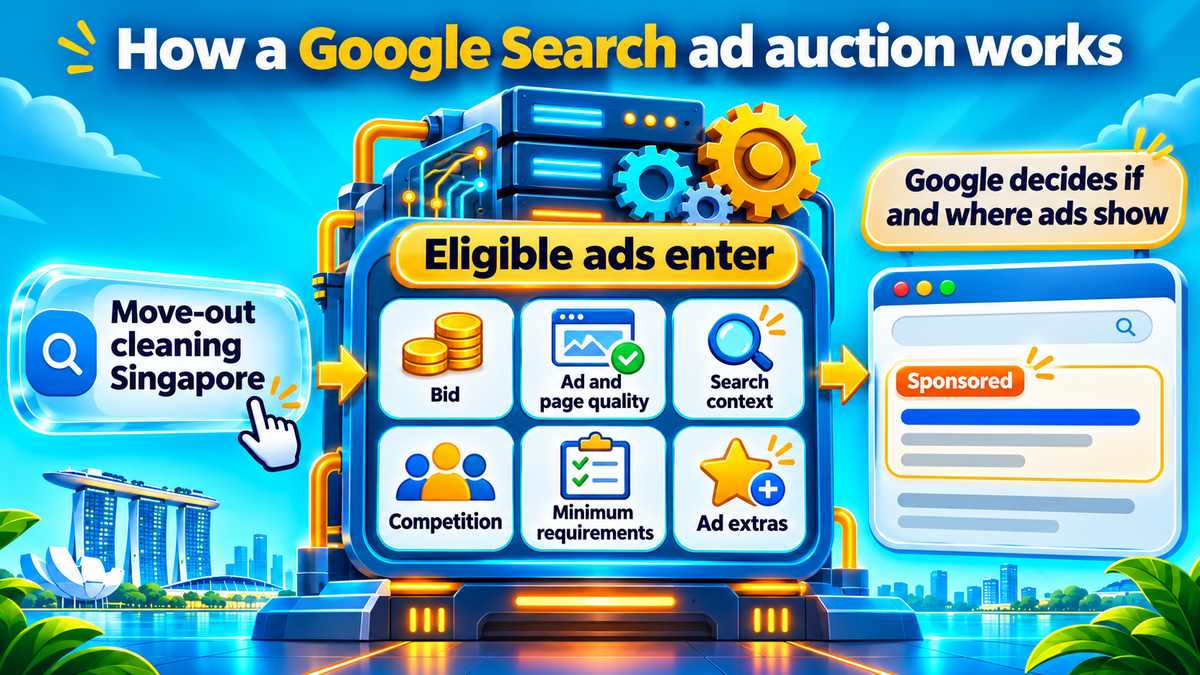
When someone searches on Google, eligible ads can enter an auction. Google uses Ad Rank to decide which ads can show and where they can appear. It considers the bid, the quality of the ad and landing page, the search context, the competition, minimum ranking requirements and the expected effect of extras such as links shown with the ad.
The bid is part of how the platform decides what it can pay in an auction. Your cost per click, or CPC, is what you actually pay for a click. If a campaign spends S120on40clicks,itsaverageCPCisS3. That average describes your campaign over a given period. A different set of searches or a change in competition can produce a different average.
The search “move-out cleaning Singapore” could bring several cleaning companies into the same auction. Your business can control which services it promotes, where it advertises and what the customer sees after clicking. Those decisions give you more to work with than a bid change alone.
What Quality Score tells you
Google reports Quality Score on a scale from 1 to 10 for eligible keywords with enough data. The score draws on three checks. Expected click-through rate estimates how likely people are to click.
Ad relevance looks at how closely the ad matches the search. Landing page experience assesses the page people reach after they click. The displayed score helps you diagnose problems. Google runs the auction using separate auction-time inputs.
Suppose your ad offers move-out cleaning, but the link opens a home page that leads with office cleaning. A visitor now has to hunt for the service they saw in the ad.
A dedicated move-out cleaning page can answer that visitor’s questions sooner. If the score shows a weak landing page experience, this is the kind of mismatch worth checking.
Which PPC Platform and Ad Type Should You Use?
The right starting point depends on how people buy. A customer with a blocked drain may search for a plumber right away. An office manager who sees an ad for corporate catering may save the vendor’s name for the next event. Each buyer is at a different stage, so each campaign needs a different goal.
| Business goal | Ad type to consider | Example |
| Reach people who already want a service | Google Search or Microsoft Search | A mover reaches people searching for office relocation quotes. |
| Show products with prices and images | Shopping ads | A homeware retailer promotes products from its catalogue. |
| Introduce a product people can see in use | Paid social, such as Meta ads | A kitchenware brand shows how a compact rack folds away. |
| Reach buyers by professional role | LinkedIn ads | A training provider promotes a workshop to HR managers. |
| Build awareness across websites or apps | Display ads | A retailer announces a new showroom before opening day. |
Search is a sensible first test when people already use terms you can name and those terms point to a service you sell. Retailers with product images, prices and stock details may prefer a catalogue-led test.
An early look at Search ads and Performance Max can help retailers decide how much control they want over the first test. Paid social and display campaigns can also use different billing models, so the campaign settings determine how you pay.
A small team can learn more by choosing one format and giving it a job it can measure. For a quote-based service, that could mean Search ads for one service area.
For a retailer, it could mean promoting one product group with enough stock to support the test. Each choice limits the number of offers, audiences and pages the team has to review.
Is Your Business Ready to Run PPC Ads?
A campaign can bring people to your site before your team is ready to serve them. These four checks help you decide whether the offer is ready for paid traffic.
| Readiness check | What should be in place | What can delay launch |
| Offer | One service or product with a defined next step | The ad promises work your team cannot book this month. |
| Landing page | A page that matches the ad and works on a phone | The quote button opens a form that fails on mobile. |
| Tracking | A test enquiry or order shows up where you expect it | A click on the form button counts even when submission fails. |
| Budget | A spending limit and a cost per lead or sale you can afford | The plan relies on every enquiry turning into a sale. |
A cleaning company might have ten appointment slots open this month but only two on weekends. If most customers need weekend handovers, the ad and page can explain which days are available. That detail can save the team time quoting jobs it cannot take. A shop running a catalogue test can do the same with stock, delivery areas and lead times.
Someone also needs to own the follow-up. A working form has limited value if requests go to a shared inbox that nobody checks. A test enquiry can confirm who receives it, how the team replies and where they record the outcome. For phone enquiries, the same check can reveal what happens during lunch, after closing or when the line is busy.
How to Build Your First PPC Campaign
Choose keywords that match the job
The phrases people use when they ask for a quote can give you a starting list. A cleaning company may hear “end-of-tenancy clean”, “move-out cleaning” or “cleaning before handover”. Those phrases tell you more about keyword intent than a broad term like “cleaning”, which could refer to jobs, supplies or weekly service.
One ad group can cover searches that point to the same service. A separate group makes sense when the customer expects a different page or offer. For example, move-out cleaning and office cleaning may need different details about timing, space and prices. Phrase or exact match can help keep a first Google Search test focused, though both can match searches with wording that differs from the keyword.
Google’s search terms report shows reported searches that triggered ads. If the company sees job searches or requests for cleaning products, negative keywords can help block those searches. The report may also show wording customers use that your team missed. A phrase like “handover cleaning quote” could deserve a place in the ad copy or a question on the landing page.
Write ads that make the next step easy
A Search ad has a small space to tell people what they can get and what to do next. Google’s responsive search ads allow up to 15 headlines of 30 characters each and four descriptions of 90 characters each. Google can show different combinations, so each headline and description should make sense on its own and alongside the others.
- Service headline. Move-Out Cleaning Singapore
- Offer headline. Cleaning Before Handover
- Action headline. Request a Cleaning Quote
- Description. Share your property size and handover date. Our team will confirm availability.
The example asks for two details the team needs to quote. A headline about a discount or same-day service should only appear when the business can honour it. If a price depends on the size of the property or the work required, the page should explain what changes the price.
Match the page to the ad
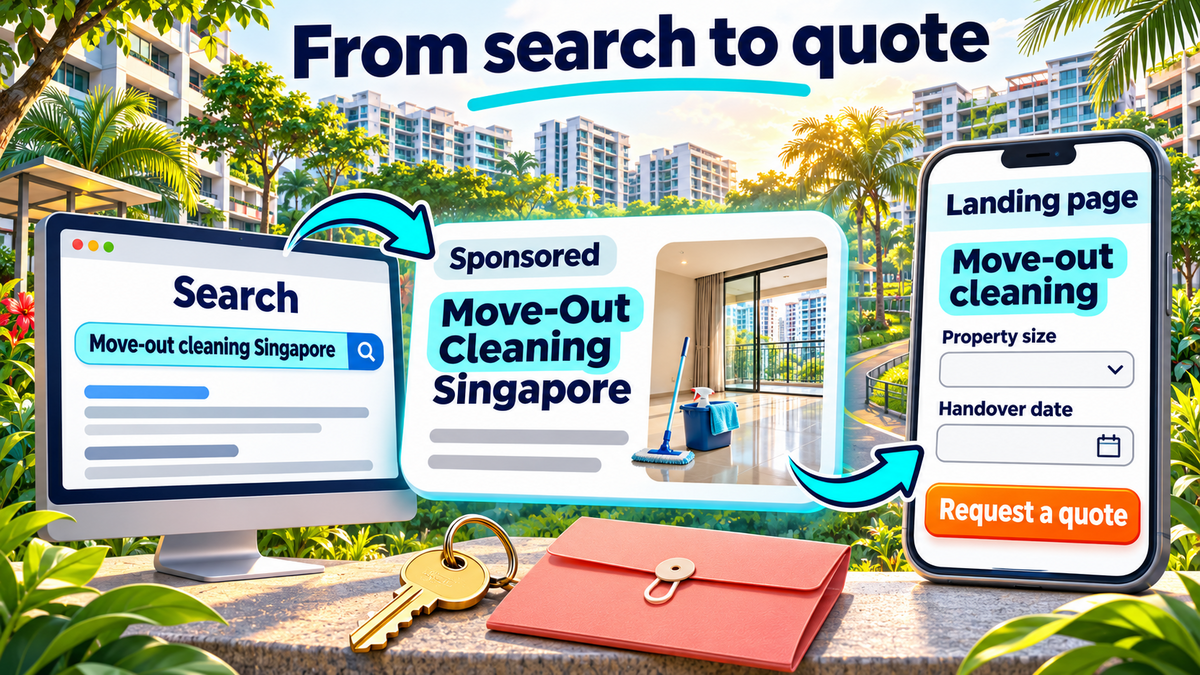
The first screen on a phone should tell visitors they reached the page they expected. A move-out cleaning page can open with the service name, explain what the clean covers and give visitors a way to request a quote. The form can ask for property size and handover date, then leave room for any details the team needs before calling back.
A phone test can reveal issues a desktop review misses. The quote button may sit under a banner. The form may open the wrong keyboard for a phone number or lose what someone typed after an error. A customer who submits the form should see a message that confirms receipt and explains what happens next.
Set a service area your team can cover
Location settings should reflect where you can deliver, visit or book work. A provider that serves customers across Singapore can start there. A team that only visits certain areas can narrow the campaign or use the ad and form to set expectations about coverage.
Google’s advanced location options distinguish between people likely to be in or regularly in an area and people who show interest in that area. A local emergency service may want to focus on people in its service area. A mover may also want to reach someone overseas who is planning a move to Singapore. The right choice depends on which of those customers your team can serve.
How Much Should You Budget for PPC Advertising?
Work backwards from a sale
Your budget starts with how much a sale leaves after the direct cost of doing the work. A campaign that brings in S$300 per job has different room to pay for leads if each job costs S$80 to deliver or S$250. When you sell through quotes, the next number is how often an enquiry becomes a paid job.
Consider a hypothetical cleaning company. It has S$120 left per completed job after paying the direct costs of doing the work. It can spend up to S$80 on ads to win that job and leave S$40 towards overhead and profit. If one in four qualified enquiries turns into a job, its target cost is S$20 per qualified enquiry. The target is S$80 multiplied by one in four.
A campaign can meet that target on paper and miss it in practice if the team counts every form submission as qualified. For this company, a qualified enquiry might mean a real customer who needs move-out cleaning in the service area on a date the team can take. The team can use its own past sales to estimate the close rate. With little sales history, a few scenarios in a Google Ads budget plan can show how the target changes if fewer leads close.
Estimate clicks and set a spending limit
Google’s Keyword Planner can forecast traffic for the terms and locations you select. Forecasts help you build a budget before launch. Your bids, targeting and results in the auction affect what happens once the campaign runs.
If you use S$3 as your planning cost per click, a S$600 ad budget would cover about 200 clicks at that rate. That example gives you a starting point for judging whether the test can produce enough enquiries to review. A very small budget spread across several services could leave each one with too few visits to learn much.
An average daily budget in Google Ads allows spending to vary by day. Google applies daily and monthly spending limits under its budget rules. A 30-day test may cross two calendar months, so check total spend over your chosen dates as well as the campaign’s daily setting.
How to Run and Review a 30-Day PPC Test
Set up conversion tracking before launch
A conversion is an action you want the campaign to produce. That might be a submitted quote form, a booking or a paid order. Google’s conversion measurement can record selected actions, including website activity and certain calls. A service business still needs a way to tell which enquiries qualify and which become paid jobs.
A test enquiry should appear in the ad account or reporting tool and reach the person who handles leads. A simple sales log can then record the enquiry date, service requested, whether the lead qualified and whether it turned into a sale. A click on a call button shows interest. Your team’s call record can tell you if the caller reached someone and what they needed.
Give each week a job
| When | What to review | What to do with the result |
| Days 1–7 | Spend, reported searches, form delivery and call handling | Fix tracking or page errors as soon as they appear. |
| Days 8–14 | Search terms and the reasons leads qualify or fall through | Exclude irrelevant searches and flag gaps in the offer or service area. |
| Days 15–21 | One change linked to the main problem | Record what changed and when so you can compare the periods. |
| Days 22–30 | Total spend, qualified leads and any completed sales | Decide whether to continue, fix a problem or pause. Note any leads still open. |
The schedule leaves room to act on obvious errors early. If a mobile form fails on day two, every extra day costs more clicks. If a campaign has a few slow days and the form works, changing the bid, page and offer together can make it harder to tell what affected the results.
A small team may also want to test automated bidding or ad text. The comparison is easier to read when the offer, page and conversion goal stay the same during that test. For a service business, a feature that brings in more forms can still leave sales flat if those forms come from people outside the service area. Lead quality belongs in the review alongside volume.
Decide whether to continue, fix or pause
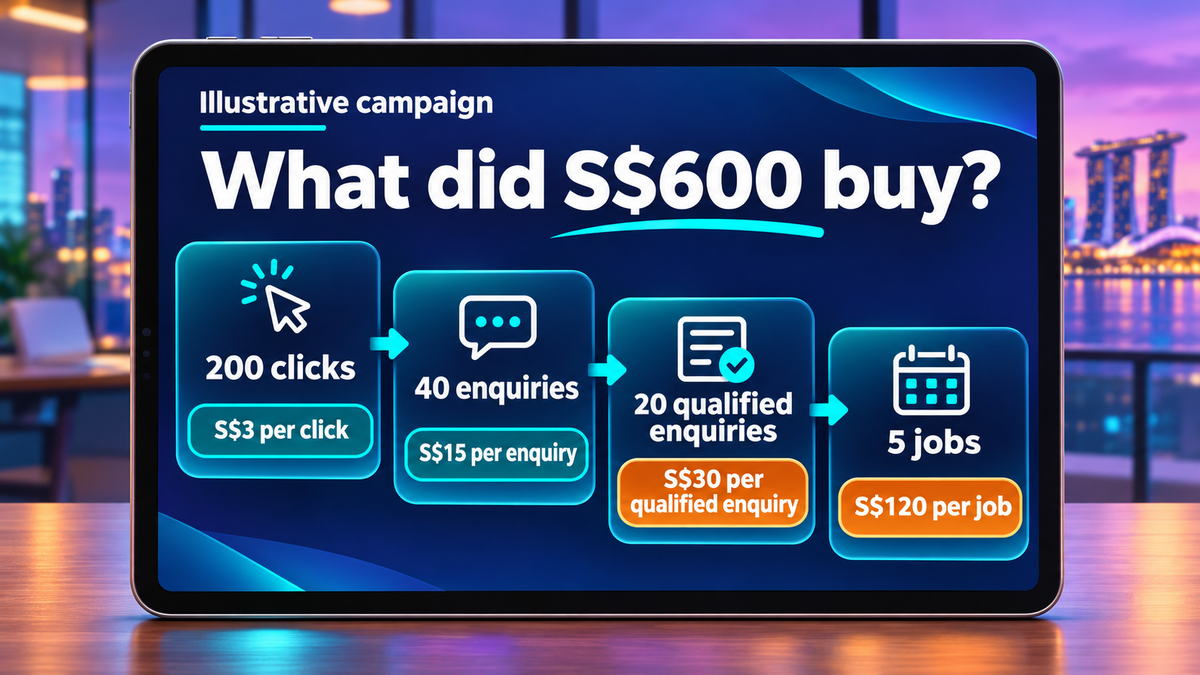
Suppose the cleaning campaign spends S$600 and records 200 clicks, 40 enquiries, 20 qualified enquiries and five jobs. The following figures illustrate how the same campaign can look different as you follow each click through to a sale.
| Measure | Calculation | Result |
| Average cost per click | S$600 ÷ 200 clicks | S$3 |
| Cost per enquiry | S$600 ÷ 40 enquiries | S$15 |
| Cost per qualified enquiry | S$600 ÷ 20 qualified enquiries | S$30 |
| Ad cost per job | S$600 ÷ 5 jobs | S$120 |
The S$15 enquiry cost looks affordable at first. Once the team checks who qualified, each qualified lead costs S$30, above the S$20 target. Each job also costs S$120 in ads, above the S$80 the company planned to spend to win it. The reason for the gap can tell the team which change to try next.
Your First PPC Test Starts With One Offer
Your first PPC advertising test can start with a service your team already quotes and delivers. The person who takes those calls can often tell you which details customers ask about, which jobs the team turns down and how long it takes to win an order. That information belongs in the ad, on the quote page and in the sales log you review at the end of the test.
If your team wants help preparing the campaign, MediaOne’s Google Ads management service can support campaign setup and review. A business weighing paid Search as part of a wider plan can discuss its offer, service area and sales goals through MediaOne’s search engine marketing services.
FAQs About PPC Advertising
How long does Google take to review a new ad?
Most ads complete review within one business day, according to Google. Some take longer. Google may review the ad again after you edit it, so a campaign tied to a sale or opening date needs time for review before launch. The status and next steps appear in the account during Google’s ad review process.
What is the difference between PPC and SEO?
PPC buys visits through paid ads. SEO helps pages appear in unpaid search results by improving the site and its content. A business can use both. For example, an ad can promote an offer with an end date, while a service page can answer questions customers search for all year. Google Ads and SEO can also be assessed over different time periods.
Can a business run PPC ads during certain hours?
Yes. Ad scheduling can limit when ads are eligible to show. A company that relies on phone calls might schedule ads around the hours someone can answer. A company that collects quote requests online may choose to keep ads eligible after hours if it can reply within the time it promises on the page.
Who should own the ad account if an agency manages it?
The business should have administrator access to its ad account and know who controls billing and tracking. The agency can have the access it needs to manage campaigns. A written agreement can spell out who can see campaign history, change billing details and manage conversion tracking when the relationship ends.