| AI Summary
A profitable Google Ads budget in Singapore depends on customer acquisition costs, expected cost per click (CPC) and conversion rates. Businesses should calculate their maximum affordable cost per acquisition (CPA), assess keyword forecasts and allocate spending to campaigns that generate qualified leads and sales. Google’s standard monthly spending limit is 30.4 times the average daily budget, although daily spending can fluctuate. Advertisers should also account for Singapore’s 9% GST, monitor campaign performance and improve targeting before increasing their budgets. Regular reviews help control advertising costs and support sustainable business growth. |
A practical Google Ads budget starts with two questions: what can your Singapore business afford to pay for a customer, and what will it take to attract enough qualified clicks? The right daily budget sits where those two answers meet. If search advertising costs exceed the profit a customer brings, a bigger budget will not solve the problem.

We recommend checking your business economics alongside current keyword forecasts before choosing a spending level. Then track what happens after the click, from a genuine enquiry to a completed sale. This lets you distinguish a campaign that needs more money from one that needs a stronger offer, better targeting or more accurate measurement.
Below, we explain Google’s daily spending rules, show Singapore-dollar calculations for different business models and outline how to split, monitor and adjust your Google Ads budget. All worked commercial figures are illustrative, not verified Singapore industry averages.
Key Takeaways
- Use both margin and auction estimates. Your maximum affordable customer acquisition cost determines whether the keyword forecast makes commercial sense. Neither figure is sufficient on its own.
- Calculate monthly media spend using 30.4. For most campaigns, Google’s standard monthly spending limit is 30.4 times the average daily budget. The usual daily limit is twice the daily budget.
- Keep leads and customers separate. A S40costperleadcanmeanS200 per customer if only one in five leads buys.
- Treat S20,S50 and S$150 per day as examples, not prescribed minimums. Campaign economics, likely click volume and available cash determine the appropriate starting point.
- Give every campaign a clear purpose. Brand protection, new-customer acquisition and remarketing do not necessarily deserve the same allocation or performance target.
- Include Singapore’s 9% Goods and Services Tax (GST) in cash planning. The amount you ultimately expense may differ if your business qualifies to reclaim input tax.
What a Google Ads Budget Actually Controls
A campaign budget tells Google how much you are prepared to spend, on average, within the advertising system. It does not guarantee impressions, clicks, leads or revenue. Those depend on search volume, eligibility, ad relevance, the landing page, bid strategy and the competition in each auction.
For example, one advertiser might pay S2perclickandreceive25visitsfromS50. Another might pay S$10 and receive five. Neither is automatically the better result. What matters is how much those visits cost to turn into profitable customers.
Daily budget versus monthly spending limit
A Google Ads daily budget is normally an average, not a strict daily cap. For most campaigns, Google can bill up to two times the average daily budget on a particular day. The standard monthly billing limit is 30.4 times the average daily budget, rather than 28, 30 or 31 times that amount according to the calendar month. Google’s spending limits guidance explains these rules and their exceptions.
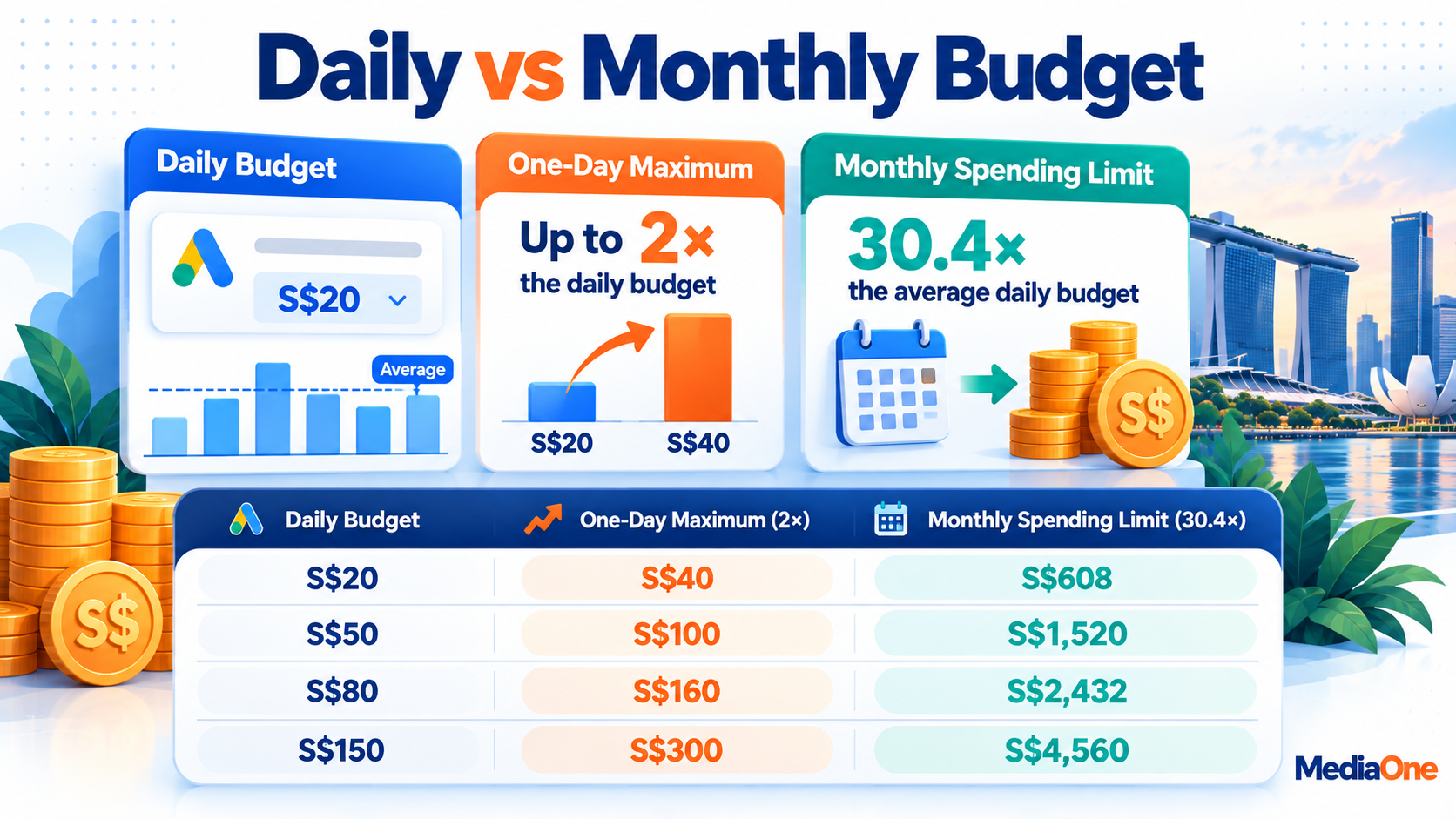

| Average daily budget | Usual maximum billed on one day | Standard monthly spending limit |
| S$20 | S$40 | S$608 |
| S$50 | S$100 | S$1,520 |
| S$80 | S$160 | S$2,432 |
| S$150 | S$300 | S$4,560 |
The table assumes an unchanged daily budget for a full month and the standard campaign payment model. A partial first month, budget changes or different payment models can alter the applicable limits. Spend may also finish below the limit when there is insufficient eligible traffic.
Consider a Singapore business with a daily allowance of SGD 50. Its usual monthly media-spend limit is SGD 1,520, even in a 31-day month. Google may spend SGD 90 on one day and SGD 25 on another while pacing the campaign across the month. The daily budget does not guarantee that the business will be charged exactly SGD 50 each day.
If you have a fixed monthly media allowance, divide it by 30.4 to calculate the corresponding average daily budget. For a monthly media spend of SGD 1,500, the result is approximately SGD 49.34 per day. Keep taxes, agency fees and applicable payment charges separate when calculating the total cost.
How budgets work with bidding strategies
A budget controls available spend; bidding decides which advertising opportunities to pursue. With Maximise Clicks, Google seeks click volume within the settings. With Maximise Conversions, it seeks conversions. Target cost per acquisition (Target CPA) and Target return on ad spend (Target ROAS) use performance goals you specify.
Google’s Smart Bidding documentation covers Maximise Conversions, Maximise Conversion Value, Target CPA and Target ROAS. From June 2026, Google began relabelling some Search strategies without changing their underlying behaviour. Your account may show a newer strategy name than older tutorials use.
Low conversion volume can make your analysis less dependable, but there is no universal rule that a campaign must record 15 or 30 monthly conversions before Smart Bidding can operate. Google uses auction-time signals and can work with limited campaign history. We would judge early performance against the actual sales cycle, tracking quality and available evidence rather than an invented minimum conversion requirement.
In August 2026, Google also completed a change to how budget-constrained Target CPA and Target ROAS campaigns optimise towards their stated targets. This matters if an older campaign historically achieved a CPA substantially below the target entered in the account. Review whether the current target still expresses the economics you want before raising spend. Google’s 2026 target-based bidding update explains the new behaviour.
A shared budget allows eligible campaigns to use one common average daily allowance. That can simplify management when campaigns serve a similar commercial goal. Separate budgets are usually easier to control when a brand campaign needs predictable coverage or two product lines have different acquisition targets.
A campaign labelled Limited by budget is not necessarily paused. It can continue to advertise, but its budget restricts the opportunities it can capture. The warning is a reason to investigate performance, not an instruction to accept Google’s suggested increase.
Pausing a campaign stops its new advertising activity. Its unused allocation does not accumulate as a savings balance for the following month. If the campaign belongs to a shared budget, active campaigns may draw on the common allowance instead. We recommend reviewing the budget arrangement before pausing a campaign to free up spend.
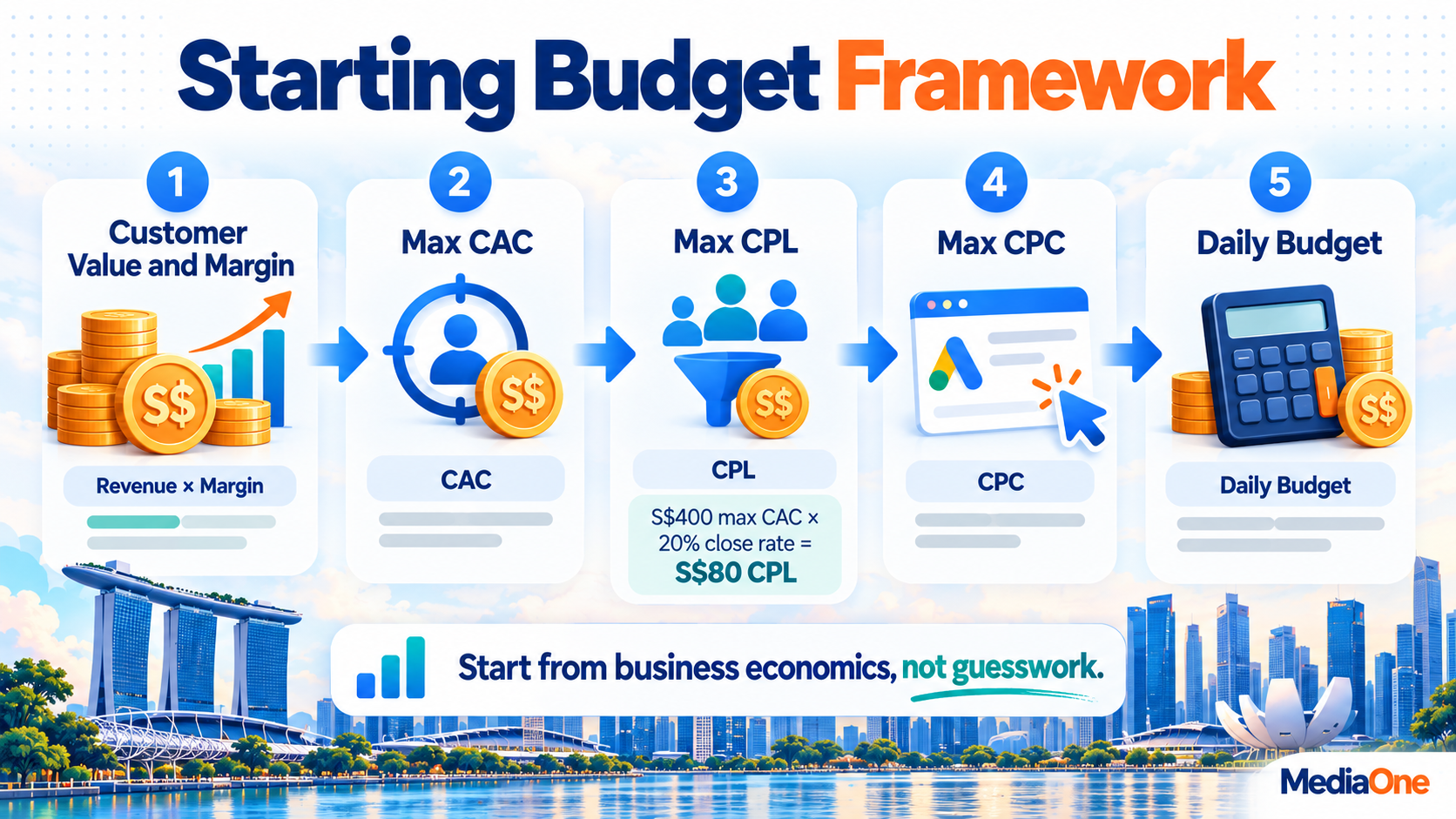
How to Calculate a Starting Google Ads Budget in Singapore
The strongest starting calculation connects customer value, conversion rates, potential traffic costs and the number of sales you want. This approach works for service businesses and ecommerce, although each model needs different conversion values.
Step 1: Calculate the maximum affordable cost per customer
Begin with the revenue earned from an average customer. Subtract direct fulfilment costs and other variable expenses to find contribution before advertising. Then reserve enough profit to cover the remaining obligations and your target return. The amount left is your maximum affordable customer acquisition cost (CAC).
Suppose a service produces SGD 400 in contribution before advertising, but the business wants to retain SGD 320 to cover overheads and profit. Its maximum affordable CAC is SGD 80. This figure is a business decision. It should not be copied from a competitor or mistaken for a Google recommendation.
If your company sells subscriptions or repeat-purchase products, customer lifetime value may be relevant. Use a defensible expected contribution from retained customers, adjusted for cancellations and future servicing costs. Avoid spending today’s cash against speculative lifetime revenue that the business may never collect.
Step 2: Turn customer acquisition cost into a lead target
Lead generation requires another calculation. A form submission is not necessarily a paying customer, so cost per lead (CPL) and customer acquisition cost are different measures.
Imagine a renovation firm can spend S$400 to acquire a confirmed customer. Its sales records show that 20% of qualified enquiries become signed jobs. The affordable CPL is:
S400maximumCAC×20%lead-to-customercloserate=S80 maximum CPL.
At SGD 80 per lead and a 20% close rate, five leads cost SGD 400 and produce one expected customer. The calculation assumes those leads are comparable in quality. If many are duplicates, outside your service area or merely collecting quotations, use the qualified-lead close rate instead.
We would track enquiry volume, qualified leads, appointments, quotations and sales separately. That reveals whether the campaign is producing a worthwhile pipeline or simply inexpensive form submissions.
Step 3: Estimate cost per click using Keyword Planner
Google Keyword Planner can help assess Singapore search demand, competition, historical top-of-page bid ranges and campaign forecasts. However, the top-of-page bid low and high ranges are not actual average CPCs charged to every advertiser. They describe historical bid conditions for showing among top ads. A forecasted average CPC is an estimate of what a planned campaign might pay, not a guaranteed price.
To prepare a realistic first estimate, we recommend the following process:
- Set the geographic target to Singapore or the locations you actually serve, and select the appropriate languages and Search network settings.
- Group keywords by commercial intent. For example, keep ‘serviced apartment monthly rental Singapore’ separate from general travel-information searches.
- Review search volume, top-of-page bid ranges and forecasted clicks, cost and average CPC where available.
- Check whether the estimated traffic level can support your sales target. A cheap keyword with almost no qualified searches may not be useful.
- Record the assumptions and refresh the forecast when your offer or market conditions change.
Google’s forecast definitions distinguish projected average CPC from historical bid ranges. We recommend using a range of possible outcomes rather than labelling any one number the market’s fixed auction price.
Step 4: Calculate the most you can afford per click
The maximum affordable CPC depends on the conversion rate from an ad click to the business outcome your target represents. Where the target is a customer, use the click-to-customer conversion rate. Where the target is a lead, use the click-to-qualified-lead conversion rate.
Maximum affordable CPC = maximum affordable cost per conversion × conversion rate.
For a maximum cost of SGD 80 per qualified lead and an estimated 4% click-to-qualified-lead rate, the affordable CPC is SGD 3.20. If the projected CPC is SGD 5, your projected CPL would be SGD 125, above the SGD 80 ceiling. Increasing the budget only scales that shortfall unless traffic quality or conversion performance improves.
A rate taken from previous campaigns is stronger evidence than an industry-wide assumption. If you have no historical data, label the rate as a forecast and test several scenarios. For example, compare 2%, 4% and 6% conversion rates before committing the full month’s allowance.
Step 5: Back-solve the daily allowance from the required volume
Once acquisition economics are plausible, calculate the clicks and spend needed to reach the campaign’s desired number of conversions. A simple planning model is:
- Required clicks = target conversions ÷ expected click-to-conversion rate.
- Estimated media spend = required clicks × forecasted average CPC.
- Average daily budget = planned full-month media spend ÷ 30.4.
For 20 qualified leads at a 4% conversion rate, you need an estimated 500 clicks. At S$3.20 CPC, the media allowance would be S$1,600, or about S$52.63 per day. These are expected values, not promised results. Actual lead volume and CPC will fluctuate.
Check that enough relevant searches exist to supply those clicks. Also check whether the projected lead volume fits your team’s capacity. Paying for 60 enquiries when staff can follow up with only 15 is a costly mismatch, even if the CPC is attractive.
Worked Google Ads Budget Examples for Singapore Businesses
We use hypothetical examples rather than unsupported Singapore-wide CPC benchmarks. The purpose is to show how different margins and conversion funnels produce different spending decisions.
Example 1: Serviced apartment operator
Assume a serviced apartment operator earns SGD 400 in contribution per completed booking before advertising. It decides that SGD 80 is the maximum acceptable acquisition cost for each booking. Its expected click-to-enquiry rate is 5%, and 40% of those enquiries become bookings.
The combined click-to-booking rate is 5% × 40% = 2%. The operator can therefore afford S80×2%=S1.60 per click. Its maximum CPL is S80×40%=S32.
For a goal of 30 bookings, it would need approximately 75 enquiries and 1,500 clicks. At the maximum S$1.60 CPC, that means S$2,400 in media spend, equivalent to approximately S$78.95 per day over a full month.
This budget is viable only if the forecasted search traffic and real conversion rates support those assumptions. If relevant clicks are expected to cost S3,themodelprojectsS150 per booking. We would first test stronger booking intent, landing-page quality or a different offer before approving that higher acquisition cost.
Example 2: Business-to-business software company
Assume a business-to-business (B2B) software company can devote S$400 to acquiring a signed annual contract. Four percent of ad clicks produce demo requests, and 25% of those demonstrations turn into customers. The click-to-customer rate is 1%, which supports a maximum CPC of S$4.
To acquire ten contracts, the model needs approximately 40 demonstrations and 1,000 clicks. At S$4 CPC, that is S$4,000 in monthly media spend, or S$131.58 per day. Each demonstration would cost an expected S100andeachcustomeranexpectedS400.
Now suppose Keyword Planner forecasts clicks closer to SGD 8. With unchanged conversion rates, the expected acquisition cost doubles to SGD 800 per signed contract. The firm should not assume that a SGD 4,000 budget can still deliver ten profitable customers. We would revisit higher-intent terms, demo qualification, conversion value or the commercial target itself.
A longer B2B sales cycle adds another constraint. This month’s demos may not close until next quarter. Track pipeline progression and imported offline conversions so the campaign is not judged only by immediate signed revenue.
Example 3: Ecommerce retailer
Consider an online retailer selling a product for SGD 120. Its direct product and fulfilment costs leave SGD 48 in gross profit. After another SGD 8 in variable costs, contribution before advertising is SGD 40. The retailer wants to retain SGD 16 per order, leaving SGD 24 as the maximum acquisition cost.
At a 2% click-to-purchase conversion rate, the affordable CPC is SGD 0.48. A goal of 100 purchases therefore requires an estimated 5,000 clicks and SGD 2,400 in media spend if the estimated CPC is achievable. The daily equivalent is approximately SGD 78.95.
Return on ad spend (ROAS) compares advertising-attributed revenue with advertising cost. At SGD 120 in revenue and SGD 24 in advertising costs, the target is 5× ROAS, or 500%. That differs from dividing SGD 40 in gross contribution by SGD 24 in advertising spend. The latter calculation is not revenue-based ROAS.
| Business model | Conversion measured | Affordable acquisition cost | Assumed click-to-final-conversion rate | Affordable CPC |
| Serviced apartments | Completed booking | S$80 | 2% | S$1.60 |
| B2B software | Signed contract | S$400 | 1% | S$4.00 |
| Ecommerce retailer | Completed order | S$24 | 2% | S$0.48 |
These examples deliberately use different end conversions. We would not compare their CPCs without looking at qualification, close rates, order values and actual contribution.
Should You Start at S20,S50 or S$150 per Day?
These three amounts are useful planning scenarios, but none is a required starting budget. A small budget can work in a narrow market with affordable qualified clicks. The same amount may produce too little information in a competitive sector.
To make the decision tangible, assume a projected CPC of S$4 and a 3% click-to-conversion rate. Ignore seasonality for this illustration.
| Average daily budget | Standard monthly media limit | Approximate monthly clicks at S$4 | Expected conversions at 3% |
| S$20 | S$608 | 152 | 4.6 |
| S$50 | S$1,520 | 380 | 11.4 |
| S$150 | S$4,560 | 1,140 | 34.2 |
At S$20 per day, this model generates fewer than five expected monthly conversions. That does not mean Google’s system is prohibited from learning. It means a single conversion can change the reported CPA dramatically. We would extend the observation period or improve conversion volume before drawing firm conclusions.
At SGD 50 per day, there may be enough traffic to identify obvious search-term or landing-page problems, although results may still vary substantially. At SGD 150 per day, the account receives more observations, but it also exposes much more cash to an unproven offer. A higher volume of poor-quality clicks is not an advantage.

Before selecting a tier, check whether the forecast CPC is below your affordable CPC, whether your audience is large enough and whether your business can absorb the planned test cost. We recommend choosing the smallest budget that can answer a defined question within an acceptable test period, not the smallest number the interface allows.
How to Allocate Your Google Ads Budget Across Campaigns
The total budget is only useful when each portion has a purpose. A business looking for new customers should not judge brand traffic, high-intent non-brand searches and display awareness by the same metric. We generally separate these jobs where the budget and campaign setup permit it.
Search, Shopping, Performance Max and Display
Search is often an appropriate starting point for service companies because keywords can express immediate intent. A user searching for ‘commercial cleaning quotation Singapore’ may be closer to an enquiry than someone reading general cleaning tips. Strong intent still needs to be tested; Search is not automatically the best channel for every business.
Standard Shopping can suit eligible retailers using a Merchant Center product feed. Performance Max can access multiple Google channels to pursue a conversion goal. It may be worth testing when product information, creative assets and conversion measurement are reliable. Its broad reach is not proof that every conversion is incremental.
Display can support awareness or remarketing where available and appropriate. Its success may require different measurement from high-intent Search. We would not allocate an arbitrary equal share to every format simply to appear comprehensive.
For a first campaign with limited funds, one tightly focused Search campaign may be easier to evaluate than four underfunded campaigns. Retailers may reasonably start with Shopping or Performance Max instead, depending on their product feed and goals. The channel mix should follow the economics of the offer.
Brand versus non-brand demand
Brand searches include your business or product name. Non-brand searches express a need without naming you. Both can be valuable, but they answer different questions. Brand campaigns often capture existing awareness, while non-brand activity helps reveal the cost of attracting new prospects.
There is no universal 20% rule for brand spending, and no defensible requirement to keep it below half the total budget. A familiar Singapore brand, a new startup and an ecommerce reseller face different competitive conditions. We recommend budgeting for brand protection according to genuine search demand, competitor activity and measured incremental value.
Keep the results separate where possible. If brand terms deliver most tracked conversions, that does not necessarily prove they generated most new demand. Evaluate non-brand performance using qualified leads, new customers and incremental commercial outcomes rather than relying on blended CPA alone.
Devices, locations and scheduling
Review mobile, desktop and tablet results, but do not assume the device with the lowest observed conversion rate deserves an immediate bid reduction. A mobile customer may research first and convert later on desktop. Poor mobile lead quality may also signal a broken form, slow page or confusing call-to-action.
Bid adjustment controls depend on the bidding strategy. Under Google’s bid adjustment guidance, many manual adjustments are not supported by Smart Bidding, which already evaluates device and other signals. With Target CPA, a supported device adjustment changes the CPA target for that device rather than directly changing the bid in the way Manual CPC does.
Apply the same care to location targeting. A company operating only in Singapore should review location settings, location reports and areas it actually serves. A firm serving Jurong and Tuas may not benefit from inquiries for work it cannot fulfil elsewhere. Use actual business coverage and lead quality, not a broad geographic assumption.
Ad scheduling can focus activity on useful hours, but it does not create a strict hourly budget. If customers convert in the evening, examine those results before restricting delivery. Consider conversion lag, staff response times and whether enquiries outside office hours can still be handled effectively.

Budget pacing shows whether spending is ahead of, behind or broadly aligned with the intended allowance. Impression-share data helps explain whether missed visibility is associated with budget or auction competitiveness. We recommend using both alongside conversions rather than treating any single warning as decisive.
Google defines impression share as impressions received divided by estimated eligible impressions. For eligible Search campaigns, Search Lost IS (budget) estimates the percentage of eligible Search impressions missed because of insufficient budget. Search Lost IS (rank) estimates losses associated with Ad Rank. Google’s impression-share guidance explains the calculation.
| Account signal | What it suggests | Our first check |
| High budget loss and acceptable CPA | More relevant demand may be available | Forecast the extra conversions and marginal CPA |
| High rank loss | Auction competitiveness or ad quality may constrain visibility | Review bids, relevance, assets and landing page |
| High budget loss but poor lead quality | More spending could expand unprofitable activity | Fix query targeting and qualification first |
| Little budget or rank loss but weak sales | Budget may not be the main problem | Inspect conversion tracking, offer and sales follow-up |
Do not interpret impression share as the percentage of searchers who clicked. It measures impressions received against estimated eligibility. It is also an estimate based on account settings and the selected reporting period, not a census of every possible customer.
Quality Score is useful when diagnosing relevance, but Google’s Quality Score documentation explicitly says the displayed 1–10 score is not a direct input in the ad auction. Auction-time ad quality, bids, expected asset impact and contextual signals contribute to Ad Rank. Improve weak ads and landing pages for their actual user value, not simply to chase a numerical Quality Score.
When to increase a constrained campaign budget
We would consider adding budget when conversion tracking is trustworthy, the campaign generates commercially valuable outcomes and credible forecasts suggest profitable additional volume. A Limited by budget status is useful supporting evidence. It is not sufficient by itself.
For example, a campaign with S100actualcostpercustomerandaS150 affordable ceiling may have room to scale. Before increasing spend, check whether recent traffic includes low-quality search terms and whether conversion rates remain reasonable as the campaign reaches a broader audience. The next group of customers may cost more than the first.
Avoid rules that claim a 15% impression-share loss always justifies an increase or that every campaign should be raised by exactly 20%. Neither is a Google-wide performance standard. Google’s 2026 bidding change also makes it important to review stated Target CPA or Target ROAS values before changing a constrained campaign’s budget.
Where you have enough data, use budget forecasts or experiments to estimate marginal outcomes. After a meaningful change, allow time for conversion lag and the bidding system to respond. Google recommends evaluating budget increases after roughly one to two conversion cycles in the context of its 2026 target-based bidding changes.

Seasonal Google Ads Budget Planning in Singapore
Singapore businesses may experience demand changes around Lunar New Year, school holidays, year-end travel, Christmas and major retail promotions. The Great Singapore Sale can also matter to participating retailers, but its dates and commercial relevance should be verified for each edition. We would not assume that every category experiences higher CPC or better conversion rates during every event.
Start with your own account history. Compare search volume, conversion rates, CPC, order value and qualified sales during equivalent prior periods. Then decide which campaigns deserve a temporary increase and what performance would cause you to scale back.
For a time-limited promotion, confirm the promotion’s dates, inventory, fulfilment capacity and profit margin before changing spend. A discount that increases conversion rate can still reduce profit per order enough to make a previously acceptable CPA unprofitable. Recalculate allowable acquisition cost using the promotional margin.
Seasonality adjustments are a particular Google Ads Smart Bidding feature. They inform bidding about an expected change in conversion rate; they are not simply a way to raise the daily budget or change a Target CPA. Google’s seasonality adjustment guidance says they are best suited to major, short-term conversion-rate changes, typically events lasting one to seven days, and are not generally needed for ordinary seasonal patterns that Smart Bidding already manages.
We recommend documenting the intended start, end, forecast conversion change and rollback plan. Evaluate results against comparable periods without assuming that a seasonal campaign must spend more to be successful.
Measure Your Budget Against Real Business Return
Advertising dashboards can report clicks and conversions while the business makes little money. A budget review should connect platform results with the revenue and contribution actually generated. That includes distinguishing a qualified lead from a sale, accounting for refunds and recognising that some conversions take weeks to close.
Understand CPA, CPL and ROAS correctly
CPL is advertising cost divided by recorded leads. CPA is advertising cost divided by the conversion action being measured; clarify whether that action is a lead, booking, order or acquired customer. CAC is the cost of acquiring a new customer and may include additional acquisition expenses outside Google Ads.
ROAS = attributed advertising revenue ÷ advertising spend. If a campaign produces S10,000intrackedrevenuefromS2,000 in media spend, its reported ROAS is 5×, or 500%. That does not mean the business earns S$8,000 in profit. Product costs, delivery expenses, fees, returns and operating costs still matter.
A simple gross-margin break-even ROAS calculation is 1 ÷ gross margin rate when gross margin is the only cost considered. At a 40% gross margin, that is 2.5× before other costs. Once fulfilment, payment fees, refunds and required profit are included, the required ROAS can be materially higher. We would use contribution per order rather than treating the gross-margin shortcut as a complete profitability test.
Use conversion values that reflect genuine outcomes
Not every enquiry has the same commercial value. A qualified procurement enquiry may be worth considerably more than a general brochure request. Where the evidence supports it, assign conversion values that reflect expected business outcomes. For ecommerce, record actual order values and reconcile them with completed orders, returns and cancellations.
Google’s conversion value rules can adjust recorded values for supported conditions, including audience, device and location. These rules are not a substitute for passing the right transaction value or importing reliable offline sales information. A different margin for each product is best addressed through accurate conversion values and suitable campaign structure, not a blanket assumption that every visitor from one device is worth the same amount.
For service businesses, importing qualified and closed-lead outcomes can improve measurement when customers convert offline. Keep consent, data accuracy and customer-data obligations in view. Tracking a WhatsApp button click is useful as a contact signal, but it does not establish that a conversation occurred or that a job was won.
Account for GST and the actual cost of advertising
Google’s Singapore tax guidance states that Google Ads sales to accounts with a Singapore business address are subject to 9% GST. That means S$1,520 in media spend would correspond to S$136.80 GST and S$1,656.80 in total, before any other applicable charges.
Input GST recovery depends on the business’s circumstances. Under the Inland Revenue Authority of Singapore’s conditions, GST registration, the nature of the business use and valid supporting invoices are among the requirements. A non-GST-registered business generally cannot reclaim input GST, while an eligible registered business may be able to claim it.
If your fixed cash allowance is S$1,500 including GST, dividing by 1.09 leaves approximately S$1,376.15 for media. Divide that by 30.4 to get approximately S$45.27 per day before other fees. We recommend checking the current invoice, tax treatment and payment method with your accountant rather than confusing the account’s media budget with total cash outflow.
Common Google Ads Budget Mistakes and How to Fix Them
Poor results are often caused by measurement or targeting errors that look like spending problems. Before raising or cutting a Google Ads budget, investigate where the money actually goes.
Assuming overlapping keywords bid against each other
Two similar keywords in the same Google Ads account do not bid against each other in the same auction. Google selects an eligible keyword or ad according to its prioritisation rules. Its ad group and asset group prioritisation guidance explicitly addresses this point.
Overlapping coverage can still make reporting confusing, shift traffic between campaigns and undermine your intended allocation. We would review keyword ownership, search terms and negative keywords to keep reporting meaningful. The reason is strategic control, not a claim that your keywords are artificially bidding up one another’s CPC.
Spreading a small budget across too many campaigns
A daily allowance of SGD 50 divided evenly among five campaigns leaves SGD 10 per campaign, before differences in search demand. Some campaigns may get too few clicks to judge their performance. Consolidating related activity can make the budget easier to manage, provided the campaigns genuinely serve compatible goals.
Focus first on the highest-priority business outcome. Add new formats or ad groups when there is a clear reason and sufficient spend to measure them. We would not preserve a complicated account structure simply because it contains every campaign type Google offers.
Counting duplicate or low-value conversions
Double-counted form submissions can make reported CPA appear artificially low. Missing phone calls, offline sales or failed tags can make it appear too high. Both errors can lead to poor spending decisions, especially when automated bidding optimises towards the flawed conversion data.
Test forms and call tracking, review conversion action settings and compare Google Ads reports with customer relationship management (CRM) records. Classify conversions according to their commercial meaning. Do not treat a click on a contact button as a closed sale.
Making large changes before results have matured
A campaign can appear unprofitable before customers finish the buying process. Businesses selling high-value software, commercial property services or complex repairs may need time to see the final outcome of early enquiries. Evaluate performance across an appropriate sales cycle rather than a fixed seven-day window.
Changing budgets, target CPA, keywords and landing pages simultaneously also makes diagnosis harder. We recommend recording one major hypothesis at a time, noting its expected effect and allowing a suitable observation period before judging the outcome.
Treating cheap clicks as a goal
A low CPC is helpful only when the traffic has commercial potential. Broad informational searches may generate many inexpensive visits without corresponding sales. Conversely, a costly high-intent search may be profitable when the contract value justifies the acquisition cost.

Look beyond CPC to qualified-lead rate, sales close rate and contribution after acquisition. If a cheaper keyword attracts prospects your team cannot serve, we would exclude it despite its attractive traffic price.
A Repeatable Monthly Google Ads Budget Review
We recommend reviewing budget performance on a consistent schedule, with faster checks when tracking fails or spending changes unexpectedly. The monthly review should produce a decision and a documented reason, not simply another dashboard export.
- Reconcile media spend and invoices. Compare platform spend with the intended monthly allowance, GST and any applicable fees. Check changes to daily budgets during the period.
- Validate conversion tracking. Review recorded leads, duplicate actions, offline sales imports and the time lag between enquiries and purchases.
- Check commercial performance. Calculate qualified CPL, customer acquisition cost, attributed ROAS and contribution after advertising where data permits.
- Identify constrained campaigns. Review Limited by budget status, Search Lost IS (budget), Search Lost IS (rank) and relevant performance forecasts.
- Inspect query quality. Find irrelevant search terms, mismatched landing pages and queries that convert into genuine customers rather than superficial actions.
- Review allocations. Compare brand, non-brand and other campaign types according to their purpose. Check whether profitable growth campaigns have adequate funding.
- Check the next commercial period. Consider confirmed promotions, stock availability, staff capacity and changes to product or service margins.
- Document the decision. Record whether to increase, hold, decrease or redistribute spend, along with the evidence and the next review date.
A useful review log has five fields: date, campaign, observed problem, action and expected result. Over several months, it becomes a record of what actually worked for your business. That is more valuable than an unsupported industry-wide recommendation to spend a particular amount every day.
When performance is uncertain, we would normally improve measurement before investing additional cash. When results are profitable and demand remains available, forecast the incremental effect of more spend. When expected acquisition costs exceed allowable margins, adjust the offer, targeting or sales process before trying to scale.
Frequently Asked Questions
How much should a small business in Singapore spend on Google Ads per month?
There is no universal minimum or recommended amount for every Singapore business. Calculate your allowable acquisition cost, forecast relevant CPC and conversion volume, then choose a budget that can fund a measurable test without exceeding your cash limits.
Why did Google Ads spend more than my daily budget?
For most campaigns, Google can bill up to twice the average daily budget on a given day while applying a standard monthly spending limit of 30.4 times the average daily amount. Budget changes, partial months and certain payment models can affect the calculation, so check the budget report and Google’s spending limits.
Can I run Google Ads with S$20 per day?
Yes, but the usefulness of that budget depends on the expected CPC, audience size, conversion rate and length of your test. At S4perclick,S20 buys roughly five clicks a day on average, which may be insufficient for rapid conclusions.
Does Smart Bidding require 30 conversions every month?
No, 30 conversions per month is not a universal eligibility requirement for Google Ads Smart Bidding. More reliable conversion data generally improves measurement, but bidding performance depends on the strategy, signals, tracking quality and conversion cycle.
Separate budgets are often easier to manage when you need to protect brand demand while measuring new-customer acquisition independently. A shared budget may suit compatible campaign objectives, but it does not guarantee a specific amount to each campaign.
Does Google Ads charge GST in Singapore?
Google states that its advertising sales to accounts with Singapore business addresses are subject to 9% GST. Whether the business can claim input GST depends on the IRAS eligibility conditions.
When should I increase my Google Ads budget?
Consider an increase when conversion tracking is trustworthy, customers are acquired within your acceptable cost and forecasts suggest sufficient additional qualified demand. Check the stated bidding target and allow time for conversion lag before judging the effect.
What happens to unused Google Ads budget when a campaign is paused?
Pausing stops that campaign’s new spending, and unused allocation does not build up for later use. If several campaigns share a budget, the remaining active campaigns may continue using the shared allowance.
Turn Your Google Ads Budget into Profitable Growth
A sustainable Google Ads budget starts with realistic traffic costs and profitable customer acquisition. Calculate your maximum affordable acquisition cost, estimate qualified conversion rates and use Keyword Planner to assess potential click volume. Then set your daily allowance using Google’s 30.4-day monthly spending calculation.
We recommend prioritising campaigns that attract qualified customers and deliver measurable returns. Track completed sales, account for Singapore GST and review performance before increasing spend. Our Google Ads management services help businesses optimise campaign targeting, bidding strategies and budget allocation to improve advertising efficiency.
If acquisition costs exceed what your margins can support, review your keywords, offers and landing pages before committing additional funds. Our conversion rate optimisation services can help turn existing traffic into qualified leads and customers. Increase your budget when reliable conversion data and profitable results justify further investment.