| AI Summary
Private blog networks (PBN) create links that aim to influence search rankings. Business owners reviewing these links need evidence about how publishers placed them, who arranged them and whether payment bought ranking credit. This article explains the risks, provides a practical audit checklist and shows when link removal or disavowal deserves consideration. |
A private blog network is a group of websites controlled to place links that manipulate another website’s search rankings. PBN links can lose their ranking value or contribute to a manual action. Shared ownership alone does not prove abuse; the purpose and arrangement behind the links need examination.
Key Takeaways
- Campaign records and placement agreements can reveal more than a domain score.
- Shared hosting, private registration and repeated designs are clues, not proof.
- A traffic decline does not establish that PBN links caused it.
- Most websites do not need a disavow file.
- A link report should show actual source pages, costs and placement terms.
A link offer can sound simple: one monthly payment, several new backlinks and better rankings. The difficult part is knowing what sits behind those links.
Some placements come from publishers serving real readers. Others come from websites created mainly to sell ranking signals. Both can appear in the same spreadsheet with similar-looking metrics.
Private blog networks deserve closer inspection before a business pays for them or removes existing links. The sections below explain what to check, which warning signs need context and how to document a decision without treating every unfamiliar website as a threat.
What are private blog networks, and how do they work?
A private blog network gives an operator control over several websites and the links those websites publish. The target is often a commercial website, sometimes called the “money site”.
The operator can choose which pages receive links, what the clickable words say and when the placements appear. That control is the attraction for buyers who want predictable link delivery.
The basic PBN structure
A network may involve three parts:
| Part | What it does |
| Supporting websites | Publish articles containing links to selected destinations |
| Network operator | Controls the websites or arranges their placements |
| Target website | Receives links intended to improve its search position |
Some operators acquire expired domains that already have backlinks. Others create new sites or publish through existing accounts. Expired domains are therefore one possible ingredient, not a requirement.
The sites do not have to link to each other. Several separate blogs pointing towards the same business can still form part of a coordinated arrangement.
Why buyers find the offer appealing
PBN sellers can package links as a fixed deliverable. A buyer may receive ten placements each month, selected anchor text and a report showing domain metrics.
The apparent certainty can hide unanswered questions:
- Who owns the publishing sites?
- What audience reads them?
- Why does the article mention this business?
- What happens when the buyer stops paying?
A Singapore furniture retailer, for example, might receive links from unrelated blogs covering loans, gardening and software. The report shows delivery, but those placements need further examination before anyone calls them valuable.
How legitimate website groups differ
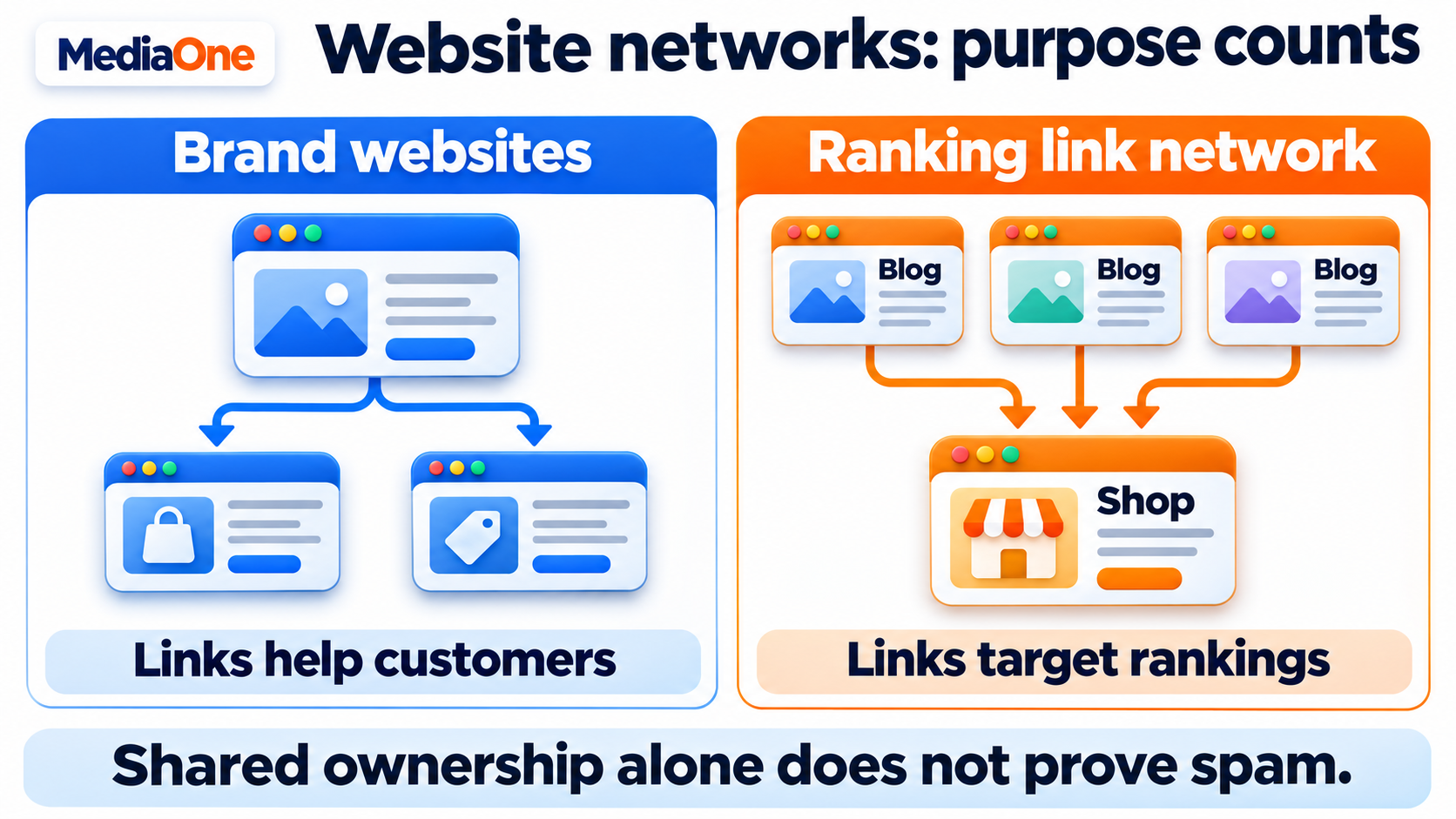
A publisher may own several magazines. A company may run separate websites for different brands. Their links can help readers find related information.
Shared ownership does not establish manipulation. A practical test is whether the page and link serve a reader’s need.
A parent company linking to its subsidiaries explains a business relationship. A group of generic blogs repeatedly inserting paid commercial links presents a different situation.
How does Google treat PBN links?
Google’s link spam policy covers links created primarily to manipulate search rankings. A PBN built for that purpose falls within the policy, regardless of the name used in a sales proposal.
Labels such as “managed publishing,” “premium placements” or “private outreach” do not explain how the links were obtained. The underlying arrangement needs examination.
Links can lose their ranking value
Google described its systems’ ability to neutralise unnatural links in its December 2022 link spam update. Any ranking benefit from those links can disappear when Google discounts them.
A campaign can therefore meet its promised placement count without delivering lasting search value.
A ranking increase after publication also does not prove that the links caused it. Content changes, competitor activity and other updates may happen during the same period.
Manual actions involve a human review
Google’s Manual actions report records actions issued after a human reviewer finds a policy violation. Affected pages or websites may rank lower or disappear from search results.
| Outcome | What the owner can observe | Appropriate next step |
| Manual action | A notice in Search Console | Address the issue described in the notice |
| Links discounted by automated systems | No manual-action notice identifying those links | Investigate the wider performance evidence |
| Unrelated search decline | Lower traffic without proof of a link issue | Check technical, content and demand changes |
A missing manual-action notice does not confirm that every link is acceptable. Equally, lower traffic does not prove that a network caused a penalty.
Paid advertising needs different treatment
Paid publication can serve a legitimate advertising purpose. Google identifies rel=”sponsored” as the preferred attribute for paid links; nofollow remains acceptable. These attributes describe the link relationship in the page’s code.
A paid article should have an audience and a business purpose beyond selling ranking credit. Sponsorship disclosure for readers and link qualification for search engines address different needs.
Which PBN warning signs deserve investigation?
An audit looks for evidence that explains a placement. Several connected observations can justify closer review, but no single technical feature establishes a PBN.
Google does not publish a complete PBN detection checklist. The following checks support a business review; they do not describe a confirmed list of Google ranking signals.
Publisher identity and editorial purpose
A reviewer should be able to understand what the website publishes and whom it serves. Relevant evidence includes:
- A consistent subject or audience.
- Articles with identifiable sources.
- Working contact details.
- Authors whose involvement can be checked.
- An explanation for the link within its paragraph.
A missing author biography may reflect a small publisher’s resources. It becomes more concerning when combined with unrelated articles, repeated commercial anchors and records of paid ranking placements.
Private domain registration also has legitimate privacy uses. It should not receive an automatic negative judgement.
Repeated commercial link patterns
The surrounding article often explains more than the homepage.
A plumbing company might appear naturally in a local renovation feature. Its appearance in a generic article about cryptocurrency needs a stronger explanation.
Patterns worth recording include:
| Observation | Follow-up check |
| The same sales phrase appears across unrelated sites | Whether a supplier requested that wording |
| Articles repeatedly link to unrelated businesses | Whether placements are sold as ranking links |
| Several sites share identical paragraphs | Whether content was copied or distributed |
| Links appear in awkward sentences | Whether someone inserted them after publication |
| A supplier controls many publishing destinations | Whether independent editorial review exists |
Anchor text optimisation should help readers understand the destination. Repeated wording deserves context, especially when a product name naturally matches a common search phrase.
Technical similarities need context
Websites can share an IP address because they use the same hosting company. Many independent publishers also use WordPress themes and common plugins.
These similarities can help group sites for inspection. They cannot establish why a link exists.
The strongest audit notes connect observations to records: a placement invoice, an operator’s offer or an email promising followed links across controlled sites. A shared footer design supplies much weaker evidence.
Domain history can explain unusual content
An old domain may have hosted a different organisation. Earlier versions can help explain a sudden change in subject, ownership or publishing activity.
A former cycling club website now carrying articles about unrelated loans and casinos deserves investigation. A new owner developing a relevant publication presents a different case.
The reviewer’s note should describe the evidence found, including gaps. “Earlier pages unavailable” is more accurate than inventing a history from the domain’s age.
Do redirects or cloaking prove a PBN?
A redirect sends a visitor or crawler from one URL to another. Google documents legitimate redirect uses, including website moves and changes to page addresses.
A redirect is not automatically cloaking. Cloaking concerns deceptive differences between what users and search engines receive, intended to manipulate rankings.
The final destination needs checking
A backlink audit should record both the linked address and the page it reaches. The review can then establish whether the destination still matches the source article.
Relevant checks include:
- The original linked URL.
- Any intermediate addresses.
- The final destination.
- Whether the destination answers the link’s description.
- Any unexpected difference between access methods.
A link to an old product page may redirect to its replacement. A link that unexpectedly reaches an unrelated commercial website needs further review.
Redirect chains are evidence to explain
Several hops can create maintenance problems or obscure an outdated destination. They do not establish a network by themselves.
A reviewer should avoid assuming that every chain hides wrongdoing. The report needs a factual description, such as “The article links through two addresses before reaching a loan application page.”
That observation gives the business something concrete to investigate. An unsupported label such as “cloaked PBN link” does not.
How to audit an existing backlink profile
An audit should produce a decision record, not a list of frightening scores. The owner needs to know which placements were examined, what evidence exists and what action follows. A broader off-page SEO review can provide context about publishers, audiences and referral activity alongside the link checks.
Step 1: Gather available links and campaign records
Search Console’s Links report provides a sample of links, not a complete inventory. Its data may include links that have since disappeared.
Third-party backlink tools can add other discoveries. Each tool has different coverage, so combined exports still need checking.
The working sheet should include:
| Field | Why it belongs in the review |
| Source page | Shows where the link appears |
| Destination | Identifies the receiving page |
| Anchor text | Records the clickable wording |
| Link attribute | Helps identify the stated relationship |
| Placement source | Connects the link to an agency, publisher or unknown origin |
| Payment records | Helps explain the arrangement |
| Evidence and decision | Makes the review repeatable |
Invoices, old reports and supplier emails can explain links that a crawler cannot.
Step 2: Inspect the live source pages
A reviewer should open the actual article. Domain-level metrics cannot show whether a particular paragraph makes sense.
The page review should establish:
- What the article discusses.
- Whether the business belongs in that discussion.
- Whether the link remains live.
- Whether the linked wording describes the destination.
- Whether other commercial placements follow the same pattern.
A respected website can contain a poor placement. A small website can publish a relevant, independently chosen reference. Automatic exemptions based on domain type or reputation can miss both.
Step 3: Apply a consistent evidence checklist
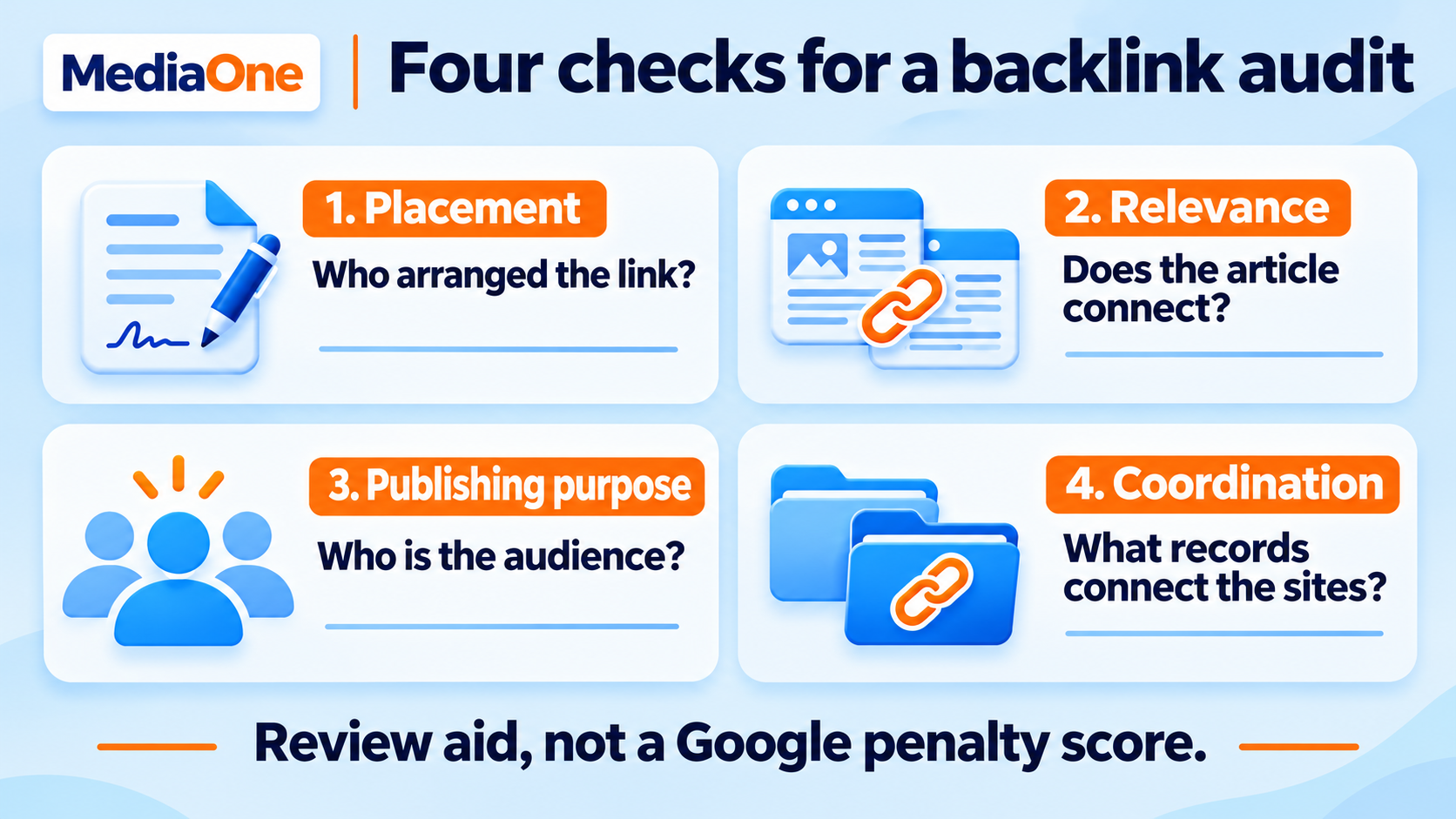
The following framework organises review work. It is an editorial checklist, not a Google score or a prediction of penalties.
| Review area | Lower concern | Further investigation |
| Placement arrangement | Publisher chose the reference independently | Payment or contract promises ranking credit |
| Relevance | Article explains why the business appears | Link interrupts an unrelated subject |
| Publishing purpose | Site serves an identifiable audience | Pages appear designed mainly for placements |
| Coordination | Similarities have an ordinary explanation | Records connect several sites to one link seller |
A finding in the right-hand column starts an investigation. It does not automatically justify removal.
The final decision should identify the strongest evidence. Unknown ownership, for example, should remain an unanswered point until other information supports a conclusion.
Step 4: Compare a small cluster
Consider an illustrative Singapore retailer with links from a home-design magazine and three generic blogs. The magazine includes the retailer in a researched feature about compact furniture. The editor selected the products, and the article explains each choice.
The three blogs use the same sales phrase in unrelated articles. An old supplier invoice lists all three as paid followed-link placements.
The invoice and placement context support a concern about the blog links. Their matching designs add context but do not carry the decision alone.
Step 5: Record uncertainty and assign actions
A practical review can use three statuses:
- Retain: The available evidence supports a legitimate reference.
- Investigate: Important information remains missing.
- Address confirmed scheme: Records establish a manipulative arrangement.
Each investigated link needs an owner and a review date. Otherwise, the same unanswered findings can appear in every monthly report.
The audit should also preserve screenshots and dates. Publishing pages change, and a later reviewer needs to understand what supported the original decision.
What should businesses ask a link-building vendor?
A proposal should explain the work before the buyer signs. A placement count alone cannot show whether the campaign reaches relevant readers.
Businesses outsourcing SEO should include link methods, reporting and publisher selection in their supplier checks.
Questions that reveal the arrangement
| Question | What the answer should explain |
| Who selects the publishing websites? | The selection process and review responsibility |
| Does the supplier own those websites? | Any control over publishing destinations |
| What does payment buy? | Research, writing, outreach, advertising or ranking links |
| Can publishers reject a placement? | Whether independent editorial decisions exist |
| How are paid links qualified? | The attributes used for advertising relationships |
| What appears in the report? | Source URLs, destinations, dates and costs |
| What happens when the contract ends? | Whether placements remain, change or disappear |
A supplier may protect journalists’ contact details or outreach methods. The buyer still needs enough information to assess the delivered work.
Promises that need closer examination
Claims such as “undetectable”, “penalty-proof” or “guaranteed ranking power” cannot establish safety. A vendor should also explain any guarantee of followed links on websites it describes as independent. The buyer needs to know how that guarantee works.
Itemised SEO packages make comparison easier when they distinguish content production, outreach and paid advertising. A single line labelled “authority links” leaves too much unanswered.
Contract terms should match the report
The agreement should state whether controlled networks, undisclosed paid placements and links intended to manipulate rankings are excluded. The report should then demonstrate compliance with those terms. A promise in a sales call has little value if the delivery sheet contains only domain scores and link totals.
A business also benefits from keeping its own copies of reports and placement records. Supplier changes should not erase the history needed for a later audit.
When should links be removed or disavowed?
An unfamiliar backlink does not create an automatic cleanup task. The response should reflect the arrangement behind it and the evidence available.
Google’s disavow requirements set two conditions: a considerable number of artificial or low-quality links, and a manual action caused by them or likely to result from them. Most sites do not need the tool.
Confirmed schemes need a documented response
A business that arranged manipulative links should stop further placements and examine the existing campaign.
The response can include:
- A record of the affected source pages.
- Removal of links the business controls.
- Requests to publishers for changes or removal.
- Evidence of replies and completed work.
- Assessment of whether disavowal meets Google’s conditions.
A link attribute change may address a genuine paid advertising relationship. Replacing an anchor phrase alone does not change a scheme’s underlying purpose.
Disavowal needs careful scope
A disavow file asks Google to disregard listed links. It does not remove them from the publishing websites.
The file can identify individual URLs or whole domains. The scope should follow the evidence; an entire publisher should not be excluded because of one misunderstood page.
Existing files also need checking before an upload. Google states that a new upload replaces the previous list, so earlier entries must be preserved when they remain appropriate.
Reconsideration follows a manual action
A reconsideration request applies when a manual action exists. The request should explain the issue, the corrective work and the measures intended to prevent another scheme. The account should include specific examples and an honest record of links that could not be removed.
Review times vary. A business should avoid promising a fixed recovery date or a return to previous rankings, particularly where those rankings depended on artificial links.
What can PBN exposure cost a business?
The cost extends beyond the original placement fee. A review may require staff time, publisher contact and changes to future marketing plans.
A simple budget separates:
- Past spending on the link campaign.
- Audit and removal work.
- Additional marketing needed during disruption.
- Any measured effect on enquiries or sales.
A worked budget example
Suppose a retailer spends S$2,000 reviewing an old campaign and S$1,000 arranging changes. Its direct cleanup cost is S$3,000.
If organic revenue also falls by S$5,000 monthly for three months, the decline totals S$15,000. That amount should remain separate until evidence supports a connection to the link issue.
The example describes a budgeting method, not a typical fee or expected penalty loss.
Traffic changes need a wider investigation
Google’s approach to diagnosing search traffic drops includes examining technical issues, ranking changes, seasonality and changing search demand.
A business should compare affected pages, queries and dates before assigning a cause. A website migration or tracking error may explain a decline that first appears to be a backlink problem.
What can businesses invest in instead of PBNs?
A stronger link programme begins with something another publisher has a reason to reference. The work should also create value when no backlink follows.
Google’s people-first content principles emphasise original information, substantial value and content created for an intended audience.
Original information gives publishers a source
Potential assets include:
- Research with a published method.
- Calculators that explain their assumptions.
- Comparisons supported by current evidence.
- Detailed answers to recurring customer questions.
- Industry observations with permission to publish.
A furniture retailer could analyse common room measurements from an appropriately collected dataset. The resulting findings might help readers plan small homes and give journalists something specific to cite.
Relevant outreach connects the asset to readers
Digital PR can bring a researched finding to publications covering that subject. The publisher decides whether the information deserves coverage.
A guest article can contribute first-hand knowledge to another audience. Its value depends on the contribution and publishing arrangement.
Neither label guarantees acceptable links. Payment, editorial control and placement terms still need examination.

Reporting should include business outcomes
A campaign report can track relevant coverage, referral visits, enquiries and conversions alongside links. A quarterly review should also ask whether the asset remains accurate and whether publishers still reach the intended audience. That keeps attention on customers and publishing quality.
A stronger link programme starts with evidence
A business considering private blog networks needs a record of what it is buying and why each placement exists. Source pages, campaign records and publisher decisions support better choices than unsupported safety claims.
MediaOne’s team can discuss the current campaign, its reporting and the business’s search goals through a digital marketing consultation.
FAQs About Private Blog Networks (PBN)
Are private blog networks illegal?
A breach of Google’s search policies is different from breaking the law. The PBN label alone does not establish unlawful activity. Separate conduct, such as fraud or copyright infringement, raises different issues.
Can a PBN link send genuine visitors?
A link can receive clicks even when its placement creates a search-policy concern. Referral traffic and policy compliance are separate assessments. A few visits do not explain or justify the arrangement behind a ranking link.
Can a business inherit PBN links when buying a website?
A website purchase can include links arranged by previous owners. Due diligence should therefore include historical supplier reports, placement agreements and Search Console access before the transaction is completed.
Does a PBN have to use WordPress?
A PBN can use different publishing systems. The software does not define the practice. Ownership, placement arrangements and the purpose of the links provide the relevant context.
Should a business pay a publisher to remove a link?
A removal demand deserves examination before payment. The business should preserve the request, verify the sender and check the original placement records. Payment should not become an automatic response to an unsolicited warning.