Off-page SEO is the work of earning trust signals from other websites, directories and reviews, rather than changing your own pages. It matters because search engines and AI answer systems judge your business partly by what others say about it.

Most Singapore businesses that invest in off-page SEO start with the wrong question. They ask how many backlinks they need. The better question is which sources their customers already trust enough to mention. A link from a respected industry association or a well-read local publication does more work than a hundred links from sites nobody visits. That is the discipline behind a white hat link building system – sources chosen for trust, not volume.
This guide treats off-page SEO as a reputation-building discipline. It covers how to judge which external signals carry real trust, which local sources are worth pursuing, how to audit a backlink profile for risk, and how to measure progress. Each section stands alone, so you can jump straight to the audit or the outreach plan.
Key Takeaways
- Trust beats volume. A few links from sources your buyers already trust usually do more for rankings and enquiries than hundreds of links from unrelated sites.
- Score before you pursue. Rate each opportunity on relevance, audience overlap with Singapore buyers, editorial standard, likelihood of a real visit and effort to earn. Drop any opportunity with a weak editorial standard, whatever its total score.
- Look locally first. Industry associations, chambers of commerce, business listings and review platforms often carry more weight with Singapore buyers than generic link lists.
- Audit for risk. Look for unrelated directories, undisclosed paid placements and sudden spikes in exact-match anchor text. Remove or disavow only what you can clearly identify as harmful.
- Measure outcomes. Track referral traffic, branded search growth and enquiry quality alongside rankings. Domain authority is a proxy, and a weak one for commercial results.
- Off-page work supports AI-powered search too. Consistent, credible mentions across trusted sources help search engines, and AI answer systems recognise your business as a reliable source to cite.
What Off-Page SEO Really Is, and What It Is Not
The working definition: signals earned outside your own domain
Off-page SEO covers every signal that search engines and AI systems use to judge a business, and that the business does not fully control on its own website. Backlinks are the best-known example. The category also includes brand mentions on other sites, reviews, directory listings, and co-citations, where your business is named alongside a competitor or a sector term.
The test is simple. If you can change the signal by editing your own pages, it is on-page work. If another party has to decide to create it, it is off-page.
That test has a consequence. Off-page work is slower and less predictable, because you are asking other people to act. The payoff is that these signals are harder to fake, which is why search systems weight them.
Why links are a proxy for trust, and where that proxy breaks down
Links spread through the web because one site pointed to another when it found something useful. Search engines adopted links as a rough measure of endorsement. A page that many relevant sites link to is probably worth showing.
The proxy breaks down in three places. First, sellers can buy, trade or generate links at scale, which cuts the link off from any real endorsement. Second, a link from an irrelevant site tells a search engine little about your subject. Third, some valuable trust signals carry no link at all. A named mention in a trade publication is one example.
This is why the number of links is a poor target. A better question is whether a real buyer in your market would reasonably trust the source enough to act on what it says about you.
Off-page versus on-page versus technical SEO: where the boundaries sit
The three disciplines overlap, but each has a clear job.
|
Discipline |
What it controls |
Example |
|
On-page SEO |
Content and markup on your own pages |
Title tags, headings, copy depth, internal links |
|
Technical SEO |
How your site is crawled, rendered and served |
Page speed, indexing rules, site architecture, structured data |
|
Off-page SEO |
Signals created by other parties |
Backlinks, unlinked mentions, directory listings, reviews |
Two boundary cases cause confusion. Internal links are on-page, even though they affect how authority flows through your site. Your Google Business Profile is an off-page listing on a third-party platform, even though you manage it – treat it as off-page for planning, because its signals depend on how others engage with it. Getting the profile right is its own discipline; this Google Business Profile SEO walkthrough covers the fundamentals.
Why Singapore businesses often misjudge the role of off-page work
Singapore businesses often make one of two mistakes. Some buy a monthly package of links from a vendor without knowing where those links come from – and bought authority tends to behave like bought followers and likes, which inflate a count while quietly undermining the trust the count was meant to signal. Others skip off-page work, assuming a well-optimised website and a Google Business Profile are enough.
Both mistakes ignore how local buyers decide. Many buyers check reviews, association memberships and third-party listings before they enquire. An off-page presence on those sources affects enquiries as well as rankings, so it earns its keep even when search results move slowly.
Judge off-page work on two outcomes. Does it improve visibility for the searches you care about? Are the people arriving from those sources more likely to enquire? Link volume alone tells you neither.
How Search Engines Evaluate External Signals Today
Search engines weigh each external signal against who sends it, why, and whether the surrounding page makes sense for the reader. This section covers the four mechanisms that matter most, what each one rewards, and where the public guidance stops.
A link carries weight when the source is credible, and the topic matches. A Singapore accountancy firm listed in a Singapore Business Federation member directory sends a different signal from the same firm receiving a link from a random blog about cryptocurrency. Google’s documentation treats links as one of many signals used to judge relevance and quality, not a standalone vote.
Context decides the value. The sentence around the link, the heading above it, and whether the linked page answers a need on the source page all shape how it is read. A link in a relevant paragraph of a local trade publication usually does more than a sitewide footer link pointing to the same URL.
Before you pursue a link, check three things:
- Does the source site cover a topic your buyers care about?
- Is the link placed by an editor, or is it one of many listings with no selection standard?
- Would a reader who clicked it find the destination useful?
If all three are yes, the link is likely to carry trust. If two or more are no, treat it as noise.
Unlinked mentions, brand search and co-citation

Search engines also read references that carry no hyperlink. An unlinked mention of your business in a news article or association newsletter shows that the brand exists and is discussed in a particular context. Google’s Search Central documentation focuses on helpful content and does not publish how much an unlinked mention contributes to ranking, so treat any claim about its weight with caution.
Brand search is easier to measure. When more people type your company name into search, that demand shows the brand is known. You can track it in Google Search Console rather than guessing.
Co-citation means appearing alongside peers. When two or more businesses appear together in the same source, such as a list of accredited training providers, engines infer that they belong to the same category. Being listed next to established firms in an industry directory can place a Singapore business within that competitive set.
Spam detection, manual actions and what triggers them
Search engines run automated systems to detect manipulative link patterns, and a human reviewer can apply a manual action when a site breaks the rules. Google’s spam policies name link spam directly: buying or selling links for ranking purposes, excessive link exchanges, and low-quality directory or bookmark site links, among others.
Triggers are usually patterns rather than single links:
|
Pattern |
Why it looks unnatural |
|
Sudden spikes in referring domains |
Earned links usually build up gradually |
|
Exact-match anchor text repeated across many sites |
Natural linking uses varied, often branded or generic anchors |
|
Links from sites with no topical connection |
Suggests the link was bought or traded |
|
Sitewide footer or sidebar links from unrelated domains |
Common in paid networks |
|
Links from pages with thin or machine-generated content |
Often signals a link farm |
A manual action appears in Google Search Console under the Manual actions report. Most automated devaluations send no notice, so a drop in visibility without a message may reflect an algorithm update rather than a penalty. The difference matters because the fix differs.
What Google has said about links, and what it has not
Google has stated several points on the record: links remain a signal; quality matters more than quantity; and Google ignores or devalues links it considers unnatural. Its Search Central documentation sets out these positions, and it is the best starting point for an off-page programme.
Google has not published the weighting of any link attribute, the point at which a pattern becomes a problem, or how much a brand mention adds to rankings. Claims that a set number of links yields a set ranking gain are not supported by Google’s statements. Third-party metrics such as domain authority are comparative estimates from tool vendors, not values Google uses directly.
Where the public record is silent, focus on what you can check: whether the source is credible, whether the link is earned, and whether the referral brings in people who engage.
Our Position: Relevance Beats Volume for Singapore Brands
The thesis: a few relevant links beat bulk acquisition
Most off-page work is still measured by link count, and that measure rewards the wrong behaviour. A Singapore business that earns twelve links from a bookkeeping directory, a regional business newsletter and two partner websites in its industry is usually better placed than one that buys 400 links from unrelated blogs and exchange networks.
Our specific claim is this: for a Singapore SME, a link from a source its buyers already read is worth more than dozens of links from sources they never visit. We test this with one question. Would a buyer click the link, read the page and enquire? If the answer is yes, the link goes in the plan. If the only reason to get it is a possible ranking boost, it does not.
Each link is one site saying another is worth pointing to. A link from a source the buyer trusts carries that trust forward. A link from a source with no audience overlap carries little, and a large pile of such links can look like manipulation to the systems reviewing them. Google’s spam policies warn against links placed mainly to manipulate rankings, so volume without relevance is a liability.
The Trust Source Scorecard
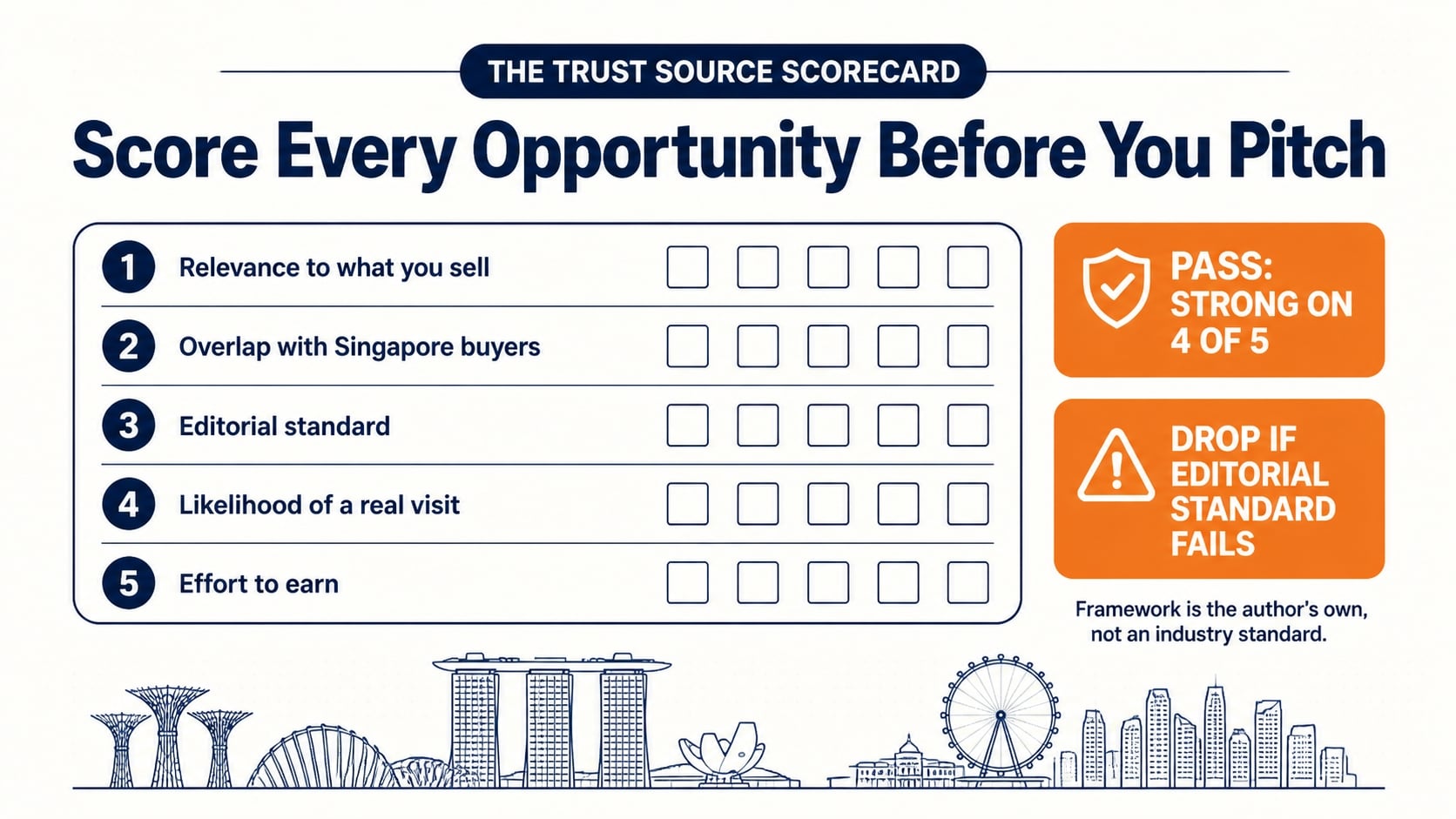
We use the Trust Source Scorecard to make this practical. Each opportunity is scored on five criteria:
- Relevance to what the business sells and the questions its buyers ask
- Audience overlap with Singapore buyers, not a generic global readership
- Editorial or verification standard, meaning the source checks what it publishes or lists
- Likelihood of a real referral visit, a person clicking through and reading
- Effort to earn, the time and cost to secure the placement
The pass/fail threshold is simple: an opportunity passes if it scores well on at least four of the five criteria and clears the editorial standard. Any opportunity that fails the editorial standard is dropped, whatever its total score.
Evidence from common patterns in local results
This position rests on a repeated pattern in local search results, not on a controlled test. When we review the first page for commercial queries in Singapore, such as accounting, renovation, clinic, tuition or logistics terms followed by a district name, the top businesses tend to share a similar set of off-page signals:

- Consistent Google Business Profile listings with a steady flow of reviews, rather than a spike followed by silence
- Presence in sector-specific directories and industry association pages that describe the business accurately
- A small number of mentions in local press, trade publications or partner websites
- Name, address and phone details that match across every listing
Bulk link profiles are largely absent. A business with a few hundred links from unrelated sites does not usually outrank one with a tight, relevant set of listings and mentions. The local pack in particular seems to reward prominence and consistency – the substance of local SEO services work. Reviews carry part of that weight; our test of how Google reviews affect SEO and AI mentions shows the effect in current results, and matching NAP details across the web is the job of local citations.

We should be clear about the limits. We have not run a controlled experiment isolating links from content quality, page experience and proximity, and Google does not publish how much each factor weighs. The pattern is consistent with our position, but it does not prove it.
Where this position is contested, and when volume still matters
Large national brands, publishers and e-commerce sites often need a wider referring domain footprint. Their competitive set is larger, and their pages compete with sites that have long link histories. For a Singapore business competing nationally on broad, high-volume terms, a relevant-only approach may stall before the first page.
Volume also matters for a new site. A brand-new domain with no references gets little from a handful of relevant listings alone. At that stage, a reasonable spread of legitimate directories and sector pages is sensible, provided they are reputable and not link farms.
Where we think volume still counts, the business is large, competes nationally or is brand new. For most Singapore SMEs, the first category of link deserves the time, and the second carries a risk that rarely justifies its cost.
A Step-by-Step Off-Page SEO Audit
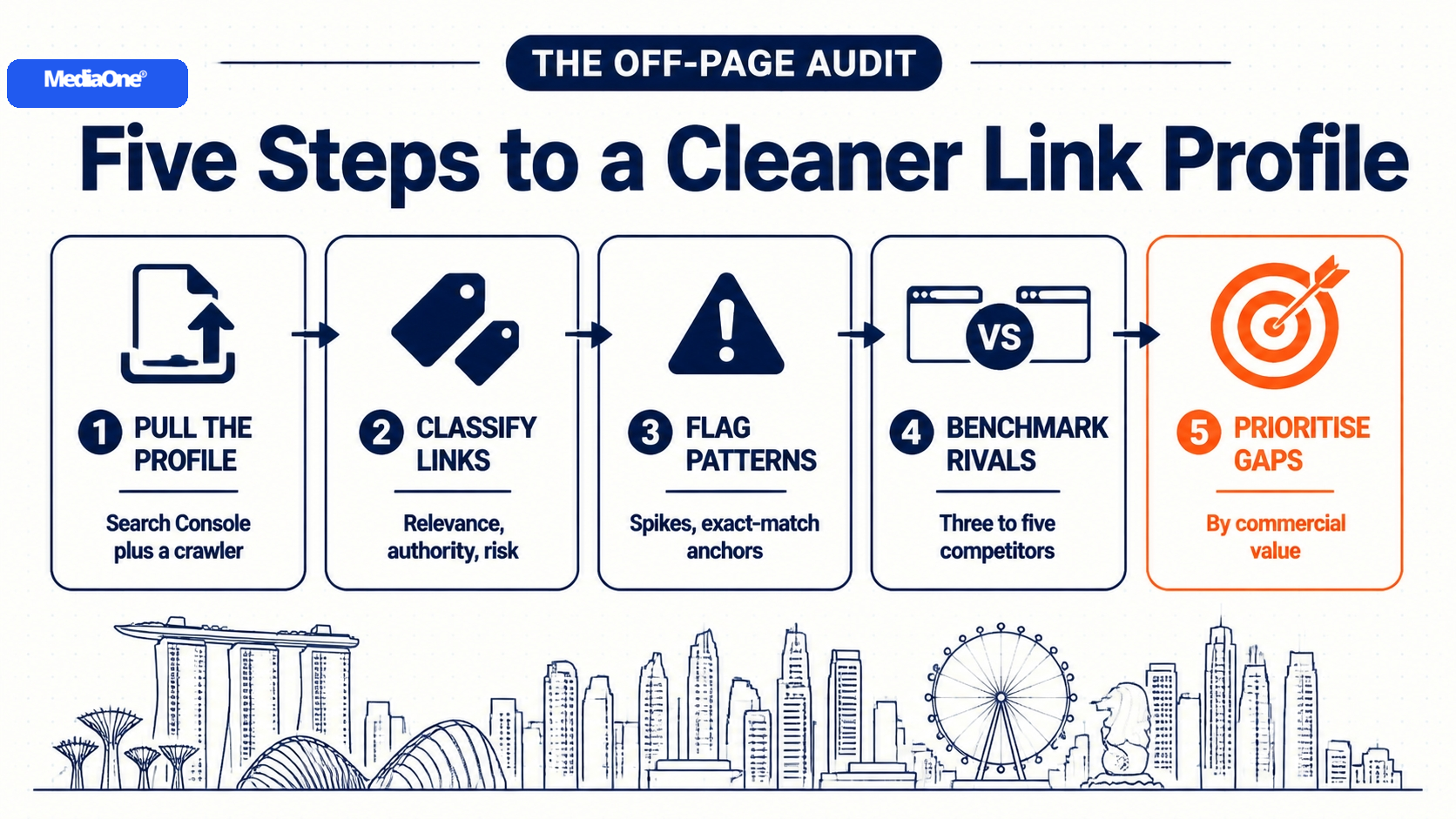
Most off-page audits start with a spreadsheet of referring domains sorted by a single authority score. That misses the point. An off-page SEO audit should check whether real businesses trust your site enough to link to it. Before starting, run a free website SEO audit so the on-page basics are not the blind spot behind your off-page plan. Then work through the five steps below in order, and use the checklist at the end to keep the review honest.
Step 1: Pull your existing backlink profile
Export every linking domain and URL you can reach. Use at least two sources, because no single tool sees the full picture. Google Search Console’s Links report shows the links Google has chosen to report. A third-party crawler such as Ahrefs, Semrush or Moz shows a broader set. Record the referring domain, the target URL on your site, the anchor text, the date first seen and whether the link is follow or nofollow.
Deduplicate the list by referring domain as well as by URL. One domain that links to you from twenty pages is one trust relationship, not twenty. Keep the raw export, because you will need it when you measure progress later.
Give every referring domain three labels. Relevance asks whether the linking site covers your sector, your region or your buyers. Authority asks whether a real audience visits the site, which matters more than a third-party metric alone. Risk asks whether the site looks like it exists to sell links.
|
Label |
Strong |
Weak |
|
Relevance |
Industry association, local trade publication, partner site |
Unrelated blog, generic link list |
|
Authority |
Named organisation with editorial team and visible traffic |
Thin site with no contact or ownership details |
|
Risk |
Verifiable business, clear editorial policy |
Paid link network, auto-generated pages |
Review domains that are strong on relevance but weak on risk manually before you keep them. Do not rely on a score to make that call.
Step 3: Identify toxic or unnatural patterns
Look for patterns rather than single links. Check these warning signs first:
- A sudden spike of links in a short window that does not match any campaign you ran.
- Exact-match anchor text (the same keyword phrase used as the link text) repeated across many unrelated domains.
- Clusters of links from sites with identical templates, hosting or ownership.
- Links from pages with no real content, or from pages in languages and sectors unrelated to your business.
- Sitewide footer or sidebar links from sites that have no connection to you.
Not every flagged link is harmful. Many are legitimate directory listings or mentions from partners. Mark each pattern as confirmed, likely or unclear, and act only on confirmed and likely cases. Google’s spam policies explain what counts as a manipulative link and are worth reading before you decide anything.
Step 4: Benchmark against three to five direct competitors
Pick competitors that rank for the same commercial queries in Singapore, not just the largest brands in your category. Run the same export for each one. Compare three things: how many relevant referring domains they hold, which sources appear in their profiles but not yours, and what share of their links come from Singapore-based or regional sites. The method is the same as a full competitor backlink analysis – the gaps that matter most are usually sources, not counts. If three competitors are listed with the same industry association and you are not, that is a concrete, verifiable opportunity. If they have forty links and you have twelve, the number alone tells you little.
Step 5: Prioritise gaps by commercial value
Turn the gaps into a ranked list using the Trust Source Scorecard. Score each opportunity on the five criteria from the section above. The pass threshold is a score of four or more on at least four of the five criteria, with the editorial standard cleared. An opportunity that fails the threshold is dropped, whatever its total. Then ask one commercial question: if this link appeared tomorrow, would a qualified buyer click it and enquire? If the answer is no, the link may still help rankings, but it should rank below sources that send real visitors. For starter tactics that fit a small budget, these tips on getting your first backlinks cover guest blogging, local Singapore websites and relevant directories.
Downloadable audit checklist
Use this checklist to record each audit. Copy it into a spreadsheet and tick each row when complete.
- Export backlinks from Google Search Console and at least one third-party crawler.
- Deduplicate by referring domain and keep the raw export.
- Label every referring domain for relevance, authority and risk.
- Flag patterns: link spikes, repeated exact-match anchors, shared templates, irrelevant sites.
- Review each flagged domain manually and mark it confirmed, likely or unclear.
- Export the same data for three to five direct competitors.
- List sources competitors hold that you do not.
- Score each opportunity on the five Trust Source Scorecard criteria.
- Drop any opportunity that fails the pass threshold.
- Rank the remaining opportunities by commercial value and set a review date.
Link Building Methods Compared
Most link building advice lists tactics without saying which one a given business should spend money on. The better question is which method earns a link from a source your real buyers trust, at a cost your budget can carry. The table below compares six methods on the criteria that decide that choice. For the local dimension of several of these, the complete guide to local link building for Singapore businesses goes deeper.
|
Method |
How the link is earned |
Typical quality and risk |
Cost and time to first link |
Best suited to |
|
Digital PR |
A story, data point or expert comment is pitched to journalists |
High where the publication is relevant and editorially reviewed; low to medium risk |
Retainer or staff time; several weeks to months depending on the story |
Brands with something newsworthy |
|
Guest contributions |
A byline article is placed on an industry or local site |
High to medium, depending on the site’s editorial standard; medium risk if the site sells placements |
Writing and placement fees, quoted per article; several weeks |
Businesses with subject expertise |
|
Directories |
A listing is created on a business or sector directory |
Varies widely, from strong verified listings to thin pages; low risk for verified directories, high for link farms |
Often free; paid premium listings vary; weeks |
Local visibility and citation consistency |
|
Partnerships |
A supplier, client or complementary firm links to you in return for a real collaboration |
High when the partner is genuinely related to your work; low risk |
Low cash cost, high relationship cost; months |
Businesses with established networks |
|
Sponsorships |
A sponsored event, award or community programme credits your brand with a link |
Medium to high, often on event or association pages; low to medium risk |
Quoted by the organiser; set by the event calendar |
Brands with a community or sector profile |
|
Resource pages |
A useful tool, guide or page is suggested to a site that curates links |
Medium to high, usually in a relevant context; low risk |
Low, mainly staff time for outreach; several weeks |
Businesses with a well-made reference asset |
Two of the methods in the table have their own playbooks on the MediaOne blog: the HARO route to journalist backlinks sits inside digital PR, and this guide to guest posting covers byline placements. Paid link placements are not in the table because they are not a method a serious programme should buy – they are prohibited under Google’s spam policies when they pass ranking credit, and the sustainable alternative is the white hat link building system that earns links which survive algorithm updates.
The table describes how each method works and what drives its cost. Costs and timelines vary by provider, audience size and demand, so get a current quote before budgeting.
Which methods suit a Singapore SME versus an enterprise brand
A Singapore SME with a small team and a modest budget should start with the cheapest methods that carry the most trust: verified directory listings, industry association memberships and resource-page outreach. These methods produce few links at a time, but they produce relevant ones. That is the right trade-off for a business whose buyers check listings before they enquire.
An enterprise brand can afford digital PR, sponsorships and sustained partnership programmes. Its advantage is scale. The trap is that a large budget spent on bulk placements can still buy low-trust links. Apply the Trust Source Scorecard before committing to any sponsorship or placement, and drop any opportunity that fails the editorial standard criterion, whatever its total score. The principle is the same one behind ethical SEO: rankings built to last come from sources a business would be proud to be named in.
Industry bodies are worth checking at both sizes. Membership listings with bodies such as the Singapore Business Federation and sector associations often include a verification step that generic directories lack, which makes them stronger signals of trust.
Costs, effort and realistic timelines
Plan on three things when budgeting.
- Cash cost is often the smaller part. A guest article may cost little in placement fees, but the staff time to research, pitch and revise it can exceed that.
- Timelines run longer than most teams expect. A digital PR campaign typically needs weeks or months before coverage appears, and a partnership can take half a year to mature.
- Expect many pitches to fail. Budget the outreach volume to match, because most outreach emails do not produce a placement.
Treat the table as a starting point, not a plan. Score each specific opportunity on the Scorecard, then compare its expected value against the cost and time it will take to earn it.
Earning Links Through Content Assets
Most off-page SEO work starts with outreach. The strongest links usually come from something a site has already published. A page that gives a journalist, a trade association or a sector blogger a fact they need will attract links without a sales pitch. This section covers three steps: making assets worth citing, writing them so they can be quoted, and distributing them after launch.
Original data, tools and calculators that attract citations
Original data gives other sites a reason to link back. A survey of your customers, a count of enquiries by sector or a benchmark from your own operations is information that exists nowhere else. Anyone writing on the subject has to cite you.
Tools and calculators work the same way. A business owner comparing costs might link to a payroll estimator, a rental yield calculator or a GST-inclusive pricing tool, because the tool does a job the reader would otherwise do by hand. Interactive assets tend to earn links for longer than static articles, because they stay useful.
Three test questions help decide whether an idea is worth building:
- Does the asset contain information or a calculation that does not already exist in a search result?
- Would a journalist or association writer need to name the source to use it?
- Can it be maintained so the figures do not go stale within a year?
If the answer to the first two is no, the asset is probably a rewritten article. If the third is no, the asset will decay into a page that links to outdated numbers, which damages trust.
Keep the methodology visible. A survey with a stated sample size, collection period and question wording is far more citable than a headline figure with no source behind it. State the year the data was collected, since readers and AI search engines weigh recency.
Writing for citation: claims, sources and self-contained passages
Writers and AI answer engines both look for passages they can lift without rewriting. A self-contained passage makes one claim, names its evidence and makes sense without the surrounding page. It should carry its subject, its figure, its date and its sample, so a citing writer can use it as written. Replace any example with figures from your own verified research.
Apply the same discipline across the page:
- State each claim plainly. Put the answer in the first sentence of a section, then support it.
- Attribute every number. Name the source organisation and its year. Do not write “studies show” without naming the study.
- Keep sections standalone. Each heading should be answered by its opening paragraph.
- Separate findings from interpretation. A reader should be able to tell which sentence is your data and which is your opinion.
- Avoid vague superlatives such as “the best” or “the leading”. They give a citing writer nothing specific to repeat.
Where you rely on an external source, link to it directly. Official statistics from the Singapore Department of Statistics give a claim a verifiable trail, and so does published research from a named university. Writers prefer pages that show their working, so credible citations also raise the chance that your page is cited.
Distribution after publication: the step most teams skip
Most content efforts stop at publishing, and that is where links are most often lost. An asset nobody sees earns nothing. Distribution means putting the asset in front of the people who would cite it.
A practical sequence after launch:
- Map the likely citers. List five to ten trade publications, industry associations, business bloggers and sector newsletters your buyers already read, including local outlets.
- Write a short, specific pitch. Lead with the single finding or tool, explain why it helps the recipient’s readers, and link the asset. Do not send the full article unless asked.
- Notify existing partners. Suppliers, clients and industry contacts can link to or share the asset with little effort. Ask them directly.
- Share where your buyers discuss the topic. Post in relevant professional groups, and answer related questions with a link where it genuinely helps.
- Follow up once. A polite second message a week or two later recovers responses that were simply missed.
- Refresh and re-promote. When the data changes, update the asset and tell the people who linked to it before.
Track distribution as its own activity. Record which outlets received the asset, the date, the response and any link that resulted. Over several launches, this shows which assets and outlets actually produce citations.
A content asset is only as good as the audience it reaches. Plan distribution before you build the asset, and budget time for it equal to the time spent producing it.
Conclusion and Summary
Off-page SEO for a Singapore business comes down to one question: which outside sources do your real customers already trust, and have they noticed you? Links, mentions and reviews matter because they show that trust. A handful from the right places does more for visibility and enquiries than a large pile from anywhere.
Three things are worth carrying forward from this guide. First, score every opportunity on relevance, audience overlap, editorial standard, likelihood of a real referral visit and effort to earn. Drop any source with weak editorial standard, however well it scores elsewhere. Second, audit your existing profile before adding to it, because removing risky links often protects you more than adding new ones. Third, measure progress through referring domains that matter, branded search growth and enquiry quality, not raw link counts.
If you take only one action this quarter, make it the audit. Pull your current backlink profile, classify each link, and identify three Singapore-relevant sources where a listing or mention would be credible. A trade association, a local directory or a review platform your buyers use are good places to start. Then build outward on a 90-day plan.
Frequently Asked Questions
How long does off-page SEO take to show results?
Most businesses see the first measurable movement within three to six months. Meaningful ranking gains usually take six to twelve months. That matches practitioner timelines such as MarketerHire’s SEO roadmap: groundwork and minor ranking movement in months one to three, clearer traffic and ranking gains in months four to six, and significant growth from six to twelve. The exact pace depends on how competitive your category is, how strong your site already is, and how many relevant sources you can earn. A Singapore accounting firm competing for “corporate tax filing” will take longer than a specialist bakery competing for “custom wedding cakes Tiong Bahru”.
Early signs rarely appear as rankings first. They tend to be new referral visits, more branded searches, and reviews or mentions in places buyers already look. Track these leading indicators monthly, so you are not waiting on rank trackers alone.
How much should a Singapore SME budget for link building in S$?
A realistic planning assumption for a sustained, well-run outsourced programme is S$1,500 to S$5,000 a month – the same band as global pricing guides such as HigherVisibility’s 2026 survey report for most engagements. Treat that as a planning assumption, not a market rate, and confirm it against itemised quotes. Costs rise where outreach involves paid placements, sponsored content or events. Ask each agency for an itemised quote covering the number of outreach targets, the content produced and the reporting included.
Be cautious with very cheap packages promising a fixed number of links. Those often rely on low-quality sites that carry little trust with search engines or buyers. A smaller budget spent on three to five well-chosen placements, such as a relevant association listing or a local trade publication feature, usually returns more than a large batch of weak links. Apply the Trust Source Scorecard to each proposed placement before you approve spend.
Are directory submissions still worth doing?
Yes, but only selectively. Directories help buyers find accurate business information and keep your name, address and phone number consistent across the web. Listings on platforms such as Google Business Profile, the Singapore Business Federation’s member directory where applicable, and relevant sector association pages are generally more useful than generic submission sites. These are general business listing practices, and they do not guarantee a ranking benefit.
Skip directories that charge for links, accept any business without verification, or look like content farms. Check whether a directory verifies listings and whether real buyers use it. If it fails both tests, it is unlikely to help rankings or enquiries.
Google’s own position is that it does not use social signals as a ranking input in the way many marketers assume. That is Google’s stated position, not a proven fact, and independent testing on the question is limited. Treat social activity as a route to visibility rather than a ranking shortcut. A post that gets read may lead to a mention, a link, a branded search or an enquiry, and those outcomes can affect search performance.
Social still matters for discovery and reputation. Use it to distribute content that earns citations, and measure success by referral visits, branded search growth and enquiry quality rather than share counts alone.
How do I know if a link is harmful?
A link is more likely to be harmful when it comes from a site with no editorial standard, appears in an unrelated context, is sold or traded in bulk, or sits on a page stuffed with unrelated outbound links. Look for sudden spikes in referring domains, anchor text that repeats the same commercial phrase, and sources with no real audience. Google Search Console shows links pointing to your site, which is a good starting point for review.
Harm is a judgement call, not a single test. Ask whether a real person would plausibly click the link and whether the source would be credible to a buyer. If the answer is no on both counts, mark it for review. Remove or disavow a link only after careful evaluation, not by reflex.

Should I use a disavow file?
Use a disavow file only when you have identified a clear pattern of manipulative links and cannot get them removed through outreach. Google’s disavow guidance says most sites will not need the tool, because Google can assess which links to trust without additional guidance; it suits cases where you have a manual action or a significant volume of spammy links you created or paid for.
Disavowing good links can reduce your visibility, so avoid submitting a file as routine housekeeping. Attempt removal first, document your reasoning, and keep the file focused on links you can justify. If you are unsure, an experienced auditor can review the profile before you act.