If your competitors keep ranking higher than you on Google, they know something you don’t. And chances are, it’s about backlinks.


In 2026, backlinks remain one of the top three factors that get websites to rank, and your competitors are already using them to stay ahead.
Here’s the thing: websites in the top positions have 3.8 times more backlinks than those sitting in positions 2-10. That’s not luck, it’s strategy. When you figure out where your competitors are getting their links, you’ve got a clear roadmap to building your own authority and climbing past them in search results.
For businesses in Singapore competing both locally and internationally, understanding your competitors’ backlink game can make or break your visibility online.
Let’s break down how to do this step by step, tool by tool, tactic by tactic.
Key Takeaways
- In 2026, backlinks remain one of the top three ranking factors. Competitor backlink analysis lets you reverse-engineer their strategies, giving you a clear blueprint for building authority and outranking them. Sites in top positions typically have 3–4 times more backlinks than those ranking below, making analysis essential.
- Ten high-authority, contextually relevant links are far more impactful than hundreds of low-value backlinks. Google evaluates both the authority of the linking site and the relevance of the link to your content, so focus on links that carry real SEO weight.
- Study your competitors’ top-performing pages to uncover what resonates with audiences and earns backlinks. This could include long-form guides, interactive tools, infographics, original research, or controversial insights. Understanding this helps you create content that performs even better.
- Backlinks can be earned in different ways like guest posts, resource pages, digital PR, or organic mentions. Knowing which tactics work for competitors allows you to prioritise strategies that scale and avoid approaches that are low ROI.
Why Competitor Backlink Analysis Matters in 2026

Backlinks work like votes of confidence. When a trusted website links to your content, Google sees it as proof that you know what you’re talking about.
More quality backlinks means more trust from Google, which means better rankings.
But here’s where most people get stuck: building backlinks from scratch takes forever. You’re guessing which websites to target, what content to create, and which outreach messages actually work.
Your competitors have already solved much of this puzzle. They’ve identified which websites matter, which content earns links, and which tactics deliver results for their digital marketing services. Instead of starting from zero, you can learn directly from what they’ve already done.
You study their wins and their mistakes, then use that knowledge to build your own strategy—but better.
In 2026, Google cares more about link quality than quantity. That means understanding where your competitors get their most powerful links matters more than ever.
What is Competitor Backlink Analysis?
Competitor backlink analysis means looking at the backlink profiles of websites that rank higher than you. You’re checking which sites link to them, how good those links are, and finding opportunities to get similar or better links for yourself.
But it’s not just about collecting data.
You need to understand why each link matters—the authority of the linking website, how relevant it is to your niche, what anchor text they used, and what content earned that link in the first place.
When you analyse competitor backlinks, you’re looking for five key things.
- Link sources: Every website linking to your competitors
- Link quality: Authority scores, relevance, and placement
- Content gaps: What type of content earns the most links
- Outreach targets: Which websites are most likely to link to you
- Winning strategies: What tactics do your competitors use
Once you understand what to look for, the next step is to choose the right tool.
Essential Tools for Competitor Backlink Analysis
Sorry to break it down to you, but you can’t do serious competitor backlink analysis without the right tools. While you could do this manually, you’d spend weeks gathering data that professional SEO tools provide in minutes.
Let me break down the three main options and when to use each one.
Ahrefs: Your Main Weapon ($129/month)

Source: https://ahrefs.com/assets/esbuild/1_Metrics@2x-6QB3VSCG.png
Ahrefs has the largest and most frequently updated backlink database in the industry. It’s the gold standard for a reason. Key features include:
- Site Explorer: Analyse any competitor’s complete backlink profile in detail.
- Link Intersect: Shows websites linking to multiple competitors but not to you—your easiest outreach targets.
- Best by Links report: Identifies competitors’ most linked-to content in seconds.
The tool starts at $129/month, which is worth it if you’re serious about link building and want the most comprehensive data available.
SEMrush: The All-in-One Option ($139.95/month)

Source: https://static.semrush.com/free-tools-assets/images/backlink-checker/what-is-backlink-analytics.png
SEMrush combines backlink analysis with competitive intelligence and keyword research. Key features include:
- Backlink Analytics: Detailed insights into competitor link profiles, including authority scores and toxic link identification.
- Backlink Gap tool: Reveals linking domains your competitors have that you don’t, highlighting quick-win opportunities.
- Backlink tracking: Monitors competitors’ new and lost backlinks over time to spot emerging trends.
At $139.95/month, it’s a better value if you need keyword research alongside backlink analysis.
Moz Link Explorer: Budget-Friendly Quality Focus ($99/month)

Moz Link Explorer emphasises link quality over quantity. Key features include:
- Domain Authority & Page Authority metrics: Evaluate the value of links.
- Link Opportunities: Suggests specific websites to target based on competitor data.
- Spam scores: Helps avoid low-quality or risky link sources.
At $99/month, it’s the most budget-friendly option for small businesses just getting started with competitor backlink analysis.
Quick Comparison Table
Here’s a side-by-side look at the key differences to help you decide fast:
| Tool | Best for Local SEO | Best for International SEO | Price | Pros | Cons |
| Ahrefs | Small businesses targeting local markets | Large-scale global campaigns | $129/month | Largest & most frequently updated backlink database
Site Explorer & Link Intersect Best by Links report |
Pricier than some options |
| SEMrush | Businesses needing combined SEO + backlink insights | Agencies running multi-country campaigns | $139.95/month | All-in-one SEO suite
Backlink Analytics & Gap tool Competitor backlink tracking |
Slightly complex interface for beginners |
| Moz | Small businesses or startups on a budget | Not ideal for large international campaigns | $99/month | Emphasises link quality over quantity
Domain & Page Authority metrics Link Opportunities & Spam Detection |
Smaller backlink database; Less suitable for global campaigns |
There are more tools available, but these are the ones my team swears by.
The 5-Step Process for Competitor Backlink Analysis
Tools provide the data, but a clear process turns it into actionable insights. Here’s a five-step framework to guide your analysis.
Step 1: Find Your Real SEO Competitors

Your business competitors aren’t always your SEO competitors. The websites you need to analyse are the ones actually ranking above you in search results for your target keywords.
Follow these steps:
- Open Google in an incognito window
- Search for your main target keywords
- Note which websites consistently appear in the top 10
- Pick 3-5 sites that have a similar domain authority to yours
Comparing yourself to industry giants with massive backlink profiles isn’t useful when you’re still building your authority.
You want realistic targets where you can actually replicate their success.
For example, if you run an SEO agency in Singapore and search “SEO services Singapore,” look at the other Singapore agencies ranking in the top 10. Those are your benchmarks, not Moz or Search Engine Journal.
Step 2: Pull and Filter Their Backlink Data
Now you need to see every website linking to these competitors. Not manually, but with the right linking building tools.
At MediaOne, we both use Ahrefs and SEMrush to analyse our competitors’ backlinks. If you have the same tools, here’s how you do it.
For Ahrefs, go to Site Explorer and enter your competitor’s domain. Click “Backlinks” in the left sidebar, set your filter to show dofollow links and one link per domain, then export the data to a spreadsheet.
In SEMrush, go to Backlink Analytics, enter the domain, click the Backlinks tab, and export to CSV. Repeat this process for each of your 3-5 competitors.
You’ll end up with thousands of backlinks, but most won’t be worth your time.
Sort your exported data by Domain Authority or Domain Rating, and delete any entries below DA 30 (adjust this threshold based on your industry).
Remove obvious spam—sites with weird domain names, foreign language sites completely unrelated to your niche, or adult content.
Look for patterns in the remaining links. Are most high-quality links coming from industry blogs? News sites? Resource pages? Understanding these patterns helps you prioritise your link-building efforts later.
Step 3: Find Their Best Link-Earning Content
Some pages on your competitor’s site attract way more links than others. These pages are goldmines because they show you exactly what type of content works in your niche.
In Ahrefs, click “Best by Links” and sort by referring domains. In SEMrush, go to “Best Pages by Links” under Indexed Pages. Look at the top 10-20 pages and analyse what makes them successful.
Open each high-performing page and study it carefully.
Is it a comprehensive guide running 5,000+ words? An infographic or visual content? Original research with unique data? A free tool or calculator? Maybe it’s a controversial opinion piece that sparked discussions.
What’s important is: Take detailed notes on what makes each piece link-worthy.
For example, you might find a competitor’s “Complete Guide to Instagram Marketing” has 150 backlinks. That means 150 different links from other websites point to that page.
When you open it, you see it’s packed with screenshots, includes a downloadable checklist, and covers strategies most guides miss.
That’s your blueprint for creating something even better.
Step 4: Categorise How They Got Each Link
Click through your filtered backlink list and figure out how each link was likely acquired.
Earned links are used when someone mentions your competitor in an article without being asked. Guest posts are when your competitor writes for the site.
You’ll also find links on resource pages, listed alongside other helpful tools or guides. Digital PR generates links from news coverage or journalist citations.
And some links simply come from directory or business listing sites.
Understanding link acquisition methods matters because some tactics scale better than others.
- Guest posting and resource page outreach can be repeated with consistent effort.
- Earned links require exceptional content but often carry the highest authority.
- Digital PR can generate multiple links from a single campaign.
Now, go back to your spreadsheet. Add a column to it, marking each link type to identify which tactics your competitors rely on most.
Step 5: Build Your Target Outreach List
This is where the magic happens. Outreach is the process of contacting other websites to encourage them to link to your content.
At this stage, you’ve already analysed your competitors’ backlinks and identified the types of links that work.
Now, you’re ready to turn those insights into actionable opportunities by targeting sites that are most likely to link to you.
Let’s use our tools again.
In Ahrefs, use the Link Intersect tool and enter 2-3 of your competitors’ domains. Add your own domain in the “But don’t link to” field and click to see results. This reveals websites that link to multiple competitors but not to you. These are your easiest targets because they’ve already demonstrated interest in your topic.
In SEMrush, the Backlink Gap tool does the same thing. Add your domain and up to 4 competitors, click “Find prospects,” and you’ll see opportunities ranked by value.
Then, create a prioritised spreadsheet with columns for target website, domain authority, contact email, link opportunity type, priority level, and status.
| Target Website | Domain Authority (DA) | Contact Email | Link Opportunity Type | Priority Level | Status |
| Example.com | 45 | info@example.com | Guest post / Resource link | High | Not contacted |
| AnotherSite.com | 38 | outreach@another.com | Digital PR / Mention | Medium | Not contacted |
| ThirdSite.com | 25 | contact@third.com | Directory / Listing | Low | Not contacted |
Priority Levels Explained:
- High Priority: DA 40+ sites, strong topical relevance, links to 2+ competitors. Focus outreach here first.
- Medium Priority: DA 30–40 sites, links to at least 1 competitor. Reach these after high-priority targets.
- Low Priority: Everything else. Outreach is lower impact and can be done later.
Focus your outreach efforts on high-priority opportunities first. These sites are most likely to link to your content because they’ve already shown they value similar resources in your niche.
Advanced Tactics for Replicating Competitor Backlinks
Now, let’s get tactical. Actually getting those links for yourself requires specific tactics that work. Here’s how to get these links.
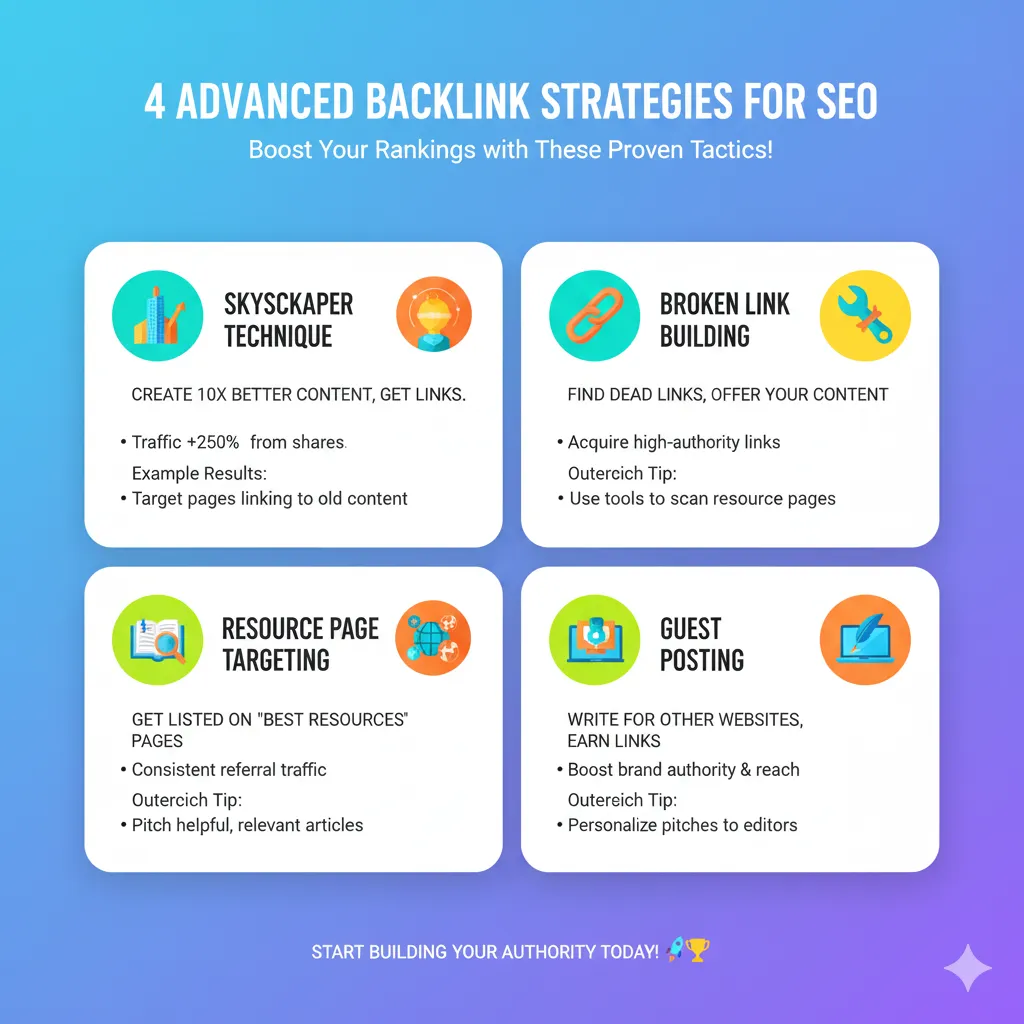
Tactic 1: The Skyscraper Technique
When your competitor has content that’s attracting multiple backlinks, your job is to create something significantly better.
Find their top-linked piece using the methods we covered earlier. Let’s say they have an “SEO Guide for Beginners” with 50 backlinks. Study it carefully. How long is it, what does it cover, what’s missing or outdated?
Now create something 10x better. Make it longer and more comprehensive. Add more visuals, screenshots, or videos. Include downloadable resources like checklists or templates. Update any outdated information and cover topics they missed entirely.
Your upgraded content gives you a compelling reason to reach out to sites linking to the original.
Here’s the exact email to send:
Subject: Quick question about your [Topic] article
Hi [Name],
I noticed you linked to [Competitor’s Article] in your piece about [Topic].
I just created a more comprehensive resource that includes [specific unique feature 1], [specific unique feature 2], and [specific unique feature 3].
Here’s the link: [Your URL]
Would it add value to your readers?
Thanks!
[Your name]
Real example: A competitor has “15 Instagram Growth Hacks” with 30 backlinks.
You create “50 Instagram Growth Strategies for 2026” with detailed case studies, before/after examples, and a strategy calculator. You reach out to those 30 sites, explaining how yours is more comprehensive. Eight sites update their link or add yours as an additional resource.
That’s eight high-quality backlinks from a single piece of content.
Tactic 2: Broken Link Building
This tactic works because you’re helping website owners fix actual problems on their sites.
In Ahrefs, enter your competitor’s domain in Site Explorer, click Backlinks, then filter by “Broken” to see links pointing to their dead pages.
Use the Wayback Machine to view what content was available at that URL. Create your own content covering the same topic, but better and more current.
Then reach out to every site with a broken link using this approach:
Subject: Broken link on your [Page Name]
Hi [Name],
I was reading your article “[Title]” and noticed a broken link in the [section name] section. The link to [dead URL] returns a 404 error.
I recently wrote a comprehensive guide on the same topic: [Your URL]
Would you be interested in updating the link?
Thanks!
[Your name]
Most site owners appreciate it when you point out broken links. You’re helping them improve their content while earning a backlink for yourself.
In one recent example, I found 15 broken links pointing to a competitor’s old Instagram strategy guide. I created my own guide, reached out to all 15 sites, and 6 updated their link to point to mine instead.
That’s six quality backlinks from one afternoon of outreach.
Tactic 3: Resource Page Targeting
Resource pages are designed to link to valuable content in a specific niche. They’re ideal link-building targets because the site owner actively maintains a list of helpful resources.
Find these pages using Google searches like “[your topic] + helpful resources” or “[your topic] + intitle:resources“.
Check what types of content they’re already linking to and create something worthy of inclusion. Your content needs to match or exceed the quality of existing links on the page.
Then send a brief, personalised pitch:
Subject: Resource for your [Page Name] page
Hi [Name],
Your [Resource Page Name] is really useful. I noticed you include resources about [Topic].
I created a [resource type] that might be valuable: [Your URL]
Would it be a good fit?
Thanks!
[Your name]

I recently found 12 resource pages on digital marketing that linked to competitor SEO guides. After creating an interactive SEO checklist tool, I pitched it to all 12 and got added to 5 of them. These links stay up for years because resource pages are rarely updated to remove outdated content.
Content marketing services can help you create the type of link-worthy resources that actually get added to these curated lists.
Tactic 4: Guest Posting (The Right Way)
Guest posting still works when done strategically. Guest posting still works when done strategically. It’s one of the many ways you can learn how to get backlinks from reputable sites.
Start by finding sites that accept guest posts. Look at where your competitors are publishing, or search Google with “[your topic] + write for us” or “[your topic] + guest post guidelines.”
Next, study what performs well on each site. Read their most popular posts, note which topics get the most engagement, and pay attention to their style and article length.
Then, pitch topics they haven’t covered. A simple email might look like this:
Subject: Guest post pitch: [Your Topic]
Hi [Name],
I enjoyed [specific article] on [Publication]. I noticed you haven’t covered [topic] yet and would love to contribute a post.
Here are three angles I’m thinking about:
[Pitch 1]
[Pitch 2]
[Pitch 3]
I can provide samples if helpful. Please let me know if any of these interests you.
[Your Name]
[Portfolio link]

Once accepted, write high-quality content following the site’s guidelines. Include 1–2 contextual links to your own content, and ensure the post adds real value to their audience.
Common Mistakes to Avoid in Competitor Backlink Analysis
Even experienced marketers make costly mistakes with competitor backlink analysis.
Here’s my advice:
Don’t Obsess Over Total Link Counts
- Focus on referring domains, not total links.
- Fifty quality links from 50 different domains are far more valuable than 1,000 low-quality links from just 10 domains.
- Google values diversity and quality, not raw numbers.
Always Check Links in Context
- Click through to actually view each link.
- A DA 45 link might look impressive on paper, but if it’s buried in an old blog post nobody reads, it’s not worth pursuing.
Don’t Copy Competitor Content
- Never expect similar results from duplicating a competitor’s content.
- Websites won’t link to your version if a better-established resource already exists.
- Create something genuinely better: more comprehensive, current, well-designed, and actionable.
Track Link Velocity
- Monitor new backlinks your competitors acquire each month.
- If a competitor gains 20 links from guest posts in one month, that shows their current strategy in action.
- Focus on tactics that work today, not strategies from three years ago.
Watch Anchor Text Distribution
- Avoid overusing exact-match keyword anchors; more than 30% can look unnatural to Google.
- Aim for a balanced mix: brand name, website URL, and a few keyword links.
- Keep your backlink profile natural and safe.
Backlink analysis goes beyond numbers. Focus on quality, context, and creating better content than your competitors.
Tracking Your Competitor’s Backlink Strategy
You can’t improve what you don’t measure. To make your backlink strategy effective, track these five key metrics each month:
- Referring Domains: Count the number of unique websites linking to your site. Even steady growth of 3–5 new domains per month adds up over time and boosts your site’s authority.
- Domain Authority (DA) Growth: Monitor your DA score to see how your site’s overall strength improves. Don’t expect overnight jumps; moving from DA 30 to 35 typically takes around six months of consistent link building.
- Keyword Rankings: Check the positions of your 10–20 target keywords weekly or monthly. Remember that new backlinks usually take 2–4 months to influence rankings as Google crawls and factors them into its algorithm.
- Organic Traffic: Look at visits from organic search in Google Analytics. Pages that recently earned backlinks should show measurable traffic increases, confirming those links are driving results.
- Referral Traffic from Backlinks: Track visitors coming directly from each backlink. High-quality links don’t just help SEO. They bring engaged readers. For example, a link from a DA 50 marketing blog that drives 40 visitors per month with a 3-minute average session is a high-value link.
To make tracking easier, use MediaOne’s Competitor Backlink Analysis Tracker, which lets you log all five metrics in one place.
After six months, you’ll see clear patterns showing what’s working and where to focus more effort.
Your Next Steps: Turning Competitor Analysis into Action
Competitor backlink analysis isn’t spying. Like I tell my team all the time: learn from what works, and use it to get smarter.
Your competitor’s backlink profiles are full of clues you can use to improve your own strategy. Start with your top three competitors, grab their backlink data, and find 20 “low-hanging fruit” sites linking to multiple competitors but not you.
This month, create one piece of content that’s genuinely better than what’s out there, and start outreach next week—even just a few thoughtful emails.
Remember: ten high-quality, relevant backlinks beat a hundred weak ones. Focus on links that actually move the needle.
If you need expert help implementing these strategies, MediaOne Marketing specialises in data-driven link building that delivers measurable results for Singapore businesses.
We can analyse your competitors, identify the best opportunities, and build a backlink profile that gets you ranking higher. Contact us and let’s talk about outranking your competition together.
Frequently Asked Questions
How often should I analyse competitors’ backlinks?
Do a deep dive every quarter (3 months). Check for new backlinks monthly to spot emerging tactics. Take 30 minutes per month to review and adjust your strategy.
Can I use this for local SEO?
Absolutely. Analyse local businesses ranking in Google’s Local Pack. You’ll find local directories, community sites, and regional news sources. Your local SEO ranking strategy should include competitor backlink analysis.
How many competitors should I track?
Start with 3-5 direct competitors ranking just above you. Analysing too many creates information overload. Comparing yourself to industry giants isn’t useful when you’re still building authority.
How long until I see ranking improvements?
Usually, it takes 2-4 months after acquiring quality backlinks. Google needs time to crawl, process, and update rankings. Stay consistent for 6-12 months to see significant changes.
Should I target only sites that competitors link to?
Start there, but don’t limit yourself. Use competitor analysis to identify which types of sites work, then expand into similar sites they don’t have yet.
What if competitors have links I can’t get?
Focus on what’s achievable. If they have Forbes links because they’re huge, target industry blogs where you have a shot. Find your own opportunities that match your resources.