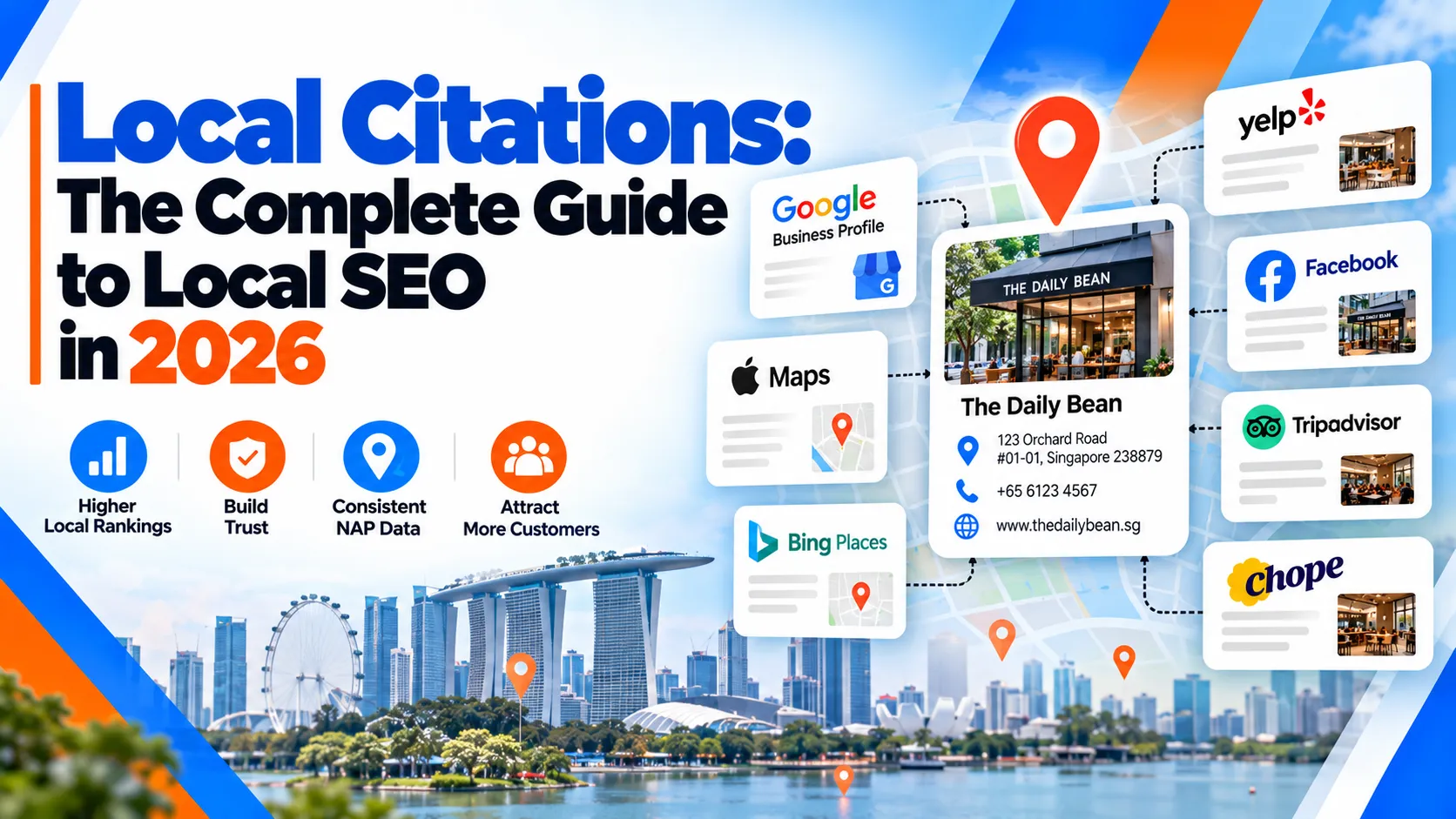
Local citations are online mentions of your business name, address and phone number (NAP) on external websites. They appear on directories, review platforms, industry associations and data aggregators such as Google Business Profile, Apple Maps, Bing Places and specialised websites like HealthHub or Chope. A citation is any reference to your business details, and it does not need to include a clickable link back to your site.

Search engines treat citations as trust signals. They verify that your business exists, operates where you claim, and deserves visibility for local queries. A business with consistent, authoritative citations gets stronger local search visibility than one with the same website but scattered, incomplete, or conflicting data.
This guide covers what citations are, how Google, Bing and Apple use them, and a step-by-step framework for building a citation profile that affects local search rankings. It is written for practitioners: single-location owners, in-house local SEOs and agencies managing multi-location brands.
Key Takeaways
- Local citations are mentions of your business NAP on external websites, and they influence local pack rankings.
- NAP consistency across all citation sources is a trust signal to Google, Bing, and Apple Maps and one of the fastest ways to boost visibility.
- High-authority universal directories (Google Business Profile, Apple Maps, Bing Places) matter more than volume: 10 citations on trusted platforms outperform 100 on obscure ones.
- Duplicate, incomplete or conflicting citations may negatively impact local search visibility. A citation audit and cleanup can improve rankings over time.
- Multi-location businesses need automated citation management once they pass roughly five locations; manual tracking becomes impractical beyond that scale.
- Citation impact is measurable: monitor impressions, click-through rate and local pack positions rather than making assumptions.
- Industry and regional directories vary widely by geography. A Southeast Asian retail business requires a different source list than a North American software company.
What Are Local Citations, and Why Do They Matter?
What is a citation?
A local citation is any online mention of your business name, address and phone number (NAP). It appears on directories, review platforms, industry associations and data aggregators. It does not need to be a hyperlink or a dedicated page about your business. A single line listing you in a plumbing directory counts. So does your entry in a hospital’s affiliated-physician database.
Why citations matter
Citations tell search engines that your business exists, where it operates, and how to reach it. When Google sees your NAP data on multiple independent websites, it treats that consistency as evidence you are a real, stable business at that address. Each citation adds a data point to the knowledge graph search engines build for your business. This graph powers local search results, map listings and knowledge panels.
How Citations Differ from Backlinks
A backlink is a hyperlink from one website to another. A citation is a mention of your business details, usually with no clickable link. Each signals a different kind of trust.
A backlink says, “This website vouches for your content and found it relevant enough to reference.” A citation says, “Your business data appears consistently across the web.” Search engines use both, but they measure different dimensions of trustworthiness.
Two structural differences are relevant for local SEO:
- No editorial judgement required. You can claim a listing on Google Business Profile or submit to a directory without anyone reviewing your work. A backlink only happens when someone else chooses to link to you.
- Permanence. If a website removes a page, the backlink vanishes. Directories often archive old business data or keep listings live for years. A citation from 2020 can still influence local search visibility in 2026.
For local SEO, citations often matter more than backlinks. Local algorithms weight directory presence and NAP consistency heavily, especially for service-area businesses like plumbers, dentists and electricians, where proximity and verified business data take priority over editorial endorsements.
Business impact: ranking, map pack and click-through
Citations affect three measurable outcomes: local search ranking, visibility in map packs, and click-through rate.
| Outcome | How citations influence it | What to expect |
|---|---|---|
| Local search ranking | Citation authority and consistency act as ranking signals alongside on-page content | A stronger citation profile contributes to improved visibility |
| Map pack visibility | Inclusion in the three or five map results is driven by proximity, relevance and prominence | Without citations, map pack inclusion becomes difficult in competitive searches |
| Organic click-through rate | Accurate NAP displays build confidence; conflicting or sparse data looks unreliable | Inconsistent contact details across citations may reduce conversion confidence |
The cumulative impact is significant. A dental practice with a poor citation profile may rank outside the top three results for “dentist in [suburb]”, reducing the search traffic it would otherwise capture. A home-service business with strong citations can drive more leads from improved listing consistency alone.
Citations also reduce paid advertising reliance. Organic rankings in local results capture traffic at a lower cost than local services ads. For businesses new to SEO, citations are among the most cost-effective ways to build that organic advantage.
How Search Engines Use Local Citation Data
Entity recognition and knowledge graphs
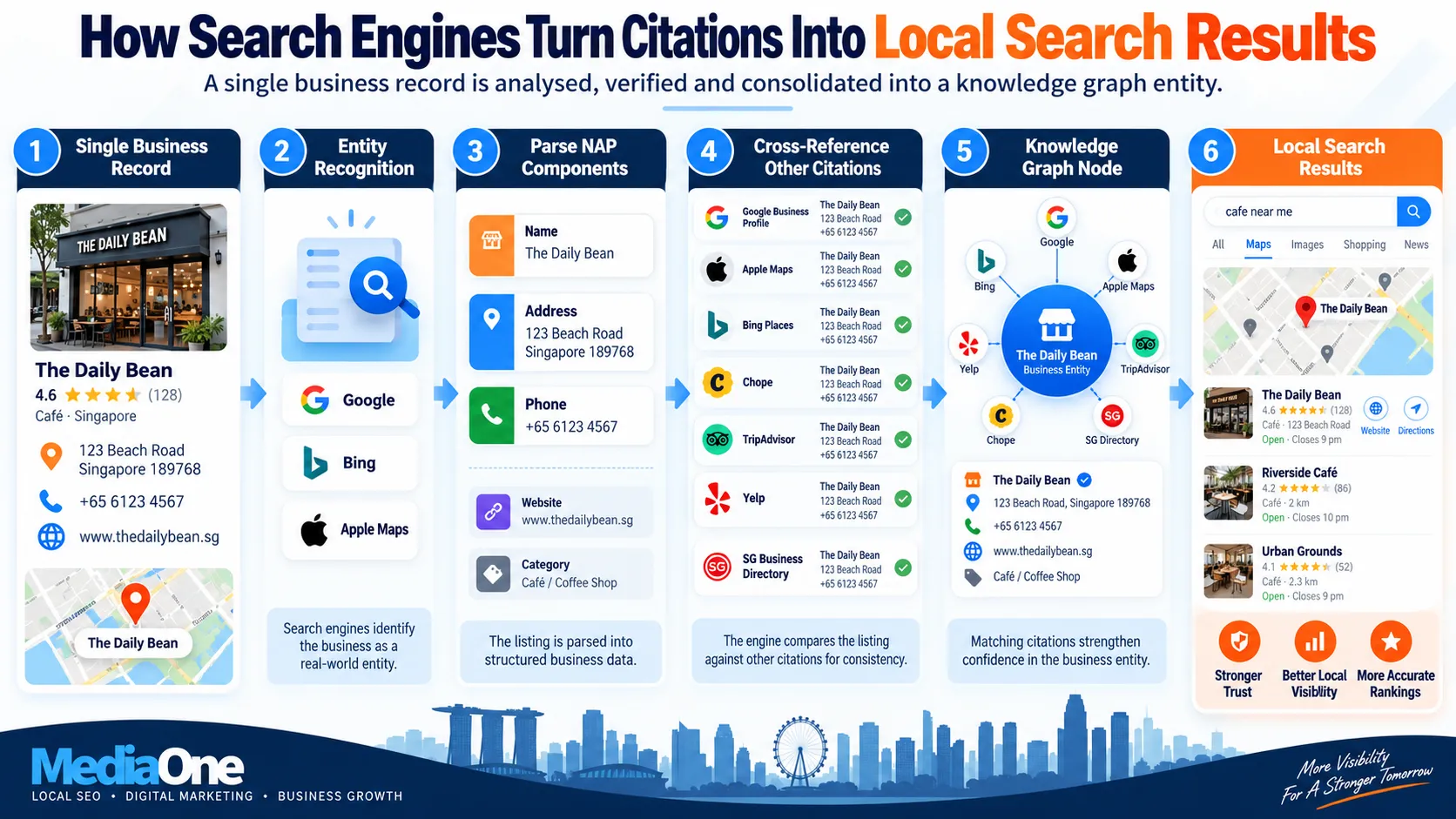
Search engines use citations to recognise and verify your business as a distinct entity. When your NAP appears on multiple websites, search engines match these mentions to build a single business profile in their knowledge graph. This consolidated record powers local search results.
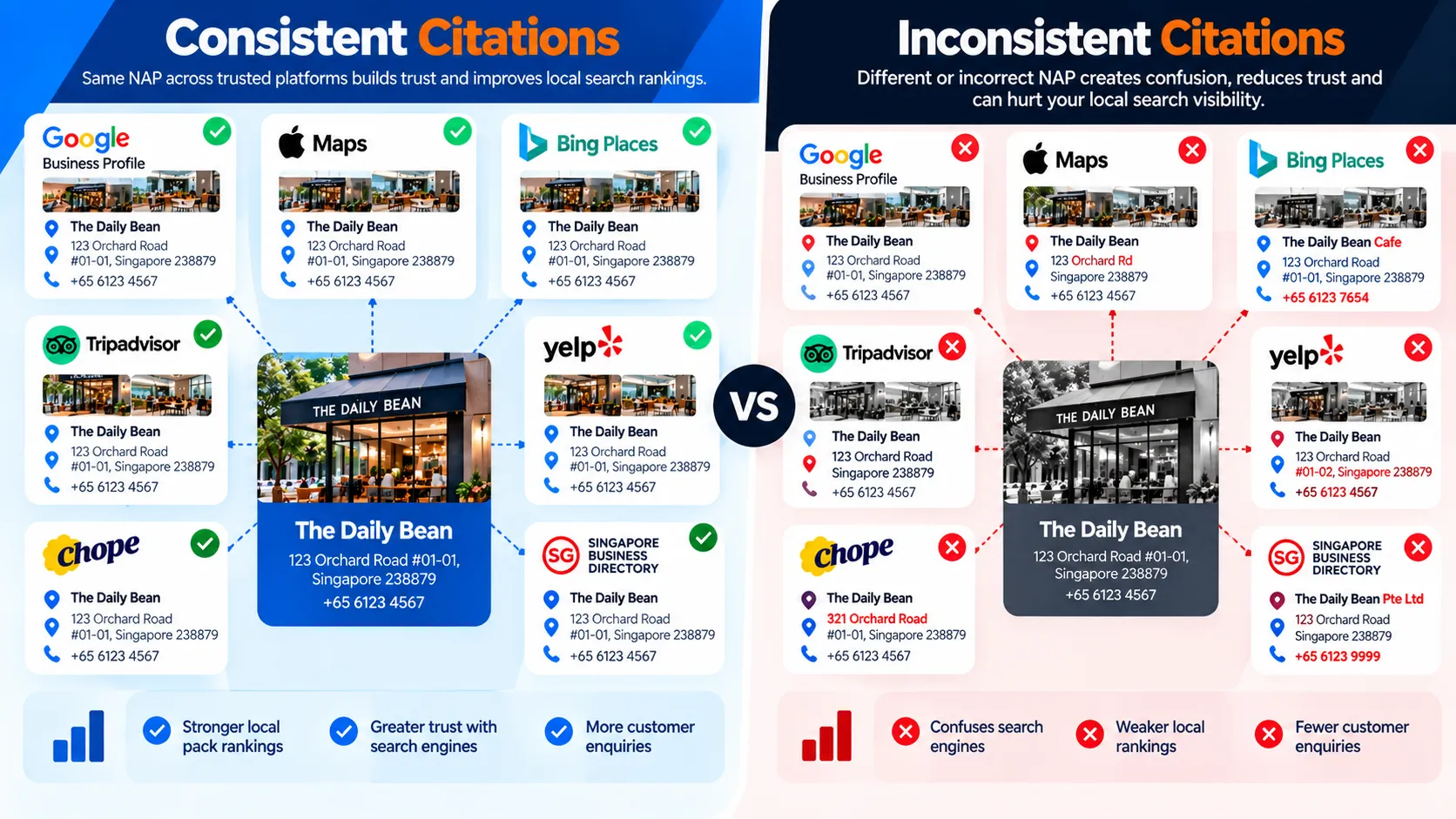
Conflicting data (your address listed two different ways, or your phone number varying across sites) creates confusion. Search engines may treat these as separate businesses or reduce confidence in your primary listing.
NAP consistency as a trust signal
Consistency across citations signals to search engines that your business is stable and legitimate. When someone searches for your business name or your service category near your location, consistency makes your listing rank higher.
Not all citations are equally authoritative. A listing on Google Business Profile or Apple Maps carries more authority than a mention on an obscure local blog. Search engines assign authority based on the reputation and traffic of the citing website, the freshness of the data, and how often it updates.
Industry-specific directories also carry more weight for their vertical. A dentist’s listing on a dental association directory signals more relevance than a general business directory listing.
Building Your Citation Strategy: A Step-by-Step Framework
Step 1: Audit and standardise your NAP data
Before claiming or submitting to any directory, document your canonical NAP data. This is your single source of truth.
Define it precisely: Is your address “123 Main Street, Singapore 012345” or “123 Main St, Singapore 012345”? Choose one format and use it everywhere. Include or exclude suite numbers, postal codes, and directions consistently. Phone numbers should follow a single format (e.g., +65 6123 4567 vs 61234567).
Audit your existing web presence. Search for your business name online. Check Google Business Profile, Apple Maps, Bing Places, industry directories and review sites. Document every listing you find and flag any that use different addresses, phone numbers, or business names.
Not all citations are equally valuable. Start with universal directories that all local businesses should claim: Google Business Profile, Apple Maps, Bing Places, and any country or regional directory of equivalent authority.
Then identify industry-specific directories relevant to your field. These vary by geography and vertical.
Create a tiered action plan: Tier 1 (essential directories you must claim), Tier 2 (industry-specific platforms), and Tier 3 (niche or regional directories).
Step 3: Timing, frequency and monitoring
Claim or update your Tier 1 citations within the first month. Roll out Tier 2 citations gradually over the following two to three months. Space submissions apart to avoid triggering spam filters.
Set a review cycle. Quarterly audits catch outdated information before it spreads. Monthly spot-checks on high-authority directories, such as Google Business Profile, help catch vandalism or competitor abuse early.
Track metrics: monitor impressions, clicks and local pack position weekly in Google Search Console. Link citation cleanup activity to measurable changes in traffic and ranking.
This guide is the first of a three-part series. The full article includes detailed sections on high-value citation sources by region, common citation errors and troubleshooting, and a complete FAQ addressing cost, quality evaluation, disputes and edge cases for working professionals managing local SEO.
How Search Engines Use Local Citation Data
Search engines treat citations as structural signals. Understanding how this process works is what separates a citation list from a citation strategy.
Entity Recognition and Knowledge Graphs
When Google, Bing or Apple encounter your business name, address and phone number across multiple platforms, they perform entity recognition: connecting disparate data points to a single real-world entity. This is how search engines build and populate their knowledge graphs.
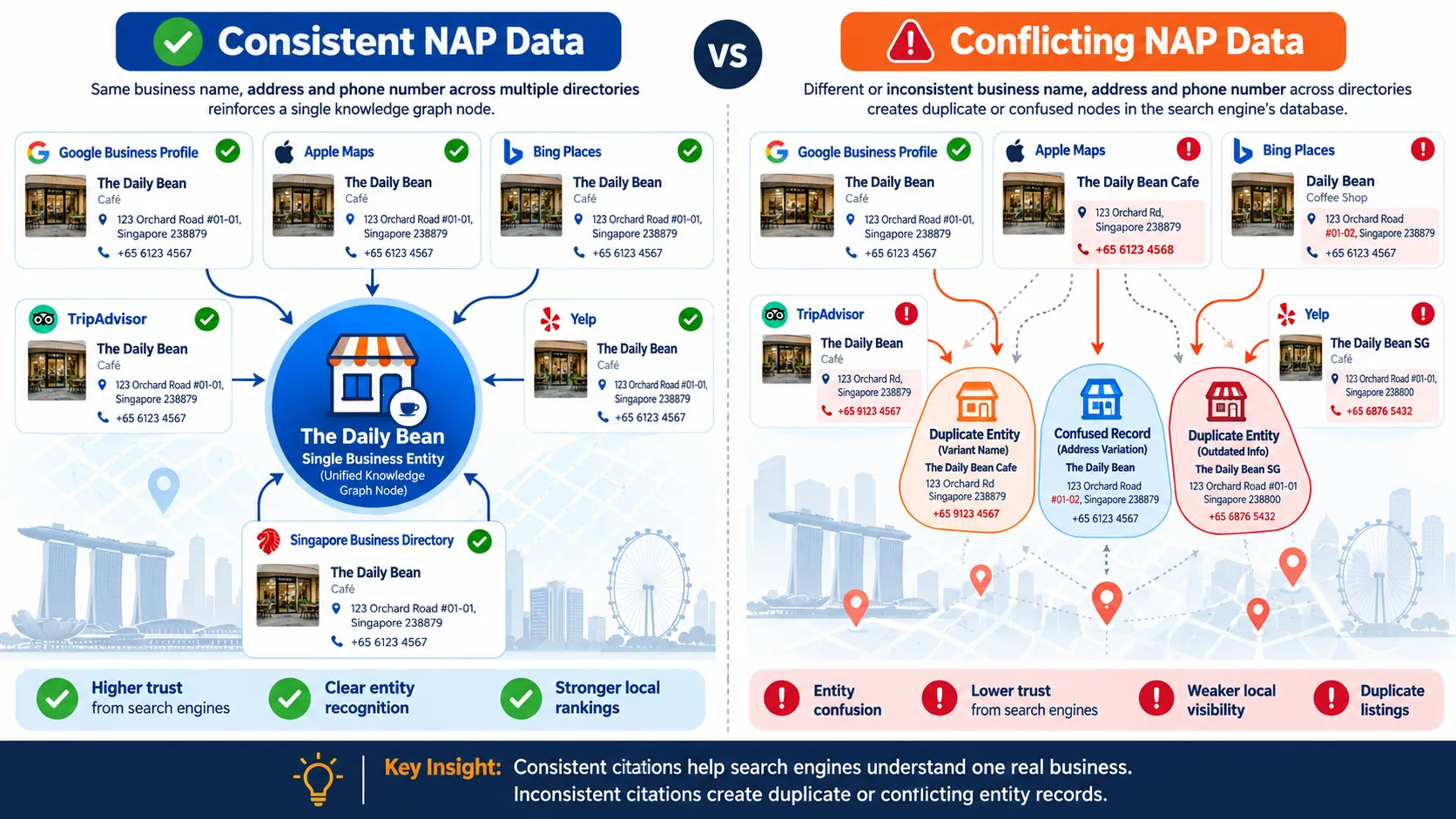
A knowledge graph is a database of entities (people, places, organisations) and the relationships between them. Your business exists in this graph as a node. Each citation reinforces or contradicts the graph’s understanding of who you are, where you operate, and what you do.
Google’s Knowledge Graph processes citations to extract structured data about your business. When your NAP appears consistently across authoritative sources like Apple Maps, Bing Places and industry directories, the engine gains confidence that this entity is real and stable. Inconsistent citations create noise, forcing the algorithm to resolve contradictions. A single citation on a weak directory contributes little: the engine cross-references it against dozens of other signals.
NAP Consistency as a Trust Signal
NAP consistency is the foundation of citation trust. Search engines measure whether your business name, address and phone number are identical across every citation, your website and your Google Business Profile.
A variation as small as including versus excluding a suite number (for example, “123 Main Street” versus “123 Main Street, Suite 10”) creates inconsistency. The same applies to a phone number with parentheses around the area code in one citation but not in another. Engines treat these as separate entities unless other signals (brand name, reviews, geo-coordinates) connect them.
Consistency signals that you control your information and take local SEO seriously. Inconsistency signals negligence or mismanagement. A business with identical NAP across 50 directories appears more trustworthy than one with the same information across 5 directories but variations on 10 others.
Research into local search ranking factors has long positioned citation consistency as one of the top three drivers of local pack visibility. The reasoning is straightforward: if your NAP changes between sources, which version is correct? Engines prefer to rank businesses where that question does not arise.
Citation Authority and Relevance Scoring
Not all citations are equal. Engines assign authority scores based on domain authority, freshness, review volume, and relevance to your industry and geography.
| Source type | Relative weight | Why |
|---|---|---|
| Google Business Profile | Highest | Data feeds directly into local pack rankings and knowledge panels |
| Apple Maps, Bing Places | High | Search engines own and integrate them into results |
| National Chamber of Commerce | High | Established domain, low spam signal |
| Industry-specific directory (for example, HealthHub Singapore) | High for that vertical | Relevance weight from category alignment |
| Generic aggregator | Medium | Broad reach, weaker contextual signal |
| Local blog | Low | Limited authority and crawling frequency |
Relevance works alongside authority. A restaurant citation on Chope or a local dining guide carries more weight than the same citation on an auto-parts directory. Engines measure relevance through whether other businesses in your category cite the same source, whether the directory’s audience aligns with your industry, and whether your listing sits beside contextually similar businesses.
Recency also matters. A citation added this month signals more current information than one from five years ago. A stale citation on a high-authority source may contribute less than a fresh citation on a mid-tier source.
The practical rule is simple: a focused strategy targeting the top 15 to 20 authoritative sources in your industry and region will outperform a broad strategy with 100 mediocre listings.
Building Your Citation Strategy: A Step-by-Step Framework
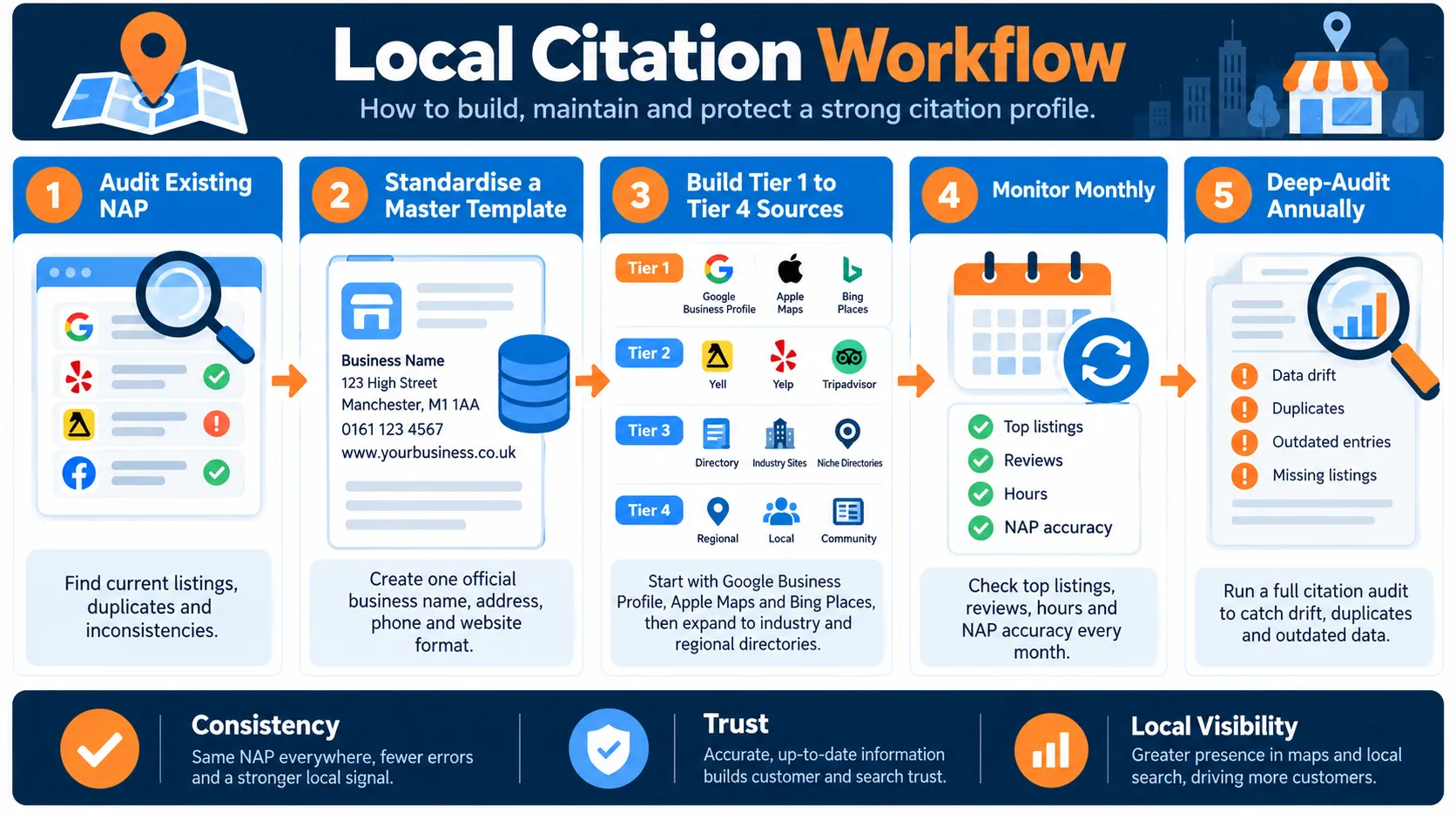
Most businesses either ignore citations or scatter them across dozens of directories without a plan. Without understanding why their rankings stall, they fail to prioritise ongoing maintenance. This framework handles the three real friction points: audit, prioritisation and ongoing maintenance.
Step 1: Audit and standardise your NAP data
Before adding any new citations, please check what already exists. Search for your business name, phone number and address across the web using these tools:
- Google Business Profile (for any new citations, please verify that the NAP is exactly correct, including spelling, spacing and abbreviations. This is your source of truth.
- Citation audit tools: Digimetrics.ai, Whitespark, SEMrush Local Business or BrightLocal crawl directories and flag inconsistencies automatically. For 5 or more locations, this process saves days of manual work.
- Manual spot-check: search your business name and phone number in Google Search itself, note the top 10 results, and review 3 to 5 major directories in your industry. Document what each says about the address, phone, website URL and category.
Look for three common problems:
- Formatting variations, such as “123 Main Street,” “123 Main St,” and “123 Main Str,” are all considered inconsistencies. All count as inconsistencies.
- Outdated phone numbers or old addresses: a citation to a closed location or disconnected number sends conflicting signals.
- Duplicate listings: one business may have three separate listings on the same directory, often created by different team members or data aggregators.
Then build a master spreadsheet with columns for legal business name, street address (with postcode), primary phone number, website URL and business category. Every new citation pulls from this sheet. For multi-location businesses, use one row per location so branch managers cannot create variants.
Rank sources by their domain authority and relevance to your industry and geography.
Tier 1: Foundational (immediate)
- Google Business Profile (not optional)
- Apple Maps
- Bing Places
- Waze (for location services)
Tier 2: High-impact aggregators (next)
These feed multiple directories at once, giving a multiplier effect.
- Yext
- Whitepages (consumer and business profiles)
- TripAdvisor (hospitality, food, travel)
- HealthHub (medical practices in Singapore)
- Yelp Singapore (restaurants and retail)
Tier 3: Industry-specific platforms (by sector)
- Restaurants: Chope, DoorDash, Uber Eats, Grab Food, Zomato
- Medical: HealthHub, Singapore Medical Council directory, Practo
- Legal: Singapore Law Society directory, FindLaw, Singapore corporate registry
- Beauty: Yelp SG, Instagram Business Profile, Treatwell, Fresha
- Home services: Thumbtack, Airtasker (Asia-Pacific), HomeAdvisor, local property portals
Choose 3 to 5 Tier 3 platforms that your customers actually use. Check your Google Business Profile reviews and website analytics to see which platforms send traffic or inquiry calls.
Tier 4: Regional and local niche directories
Add region-specific directories once Tiers 1 to 3 are locked in. Southeast Asia examples:
- Singapore: Time Out Singapore, HungryGoWhere, Singapore.com directory
- Malaysia: Klook, Time Out Kuala Lumpur, Yellowpages.my
- Philippines: Waze, Time Out Manila, Viber Business Pages
- Thailand: Google My Business, Thai listing sites
- Vietnam: Foody.vn, Vietnamese business directories
Check where your top three local competitors are listed. If they appear on a directory you are missing, audit whether it is relevant to your audience.
Decision rule: skip any directory that requires paid premium placement unless it sits in Tier 1 or 2, or unless your customers actively use it to discover you. Most paid directory placements return poor ROI.
Step 3: Timing, frequency and monitoring
Citations can drift, become duplicated, and compete with outdated versions of your data. Treat maintenance as a recurring task, not a project.
Initial phase (weeks 1 to 4). Claim or create all Tier 1 and Tier 2 citations in parallel. Start with Google Business Profile, which takes 2 to 5 business days to verify, then complete Tier 2 while that processes. Do not try to match your website copy exactly at this stage; cross-citation consistency matters more. If your website says “David’s Pizza Restaurant” but your legal entity is “David’s Pizza Pty Ltd”, use the legal name in citations.
Monthly maintenance (30 minutes). Set a reminder for the first Monday of each month and work through this checklist:
- [ ] Review the top 5 citations (Google Business Profile, Apple, Bing, plus 2 industry-specific) for unchanged NAP.
- [ ] Update all five simultaneously if you moved or changed phone numbers.
- [ ] Check review counts and respond to any new reviews.
- [ ] Verify business hours, especially during seasonal changes.
For multi-location businesses, it would be helpful to assign one person per location to take ownership of the audit.
Annual deep audit. Run a citation audit tool to crawl the web and look for new duplicates created by data aggregators, citations you forgot existed from previous owners, and spikes in inconsistency. If you identify duplicates, claim them first, then either merge into the primary listing or close them. Never leave two active listings for the same location on the same platform.
| Monitoring tool | Best for | What it does |
|---|---|---|
| Whitespark | Practitioners needing alerts | Monthly NAP change alerts and new listing notifications |
| BrightLocal | Multi-location brands | Audit, tracking and bulk update features |
| SEMrush Local Business | All-in-one preference | Crawls 50+ citation sources |
| Google Alerts | Free entry point | Catches new mentions of your business name and phone number |
Frequency by situation:
- Stable single-location business: monthly 30-minute spot-check, annual deep audit.
- Growing business or new location: monthly maintenance plus quarterly audits in year one.
- Multi-location chain (10 or more): a dedicated citation manager or an automated platform, weekly spot checks of the top 10 locations, and a monthly full sweep.
The cost of inconsistency outweighs the cost of maintenance. A single wrong phone number on three directories may significantly reduce organic search visibility and cost enquiries, calls, and customers who find outdated information.

High-value citation sources by industry and region
Directories are not equally valuable. Some carry far more weight with search engines. Others reach your specific audience better. Match your source list to your industry and market rather than working from a generic list.
Universal directories: Google Business Profile, Apple Maps, Bing Places
Start here. These three have outsized ranking influence because search engines own them or deeply integrate them into their results.
Google Business Profile remains the single highest-impact citation source. Google gives preferential weight to data entered directly into GBP when ranking local results. Business name, address, phone number, hours, category and service areas all feed local pack rankings and knowledge panels. Inconsistencies between your website and GBP are flagged immediately.
Complete the profile fully: all service categories, business description, photos, posts and website links. Incomplete profiles rank lower. When you update information on your website, update GBP within 24 hours.
Apple Maps and Bing Places rank second and third in impact. Apple Maps matters if your audience uses iPhones for local search. Bing Places matters for Bing and Edge-based local search. Both pull data similarly to Google but weight rankings differently, and many businesses neglect them, which means less competition for prominence. Submit to all three even if you think your audience skews toward one.
Industry-specific citation platforms
Your industry has vertical directories where competitors and ideal customers look. These carry relevance weight because they target your business type directly.
| Industry | Priority platforms | Why they matter |
|---|---|---|
| Healthcare | HealthHub (Singapore), Doctolib, Zocdoc | Signals a verified healthcare provider, not a generic business |
| Legal | Law Society of Singapore, Avvo, FindLaw | Validates credentials and integrates with local results for practitioners |
| Restaurants and hospitality | Yelp Singapore, TripAdvisor, Chope, Michelin Guide (where applicable) | Missing from key platforms reads as incomplete to customers and search engines |
| Real estate | PropertyGuru, EdgeProp, and local property portals by country | Dominant property platforms hold agent profiles; absence means no local footprint |
| Professional services | Thumbtack, trade association directories, chamber of commerce listings | Where customers search for pre-vetted professionals |
Identify 3 to 5 vertical directories for your industry and use them before chasing generic directories. The ranking impact from one industry-specific citation often exceeds the combined effect of five generic ones.
Regional and local directories in Southeast Asia
Southeast Asia does not use the same directories uniformly. Sources that dominate in Singapore differ from those in Thailand, Vietnam, Indonesia, Malaysia and the Philippines.
Cross-regional platforms. Google Business Profile, Google Maps and Bing Places work across all Southeast Asian countries, though local customisation matters. Apple Maps has lower adoption in the region but is growing.
Singapore and Malaysia. Yellow Pages Singapore, Yellow Pages Malaysia, Onesearch (Malaysia) and chamber of commerce directories rank well. Government business registries such as ACRA in Singapore and SSM in Malaysia also carry authority signals.
Thailand. GMM Z, the Thai Business Directory and local chamber citations improve rankings. Many Thai users search Thai-language directories first.
Indonesia. Bisnis Indonesia, Kompas Bisnis and regional directories dominate. Google Maps integration is strong, but local directories remain important for audience trust.
Philippines. Philippine Business Directory, PhilDex and local chamber listings are standard. Yelp has lower usage than in Western markets.
Vietnam. Chotot.com and Vietnamese business registries matter. Regional platforms fragment the Vietnamese-language local search ecosystem.
A business serving multiple Southeast Asian countries should prioritise Google Business Profile (with localised listings per country), Apple Maps, Bing Places, and 2 to 3 country-specific dominant directories per market. Listing on 50 weak directories in each country wastes time. Focus on the 5 to 8 that drive traffic and carry the most ranking weight. Use citation tracking tools to identify which directories rank highest for your industry and region, rather than submitting to directories chosen by generic lists.
Common citation errors and how to fix them
Most businesses discover citation problems only when local rankings stall or conflicting information appears in search results. A clear audit process can prevent these errors.
Duplicate and conflicting listings
Multiple listings for the same business can negatively impact local search visibility. Search engines see each as a separate entity, diluting your authority signal and confusing ranking algorithms about which listing is canonical.
Duplicates form easily. An owner creates a Google Business Profile. An agency builds another. An employee adds the company to a platform they use personally. A scraper copies old data. Within months, you have five listings with slightly different information.
To find them:
- Search your business name plus city in Google, Bing and Apple Maps, looking for multiple results with your logo or business type.
- Run a citation audit tool across major directories to flag duplicates and near-duplicates.
- Search your phone number and address directly across directories.
Claim the authoritative listing, then request deletion or merger of the duplicates. Most major directories (Google Business Profile, Bing Places, Apple Maps) let you claim your real profile and suppress impostor listings. Smaller directories may require you to contact support with verification documents. If legitimate listings conflict, standardise promptly: the most current listing will hold authority until you harmonise the data.

Incomplete or outdated business information
Search engines reward complete citations. A listing with only a name and address but no phone number or website scores lower than a full profile. Outdated information can significantly reduce organic search visibility: stale hours, disconnected numbers, or moved addresses erode customer trust.
Many businesses cite their data once and never revisit it. A restructured phone system, website redesign, relocation, or hours change can leave citations out of sync. Even seasonal closures should be reflected so customers are not sent to a closed location. Audit each citation for completeness:
- Confirm every field is filled: name, address, phone, website, hours, category, and description.
- Verify hours for all seven days, including seasonal variation.
- Confirm the website URL is current and does not redirect through an outdated domain.
- Ensure the business category matches your primary service, not a catch-all.
Update citations whenever your business changes, and run a quarterly review to catch drift before it compounds.
Inconsistencies between your website and citations
Search engines cross-reference your website against citation data to verify your business is legitimate. If your website says London but citations say Leeds, or your website says 18:00 while Google Business Profile says 17:00, algorithms flag a trust problem.
The phone number is the most common friction point. A website footer may list a switchboard, while citations use a branch line. A website may show a global address while the citations list a regional office. These inconsistencies need not be dramatic to affect local search performance. Create a single source of truth document that contains:
- Official business name, exactly as registered
- Primary address and any secondary locations
- Correct phone number(s) per location
- Website URL, with or without www, matching your canonical version
- Business hours in a standard format (09:00–17:00, not “9am to 5pm”)
- Category or service description

Please ensure that your website footer, contact page, and schema markup match this document exactly, and then populate all citations from it. If you later change your phone number, update the website first and propagate the changes to your top 5 to 8 high-authority directories within one week, then to secondary directories within the month.
| Common citation error | Why it happens | Recommended action |
|---|---|---|
| Duplicate listings | Multiple team members, agencies or automated scrapers create separate entries | Audit all major directories, claim the authoritative profile, and request deletion of duplicates |
| Outdated phone number | Website redesign or phone system change not reflected across all listings | Maintain a master business data document; update GBP first, then secondary directories within one week |
| Inconsistent business name | Variations between registered name, trading name and website branding | Standardise on the officially registered name across all citations and website schema markup |
| Missing or incomplete address | Partial entries or use of a regional office instead of a service address | Complete the full street address, postcode and suburb; use consistent formatting across all platforms |
| Mismatched business hours | Seasonal changes, branch relocations or incorrect timezone assumptions | Update GBP immediately when hours change; verify all seven days and note any closed periods |
| Wrong business category | Use of a catch-all or parent category instead of a primary service type | Select the most specific category available on each platform; ensure it matches your main offering |
Frequently Asked Questions
What are local citations in SEO?
Local citations are online mentions of a business’s name, address and phone number, commonly called NAP. They can appear on business directories, review platforms, mapping services, industry associations and other websites. A citation does not need to include a clickable backlink to help search engines verify the business.
Why are local citations important for local SEO?
Local citations help search engines confirm that a business exists, operates at a particular location and provides consistent information across the web. Accurate citations can strengthen trust signals, support local pack visibility and improve confidence in a business entity.
What does NAP consistency mean?
NAP consistency means using the same business name, address and phone number across your website, Google Business Profile, Apple Maps, Bing Places and other directories. Conflicting information can make it harder for search engines to determine which record is correct.
Which citation sources should businesses prioritise first?
Start with high-authority platforms such as Google Business Profile, Apple Maps and Bing Places. Once these are accurate, add relevant industry directories, regional directories, and platforms that your customers actively use.
Are more citations always better for local SEO?
No. Citation quality and relevance matter more than volume. A smaller number of accurate listings on trusted, relevant directories is generally more useful than dozens of low-quality or unrelated directory listings.
How often should local citations be audited?
Businesses should spot-check their most important citations regularly and perform a more comprehensive audit at least once a year. Businesses that frequently change locations, phone numbers or operating hours may need more frequent reviews.
What should I do if I discover duplicate business listings?
Identify the listing that contains the correct business information and claim it where possible. Then request that duplicate or outdated listings be merged, removed or marked as closed. Keeping several conflicting listings active can weaken the consistency of your citation profile.
How can I measure whether citation building is working?
Track local search impressions, clicks, Google Business Profile activity and local pack rankings before and after citation improvements. Evaluate citation work as part of a broader local SEO strategy, not by counting the number of listings created.