A guest post is an article written for another site’s audience, published under your name with a link back to your site. Content teams use guest blogs to reach readers, build relationships with thought leaders, and grow their online presence.

This guide covers how to find and vet blogs, pitch a guest blog post, and write content editors want to publish.
Key Takeaways
- Guest blogging is a relationship and audience tactic, not a primary SEO lever. Treat any ranking benefit as a side effect.
- Google warned against spammy guest posting in 2014, so volume-driven link building carries real risk.
- Score every target site before you pitch. Use the Fit Scorecard (audience relevance, editorial standards, link policy, traffic quality, topical match) and pitch only sites that score 20 or higher out of 25.
- Pitch two or three topics per site, the ones most likely to be accepted.
- Judge sites based on real traffic and audience, not on domain authority or advertised reach.
- Avoid pay-to-publish sites and link farms. Check them before you spend time pitching.
Guest posts earned their dubious reputation, for good reason. Many marketers used them to buy cheap links, and publishers were flooded with thin, keyword-stuffed articles. When Google’s Matt Cutts said in 2014 that guest blogging had “just gotten too spammy”, he was describing that problem. Editorial guest posting was never banned, but search engines penalise the spammy version.
Pitching and Writing a Guest Post That Gets Accepted
Pitching sequence: from shortlist to published article
Start with the shortlist of sites that pass the Fit Scorecard. Read three recent posts on each blog, then send a short pitch with two or three topics that fit its readers. Refer to a specific article to show you have read the blog. Once a topic is agreed upon, write to the host’s guidelines and send the draft for edits.

Example pitch email
Subject: Topic idea for your readers on their recent topic
Hi,
I read your recent piece on [article title] and thought your readers would value a practical follow-up on the topic. I can cover it in about 1,000 words, with examples from your field. Would that suit your editorial calendar?
Best,
Your name
Pitching strategy: choosing two or three topics per site
Offer two or three topics per blog, not a long list. Choose the ideas most likely to be accepted, since hosts review the strongest ideas first.
Writing high-quality guest posts that serve the reader
Write for the host’s readers. Open with the reader’s problem, answer it in plain language, and use short paragraphs and scannable subheadings. Good posts usually run 800 to 1,200 words, though the host’s guidelines come first. Editors accept strong content that delivers clear results for the reader, and a relevant angle helps it stand out.
Incorporating links and keywords naturally
Use one or two links where they help the reader, such as a source or a related guide. Place the keyword in a heading or opening sentence where it reads naturally, and let the search engine pick up the topic from the clear wording.

Following guidelines and formatting requirements
Most publishers set word counts, image rules, link limits and bio length. Follow them exactly, since editors often reject posts that break the guidelines, no matter how strong the writing. Editors check every website’s rules before accepting a post, and a guest blog that ignores them rarely gets a second look.
The SEO Reality: Backlinks, Nofollow Links and Attribution
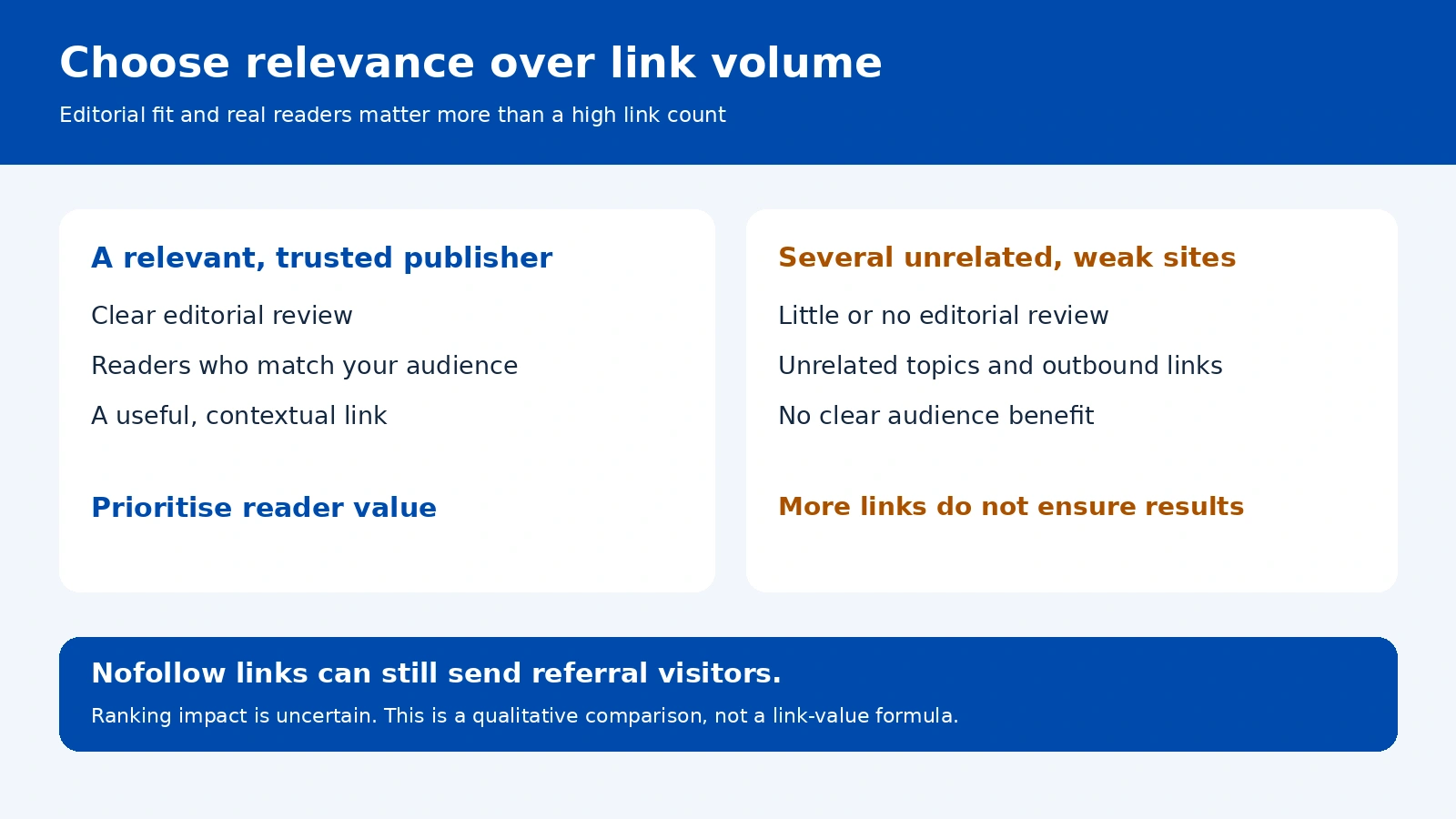
Backlinks from authoritative sites are one of many signals that search engines weigh, but the evidence on how much weight they carry is mixed. The Live Webinar’s guide to guest posting describes them as a key ranking factor. A single link from a trusted, relevant publisher is worth more than several from unrelated or low-quality sites.
Why a guest post alone will not move rankings
A single guest post rarely changes where a page ranks. Backlinko’s research, cited by the Content Marketing Institute, suggests one guest post does not deliver the same boost to search rankings or online visibility. A strong backlink profile built solely from guest blogging is unlikely to work for a B2C company. Treat each blog post you contribute as one part of a wider authority programme, alongside your own blog and social media activity, since thought leaders are judged on their overall presence.
Nofollow links, attribution and what they mean for traffic
Many publishers add nofollow attributes to contributor links. Google treats nofollow as a hint, not a strict block, so ranking credit is uncertain. A nofollow link doesn’t pass ranking credit, but it can still drive referral visits, so its value lies in traffic and brand exposure. Check the link policy before you pitch, and measure visits from each post in your analytics.
Researching target blogs and their readers
Before pitching, decide whether a site is worth the time. The Guest Post Fit Scorecard is this publisher’s own method: it rates each candidate blog from 1 to 5 on five criteria (audience relevance, editorial standards, link policy transparency, traffic quality, and topical match), for a maximum of 25. Only sites scoring 20 or more make the pitch list. The threshold is high because a weak placement costs time and can carry link risk. Rebuild the list each quarter, as sites can change.

What the scores mean. A score of 1 means the criterion is missing or works against you. A score of 3 is acceptable. A score of 5 clearly meets the standard. For example, a niche marketing blog whose commenters are your buyers scores 5 on audience relevance, while a general lifestyle blog with no link to your market scores 1.
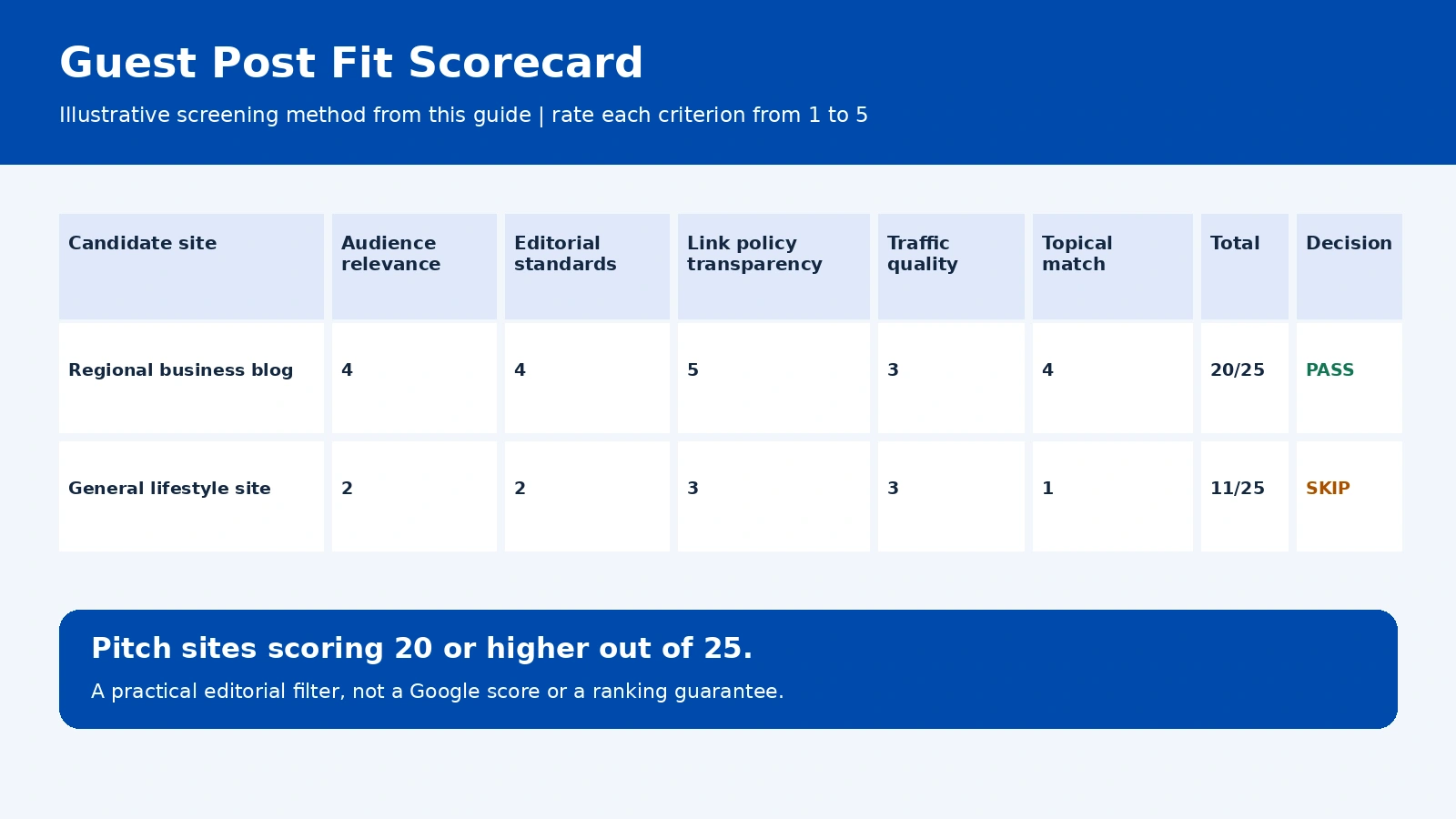
Worked example. A B2B software firm scores a regional business blog 4, 4, 5, 3 and 4, a total of 20, so it passes. A general lifestyle site scores 2, 2, 3, 3 and 1, a total of 11, so the firm drops it, even though the site has more visitors.
Traffic quality matters more than headline reach. Look at who reads the blog, what they comment on, and whether people in your market share its posts. Domain authority, a third-party estimate of search strength, says little about whether your customers will find your article.
Checking website quality and publisher standards
Good publishers publish clear contributor guidelines, name their editors, and review submissions before they go live. Check how recent its posts are and whether its articles are substantive. If a site has no content for contributors to read, it will likely treat your work as filler. Sites that accept guest posts should show these details in their guidelines, not only in a pitch reply.
Be wary of blogs that offer to publish anything for a fee. Those sites rarely deliver readers, and search engines often discount or penalise their links. Under Google’s spam policies, backlinks intended to manipulate rankings may be considered link spam, and paid links or swaps made only to pass authority fall into that category.
Spotting red flags: link farms and pay-to-post sites
Three warning signs cover most bad placements:
- Pay-to-publish offers with no editorial review
- Pages stuffed with unrelated outbound links
- Sites whose “authors” all write on unrelated topics
Avoid any site that refuses to say how it handles links. A publisher open about its policy is a safer long-term partner.
Common Guest Posting Mistakes to Avoid
The most damaging mistakes treat guest blogging as a volume exercise. Google’s 2012 Penguin update targeted black-hat link building. Content Marketing Institute notes that one guest post rarely delivers the ranking boost many expect, so judge the tactic by the results it brings readers.
Chasing volume over quality
Publishing many posts on weak sites wastes time and invites link risk. Fewer placements on sites that pass the Fit Scorecard usually produce more readers.
Over-optimised anchor text and keyword stuffing
Repeating exact-match anchor text across posts looks manipulative. Use natural anchors that describe the destination, and write for the host’s readers first.
Ignoring the host site’s audience and tone
A post that suits your blog may not suit the host. Read the site’s recent articles and match its voice, depth and examples.
Pitching and Writing a Guest Post That Gets Accepted
Pitching sequence: from shortlist to published article
Before you pitch, score each blog on the Fit Scorecard and pitch only the sites that pass the 20-of-25 threshold. Then:
- Read the contributor guidelines and the three most recent posts on each target site, and note what you have already covered.
- Choose two or three topics that suit the readers and fill gaps.
- Send one short pitch email covering all of them.
- Follow up once after one to two weeks if you do not receive a reply.
- If accepted, please send the full draft in the requested format and respond promptly to any edits.
Silence after two follow-ups usually means no.
Example pitch email
Subject: Guest post idea for the host’s blog name
Hi,
I read your recent post on [topic] and think your readers would value a piece on it. Here are three angles:
- Angle one, with the reader problem it solves
- Angle two: how it differs from existing posts
- Angle three, with the gap it fills
Best,
Your name
Pitching strategy: choosing two or three topics per site
Give the site owner two or three titles, as Hostinger’s guest post tutorial advises. Name the reader problem, explain why this audience cares, and show how your angle differs from the blog’s existing content.
Writing high-quality guest posts that serve the reader
A guest post earns its place by helping someone who has never heard of the author. Match the host’s tone, length and depth, and answer the question in the opening paragraphs. Support claims with named sources, and make the results of each example clear. Write for thought leaders in the field and general readers, so the piece holds up when a search engine surfaces it. Readers who find the piece through search should find the answer quickly. Posts that are shared on social media reach readers beyond the host’s audience.
A practical guide is often 1,000 to 2,500 words, but check what the host already publishes.
Incorporating links and keywords naturally
Use one or two links to genuinely relevant pages, with descriptive anchor text rather than exact-match keywords. Over-optimised anchors are the quickest route to an edit or rejection.
Following guidelines and formatting requirements
Read the contributor guidelines before drafting, and verify whether the site accepts guest submissions at all. Check word count, image rules, link policy and how bylines and bios are handled. Many blogs accept guest posts only from writers who follow these rules closely.
Conclusion: A Guest Posting Approach That Holds Up in 2026
Score each target site on the Fit Scorecard, pitch only the sites scoring 20 or higher out of 25, and review that list every quarter.

Frequently Asked Questions
What is a guest post?
A guest post is an article written by someone outside a website’s editorial team and published there, usually with a short author bio and a link back to the writer’s site. The host gains content and a new audience, and the writer gains exposure and occasionally a backlink. Unlike sponsored content, a guest post is accepted on editorial merit, not bought as an advertisement.
Do guest posts still help SEO?
They can, but rarely on their own. Backlinks from authoritative sites remain one factor in how search engines assess a page, as LiveWebinar’s guide to guest posting notes. The Content Marketing Institute reports that Backlinko research found a single guest post won’t provide the same ranking boost as earlier link-building tactics. Treat guest blogging as a channel for referral traffic and reputation, not a ranking lever.
What is the difference between a nofollow and a dofollow link?
A dofollow link passes ranking signals to the linked page. A nofollow link carries a rel=”nofollow” attribute, telling search engines not to treat it as an endorsement. Google treats nofollow as a hint, and a nofollow link can still send real visitors.
How do I pitch a guest post to a blog?
Read the site’s contributor guidelines, then offer two or three topics suited to its audience, as Hostinger’s guest post tutorial advises. Send a short, personalised email with a sample link. Follow up once after one to two weeks if you hear nothing.
How many guest posts should a business publish?
Fewer, better placements beat volume. Score each target site on the Fit Scorecard and pitch only those scoring 20 or more out of 25. For most small teams, a handful of strong posts a quarter is a realistic ceiling.
How long should a guest post be?
Length should fully answer the topic. Many editors expect 1,000 to 2,500 words, though the host’s guidelines override any general figure. Padding to hit a word count lowers acceptance chances.