| AI Summary To get backlinks in 2026, Singapore businesses should focus on earning relevant, editorial links through original research, guest contributions, expert commentary, broken link building and industry partnerships. High-quality backlinks can support search visibility, referral traffic and business credibility. Prioritise topical relevance, publisher credibility and genuine reader value over backlink volume or third-party authority scores. Avoid paid link schemes and automated backlink generators that violate Google’s spam policies. Track results through Google Search Console and website analytics, focusing on qualified traffic, enquiries and long-term SEO performance. |
To get backlinks in 2026, create something worth citing: research, a practical resource or genuine expertise. Approach relevant publishers and industry partners. We prioritise editorial links over automated submissions, which can violate Google’s spam policies.


Key Takeaways
- Earn links with useful content. Original data and expert commentary give publishers a reason to cite you.
- Relevance matters. Assess the linking page, its audience and editorial standards. A high third-party authority score alone does not establish quality.
- Understand link attributes. There is no dofollow attribute. Google treats nofollow, sponsored and ugc as hints.
- Avoid link schemes. Buying links to pass ranking credit, excessive exchanges and automated link creation are examples of link spam.
- Measure outcomes. Track referrals, search visibility and enquiries, without expecting guaranteed rankings.
What Is a Backlink and Why Does It Matter?
A backlink is a hyperlink from another website to yours. If a Singapore publication cites your research, its link is your backlink and the publication’s outbound link.
Google uses links for discovery and as a relevance signal. Links do not automatically raise rankings; content, search intent and crawlability matter too.
Backlinks versus internal links
Internal links connect your own pages, helping visitors navigate and Google understand site structure. Backlinks come from other websites and can introduce new audiences.
We recommend both. A research report can attract coverage, while internal links guide readers towards relevant service pages. Neither replaces helpful content.
How dofollow, nofollow, sponsored and UGC links differ?
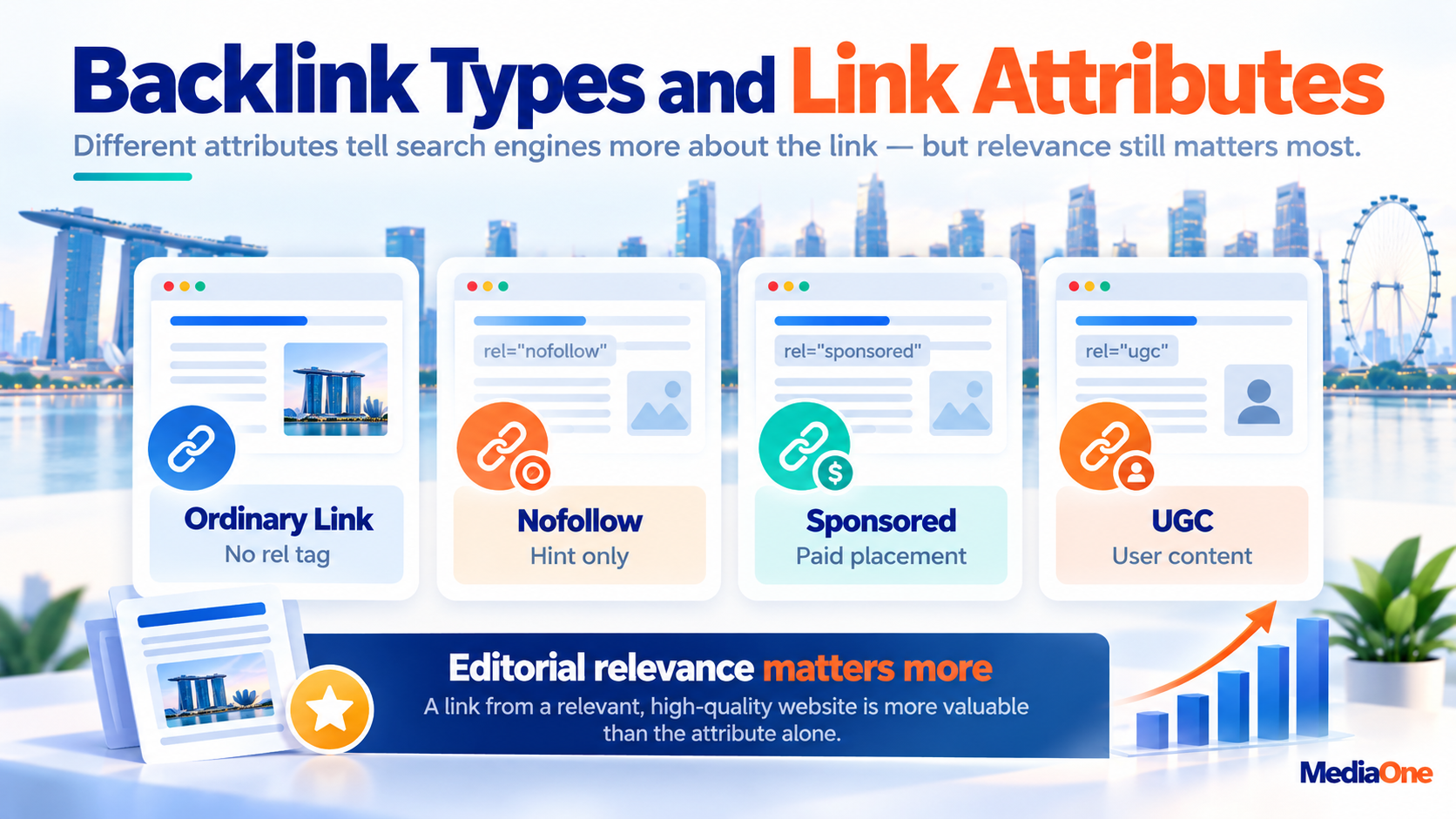
A normal crawlable HTML link does not need a dofollow attribute; “dofollow” is informal SEO terminology. A publisher may instead qualify its link using a rel attribute. Google’s link qualification guidance distinguishes the following:
| Link treatment | What it means | Practical implication |
| Ordinary link | No special rel qualification | Google may consider it among its ranking signals. |
| rel=”nofollow” | Publisher does not want to imply endorsement | Google treats this as a hint, not an absolute exclusion. |
| rel=”sponsored” | Advertisement or compensated placement | Preferred label for paid placements. |
| rel=”ugc” | Link in user-generated content | Recommended for comments and forum contributions. |
Google introduced these hints in September 2019, extending them to crawling and indexing in March 2020. Attributes do not reveal a link’s ranking value. Qualified links can still bring customers.
Types of Backlinks and How to Assess Their Quality
Links serve different purposes. Editorial coverage builds awareness, while legitimate listings and profiles help customers find or verify businesses.
| Link type | Example | Best reason to pursue it |
| Editorial | Trade publication cites your research | Relevant readership and independent coverage |
| Association | Industry body features a member resource | Sector relationships and credibility |
| Directory | Genuine industry or local business listing | Business discovery and accurate information |
| Profile | Supplier or professional biography | Useful referral path for interested visitors |
| Sponsored | Clearly labelled paid partnership | Advertising reach, not purchased ranking credit |
Not every editorial link is powerful or every directory link worthless. A specialist directory can produce qualified visits even without measurable ranking gains.
What makes a backlink worth earning?
Examine the linking page. Does its topic overlap with yours, and would readers benefit from your resource? Check authorship, maintenance and editorial standards.
Placement also matters. A contextual article reference is generally more useful than an unrelated footer link. Google recommends descriptive, concise anchor text.
Domain Authority and Domain Rating are third-party estimates, not Google scores. We use them for context, never as a single measure of link value.
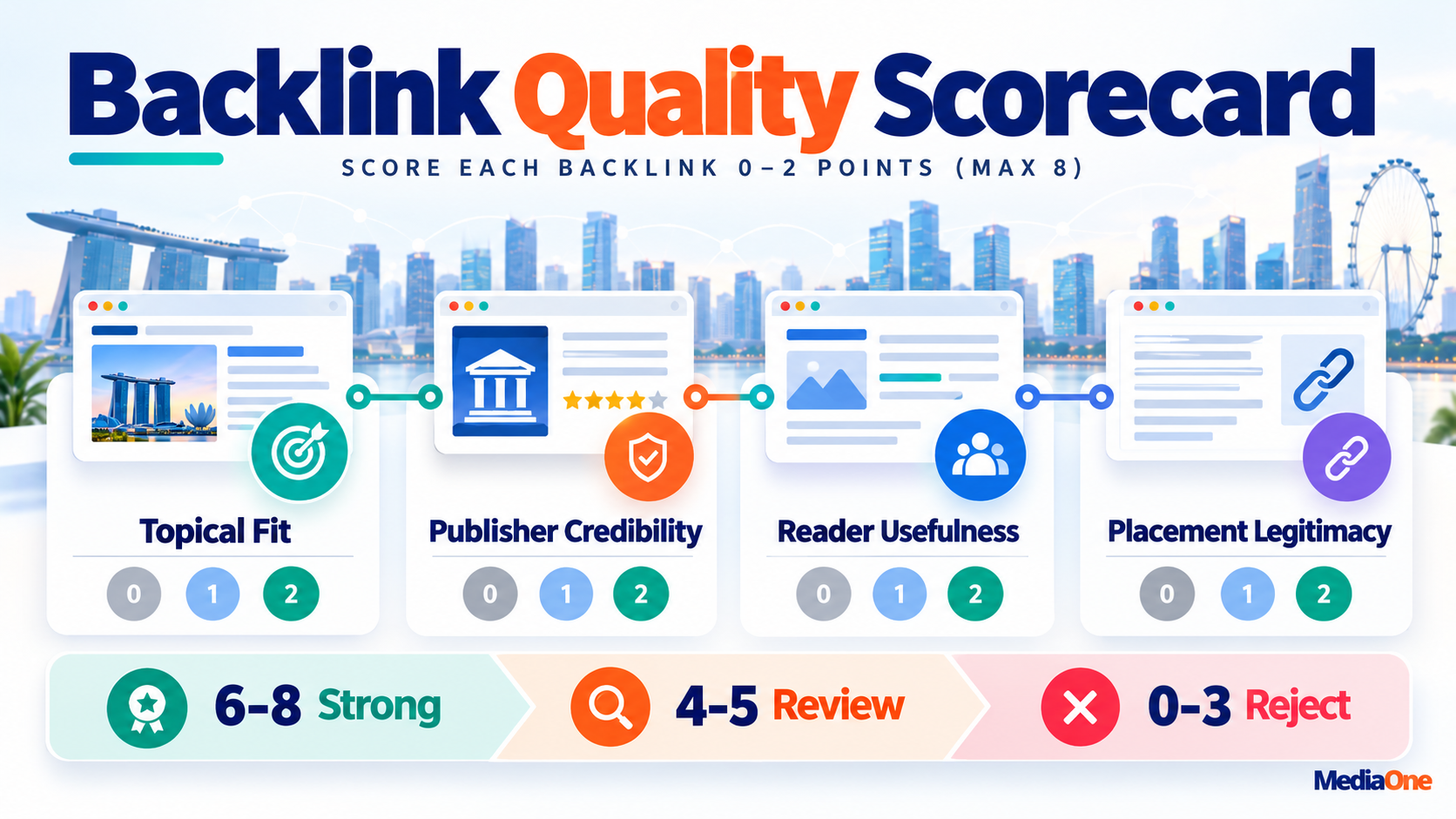
A practical eight-point link evaluation scorecard
Our Link Value Scorecard is an editorial prioritisation tool, not a Google metric or a formula for predicting rankings. Give each area zero, one or two points:
- Topical fit: Two for a directly relevant page, one for an adjacent topic, zero for no meaningful connection.
- Publisher credibility: Two for clear authorship and genuine editorial oversight, one for limited evidence, zero for a questionable site.
- Reader usefulness: Two if the link answers a real question, one if moderately useful, zero if inserted only for SEO.
- Placement legitimacy: Two for a natural, appropriately disclosed placement, one for a basic legitimate listing, zero for manipulative placement.
Treat six to eight points as a strong outreach candidate, not a guaranteed ranking asset. Four or five warrants closer review. Reject opportunities that breach Google’s spam policies regardless of their total. A relevant nofollow link may still deserve attention because it can generate enquiries or useful exposure.
Before pitching a site, inspect how its pages link to external resources. A newspaper interview may cite sources selectively, while an association directory may link automatically. Consider the likely referral audience alongside editorial relevance. This helps distinguish opportunities worth personal outreach from listings that can be handled during routine business administration.
How to Get Backlinks: Eight Practical Strategies
Choose tactics according to your audience and resources. We favour creating reader value before asking for a link, without arbitrary monthly quotas.
1. Publish original Singapore-focused research
Use information your business can legitimately share, such as anonymised customer questions, industry pricing observations or a survey with a disclosed methodology. A renovation company might publish a guide comparing typical project stages in Singapore. A logistics provider could explain common documentation delays across its service categories.
Present the findings clearly, show how the information was collected and state any limitations. Offer charts or concise summaries that journalists can reference. Google’s people-first content guidance encourages original information and analysis rather than content that merely repeats existing sources.
2. Contribute expert commentary to relevant publishers
Identify journalists and editors who cover your sector, then respond with a specific observation they could verify or quote. A cybersecurity consultant might explain a newly published advisory. A restaurant operator could provide informed context for a local hospitality trend.
Keep your pitch concise and include your credentials, a usable quotation and the relevant source material. Do not demand a followed link as payment for providing an opinion. Editorial teams decide whether to link, and worthwhile coverage may provide recognition even when no link appears.
3. Reclaim relevant unlinked brand mentions
Search for your company name, product names and distinctive research titles. Where another website mentions your organisation without linking, first check whether a link would improve the reader’s experience. A case study referencing your findings is a stronger prospect than a passing mention in an unrelated article.
Contact the editor politely, identify the exact passage and suggest the most relevant destination. Avoid requesting links to your homepage when a specific report or resource would answer the reader’s question better. Record replies so the same contact is not approached repeatedly.

4. Replace genuinely broken resources
Find industry articles or resource pages containing links that lead to missing content. Confirm that the original resource is unavailable, then check whether your existing page covers the same question accurately. A replacement should be comparable in purpose, not simply contain a matching keyword.
Tell the publisher which URL is broken and explain why your resource could help its readers. We recommend fixing gaps in your content before pitching it. Broken-link outreach works best when it improves a real page, rather than disguising a generic sales proposal.
5. Create useful guest contributions
Guest articles can expand your reach when they are written for a credible publication’s actual audience. Pitch a narrowly defined subject that the publication has not already covered thoroughly. Include practical examples and write to the editor’s standards.
Google does not discourage informative guest articles. It does warn against large-scale article campaigns designed mainly to manufacture ranking links, especially those with keyword-rich anchors. Avoid mass-produced submissions and let the publisher decide whether a contextual reference is appropriate.
6. Pursue relevant Singapore associations and directories
Start with associations that already serve your customers or business sector. The Singapore Business Federation maintains membership information and a directory, while sector-specific trade associations may publish member resources, event recaps or partner features.
Membership alone does not guarantee a backlink. Before paying a fee or submitting information, confirm whether a public page actually links to members’ websites and whether the audience is relevant. For local listings, keep your business name, address and phone number accurate. Google’s Business Profile guidelines emphasise accurate real-world information, but a Google Business Profile should not be counted as an editorial backlink.
7. Analyse competitors’ relevant backlinks
Use a backlink research tool to identify publications and resource pages linking to businesses competing for your target searches. Inspect a sample manually instead of copying every source. Separate genuine editorial mentions from paid sponsorships, syndicated material and low-quality listings.
Ask why the publisher cited your competitor. Was it a statistic, detailed tutorial, useful tool or original interview? Create a resource that addresses an unmet need, then pitch it only where it adds value. Copying a competitor’s exact anchor text or buying the same placements is not a sustainable strategy.
8. Turn partnerships and events into helpful resources

Suppliers, industry collaborators and event organisers may already have legitimate reasons to mention your business. Co-produce a useful checklist, publish a webinar summary or contribute a technical explanation to a partner’s resource centre. Give readers a reason to visit the linked page.
A partnership should exist for business or educational value, not solely for reciprocal links. Google’s spam policies identify excessive link exchanges and link requirements imposed through contracts as problematic. Where a relationship includes payment or other compensation, ensure the publisher uses appropriate link qualification.
A 90-Day Backlink Plan for Singapore Businesses
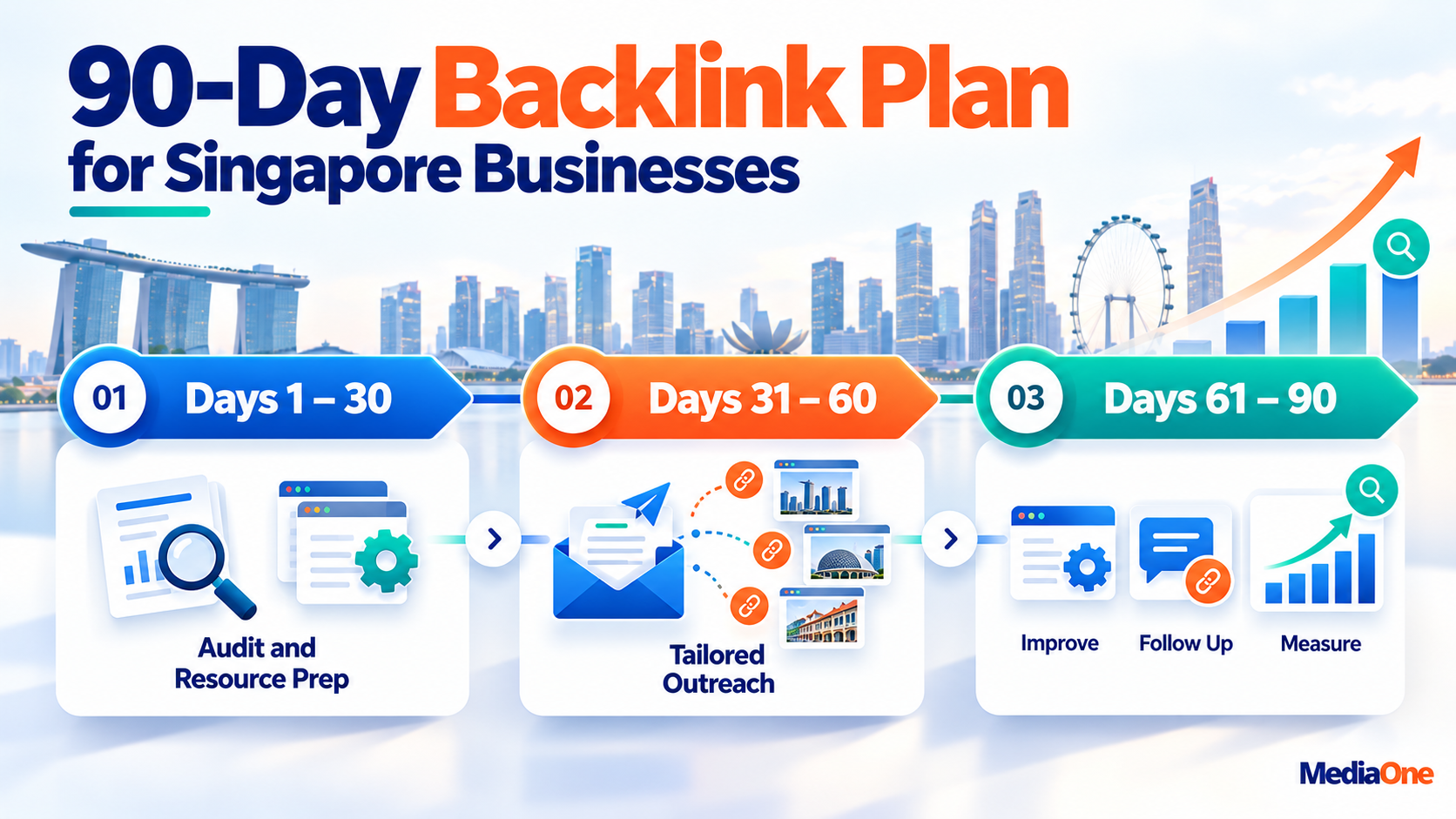
We recommend treating the first three months as a structured outreach and learning period, not a deadline for specific ranking gains. Choose one or two priority pages before starting. A detailed guide or original research page often gives publishers a clearer reason to link than a generic sales page.
| Period | Priority work | What to review |
| Days 1–30 | Audit existing links, identify target pages, prepare a useful resource | Baseline search and referral performance |
| Days 31–60 | Approach relevant editors, associations and partners with tailored pitches | Replies, publications and confirmed links |
| Days 61–90 | Follow up selectively, improve the resource and expand successful outreach | Referral quality, enquiries and search trends |
Choose a realistic outreach priority
A new local business can begin with accurate profiles and relationships within its actual trade. An established business with credible research should lead with media outreach and specialist publications. An ecommerce brand might create independently useful buying or maintenance guides that retailers and publishers can cite.
We would prioritise five carefully researched prospects over fifty generic emails. Identify the person responsible for the relevant page, describe the value to their audience and link to a resource that already answers a question. Track outreach without repeatedly chasing editors who decline or do not respond.
Keep a simple outreach register showing the target publication, relevant article, contact, reason for the pitch and follow-up status. Document any editorial conditions before agreeing to a placement. This makes the programme easier to audit and prevents duplicated requests when several team members approach the same publication.
When should you expect results?
There is no reliable universal four-to-eight-week timeframe for backlink-driven ranking improvements. Google must first discover and evaluate the relevant pages, and ranking changes can reflect many factors unrelated to links. Publication delays and competitive search results add further uncertainty.
Review progress monthly, but judge the programme over several months. Google’s SEO Starter Guide says some changes take hours, while others take months to appear in Search. Use early activity measures to assess execution without presenting them as proof that a link caused a ranking change.
How to Measure Backlink Results
Open the Links report in Google Search Console to review top linking sites and linked pages. Google says this report shows a sample, not a complete inventory. Compare it with an independent backlink tool if you need broader prospect discovery, and verify important links on the actual published pages.
Use Search Console’s Performance report to monitor relevant search queries, impressions and clicks. Google also explains how Search Console and Analytics work together: one shows activity in Search, while the other helps assess visits and subsequent behaviour. Record enquiries or purchases generated by referral traffic where your measurement setup permits.
For each earned placement, track the publishing page, destination URL, date, context, attribute and referral activity. Note major site updates during the same period. This prevents ordinary ranking fluctuations from being attributed automatically to a new backlink. Check that links stay live and point to the intended resource. A mention that disappears or points to an obsolete URL needs different follow-up from a referral attracting qualified visitors. Do not present month-to-month movement as proof of causation.
Common Link-Building Mistakes
- Buying links to influence rankings: Google identifies paid links that pass ranking credit as link spam. Legitimate advertising should use rel=”sponsored” or rel=”nofollow”.
- Using backlink generators: Automated link creation for ranking manipulation is explicitly covered by Google’s spam policies. We do not recommend these services as a foundation.
- Obsessing over authority scores: A high metric cannot establish topical relevance, editorial quality or referral potential.
- Forcing exact-match anchors: Repetitive commercial anchor text can appear manipulative. Let publishers use descriptive wording that suits their readers.
- Disavowing every suspicious link: Google says most sites do not need its disavow tool. Use it cautiously when substantial unnatural linking creates, or is likely to create, a manual-action problem.
- Ignoring the landing page: Even a relevant referral is wasted if the linked content is outdated, inaccessible or confusing.
Frequently Asked Questions
Can I get backlinks for free?
Yes. You can earn backlinks through original resources, relevant contributions and genuine business relationships without buying placements. You still invest time in research, publishing and outreach, and no publisher is obliged to link to you.

How many backlinks does a small business need?
There is no universal target. We recommend comparing your coverage and search visibility with relevant competitors, then focusing on links that introduce the right readers. A numerical quota cannot guarantee better rankings.
Do nofollow backlinks help SEO?
They can support discovery and referral traffic, while Google treats the nofollow attribute as a hint when assessing links. Do not promise that a particular nofollow link will improve rankings or dismiss it solely because of its attribute.
Is guest blogging still effective in 2026?
Yes, when your contribution is genuinely useful to a relevant publication’s audience. Avoid large-scale guest-post campaigns whose main purpose is building ranking links, especially with optimised commercial anchors.
Should I use a free backlink generator?
We do not recommend automated backlink generators for ranking purposes. Google’s spam policies explicitly list automated services that create links to a website, so invest instead in valuable content and selective outreach.
How long does it take to get backlinks?
A link may appear shortly after an editor accepts a contribution, or outreach may take months. Publication timing, Google’s discovery and ranking effects are separate questions; none has a guaranteed schedule.
Build Backlinks That Earn Trust and Qualified Traffic
To get backlinks sustainably in 2026, we recommend beginning with one credible resource, a shortlist of relevant publications and an outreach process built around reader value. Use associations and genuine listings where they serve customers, but prioritise independent editorial coverage when your expertise warrants it.
At MediaOne, we approach backlink development as part of a wider SEO strategy that also considers content quality, technical accessibility and conversions. Measure the enquiries and visibility you earn, not merely the number of links reported.