| AI Summary
Anchor text optimisation means choosing link words that describe the destination and read naturally within a sentence. An effective review covers internal links, incoming backlinks, image links and the pages they lead to. Google publishes no safe percentage for exact-match anchors. Accuracy, relevant placement and honest linking practices provide a better basis for decisions. Search Console, website crawls and analytics answer different questions when measuring results. |
Anchor text optimisation is the process of improving the clickable words in a link. An effective anchor tells readers what the linked page contains. The process includes checking the destination, choosing descriptive wording, removing forced keywords and measuring link interactions. No fixed anchor text ratio guarantees rankings or prevents penalties.
Key Takeaways
- Broken destinations and misleading labels deserve attention before cosmetic wording changes.
- Repeated menu labels are normal. Repetition alone does not prove link spam.
- Internal link audits and backlink audits require different data.
- Search result clicks do not measure clicks on links inside an article.
- A small, recorded test provides better evidence than changing every anchor at once.
Most anchors are written in seconds. A writer adds a link, selects a few words and moves on. Problems start when those words promise something the destination does not deliver.
A reader who clicks “website pricing” expects costs. A page that offers only a contact form leaves that expectation unanswered.
Anchor text optimisation starts with that reader’s experience. Each link needs an honest label, a relevant destination and a reason to appear in the sentence. The following sections explain how to make those decisions, audit existing links and measure changes without chasing invented percentage targets.
What Does Anchor Text Do for Readers and Search Engines?
Anchor text is the clickable wording in a link. It helps people decide whether the destination answers their next question. Search engines also use links to discover pages and understand relationships between them.
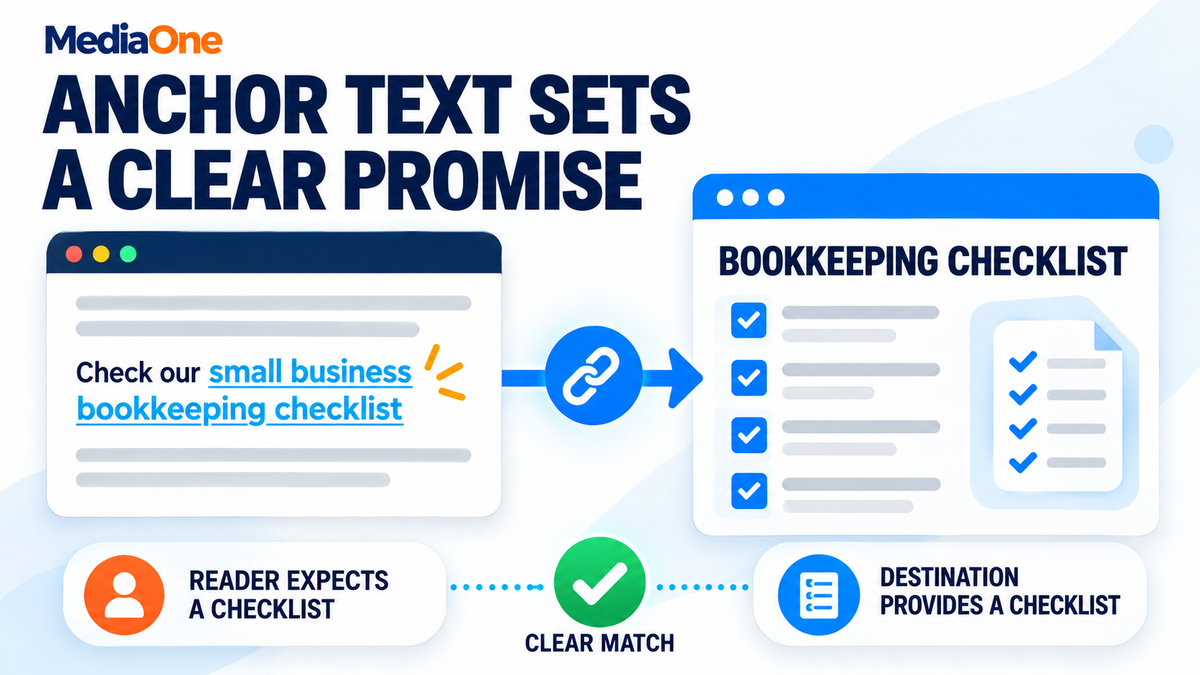
A link labelled “small business bookkeeping checklist” gives a reader more information than “click here”. The surrounding sentence can then explain when the checklist helps, such as before a monthly accounts review.
Google’s link best practices describe the role of descriptive, concise wording and crawlable links. Those principles support a reader’s understanding without requiring a keyword in every anchor.
Internal links and backlinks serve different roles
Internal links connect pages on the same website. A bakery might link its sourdough article to its bread delivery page. The business controls both the wording and destination.
Backlinks arrive from other websites. A newspaper, supplier or customer may choose the anchor. Their wording can include a business name, product name or description.
| Link relationship | Example | What the website owner controls |
| Internal link | A blog links to a service page | Anchor, placement and destination |
| Incoming backlink | A newspaper links to a business | Its own destination page; the publisher controls the link |
| Outgoing external link | An article cites research | Anchor, placement and selected source |
An internal linking strategy covers how pages connect across a website. Anchor text optimisation focuses on the words attached to each connection.
Which Anchor Text Type Should You Choose?
Anchor categories describe wording patterns. They help organise an audit, but they do not provide a formula for writing every link.
A brand mention, product reference and research citation can each need different wording. The destination and sentence determine the choice.
| Anchor type | Example | Where it can work |
| Exact-match | “anchor text optimisation” | A direct reference to that subject |
| Partial-match | “anchor text optimisation examples” | A reference to a particular part of the topic |
| Descriptive | “how to label website links” | An explanation written in everyday language |
| Branded | “MediaOne” | A reference to the company |
| Naked URL | “example.com” | A displayed website address |
| Generic | “read more” | A component with enough surrounding context |
| Linked image | An image with a text alternative | A logo, product image or linked graphic |
Exact-match wording can be appropriate
An exact-match anchor repeats a target search phrase. “Corporate tax calculator” is a sensible label for a corporate tax calculator.
The phrase does not become wrong because it matches a keyword. Problems arise when writers force commercial phrases into unrelated sentences or arrange links to manipulate rankings.
A page about wedding planning, for example, does not need repeated links labelled “cheap business accounting Singapore”. The topic and sentence provide no reason for that wording.
Descriptive anchors do not need a keyword formula
A descriptive anchor explains the destination in the language the sentence needs.
A sentence about campaign planning might include “monthly marketing budget template”. Another article might refer to the same page as “a template for planning marketing costs”. Both labels can describe the resource accurately.
Artificial variation adds little. A team does not need a thesaurus or a different phrase for every link. Consistent wording helps when the same destination serves the same purpose.
Generic labels need enough context
Generic labels such as “read more” leave readers dependent on nearby content. A repeated list of identical labels can make destinations difficult to distinguish.
The W3C explanation of link purpose allows purpose to come from link text or its programmatically associated context. Descriptive wording often makes that purpose easier to understand
A card titled “Annual report 2025” may give its “Download” link enough context. A standalone “Download” link in a long paragraph gives readers less information.
How to Write Anchor Text That Matches the Destination
An anchor works as a small promise. The destination should fulfil that promise without making readers search through unrelated content.
A destination check belongs before the wording decision. A polished phrase cannot repair a page that answers a different question.
The destination determines the wording
A short review can establish what the link should communicate:
- The destination’s main subject.
- The format, such as a checklist, calculator or service page.
- The detail the reader needs next.
- Any restriction, such as a download or sign-in requirement.
For example, a service page that describes an audit should not receive the anchor “free SEO audit checklist” unless it actually supplies that checklist.
Keyword intent helps separate what someone wants to learn from what they want to buy. Anchor wording should preserve that distinction.
The sentence supplies the reason to click
A natural link belongs where a reader could reasonably want the destination.
“The campaign needs a budget” provides little reason to open a detailed forecasting spreadsheet. “The team uses a monthly budget template to compare planned spending with actual costs” gives the link a purpose.
| Weak wording | More descriptive wording | Reason for the change |
| “Details are here” | “The delivery policy lists postcode restrictions” | Names the information |
| “Explore our solutions” | “Payroll services include monthly payslip preparation” | Identifies the service |
| “Download now” | “The stocktake checklist covers counting and recording” | Describes the download |
| “Find out more” | “The returns policy explains refund deadlines” | Sets an expectation |
The anchor should cover the words that identify the destination. The whole sentence rarely needs to become clickable.
Accuracy comes before sales language
An anchor should avoid claims the destination cannot support. “Guaranteed first-page rankings” creates a promise that an ordinary SEO service page cannot reliably fulfil.
The same check applies to softer claims. “Complete pricing” is misleading if the destination contains only a starting price.
A content marketing plan can identify resources that answer readers’ next questions. Each link then has a practical role within the article.
How to Plan Internal Anchors Across Your Website
Internal anchors become easier to manage when each destination has a defined purpose.
A simple page map helps writers distinguish a service page from a tutorial, comparison or pricing resource. Keyword research can inform those topics, while the page itself must answer the intended need.
A page map prevents misleading links
A small spreadsheet can record the following:
| Destination | Reader’s need | Suitable anchor example |
| Website design service page | Understand the service | “website design services” |
| Website pricing article | Understand costs | “website design costs” |
| Website launch checklist | Prepare for launch | “website launch checklist” |
| Portfolio | Review previous work | “website design portfolio” |
Related pages can share words without competing for exactly the same purpose. Two pages mentioning “website design” do not automatically create keyword cannibalisation.
The concern is whether multiple pages answer the same need so similarly that their roles become difficult to distinguish. Anchor wording should reflect their differences.
Repeated labels can be sensible
Menus commonly repeat “Contact,” “About us” and “Services”. Product categories also need stable names.
Those repetitions help visitors recognise familiar destinations. An audit should distinguish site navigation from editorial links inside articles.
An identical anchor across several relevant articles may also be accurate. A revision needs a reason, such as a misleading label, awkward sentence or opportunity to describe a more specific destination.
Every link needs a reader benefit
An article does not need a link on every mention of a topic. Excessive linking can interrupt reading and make important destinations harder to notice.
A practical review asks:
- Does the destination answer a question raised here?
- Does the link add information beyond this paragraph?
- Is another nearby link already doing the same job?
- Does the label match the destination’s current content?
A technical SEO audit can identify broken links and crawl problems. Editorial review then checks whether working links still make sense.
How to Audit Internal Anchor Text
An internal anchor audit needs the source page, destination and visible wording. A list of destination URLs alone cannot show how each link appears in its sentence.
A website crawler can collect those fields. Manual checks remain valuable because a technically valid link can still mislead readers.
The audit starts with an inventory
The spreadsheet should contain enough information to support a decision:
- Source page URL.
- Destination URL.
- Anchor text.
- Link location, such as navigation or article body.
- Destination status, including errors and redirects.
- Finding, proposed change and review date.
Important service pages and frequently visited articles make a practical starting sample. The review can then expand to older or less visited content.
Broken destinations need attention first
A broken link prevents readers from reaching the promised information. An accurate anchor cannot compensate for that failure.
A redirect needs a different check. The replacement page may be appropriate, or it may have changed the subject.
| Finding | First action |
| Destination returns an error | Restore it or select a relevant replacement |
| Link passes through several redirects | Update the source to the final destination |
| Destination answers a different question | Change the destination or wording |
| Anchor gives little information | Add a descriptive label |
| Working link serves readers well | Keep it |
A page with no incoming internal links is often called an orphan page. A page with no outgoing internal links is a different condition. The two should not be grouped as the same problem.
Search Console supports the review but has limits
The Search Console Links report shows information about internal and external links, including top linking text for external links. Its data is a sample, and some reported links may no longer exist.
The report does not provide a complete internal anchor inventory or link click data. A crawl and a check of the live page provide the detail needed for wording edits.
How to Review Backlink Anchor Text Without Chasing Ratios
Backlink reviews examine links other publishers have created. Their wording may reflect a brand mention, quotation, product reference or discussion.
A review should investigate where links came from and why they exist. Percentages can describe a dataset, but they cannot establish whether links are acceptable.
Google publishes no safe anchor percentage
Google does not provide a universal limit such as “5% exact-match anchors”. A percentage presented as a penalty threshold gives a false sense of precision.
A product whose name matches a common search phrase may naturally receive repeated anchors. A report may receive many links using its title.
The meaning depends on the source, placement and relationship behind the links. An unusual pattern deserves inspection; it does not prove misconduct.
A backlink audit needs source-level checks
A practical review can follow this sequence:
- Export available backlink and anchor data.
- Group links by destination page.
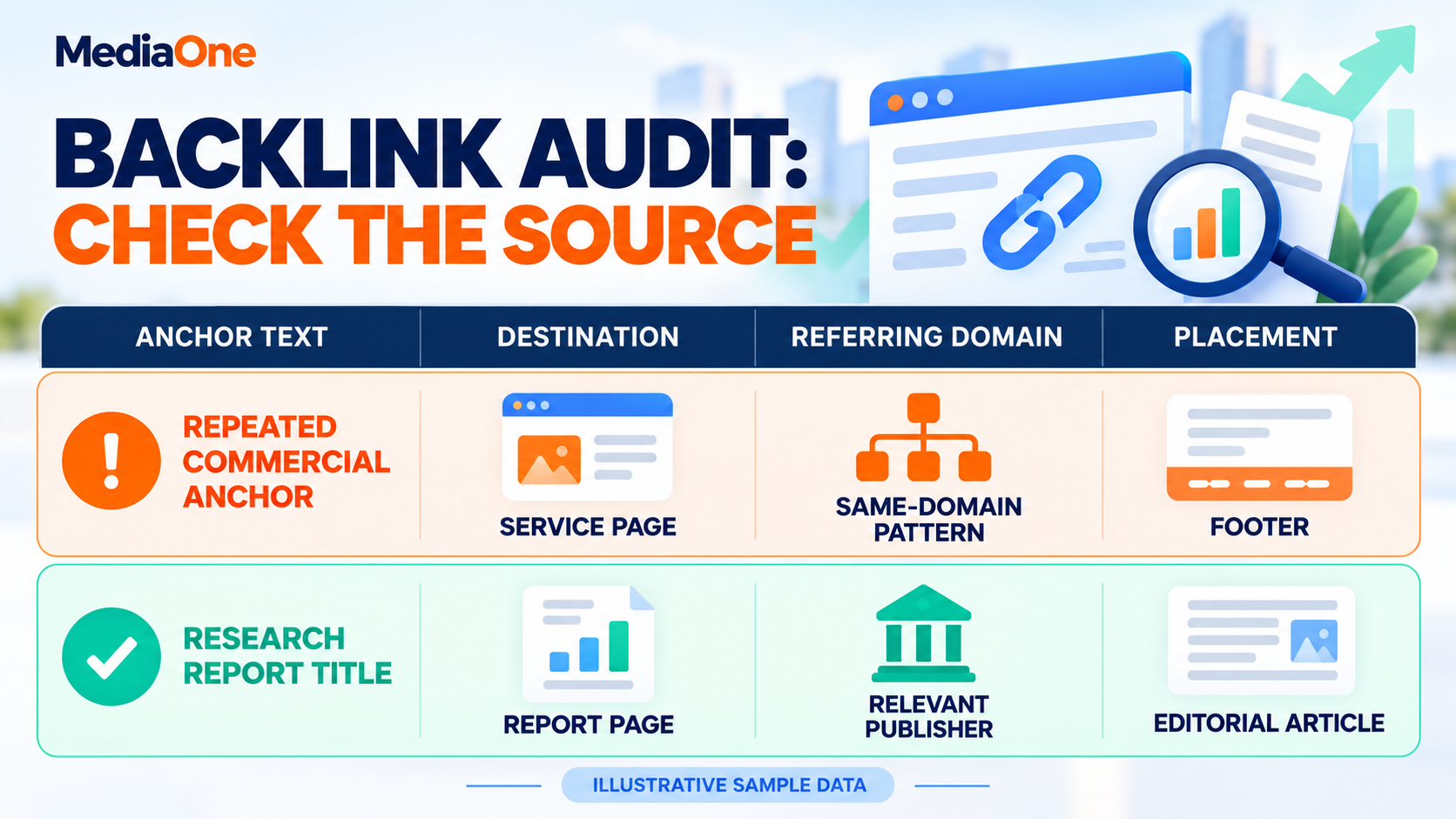
- Separate repeated links from the same domain.
- Label the main anchor types.
- Open examples from each repeated group.
- Record the source, context and reason for concern.
A hundred footer links from one website tell a different story from a hundred editorial links across separate publishers. Both raw link totals and referring domains can help explain the pattern.
Outreach should respect editorial choice
An outreach message can identify the resource and explain why it supports the publisher’s article. The publisher should retain control over whether and how to link.
A bookkeeping checklist might earn “monthly accounts checklist”, its document title or the company name. Each can be accurate in a different sentence.
A request for the same commercial phrase across many unrelated placements deserves scrutiny. Changing that phrase alone does not repair an arrangement created to manipulate rankings.
When Does Anchor Text Become a Link Spam Concern?
Link spam concerns involve the purpose and method of obtaining links. Anchor wording forms part of that assessment.
Google’s spam policies identify practices such as buying links for ranking purposes and distributing links with optimised anchors through certain articles, guest posts or press releases.
The placement needs examination
Patterns that justify investigation include:
- Paid placements intended to pass ranking credit.
- Commercial anchors inserted into unrelated articles.
- Links distributed through templates across other websites.
- Low-value pages created mainly to carry links.
A site owner should establish whether their business or a previous supplier arranged the links. Records of campaigns and payments can explain patterns that anchor data alone cannot.
Paid links need appropriate attributes
Google recognises advertising and sponsorship as normal activities. Its documentation on qualifying outbound links identifies rel=”sponsored” for paid placements and rel=”ugc” for user-generated content. nofollow also applies in specified circumstances.
Those attributes describe the link relationship. They do not make an inaccurate anchor helpful to a reader.
Disavow is not routine maintenance
An unfamiliar or low-quality backlink does not automatically require disavowal.
Google’s disavow documentation says most sites do not need the tool. Its stated conditions involve considerable artificial or low-quality linking combined with a manual action, or a likely manual action. Incorrect use can harm search performance.
A percentage target or a third-party warning score does not establish those conditions.
How to Measure Anchor Text Performance
Measurement should separate search visibility, link interactions and business outcomes. Each answers a different question.
A data-driven SEO approach combines those views without treating one report as proof of everything.
| Measure | What it helps assess | Main limitation |
| Search impressions and clicks | Destination visibility in search | Does not measure clicks on article links |
| Tracked internal link clicks | Interactions with a particular link | Needs suitable tracking |
| Referral visits | Traffic arriving from other websites | May not reveal the exact anchor |
| Enquiries or purchases | Outcomes after visits | Several factors influence results |
Search CTR is different from link CTR
Search Console reports clicks and impressions from Google Search. Its definitions of clicks, impressions and position explain those search measurements. They do not show how often someone clicked a link inside a blog post.
An internal link click-through rate needs a suitable denominator. A rate based on page views differs from one based on visitors who actually saw the link.
An illustrative calculation is:
30 tracked clicks ÷ 1,000 tracked link views × 100 = 3%
That figure describes the example. It is not an industry benchmark.
GA4 internal link measurement needs planning
GA4’s enhanced measurement events include outbound clicks to other websites. That feature does not automatically provide a complete record of internal link clicks.
A defined internal link event can record the source page, destination and placement. Testing should confirm that one click produces the intended event.
Page sequences can show movement between pages. They do not prove which anchor someone clicked when several links share a destination.
Outcomes need context
A link from an article to a service page may contribute to an enquiry later in the visit. The anchor is only one possible influence.
The destination’s content, offer and form can affect the result. Measurement should distinguish a link that attracts interested readers from a page that fails to answer them.
Should You Keep, Rewrite or Remove an Anchor?
An audit becomes practical when each finding leads to an action. Wording should change because it causes a problem or leaves information missing.
| Situation | Decision |
| Accurate wording and relevant destination | Keep |
| Vague wording and relevant destination | Rewrite the anchor |
| Accurate wording buried in an unsuitable section | Review placement |
| Wording promises content the page lacks | Change wording or destination |
| Broken destination | Repair or replace the link |
| Link adds no relevant information | Remove |
An accurate link does not need rewriting merely because another site uses a different anchor mix.
A small test produces more interpretable results
A sample of comparable articles can show whether a proposed wording change helps readers. The record should include the original phrase, replacement, destination, placement, date and available baseline data. Other page changes need recording too.
A link placed higher in an article may receive more clicks even when its wording stays the same. Changing wording and placement together makes their separate effects harder to assess.
A before-and-after example
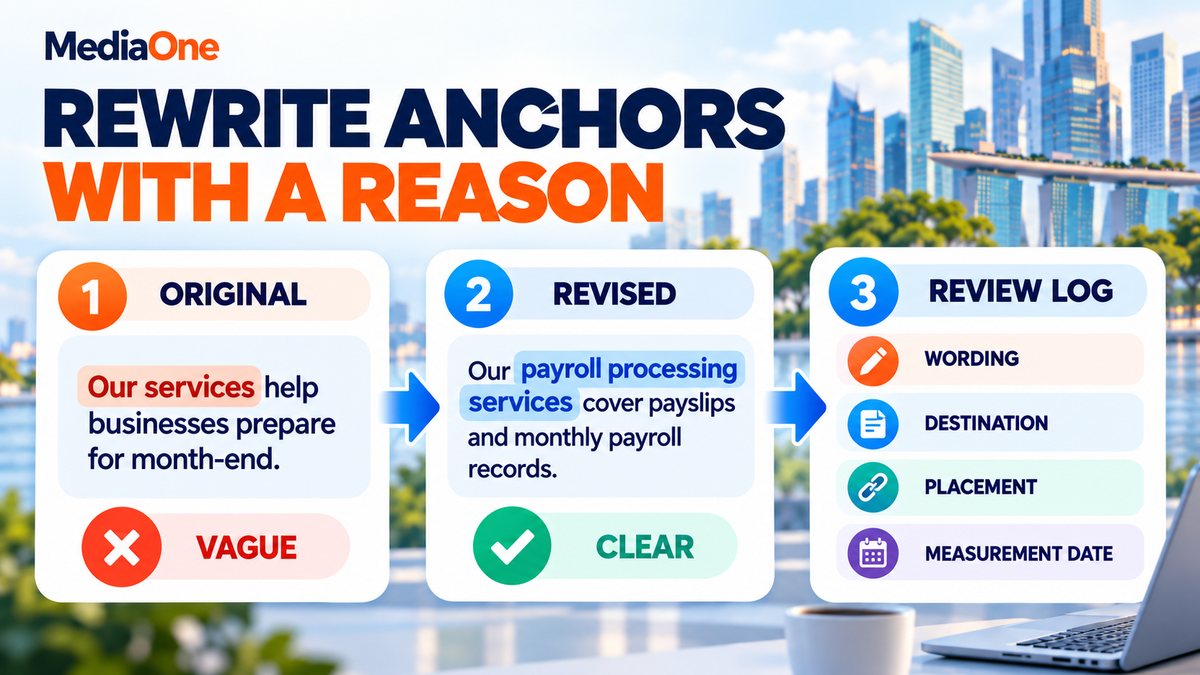
An illustrative article contains: “Our services help businesses prepare for month-end.”
The destination covers payroll processing. “Our services” gives readers little information, while “payroll processing services” names the offer.
The revised sentence could read: “Our payroll processing services cover payslips and monthly payroll records.”
That revision is appropriate only if the destination supports those details. No ranking improvement or enquiry increase should be claimed without measurement.
Make Anchor Text Optimisation Part of Your Content Review
Anchor text optimisation works best as part of routine editing. A short destination check can prevent misleading labels before publication, while a recorded audit helps teams address older links.
MediaOne’s SEO services can support a broader review of content, website structure and search performance. A defined review scope helps the team connect wording changes with the pages and business goals they support.
FAQs About Anchor Text Optimisation
How long should anchor text be?
Anchor text has no universal word count. A short phrase often identifies the destination, but a document title or specific resource may need more words. Extra wording earns its place when it helps readers understand what they will open.
Can an anchor link to a section on the same page?
An anchor can point to a heading within the current page. A table of contents commonly uses these links. The label should match the section topic, and the link needs the correct section identifier to reach it.
Should a PDF link say that it opens a PDF?
A PDF label helps readers anticipate a document instead of a normal webpage. File size can also help people using limited mobile data. “Annual report 2025 (PDF, 2 MB)” is an example when the format and size are accurate.
What alt text should a linked image have?
A linked image’s text alternative should communicate its purpose. The W3C functional image examples show how a linked logo can identify the homepage destination. An image beside equivalent text in the same link may need empty alt text to avoid repetition.
Does a link’s title attribute replace descriptive anchor text?
A title attribute does not replace the visible link label. Google’s link documentation describes it as a fallback in certain cases when an anchor is empty. Readers should receive the necessary destination information through the link’s accessible name and context.
Can anchor text optimisation guarantee AI Overview citations?
Anchor wording cannot guarantee an AI Overview citation. Google’s documentation on AI features and websites says established SEO practices remain relevant and no special optimisation is required for inclusion. MediaOne’s approach to SEO content writing also considers the substance of the answer.