Digital PR is a campaign that earns coverage by giving journalists something worth reporting. Many campaigns still fail because they spend the budget on press releases that no journalist wants to run. This guide explains what digital PR is, how it differs from traditional public relations and link building, and how to plan a campaign that earns coverage on its merits. It is written for in-house marketers, founders and agency leads deciding whether to fund digital PR.
Most digital PR scorecards measure the wrong thing. They count links and mentions, which show how many outlets published something but not whether any of them reached a buyer. This guide argues for a different test: whether the asset is worth covering before anyone pitches it. Five tests, covering newsworthiness, audience fit, editorial timing, verifiability and outreach realism, help you check a campaign before you commission it. Used only to distribute press releases, digital PR rarely outperforms paid placement. Used to create a finding a reporter can cite, it can build brand and search visibility over time.
Key Takeaways
- Digital PR earns its budget only when the campaign produces an asset journalists would cover anyway. Examples include original data and timely angles.
- Score each candidate campaign before commissioning it. Rate five tests from 0 to 2. Do not proceed if the total is below 6.
- Itemize agency quotes before comparing totals. Separate research, writing, outreach and reporting.
- Judge coverage by relevance, not link count. A few placements in outlets your buyers read usually beat many unrelated links.
- A small team can run a campaign on one data asset and a short, checked outreach list.
- Measure outcomes beyond links. Track referral traffic, branded search and pipeline.
What Digital PR Is and Where It Came From
Digital PR is the practice of earning coverage, links and mentions from journalists and online publications by giving them something worth reporting. It starts with a story and ends with a publication running it. The asset is usually original data, a study, a tool or a sharp expert view tied to a live news story. The coverage builds brand awareness and visibility on Google, and it can also spread across social media when audiences share the story. The company does not buy the placement. A well-judged strategy treats each story as a way to reach the readers most likely to act, and it is built on lasting relationships with journalists rather than one-off pitches. Earned media is the coverage a brand receives without paying for placement, and digital PR is one of the main ways to earn it.
Defining Digital PR
Digital PR is a campaign that starts with a story and ends with a publication running it. A brand creates a piece of information, pitches it to reporters who cover that subject, and measures whether the resulting articles reach the right readers and link back to the brand’s website. A newswire press release describes what a company has done. A digital PR asset gives a journalist a finding they can cite, chart or build a story around, and it can also help draw attention to the business’s sales.
Digital PR fundamentals: the newsworthy asset, the journalist, and the audience
Three elements decide whether a campaign works.
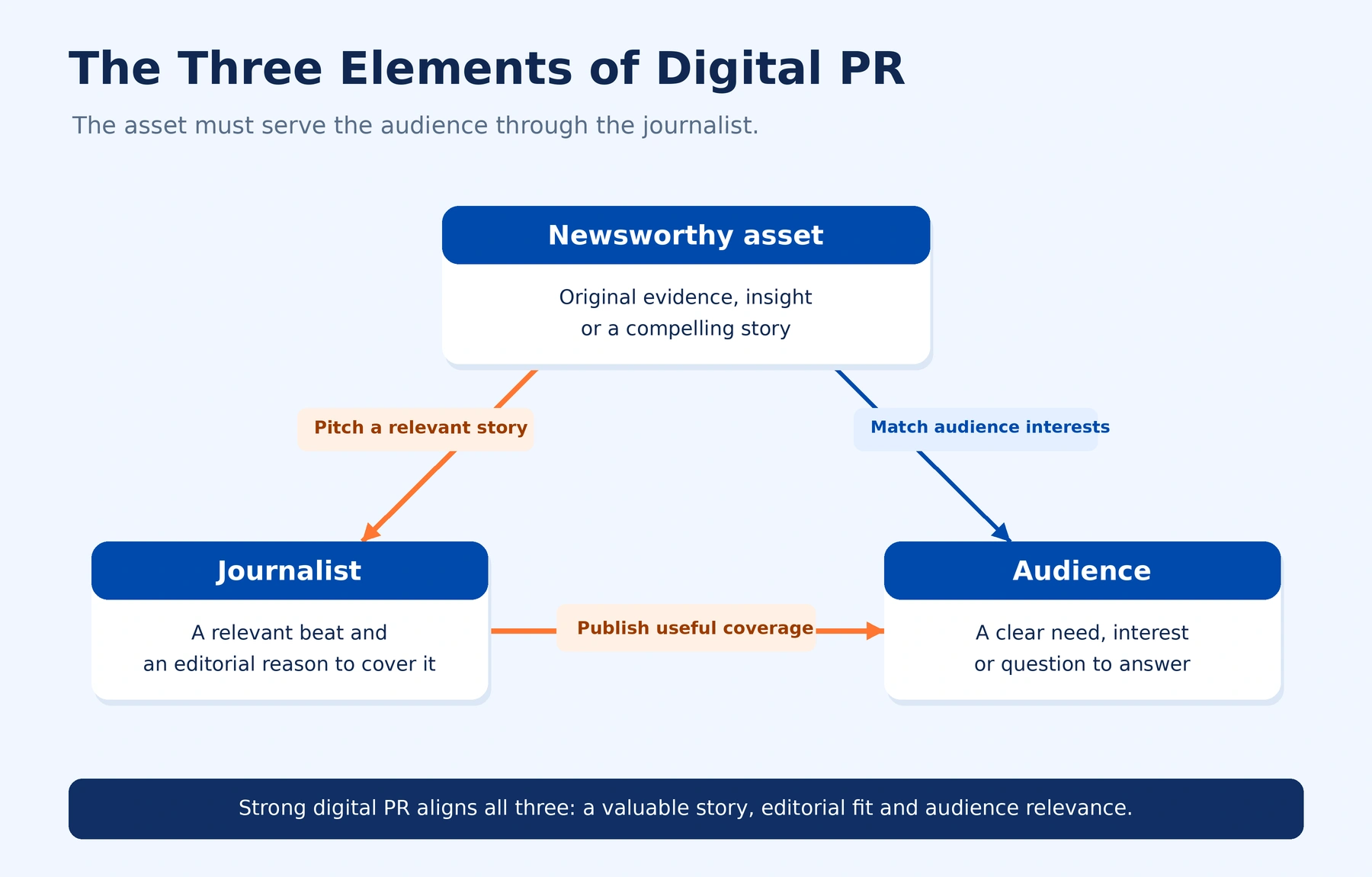
The newsworthy asset is the reason anyone writes about you. It needs a verifiable data point, a new angle on a known problem, or a perspective a reporter does not already have. Generic surveys with predictable answers rarely attract attention.
The journalist decides whether the asset becomes a story. Reporters are short on time and reject anything they cannot use for their readers quickly. Campaigns that build long-term relationships with journalists tend to get a better response for each new asset.
The target audience is the reader the journalist writes for. A finding that matters to logistics managers will not travel to a personal finance desk, no matter how strong the numbers. Matching the asset to the audience is the step most campaigns skip, and it is where most wasted effort sits.
History and origins of digital PR
Digital PR grew out of traditional public relations and early search marketing. When PageRank, described in the original paper by Larry Page and Sergey Brin and used at Google from 1996, began weighing the quality and number of incoming links, marketers noticed that a feature in a respected publication could move rankings as well as reputation. Early practitioners sent press releases and hoped for links. As editors grew more selective, the practice shifted towards creating material editors wanted in the first place, such as original research and data visualizations.
The current state of digital PR in 2026
As of 2026, the bar for coverage is higher. Many reporters receive large volumes of pitches each day, and editors often see generic outreach, surveys built only to generate a headline, and sponsored content presented as editorial. Successful campaigns usually have three traits: a dataset or insight the outlet could not produce itself, a clear tie to the news cycle, and a named expert who can speak to the findings. Teams increasingly judge coverage by relevance, editorial links and referral visits rather than raw link counts, and they track how media coverage feeds business goals. Media outlets also weigh coverage by how often the story is shared across social media. Thought leadership, built on a named expert’s credible view, is one way campaigns earn that standing in a crowded field.
Reporters are not short on pitches, so a claim that editors are busy needs a number to back it up. Consult a recent journalist survey from a named publisher before quoting it, and check its date. Until then, treat the claim as a direction rather than a measured fact.
Planning a Digital PR Campaign, Step by Step
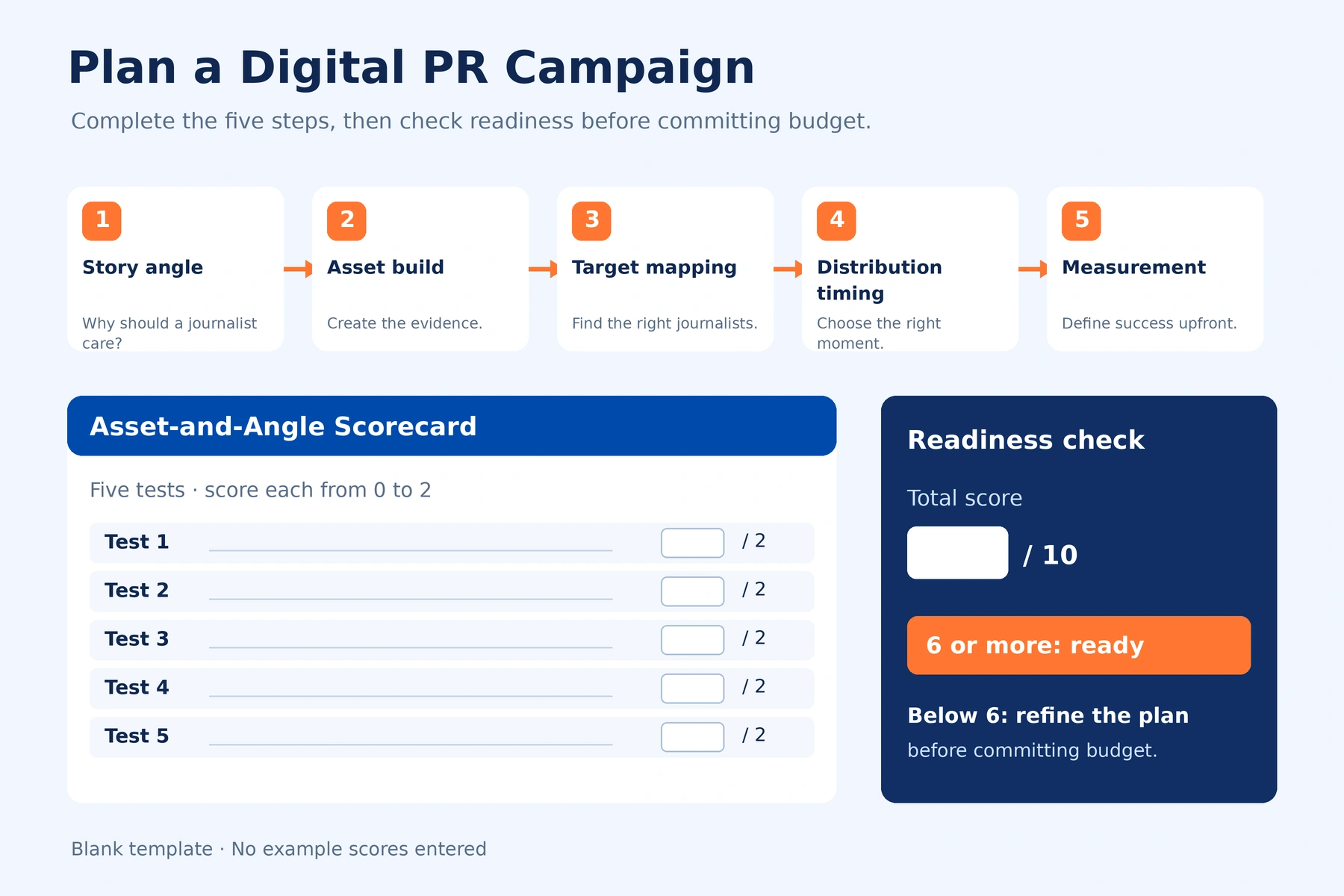
Most campaigns fail before anyone sends a single email. Planning decides whether a journalist has a reason to care. Work through the five steps below in order, then score the result against the Asset-and-Angle Scorecard before committing to a budget. A total below 6 out of 10 means the campaign is not yet ready.
Step 1: Identify a Story Angle a Journalist Would Run Without a Pitch
Ask whether a business editor would publish this story if you had never contacted them. If the answer depends on your pitch, the angle is too thin. A usable angle connects your data to something already in the news, such as a regulatory change, a seasonal pattern or a shift in buyer behavior. Editors decide quickly, so the story has to earn its place. A strong angle helps your brand earn media coverage without paid placement, and earned media is a core goal of digital public relations. Stories that work well online often connect to what people are already searching for, helping you build brand awareness beyond a single article.
Step 2: Build the Asset (Dataset, Study, Tool, or Commentary)
The asset is the reason coverage happens. Original data beats recycled statistics because no other outlet can publish your numbers without citing you. A survey, an analysis of your customer records, or a calculator that answers a common question can all qualify. Keep the method simple enough to explain in two sentences: who was measured, when, and how. Thought leadership commentary from your team can serve as the asset when you don’t have a dataset.
Worked example: one campaign asset and its outlet list
Consider a hypothetical logistics software company, with placeholder figures to replace with your own data.
- Asset: A recent survey of warehouse managers on how often they reroute shipments during peak season, open to press review on request.
- Hook: A reported rise in peak-season delivery delays, tied to the current news cycle.
- Outlet list: A trade logistics publication (reporter who covers warehousing), a business section of a national newspaper (reporter who covers supply chains), and a regional business weekly (reporter who covers local manufacturing).
- Why it fits: Each outlet’s readers buy freight and warehouse services, so the finding matters to the people who would enquire.
Replace each bracketed value with real data before any outreach begins. Do not pitch the story until the survey has been run and the figures checked.
Step 3: Map Target Publications and Reporters
Create a list of five to eight outlets that align with the story’s existing coverage. For each, find the reporter who has written on the topic recently. Relevance matters more than reach. A trade publication your buyers read usually brings more qualified visitors to your website than a general site that links to you once. Write one line per reporter explaining why the story suits their beat, and match each outlet to the marketing goal the campaign supports, whether that is sales or brand awareness.
Search visibility also responds to this step. Google weighs relevance, content quality, usability, links, context, and other signals to determine the best results for each query, so an editorial link from a relevant publication carries more weight than a link from an unrelated site. Relevance and readership should guide your list before raw link count does. Keeping relationships with journalists warm over time makes each new pitch easier to place.
Step 4: Set a Distribution Plan and Timing Window
Decide in advance when the story goes out, who gets it first, and what to do if nobody picks it up. Embargoed exclusives to one or two top-fit outlets often work better than a broad send. Avoid major news days and weekends. Lack of personalisation is the number one reason editors immediately reject an otherwise relevant pitch, cited by 21% of respondents, so write each email for the individual reporter. If you don’t receive a response, send a single follow-up cold email; if that doesn’t help, you may want to move on. Align the timing with your wider content and social media calendar to amplify the story across channels.
Step 5: Measure Coverage, Referring Domains, and Search Impact
Count coverage quality as well as volume. Record each placement’s relevance, whether the link is editorial or a passing mention, and the audience it reaches. Then track referral sessions, branded search volume in the weeks after publication, and enquiries that name the story. Set these measures before launch. A campaign judged only on links will look successful, even if those links bring no buyers. Strong results also show whether the campaign is building brand strength for the wider marketing strategy.
| Measure | What it shows | When to check |
|---|---|---|
| Relevant placements | Whether the right outlets picked it up | 2 to 4 weeks |
| Editorial links from relevant domains | Authority gained, not raw link count | 4 to 8 weeks |
| Referral sessions | Direct traffic from coverage | 30, 60 and 90 days |
| Branded search change | Awareness among people who saw the story | 60 and 90 days |
If a campaign fails, the scorecard shows where. A weak score on the data or hook test means rework before outreach. A strong asset with no pickup usually points to the outlet list or the timing.
Asset-and-Angle Scorecard
Score each of the five tests from 0 to 2. A total of 6 or more out of 10 is the pass threshold. The scorecard has not been validated against published campaign data, so treat it as a working checklist rather than a predictor.
- Verifiable data. 0 = no data, or data you cannot source. 1 = data exists, but the method is vague. 2 = a named method, a sample size and a date. Pass example: “A survey of 200 warehouse managers, run in March.” Fail example: “Our research shows most managers struggle.”
- Newsworthy hook. 0 = no link to the news. 1 = loosely related to a trend. 2 = tied to a live event or a dated change. Pass example: a finding that responds to a new regulation taking effect this quarter. Fail example: a general statement about “the future of logistics.”
- Outlet fit: 0 = no outlet clearly reads this. 1 = a broad outlet with a loose fit. 2 = a named outlet whose readers are your buyers. Pass example: a trade title covering your exact sector. Fail example: a general lifestyle site with no business readers.
- Expert availability. 0 = no named spokesperson. 1 = a spokesperson who has not agreed to speak. 2 = a named expert who has agreed to comment. Pass example: a team lead ready for interviews this week. Fail example: “A company representative will comment” with no name.
- Measurable goal. 0 = no goal set. 1 = a goal set for links only. 2 = goals set for referral traffic or enquiries. Pass example: a target of 50 referral sessions and three enquiries in 90 days. Fail example: a target of 20 links with no traffic or enquiry measure.
Digital PR Compared With Traditional PR and Link Building
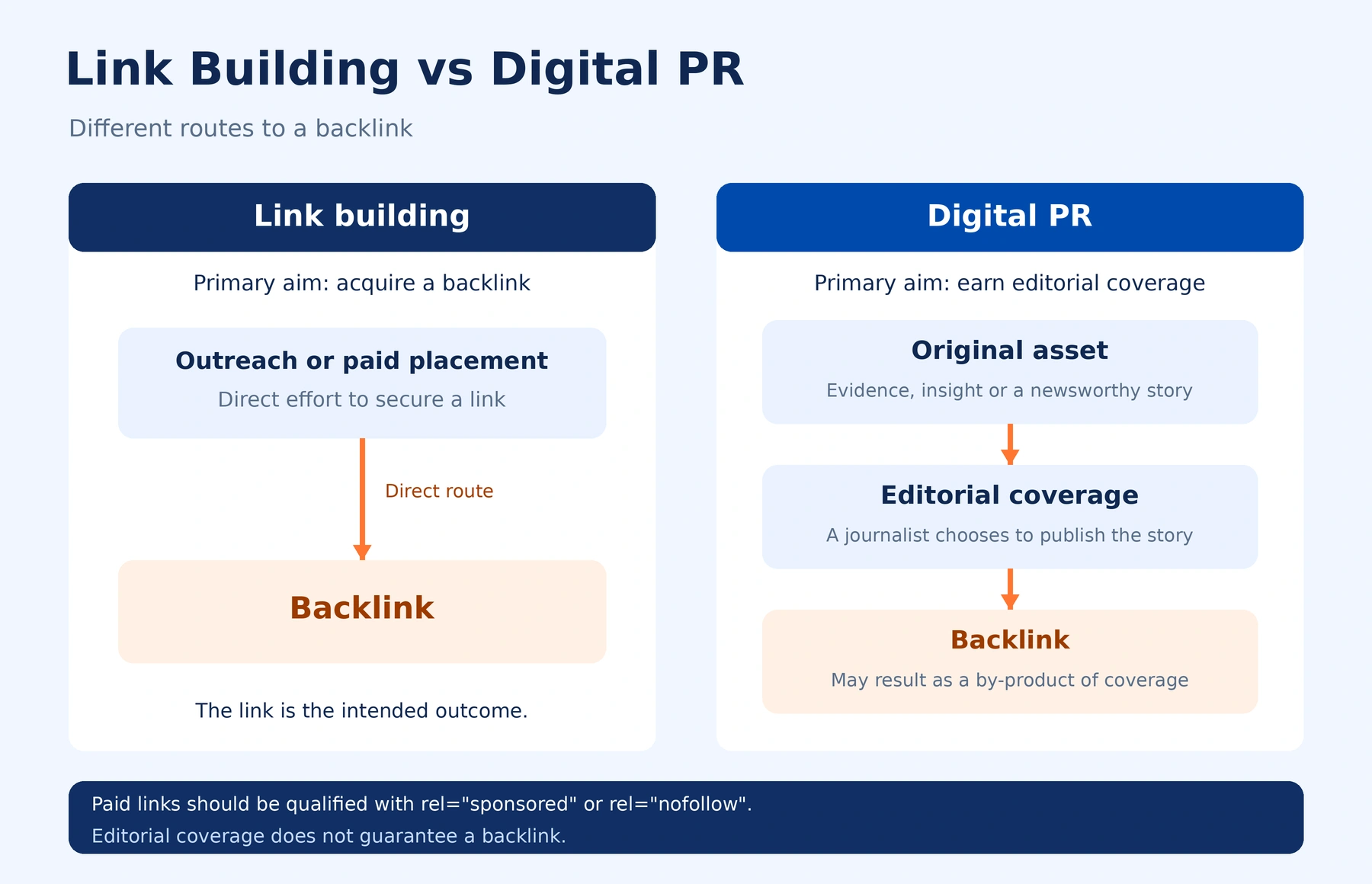
Digital PR overlaps with two older disciplines but differs from both in its purpose. Traditional public relations protects and shapes a brand’s reputation through press coverage, events and crisis handling. Link building is a search engine tactic that acquires links from other sites, often through guest posts or directories.
Digital PR sits between them. It uses the storytelling of public relations to earn the links that link building seeks, but it measures success by audience reach and business outcomes, not reputation management alone. A campaign built on a genuine finding can serve all three goals at once, helping a brand create demand for its content, drive traffic to its website, and build brand awareness while supporting sales. Google can also reward the links such a strategy earns.
Digital PR Campaigns and Services: What to Buy and What to Build
Many businesses buy digital PR from an agency, so itemize the work before comparing quotes. Separate research and asset production, writing, outreach, and reporting. Two quotes of the same total can buy very different work, so compare the deliverables first. An agency that quotes one figure for “digital PR” without listing these parts is difficult to evaluate.
Building in-house suits teams with a clear data source and a writer who knows the audience. Buying suits teams that need outreach capacity or a reporter network they do not have. Either way, run the scorecard first, because no supplier can rescue an asset that fails the data and hook tests.
Conclusion
Digital PR earns its budget only when the campaign produces something journalists would publish without a pitch. That means original data, a timely hook, or a named expert with a useful view. Without that asset, the campaign is a press release sent to a list, which most editors ignore. Before commissioning anything, run the Asset-and-Angle Scorecard from earlier in this guide. A total below 6 out of 10 means you should rework the idea, not push it harder.
For your first campaign, keep it simple. Pick one verifiable data point, one news event it connects to, and five to eight online media outlets you have read and checked for relevance to your target audience. Write down the work each price assumes before comparing supplier quotes. Then track referral sessions and relevant placements over 30, 60 and 90 days, not just link counts. If the first campaign produces qualified coverage, you have a repeatable method. If not, the scorecard will show which test failed.
Frequently Asked Questions
What is digital PR?
Digital PR is the practice of earning editorial coverage and links by publishing a story that journalists want to report. It usually rests on original data, a timely hook or a named expert. The aim is placement in relevant outlets, not a bulk press release. Journalists decide whether to cover the asset.
How is digital PR different from link building?
Link building aims to acquire backlinks. Digital PR is one way to earn them. It produces links as a side effect of coverage, so those links tend to sit on editorial pages with real readership.
Does digital PR help SEO?
It can. The main gains are referring domains, referral traffic and branded search that coverage generates. Google considers relevance, content quality, usability, links, context, and other signals to determine the best results for each query, so links are one input among many. Treat the SEO benefit as indirect rather than guaranteed.
What are the most effective digital PR tactics?
Data-driven research studies attract media coverage because they give journalists figures that can anchor a story. Reactive commentary works when the response is fast and specific. Press releases alone usually earn pickup only if the news itself is new.
How do I measure digital PR results?
Start with coverage quality: publication relevance, placement type and whether the piece is editorial rather than paid. Then track referral sessions, branded search volume over 30, 60, and 90 days, and any sales or pipeline influenced by the campaign. Raw link count is a weak signal on its own.
How much does a digital PR campaign cost?
Pricing varies widely by agency, scope and whether research is included, so no single figure applies. The four main pricing models are monthly retainers, project fees, hourly rates, and performance-based pricing, and each carries different costs. Compare quotes line by line: research, writing, outreach and reporting. The gap between quotes usually comes from which of these each one includes.