

| AI Summary
Businesses can outsource GEO or generative engine optimisation when they need outside help to measure and improve their presence in AI-generated answers. A successful arrangement needs agreed buyer questions, recorded results, access to website support and someone inside the business who can approve changes. The readiness scorecard below helps teams assess those needs, while the partner checklist explains how to compare proposals and verify reporting. |
When you outsource GEO, it means you’re hiring an outside team to assess how AI answers describe, mention or cite your business, then improve the web content supporting that presence. The decision depends on the work your team can manage, the support it needs and how you will check progress.
An agency can handle research, monitoring and content changes, but your business still supplies product knowledge and approves what gets published. Our GEO services bring those activities together. Before choosing a partner, the scorecard and checks below can help you decide which responsibilities to hand over.
Key Takeaways
- Readiness depends on internal support. A named owner, website access and time for approvals help an outside team deliver the agreed work.
- AI visibility needs a recorded baseline. Dated questions, saved answers and source links give both teams something to compare.
- Mentions, citations and visits need separate reporting. Each measures a different part of discovery and customer behaviour.
- Comparable proposals need the same brief. Software, research, content, technical work and reporting should have stated allowances.
- Ownership belongs in the agreement. Data exports, account access, content rights and handover terms affect what your business keeps.
What Outsourcing GEO Involves
A GEO partner studies how your business appears in AI answers and identifies website improvements that could support discovery. That work overlaps with SEO because accessible pages and accurate information help search systems understand what your business offers.
The difference between AEO and GEO helps define the brief. Answer engine optimisation often focuses on answering specific questions, while GEO considers how brands and sources appear in generated responses. Agencies use these terms differently, so the deliverables need to explain what you are buying.
| Work area | What the partner does | What your business receives |
| Initial review | Tests relevant questions and checks current answers | A dated starting record |
| Buyer research | Groups questions by customer need | An agreed question list |
| Website checks | Reviews access and page problems | Prioritised issues with owners |
| Content improvements | Updates explanations, evidence and service details | Reviewed pages and a change log |
| Monitoring | Repeats agreed tests | Comparable results and saved evidence |
| Reporting | Explains results and next actions | Findings linked to completed work |
Software supports these tasks, but the subscription does not perform every job in the table. Someone must review answers, investigate errors and make changes. A proposal should explain who supplies that time and which tasks need your team’s involvement.
How GEO relates to existing SEO work
Google’s AI search documentation says established SEO practices remain relevant to AI Overviews and AI Mode. A supporting page must be indexed and eligible for a search snippet; Google does not require special AI markup. Eligibility also does not guarantee inclusion.
A GEO brief should therefore account for existing SEO foundations. If a page contains outdated service information or cannot be accessed, the first task is to resolve that problem. Extra monitoring will help document the issue, but someone still needs to fix it.
When to Outsource GEO
Outsourcing becomes practical when your team knows the business questions it wants to address but lacks time or specialist support to complete the work. Repeated delays can help identify which tasks belong in the brief.
| Situation inside the business | Outside support to consider |
| Nobody records AI answers consistently | Measurement setup and monitoring |
| Reports arrive, but pages remain unchanged | Content and implementation support |
| Product information contains repeated errors | Research and editorial review |
| Website problems block planned changes | Technical investigation and fixes |
| Several teams publish conflicting details | Content coordination and approval support |
For example, a software company may have strong product experts but no editor available to turn their knowledge into customer-facing pages. Outsourcing research and writing could address that gap, provided an internal expert can review the drafts.
Another business may already have writers and developers. Its main need could be independent measurement and a prioritised work list. Buying a full production package would add responsibilities it can already manage.
When a smaller project makes sense
A one-off review can help when the problem is still uncertain. The output should identify what was tested, what needs attention and who can complete each action.
A limited project might cover:
- A baseline for one product or service.
- A review of inaccurate brand descriptions.
- A technical investigation affecting important pages.
- A small group of revised service pages.
- A reporting process your team can maintain.
An ongoing contract becomes easier to assess once the business understands the workload. The initial project also gives both teams experience of approvals, reporting and delivery before making a longer commitment.
The GEO Outsourcing Readiness Scorecard
The scorecard measures whether your business can support an outside partner. It does not predict citations, rankings or revenue. Higher scores indicate that the working conditions are better prepared.
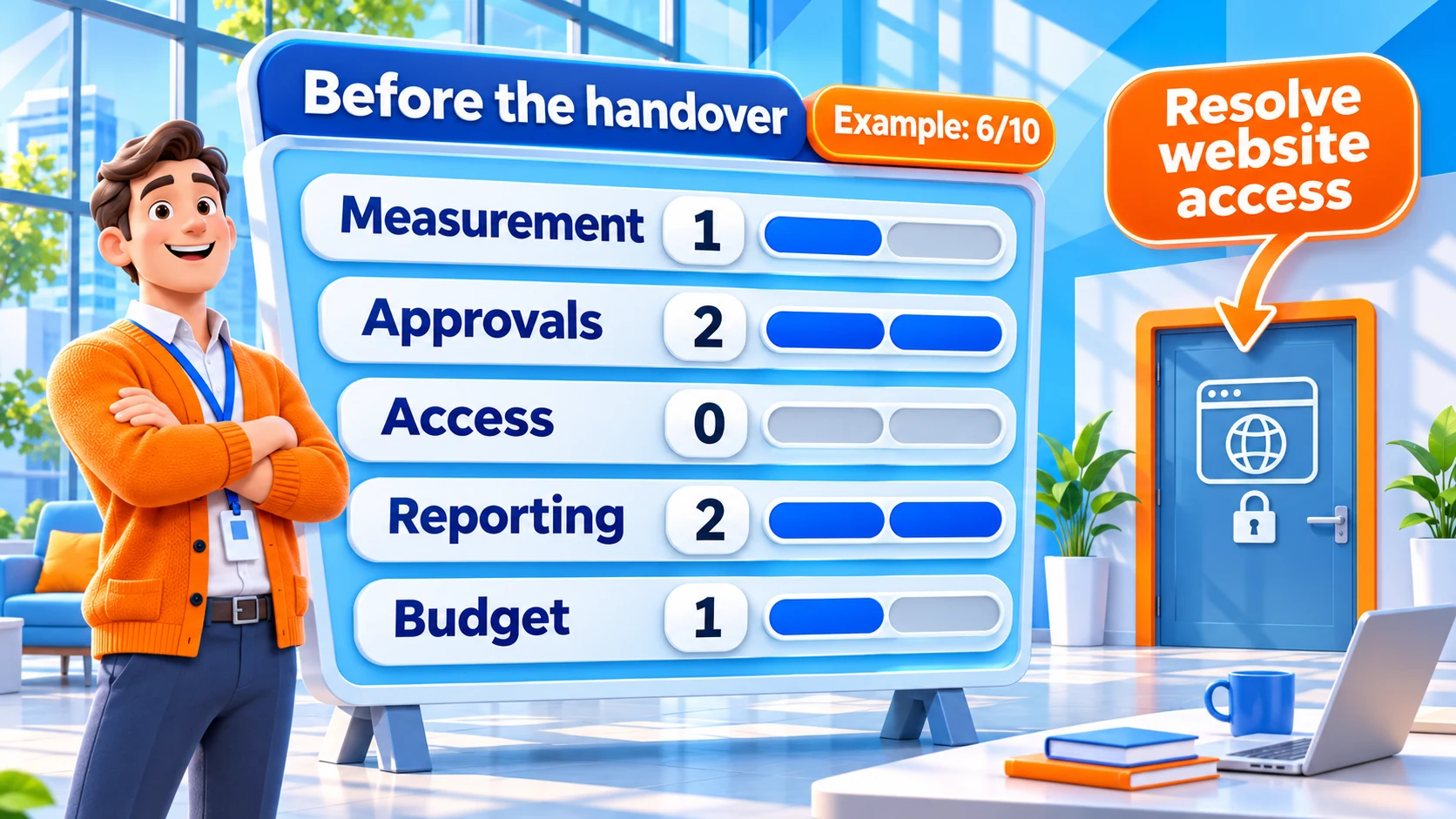
Each area receives zero, one or two points. The bands below are an editorial planning tool, without a validated industry threshold.
| Readiness area | 0 points | 1 point | 2 points |
| Measurement oversight | Nobody can review reports | Someone can check summaries | A named owner can review evidence |
| Content approvals | No reviewer is available | Reviews happen when time allows | A reviewer has agreed response times |
| Website access | Changes cannot be arranged | Access depends on an occasional supplier | A developer or editor can implement changes |
| Reporting ownership | Results stay in the supplier’s system | Some reports can be exported | Data, methods and exports are agreed |
| Budget and purpose | No goal or approved budget | A limited project has approval | The business has an agreed goal and review budget |
How to interpret the total
A score of seven to ten supports discussing a managed engagement. The business has several conditions in place, although any zero still needs attention.
Lower totals suggest a narrower starting point:
- Four to six: A shared arrangement may work, with specific responsibilities assigned internally and externally.
- Zero to three: A short setup project can establish ownership, access and measurement before wider delivery.
A total of eight does not cancel out a zero for website access. That gap could prevent the partner from publishing the improvements it recommends. Each individual score should therefore shape the contract.
The example below shows how the same scorecard can reveal the next practical step.
How to Verify AI-Answer Visibility
AI visibility reporting needs a defined test. A screenshot can show what appeared during one recorded interaction, but it cannot establish how every customer sees your business.
A repeatable process gives that screenshot context. The partner should preserve the question, platform, date, answer and linked sources so your team can inspect the finding.
Questions should reflect customer decisions
Customer conversations provide a starting point. Sales emails, support tickets and keyword research can reveal the problems people describe before they know which supplier they need.
A test list can cover several stages:
| Customer task | Example question |
| Understand a problem | “Why does warehouse stock keep going missing?” |
| Compare approaches | “Barcode scanning or manual stock counts for a small warehouse?” |
| Find suppliers | “Which inventory systems support several warehouses?” |
| Check a brand | “Does Company A support barcode scanning?” |
| Confirm limitations | “Can Company A work without an internet connection?” |
Unbranded questions help assess discovery. Branded questions help assess how the business is described once someone already knows its name. Reports should separate those groups because a brand appearing in an answer that names it has a different meaning.
The agreed list should stay stable during each comparison period. New questions can be added as a separate group, preserving the original baseline.
Every test needs enough context
The record should describe how the answer was obtained. Tests through a consumer interface and tests through an API need separate labels because they may represent different experiences.
A practical log includes:
- The exact question and any earlier conversation.
- The platform, interface and displayed model, where available.
- The date, language and relevant location settings.
- Whether search or browsing was enabled.
- The saved answer and any visible source links.
- Whether the brand description was accurate.
A new conversation helps reduce the influence of earlier messages. Repeated checks then show variation across the agreed sample. The reporting method should explain how many runs occurred and how missing or failed responses were handled.
Mentions and citations need separate counts
A mention means the answer names your business. A citation means the answer links to a source. That source could be your website or another publisher, so the destination needs checking.
The distinction becomes easier to see when the evidence is followed from question to source.
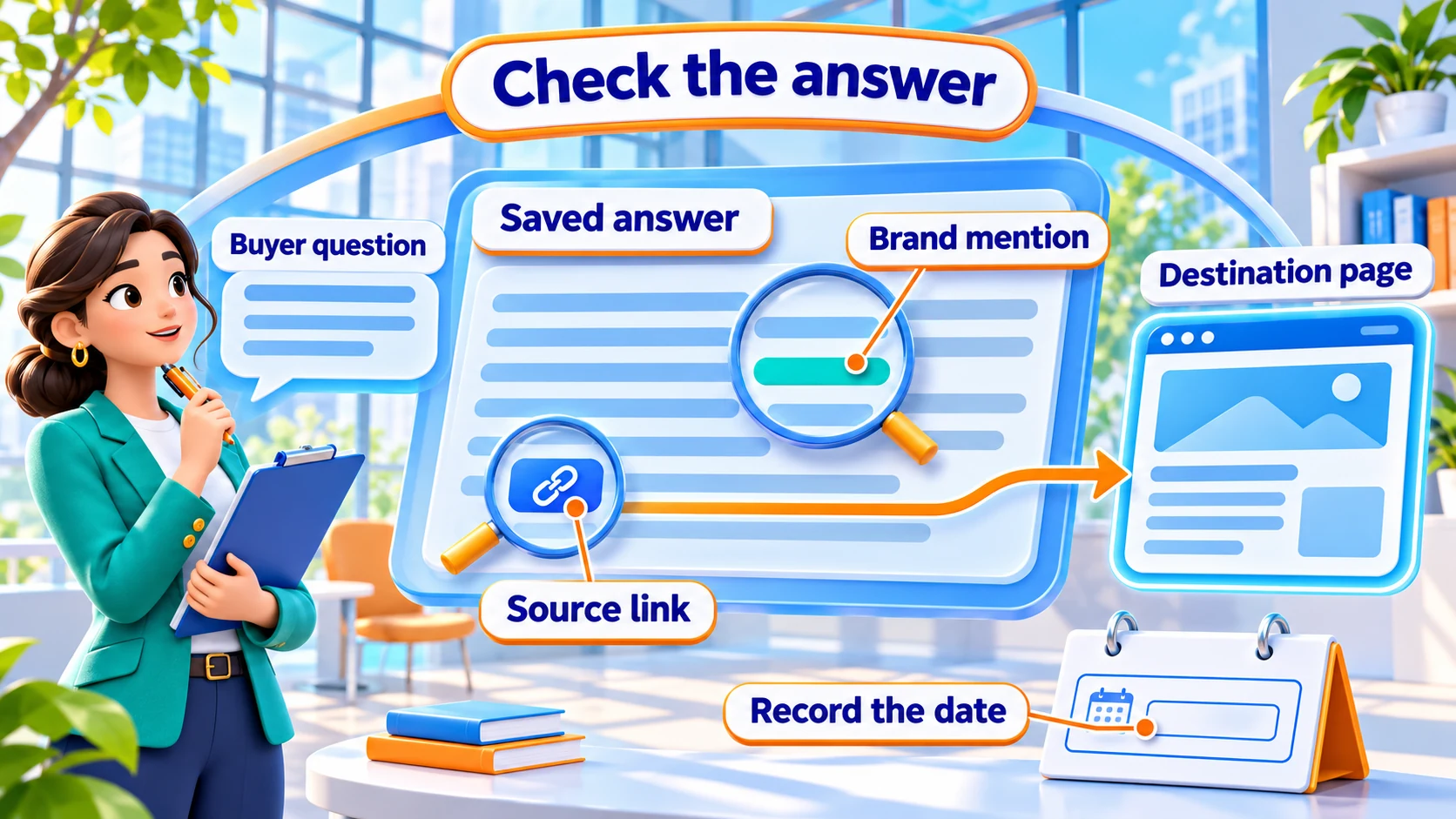
A reporting definition might count an answer containing at least one link to your domain as one successful citation test. Another system might count every individual link. Either approach needs a stated denominator so the percentage can be checked.
For an illustrative sample, 12 answers linking to your site out of 40 recorded answers gives a 30% answer-level citation rate. The result describes those tests. It does not measure your share of all AI answers.
What the Partner Should Improve
Measurement should lead to work on the pages and information customers need. The partner’s recommendations should explain the observed problem, the proposed change and how completion will be checked.
Google’s people-first content principles emphasise original information, relevant experience and content that helps readers achieve their goal. Those principles support an editorial brief grounded in the business’s knowledge.
Accurate answers to buying questions
Service and product pages often need attention before another blog post. Customers may need details about availability, compatibility, delivery or exclusions to decide whether to enquire.
A content review can check:
- Whether the opening explains the offer.
- Whether service boundaries are stated.
- Whether examples reflect actual delivery.
- Whether important claims have supporting evidence.
- Whether names and product details agree across pages.
Good SEO content writing connects those details to the reader’s question. For example, a compatibility page should explain which systems work together and any limitations that affect the purchase.
Different questions may need different content formats. A comparison table can help a buyer assess options, while a troubleshooting guide needs steps and explanations. The format should follow the task.
Website access and technical repairs
Google’s technical requirements include access for Googlebot, a successful HTTP response and indexable content. A partner checking Google visibility should investigate failures in those areas before attributing absence to the wording alone.
A technical work list should identify the affected URL, the issue, the person responsible and the completion check. The same level of detail helps when selecting technical SEO support: an audit needs a route into implementation.
Structured data that matches the page
Structured data labels information in a format search systems can process. Google’s structured data policies require it to represent the page accurately and avoid misleading claims.
A partner proposing markup should explain what it describes and how it matches visible content. The delivery record should include validation results and any remaining issues. A package selling schema as a guaranteed route into AI answers deserves further scrutiny.
How to Choose a GEO Partner
A shared brief makes proposals easier to compare. Each shortlisted partner should receive the same business goal, website scope, question sample and description of internal resources.
The written response should answer the following questions.
| Question | Evidence to request |
| What will be tested? | Question groups, platforms and testing frequency |
| Who will do the work? | Named roles and relevant project experience |
| Who will publish changes? | Responsibilities for writing, review and implementation |
| How will progress be assessed? | Definitions, baseline and sample reporting |
| What does the business keep? | Data exports, content rights and account access |
| What happens at the end? | Notice period and handover deliverables |
Case studies need a measurement method
A percentage increase means little without the starting figure and test conditions. A credible case study should connect the result to a named measurement period and describe the work completed.
The review should establish:
- Whether the question set stayed consistent.
- Which platforms and interfaces were tested.
- Whether the figures count mentions, links or answers.
- Whether the client also changed its website or campaigns.
- Whether results can be inspected through authorised evidence.
Client confidentiality can limit what an agency shares. An anonymised example can still explain the method and show the structure of the evidence. Your own pilot can then test whether that reporting standard appears in practice.
Proposed tactics need editorial scrutiny
Google’s spam policies address practices such as link spam and producing large amounts of low-value content to manipulate rankings. A GEO label does not remove those concerns.
Any proposal involving mass publishing, paid mentions or external placements should explain what readers receive and how the work will be reviewed. The business should know where its name will appear and what claims will be made on its behalf.
How to Compare GEO Quotes
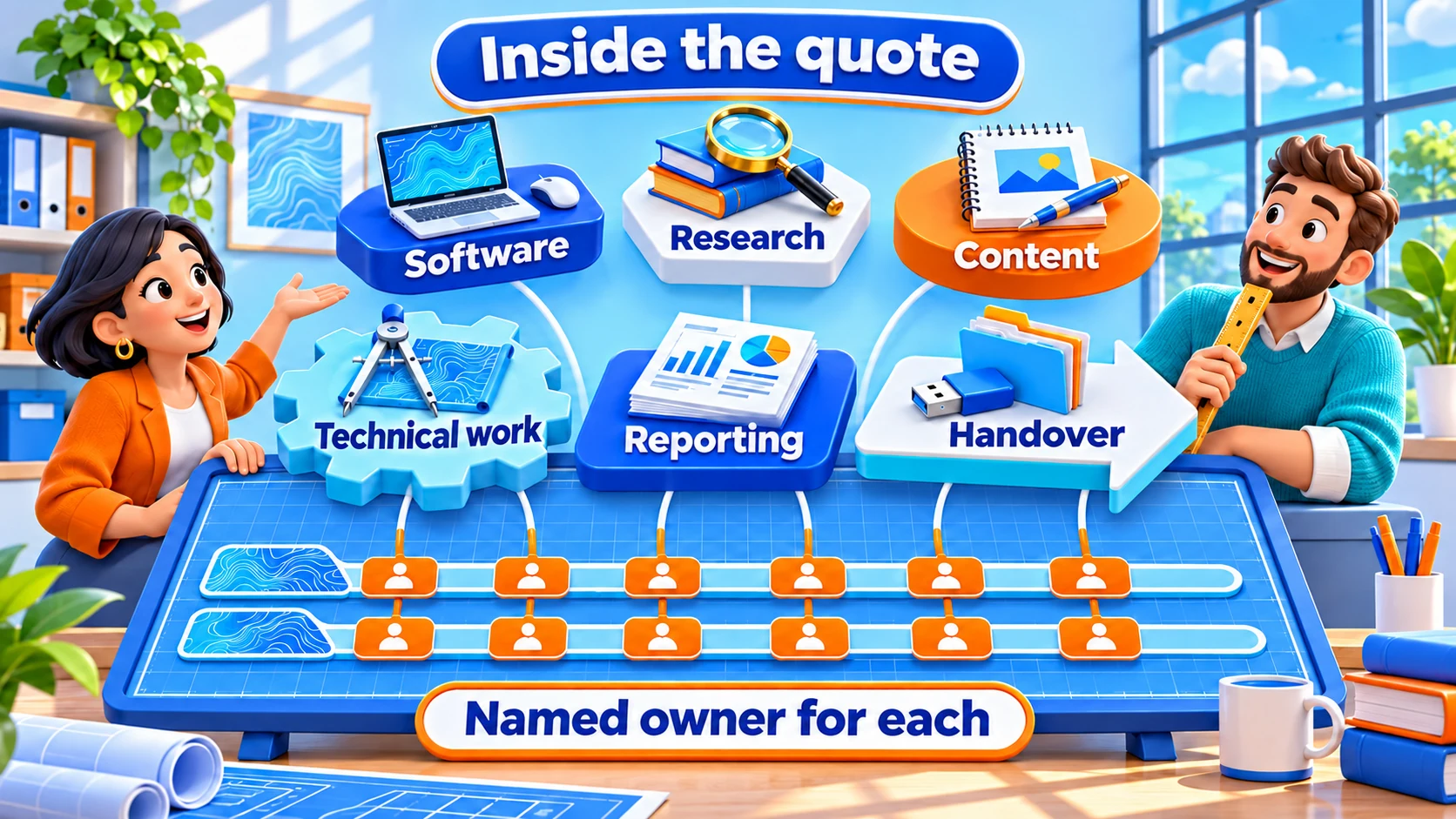
A quote needs to show what the fee buys. Software access, specialist time, content production and development can sit inside one package, but each requires an allowance.
| Cost line | Details to compare |
| Software | Platforms, question limits, seats and export access |
| Research and monitoring | Question development, testing frequency and manual checks |
| Content | Page types, quantities, review rounds and expert input |
| Technical work | Investigation, implementation and retesting |
| Reporting | Meetings, evidence access and written analysis |
| Handover | Documentation, exports and transition support |
The proposed working rhythm also affects cost. A package requiring your team to write every page creates a different workload from one including research, drafting and revisions.
The comparison below turns the quote into a set of tasks both sides can recognise.
Content allowances need quality checks
Google’s generative AI content documentation recognises AI’s role in research and structure while warning about producing pages without added value. The production method therefore needs an editorial review process.
A proposal should explain who checks facts, who reviews business claims and how revisions are handled. Our content marketing services can support planning and production, with the agreed scope defining the pages and review responsibilities.
What a GEO Pilot Should Prove
A pilot gives the business a limited period to assess delivery and evidence. Its duration should allow time for the agreed research, approvals, implementation and repeat checks.
The review should separate completed work from observed outcomes.
| Delivery evidence | Outcome evidence |
| Baseline recorded | Changes in sampled mentions and citations |
| Agreed pages reviewed | Accuracy of business descriptions |
| Approved changes published | Visits from identifiable AI referrals |
| Technical fixes checked | Relevant enquiries or purchases |
| Reports and exports delivered | Limits and uncertainty in the results |
A partner can commit to completing agreed tasks. Platform inclusion remains outside its control, so the pilot should not rely on a promised citation count.
Customer actions need their own measurement
Website visits help connect discovery to behaviour. Google Analytics events can measure interactions such as purchases and link clicks; suitable events can also support analysis of enquiry activity.
The business should agree which actions count before the pilot begins. A submitted form, a suitable sales enquiry and a completed sale represent different stages. Separating them prevents a rise in low-quality contacts from appearing to be a successful commercial result.
Referral reporting also has limits. Customers may see an AI answer, return later through another channel or never click. Reports should describe what the available data shows and keep unverified attribution out of revenue claims.
Choosing a GEO Partner You Can Evaluate
A decision to outsource GEO works best when the business can support approvals, implementation and reporting. The readiness scorecard identifies gaps before the contract, while a shared brief and pilot help test how a partner works. A dependable arrangement leaves your team able to inspect the evidence and understand the next action.
At MediaOne, we connect our GEO support with SEO services so research can inform website improvements. A conversation with our team can help define the questions, pages and responsibilities for your proposed engagement.
FAQs About Outsource GEO
Can an existing SEO agency take on GEO work?
An existing agency may be able to add the work if it can demonstrate a repeatable testing method and explain the additional responsibilities. Its current knowledge of the website can help, but the expanded agreement still needs defined platform coverage, evidence access and reporting.
Does a small business need paid GEO software immediately?
A small business can begin with manual checks and a shared record when the question list is manageable. Paid software becomes easier to justify as platforms, questions and reporting needs increase. The purchase should solve a documented workload or measurement need.
Can GEO work begin before a website redesign?
Research can begin before a redesign, especially when it identifies customer questions and missing information. Major page changes may need coordination with the redesign team to avoid duplicated work. The brief should distinguish content that can be improved now from changes scheduled for launch.
Should different languages have separate GEO reporting?
Separate language groups make comparisons easier to interpret. Each group should use natural customer questions and relevant reviewers, since direct translations may miss how people describe the same need. A combined headline figure should preserve access to the underlying language results.
Can a GEO partner fix incorrect information on another website?
A partner can identify the source and help prepare a correction request, but the publisher controls its own page. The business should expect a record of outreach and responses. Removal or amendment cannot be assumed before the publisher agrees.