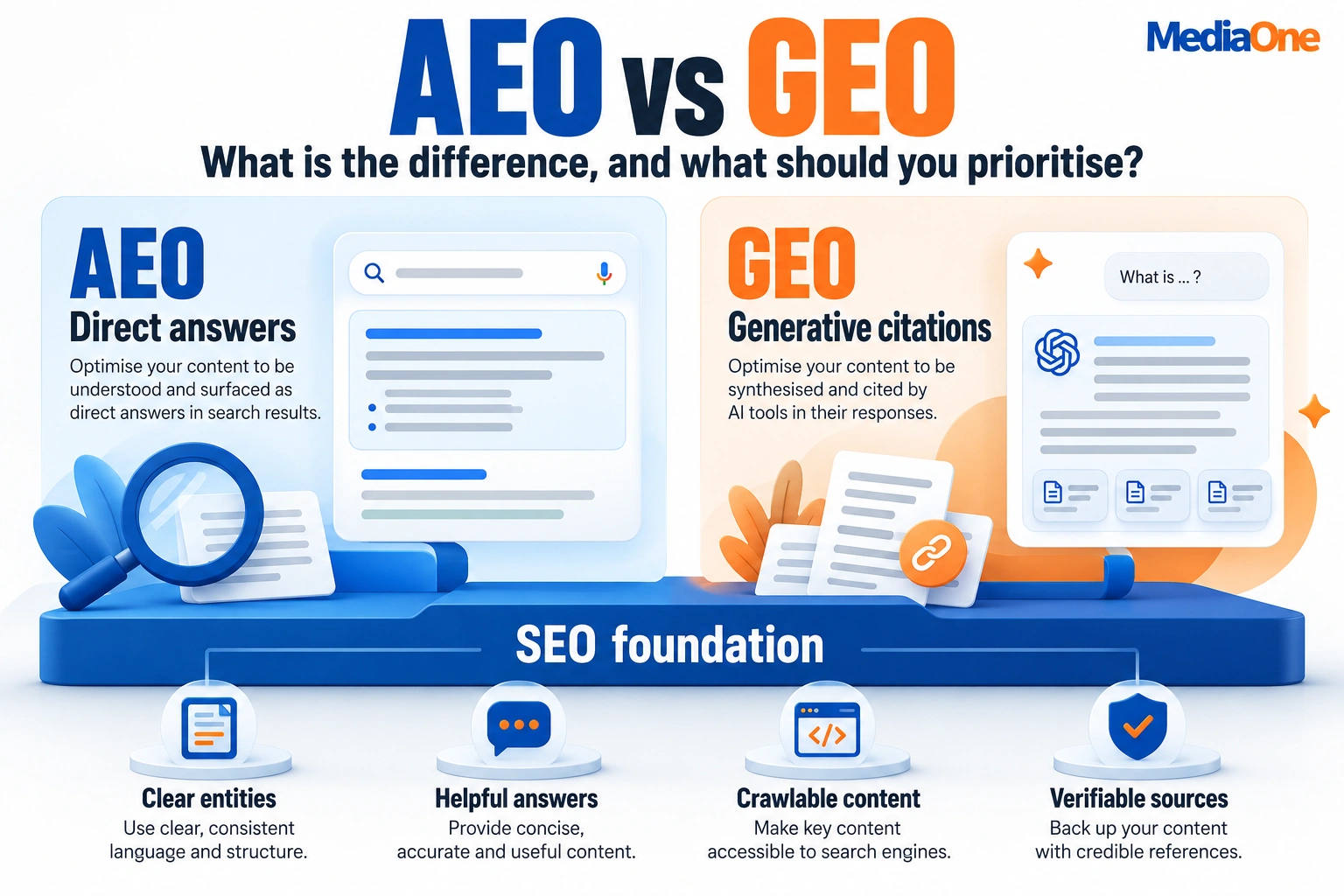
Many Google searches now end without a click. For marketing teams, the question is which discipline to fund first: answer engine optimization (AEO), generative engine optimization (GEO), or traditional SEO. Teams weighing GEO and AEO should first look at the questions their buyers actually ask.

Both share most of their groundwork: clear entity definitions, direct answers, and crawlable, attributable content. The decision turns on which signals to build first, given the questions your buyers ask and where those questions get answered. Content that earns trust and <u>authority</u> also tends to be easier for an answer engine to cite.
Decision rule: If buyers mostly run short, product-name searches, prioritize SEO, then AEO. If they ask long, comparison-style questions in chat tools, add GEO citation work. Most B2B teams should start with AEO, but only if they already rank for core terms. If rankings are weak, prioritise fixing the SEO foundation first, as AI systems rely heavily on pages that already rank. Teams that build these together get the most from each effort.
This article sets out that decision as a query-mix matrix your team can apply to its own keyword list. Work through it with your own keyword data, not with the examples here.
Key Takeaways
- AEO and GEO share most of their work, so treat them as two targets on one foundation.
- About 68% of Google searches end without a click, so answer-surface visibility matters even when rankings hold.
- Only 32% of Google page-one results were cited by AI Overviews, so a good ranking does not guarantee citation.
- Fold this work into your SEO program rather than running a separate GEO budget. About 70% of strategies overlap, per MediaOne.
- Measure citation share and clicks separately, as they can move in opposite directions.
What AEO and GEO Actually Mean
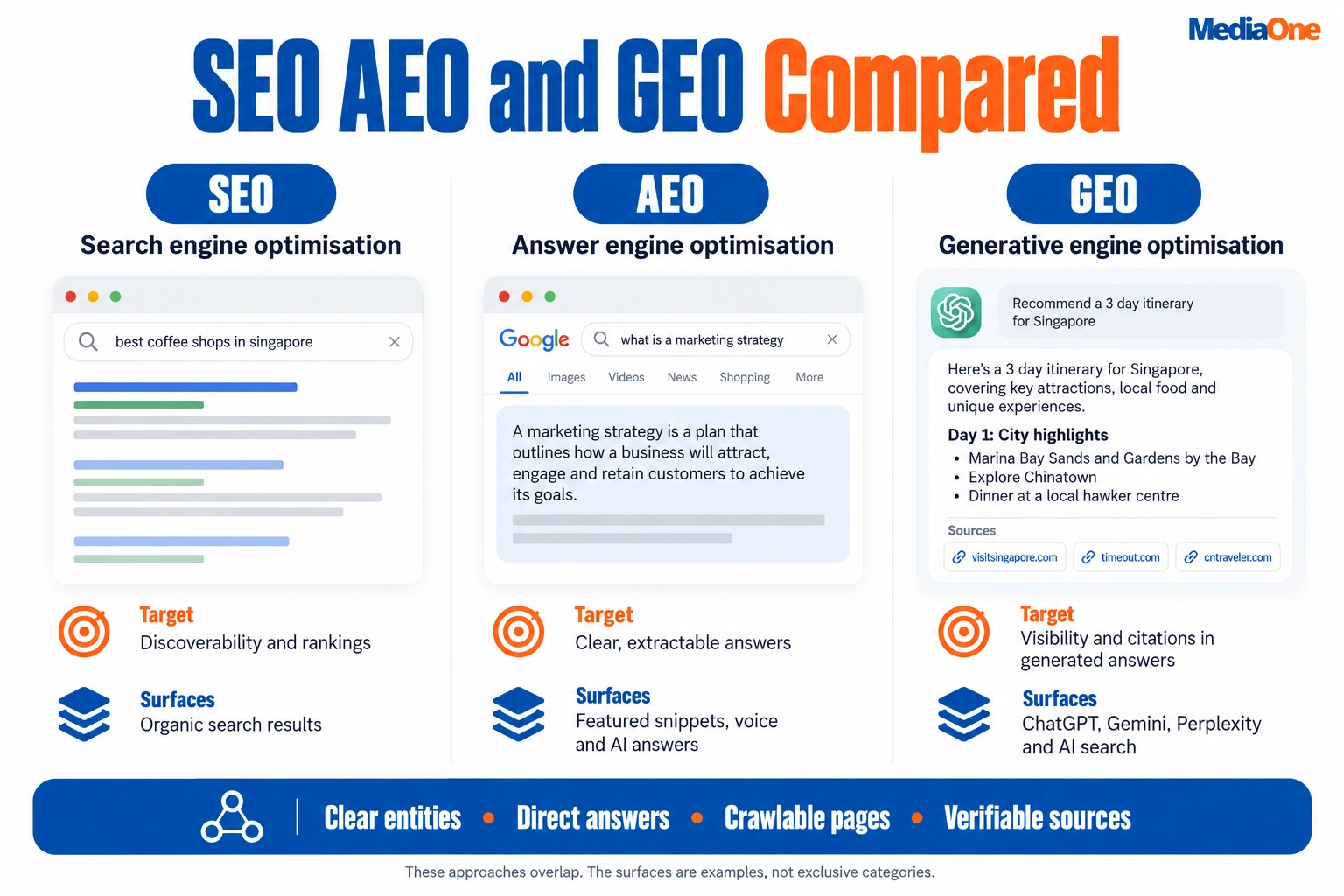
Answer engine optimization (AEO) and generative engine optimization (GEO) share most of their underlying work. AEO makes a page’s answers easy for search engines to extract. GEO earns citations inside generative answers. Both depend on clear entity definitions, direct-answer passages and attributable content, built on the authority and trust a brand earns over time. Geo and AEO work is most effective when the two are planned together rather than as separate projects.
AEO vs GEO vs SEO at a glance
| Discipline | Primary target | Where it shows up |
|---|---|---|
| SEO | Rankings in classic search results | Blue links and featured snippets |
| AEO | Extraction of direct answers | AI Overviews, which now return for nearly 19% of search queries |
| GEO | Citation inside generative answers | ChatGPT, Gemini, and Perplexity |
SEO remains the foundation for any AEO vs GEO strategy. According to MediaOne, when a query triggers a Google AI Overview, the zero-click rate jumps to 83%, and in AI Mode it hits 93%.
How AEO, GEO and SEO Relate to Each Other
Classic SEO still does the heavy lifting, but it no longer decides who gets cited on its own. Only 32% of Google page-one results were cited by AI Overviews, according to a LinkedIn post by Salil Panikkaveettil. A page can rank well and still be missed by answer engines. Build the “geo and aeo” work alongside ranking, and track the sources an engine cites as closely as the ranking itself.
How the tests differ
SEO aims to win a ranked position. AEO aims to win the extracted answer: a short, self-contained passage that an engine can lift word for word. Generative search adds a third test: whether the engine trusts the page enough to cite it. Page-level authority matters most at this stage, and the engine’s responses reflect which pages it trusts.
Where the work overlaps
Clear entity definitions, structured data, direct-answer passages and crawlable, attributable content help search engines and AI systems alike. Gemini searches the web for 99.4% of its answers, according to the same LinkedIn post. Indexed, attributable content therefore feeds both AI surfaces and classic results.
The layered model

Treat SEO as the foundation, AEO as the extraction layer, and GEO as the citation layer. Build the foundation first, then add the layer that matches where your buyers ask their questions.
A worked example: one page, two rebuilds
Take a product page titled “Cloud Backup Pricing” that opens with a brand story and mentions “pricing” only in a footer table.
- Rebuilt for AEO: The first two sentences state the plan names and what each includes, under a heading that repeats the question (“How much does cloud backup cost?”). A short comparison table follows.
- Rebuilt for GEO: The page adds a named, dated source for each claim, a plain statement of who the plans suit, and an honest “how we compare” section. Each claim is backed by citations that readers and engines can trace.
Both rebuilds keep the SEO foundation: one clear page topic, a descriptive title tag and crawlable text.
Mapping the Query Mix
Most teams do not need to choose one discipline and drop the others. The useful question is which signals to build first, given where buyers search across search engines and AI answer surfaces. Teams working on AEO vs GEO together can build signals that fit where their brands are found, using tools to track each surface. Content that answers buyer questions directly is the starting point for both, because it gives generative search systems something specific to extract and cite. Teams weighing geo and aeo should treat them as complementary layers, not rival strategies.
Start by listing 20 to 30 questions your buyers ask before purchasing:
- Write each question exactly as a buyer would type or say it.
- Mark any question of ten words or more as long.
- Note where it is most likely answered: classic results, AI Overviews or AI Mode, or a chat assistant such as Perplexity.
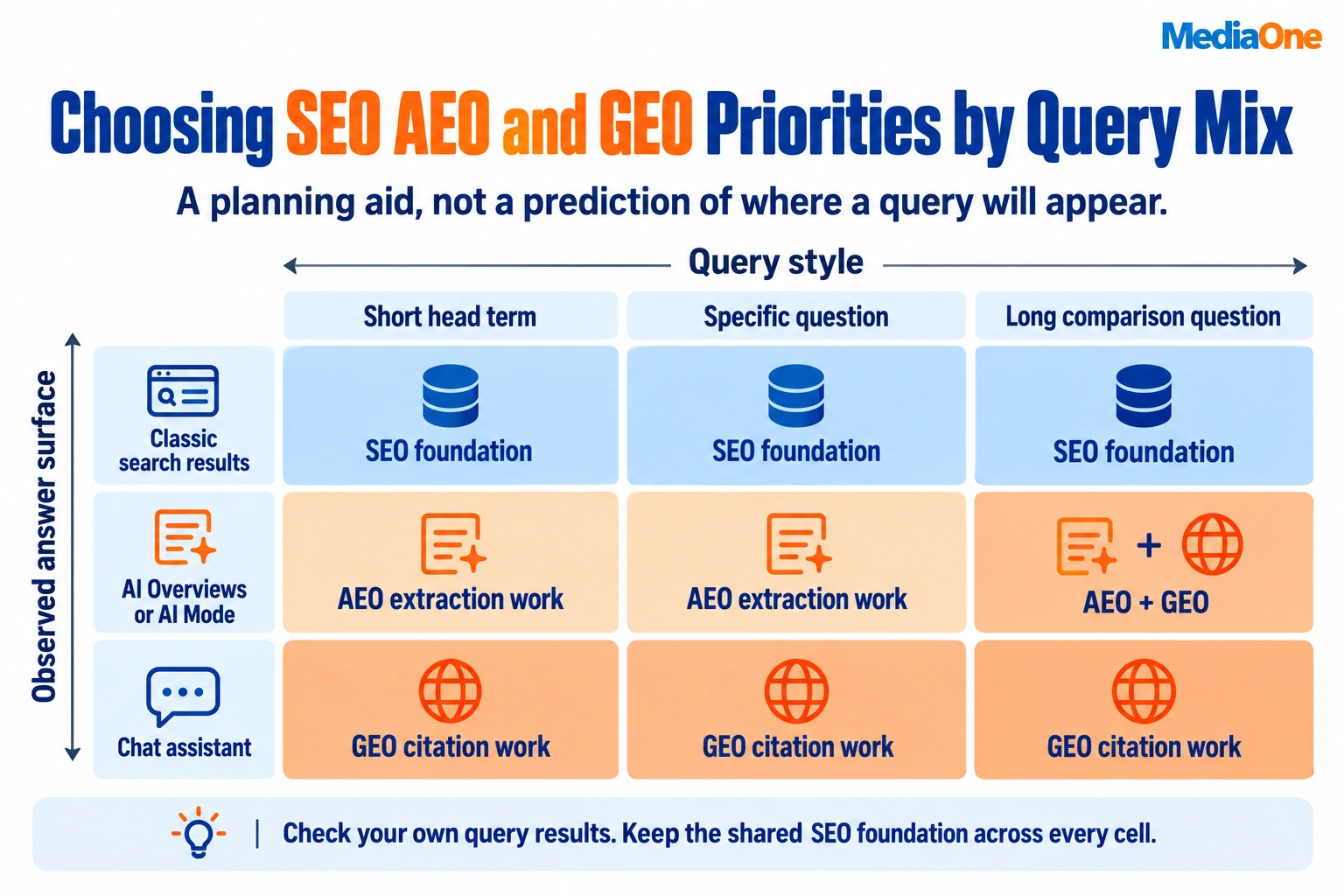
- Assign each question a lead action from the table below.
- Review the split quarterly, because the mix shifts.
Longer, natural-language questions are where AI answers dominate. One analysis found that 46.4% were seven words or longer among ChatGPT searches. A single analysis like this is an estimate, not a benchmark, so test the pattern on your own queries before acting on it.
| Query type | Likely answer surface | Lead action |
|---|---|---|
| Short head term | Classic results | SEO foundation |
| Long conversational question | AI Overviews or AI Mode | AEO extraction work |
| Comparison or “which should I choose” question | Chat assistant | GEO citation work |
This matrix suits teams whose buyers search broadly. Referral-led businesses may find it barely applies, as their buyers arrive already decided and search for the firm by name. For them, the lead action is ensuring the brand is accurately described when a referred buyer checks it.
Fund the shared foundation first: clear entity definitions, structured data, direct-answer passages and crawlable pages. Then add the layer your query mix demands.

Measuring Performance and Tracking AI Visibility
Measuring AEO vs. GEO performance is harder than classic SEO because many answers appear without a click. With about 68% of Google searches ending without a click, traffic alone undercounts visibility. Track how often your brand is cited or named in AI answers and what those answers say about you. Citations and content mentions in AI answers, tracked against each search engine’s results, show visibility that clicks cannot.


Report citation share alongside clicks, since they can move in opposite directions. Use the threshold below as a suggested starting point drawn from your baseline, not an industry benchmark. Run your first monthly tracking cycle, record the share of tracked answers that cite your brand, and set the starting target at that level. Trigger a review if the citation share falls five points or more over two consecutive monthly runs.
Use this monthly routine:
- Run the same 20 to 30 buying questions across ChatGPT, Gemini and Google AI Overviews.
- Log brand presence, position, cited sources and description accuracy.
- Compare citation share with clicks and rankings.
When a query shows no brand presence, check which sources the answer cites and whether your page gives a direct answer in its first two sentences. If not, rewrite the opening, add a named source, and retest the following month. Clear, verifiable claims are more likely to be cited again.
Adapting Content for Generative AI Platforms
Most teams do not need a second content library for answer engines. They need to rebuild the existing library around extractable answers, combining GEO and AEO practices with the existing search engine foundation. Start with your top 20 to 30 buying questions and verify whether each has a direct answer in the first two sentences of the relevant page. If not, please rewrite that page first.
Use a clear definition, a short explanation, and a specific number where you have one. Keep each heading tied to one idea and a consistent page structure. Cite sources by name, as ChatGPT and Gemini favour pages that state where claims come from, which builds trust with both readers and engines. Brands that answer each question directly, with named sources, give engines and readers the same clear, trustworthy answer, so the page’s authority rests on the accuracy of its claims. Engines reward well-structured responses, and the content behind them must be accurate enough to be quoted in full.
How retrieval and passage selection work
AI answer engines retrieve candidate pages, then select self-contained passages that answer one question about a clearly identified entity. A clear heading, direct answer and named source make a page more likely to be cited, and together they make the passage easier to quote in full.
Common AEO mistakes to avoid
- Writing for the keyword instead of the question. Pages that repeat a phrase without answering it are rarely extracted.
- Burying the answer. A long preamble makes the passage difficult to quote.
- Publishing unsourced claims. Unattributed statistics discourage an engine from citing you.
- Ignoring the SEO foundation. Crawlability, page speed and clean metadata still determine retrieval.
Conclusion
AEO and GEO are not rival disciplines. They are two targets—answer extraction and citation in generative search— built on the same foundation. Build that foundation first, then add the layer that fits your query mix. Map your top 20 to 30 buying questions, assign a lead action to each, and keep the supporting content current. Structured, well-sourced pages help search engines and generative tools alike.
Measure both channels separately, because citations can rise while clicks fall. Review the query mix each quarter.
Frequently Asked Questions
What is the main difference between AEO and GEO?
AEO (answer engine optimization) aims to have your content extracted as a direct answer in featured snippets, Google AI Overviews or voice responses. GEO (generative engine optimization) aims to have your brand cited in longer, synthesized answers from ChatGPT, Gemini or Perplexity. Both depend on clear entity definitions, structured data and self-contained answer passages.
Do I need both AEO and GEO, or can I pick one?
Most teams should not choose between them. Branding Marketing Agency notes that SEO, GEO and AEO overlap, with around 70% of strategies shared. Build the shared foundation first, then add the layer that fits your query mix.
Does traditional SEO still matter if AI answers are growing?
Yes. About 68% of Google searches end without a click, and that share is rising. MediaOne Marketing reports that Google has rolled out AI Mode to over 200 countries and 35+ languages. Ranking still shapes which pages AI systems see. Only 32% of Google page-one results were cited by AI Overviews, so ranking alone does not guarantee citation.
How do I measure whether AEO or GEO is working?
For AEO, track featured snippet and AI Overview appearances for target questions, along with click-through. For GEO, track citation share: how often your brand appears in AI responses to a fixed set of buying questions, tested monthly. Treat 10% as a suggested starting point drawn from your baseline, not a benchmark. Review it if it falls by five points or more over two monthly runs.
Which teams should own AEO and GEO work?
SEO or content teams usually own the shared foundation and AEO extraction work. Brand, PR and communications teams are often best placed to own GEO citation work. Assign one owner for the query map so both efforts stay coordinated.