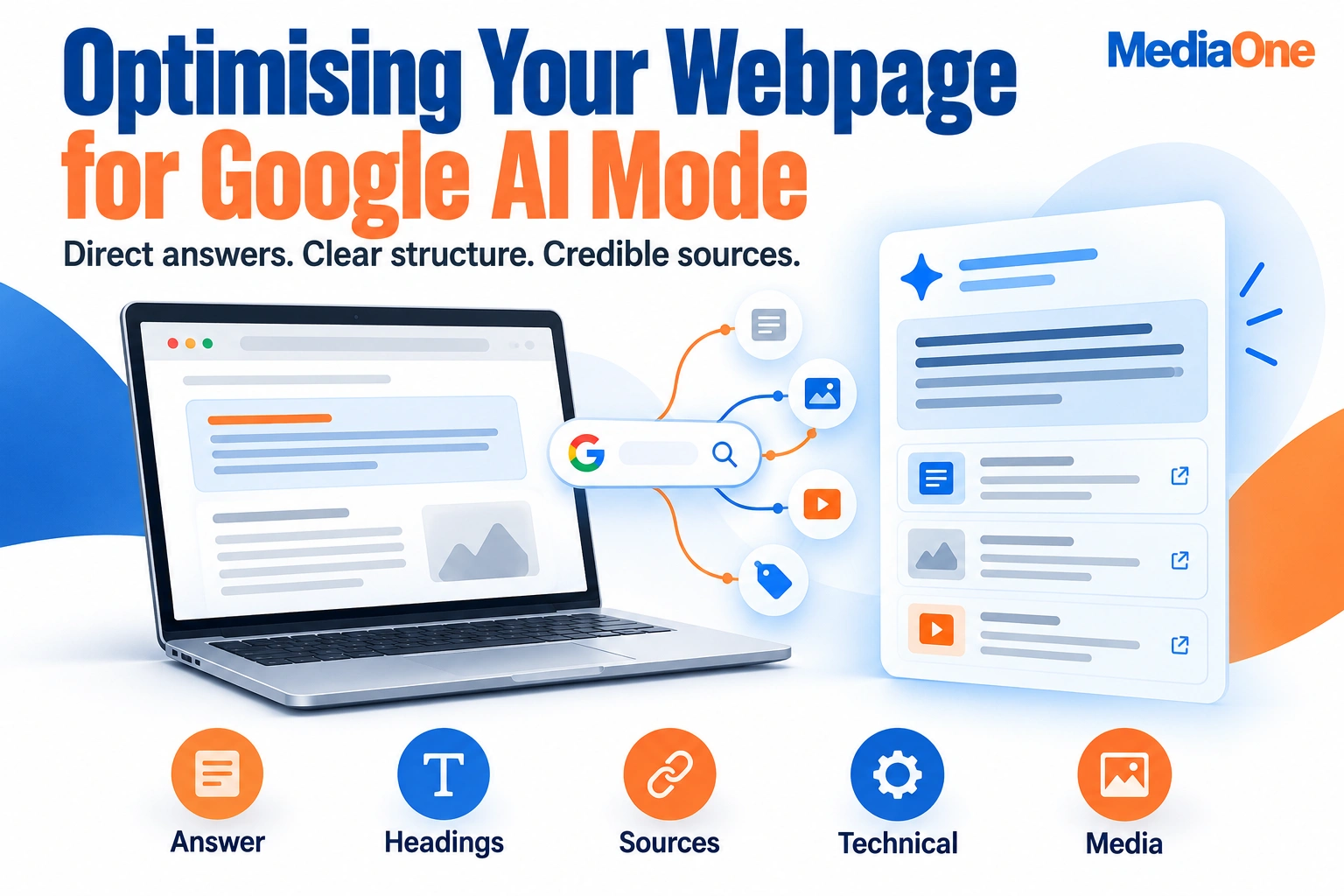
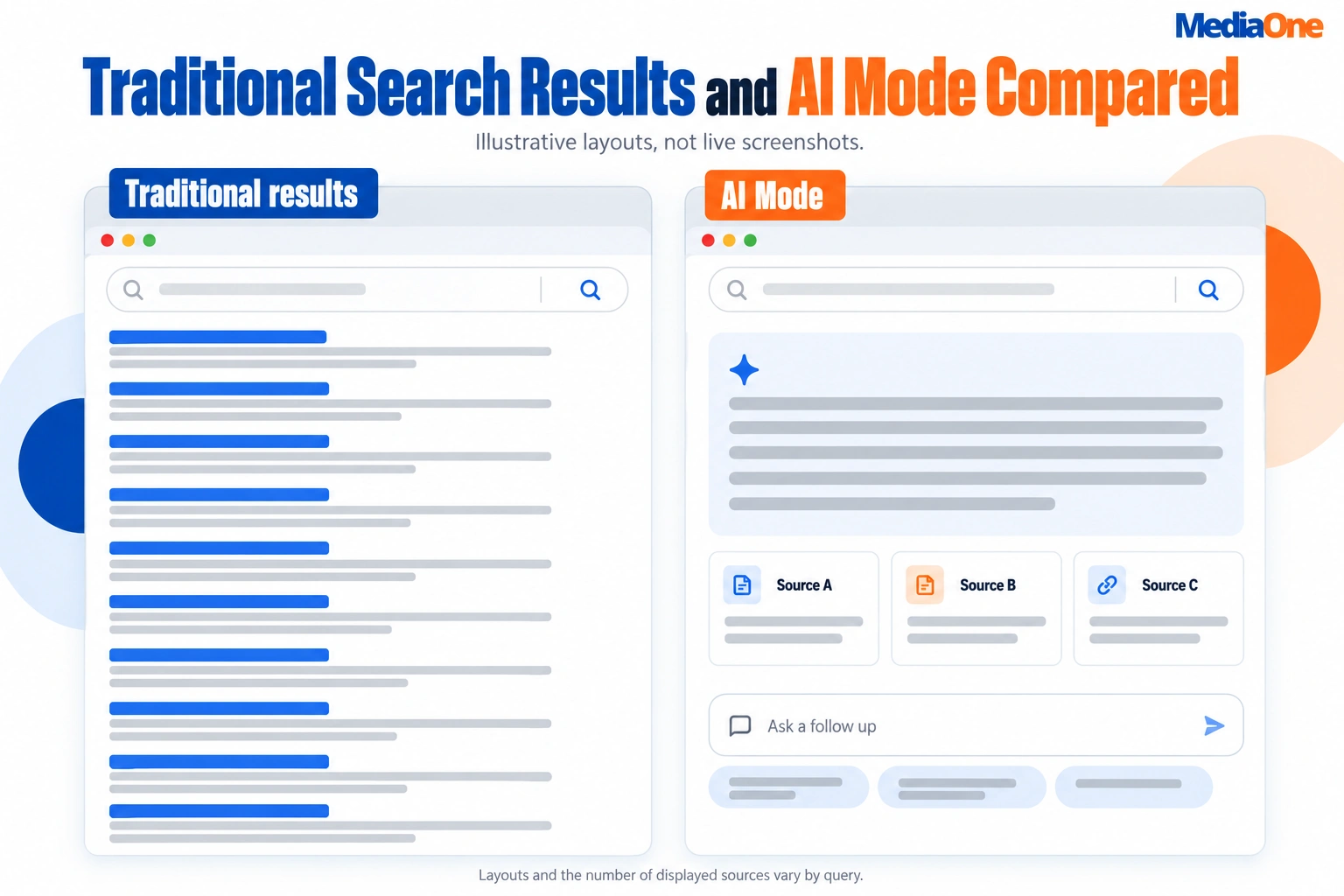
Optimising a webpage for Google AI Mode means making its content straightforward for search engines to read, verify and quote. AI Mode cites few sources. TRE Digital reports 3 to 4 sources, compared with 10 to 20 links on a standard results page.
Pages that answer one question directly, show who stands behind their claims, and structure quotable passages are the ones that earn these citations.
Key Takeaways
- AI Mode cites only 3–4 sources, so pages must answer their target question clearly.
- Top 10 rankings are not sufficient: about 20% of AI answers cite a top-10 page.
- Score pages on five criteria; first rewrite any criterion that scores below 3 out of 5.
- Measure lead quality and conversions, not sessions alone.
Start Here: The Five-Step Optimisation Checklist
- Direct answer. Put the answer in the first 100 words.
- Sub-question headings. Each heading answers one question fully.
- Citable claims. Attach every figure to its source, year and context.
- Technical readiness. Keep key text as HTML, use an accurate schema, and link internally.
- Media text. Add alt text, captions or transcripts.
What Google AI Mode Is and Why It Matters for Your Traffic

What AI Mode is and where it lives
AI Mode is Google’s conversational search experience. It answers a question with a generated response and a small set of cited sources, not a list of links. You can find it in the dedicated tab near the search bar. It is rolling out in the U.S., and Google I/O 2025 covers the launch.
AI Overviews vs AI Mode: How They Differ
Google’s AI Overviews appear above traditional results and summarise the page. AI Mode splits a question into many subqueries, so one page can be cited for several. Being a useful source across related topics matters more than ranking for a single keyword.
A well-structured website with accurate content is more likely to earn citations. A guide or blog post that delivers real value to users also has a better chance. Sites that pair clear product data with disciplined content creation are better placed to earn citations. Sound search engine optimization still supports this, because it shapes how pages are discovered and understood, and the right tools make that work easier to manage. Pages that help users evaluate information in a useful way, including clearly marked AI-generated material, are also more likely to earn citations.
The zero-click problem and what it means for your business
By 2024, OuterBox Design found that 65% of Google searches ended without a click. Organic traffic is down 30 to 40 percent this year for some sites, according to Google. One client saw a 42% lift in lead quality after realigning around answer engine optimisation, despite losing 18% of organic traffic (Foundcoo).
Build pages that earn the clicks that remain, and check content for accuracy before you publish. Answers that draw on multiple sources tend to hold up better when AI systems summarise a topic, so it makes sense to cite your sources clearly.
How AI Mode Selects the Sources It Cites
AI Mode cites roughly 3 to 4 sources, whereas a classic results page once offered 10 to 20 links (BBC, 2025, via TRE Digital). Each citation is a scarce slot in generative search results, so every source has to earn its place by delivering real value to the reader.
Query fan-out: one question, three sub-questions
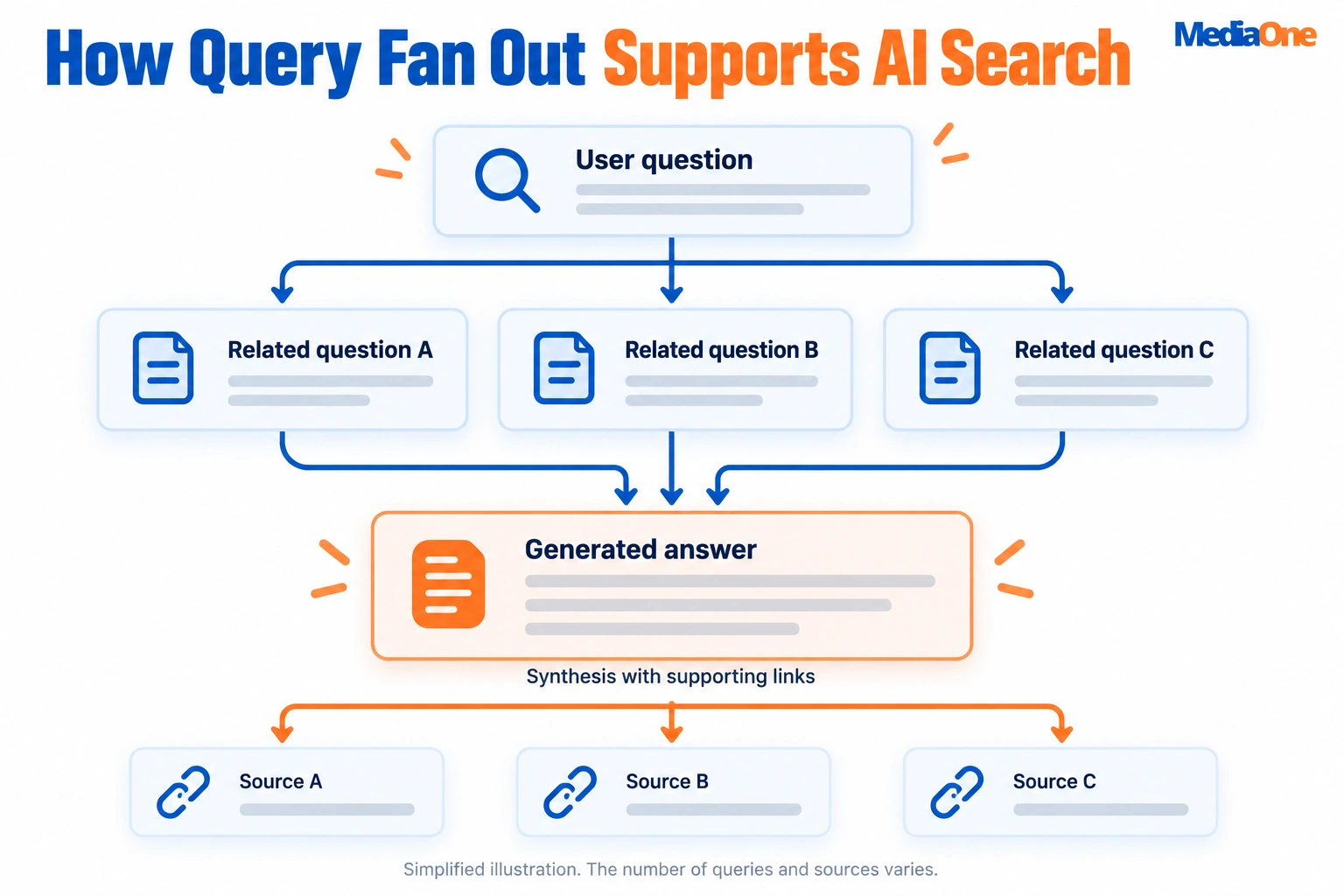
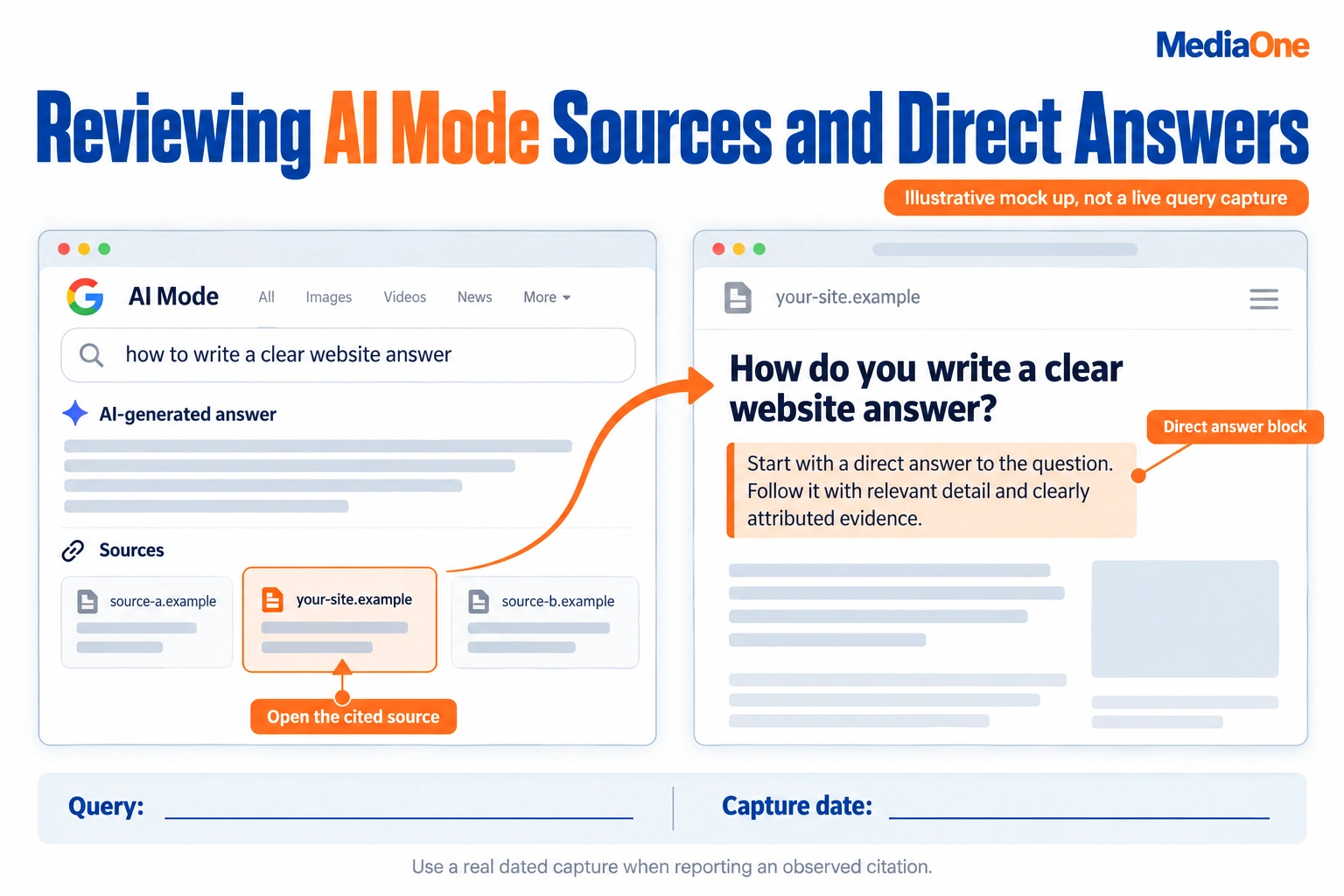
AI Mode splits a question into a dozen or more subqueries, called query fan-out (SMA, 2025, via TRE Digital). Take the target query “optimise webpage for Google AI Mode” and split it into three sub-questions, each with its own heading: “What does AI Mode cite?”, “How is a page scored?” and “Which schema types help?” Each heading can then serve as a separate sub-query.
Well-structured content, with accuracy checked by a human editor, also helps tools and blog posts that answer AI Overviews and other AI-generated results. A clear answer to each sub-question makes the page easier for answer engines to cite directly, and the same structure helps users find what they came for. Structured product data and clear answers help you create content that makes sense to both readers and answer engines.
Why ranking in the top 10 still matters
Ranking is a prerequisite, not a guarantee. About 20% of AI answers cite at least one top-10 site (AI for Marketings). Pages at positions 11 to 20 should first improve relevance and authority. The Google & AI Mode Facebook group discusses these changes and the surrounding information. Search-focused engine optimization still underpins each of these steps.
The Citation Readiness Scorecard: Five Criteria

Score each page from 1 to 5 on each criterion, and rewrite any criterion that scores below 3 first. A score of 1 means the element is missing or actively misleading. A score of 3 means it is present but inconsistent. A score of 5 means it is complete and easy for a reader or an answer engine to verify.
- Direct answer: Does the first 100 words answer the target question plainly? A 1 buries the answer under background; a 5 states it in the opening sentence of this blog post.
- Sub-question coverage: Does each heading map to one distinct question? A 1 uses vague headings; a 5 gives each heading a single question it answers fully so that search engines and AI systems can match it to a query.
- Citable claims: Does every figure carry its source, year and context? A 1 has unattributed figures; a 5 names the source, year and scope of every statistic.
- Technical readiness: Is the key text HTML, is the structured data accurate, and are the pages indexable? A 1 hides content in images or scripts; a 5 keeps all key text crawlable with valid schema so that website ranking tools and systems can read it.
- Media text: Do images and video carry alt text, captions or transcripts? A 1 has none; a 5 describes each visual specifically.
These thresholds are working guidance, not published Google rules. The citation patterns described here are observed in practice, not documented Google behaviour, and Google does not publish citation rules, including for Google’s AI overviews.
Step 1: Start Each Page With a Direct Answer
AI Mode cites pages that answer the question immediately. Put the answer in the first 100 words.
Before: “Search has changed a great deal over the past few years, and many businesses are wondering what it means for them.”
After: “Google’s AI Mode answers questions with a short synthesis and three or four cited sources. Pages must answer their target question in the first paragraph, using clear information that users can scan quickly on any website.”
Step 2: Map Headings to Likely Sub-Questions
Query fan-out splits one search into related micro-queries, as Gemini’s query fan-out process shows. Match each heading to one sub-question and answer it fully.
Step 3: Make Claims Citable
State figures with their source, year and context. AI Mode cites 3 to 4 sources, down from 10 to 20 links, according to BBC reporting in 2025. A statement that gives the source and year can be attributed. “Many sources say” cannot.
Before: “Many sources say AI answers are reducing clicks.”
After: “OuterBox Design reported in 2024 that 65% of Google searches ended without a click, though the figure varies by query type and device.”
Step 4: Add Structured Data and Fix Crawlability
Match schema markup to the page type, keep key text as HTML, and check that important pages are indexable and linked internally. Teams that need help with this audit can look at Media One Marketing’s services.
Step 5: Give Images and Video Descriptive Text
Write specific alt text and captions, and add transcripts for video. Charts need a text summary.
Before: “Image: chart.”

After: “Chart: lead volume by source, Q3, with a text summary beneath it.”
Conclusion and Next Steps
Optimise your webpage for Google AI Mode by checking whether a reader or AI system can quickly pull a correct, attributable answer. Rewrite pages that score below 3 out of 5 on the Citation Readiness Scorecard first, then track citations monthly.
Frequently Asked Questions
Does AI Mode replace traditional rankings?
No, but it changes what a ranking is worth. About 20% of AI answers cite a site already in the top 10, according to AI for Marketing. Ranking is a prerequisite, not a guarantee.
Do I need special markup to appear in AI Mode?
No. Clear HTML, crawlable text, and accurate structured data help Google interpret your page, but they don’t switch on eligibility.
How many sources does AI Mode typically cite?
AI Mode cites only 3 to 4 sources, compared with 10 to 20 links on a traditional results page, according to TRE Digital.
Can a small site earn AI Mode citations?
Yes, if it answers a precise question better than the alternatives. Specific, sourced, dated answers from a narrow site can outperform broad content from a large one.
How long does it take to see changes?
Expect weeks, not days. Track citations through a saved query set over at least one full review cycle.