| AI Summary
Local link building works best when each link has a clear geographic, editorial or commercial reason to exist. Start with a Search Console link audit, then prioritise credible Singapore directories and member networks, existing supplier and partner relationships, link reclamation, evidence-led digital PR and citable Singapore data assets. Google’s spam policies rule out paid followed links, directory blasts and forced exact-match anchors, and paid placements should use the sponsored or nofollow attribute. Keep bulk outreach compliant with Singapore’s Spam Control Act, and measure results through referral traffic, qualified enquiries and organic visibility, not backlink counts. |
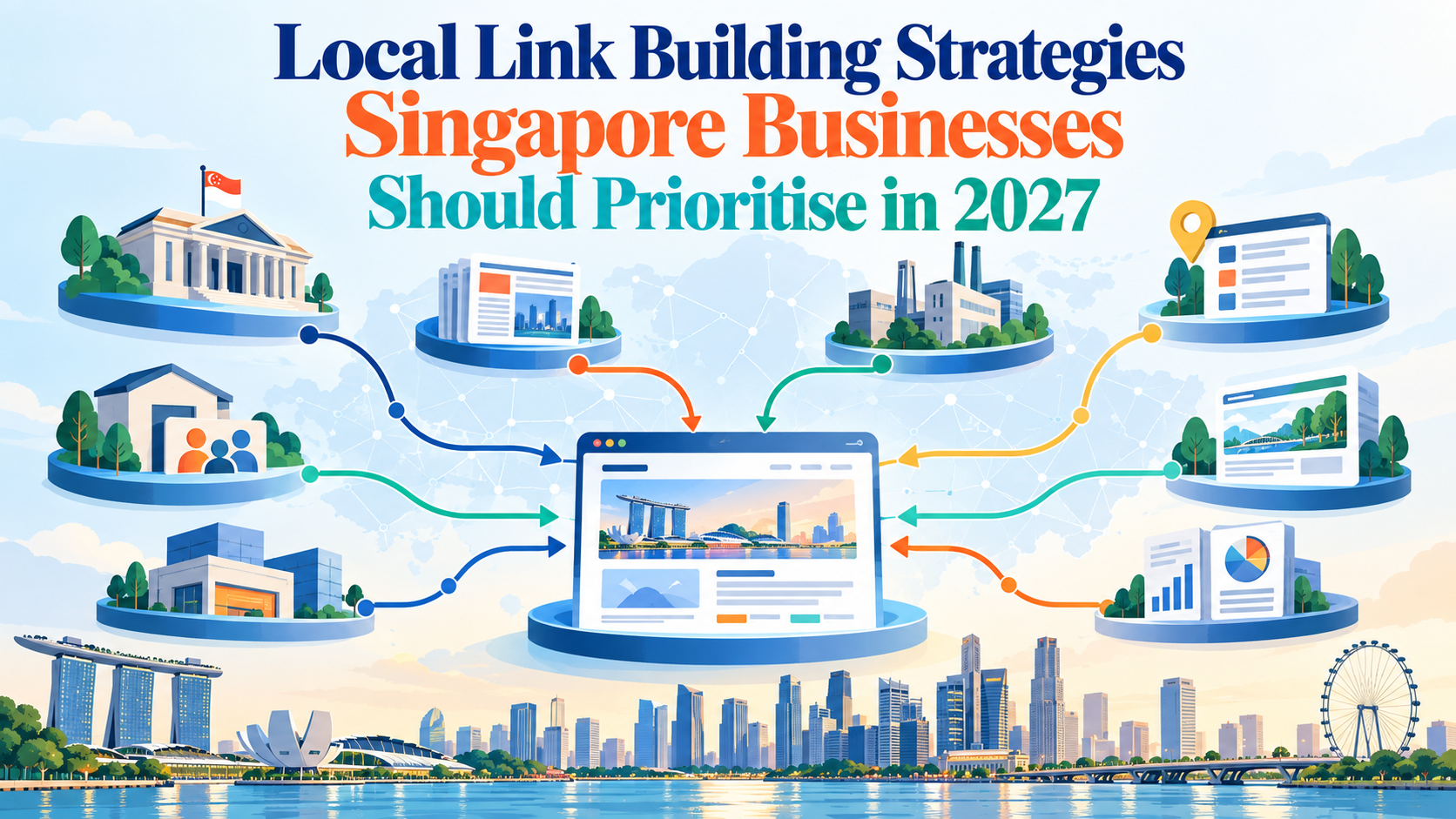
Local link building strategies still deserve a place in a Singapore search engine optimisation programme. For 2027, we focus on links that have a clear geographic, editorial or commercial reason to exist.

According to Google, local results are mainly based on relevance, distance and prominence. Google also says prominence can draw on information such as websites linking to a business and the number of reviews it has.
That gives link building a clear role within local SEO. Geographic relevance alone does not make a backlink useful. We still examine the source, audience and reason for the mention.
Key Takeaway
- Prioritise local and topical fit. A source should serve the same market, audience or industry as your business. We do not chase a high authority score when the source has no clear customer connection.
- Start with existing relationships. Suppliers, trade bodies, partners and community groups often provide cleaner opportunities. Their mentions already have a business reason to exist.
- Use directories selectively. A credible directory or member network can support discovery and verification. Bulk submissions to weak directories add little commercial value.
- Give publishers something worth citing. Original Singapore data, expert commentary, useful tools and local guides make outreach easier. Generic company announcements rarely do.
- Treat paid placements correctly. Google says paid placements should use a sponsored or nofollow link attribute. We do not ask publishers to disguise a commercial relationship.
- Measure outcomes alongside links. Referring domains show acquisition activity. Referral visits, enquiries and organic visibility show what happened after the link went live.
Start With a Local Link Audit
Begin with the Google Search Console Links report. It shows top linking sites, top linked pages and common linking text. Google notes that the report is a sample, not a complete inventory of every backlink it knows about.
We assess each current source through four checks.
- Source relevance. Is the site connected to Singapore, the industry or the target audience?
- Destination quality. Does the backlink lead to a useful live page?
- Link context. Does the surrounding content explain why the source links to the site?
- Commercial evidence. Has the source generated referral traffic, enquiries or another useful action?
We also look for broken destinations, lost links and unlinked brand mentions. Competitor sources can reveal useful gaps.
Do not disavow a backlink only because a third-party tool labels it toxic. Google says known spam links are typically ignored. If a site receives a manual action for unnatural links, Google advises reviewing the links and contacting site owners before disavowing them.
What Makes a Local Link Worth Pursuing?
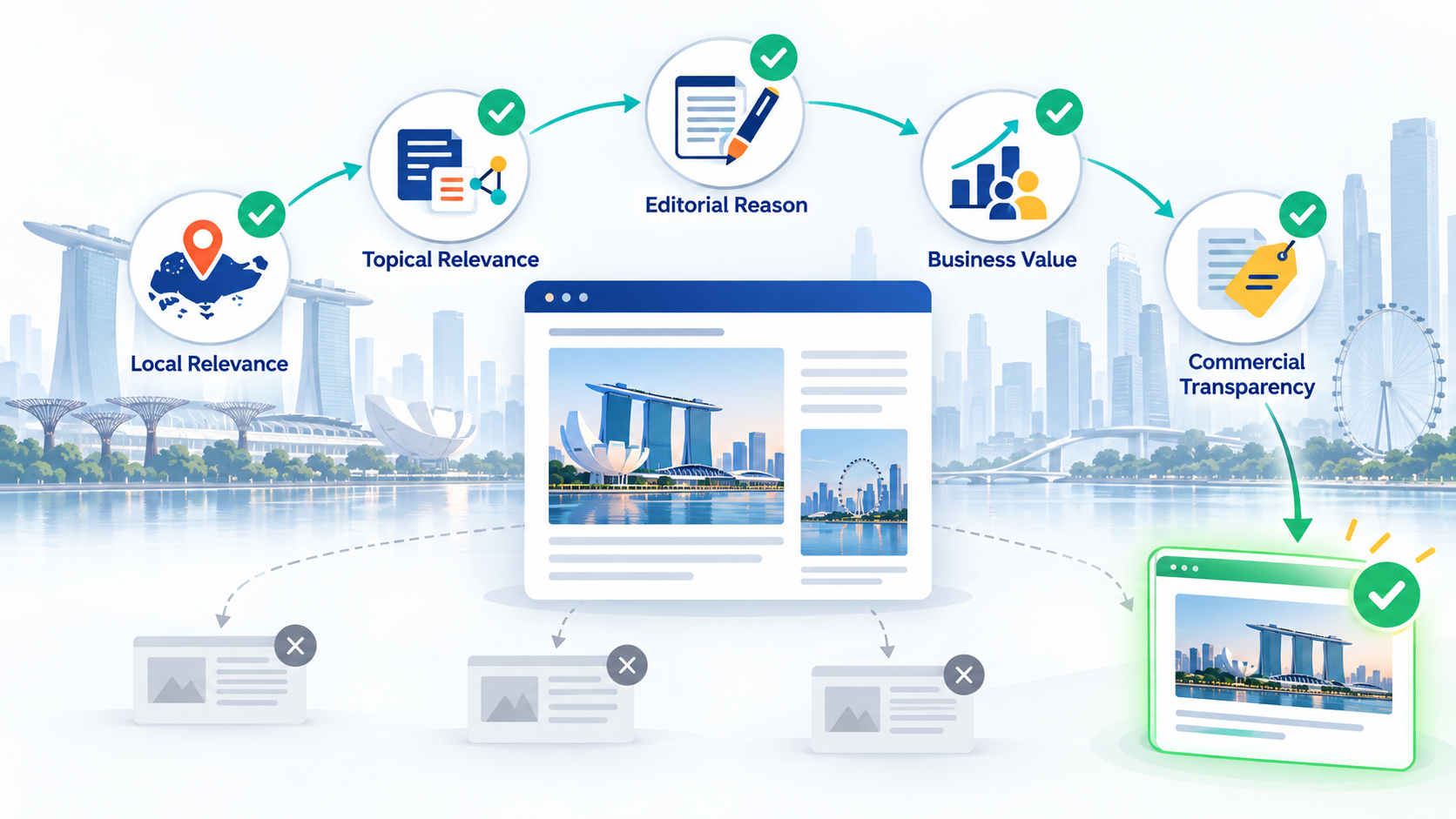
Not every local backlink is worth pursuing. Before outreach, we assess each opportunity for local relevance, topical fit, editorial purpose and business value. Third-party authority scores can support the assessment, but they should not decide it.
We ask five questions.
- Does the site reach people in Singapore or another market the business genuinely serves?
- Is the page relevant to the service, product or customer problem?
- Would the mention still make sense without an SEO benefit?
- Could the placement bring relevant visitors, enquiries or credible brand exposure?
- Is the link earned editorially or clearly identified as commercial?
A strong local link should have a clear reason to exist. We prioritise sources that reach the right audience and can contribute to measurable business results.
1. Build Listings in Credible Singapore Directories and Member Networks
Local directories still have a role. We prioritise Singapore networks, professional bodies and directories that customers may use.
The Singapore Business Federation membership programme reported 34,160 members as of December 2025 and provides access to a member directory. The Singapore Chinese Chamber of Commerce & Industry members directory also covers corporate and trade association members.
Check the organisation before paying membership fees or submitting a profile. Use these four checks.
- Confirm that your business fits the membership or listing criteria.
- Review the public profile and website field.
- Check the audience and possible referral value.
- Keep business information accurate across every listing.
Membership does not automatically provide a follow-back link. We verify the live listing before counting it as a link opportunity.
Businesses that rely on nearby demand should connect this work with our local SEO service. Local links work best when they support accurate business information and a strong local search presence.
2. Build Local Digital Public Relations Around Evidence
Local digital public relations works best when the pitch begins with a useful fact. We look for original data, expert commentary and timely local insight.
Strong Singapore angles can come from customer behaviour, regulatory changes, public datasets or first-party research. Give editors material they can use quickly.
- State the finding in plain language.
- Show the source or method.
- Explain the Singapore context.
- Provide a chart, table or expert quote when it improves the story.
The publisher should have a reason to use the information even if no follow-back link appears. This keeps the pitch focused on editorial value.
Google’s Search spam policies identify paid ranking links, excessive link exchanges and optimised links in widely distributed press releases as link spam. Paid promotion can still be legitimate when the link uses the correct attribute.
3. Earn Mentions on Useful Local Resource Pages
Resource-page outreach works when the page already serves people you want to reach. The target needs a real audience and a clear reason to add your resource.
A clinic could contribute a patient guide. A renovation company could publish a Singapore renovation checklist. A professional services firm could explain a local filing requirement.
Useful prospects include
- local guides that already cite outside resources
- industry reference pages from credible organisations
- community resources serving a defined Singapore audience
- existing articles with outdated supporting sources
- pages with broken links where your resource fills a genuine gap
Do not offer a gift, service or reciprocal followed link as hidden payment. Google treats money, goods and services exchanged for ranking links as link spam.
Keep the resource-page pitch short. Explain the gap and show why your page improves the resource.
4. Use Industry Associations, Suppliers and Existing Relationships
Existing relationships can produce some of the cleanest local links because the connection already exists offline. Review suppliers, professional bodies, implementation partners and trade groups before starting cold outreach.
Useful placements can include
- member profiles
- approved supplier pages
- partner directories
- genuine testimonials
- speaker pages
- joint case studies
The Singapore Business Federation membership network spans thousands of companies. The Singapore Chinese Chamber of Commerce & Industry trade association directory lists groups across sectors such as information security, telecommunications, catering and marine industries.
We do not ask every partner for a link. We first identify what the other organisation’s audience gains from the mention.
5. Reclaim Unlinked Mentions and Repair Broken Backlinks
Established businesses should check link reclamation early. The publisher has already mentioned the brand or linked to the site.
Look for two opportunity types.
- Brand mentions that name the company but do not link to a useful source
- Existing backlinks that now point to removed pages or outdated addresses
Use the simplest valid fix. Ask for a link when it helps readers identify the source. Restore a missing resource when it still serves a purpose. Redirect an obsolete address only when a closely related replacement exists.
We would not build a scholarship mainly to obtain an education-domain backlink. Google treats .edu as a generic top-level domain for search targeting, so the domain ending does not create a special geographic advantage by itself.
What Our Terry Chew Academy Case Shows
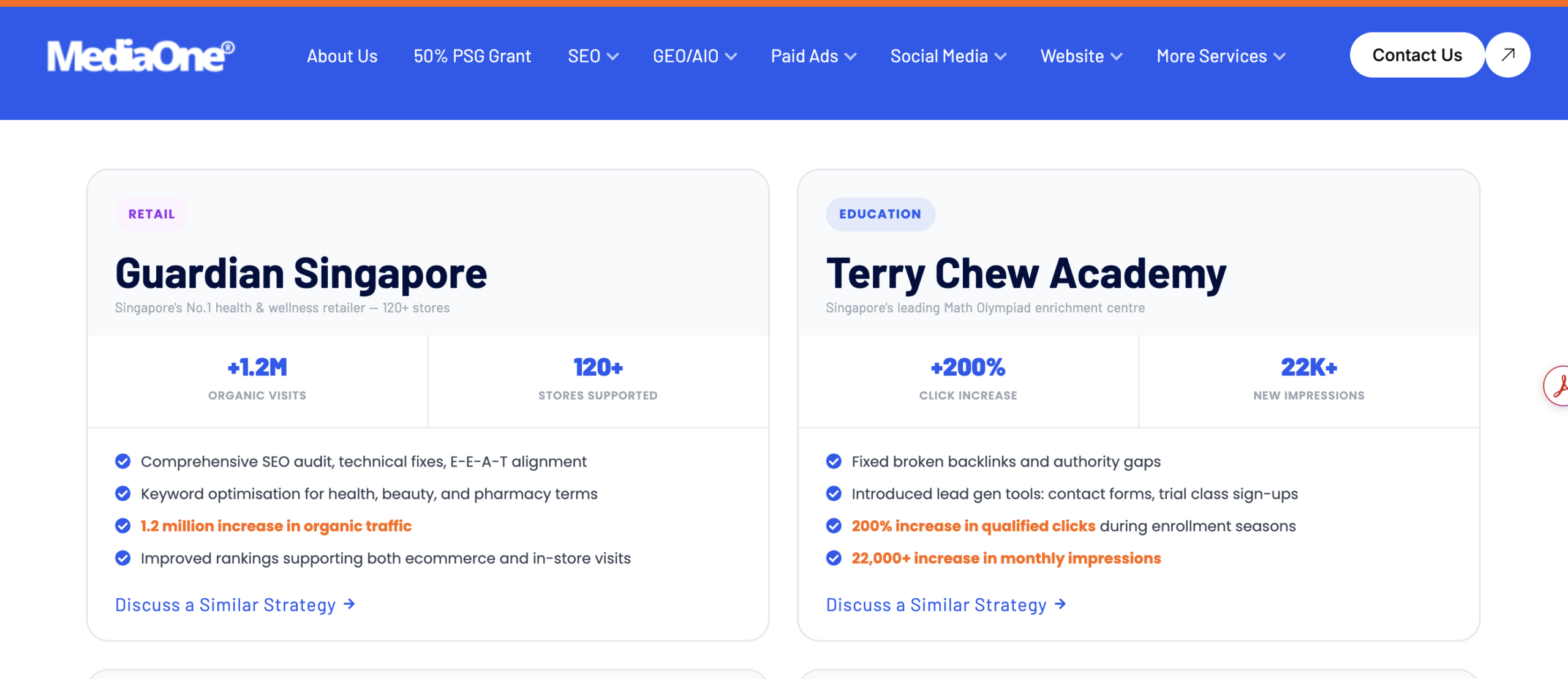
MediaOne has first-party evidence that supports link repair as part of a wider SEO programme. In our published Terry Chew Academy case, we stated that we fixed broken backlinks and authority gaps.
The wider programme produced a 200 per cent increase in qualified clicks during enrolment seasons and more than 22,000 additional monthly impressions.
Those results came from a broader campaign that also included lead-generation work. We therefore treat backlink repair as one contributor, not the sole cause.
6. Support Relevant Community Programmes and Local Events
Community involvement can produce local mentions and referral traffic when the programme fits the business. The activity should make sense even without an SEO benefit.
The People’s Association WeCare PALs programme works with corporate and community partners on local programmes. Its information lists expertise, volunteering and cash or in-kind donations as possible forms of contribution.
Before committing time or budget, use these questions.
- Does the programme connect with customers, employees or relevant communities?
- Would participation still make sense without a backlink?
- Could the activity produce useful exposure or relationships?
- Will a paid website placement use the correct link attribute?
If sponsorship funds the placement, Google says the sponsored attribute is preferred. nofollow also remains acceptable for paid links.
7. Contribute Expert Content to Relevant Publications
Guest contributions can earn useful exposure when the publication has real editorial standards. The article also needs specialist knowledge that fits its readers.
A corporate services firm could explain a filing change. A logistics operator could analyse regional shipping data. A cybersecurity company could discuss a current issue affecting Singapore organisations.
Before pitching, check
- audience overlap
- editorial standards
- evidence supporting the topic
- the publication’s link policy
- the value of the article without an exact-match anchor
Google’s spam policies flag optimised links in guest posts when they form part of campaigns built mainly to influence rankings.
Our guest posting guide covers publication research, pitching and measurement in greater detail. It gives businesses a natural next step when they want to build editorial authority outside local listings.
8. Publish Singapore Data Assets That Other Sites Can Cite
Useful local data gives publishers a stronger reason to cite your site. Singapore has a strong base of public information for original analysis.
The national data.gov.sg open data portal lists more than 4,500 datasets from over 70 government agencies. These datasets can support calculators, benchmarks, research articles and updated reference pages.
A useful citation asset needs a clear method. Readers and publishers should be able to understand how the figures were produced.
- Name the source.
- State when the source was updated.
- Explain the calculation or research method.
- State the limitations.
- Add interpretation instead of republishing raw figures.
A property business could analyse Housing and Development Board data. A recruitment company could work with the Ministry of Manpower statistics. The value comes from the analysis, not from copying the source.
This approach also supports artificial intelligence (AI) search visibility. In May 2026, Google published new guidance for generative AI features in Search. It emphasised valuable, unique content and confirmed that established SEO practices still apply.
Google also says pages do not need additional technical requirements to appear as supporting links in AI Overviews or AI Mode. The page must be indexed and eligible to appear in Google Search with a snippet.
Testimonials and case studies can earn relevant links when the relationship is real. The goal should be useful evidence, not a backlink trade.
A strong joint case study should document enough detail for another organisation to verify the result. Include these elements.
- the starting problem
- the work completed
- the measurement period
- the verified result
- any limits on attribution
If a supplier or partner publishes the story, a link can help readers verify the relationship or review supporting information. The same case study can also support sales content and digital public relations.
Use numbers both parties can support. Clear evidence gives publishers something specific to cite.
Keep Link Outreach Compliant in Singapore
For bulk commercial email outreach in Singapore, check the Spam Control Act rules. The Infocomm Media Development Authority’s electronic marketing guidance defines spam as unsolicited commercial messages sent in bulk. Covered messages need proper labelling and an unsubscribe option.
We prefer small, researched outreach lists. This improves relevance and reduces unnecessary bulk messaging.
Use a simple operating standard.
- Contact people whose role connects to the topic.
- Avoid scraped mass lists.
- Use accurate sender information.
- Maintain unsubscribe records.
- Keep the pitch relevant to the recipient.
The Personal Data Protection Commission overview of the Personal Data Protection Act states that business contact information generally falls outside the Act. Examples include a person’s business email, business phone number, business address and job title.
That exclusion does not remove separate rules for covered bulk commercial messages. We apply both checks before scaling outreach.
Measure Local Link Building by Business Outcomes
Do not judge a campaign from backlink totals alone. Different businesses begin with different authority, search demand and competitive conditions.
Track six areas and use the same baseline each reporting period.
| Measurement | What We Review |
| Referring sources | New credible domains, recovered links and lost links |
| Linked pages | Service, location and research pages attracting references |
| Referral traffic | Visits from earned placements |
| Organic visibility | Search impressions, clicks and local query coverage |
| Qualified actions | Calls, forms, bookings and purchases |
| AI search visibility | Visibility inside Google generative AI reporting |
Google launched dedicated Search Generative AI performance reports in Search Console in June 2026. Google states that the reports reached all websites worldwide by 31 August 2026. They provide separate views for visibility in features such as AI Overviews and AI Mode.
Use that data as an additional visibility measure. Do not credit one backlink for an AI appearance. Readers who need the wider commercial context can continue to our guide on local SEO and customer acquisition in Singapore.
A 90-Day Local Link Building Plan for 2027
A 90-day plan should create a repeatable process, not an arbitrary backlink quota. Start with the baseline, test a small number of tactics and expand what produces useful results.
Days 1 to 30
Build the baseline and identify existing opportunities. Complete the audit before new outreach begins.


- Export Search Console link data.
- Find broken destinations and lost links.
- Identify unlinked brand mentions.
- Review relevant competitor sources.
- Check Singapore directories and associations.
- Record referral traffic and qualified actions.
Days 31 to 60
Start with sources that have the clearest editorial or relationship basis. Record each placement and its destination page.
- Reclaim valid brand mentions.
- Repair useful broken backlinks.
- Contact selected associations and partners.
- Pitch appropriate resource pages.
- Test evidence-led digital public relations angles.
- Publish one Singapore-focused resource.
Days 61 to 90
Review evidence before increasing activity. Keep tactics that produced useful exposure or qualified traffic.
- Expand tactics that generated useful placements.
- Drop weak directories and paid-link offers.
- Review linked-page search performance.
- Compare qualified actions with the baseline.
- Check generative AI visibility where relevant.
The next quarter should build on observed results. A fixed backlink target does not prove customer value.
Local Link Building Tactics to Avoid in 2027
Google’s current Search spam policies give us clear reasons to reject several common tactics. The same policies apply across Google Search, including its generative AI features.
Avoid these tactics.
- paid followed links bought mainly for ranking credit
- automated link creation
- low-quality directory blasts
- excessive reciprocal-link schemes
- guest posts built around forced exact-match anchors
- scholarship campaigns created mainly for .edu links
- sponsorships that require an undisclosed followed link
- mass press-release links with optimised anchors
- routine disavowal based only on a third-party toxicity score
Commercial partnerships can still provide referral and brand value. The link treatment should reflect how the placement was obtained.
Build Local Authority With Links You Can Explain
For 2027, we start with sources and relationships that already fit the business. Credible directories, association links, reclamation and partner opportunities provide a practical base before higher-effort digital public relations and original research.
Every link should answer three questions.
- Why did the publisher include it?
- Who benefits from it?
- How will we measure the result?

Businesses planning a wider search programme can review our local SEO services in Singapore or contact us to discuss the best approach for your goals.
Frequently Asked Questions
How long does local link building take to show results?
There is no fixed timetable because competition, the starting link profile and the target pages differ by business. Referral traffic can appear as soon as a placement goes live, while organic search changes need a longer measurement period.
Are nofollow links useful for local SEO?
They can still send referral traffic and expose the business to a relevant audience. Google accepts nofollow for links that should not pass normal ranking credit and prefers sponsored for paid placements.
What is the difference between local link building and general link building?
Local link building gives extra priority to sources connected with the geographic market a business serves. General link building can target relevant publishers anywhere, while local work also tests geographic fit and local customer value.
Do local directories still help?
Credible directories can help people discover and verify a business. We choose them based on audience relevance, membership standards and local or industry fit instead of submission volume.
Should I disavow spammy backlinks?
Not automatically. Google says known spam links are typically ignored, while its manual-action guidance focuses on links that violate spam policies. Review the source and link history before taking action.