| AI Summary
The scope of digital marketing covers SEO, paid advertising, social media, content, email, affiliate partnerships, influencer campaigns and analytics. These activities help businesses attract customers, support buying decisions and encourage repeat purchases. The best starting investment depends on customer demand, website readiness, profit margins and the team’s ability to follow up. |
Digital marketing covers how a business reaches, wins and keeps customers through digital channels. Its scope extends from the first search or social post to the website visit, purchase and follow-up message.
For a business owner, understanding these connections helps answer a practical question: where should the next marketing pound or dollar go? For someone considering a career, those same connections reveal the skills behind each role.
The sections below explain what each channel does, how the work comes together and how to choose an investment your business can measure.
Key Takeaways
- Match spending to customer behaviour. Search can capture existing demand, while social content and partnerships can introduce an offer to new audiences.
- Prepare the buying experience. Relevant pages, working forms and reliable follow-up help turn attention into enquiries and purchases.
- Measure business outcomes. Qualified leads, customer acquisition cost and profit provide stronger budget signals than traffic alone.
- Connect content across channels. One well-researched topic can support search, social posts, video and email when each version serves its audience.
- Build skills through practical work. A small project with documented decisions and results helps demonstrate what a marketer can do.
What Does the Scope of Digital Marketing Cover?
The scope of digital marketing includes the channels, content, technology and people involved in promoting a business through digital media. Online activity forms much of that work, although the broader term can also include digital displays and other electronic formats.
For most businesses, the day-to-day focus falls into three connected jobs:
| Marketing job | Customer situation | Examples |
| Create demand | The customer has yet to consider the offer | Social videos, creator partnerships, display advertising |
| Capture demand | The customer is researching or ready to buy | SEO, search ads, product comparisons |
| Develop the relationship | The customer needs support or a reason to return | Email, onboarding content, customer communities |
These categories describe a channel’s purpose within a campaign. Social media can generate immediate sales, and an educational search article can introduce someone to a problem they hadn’t considered.
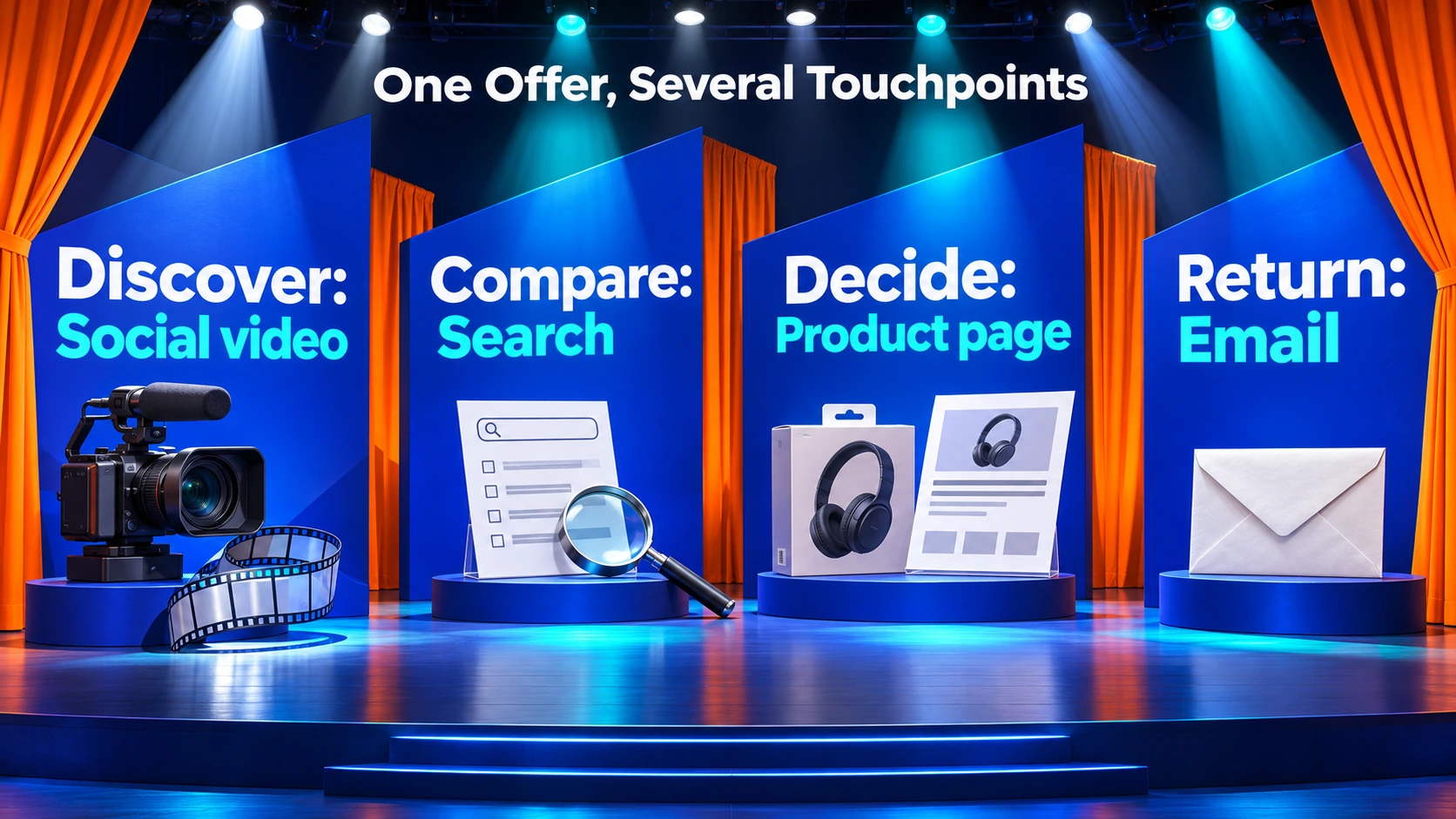
A furniture buyer, for example, might discover a desk through a video, compare sizes through search and buy after receiving an email. The business needs those touchpoints to tell a consistent story.
How digital and traditional marketing work together
Traditional marketing includes print, radio, television and outdoor advertising. Digital marketing adds opportunities to interact with audiences and record actions such as page visits, bookings and purchases.
The two can support each other. A printed event flyer might send visitors to a booking page, while an online campaign reminds interested people about the event. Measurement still needs care because the final click may reveal only part of the customer’s experience.
Core Channels Within the Scope of Digital Marketing
Each channel requires different work, but its value depends on what happens before and after the interaction. A search ad needs a relevant page; an email needs an audience that expects the message.
Search engine optimisation
Search engine optimisation, or SEO, helps search engines understand pages and helps people find relevant information. It combines website improvements, content and links that support discovery.
Google’s SEO Starter Guide explains that changes can take time to appear in search results. SEO planning therefore needs room for implementation and evaluation.
A repair company could begin with service pages that explain the problems it handles, then answer common questions through supporting articles. Our SEO work connects these content needs with the website’s technical condition.
Pay-per-click advertising
Pay-per-click advertising, or PPC, usually charges advertisers when someone clicks an ad. Paid media also includes arrangements based on impressions or other actions, so PPC describes a payment model.
Search ads can reach people who already want a product or service. Social and display ads can introduce an offer while people browse other content.
Our Google Ads campaigns involve decisions about targeting, messages, landing pages and measurement. A campaign becomes easier to assess when all four support the same customer action.
Social media marketing
Social media marketing includes publishing, replying to audiences, managing communities and running paid campaigns. Its role depends on how customers use the platform.
A kitchenware brand might demonstrate a product through a short recipe video. Comments then reveal questions about cleaning or storage, which the next post can answer.
Our social media marketing connects content and paid activity with business goals. The reporting needs to reflect those goals, whether they involve product discovery, enquiries or purchases.
Content marketing
Content marketing gives audiences information that helps them understand a problem or make a decision. Formats include articles, videos, guides, webinars and case studies.
A software buyer may need a comparison page before requesting a demonstration. An existing customer may need a tutorial before using a feature successfully.
Our content marketing brings those needs into the publishing plan. Each piece should serve a reader at a specific stage and provide a relevant next step.
Email and marketing automation
Email helps businesses maintain contact with subscribers and customers. Newsletters share information, while automated messages respond to events such as a subscription, enquiry or purchase.
An email marketing lifecycle connects those messages over time. A welcome email introduces the business, later messages answer questions, and post-purchase content supports the customer.
Audience expectations and applicable privacy rules shape what a business can send. Relevant messages and straightforward unsubscribe options support a relationship people choose to continue.
Affiliate and influencer marketing
Affiliate partners earn an agreed reward for referred actions, often sales. Influencers create content for an audience, with payment arrangements that may include fees, products or commissions.
A specialist cycling creator, for example, could demonstrate a bike accessory and explain who would benefit from it. Audience relevance, content quality and the commercial arrangement all affect the campaign.
At MediaOne, our influencer marketing sits within this partnership work. For campaigns reaching US consumers, the FTC’s endorsement disclosure principles explain when brand relationships need disclosure; other markets have their own requirements.
Websites, conversion work and analytics
A website gives customers somewhere to compare an offer, ask a question or buy. Conversion work improves that experience by examining what helps or prevents people from completing an action.
Our website design connects page content and layout with those actions. Analytics then helps identify where visitors arrive, what they do and where further investigation is needed. The same offer can move through several channels, as this example shows.
How to Choose Where to Invest First
The first investment should address the problem preventing the business from winning customers. That problem might involve visibility, the offer, the website or sales follow-up. A business with steady enquiries but poor response times needs a different plan from one whose product pages receive almost no visits.
Establish the business goal
A campaign goal should name an outcome the business can recognise and act on. “More awareness” becomes easier to manage when the audience, purpose and supporting measures are defined.
Examples include:
- More qualified enquiries for a named service.
- More first purchases from a particular customer group.
- More repeat orders from existing customers.
- More demonstration bookings from relevant businesses.
A business-to-business company might count a lead as qualified only after confirming the company type and need. That definition helps marketing and sales judge results consistently.
Assess customer demand and readiness
Customer conversations, sales records and search data help reveal what buyers already want. Our keyword research examines the language people use when researching products and services.
Existing searches can support SEO or search advertising. An unfamiliar product may first need demonstrations or educational content so people understand why they would want it.
Website readiness also affects the decision. Paid traffic can expose confusing prices or a broken form quickly, so the buying experience needs attention before spending increases.
Compare the starting options
The table below offers starting points for common situations. Each option still needs testing against the business’s audience and costs.
| Business situation | Starting investment | Evidence to review |
| Relevant customers already search for the offer | SEO and a focused search ad test | Qualified enquiries and acquisition cost |
| Customers need to see how the product works | Demonstration content and targeted distribution | Relevant visits, product interest and sales |
| Traffic arrives but few people enquire | Landing page and form improvements | Completion rates and lead quality |
| Customers buy once and rarely return | Post-purchase email and retention content | Repeat orders and customer feedback |
| Leads arrive but sales remain low | Qualification and follow-up improvements | Response time and lead-to-sale rate |
A limited team can begin with one main acquisition channel and one supporting activity. For example, search ads may bring visitors while comparison content answers the questions that delay a purchase.
Set a spending limit from the economics
Customer acquisition cost divides acquisition spending by the number of new customers gained. A practical calculation includes the costs covered by the budget decision, such as media, creative work and management.
In a hypothetical example, a business spends US$2,000 on a campaign and gains 20 new customers. Its acquisition cost is US$100 per customer.
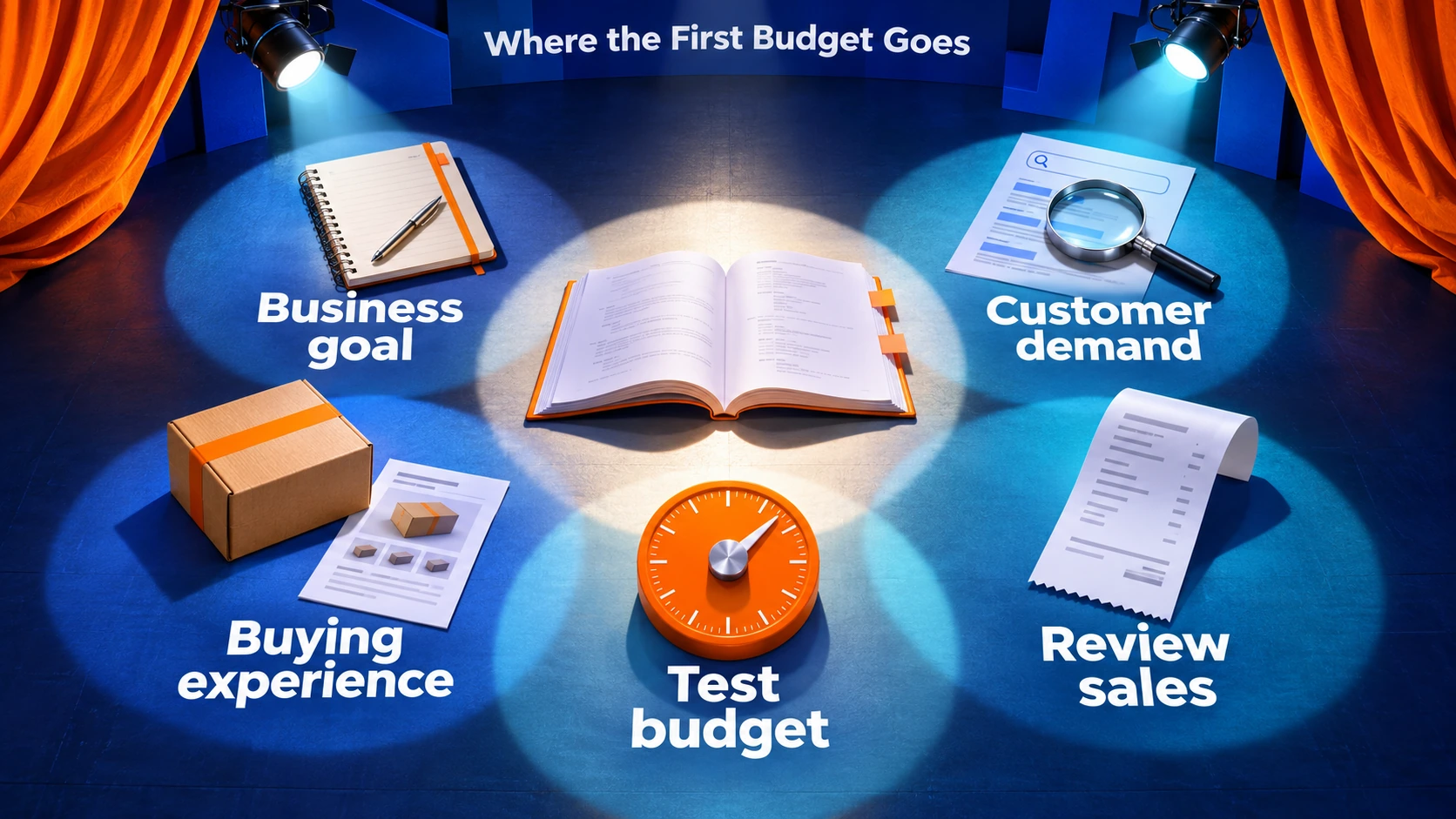
Whether that works depends on the contribution each customer provides after direct costs. Future purchases can affect the calculation, but early budgets should use evidence the business can support. A spending decision becomes easier when the business connects its goal, customer behaviour and costs.
How Content Connects the Channels
Content becomes easier to manage when the team starts with a customer question. The answer can then take different forms according to where and how the audience encounters it.
A business selling project software, for example, could explain how teams assign work. A guide covers the full process, a video demonstrates it, and an email introduces the feature to existing users.
Research the question and prepare the brief
Search queries reveal some needs, while support tickets and sales calls often reveal others. Together, they help the writer understand what the reader already knows and what needs explaining.
A content brief should include:
- The audience and its main question.
- The topic, search intent and proposed format.
- The explanation, example or demonstration required.
- Reliable sources and relevant internal pages.
- The next action available to the reader.
The brief also needs a reason for publishing. A topic that answers a frequent buying question has a stronger purpose than one selected solely to fill a calendar.
Adapt the idea for each channel
Different formats need different treatments. A short video works best around one visible point, while a comparison page needs enough detail to support a decision.
Repurposing therefore involves editing the idea for the audience and setting. The article’s opening paragraph will rarely work unchanged as an email subject line or a video script.
Review content against its purpose
A service page should help relevant visitors understand and enquire about the service. A support article should help customers complete a task.
Performance reviews should follow those purposes. Falling search clicks may require a search-results review, while repeated support questions may show that an explanation needs improvement.
How to Measure Digital Marketing Results
Measurement begins with defining the action the business values. That definition determines what needs tracking and prevents a report from giving every interaction equal weight.
Google Ads conversion measurement can record actions such as purchases, sign-ups and phone calls. The business still needs to decide which actions represent progress towards revenue.
Choose a small set of performance measures
Key performance indicators, or KPIs, connect activity with the campaign’s purpose. A dashboard becomes easier to use when each measure supports a decision.
| Measure | What it helps assess |
| Qualified leads | Whether enquiries match the intended customers |
| Lead-to-sale rate | How often qualified enquiries become customers |
| Customer acquisition cost | The spending required to gain a customer |
| Conversion rate | How often a defined visit or interaction produces an action |
| Repeat purchase rate | How often customers return within a stated period |
Consistent digital marketing KPIs help teams compare periods without changing the meaning of success halfway through a campaign.
Understand what attribution can show
Attribution assigns credit to marketing interactions connected with an action. Google Analytics offers attribution models that distribute that credit according to different rules or data.
Those reports provide a model of the journey they can observe. Offline conversations, device changes and measurement limits can leave gaps, so sales records and customer feedback add context.
Investigate before changing the budget
A campaign with many enquiries and few sales needs investigation beyond the advertising dashboard. The offer, targeting, response time or lead definition could contribute.
Our lead generation work connects acquisition with enquiry quality and follow-up. Budget reviews become more productive when the team can trace what happened after the form submission.
Careers and Skills Across Digital Marketing
Digital marketing offers roles in research, writing, design, technology, campaign management and analysis. A person can specialise in one discipline while learning how its output supports the wider business.
A well-organised digital marketing team also needs shared responsibilities. Someone must approve content, maintain tracking and connect campaign findings with sales feedback.
Roles and typical responsibilities
| Role | Typical work | Example portfolio evidence |
| SEO specialist | Page research, technical checks and content improvements | An audit with explained priorities |
| Paid media specialist | Campaign setup, testing and budget management | A campaign report with decisions |
| Content marketer | Research, briefs, writing and distribution | Articles linked to audience needs |
| Social media manager | Publishing, community replies and reporting | A campaign with content and findings |
| Email marketer | Audience grouping, automation and message testing | A welcome sequence and measurement plan |
| Marketing analyst | Tracking checks, reporting and interpretation | A dashboard that answers business questions |
Specific digital marketing job responsibilities vary by employer. A small business may combine several duties, while a larger organisation separates them.
Skills to develop first
Writing helps marketers explain an offer. Data skills help them assess results, while technical knowledge helps them identify when tracking or a website needs attention.
Google’s Skillshop training covers products including Google Ads and Google Analytics. A learner can pair that training with a small project to demonstrate practical understanding.
A portfolio is stronger when it explains the starting problem, the decision and the outcome. A result that falls short can still demonstrate sound analysis when the learner explains what the evidence suggests.
How AI Is Changing Digital Marketing Work
Artificial intelligence, or AI, can assist with drafting, analysis and campaign automation. Its value depends on the task, the information supplied and the checks applied to the output.
A content team might use AI to organise interview notes, then verify the draft against the recording. The tool saves preparation time while the team retains responsibility for accuracy.
Automated advertising needs accurate inputs
Google Ads Smart Bidding uses AI to optimise bids for conversions or conversion value. Tracking choices therefore influence what the system works towards.
A business that records every form submission as equally valuable may give weak enquiries the same signal as strong prospects. Better definitions and verified records help align automation with the commercial goal.
AI search keeps website fundamentals relevant
Google’s explanation of AI features in Search states that established SEO practices remain relevant. It describes no special optimisation requirement for appearing in AI Overviews or AI Mode.
Pages still need accessible content and reliable explanations. Specific examples, sources and descriptive headings help readers understand the answer, while eligibility for an AI feature does not guarantee inclusion.
Three Beginner Projects That Show How Channels Connect
Small projects turn channel knowledge into work a business can evaluate. Each project below produces a different piece of evidence, from a page improvement to a campaign finding.
Project 1: Improve one service page
A service page provides a manageable starting point because its purpose is usually specific.
- The page owner identifies the customer question and intended action.
- A search review checks whether the page addresses that need.
- A mobile check covers readability, links and form completion.
- The editor improves one documented weakness.
- A later review compares relevant search and enquiry data.
Forms deserve particular attention. W3C’s form labelling principles explain how labels help people understand controls, including those using assistive technology.
Project 2: Test one paid campaign
A fixed test budget creates a boundary for learning. The campaign needs one audience, one offer and a landing page that supports the promised action.
Two message variations can test a specific idea, such as convenience versus product durability. The review should consider relevant enquiries or sales alongside clicks, with enough time for the expected buying cycle.
Project 3: Connect reporting with follow-up
A shared record can connect campaign sources with lead quality and sales outcomes. Each enquiry needs a consistent status so the team can compare results.
The exercise may reveal that a low-cost source produces enquiries requiring extensive qualification. Such finding gives the next budget discussion more context than a cost-per-lead figure alone. Together, these projects show how page quality, promotion and sales evidence support each other.

Turn the Scope of Digital Marketing Into a Spending Plan
The scope of digital marketing spans discovery, buying decisions and customer relationships. Channels work together when the business connects its offer, content, website and measurement around the actions customers need to take.
At MediaOne, we connect SEO, paid advertising, content and website work with your goals. Our team can discuss your priorities and help identify where your next marketing investment should begin.
Frequently Asked Questions
Does digital marketing require coding?
Many roles begin without coding. Content, social media and campaign work rely heavily on communication, research and analysis. Basic HTML and an understanding of website tracking can help as responsibilities grow, while developers usually handle more complex implementation.
Can digital marketing support a business without online checkout?
Yes. A business can use digital channels to generate bookings, calls, store visits or sales appointments. Its reporting needs to connect those interactions with later outcomes, so a completed enquiry does not automatically count as a sale.
Should a business hire an employee or an agency first?
The decision depends on workload, required skills and internal management capacity. An employee can develop detailed business knowledge through daily involvement. An agency can provide several specialisms, while the business still needs someone to provide information, approvals and feedback.
Who should own marketing accounts when an agency manages them?
The business should retain appropriate ownership or administrative access to its advertising accounts, analytics, website and other core assets. Agency access can then match the agreed work. Documented permissions and handover arrangements help the business maintain continuity when responsibilities change.
Are certificates enough to start a digital marketing career?
Certificates can demonstrate structured learning and product knowledge. Employers also need evidence that a candidate can apply those lessons. A small portfolio with explanations of decisions, checks and results gives interviews a practical basis, even when the projects come from personal or volunteer work.