
| AI Summary
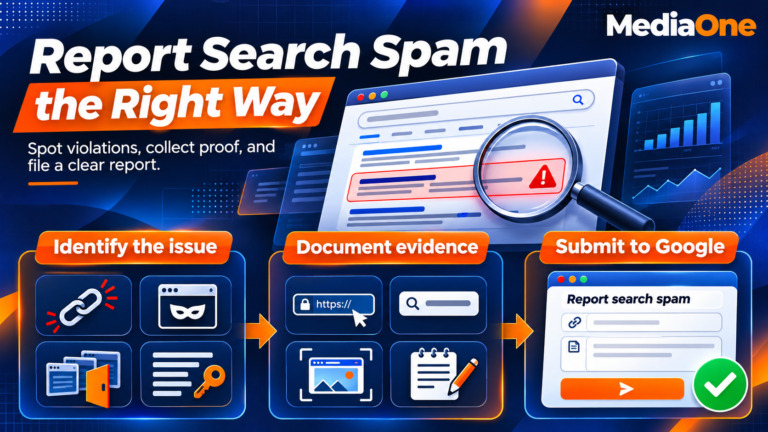
To report blackhat SEO, identify violations of Google’s spam policies, gather verifiable evidence and submit the offending URLs through Google’s Search Quality User Report. This guide covers common blackhat SEO tactics, the reporting process and potential outcomes. It also explains how to identify negative SEO, protect your website and use Google’s disavow tool appropriately. |
If you need to report blackhat SEO, start by identifying the exact pages and behaviour that may violate Google’s spam policies. Then submit the relevant URLs through Google’s Search Quality User Report. A specific, verifiable report gives Google useful information; an accusation about a competitor’s rankings does not.
Blackhat SEO, also written as black hat SEO, describes tactics intended to manipulate search visibility rather than earn it through useful content and legitimate optimisation. However, an unusual ranking position is not proof of misconduct. This guide explains what qualifies as reportable spam, how to document it, which Google form to use and what to expect afterwards.
Key Takeaways
- Report documented policy violations, not competitors simply outranking you. Check the specific practice against Google’s current spam rules.
- Use Google’s Search Quality User Report for search spam. Phishing and malware have separate reporting channels.
- Submit precise URLs and factual observations. Screenshots can support your records, but do not assume the Google form accepts attachments.
- Do not treat suspicious backlinks as automatic evidence of negative SEO. Google’s disavow tool is intended for specific, serious link problems.
- Expect no guaranteed penalty or response deadline. Google decides whether and how to use the information you provide.
What Is Blackhat SEO, and Which Practices Can You Report?
Blackhat SEO is an industry term, not a single violation category in Google’s reporting system. Google assesses conduct against its spam policies for web search, which cover attempts to deceive users or manipulate rankings.
A strategy may be aggressive without breaching those policies. Improving landing pages, publishing at scale with genuine editorial value and earning links through publicity are not automatically spam.
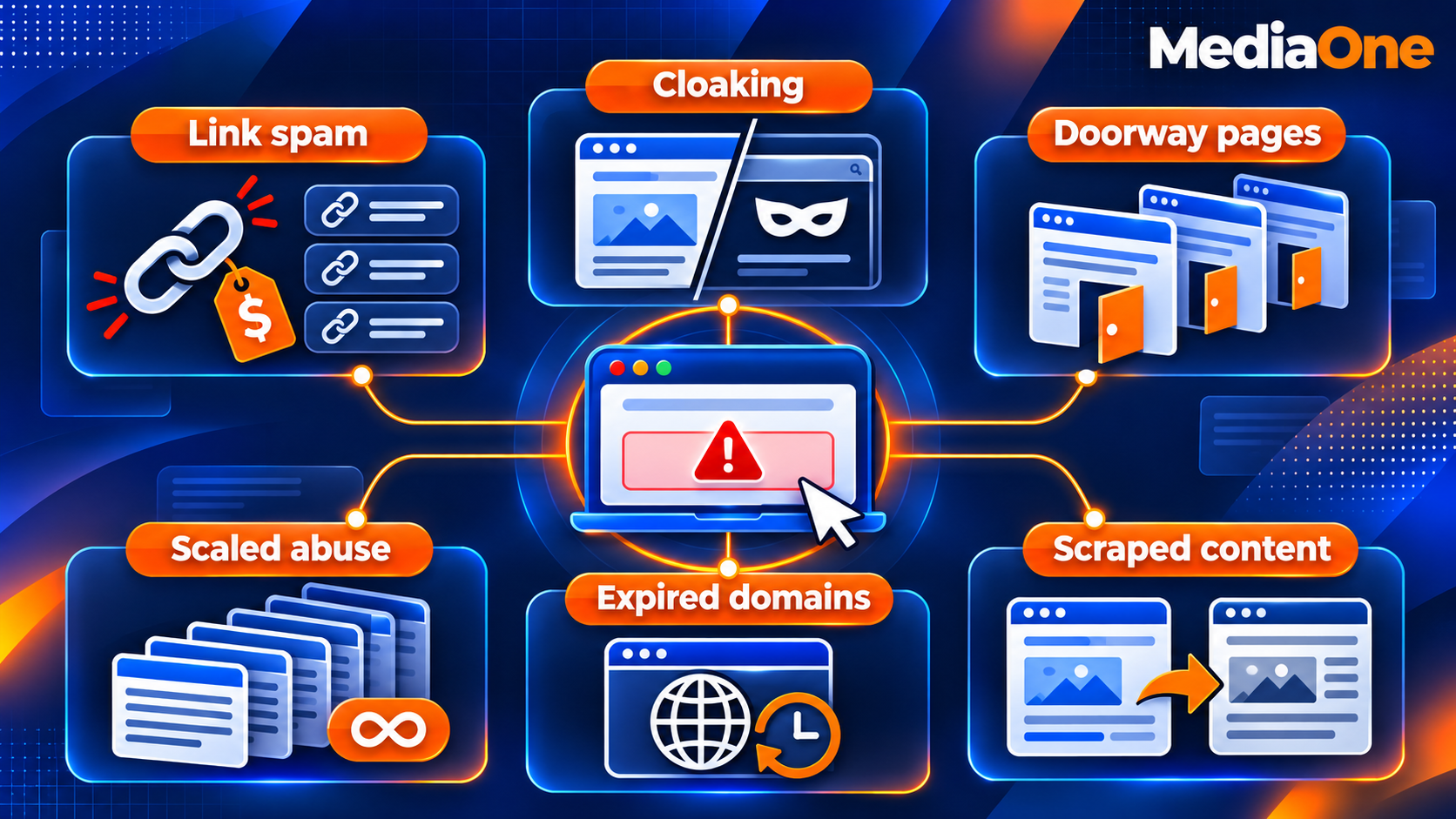
Link Spam and Paid Links Designed to Influence Rankings
Link spam involves creating or acquiring links primarily to manipulate ranking signals. Examples include paid links that pass ranking credit, automated link schemes, excessive reciprocal linking and keyword-rich links placed across unrelated websites.
Paid advertising is not inherently prohibited. Google permits advertising and sponsorship links when they are appropriately qualified, such as with rel="sponsored" or rel="nofollow".
Cloaking, Deceptive Redirects and Hidden Content
Cloaking occurs when a website deliberately presents materially different content to search engines and users to manipulate rankings. For example, a search engine might receive an informational article while visitors see unrelated commercial content.
Deceptive redirects can also violate Google’s spam policies. A search result might promise an informational guide but send visitors to a sales page unrelated to the query.
Hidden text can be abusive when its purpose is to manipulate search engines. Yet accessible screen-reader content, expandable panels and legitimate paywall implementations are not inherently cloaking.
Doorway Pages and Scaled Content Abuse
Doorway abuse involves pages created for similar searches that funnel visitors towards essentially the same destination without providing useful intermediate content. A website might publish hundreds of near-identical pages for different US cities, each redirecting readers to one generic service.
Scaled content abuse concerns large quantities of pages created primarily to manipulate rankings, with little value for users. Google assesses the purpose and value of the content, regardless of whether it was produced by artificial intelligence (AI), automated systems or people.
Expired Domain and Site Reputation Abuse
Expired domain abuse occurs when someone repurposes an expired domain mainly to exploit its previous ranking signals while publishing content that offers little user value. Purchasing an old domain for a legitimate new venture does not, by itself, violate this policy.
Site reputation abuse involves third-party content placed on an established website mainly to exploit that site’s existing ranking signals. A relevant editorial partnership should not be labelled abusive merely because an external contributor is involved.
Hacked Pages and Malicious Search Results
A legitimate site may unknowingly host injected spam pages, hidden links or deceptive redirects after a security breach. In these cases, the apparent spam may originate from an attacker rather than the business operating the website.
A spam report can flag manipulation in Google results. Sites that distribute malware or impersonate other sites to steal information should use Google’s dedicated safety channels instead.
Keyword Stuffing and Scraped Content
Keyword stuffing involves inserting search terms or numbers unnaturally to influence rankings. A service page that repeats dozens of city names without explaining where the business operates may deserve investigation. There is no universal keyword-density percentage that establishes a violation.
Scraped content is another concern when a website reproduces material from other publishers without meaningful additions. Compare the suspected copy with the original publication.
A quotation, syndicated article or properly licensed reproduction does not automatically establish search spam. If your copyrighted work has been reproduced without permission, consider Google’s legal removal process separately from a search-quality complaint.
Should You Report Blackhat SEO? Use This Decision Check
We recommend answering four questions before opening Google’s form.
- Can you identify a specific practice? Match the observed conduct to a published spam policy, such as link spam, doorway abuse or cloaking.
- Can you identify the affected URLs? Capture the exact pages showing the behaviour rather than submitting a homepage with no explanation.
- Can someone else verify your observations? Record the date, relevant search query and what a visitor sees. Note any uncertainty.
- Are you using the correct channel? Search spam, phishing, malware and issues affecting your own website may require different actions.
Pages that no longer exist or cannot be verified are less useful than current, accessible examples. Do not report a site simply because it ranks above yours, uses a different content strategy or publishes material you dislike. Poor writing, a sudden jump in rankings and an unfamiliar backlink profile are reasons to investigate, not verdicts.
Distinguish Legitimate Optimisation From Manipulation
Consider a national home improvement company with separate pages for Texas, Florida and California. Each page contains accurate service details, regional pricing considerations and information about the local team.
Similar page layouts do not make those pages doorway spam. The question is whether each page serves a genuine purpose for its intended audience.
Apply the same reasoning to backlinks. Several links from one publication may result from ordinary press coverage. A new domain may acquire legitimate publicity quickly following a product launch. Investigate the context of the links before treating the growth pattern as evidence of a scheme.
| SEO Practice | Potential Blackhat SEO | Legitimate SEO |
|---|---|---|
| Location pages | Near-identical pages that funnel users towards a single destination | Dedicated pages with useful regional service information |
| Paid links | Purchased links intended to manipulate rankings | Sponsorship links with appropriate link attributes |
| AI-generated content | Mass-produced pages with little value, created to manipulate rankings | AI-assisted content with meaningful editorial input and useful information |
| Expired domains | Repurposing domains primarily to exploit historical ranking signals | Acquiring domains for legitimate business purposes |
| Redirects | Sending users to deceptive or unrelated destinations | Redirecting outdated URLs to relevant replacement pages |
| Content syndication | Republishing material primarily to manipulate search visibility | Authorised distribution through legitimate publishing arrangements |
We recommend using these distinctions as a starting point. Google’s assessment depends on the circumstances and applicable spam policies.
Gather Evidence Before Filing a Google Spam Report
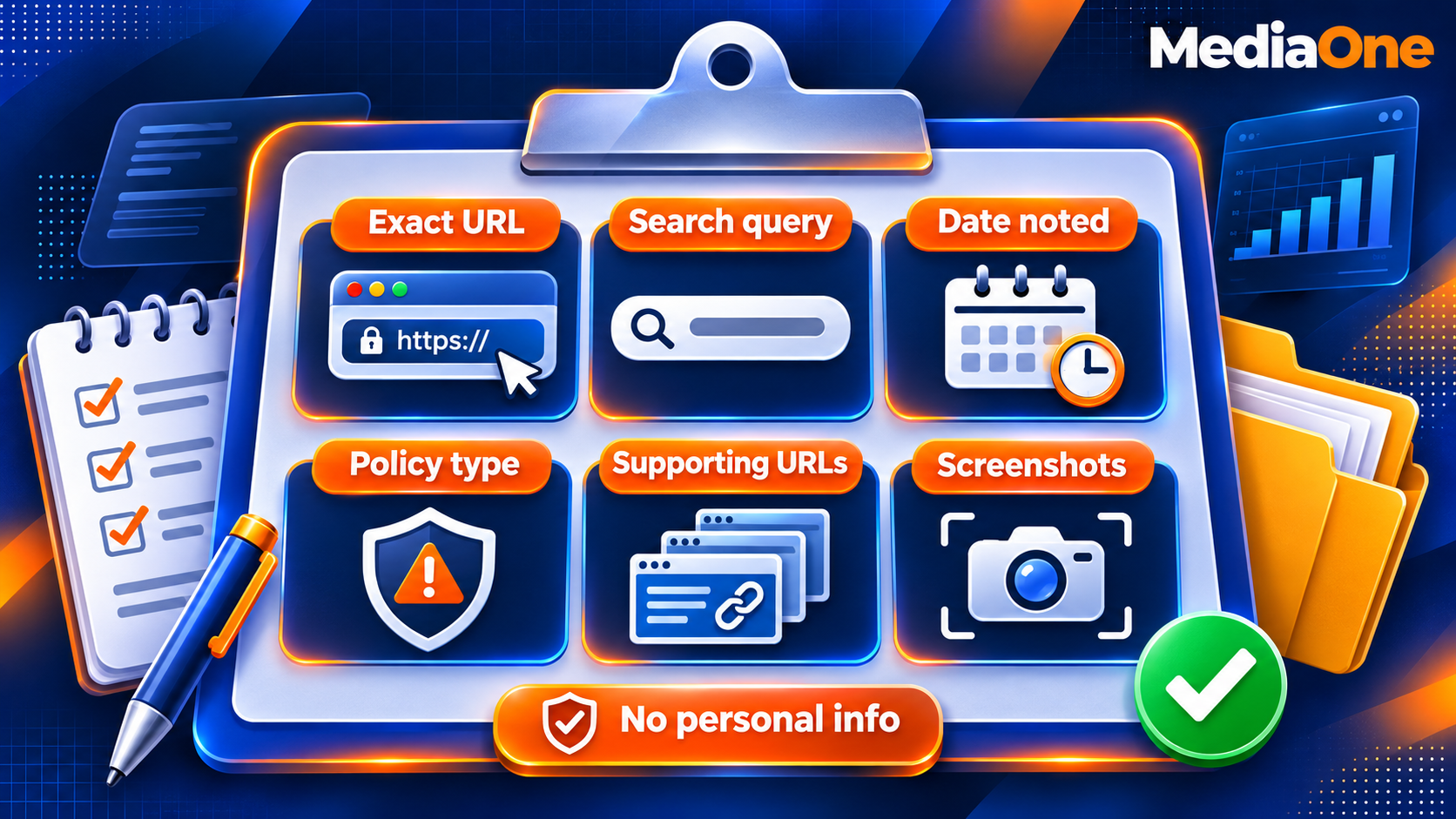
Good evidence identifies the alleged violation and makes it easy to reproduce. Build a short record before submitting anything.
| Evidence to Collect | Why It Helps |
|---|---|
| Exact page URL | Directs Google to the content or link in question |
| Relevant search query | Explains where and how you encountered the result |
| Date and observed behaviour | Establishes what was visible during your review |
| Specific policy category | Connects the allegation to Google’s published rules |
| Supporting pages or linking URLs | Demonstrates a pattern instead of relying on suspicion |
| Dated screenshots | Preserves visual evidence for your internal records |
For alleged paid-link schemes, record the page containing the link, the destination URL and any explicit sponsorship disclosure. If possible, inspect whether the link uses an appropriate attribute.
For doorway pages, compare several URLs to show how similar pages lead to the same endpoint. For suspected cloaking, note the search result, landing page and any reproducible redirect.
Keep dated screenshots and notes in your internal evidence folder. Google’s published reporting instructions describe URLs, categories and optional comments; they do not establish that every reporter can upload screenshots.
Use SEO Tools to Support Your Investigation
Third-party SEO platforms can help you investigate suspicious patterns before submitting a report. Tools such as Ahrefs and Semrush provide backlink data, historical ranking information and referring-domain analysis.
The usefulness of each tool depends on the suspected violation.
- Backlink analysis: Investigate repeated anchor text, unusual referring-domain patterns and links from unrelated websites.
- Historical website records: Use the Internet Archive’s Wayback Machine to examine previous versions of a domain when investigating suspected expired domain abuse.
- Content comparison: Compare suspected doorway pages or scraped articles to identify duplication and limited original value.
- Browser developer tools: Inspect publicly accessible page elements and link attributes when investigating hidden content or questionable links.
Third-party metrics are investigative aids. Domain Authority, Domain Rating and toxicity scores do not establish whether Google considers a website or backlink abusive.
How to Report Blackhat SEO to Google: Step by Step
Google provides a dedicated spam reporting page for misleading, manipulative or low-quality search results. That page links to the Search Quality User Report form. You may need to sign in to your Google account.
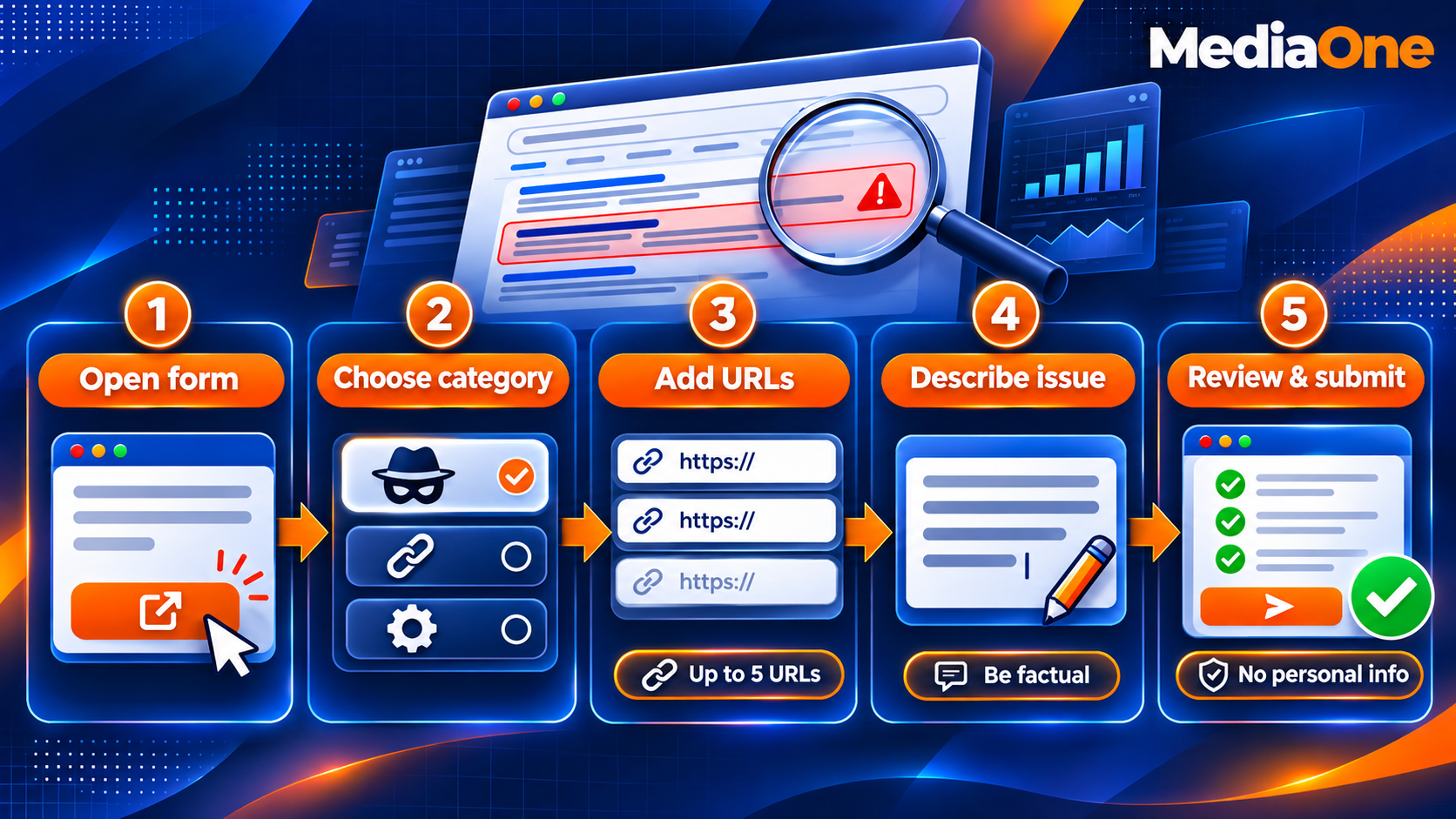
Step 1: Open the Official Reporting Form
Follow Google’s link rather than a third-party service promising to submit complaints on your behalf. Confirm that the page is part of Google’s search reporting service. The form is intended for people reporting search-quality problems they have encountered.
Step 2: Choose the Most Accurate Problem Category
Select the category that best matches your evidence. Google says its reporting process supports categories and subcategories for different search-quality issues.
If you cannot confidently classify the problem, use the form’s uncertainty option where available. Do not exaggerate a questionable link into a claim of malware.
Step 3: Enter the Offending URLs
Submit the exact pages demonstrating the issue. Google’s published explanation of its reporting process says the form supports up to five pages involving the same policy in one report.
If several URLs show separate problems across different main categories, use separate, properly classified reports. Sending identical submissions repeatedly is not useful. Google says it disregards duplicate reports from the same user.
Step 4: Describe What You Observed
Use the optional comment field to explain the visible behaviour, search query and suspected policy violation. Include only information relevant to the report. Avoid emotional language and unsupported statements about the site’s owner.
Example of a factual report:
The URLs listed appear to be near-identical landing pages targeting different city searches. Each provides little location-specific information and directs visitors to the same generic booking page. This may warrant review under Google’s doorway abuse policy. Observed on 24 November 2026.
This example is illustrative, not an allegation about an actual website. Replace its details with your own verified observations.
Step 5: Remove Personal Information and Submit
Google specifically warns against including personally identifying information in spam submissions. Its guidance says submission text may be shared with the site owner to explain a manual action. Reports containing identifying information may not be processed.
Check the URLs, category and wording one final time. Submit the report, then retain the confirmation email and a copy of your evidence for your own records.
Which Reporting Channel Should You Use?
Not every suspicious page belongs in the standard search spam form. Use the nature of the problem to choose your route.
| Problem | Recommended Reporting Channel |
|---|---|
| Manipulative SEO or search-result spam | Google Search Quality User Report |
| Malware or unwanted software | Google’s malware reporting resources |
| Phishing or impersonation designed to steal information | Google Safe Browsing phishing report |
| Copyright infringement | Google’s legal removal process |
| Manual action affecting your own website | Google Search Console |
| Fraud affecting US consumers | Federal Trade Commission ReportFraud |
These channels serve different purposes. A reconsideration request is not a way to request punishment for a competitor.
Similarly, reporting a fraudulent business to a US consumer protection agency does not automatically remove its website from Google Search. Where appropriate, separate reports may be necessary to address distinct issues.
What if Someone Is Using Negative SEO Against Your Website?
Negative SEO describes attempts to harm another website’s search performance through manipulative activity. Common suspicions include unnatural backlinks, scraped content and unexpected spam pages. We recommend beginning with your own website’s data instead of immediately filing accusations against another business.
Examine Search Console Before Blaming Backlinks
In Google Search Console, review the Performance report for the timing and scope of any traffic loss. Check the Manual Actions report and Security Issues report for notices that point to a specific problem.
Then open Links and inspect your top linking sites and linking text. Use Export external links → Latest links to download a sample of recently discovered links. Google’s Links report documentation explains that this is a sample, not a complete backlink database.
A sudden influx of unfamiliar domains may justify closer examination, but it does not automatically establish sabotage. Compare the timing with technical changes, indexing issues, seasonal demand and published Google updates before drawing conclusions.
Know When the Disavow Tool Is Appropriate
Google says most websites do not need to disavow links because its systems can generally assess which links to trust. Its disavow guidance sets a higher threshold: a considerable volume of spammy or artificial links and an actual or likely manual action related to those links.
If those conditions apply, investigate the links carefully and try to remove problematic ones where appropriate. A disavow file can then tell Google which specific URLs or domains you do not want considered in its link assessment. This is not a tool for deleting backlinks from other websites.
Disavowing legitimate links can harm performance. Do not upload broad lists based only on third-party toxicity scores. If you replace an existing disavow file, remember that the new upload replaces the previous list for that property.
Investigate Hacked Content Separately
If unknown pages suddenly appear on your domain, check website access, software vulnerabilities and security alerts. Search Console’s Security Issues report can help identify problems Google has detected, although it will not necessarily reveal every compromise.
Prioritise securing the website and removing the injected content. Reporting someone else’s spam cannot clean malware from your server or reverse unauthorised changes to your pages.
Establish an Ongoing Negative SEO Monitoring Process
Businesses operating in competitive search markets should maintain a record of their website’s technical health and organic performance. Without historical data, distinguishing a suspected attack from an ordinary ranking fluctuation becomes difficult.
We recommend the following monitoring practices:
- Backlink monitoring: Review new referring domains periodically and investigate significant changes in linking patterns.
- Website security: Maintain updated software, restrict administrative access and enable multi-factor authentication.
- Index monitoring: Investigate unexpected indexed pages, unfamiliar URL patterns and unusual changes in page availability.
- Performance tracking: Monitor organic clicks, impressions and conversions across commercially important pages.
- Change documentation: Record website migrations, redesigns, content updates and technical deployments that could affect rankings.
This process helps establish whether a problem originated within your website or warrants further external investigation.
What Happens After You Submit a Spam Report?
Google uses public reports to identify weaknesses in its spam detection systems and may use them when considering manual action. It also detects violations through automated systems.
You may receive an acknowledgement, but you should not expect a case-by-case decision, a guaranteed penalty or a fixed response time. A reported site might lose visibility, remain visible or change independently of your submission.
Where Google applies a manual action, the affected website owner can usually review the issue through the Manual Actions report. Third-party reporters cannot use that private report to confirm whether their complaint produced an action.
Google’s traffic-drop troubleshooting guidance explains why changes may relate to technical problems, demand shifts or search updates. Do not present a competitor’s subsequent decline as proof your report caused it.
Manual Actions Versus Algorithmic Spam Detection
Google uses both automated systems and human reviewers to address search spam. Understanding the difference helps establish realistic expectations after submitting a report.
| Factor | Manual Action | Algorithmic Spam Detection |
|---|---|---|
| How it occurs | A human reviewer determines that pages violate spam policies | Automated systems identify or neutralise spam |
| Notification | Affected website owners can review manual actions in Search Console | Individual notifications are generally unavailable |
| Potential impact | Selected pages or an entire website may lose search visibility | Ranking signals may be neutralised, or visibility may decline |
| Recovery | Correct the violation and submit a reconsideration request | Correct the underlying issues and allow Google’s systems to reassess the website |
A website can experience substantial ranking changes without receiving a manual action. Likewise, the absence of a manual action does not establish that every SEO practice used by the website complies with Google’s policies.
How to Monitor Search Results After Reporting Blackhat SEO
Establish a baseline when you submit the report. Record the search query, country, device type and visible results.
For a US-focused business, use consistent United States search settings when repeating the comparison. Results can vary between locations and devices, so a single screenshot is insufficient for assessing a wider ranking change.
We recommend scheduling a periodic review rather than checking the reported website every day. Compare the original URLs against your records and document any observable changes.
If the suspect pages have disappeared, note that fact without assuming Google removed them. The publisher may have deleted the content, changed its URLs or restricted indexing independently.
Meanwhile, measure your own organic performance using clicks, impressions and relevant conversions. Consult the Google Search Status Dashboard when significant ranking fluctuations coincide with wider search changes.
If traffic declines, compare affected queries and pages with previous periods. Use Google Trends to investigate whether US search demand has also changed.
Keep the reporting record separate from your SEO performance assessment. This distinction prevents an unconfirmed enforcement outcome from becoming the basis for expensive marketing decisions. Submit a further report only when you discover materially different evidence or a new violation.
Common Mistakes When Reporting Blackhat SEO
Even a legitimate concern can produce an ineffective spam report if the supporting evidence is incomplete. We recommend avoiding the following mistakes.
- Treating a rival’s success as evidence: Identify a specific rule and conduct that appears to breach it. Higher rankings do not establish manipulation.
- Reporting a homepage instead of the affected page: Exact URLs make the issue easier to review. Include related examples when they demonstrate the same pattern.
- Assuming screenshots can be attached: Keep visual records, but use the fields actually available in Google’s live form. Do not assume Google will evaluate files you never submitted.
- Including confidential details: Remove names, personal contact information and other identifying material that does not belong in a search-quality report.
- Using disavow as a routine defence: A toxic-link label from an SEO platform is not equivalent to Google’s assessment. Follow Google’s threshold and evaluate the potential consequences first.
- Submitting duplicate complaints: Repeated identical reports do not strengthen the facts. Focus on submitting accurate information through the appropriate reporting channel.
- Assuming enforcement will improve your rankings: Even if Google removes a competing page, another website may occupy its previous position. Your ranking potential still depends on your own search performance.
A credible report should withstand independent examination. Avoid presenting speculation as established fact, particularly when reporting a direct competitor.
Frequently Asked Questions
Can I report a competitor for using blackhat SEO?
Yes, if you have credible evidence of conduct that may breach Google’s spam policies. You do not need to own the competitor’s site, but an unfavourable ranking comparison alone is insufficient.
Is it free to report blackhat SEO to Google?
Yes. Google’s official search-quality reporting form is free to use. You do not need to hire an SEO agency or purchase a third-party reporting service.
Does reporting a website guarantee that Google will penalise it?
No. Google decides how to assess the report and whether any action is warranted. Submitting a report does not automatically trigger a ranking penalty or website removal.
How long does Google take to respond to a spam report?
Google does not publish a guaranteed resolution deadline for individual spam reports. You may receive a confirmation email, but that is not a decision about the reported website.
Can I report paid backlinks without knowing who bought them?
Yes. Provide the linking page, destination URL and observable evidence that the link may exist primarily to influence rankings. Do not invent details about who paid for it or why.
Is buying an expired domain always blackhat SEO?
No. Google’s expired domain abuse policy concerns repurposing a domain primarily to manipulate rankings with content providing little or no user value. Legitimate reuse is not automatically prohibited.
Should I disavow every suspicious backlink to my website?
No. Google says most sites do not need the disavow tool. Consider it only when substantial problematic links have caused, or are likely to cause, a relevant manual action.
Can I find out whether my spam report resulted in a manual action?
Google does not provide reporters with access to another site’s private Manual Actions report. A ranking change alone cannot establish whether your submission influenced enforcement.
Can I report AI-generated content as blackhat SEO?
Yes, when the content appears to violate a specific spam policy, such as scaled content abuse. Using AI to create content is not inherently prohibited. Google assesses whether the content provides value or primarily exists to manipulate rankings.
Can I report blackhat SEO on Bing?
Yes. Microsoft provides its own Bing webmaster guidelines. Use Bing’s feedback and reporting options for problematic results appearing on its search engine, as Google’s reporting system does not govern Bing’s search results.
Report Blackhat SEO Responsibly and Protect Your Organic Search Performance
The strongest reason to report blackhat SEO is an identifiable policy violation supported by clear, reproducible facts. Choose the correct Google form, submit precise URLs and keep your claims limited to what you can demonstrate.
After filing, continue improving the parts of search performance you can control. Audit your site’s technical health, assess content quality and build links that deserve to exist. If your own website has suffered a traffic drop, investigate its causes rather than assuming a competitor is responsible.
At MediaOne, we recommend treating spam reporting as a targeted search-quality action, not a competitive growth strategy. Sustainable rankings depend on sound technical foundations, useful content and legitimate authority-building practices.
If suspicious backlinks, unexplained ranking losses or aggressive competitors are affecting your organic visibility, a comprehensive SEO audit and strategy can help identify the underlying problems and determine the appropriate corrective action.
Prioritise evidence over assumptions. A well-executed SEO strategy reduces your dependence on competitor behaviour and establishes a stronger foundation for long-term organic growth.