Your backlink profile is not simply a tally of websites linking to you. It records which pages recommend your content, why those references exist, which destinations earn them, and whether they help people discover your business. Analysed properly, it can reveal competitive advantages, missed opportunities, broken pages and risky link-building practices.
If you’ve wondered whether your website needs more backlinks, whether a suspicious domain is hurting rankings, or why a competitor outranks you with fewer links, this guide shows you how to investigate those questions with evidence rather than guesswork. You will learn how to export your data, evaluate individual links, benchmark competitors and turn your findings into a realistic improvement plan.
1. What a backlink profile actually tells you
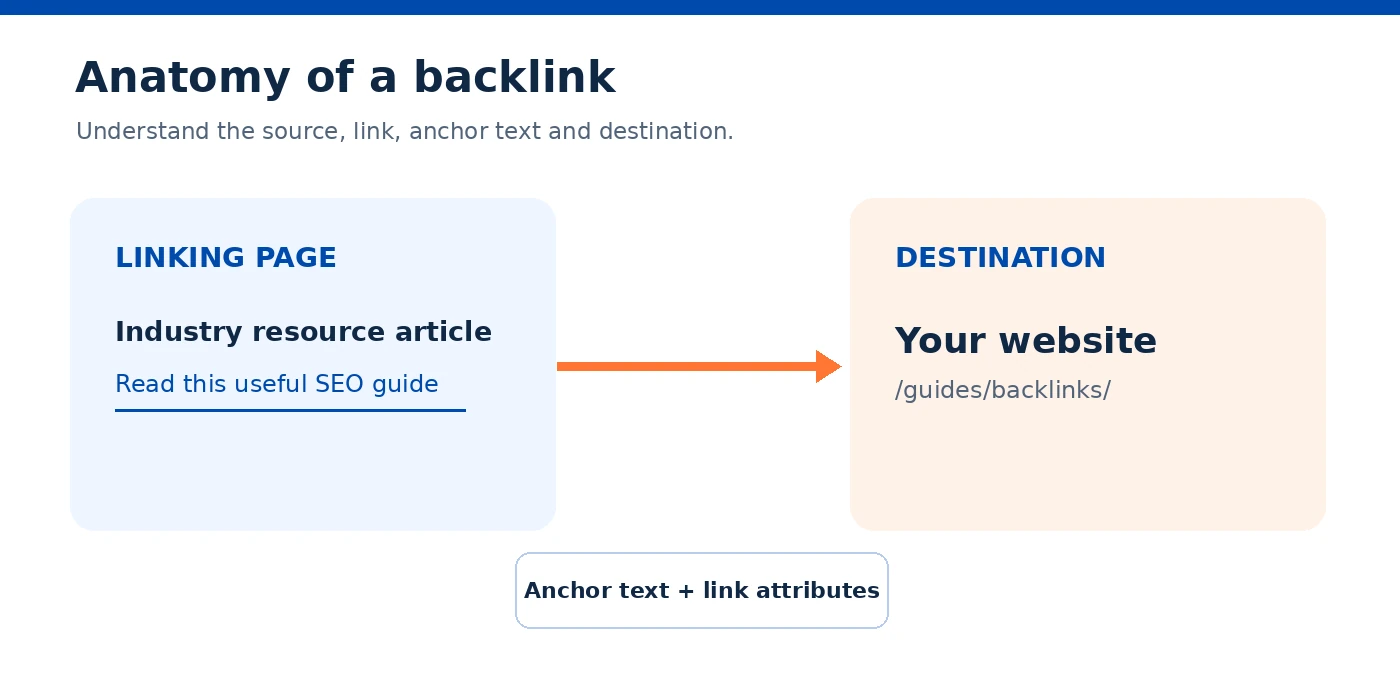
A backlink is a link from a page on another website to a page on your site. A referring domain is the distinct domain that hosts one or more of those links. Your backlink profile is the collection of these relationships at a chosen point, or across a period when historical data is available.
Links help users move between resources and help search engines discover pages and understand relationships among them. Google uses various systems and signals to rank results; links can contribute to that assessment, but they do not operate as a simple vote counter. A backlink is therefore an input to investigate, not a promise of higher rankings.
A backlink profile can answer four business questions: Are credible websites discovering and referencing our expertise? Which pages and topics attract recognition? Do important commercial pages benefit from that recognition, directly or through internal links? And are there avoidable technical or compliance problems in how links were acquired or where they lead?
Backlinks are not the same as internal links or brand mentions
An internal link joins two pages on your website. A backlink comes from another website. An unlinked brand mention names your business without a clickable hyperlink. Mentions can still contribute to awareness and referral discovery, but you should not count them as backlinks. Similarly, a citation of your brand by an AI assistant is not automatically an HTML backlink; treat AI visibility and conventional link analysis as distinct measures.
2. The 12 backlink-profile metrics that actually matter
Don’t interpret any metric in isolation. Use the following as a diagnostic dashboard, then inspect actual linking pages before making decisions.
| Metric | What it can tell you | What to check before reacting |
|---|---|---|
| 1. Referring domains | How many distinct domains link to you | Are they relevant, legitimate and genuinely independent? |
| 2. Total backlinks | How many links the crawler found | Are sitewide navigation/footer links inflating the count? |
| 3. Referring pages | How many distinct URLs link to you | Are those pages live, accessible and useful? |
| 4. Topical relevance | How closely the source page relates to the target | Does the link genuinely help the source page’s readers? |
| 5. Source-page quality | Credibility and editorial context of the actual page | Real authorship, meaningful content, genuine audience, editorial intent |
| 6. Third-party authority scores | A tool’s estimate of relative link strength | Do not mistake DA, DR or AS for Google metrics or absolute rankings |
| 7. Anchor-text mix | How linking pages describe your destination | Check brand, URL, descriptive, generic and repeated commercial anchors |
| 8. Link attributes | Whether links use nofollow, sponsored or UGC qualifiers | Was the link editorial, advertising or user-generated? |
| 9. Target-page distribution | Which pages receive external references | Do useful resources earn links while key pages remain isolated? |
| 10. New versus lost links | Changes detected by your chosen tool | Are differences caused by re-crawling, migrations or actual changes? |
| 11. Destination health | Whether backlinks lead to functioning URLs | 404s, soft 404s, redirects, noindex and canonical changes |
| 12. Referral outcomes | Visits, engaged sessions and conversions attributable to referrals | Analytics tagging, attribution limitations and actual lead quality |
Why referring domains and backlinks are different
One publishing network might produce 700 footer links from a single domain. A report citing you on 12 unrelated, reputable publications might produce only 12 links. The latter can indicate broader independent recognition, even if the total number is smaller. But independence, relevance and editorial context matter more than treating every unique domain as equally valuable.
Domain Authority (Moz), Domain Rating (Ahrefs) and Authority Score (Semrush) are vendor-specific measurements. Google does not publish these scores or use them as its own ranking formula. Scores are useful for prioritising review within a single tool, not for declaring a domain safe, relevant or worth paying for. A small specialist journal with a modest score may be more valuable to your audience than a large general-interest site that links from an unrelated page.
Anchor text: meaningful patterns, not magic percentages
Anchor text is the clickable wording used in a link. A profile commonly contains a variety of branded anchors (“Acme Accounting”), naked URLs (“acme.sg”), descriptive anchors (“GST registration checklist”), and generic references (“read the guide”). Repeated, exact-match money phrases across unrelated articles deserve investigation, especially when the same agency or link supplier places them. Google has no Approved percentage that every profile should match.
Follow, nofollow, sponsored and UGC
“Dofollow” is SEO shorthand for an ordinary crawlable hyperlink without a qualifying rel attribute; it is not a special HTML value you need to add. Google treats rel="nofollow", rel="sponsored" and rel="ugc" as link hints. Paid placements should be appropriately qualified, with sponsored preferred user-generated links can use ugc. A nofollow link can still deliver qualified visitors and exposure, and a paid link is not automatically a search-policy violation when properly marked. See Google’s link attribute documentation.
3. What does a healthy backlink profile look like?
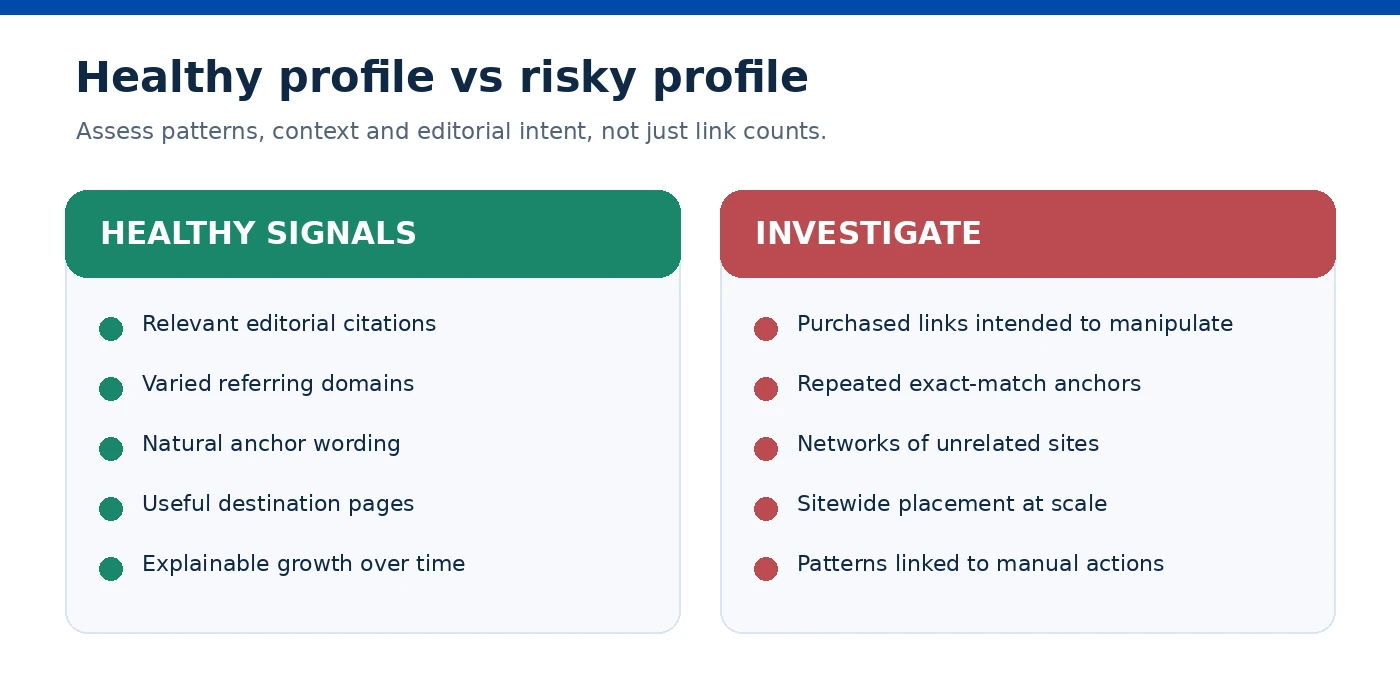
A healthy profile is coherent with the business, its industry and its history. A local restaurant, research institute and multinational retailer will naturally have different profiles. Evaluate whether the pattern makes sense, rather than comparing everyone against one arbitrary ratio.
| Signal | Reasonable pattern | What deserves investigation |
|---|---|---|
| Source relevance | Industry sites, publishers, customers, partners and useful directories | Large clusters of unrelated content with no reader benefit |
| Link placement | Contextual references within useful articles or resources | Mass-produced template/footer links inserted to rank keywords |
| Anchors | Natural variety driven by authors’ language | Repeated commercial phrases from controlled placements |
| Growth | Changes explainable by coverage, campaigns and publication schedules | Unexplained bulk placements tied to questionable tactics |
| Destinations | Live, useful pages that serve the referring audience | Important earned links terminating on errors or irrelevant redirects |
| Commercial relationship | Editorial links earned independently; paid links properly qualified | Purchased links engineered to pass ranking credit |
Important nuance: A burst of backlinks is not inherently suspicious. A well-researched report, a viral story or major media coverage can generate hundreds of legitimate references quickly. Conversely, a slow and steady programme can still violate policy if every link is manufactured. Investigate provenance and intent, not velocity alone.
4. The best tools for inspecting a backlink profile
Use at least one source you control and, for competitive or historical research, a third-party crawler. No provider sees every live link. Backlink datasets differ because their crawlers discover pages at different times, normalize URLs differently and apply different inclusion criteria.
| Tool | Best use | Key limitation |
|---|---|---|
| Google Search Console | Free sample of links to verified properties; top linked pages, linking sites and link text; manual-action checks | Its Links report is not comprehensive and report tables have limits; no competitor links |
| Ahrefs | Third-party backlink discovery, link history and competitor gap research | Proprietary index and features; subscription limits vary |
| Semrush | Competitor comparisons, link monitoring and backlink audit workflow | Its risk scores require manual verification |
| Moz Link Explorer | Link discovery and Moz-specific authority comparisons | Index and score differ from other vendors |
| Digimetrics | Complement backlink findings with broader SEO analysis and website diagnostics | Confirm the specific backlink-reporting features and export limits available on your plan |
| GA4 plus a website crawler | Referral outcomes and checks of destination URLs, redirects and errors | Analytics does not enumerate every backlink; crawlers do not measure ranking benefit |
Google explicitly says the Search Console Links report is a sample, may omit URLs and can truncate tables. It is useful first-party evidence, but calling it a full or definitive inventory is misleading. Consult Google’s Links report help page.
5. How to audit your backlink profile: a step-by-step process
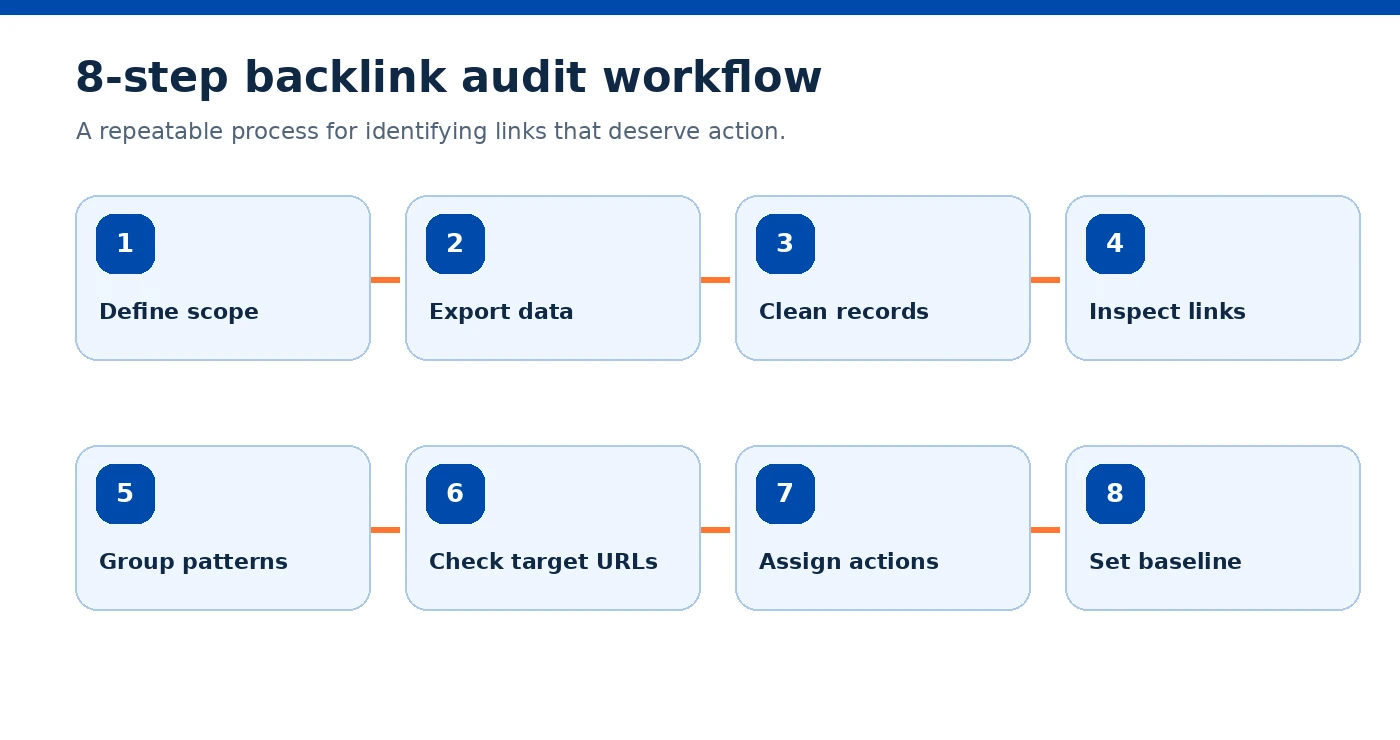
This workflow works for a small business, in-house marketing team or agency. A basic first review might take a few hours; more complex sites can require substantially more time, especially after a migration or past link scheme.
Step 1: Define the site and date range
Decide whether you are evaluating the entire domain, a subdomain, a directory such as /blog/, or a single landing page. Record the exact scope, the audit date, the reporting tool and whether the source includes live and historical links. Keep those definitions constant across reporting periods.
Step 2: Export the evidence
In Google Search Console, open your verified property, navigate to Links and review top linking sites, top linked pages and top linking text. Export available data. Supplement the export with a third-party tool if you need link-level context, recent gains/losses or competitor analysis. Review Security & Manual Actions → Manual actions before assuming a suspicious profile has resulted in a penalty.
Step 3: Build a clean working sheet
Use one row per distinct source URL → target URL link relationship as reported by your source. Deduplicate appropriately, but keep source-domain grouping available; otherwise, a sitewide link may dominate your spreadsheet. Useful columns include:
Tag known redirects and canonical variants so that http, https, www and non-www versions do not artificially divide the reporting picture.
Step 4: Inspect links that are likely to matter
Do not start by clicking every URL in a dataset of 50,000 links. Prioritise links to revenue-generating or high-value pages, important links recently lost, prominent editorial mentions, high-traffic sources and suspicious clusters. Open the source page. Confirm the link exists and is visible, inspect the paragraph surrounding it, establish why a reader would click, and check whether the destination fulfils that expectation.
Step 5: Group patterns rather than judging isolated data points
Group by referring domain, topic, target page, anchor pattern, source-site type and acquisition period. Look for concentrations, such as most commercial anchor links originating from a single outsourced campaign, or dozens of valuable sources linking to an old report now returning a 404. Compare changes against known press announcements, product launches and historical SEO activity.
Step 6: Evaluate the destination as well as the source
A valuable link landing on an error page is an opportunity to fix; a relevant article linking to a redirected homepage instead of the original guide may frustrate users. Check HTTP status, redirect destination, canonical signals, indexability and the usefulness of the target page. If a page was deliberately removed, choose the most genuinely relevant replacement; do not automatically redirect every expired URL to the homepage.
Step 7: Assign a proportionate next action
Use Keep / Recover / Improve / Investigate / Escalate rather than “keep or disavow”. Most ordinary low-value links need no action. Recover relevant links lost to a fixable URL problem. Improve pages that attract links but fail to serve visitors. Investigate manipulative patterns. Escalate a potential disavow decision only when Google’s narrow criteria are met.
Step 8: Set your baseline and repeat consistently
Record the number of relevant unique referring domains, links to priority pages, high-value links at risk, broken target URLs and any documented unnatural-link issues. Compare the next period using the same provider and scope. Annotate large changes caused by index updates, redirects and migrations so you do not attribute every number movement to real-world link gains or losses.
6. A practical scorecard for evaluating individual backlinks
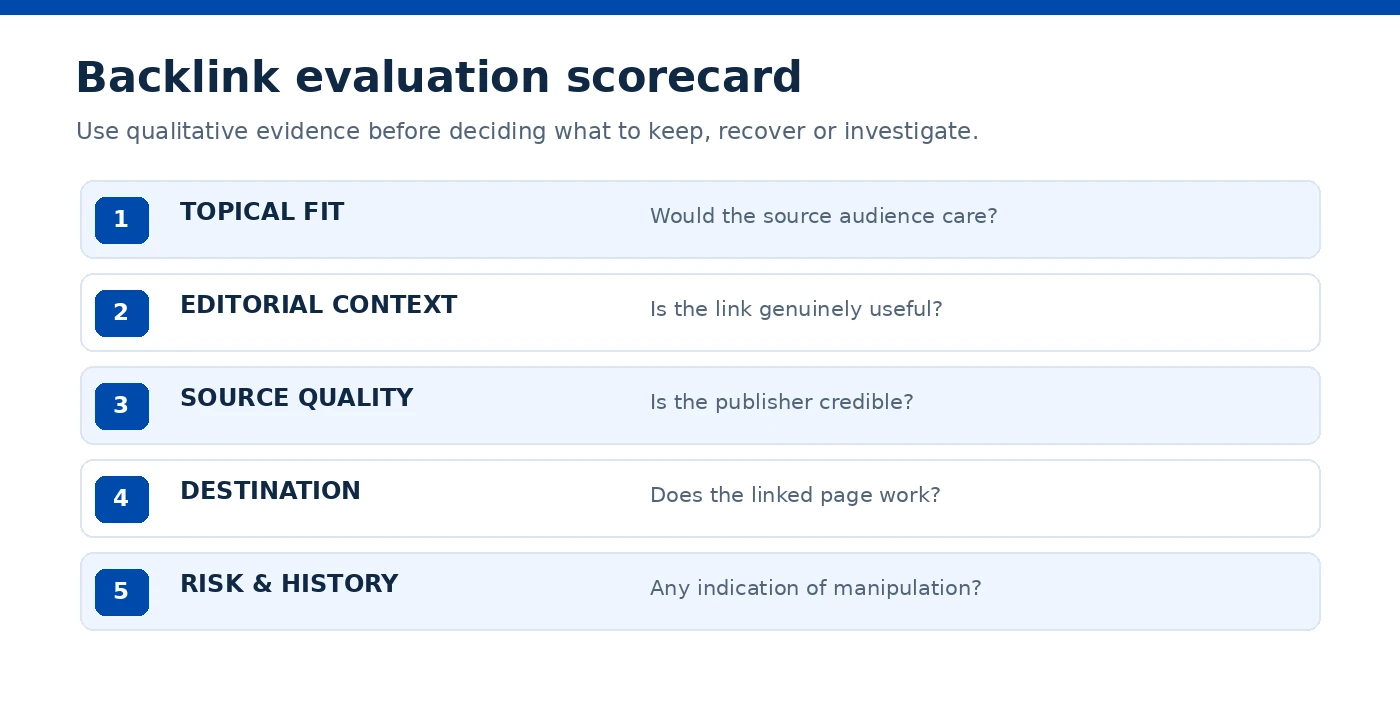
Use this evaluation framework to prioritise manual review instead of relying only on domain scores.
A weighted score can help analysts prioritise manual review, but it must not trigger automatic removal or disavowal. The following model is an editorial triage aid developed for this guide, not a Google ranking formula.
| Criterion | 0 points | 1 point | 2 points |
|---|---|---|---|
| Topical fit | Unrelated | Adjacent topic | Directly useful to target audience |
| Source credibility | Unverifiable/obvious thin spam | Legitimate but limited substance | Recognisable expertise or editorial accountability |
| Page context | Hidden, automated or unexplained | Directory/listing or weak context | Relevant editorial paragraph or citation |
| Destination usefulness | Error or mismatched page | Useful but improvable | Live, relevant and genuinely helpful |
| Audience value | No plausible audience benefit | Some discovery or brand value | Likely qualified readership or referral value |
Interpretation: Scores of 8–10 suggest priority relationships to preserve and build on. Scores of 4–7 call for normal review or improvements to the destination. Scores of 0–3 merit checking for data errors, irrelevance or a manipulative pattern; they do not establish that the link is harmful. Separately flag evidence of payment, automated creation, a controlled link network or other practices described in Google’s link spam policy.
7. How to recover lost backlinks and wasted link value
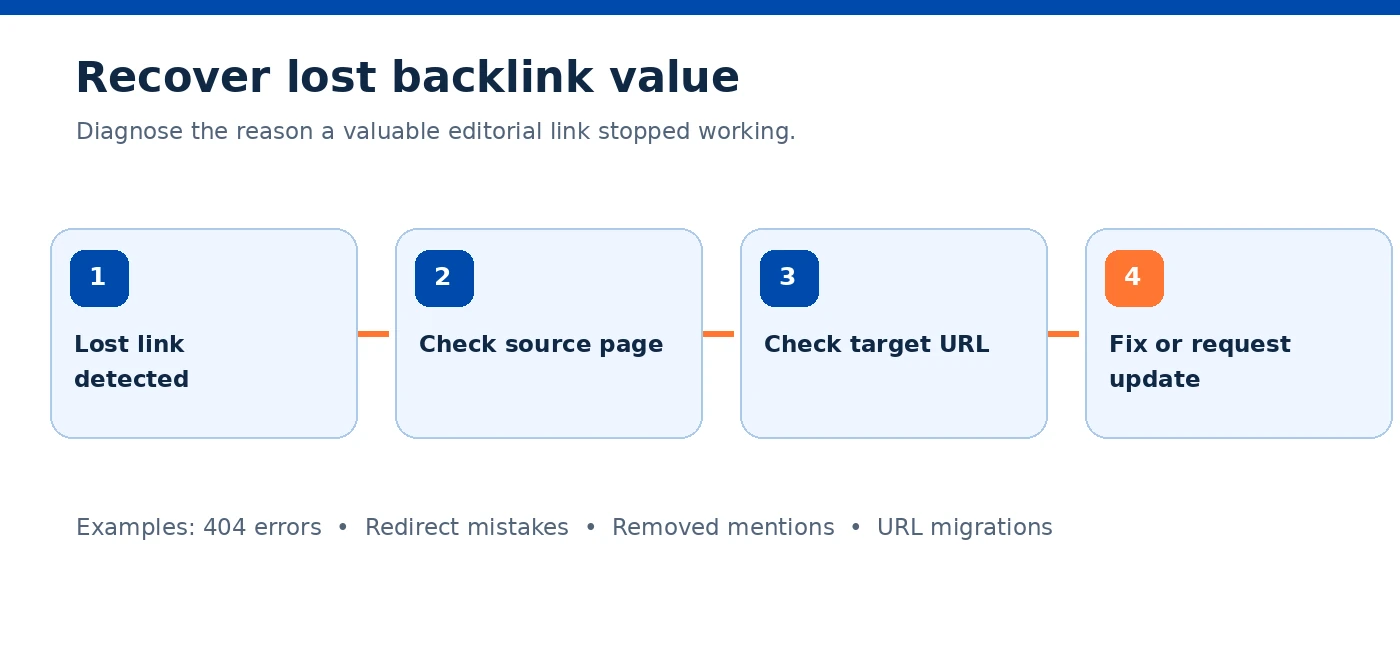
Recovery is often more practical than acquiring an entirely new editorial reference because the citing publication already chose to link to you. Start with the links that once reached useful pages or generated qualified visitors.
- Find genuinely lost links. Compare the historical and current datasets, then visit the actual source page. A crawler may label a link “lost” because it has not recrawled the page or because the URL changed.
- Fix broken destinations. Restore an accidentally deleted page if still relevant. Otherwise, create a topical 301/308 redirect to the closest legitimate replacement. Check chains and loops.
- Request corrections when appropriate. If a journalist linked to a typo, stale HTTP URL or discontinued resource, politely share the correct replacement without demanding a ranking-oriented anchor.
- Maintain evergreen resources. Update frequently cited data, screenshots, legislation, examples and references so publishers have a reason to keep recommending the page.
- Reinforce internal pathways. Link from well-cited guides to relevant service or product pages in a natural way; visitors need a useful next step, not aggressive internal keyword stuffing.
Special case: website migrations and rebrands
Before changing domains or URL structures, export important referring pages, map old URLs to equivalent new resources and test redirects. After launch, monitor 404s, unexpected chains, canonical changes and priority links pointing to decommissioned URLs. A good backlink profile cannot compensate for routing readers to the wrong destination.
8. How to use competitor backlink analysis to find real opportunities
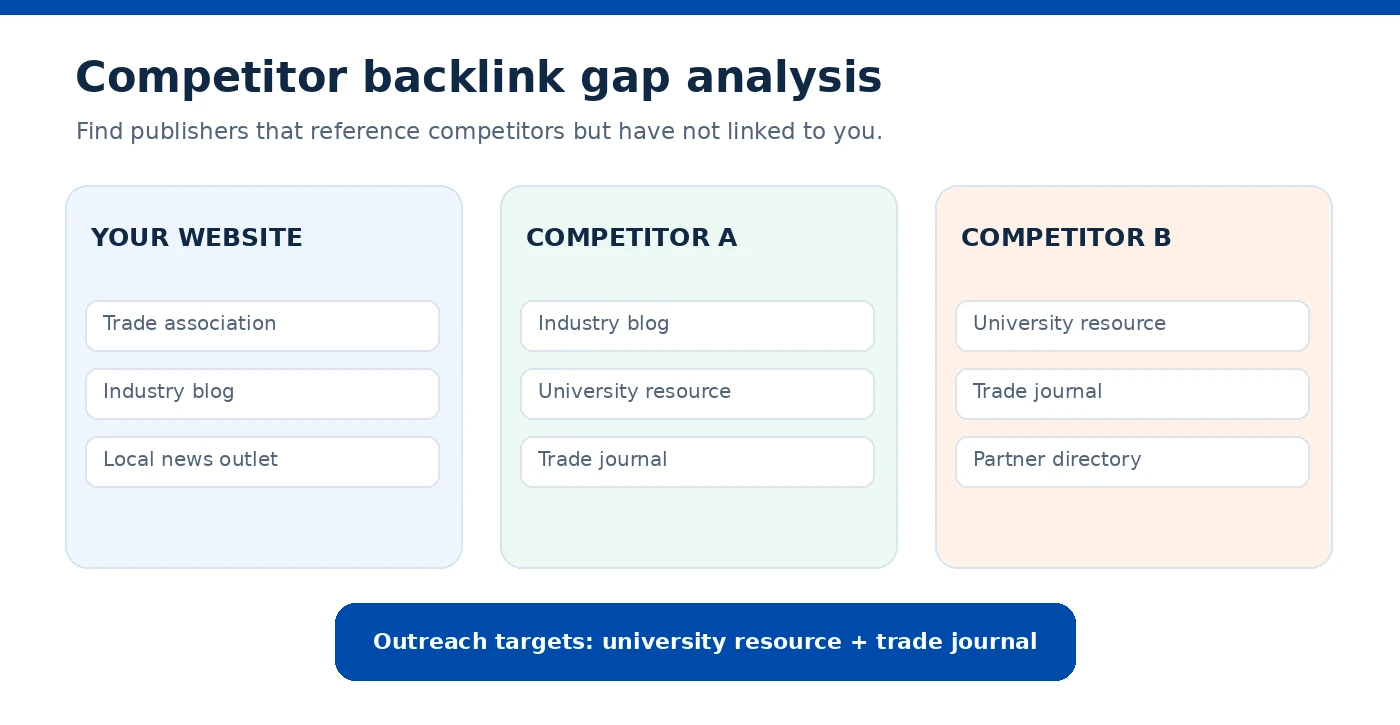
Competitor link research is valuable because it tells you which sources already cite businesses or resources in your topic. But copying a rival’s link portfolio indiscriminately is a poor strategy: some links are bought, irrelevant, inaccessible or tied to coverage you cannot credibly replicate.
First, choose the correct competitors
For each priority search topic, identify three to five websites that repeatedly compete with your pages in relevant search results. These may include publishers and informational sites, not just firms offering the same service. Compare like with like: a how-to article against another guide, or a category page against another category page, rather than a small company homepage against a global media site.
Then create a link gap list
- Export referring domains for your site and three to five search competitors.
- Find domains referencing two or more competitors but not your site.
- Inspect the specific linking pages and classify them: resource roundup, industry press, research citation, supplier, partnership, association or directory.
- Exclude obvious schemes, irrelevant sites and links you cannot reasonably earn on editorial merit.
- Rank the remaining prospects by audience fit, editorial plausibility and the strength of the resource you could offer.
Calculate the opportunity, not just the gap
A gap of 70 referring domains is not the same as 70 obtainable links. A useful planning sheet separates eligible prospects from high-fit prospects and then records outreach, responses, editorial placements and subsequent audience outcomes. If 60 domains look relevant but only 12 have a clear editorial opportunity, prioritise the 12. Outreach conversion is uncertain; treat any success rate as a measured result, not a forecast guarantee.
9. How to improve your backlink profile without creating link spam
Good link acquisition begins with something other people have a reason to reference. The best content asset depends on your audience and available expertise, not on a generic instruction to “publish more blogs”.
Publish assets that deserve citations
- Original data: surveys, anonymised benchmark studies, trend reports and methodologies that readers can scrutinise.
- Useful tools: calculators, diagnostic checklists, free templates or technical reference tables.
- Definitive explainers: carefully maintained guides answering complicated, recurring industry questions.
- First-hand expertise: documented experiments, case studies with clear methods, limitations and results.
- Local expertise: Singapore-specific regulations, industry directories and practical implementation guidance, checked against official sources.
Promote resources ethically
Send targeted, personalised outreach that explains why the source’s audience would benefit. Make research and supporting evidence easy to verify. Respond to relevant journalist requests, contribute genuine expertise to industry discussions, participate in legitimate associations and build partnerships with real business value. A publication may choose not to link to you, and you should respect that editorial decision.
Avoid buying followed links, large-scale exact-match guest posting, automated forum drops, private blog networks, excessive reciprocal exchanges and unrelated directory submissions designed primarily to manipulate rankings. Google’s spam policies describe these and other link spam examples. Sponsorship and advertising can still be useful marketing when links are correctly qualified and the placement serves a legitimate audience.
What about local citations?
For local companies, accurate listings in reputable business directories, professional bodies and partner sites can help prospective customers verify a business and find contact details. These listings should be selected for their real users, not purchased in bulk. Consistency of company details is useful operationally, but adding your URL to dozens of low-quality directories does not become a good SEO strategy simply because they are technically “referring domains”.
10. What to do about suspicious backlinks and when to disavow
This is where many backlink guides give unsafe advice. Most websites do not need to disavow links. Google says the disavow feature is advanced, can harm search performance when used incorrectly, and should generally be considered only when both conditions apply: a considerable number of spammy, artificial or low-quality links point to your site, and they caused or are likely to cause a manual action. Read Google’s official disavow instructions.
Follow this decision sequence
- Check Manual actions in Search Console. Do not infer a penalty solely from ranking declines or third-party toxicity labels.
- Establish link history. Did you, a previous agency or a supplier commission mass-paid links, automated placements or other policy-violating activity? Document evidence rather than relying on appearance alone.
- Review the scale and risk. A few strange crawler links are not equivalent to a substantial controlled link scheme.
- Seek removal or qualification of violating links. Where you control or have commissioned the placements, contact the publishers and request removal or a suitable
relattribute. - Use disavow cautiously if Google’s criteria are satisfied. Have an experienced SEO review the final file; disavowing legitimate editorial domains can remove useful signals.
- If a manual action exists, follow Google’s reconsideration guidance. Document remediation and submit a request through the Manual actions report when appropriate.
Google’s official tool uses one URL or domain:example.com entry per line in a text file. Domain-wide disavowal is especially consequential. Don’t give junior staff a ready-made disavow list without expert review; understand the feature’s supported property requirements and current documentation before uploading anything.
11. Which backlink KPIs should you report?
Report what stakeholders can act on. “We gained 500 links” tells a business owner very little unless the links are credible, the target pages work, and the coverage supports a business objective.
| Measure | Why report it? | Suggested review |
|---|---|---|
| Relevant, new unique referring domains | Tracks credible recognition rather than volume alone | Monthly |
| Quality placements to priority pages | Connects outreach to valuable resources | Monthly |
| High-value links recovered | Shows results from fixes and publisher corrections | Monthly / after changes |
| Backlinks to 4xx destinations | Identifies avoidable technical waste | After releases and migrations |
| Referral engaged sessions, leads or revenue | Shows non-ranking business value | Monthly / quarterly |
| Search visibility of linked pages | Provides context for overall SEO performance | Monthly; never attribute causality from links alone |
| Link-spam remediation, if applicable | Tracks resolution of documented policy risks | As needed |
A realistic 30-day improvement plan
| Period | What to do | Deliverable |
|---|---|---|
| Days 1–7: Establish | Define scope, export GSC and third-party data, check manual actions, map target URLs | Baseline sheet and priority-link inventory |
| Days 8–14: Diagnose | Inspect high-value sources, link clusters, broken destinations and anchor patterns | Keep/recover/improve/investigate register |
| Days 15–21: Fix | Repair redirects and broken pages, refresh linkable assets, request corrections where warranted | Change log and recovered-link queue |
| Days 22–30: Grow | Compare three to five search competitors, shortlist editorial prospects, prepare one standout asset | Prioritised outreach plan and KPI dashboard |
Continue checking monthly during active SEO or outreach campaigns and after major site changes. Stable, low-activity sites may need less frequent deep audits. The right schedule depends on traffic value, rate of change and your resources.
12. Common backlink-analysis mistakes to avoid
- Assuming more links always means better SEO. Thousands of sitewide duplicates can obscure a lack of independent editorial coverage.
- Using Domain Authority or Domain Rating as Google’s score. These are third-party heuristics, not Google ranking values.
- Disavowing every low-scoring domain. Google explicitly advises restraint; you could eliminate beneficial signals.
- Judging a link by its domain alone. Inspect the exact source page, contextual sentence and destination.
- Comparing raw totals between tools. Different indexes yield different counts; track trends with stable definitions.
- Ignoring page-level distribution. An impressive domain profile might not translate into useful discovery for the resources you want to grow.
- Presuming a ranking drop was caused by backlinks. Diagnose search demand, competitors, intent, content, technical issues and broader ranking changes too.
- Copying competitors’ questionable tactics. A ranking competitor’s backlink list contains examples to evaluate, not an approved acquisition shopping list.
- Confusing brand mentions with backlinks. Include unlinked mentions in PR measurement but keep them distinct in the link inventory.
- Reporting placements without outcomes. Track links that remain live, relevance, referral engagement and usefulness to the audience.
Frequently asked questions about backlink profiles
What is a backlink profile in simple terms?
It is the collection of links from other websites pointing to yours, including the sources, linking pages, target pages, anchor text and link attributes. Analysing it helps you understand who references your content and what to preserve or improve.
How many backlinks do I need to rank on Google?
There is no universal number. Your topic, search intent, content usefulness, competition, site structure and many other factors matter. Compare the specific pages competing for your search terms rather than chasing a generic backlink target.
What is the difference between backlinks and referring domains?
A backlink is an individual source-to-target link. A referring domain is a distinct domain containing at least one backlink. One domain may produce hundreds of links, so the figures answer different questions.
Can I check my backlink profile for free?
Yes. If you own or manage the site, verify it in Google Search Console and open the Links report. Remember that Google’s report provides a sample and is not a complete web-wide backlink index.
Are nofollow links worthless?
No. They can bring relevant visitors, publicity and potential customers. Google treats nofollow as a hint, but you should not assume every nofollow link provides the same ranking effect as an unqualified editorial link.
Are backlinks still important in 2026?
Links remain part of how Google discovers and understands content, although there is no simple formula for their ranking impact. High-quality content, matching search intent, technical accessibility and user value remain central. Invest in links people have genuine reasons to publish and click.
Not automatically. International news coverage, expatriate communities, multilingual resources and global suppliers can generate legitimate cross-border links. Judge the real source, topic and origin of the link, not just the country or language.
Is a sudden backlink spike a Google penalty risk?
Not by itself. Viral research, media coverage and popular resources can earn many links at once. Investigate whether the placements were editorial or part of a manipulative scheme. Velocity alone does not establish wrongdoing.
How do I know if I have a Google manual action for unnatural links?
Check Security & Manual Actions → Manual actions in your verified Google Search Console property. A fall in rankings or a third-party “toxic” label is not proof of a manual action.
Should I disavow spammy backlinks?
Usually not. Google’s recommendation limits disavowal to a considerable quantity of spammy/artificial/low-quality links that have caused or are likely to cause a manual action. Seek removal or correct link qualification first when applicable, and have an expert review borderline cases.
Can backlinks to old URLs be recovered?
Often, yes. Restore a useful deleted page, redirect to a highly relevant successor, or ask the linking publisher to update an outdated URL. Confirm the link and destination manually before reporting a recovery.
Do backlinks guarantee traffic or rankings?
No. Links can support discovery, credibility and referrals, but outcomes depend on search demand, competition, relevance, content and technical factors. Measure search and business outcomes alongside link data, without assuming one caused the other.
How often should I conduct a backlink audit?
A monthly light review suits many active websites. Review weekly during an intensive outreach campaign or after a significant migration. A deeper quarterly assessment may be enough for stable sites. Prioritise change and commercial risk over an arbitrary schedule.
What is the best way to get better backlinks?
Create resources your audience and credible publishers genuinely need, such as original research, practical tools and well-supported explanations, then share them with relevant editors and communities. Treat editorial independence and usefulness as more important than anchor-text control.
Conclusion: Turn backlink data into a plan, not a vanity metric
The strongest backlink profile is not the one with the biggest number in a dashboard. It is the one that reflects real expertise, credible references, relevant audience discovery and working pages. Start with your highest-value links and destinations, address avoidable technical issues, then focus your outreach on sources whose readers genuinely benefit from what you offer.
Above all, separate low value from harmful. A weak link may be ignorable; a manipulative scheme requires careful investigation. That distinction helps you invest in improvements without creating unnecessary risk.
Need help interpreting your backlink profile?
MediaOne’s SEO team can help examine link quality, competitor opportunities, technical issues and the broader search strategy behind your results. Explore MediaOne’s SEO services, or start by reviewing your website with the tools available at Digimetrics.
Sources and further reading
The analysis methods, examples and scorecard in this article are practical editorial frameworks, not Google-endorsed scoring models. Product capabilities and prices can change; confirm details with vendors.