AI marketing software can help businesses create content, analyse competitors, optimise advertising campaigns, manage leads, personalise customer communications and measure performance. Yet purchasing more AI software does not automatically make a marketing department more effective.
A team running five disconnected AI tools can easily spend more time moving data between applications, checking inaccurate outputs and correcting mistakes than it saves through automation.
The more important question is not, “Which AI tool should we subscribe to?”
It is, “Which part of our marketing operation is underperforming, and can AI improve it enough to justify the investment?”
This guide provides a practical framework for answering that question. It compares 15 established AI marketing tools, explains their strengths and limitations, provides a consistent 15-point selection scorecard, and shows how to calculate ownership costs, run controlled pilots and measure actual returns.
It also addresses an increasingly important consideration for Singapore businesses: how to use AI without compromising customer information, brand quality or accountability.
Key Takeaways
- Choose tools by workflow, not feature count. Define the marketing problem before comparing platforms.
- Audit your existing software first. You may already have AI capabilities inside your CRM, advertising platform or design software.
- Use a consistent 15-point scorecard. Evaluate workflow fit, integrations and total cost, each rated from 1 to 5.
- Shortlist tools scoring at least 9/15, provided they also meet mandatory security and compliance requirements. This is a practical screening heuristic, not an industry standard.
- Compare cost per approved output, rather than cost per generated draft. Editing, verification and integration can consume the apparent savings.
- Test on real work. Run a 30-day pilot for tasks such as content production or reporting, using pre-agreed criteria. Advertising algorithms may need a longer evaluation period.
- Measure business outcomes. Time saved matters, but qualified leads, customer acquisition costs, sales and contribution are more useful measures.
- Retain human accountability. AI can produce and recommend; a named person should approve consequential decisions, claims and customer-facing communications.
- Plan your exit before purchase. Confirm data export rights, ownership of generated assets and the effects of cancellation.
Shortlist: Top Three Tools per Workflow
No single tool wins across content marketing, SEO, paid media, CRM, and analytics.
An SEO consultant managing multiple clients has different requirements from an e-commerce retailer running hundreds of product ads. Likewise, a three-person Singapore marketing team should rarely purchase the same software stack as an international enterprise with dedicated analytics and engineering departments.
The following shortlist identifies suitable tools to investigate, rather than declaring a winner without testing.
| Marketing workflow | Three options to evaluate | Best starting point |
|---|---|---|
| Content generation and editing | Jasper, Copy.ai, Grammarly | Repeated content that requires extensive drafting or editing |
| SEO research and content optimisation | Semrush, Ahrefs, Surfer | Keyword research, competitor gaps and existing-page optimisation |
| AI search visibility | Semrush, Profound, Perplexity | Brand mentions, citations and answer-engine research |
| CRM and marketing automation | HubSpot, Copy.ai, existing CRM automation | Lead routing, segmentation and follow-up |
| Social media and creative production | Hootsuite, Canva, Adobe Firefly | Approval workflows, design assets and scheduling |
| Paid advertising | Google Ads AI features, Meta Advantage+, third-party creative tools | Campaign optimisation and creative testing |
These tools are not interchangeable. For example, Perplexity can help with manual research into AI-generated answers but is not equivalent to a dedicated visibility-monitoring platform that repeatedly measures a defined set of prompts.
Similarly, Grammarly may improve the quality of existing writing without performing the broader campaign production or workflow automation offered by other products.
Which type of business needs which stack?
Singapore SME with one marketing executive
Start with a general-purpose AI assistant, existing analytics tools and the scheduling or design software already in use. Add a specialist application only when a repeated task justifies it.
E-commerce business
Prioritise product data, feed quality, paid-media automation, customer segmentation and lifecycle messaging. A sophisticated content generator adds less value if abandoned-cart flows and conversion tracking are broken.
B2B lead generation company
Prioritise CRM integration, lead qualification, sales follow-up, content production and attribution. The objective is qualified opportunities, not simply more AI-generated emails.
SEO or digital marketing agency
Prioritise repeatable audits, keyword intelligence, technical analysis, content workflows, reporting and client-specific permissions. The ability to manage multiple client accounts reliably may outweigh a particular AI feature.
Large enterprise
Start with governance, security, integrations, brand consistency, team permissions and procurement requirements. A promising individual feature is not enough if the platform cannot operate within enterprise controls.
The appropriate stack depends on what the company already owns. Avoid buying a second system to do work an existing subscription can handle adequately.
Why Most AI Marketing Tool Lists Fail Buyers
Search for “best AI tools for digital marketing”, and many articles recommend nearly identical products.
One tool is described as ideal for content creation, another for SEO and another for social media. The descriptions often focus on features, convenience and subscription prices.
They rarely answer the questions that determine whether the purchase will succeed.
How much editing remains after the AI generates content? Can the tool retrieve accurate data from the company’s actual CRM? Does it preserve existing approval processes? Will it create another reporting dashboard with inconsistent numbers? Who fixes errors when an automated workflow fails?
These questions matter more than a product’s promotional feature list.
The AI tool demo problem
Software demonstrations usually use a prepared dataset, polished examples, and an ideal workflow.
A vendor might generate ten compelling advertising headlines in seconds.
That looks impressive until the marketing team discovers that half the headlines use claims the company cannot substantiate, several exceed platform limits, and the rest require extensive editing.
The tool completed the generation task but did not necessarily complete the business task.
A generated output is not the same as a usable deliverable.
The same problem appears in SEO.
An AI platform may produce a 2,000-word article quickly, but an editor still needs to verify its claims, identify original insights, correct outdated statistics, check search intent, add supporting evidence and improve readability.
If the resulting work requires almost as much time as writing the article normally, the tool may have limited commercial value.
1. Duplicate capabilities
A company subscribes to separate platforms for writing, rewriting, summarising, creating social captions and generating email subject lines.
Several may rely on similar underlying language models while charging separately for convenient interfaces.
2. Poor data integration
The CRM contains incomplete information, the analytics platform uses different conversion definitions, and the AI tool cannot reconcile them.
The business gets faster reports without necessarily getting more accurate reports.
3. Unmeasured rework
Management counts the number of drafts generated but not the hours editors spend correcting them.
4. Excessive tool switching
Employees move information manually between applications, exporting spreadsheets and copying content from one interface into another.
5. Vendor lock-in
Prompts, workflows, campaign records and customer information become difficult to export after the business cancels a subscription.
Worked example: Three tools versus one integrated workflow
Illustrative scenario, not actual vendor pricing or a verified client result.
A small agency has three software subscriptions:
| Tool purpose | Monthly cost |
|---|---|
| AI writing application | S$120 |
| AI content rewriting application | S$80 |
| AI reporting assistant | S$150 |
| Total | S$350 |
The monthly subscription total is S$350, or S$4,200 annually.
But subscription costs are only part of the problem.
If two employees spend a combined 12 hours a month transferring files and correcting duplicated work, at an illustrative loaded labour cost of S$45 per hour, the additional internal cost is S$540 monthly.
The combined operating cost is therefore approximately S$890 per month, before accounting for setup or troubleshooting.
An integrated alternative costing S$250 monthly might be more economical, even if it lacks a few specialist features.
However, you must test the alternative. Lower costs do not justify losing essential capabilities, data quality or workflow reliability.
The lesson: compare the full cost of completing the task, not the combined number of features.
What AI Digital Marketing Tools Are and How to Judge Them
Defining an AI marketing tool versus a standard marketing tool
An AI marketing tool uses machine learning, generative models, or related technologies to help produce, analyse, predict, or act on marketing information.
Traditional marketing automation, by contrast, can execute predefined instructions without learning or generating new recommendations.
For example:
- A system that sends an email exactly three days after a customer registers may be conventional automation.
- A system that predicts which subscribers are most likely to convert based on behavioural history uses predictive modelling.
- A system that writes several email versions based on an approved campaign brief uses generative AI.
- A system that analyses campaign performance, proposes changes and interacts with external applications may operate as an AI-assisted or agentic workflow.
Some marketing platforms combine all these capabilities.
This distinction matters because businesses should not pay a premium for “AI” when a simple automation rule would solve the same problem more reliably.
The seven-point evaluation methodology
Before purchasing any AI marketing software, test it against seven criteria.
1. Accuracy: Can you trust the output?
What to test: Use at least ten representative marketing tasks with known reference information.
For a writing tool, provide product specifications, approved claims and existing campaign material. Check whether the output introduces incorrect numbers, fictional testimonials or unsupported guarantees.
For an analytics tool, compare calculated totals against your verified source data.
Red flags: Invented statistics, inaccurate citations, changing numbers between reports or answers that cannot be traced to a source.
Practical measure: Percentage of outputs passing a documented factual review without material corrections.
2. Pricing: What does the tool cost to operate?
Do not stop at the published monthly subscription.
Include additional users, premium integrations, credit consumption, onboarding, training, support and the internal time required to manage the system.
Where pricing is usage-based, test how much a real workflow consumes.
Practical measure: Total cost per approved output, completed task or measurable business outcome.
3. AI capabilities: What does the system actually do?
Ask whether the tool generates new content, predicts performance, executes predefined rules, retrieves data or performs actions across other applications.
Determine whether those capabilities are useful for the specific workflow.
A content writer may need strong editorial controls. An SEO agency may value accurate crawling and search data more than sophisticated prose generation. A retailer may gain more from inventory and conversion optimisation.
Practical measure: Percentage of the workflow completed satisfactorily without manual intervention.
4. Integrations: Does it work with your existing stack?
Check connections to the applications your team already uses.
Common examples include Google Analytics 4, Search Console, Google Ads, Meta Ads, Shopify, WordPress, HubSpot, Salesforce and internal reporting systems.
Do not assume that an integration listed on a vendor website supports every data field or action.
A platform may offer a connector but only support scheduled imports rather than real-time bidirectional updates.
Practical measure: Number of manual steps removed from the existing workflow.
5. Data quality: Can the tool work with your real records?
An AI lead-scoring application will perform poorly if the CRM contains duplicate contacts, missing deal stages and inconsistent definitions.
Before purchasing, inspect the input data.
Ask whether the system can detect missing information, flag duplicates and identify unreliable records.
Practical measure: Percentage of records meeting the minimum quality requirements for the use case.
6. Scalability: Can it support next year’s requirements?
A subscription may work for two users but become expensive when the team grows to twenty.
Check limits for users, workspaces, projects, credits, API requests, storage, usage and the number of clients or brands.
Also assess how reliably the system handles larger jobs.
Practical measure: Forecast cost and operational capability at two to three times current usage.
7. Security and governance: Can you use it responsibly?
Confirm where customer information is processed, who can access it, whether data may be used for model training, and how long records are retained and how they can be deleted or exported.
For Singapore organisations, assess relevant Personal Data Protection Act obligations before transferring personal data into a new system.
Practical measure: Written evidence that the platform meets the organisation’s minimum data, security and access-control requirements.
Worked example: Evaluating an AI writing platform
Imagine a Singapore digital marketing team publishes eight articles a month.
Its main problem is that writers spend too much time producing initial drafts and adapting content to the company’s writing style.
The team considers a specialised content platform.
It prepares ten briefs covering different services, industries and levels of technical complexity.
Every brief includes a target audience, search intent, approved factual information, brand-voice requirements and an output format.
The team then evaluates:
| Test | What to measure |
|---|---|
| First-draft production | Minutes required to produce a usable starting draft |
| Factual accuracy | Material factual errors per article |
| Editorial workload | Minutes required for corrections and rewriting |
| Brand consistency | Score against the approved style guide |
| Search intent | Whether the article answers the intended questions |
| Originality | Whether the content adds useful examples or evidence |
| Final acceptance | Percentage of articles approved for publication |
Suppose the tool reduces initial drafting time by 60%, but editing increases because the output contains generic claims.
The net time saved may be considerably smaller.
Judge a tool by the finished, approved article rather than the draft generated in the demonstration.
Benefits and limits of AI tools in digital marketing
AI can improve speed, coverage and consistency in suitable workflows.
Potentially useful applications include generating ad variations, summarising research, detecting anomalies, drafting content outlines, grouping keywords, analysing customer segments and preparing initial reports.
However, AI also has limitations.
Generative systems can confidently produce inaccurate information. Predictive models may reflect historical biases or poor-quality data. Automated advertising can optimise toward the wrong conversion goal if tracking is incorrect.
For these reasons, treat AI as part of a managed marketing process, not a replacement for strategy, business judgement, or accountability.
The AI Tool Stack by Job: Content, SEO, Social, Ads and Automation
AI content writing and optimization tools
Content platforms have become more sophisticated than simple text generators.
Modern tools increasingly offer brand knowledge, reusable templates, collaborative editing, approval controls and specialised workflows.
The key question is whether these capabilities improve the quality and consistency of content that your team actually publishes.
Jasper: For repeatable, brand-controlled content production
Jasper is worth evaluating when a marketing team produces substantial volumes of content and wants to maintain consistent brand messaging.
Its product documentation describes capabilities for defining brand voice, storing organisational knowledge and applying audience context. When implemented properly, these can reduce repetitive briefing.
Best fit: Marketing departments and agencies producing recurring content across several formats.
Strengths to test: Brand consistency, reusable knowledge and structured content workflows.
Potential limitations: Additional setup, subscription costs and the need for substantive human editing.
Recommended test: Give Jasper five approved articles and a documented style guide. Ask it to produce a new article for the same audience. Compare editing time and factual accuracy with your current process.
Copy.ai: For repeatable go-to-market workflows
Copy.ai offers chat-based AI functionality alongside more advanced workflow automation.
Its workflow-oriented products connect activities such as research, generation, and integrations into repeatable processes.
Best fit: Teams automating repetitive marketing and sales operations.
Strengths to test: Workflow structure, integration breadth and repeatability.
Potential limitations: Workflow setup effort, variable credit consumption and the costs of advanced automation tiers.
Recommended test: Automate one recurring campaign-production process and measure how many manual handoffs disappear.
Grammarly: For editing and consistency
Grammarly is more relevant when the challenge is improving existing content than generating entire campaigns.
A company with capable writers may find that better editing support produces greater value than another drafting platform.
Best fit: Small teams that need writing assistance across documents, email and everyday communications.
Strengths to test: Clarity, grammar, readability and tone.
Potential limitations: Limited suitability as a complete content planning or campaign management system.
Recommended test: Compare editorial review time on twenty real pieces of writing.
Writer: For enterprise content governance
Writer is a candidate when organisations need centrally managed writing standards, approved knowledge and controlled enterprise workflows.
Best fit: Large teams operating under detailed brand, legal or regulatory requirements.
Strengths to test: Centralised rules, permissions, repeatability and compliance-related workflows.
Potential limitations: Implementation complexity and suitability for smaller organisations.
Recommended test: Test whether approved claims, terminology and prohibited wording remain consistent across multiple teams.
Surfer: For content optimisation
Surfer’s Content Editor provides content recommendations informed by search-result analysis, including terms, outlines and optimisation guidance.
This is a different task from simply generating readable copy.
Best fit: SEO content teams improving existing pages or preparing optimised drafts.
Strengths to test: Topic coverage, editorial guidance and workflow integration.
Potential limitations: Content scores are proprietary indicators, not guarantees of Google rankings.
Recommended test: Optimise a small set of comparable pages, document the changes and monitor subsequent organic search performance without assuming causation.
SEO research, competitive intelligence and AI search visibility
SEO professionals should distinguish between three categories:
Search research tools collect and organise information about rankings, keywords, backlinks and technical issues.
Content optimisation tools suggest how a page could better address the topic and search intent.
AI visibility tools attempt to measure how often brands appear, are mentioned or are cited in generated answers.
A platform may serve several categories, but different metrics require different evaluation methods.
Semrush: Broad SEO and competitive research
Semrush is an established option for keyword research, domain analysis and competitive research.
Its AI visibility products also cover brand visibility across selected AI search services.
Recommended test: Compare its keyword, competitor and AI visibility outputs against verified queries and your existing reporting.
Ahrefs: Backlinks and organic research
Ahrefs is especially relevant to organisations that need substantial link analysis alongside keyword and competitor research.
Recommended test: Compare referring-domain discovery, backlink classification, keyword coverage and export functionality against your existing tools.
Clearscope: Content coverage and editorial optimisation
Clearscope is relevant when teams want guidance on topics and terminology for individual pages.
Recommended test: Evaluate whether its recommendations improve content completeness without creating unnecessary keyword repetition.
Perplexity: AI-assisted research and answer checking
Perplexity can help marketers research questions, investigate cited sources and observe how a particular prompt produces an AI answer.
However, a manual query is not equivalent to a statistically representative AI visibility measurement.
Recommended test: Repeat a defined set of prompts, inspect the underlying sources and check the consistency of answers.
Profound: AI answer visibility measurement
Profound focuses on understanding how brands appear in AI-generated answers.
Recommended test: Assess prompt coverage, citation tracking, competitor comparisons, reporting transparency and reproducibility.
A practical GEO measurement workflow
Suppose a Singapore company wants to know whether AI assistants recommend its brand for a particular service.
Start with twenty to thirty realistic prompts grouped by buying stage.
For example:
- “Which companies offer enterprise SEO services in Singapore?”
- “How do I compare SEO agencies for a large e-commerce website?”
- “Which agencies help Singapore businesses appear in AI search results?”
- “What should I check before hiring an SEO agency?”
Run the same prompt set using a consistent methodology.
Track whether the brand is mentioned, whether it is recommended, where it appears in the answer, which sources are cited and whether the answer contains inaccurate information.
Compare the results over time.
Do not interpret a single mention percentage as market share or a proven predictor of sales. AI-generated responses vary with the model, prompt, date, user context and retrieval behaviour.
CRM, marketing automation and workflow planning
CRM is often where AI can deliver tangible value, because improvements may be linked directly to leads, sales activity and customer outcomes.
However, it is also where bad automation can be especially costly.
Consider a company receiving hundreds of enquiries monthly.
Its CRM contains leads from contact forms, paid advertising, webinars and referrals.
A conventional workflow sends every lead the same follow-up email.
A more advanced system could identify the lead’s product interest, recommend the appropriate sales owner, draft a relevant response and flag high-priority enquiries.
But the underlying CRM information must be reliable.
If form submissions are incorrectly labelled, the AI may confidently recommend the wrong follow-up.
HubSpot: CRM-connected marketing automation
HubSpot offers AI-assisted marketing and CRM capabilities within its broader platform.
It is a strong candidate to evaluate when customer records, sales pipelines and campaign activities already live inside HubSpot.
Recommended test: Measure lead-routing accuracy, time to first response, duplicate contact creation and qualified meeting rates.
When automation is not the solution
Suppose a contact form sends leads for Product A into Product B’s sales pipeline.
An AI lead-scoring model does not solve that underlying configuration error.
The correct intervention is to fix field mapping, routing and verification first.
Fix the process before automating it.
Social media, visual creation and ad creative generation
Social media software covers several different jobs:
- Planning and approval
- Scheduling
- Social listening
- Content production
- Image and video creation
- Reporting and analysis
- Paid advertising optimisation
One application rarely provides the strongest solution for all of them.
Hootsuite: Social scheduling and management
Hootsuite is worth evaluating where teams need centralised planning and publication across several social accounts.
Recommended test: Assess approval workflows, supported channels, reporting quality and the time required to schedule a month’s content.
Canva: Marketing visual production
Canva is particularly useful for producing repeatable assets such as social graphics, presentations and campaign variations.
Recommended test: Give non-designers a set of approved brand templates and measure the percentage of usable assets produced without designer intervention.
Adobe Firefly: Generative visual workflows
Adobe Firefly is relevant to creative teams that want AI-generated image capabilities within a broader professional production environment.
Recommended test: Assess editability, visual consistency, licensing terms, production handoffs and final creative quality.
Paid advertising: Google Ads AI and Meta Advantage+
Paid media differs from content generation because automation can directly affect advertising spend.
Google Ads provides machine-learning features for bidding, targeting and asset combinations. Meta similarly offers automated campaign and creative capabilities.
These platforms can help advertisers optimise performance, but only when conversion tracking, campaign objectives and underlying data are appropriate.
Google Ads example
A business wants more qualified enquiries, not simply more form submissions.
If an automated campaign optimises for every form completion, it may prioritise low-cost but low-quality leads.
A better setup begins by ensuring that primary conversions represent meaningful business actions and, where feasible, feeding qualified lead or sales outcomes back into the advertising platform.
The performance question becomes whether the automation improves cost per qualified lead or customer, not whether it increases the number of form submissions.
For Performance Max specifically, Google advises allowing a sufficiently long learning and evaluation period. A short test should not be treated as conclusive evidence of its effectiveness.
Meta Ads example
An e-commerce retailer uses automated creative variation to test several product images and messages.
The team should maintain an approved product feed, accurate pricing, valid landing pages and appropriate exclusions.
It should also monitor creative quality and actual contribution after advertising and fulfilment costs.
AI can assist with delivery, but it cannot repair misleading pricing or poor product economics.
The Workflow-Fit Scoring Matrix
Rather than comparing tools using subjective descriptions such as “excellent features” or “great value”, use a consistent scoring process.
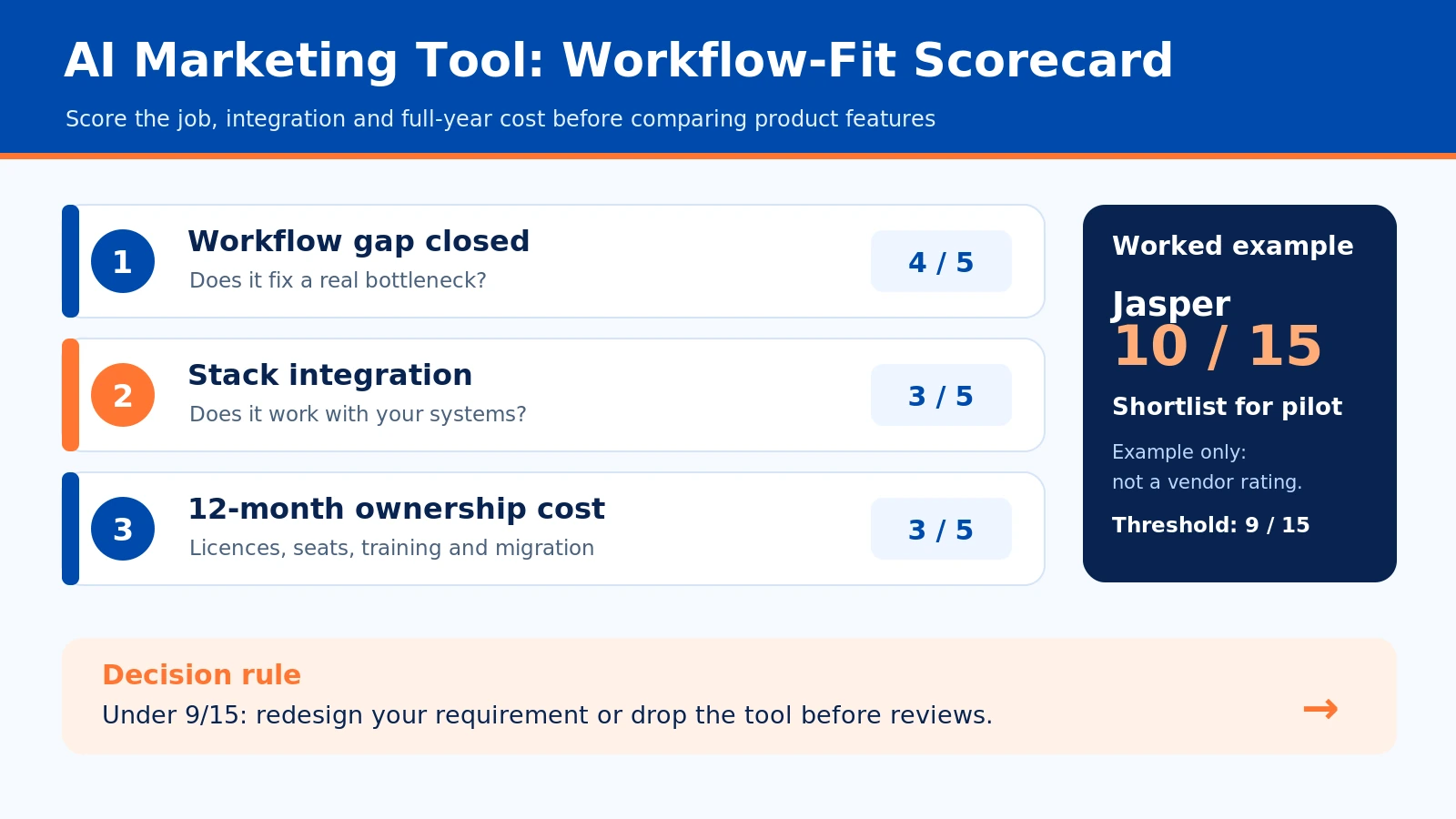
This guide recommends three criteria, each scored from 1 to 5.
Criterion 1: Workflow gap closed
1: Little meaningful improvement.
2: Helps with a small part of the workflow.
3: Addresses an important task but still requires substantial manual work.
4: Removes a major bottleneck with manageable review.
5: Reliably resolves the core workflow problem and produces a usable result.
Criterion 2: Integration with your existing stack
1: Mostly disconnected; substantial manual transfers.
2: Limited integration or significant custom work.
3: Acceptable integration, with some manual handoffs.
4: Strong integration with most essential systems.
5: Fits the operating workflow with reliable data exchange and appropriate controls.
Criterion 3: Twelve-month total cost of ownership
This score evaluates value rather than absolute cheapness.
1: Poor value relative to expected benefit.
2: High cost for limited improvement.
3: Reasonable cost for the expected workload.
4: Attractive cost relative to measurable value.
5: Strong cost efficiency with a credible, sustainable business case.
How to calculate the score
Total score = Workflow fit + Integration + Cost efficiency
The maximum is 15 points.
| Total | Suggested decision |
|---|---|
| 12–15 | Strong candidate for a pilot |
| 9–11 | Shortlist if the use case and constraints justify it |
| 6–8 | Redesign the use case or consider alternatives. |
| 3–5 | Generally poor fit |
The 9-point threshold is a screening heuristic created for this guide. It is not a validated industry benchmark.
Security, privacy and essential compliance requirements are mandatory gates. A tool that fails these should not proceed simply because it scores well on the other dimensions.
Worked example: Comparing three AI content tools
Scores are hypothetical assessments for a particular team’s needs, not independent product ratings.
A Singapore marketing department needs to produce eight well-researched articles monthly while maintaining a consistent brand voice.
| Candidate | Workflow fit | Integration | Cost efficiency | Total |
|---|---|---|---|---|
| Tool A | 5 | 4 | 3 | 12/15 |
| Tool B | 4 | 3 | 5 | 12/15 |
| Tool C | 3 | 3 | 2 | 8/15 |
Tool A provides stronger workflow capabilities.
Tool B is cheaper, although it requires slightly more manual work.
Tool C falls below the shortlist threshold.
The two leading candidates move into a controlled pilot.
The team should not automatically select Tool A simply because it has more advanced features, nor Tool B simply because it is cheaper.
The pilot should determine which tool delivers the lowest acceptable cost per approved article while meeting the team’s quality standards.
Why scoring should happen before product reviews
Reviews can help identify recurring problems, but they are often written by businesses with different needs.
An application praised for easy content generation may be unsuitable for an agency needing client-specific workspaces and export controls.
A system criticised for being expensive may be cost-effective for an organisation using its enterprise features at scale.
Score the workflow fit first. Then use reviews to investigate risks uncovered during that evaluation.
Pricing, Pros, Cons and Reviews for Each Tool Category
Pricing models and how to budget for a pilot
AI marketing platforms typically use one or more of four pricing approaches.
| Pricing model | How it works | Main risk |
|---|---|---|
| Per-user subscription | Fixed monthly or annual charge for each user | Costs rise as teams expand |
| Usage-based credits | Charges depend on generation or processing consumption | Difficult-to-predict bills |
| Tiered subscription | Advanced capabilities unlock at higher tiers | Important features may require upgrades |
| Custom enterprise pricing | Negotiated according to deployment and requirements | Limited price transparency and implementation costs |
For example, Jasper currently advertises a Pro subscription starting at US$69 per seat per month on monthly billing, while its Business tier uses custom pricing. Copy.ai publishes different pricing structures for chat usage and more advanced workflow automation. These figures are indicative and should be checked when purchasing.
Calculating the actual cost of an AI marketing tool
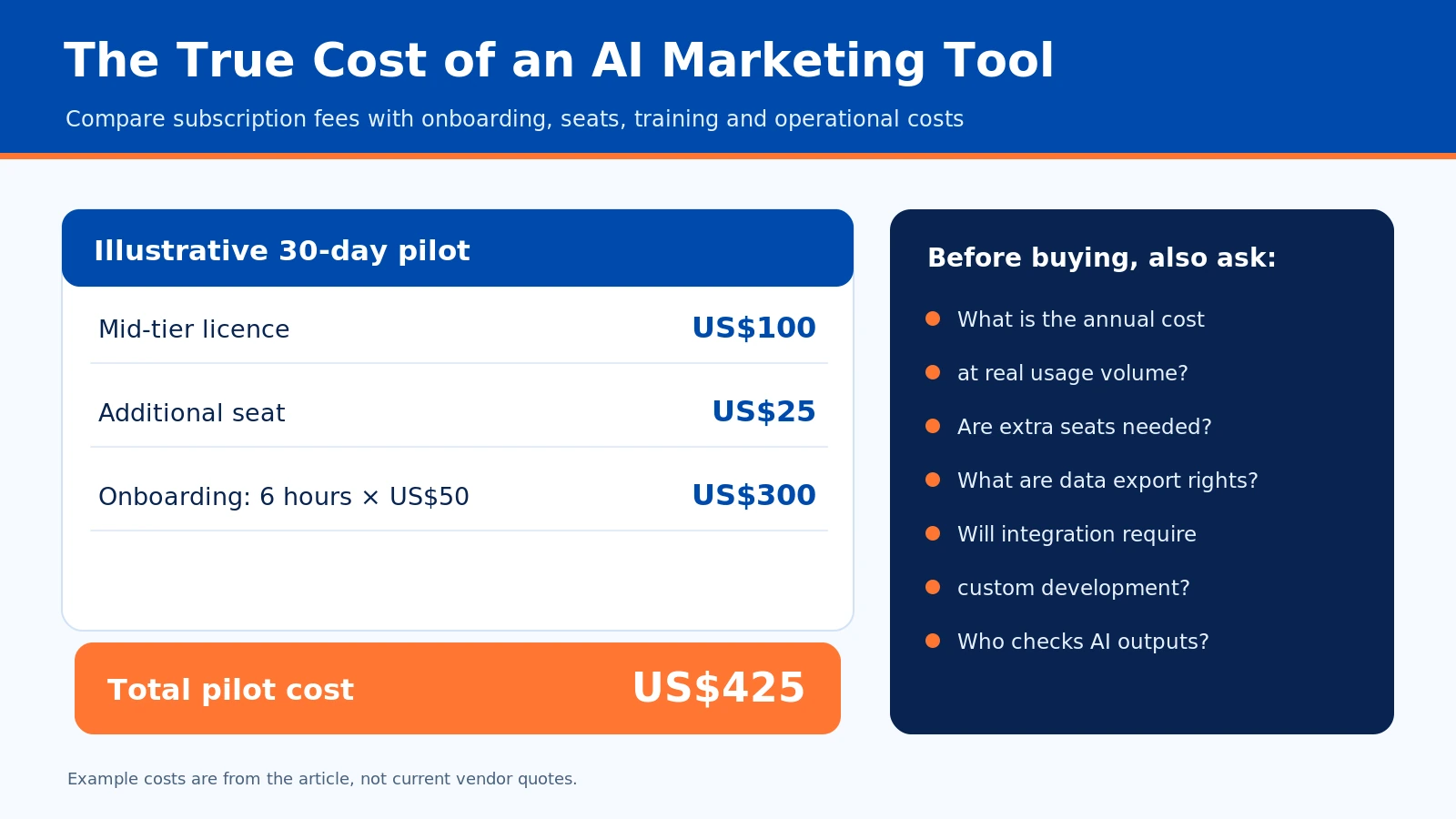
A three-person marketing team evaluates an AI writing application.
The vendor charges US$100 monthly for the relevant plan, plus US$25 for an extra seat.
The team expects to spend six hours setting up the system, valued at US$50 per hour.
| Cost component | First month |
|---|---|
| Licence | US$100 |
| Additional seat | US$25 |
| Onboarding: 6 × US$50 | US$300 |
| Total first-month cost | US$425 |
Now consider the full year.
The recurring subscription costs US$125 monthly, equivalent to US$1,500 annually.
Adding the initial US$300 onboarding cost gives a first-year ownership cost of US$1,800, before additional training, integrations or ongoing administration.
A business that compares only the US$100 advertised price is understating the real commitment.
Cost per approved output: A more useful calculation
Suppose the team produces 20 articles monthly.
Before adopting AI, each article requires six hours to research, draft, edit and approve.
After adopting the tool, each article requires four hours, including AI prompting, review, fact-checking and final editing.
Assume an internal loaded labour cost of S$50 per hour and a hypothetical AI subscription of S$200 monthly.
| Measure | Before AI | After AI |
|---|---|---|
| Articles approved monthly | 20 | 20 |
| Hours per article | 6 | 4 |
| Total labour hours | 120 | 80 |
| Labour cost | S$6,000 | S$4,000 |
| AI subscription | S$0 | S$200 |
| Total monthly cost | S$6,000 | S$4,200 |
| Cost per approved article | S$300 | S$210 |
The AI-assisted workflow saves an illustrative S$1,800 monthly, or 30% of the previous operating cost.
But this calculation makes two important assumptions.
First, article quality has not deteriorated.
Second, the twenty articles are all approved and useful.
If the AI-assisted workflow produces lower-quality content that requires additional corrections later, the economics change.
If the company does not actually reduce expenditure or redeploy the 40 hours into productive work, the S$2,000 labour reduction represents capacity released rather than guaranteed cash savings.
Measuring whether an AI marketing tool delivers ROI
For a simple productivity workflow, use:
Net benefit = Realised cost savings + incremental contribution − total AI ownership cost
Then:
ROI (%) = Net benefit ÷ total AI ownership cost × 100
Avoid counting the subscription twice when calculating net benefit.
For example, suppose an AI tool produces S$9,600 in documented annual labour savings and incremental contribution, while its first-year ownership cost is S$2,400.
Net benefit = S$9,600 − S$2,400 = S$7,200.
ROI = S$7,200 ÷ S$2,400 × 100 = 300%.
This is a hypothetical illustration, not a typical return or vendor guarantee.
For paid advertising, use campaign contribution rather than assuming that every AI-generated lead represents revenue.
Pros, cons and buyer reviews by category
| Category | Main advantage | Main limitation | Buyer should verify |
|---|---|---|---|
| Content generation | Faster drafting and variation | Factual errors and generic output | Editorial time and final quality |
| Content optimisation | Better structured research and topic coverage | Proprietary scores are not rankings | Search performance and content usefulness |
| SEO intelligence | Competitor and keyword research | Database differences and estimated metrics | Data coverage for target markets |
| AI visibility | New information about generated answers | Prompt and model variability | Measurement methodology |
| CRM automation | Faster customer follow-up | Errors can affect real customers | Lead quality and routing accuracy |
| Visual generation | Faster creative variations | Brand consistency and editing effort | Final asset acceptance |
| Paid-media automation | Optimisation at campaign scale | Dependence on conversion signals | Qualified conversions and profitability |
When reviewing software, look for patterns in independent customer feedback rather than isolated praise.
Useful questions include whether customers report repeated integration problems, unexpected charges, difficult cancellation processes, inaccurate outputs or poor support.
Where possible, request a reference from a business of comparable size and with a similar workflow.
Five questions to ask every vendor before signing
- Can you show the exact workflow using our own example data? Avoid accepting a generic demonstration as proof.
- What is the complete first-year cost? Include seats, credits, support, onboarding and integrations.
- Who owns our data, outputs and workflows? Confirm export rights and any relevant intellectual-property terms.
- What happens if we cancel? Ask about data retention, access termination and migration assistance.
- Can we conduct a limited pilot with agreed success criteria? Make the commercial commitment conditional on meaningful evidence where possible.
Running a Pilot Before a Full Purchase
A pilot should answer a specific business question.
“Does this AI tool improve our marketing?” is too broad.
A stronger question is:
“Can this tool reduce the time needed to produce an approved SEO article from six hours to four without increasing factual errors or reducing content quality?”
That gives the team something measurable.
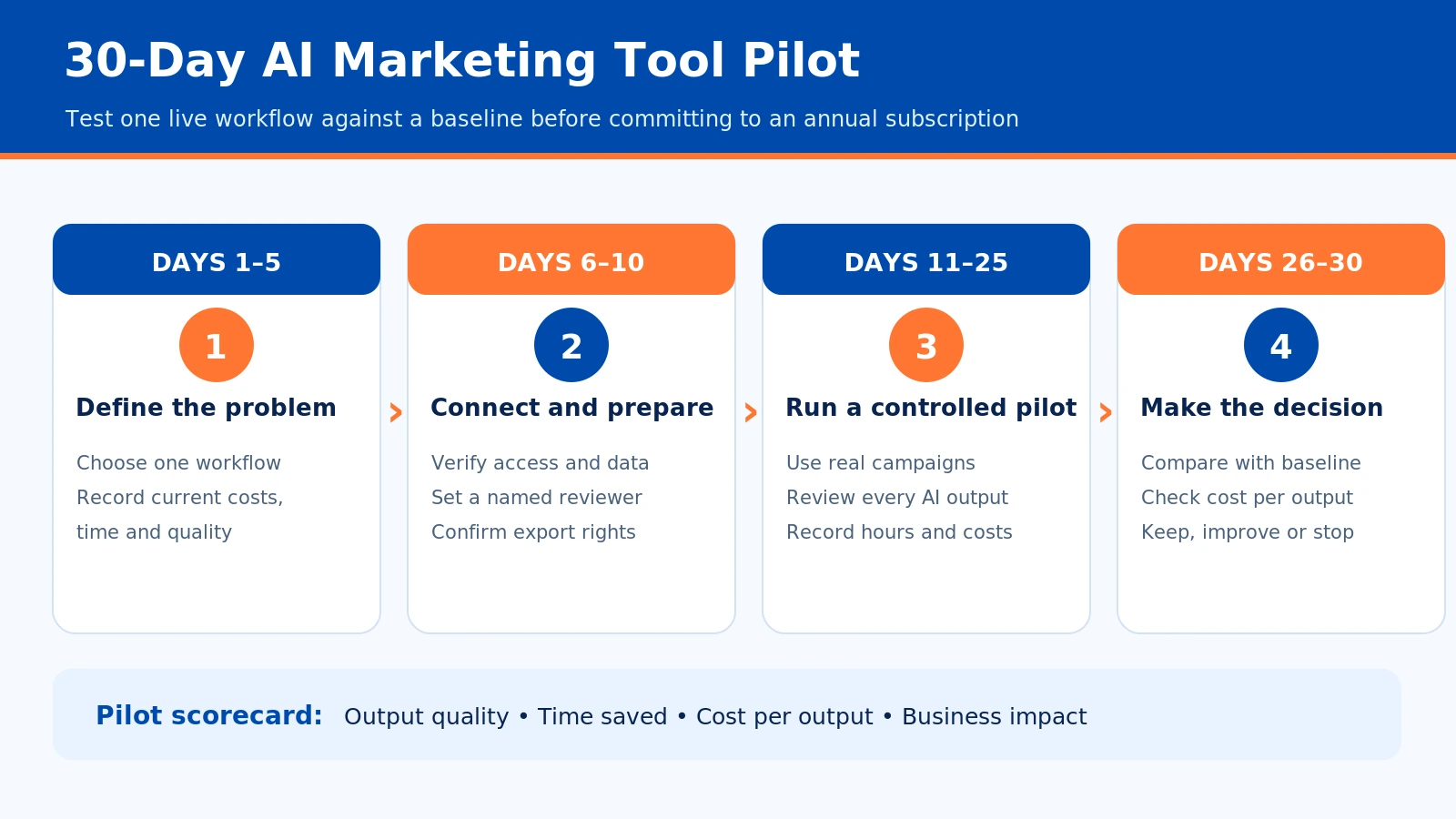
The 30-day AI marketing tool pilot framework
Days 1–5: Establish the baseline
Choose one workflow.
Document the current performance using recent, representative work.
For content, record drafting time, editing time, approval rates and output quality.
For customer service, record first-response time, resolution time and relevant customer outcomes.
For reporting, record hours spent producing reports and the frequency of reconciliation errors.
Set a minimum success threshold before beginning the test.
Days 6–10: Configure the tool
Load approved brand guidelines, relevant non-sensitive reference information and workflow requirements.
Connect only the systems necessary for the pilot.
Assign an owner and ensure access permissions are appropriate.
Train the participating employees on the approved process.
Do not let the pilot expand into unrelated activities just because the tool offers additional features.
Days 11–25: Run real work
Use the application with a limited set of actual marketing tasks.
Where practical, compare similar tasks under the previous workflow and the AI-assisted workflow.
Control for differences in task complexity.
For example, comparing an AI-generated short product description against a manually written technical research article would not provide meaningful evidence.
Record failures as carefully as successes.
Days 26–30: Evaluate and decide
Compare the results with the baseline and agreed thresholds.
Classify the outcome as:
Scale: The tool has delivered measurable improvement and passed quality and governance requirements.
Revise: The tool shows promise but needs configuration, better data or workflow changes.
Stop: The benefit does not justify cost, risk or operational complexity.
Worked pilot example: AI-assisted Google Ads reporting
Illustrative scenario.
A Singapore agency spends approximately 10 hours weekly preparing and reviewing campaign reports for a group of clients.
It is considering an AI reporting assistant.
The pilot compares the current workflow with an AI-assisted process across the same reporting requirements.
| Metric | Current workflow | AI pilot target |
|---|---|---|
| Weekly reporting hours | 10 | 6 |
| Material numerical discrepancies | 0 | 0 |
| Reports delivered on schedule | 100% | 100% |
| Human reviewer | Required | Required |
| Client-specific commentary | Manual | AI draft, human approved |
The agency should not accept a four-hour saving if the tool introduces discrepancies between Google Ads, GA4 and the client’s CRM.
Numerical accuracy is a non-negotiable requirement.
The pilot must also test whether the generated commentary is genuinely useful. Statements such as “clicks increased, indicating improved engagement” offer little value without explaining what changed, why it may have changed and what action is recommended.
A better report identifies meaningful developments such as rising cost per qualified lead, declining conversion rates, or campaign spend being directed toward underperforming segments.
Worked pilot example: AI-assisted lead follow-up
Illustrative scenario.
A B2B company receives 150 enquiries monthly.
Sales staff struggle to respond promptly and consistently.
An AI-assisted workflow drafts a tailored response based on the product requested and routes the lead to the relevant salesperson.
The pilot measures:
- Median response time
- Correct lead routing
- Qualified meeting rate
- Incorrect or misleading messages
- Manual correction time
- Customer complaints
- Sales acceptance of generated responses
Suppose response time falls from eight hours to one hour, but the number of qualified meetings remains unchanged.
The tool may still deliver operational value, but the evidence does not yet support a claim of increased revenue.
The next investigation should identify whether faster replies improve customer satisfaction, reduce lost enquiries or free sales staff for higher-value work.
Why paid-media pilots may need more than 30 days
Not every marketing application can be assessed reliably within one month.
For campaign automation, results depend on conversion volume, learning periods, seasonality, changes in competition and attribution quality.
A low-volume lead generation campaign may not produce enough data in 30 days to distinguish real improvement from ordinary variation.
For example, Google recommends allowing Performance Max campaigns at least six weeks to ramp up and generate meaningful evaluation data.
For these cases, use the first 30 days for setup validation, tracking checks and initial diagnostics, then assess performance over a longer, suitable period.
When an AI tool should fail the pilot
Stop or redesign the pilot if the tool:
- Generates repeated material factual errors.
- Cannot meet mandatory security or privacy requirements.
- Creates unacceptable customer-facing mistakes.
- Produces unreliable analytics.
- Requires more human effort than it saves.
- Cannot export essential data.
- Makes changes outside its approved authority.
- Fails to deliver meaningful improvement at a sustainable cost.
A failed pilot can still be valuable if it prevents a much larger commitment.
Governance of AI-Generated Output
AI marketing governance is not simply a legal or IT responsibility.
It is part of marketing quality control.
Incorrect product claims, misleading advertisements, poor customer data handling and unauthorised automated changes can directly affect brand reputation and financial performance.
A business should therefore establish a practical review system before expanding AI usage.
The five-stage AI marketing approval process
Stage 1: Approved inputs
Use current product information, authorised data sources, approved marketing claims and documented audience definitions.
Stage 2: AI generation or recommendation
Allow the tool to produce drafts, insights or proposed actions within a defined scope.
Stage 3: Verification
Check factual accuracy, pricing, source reliability, brand consistency and relevant platform requirements.
Stage 4: Human approval
Assign a named reviewer with appropriate authority.
Stage 5: Publication and monitoring
Publish or implement the approved output, then monitor performance and errors.
A practical responsibility matrix
| Activity | AI may assist with | Human accountability |
|---|---|---|
| Blog writing | Outlines, drafting, editing | Accuracy, originality and publication |
| Paid advertising | Creative variants and optimisation suggestions | Budget, conversion quality and compliance |
| Customer email | Personalisation and draft responses | Data protection, offer accuracy and approval |
| SEO analysis | Pattern detection and recommendations | Technical diagnosis and prioritisation |
| Reporting | Summaries and anomaly detection | Metric definitions and reconciliation |
| Visual creation | Images and design variations | Brand consistency and usage rights |
Automation may handle low-risk routine tasks within approved rules. Higher-risk actions, such as changing substantial campaign budgets or sending sensitive customer communications, should have stronger controls.
Singapore PDPA considerations
Singapore businesses should assess how the Personal Data Protection Act applies to their use of customer information in AI systems.
The Personal Data Protection Commission’s 2026 advisory guidance addresses personal-data use in generative AI, responsibilities among system providers and deployers, and safeguards throughout the AI lifecycle.
Before providing customer information to an external AI application, establish:
- What personal data is required.
- The purpose for which it will be processed.
- Whether that processing is permitted under the applicable legal basis.
- Whether information can be anonymised or minimised.
- Who can access the data.
- Where data is processed and retained.
- What happens when the subscription ends.
- How the vendor handles relevant access, correction and deletion obligations.
For example, a marketing team should not casually upload an entire customer database containing names, phone numbers and transaction histories into a new tool merely to generate audience personas.
Aggregated or properly anonymised information may be sufficient for many research and planning tasks.
Where personal data is genuinely necessary, use an approved system with appropriate safeguards.
What about business-focused AI workspaces?
Some providers offer products with stronger business-data protections than their general consumer applications.
For example, OpenAI states that its business products and API platform do not use organisational inputs or outputs for model training by default, with additional security and retention arrangements depending on the product and plan.
This illustrates why organisations should compare the terms of the actual product they intend to use, rather than assume every application from the same provider handles data identically.
AI-generated SEO content: Quality before quantity
A common marketing mistake is using AI primarily to multiply content production.
Publishing hundreds of articles is not a meaningful objective if the pages repeat existing information, contain weak evidence or fail to answer users’ questions.
Google’s published guidance warns that generating many pages primarily to manipulate rankings, without adding meaningful value, may violate its scaled-content-abuse policy.
A more effective process is to use AI for supporting tasks while adding material that demonstrates genuine expertise.
That includes original research, tested examples, specialist commentary, relevant case studies and documented solutions.
For an agency, this may mean publishing an actual technical diagnosis, explaining how an SEO issue was resolved, and showing verified outcomes rather than producing another generic explanation of technical SEO.
AI should increase the team’s capacity to publish useful information, not merely increase the number of pages published.
A governance case study: The wrong lead form
Illustrative operational scenario.
A marketing team launches a campaign using the wrong lead-generation form.
The submissions enter an unrelated sales workflow.
An AI assistant monitoring campaign performance may report that the campaign is generating leads, while the business is actually collecting enquiries in the wrong location.
This is not primarily an AI capability failure. It is a campaign quality assurance failure.
Proper safeguards include confirming the correct form, making a test submission, verifying CRM routing, checking notifications, and reviewing the live campaign after launch.
Automation can support these checks, but it should not replace them.
The lesson is that AI amplifies the quality of the processes surrounding it. When those processes are weak, automation can simply make mistakes faster.
Summary Comparison: 15 Named AI Marketing Tools
The following comparison provides a practical starting point for buyers.
It focuses on use cases and limitations instead of assigning unsupported universal rankings.
Prices, features, integrations and subscription structures can change. Confirm current details directly with each vendor.
| Tool | Main category | Best suited to | What to test before buying |
|---|---|---|---|
| Jasper | AI content platform | Repeatable branded content production | Brand voice, factual accuracy, editing effort |
| Copy.ai | AI writing and workflows | Marketing and sales workflow automation | Integrations, workflow credits, repeatability |
| Grammarly | Writing assistance | Editing and tone consistency | Editing time, supported applications |
| Writer | Enterprise AI content | Centralised brand and writing governance | Permissions, implementation, controls |
| Surfer | SEO content optimisation | Existing-page and draft optimisation | Topic guidance, workflow impact |
| Ahrefs | SEO intelligence | Backlinks, keywords and competitor analysis | Data coverage and export options |
| Semrush | SEO and AI visibility | Broad search marketing research | Keyword coverage, integration and visibility methodology |
| Clearscope | Content optimisation | Topic completeness and editorial analysis | Relevance of recommendations |
| Perplexity | AI-assisted research | Source discovery and manual answer checking | Citation reliability and answer consistency |
| Profound | AI visibility intelligence | AI answer monitoring | Prompt coverage, methodology and repeatability |
| HubSpot | CRM and automation | Lead management and customer journeys | CRM data quality, workflow and reporting |
| Hootsuite | Social media management | Scheduling, approvals and monitoring | Supported channels, team workflows |
| Canva | Visual production | Branded social and campaign assets | Template control, final design quality |
| Adobe Firefly | Generative creative | Image creation and creative workflows | Editing, rights and brand consistency |
| Meta Advantage+ | Paid-media automation | Meta advertising optimisation | Conversion quality, campaign controls and ROI |
Which tools should a small Singapore business buy first?
For a small team, the preferred order is generally:
First: Measure the existing marketing operation.
Ensure analytics, conversions and lead records are reliable.
Second: Identify the most expensive repeated workflow.
Examples include reporting, producing approved content, qualifying enquiries or coordinating campaigns.
Third: Evaluate existing software capabilities.
Check whether tools already in use include the required functionality.
Fourth: Pilot one additional application.
Avoid buying a complete stack before understanding which use cases deliver value.
Fifth: Expand only when results justify expansion.
A growing company can add tools as its processes and requirements become more complex.
Which tools should a digital marketing agency prioritise?
Agencies have additional requirements because they manage multiple clients, different brand guidelines, confidential data and separate approval processes.
Prioritise applications that support:
- Client-level access controls.
- Reusable workflows without mixing client information.
- Search and advertising account integrations.
- Reliable technical and analytical data.
- Human review and approval.
- Historical records and version tracking.
- Exportable reports and deliverables.
- Usage tracking and cost allocation.
- Scalable operations across multiple accounts.
A useful agency application should make client delivery more reliable and measurable, not just help employees generate content faster.
Frequently Asked Questions
Are AI digital marketing tools worth the cost for a small business?
They can be, as long as they solve a measurable business problem.
A small business that saves ten productive hours monthly through a modest subscription may see meaningful value. Another company could buy an expensive platform and use only a small fraction of its features.
Calculate total ownership cost, quantify actual time savings or incremental contribution, and verify final work quality.
Which AI marketing tool should I start with?
Start with the workflow that creates the greatest operational or commercial difficulty.
If content production is slow, evaluate writing or optimisation tools. If leads are poorly managed, fix the CRM and evaluate automation. If search visibility is weak, prioritise research and technical analysis.
Do not buy software without a specific use case.
Is ChatGPT enough for digital marketing?
A general-purpose AI assistant can help with brainstorming, research, drafting, analysis and planning.
It may be sufficient for many small teams.
Specialist applications become useful when the business needs dedicated search datasets, structured campaign workflows, complex integrations, brand governance or repeatable reporting.
Compare the actual task before adding a subscription.
How many AI tools should a marketing department use?
There is no ideal number.
A small team may operate effectively with a general-purpose AI tool, existing marketing platforms and one or two specialist applications.
A large agency or enterprise may need more sophisticated systems.
The objective is to avoid duplicated functionality and disconnected information.
How do I know whether an AI tool is genuinely AI-powered?
Ask the vendor what model or method supports the feature.
Determine whether it uses generative AI, predictive machine learning, conventional rules or a combination.
The label matters less than whether the capability performs the required task reliably.
How should I measure AI marketing ROI?
For productivity tools, measure verified time savings and realised cost reduction, less ownership costs.
For revenue-producing applications, measure incremental contribution attributable to the improvement, after relevant marketing and delivery expenses.
Use an appropriate baseline or controlled comparison where practical.
Avoid treating generated content volume, impressions or raw leads as proof of financial return.
Should I choose an all-in-one platform or specialist tools?
An integrated platform can simplify billing, data management and workflows.
A specialist tool may perform one important task more effectively.
For many businesses, the practical balance is an integrated core platform supplemented by a small number of specialist tools that deliver demonstrable additional value.
Can AI tools replace SEO specialists?
AI can automate parts of research, drafting, analysis and reporting.
It cannot independently guarantee sound technical diagnosis, original expertise, successful implementation or business outcomes.
Experienced SEO professionals still need to interpret evidence, prioritise work, validate recommendations and coordinate implementation.
The more complex the website, the more important these responsibilities become.
Can AI-generated content rank on Google?
Yes, AI assistance does not automatically disqualify content from ranking.
The important questions are whether the resulting page is useful, original, accurate, trustworthy and created to serve readers rather than manipulate search rankings.
Publishing large volumes of weak, repetitive content creates risks regardless of how it was produced.
Do AI-generated advertisements require human review?
Human review is strongly recommended, particularly for factual claims, regulated products, pricing, guarantees and brand-sensitive material.
Automated advertising platforms may also generate or combine creative assets in ways that require suitable campaign controls and monitoring.
How long should an AI marketing pilot last?
Thirty days is a reasonable initial period for workflows such as drafting, editing or reporting.
Campaign optimisation, lead generation and other activities with long feedback cycles may require more time.
The appropriate test duration depends on volume, variability and the business outcome being evaluated.
Can I upload customer databases into AI tools?
Not without assessing the relevant legal, contractual, security and privacy requirements.
For Singapore businesses, that includes applicable PDPA obligations and the safeguards offered by the specific provider.
Use data minimisation and anonymisation where possible. Obtain appropriate internal approval before transferring sensitive business or personal information.
What happens if I cancel an AI marketing subscription?
The consequences depend on the vendor’s terms.
Before purchasing, confirm whether you can export generated assets, datasets, workflows, prompt libraries, reports and campaign history.
Check how long the vendor retains information after cancellation and whether continuing access requires a paid plan.
How often should I review my AI marketing stack?
Review costs and usage at least quarterly.
A broader annual assessment should examine whether the tools still support the team’s strategy, whether capabilities overlap and whether better alternatives have emerged.
Also review a platform when its pricing, data practices or major product capabilities change.
Conclusion: Build a Better Marketing Operation, Not a Bigger AI Stack
AI tools for digital marketing can improve productivity, analysis and campaign execution, but the real advantage comes from applying them to the right problems.
Start with the workflow.
Identify where the team loses time, spends unnecessarily, or fails to generate useful business outcomes.
Evaluate candidate tools on workflow fit, integration and twelve-month cost. Use the 15-point scorecard to narrow the options, then test shortlisted applications with real work.
Measure final deliverables rather than generated drafts. Check qualified leads rather than raw enquiries. Evaluate contribution rather than attributing every sale to AI.
Just as importantly, keep people accountable for accuracy, brand standards, customer information and consequential decisions.
At MediaOne, we connect strategy, technology, analytics and performance rather than treating individual tools as the solution.
Our work spans SEO, paid search, social media, content, conversion optimisation and AI search visibility. The objective is to select the right capabilities for each business, integrate them into measurable workflows and keep improving the results.
Our AI-powered marketing technology, Digimetrics, reflects this broader approach, bringing together SEO research, technical analysis, keyword intelligence, and emerging AI search visibility capabilities in a connected workflow.
Businesses evaluating marketing technology should apply the same scrutiny to every platform, including ours: test the capabilities, validate the data and establish whether the results justify the investment.
The best AI marketing stack is not the one that generates the most content or automates the most tasks. It is the one that helps your marketing team make better decisions, deliver stronger work and produce measurable business results.