Branding is often treated as a marketing expense. Under the Enterprise Development Grant (EDG), it is positioned differently. It is viewed as a strategic transformation project that strengthens long-term competitiveness.

If you are serious about scaling your business in Singapore, branding is no longer optional. It is infrastructure. And if you want government support to do it properly, the EDG should be on your radar from day one.
Administered by Enterprise Singapore, the EDG supports Singapore companies undertaking projects to upgrade, innovate, or internationalise. According to Enterprise Singapore, EDG supports projects under three pillars and co-funds up to 50 percent of qualifying project costs for SMEs.
Branding qualifies because it falls under capability building and long-term business transformation, not short-term promotion.
This guide is for SME owners, founders in areas such as Jurong or Paya Lebar, and marketing leaders who are preparing to invest five or six figures in brand work and want to reduce risk. You will learn what EDG actually covers, how much you can realistically claim in SGD, how to structure your case, and what causes rejection.
If you’re exploring professional support from a team that understands both strategy and grant positioning, we also help businesses in Singapore seeking branding agency services to structure EDG-ready proposals.
Key Takeaways
- The Enterprise Development Grant (EDG) supports strategic branding projects that build long-term capability, not short-term marketing campaigns.
- To qualify, your branding proposal must address a defined business problem and show measurable commercial impact.
- EDG co-funds up to 50 percent of qualifying costs for SMEs, but you must plan cash flow carefully due to reimbursement mechanics.
- Strong applications align branding with transformation objectives, credible financial projections, and clear deliverables.
What Is the Enterprise Development Grant (EDG)?
The Enterprise Development Grant (EDG) is a co-funding scheme managed by Enterprise Singapore that supports projects to upgrade business capabilities, drive innovation, and expand overseas. It is not a marketing subsidy. It is a transformation grant. According to Enterprise Singapore, EDG supports projects under three pillars:
| Pillar | Focus | Relevance to Branding |
| Core Capabilities |
|
|
| Innovation & Productivity |
|
|
| Market Access |
|
|
Branding projects typically fall under Core Capabilities, specifically strategy development. That distinction matters. If your proposal reads like a social media campaign, it will not survive scrutiny.
How the Enterprise Development Grant (EDG) Supports Branding Projects
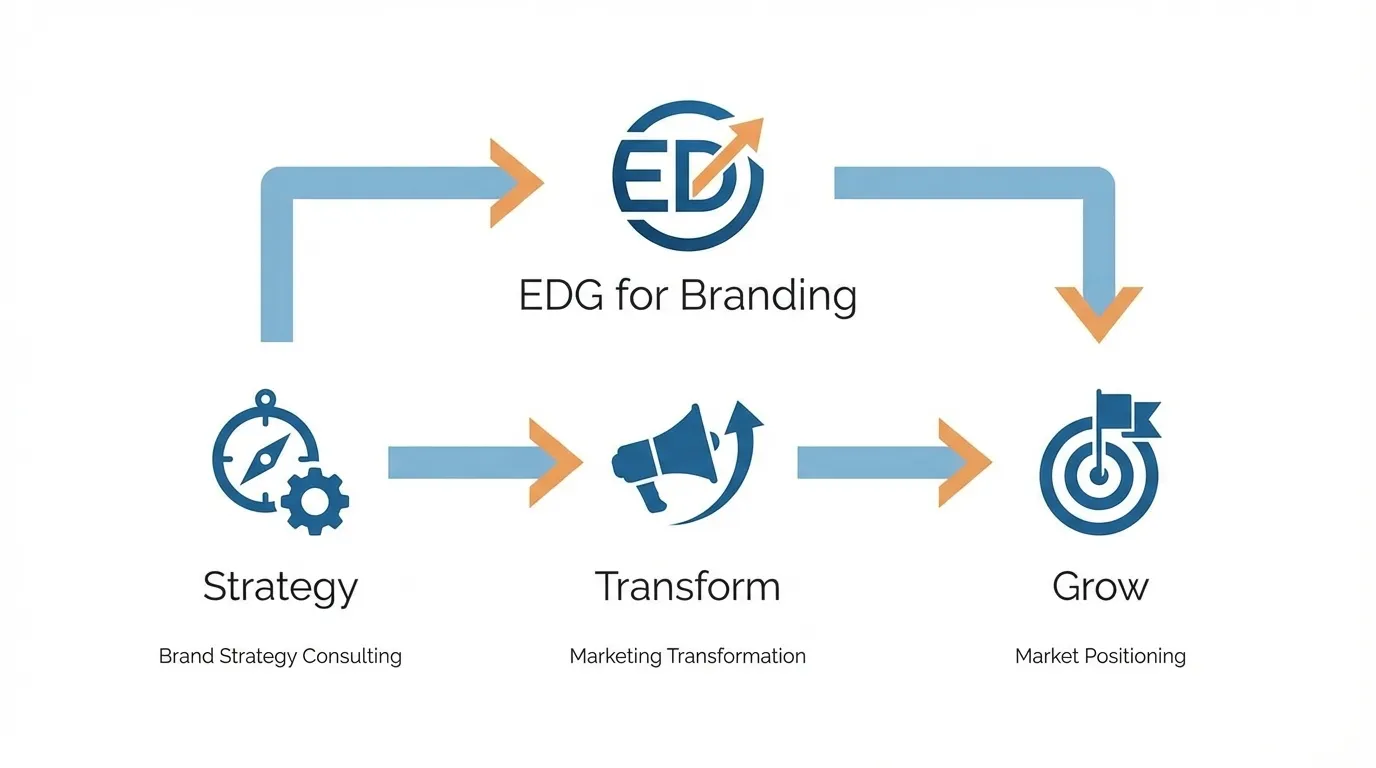
If you approach branding as a cosmetic exercise, you will struggle to justify it under the Enterprise Development Grant. If you approach branding as a capability upgrade that strengthens how your business competes, scales, and commands margin, you are speaking the language that Enterprise Singapore expects.
Enterprise Singapore states that the Enterprise Development Grant supports projects that help businesses build core capabilities and achieve sustainable growth. That is the key phrase. Sustainable growth.
Branding, when done properly, is not a marketing expense. It is a strategic investment that reshapes how your company positions itself in the market, prices, and expands locally or overseas.
You need to understand the structural difference here:
- Marketing is campaign-driven. It aims to generate traffic, leads, and short-term revenue.
- Branding is architecture-driven. It defines your market position, competitive advantage, narrative, and customer perception over time.
The Enterprise Development Grant supports the second category because it builds internal capability and long-term differentiation.
What Qualifies as a Branding Project Under EDG?
When reviewers assess your proposal, they are looking for transformation, not tactics. They want to see that your business will operate differently after the project concludes.
Branding initiatives that typically align with EDG objectives include:
- Brand strategy development: A structured review of market positioning, competitive landscape, customer segments, and value proposition. This often results in a strategic blueprint that guides future business decisions.
- Brand positioning and architecture: Clarifying how your products, sub-brands, or services are organised and differentiated. This is particularly relevant for companies expanding into new verticals or regions.
- Visual identity redesign: When supported by a strategic rationale. A redesign tied to repositioning, market expansion, or business restructuring is different from a surface-level refresh.
- Brand messaging framework: Development of a coherent narrative across channels, including value propositions, tone of voice, and core messaging pillars.
- Corporate rebranding during restructuring: Mergers, acquisitions, leadership changes, or strategic pivots often require brand transformation to reflect a new direction.
- Customer experience alignment across touchpoints: Mapping and refining how customers interact with your brand across digital, retail, and service environments to ensure consistency and differentiation.
In each case, the common thread is capability building. After the project, your organisation should have clearer positioning, documented brand systems, and internal processes that support consistent execution.
What EDG Does Not Typically Cover
It is just as important to understand what falls outside the scope. If your proposal leans heavily in this direction, it risks rejection.
Projects that are generally considered operational marketing activities include:
- Paid advertising campaigns
- Influencer partnerships
- Ongoing social media management
- Media buying and ad placements
These activities drive traffic and conversions, but they do not fundamentally upgrade your business capabilities. They are executional, not transformational.
When you prepare your case, frame branding as the foundation that improves marketing effectiveness across all channels.
Show how clearer positioning reduces customer acquisition cost, strengthens retention, and enables expansion into markets such as Malaysia or Indonesia. That level of strategic alignment makes your branding project suitable for EDG support.
If you present branding as decoration, it will look discretionary. If you present it as infrastructure, it becomes investment-grade.
A Real Singapore Example: Old Chang Kee

One credible case is Old Chang Kee. The company has undertaken business transformation and international expansion efforts.
Old Chang Kee operates within Singapore’s business grant ecosystem, which supports SMEs in the F&B industry through capability development initiatives. The company expanded to Johor with a manufacturing facility in the Johor-Singapore Special Economic Zone (JS-SEZ).
While the article does not focus solely on branding, it demonstrates how structured transformation and market positioning initiatives can be supported within Singapore’s business grant ecosystem. That is the level of strategic thinking you need.
What Costs Are Typically Covered Under the Enterprise Development Grant (EDG) for Branding?
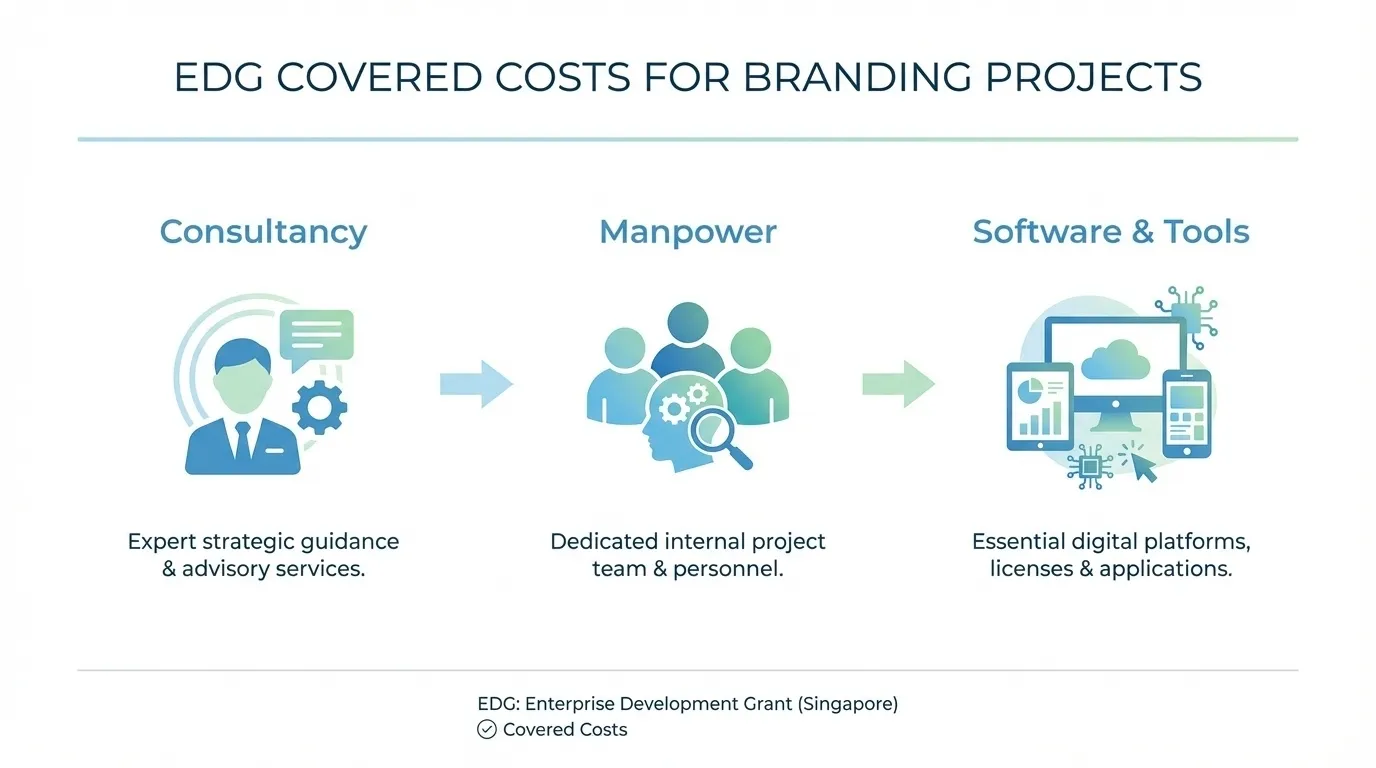
If you are budgeting for a major branding project, this section helps you determine whether your numbers make sense. Understanding what falls inside these categories, and what does not, is where experienced applicants separate themselves from hopeful ones.
Enterprise Development Grant (EDG): Consultancy Fees
For most branding projects, consultancy fees make up the largest and most justifiable portion of the budget.
Enterprise Singapore supports third-party consultancy services that are clearly scoped, outcome-driven, and aligned with business transformation objectives. This means the engagement must be project-based, not an open-ended monthly retainer.
A strong EDG-compliant branding consultancy scope typically includes defined deliverables such as:
- A comprehensive brand strategy report
- Market and competitor analysis
- Brand positioning framework
- Brand architecture model if you operate multiple product lines
- Visual identity system with guidelines
- Brand messaging framework
- Implementation roadmap with governance structure
Notice the pattern: These are strategic outputs. They build capability inside your business. They are not campaign assets.
If your proposal includes deliverables like “10 Instagram posts per month” or “Google Ads management”, that is operational marketing. It will not meet the transformation criteria Enterprise Singapore requires under EDG.
From a positioning standpoint, your consultancy proposal should clearly state:
- The business problem being addressed
- The methodology used
- The strategic outputs delivered
- How these outputs strengthen long-term competitiveness
When reviewers assess consultancy costs, they look for coherence among the problem, scope, and projected impact. If those three elements do not align, funding risk increases.
Enterprise Development Grant (EDG): Internal Manpower Costs
Many businesses overlook this category, yet it can materially affect your funding quantum. Enterprise Singapore allows claims for internal manpower costs directly attributable to the project. This refers to the salaries of employees actively working on the branding transformation, not to their general operational duties.
For example, if your Head of Marketing is dedicating 30 percent of her time over six months to overseeing the brand transformation initiative, that allocated time can potentially be claimable.
However, documentation standards are strict. You must be prepared to provide:
- Detailed time sheets showing hours spent on the project
- CPF contribution records
- Payroll documentation
- Clear role descriptions linked to project deliverables
Enterprise Singapore’s claim guidelines emphasise proper substantiation. If documentation is incomplete or inconsistent, reimbursement can be reduced or rejected.
You also need to be realistic. Inflating manpower allocation without clear evidence is risky. Reviewers assess whether the manpower claimed is proportionate to the project scope.
The strategic takeaway is this: Include manpower costs only if you can justify them clearly and document them thoroughly. Otherwise, you are introducing unnecessary friction into your claim process.
Enterprise Development Grant (EDG): Software and Tools
Software costs can be supported under EDG if they are necessary for implementing the approved project scope.
In branding projects, this may include tools such as:
- Customer journey mapping platforms
- Brand asset management systems
- Research and analytics software tied directly to the transformation project
- Experience design tools used for structured brand implementation
What matters is direct relevance. The software must enable the transformation outcome described in your proposal.
Here is where many applicants misunderstand eligibility: Ongoing SaaS subscriptions that support general business operations, such as everyday CRM tools or standard design software used in daily marketing activities, are unlikely to qualify unless they are clearly integral to the approved transformation initiative.
Enterprise Singapore’s position is consistent. The cost must be necessary, reasonable, and directly attributable to the project.
From a strategic perspective, ask yourself one question before including any software cost:
- If this tool were removed, would the core transformation still be possible?
- If the answer is yes, the cost may be challenged.
How to Think About EDG Cost Coverage Strategically
Do not treat cost coverage as a checklist exercise. Treat it as a narrative. Every dollar in your budget should support a coherent story:
- There is a defined business challenge.
- The branding project addresses it at a strategic level.
- The consultancy delivers structured outputs.
- Internal manpower ensures capability transfer.
- Software enables sustainable implementation.
When those elements are aligned, the cost categories work in your favour. When they are not, even a technically eligible cost can raise red flags.
Approach EDG cost planning with the mindset of an investor reviewing your proposal. Because in many ways, that is exactly what Enterprise Singapore is doing.
Enterprise Development Grant (EDG) Eligibility Criteria for Branding Projects
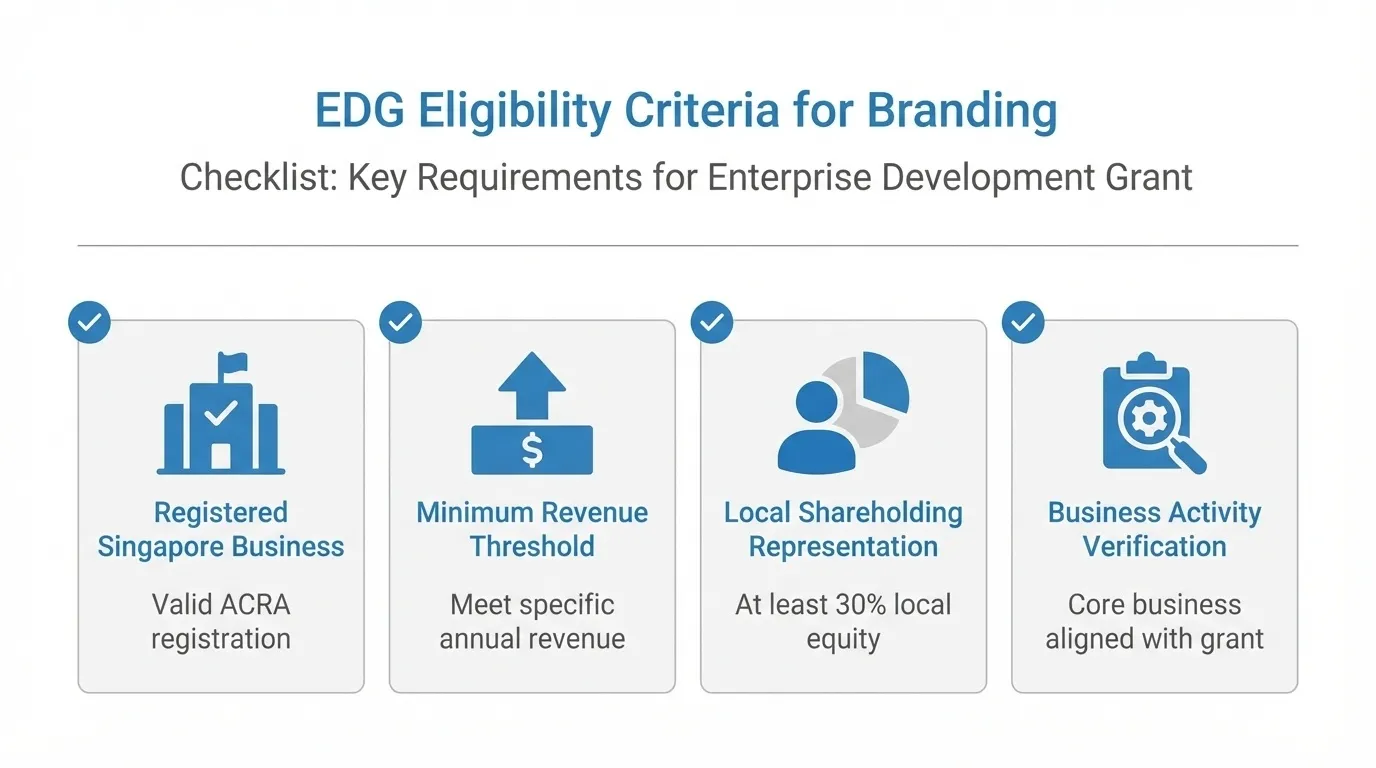
If you are planning to apply for support under the Enterprise Development Grant for a branding project, eligibility is the first gate you must pass. This is not a formality. It is a structured assessment by Enterprise Singapore to determine whether your company has the foundation to benefit from capability upgrading.
According to Enterprise Singapore’s published eligibility criteria, your company must meet the following conditions:
Registered and Operating in Singapore
Your company must be incorporated in Singapore and actively conduct business here. An ACRA profile will be required as part of your submission.
Operating in Singapore does not simply mean having a registered address. Reviewers will look at your business activities, revenue streams, and operational footprint. If you are applying for branding support to expand overseas, that is acceptable, but your core operations must remain anchored locally.
If your company is dormant, recently incorporated with no operational history, or structured primarily as a holding entity, expect additional scrutiny.
Enterprise Singapore requires a minimum of 30 percent local shareholding. “Local” refers to Singapore citizens or permanent residents holding equity in the company.
This threshold matters because EDG is designed to support local enterprise capability building. If your cap table includes foreign investors, that is not automatically disqualifying. What matters is whether local ownership meets the required proportion.
You should verify your shareholding structure before submitting. Any inconsistencies between ACRA records and your application documents will delay processing.
Financial Viability Is Mandatory
Here is where misconceptions often creep in: You do not need to be loss-making to qualify. In fact, the opposite is true. Enterprise Singapore expects applicants to demonstrate financial viability.
Financial viability typically involves:
- Positive or stable revenue trends
- Sufficient cash flow to co-fund the project
- Reasonable balance sheet strength
- No signs of insolvency or severe distress
Because EDG operates on a co-funding and reimbursement basis, you must be able to pay for the project upfront and claim reimbursement later. If your company cannot sustain that temporary outlay, approval becomes unlikely.
This is not a grant for rescue. It is a grant for structured transformation.
If your financial statements show significant losses, negative equity, or cash flow constraints, you will need to clearly justify how the project remains feasible and how the business will sustain operations during the implementation period.
Project Must Start Only After Approval
This requirement is strict. Costs incurred before official approval are generally not claimable. That includes consultant deposits, design work, or internal manpower allocation tied to the project.
From Enterprise Singapore’s perspective, this ensures fairness and accountability. The grant supports future transformation, not retrospective reimbursement.
In practical terms, this means:
- Do not sign binding contracts before approval
- Structure proposals with conditional commencement clauses
- Align internal timelines with grant processing windows
If you proceed prematurely, you assume full financial risk.
Common Misconceptions About EDG Eligibility
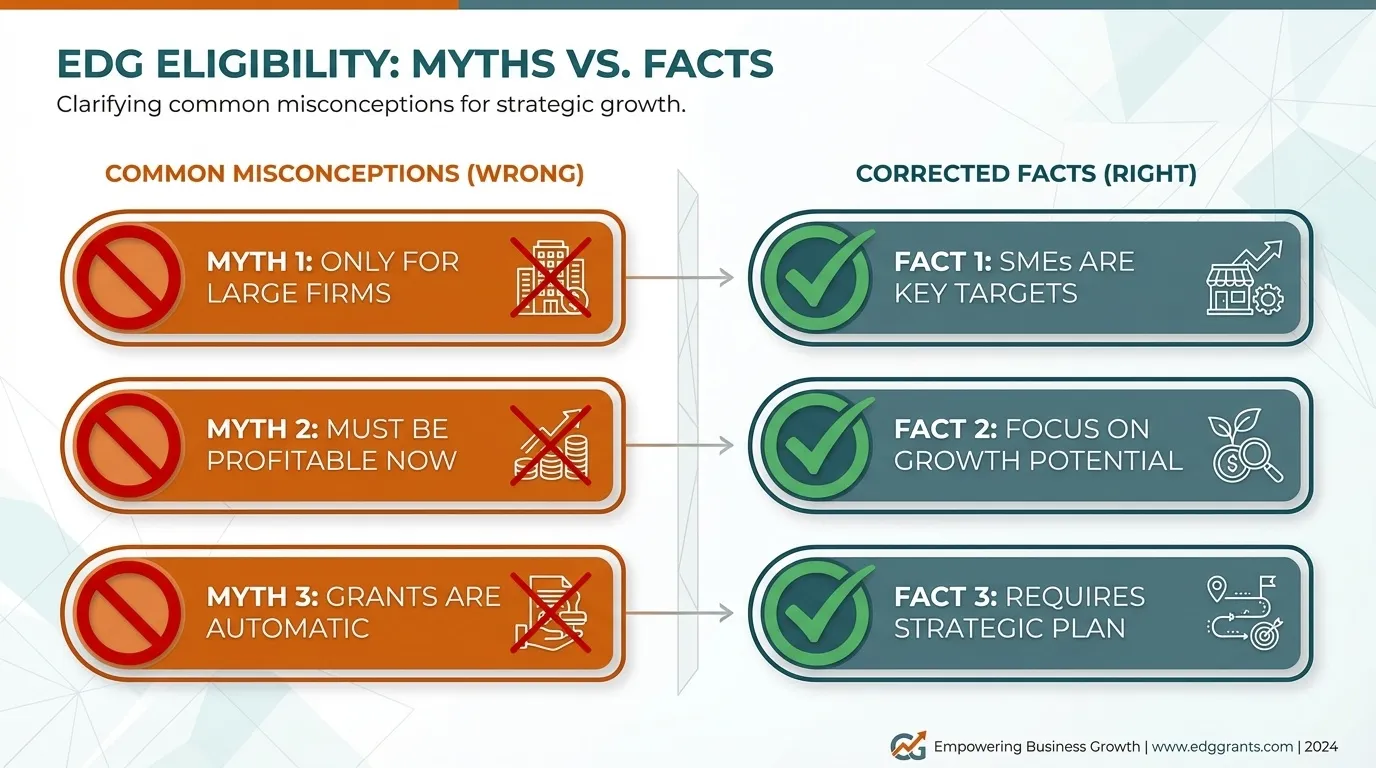
When you advise business owners long enough, you start hearing the same doubts on repeat. Not because people are careless, but because government grants in Singapore often feel opaque from the outside. The Enterprise Development Grant is no exception.
Let us unpack the most common misconceptions we’ve encountered when speaking with SME founders in areas such as Ubi, Kallang, and Jurong East, especially those planning significant brand transformation projects.
Before you even draft your proposal, you need to clear these mental roadblocks:
“We are too profitable to qualify.”
This assumption is surprisingly common. Many founders believe the Enterprise Development Grant is reserved for struggling businesses that need rescue funding. That is not how EDG works.
According to Enterprise Singapore, the grant supports projects that help businesses upgrade, innovate, and internationalise. It focuses on capability development and long-term competitiveness, not on financial distress relief.
If anything, being profitable strengthens your case. It demonstrates financial viability and your ability to co-fund the project. Remember, EDG is a co-funding scheme. You are expected to pay your portion upfront and claim reimbursement later.
If your branding project costs SGD 120,000 and support is capped at 50 percent, you still need to commit SGD 60,000. A company operating at a healthy margin is better positioned to do that.
Profitability does not disqualify you. It signals stability.
“We need to show losses to justify support.”
This belief is not just inaccurate. It can be harmful. Enterprise Singapore explicitly requires companies to be financially viable. That means your financial statements should demonstrate that you can sustain operations and complete the project.
Submitting accounts that reflect severe instability does not increase your chances. It raises red flags. You must understand how reviewers think. They are assessing:
- Can this company complete the project?
- Can it pay vendors before claiming reimbursement?
- Will the transformation meaningfully improve competitiveness?
A branding proposal built on a story of desperation rarely succeeds. A proposal built on strategic growth, capability building, and measurable outcomes stands a much stronger chance.
If your margins are thin, your job is not to exaggerate losses. Your job is to clearly show how brand repositioning will improve pricing power, customer acquisition, or expansion into new markets.
“Small companies cannot apply.”
This myth often circulates among early-stage founders who assume EDG is designed only for mid-sized enterprises. The official criteria focus on three core requirements:
- The company must be registered and operating in Singapore.
- It must have at least 30 percent local shareholding.
- It must be financially viable.
Company size alone is not a disqualifier. In fact, many SMEs apply successfully when they demonstrate that branding is part of a structured growth strategy.

A 12-person professional services firm in Tanjong Pagar can qualify just as much as a 150-person manufacturing company in Tuas, provided the proposal aligns with EDG’s transformation objectives.
What reviewers look for is clarity and capability, not headcount. If you are small but ambitious, your case should show:
- A defined growth plan
- Clear brand differentiation challenges
- Measurable commercial impact
That is far more persuasive than revenue size alone.
“We can start the branding work first and sort out paperwork later.”
This is the most dangerous misconception of all. Enterprise Singapore requires companies to obtain approval before project commencement. Costs incurred prior to approval are generally not claimable.
Starting early might feel efficient, especially if you are eager to rebrand before a product launch or regional expansion. But if you sign contracts and begin work before receiving formal approval, you risk losing eligibility for support on those expenses.
That risk is not theoretical. It happens. Here is what you should do instead:
- Finalise the scope with your branding consultant.
- Prepare a detailed proposal with deliverables and KPIs.
- Submit via the Business Grants Portal.
- Wait for approval.
- Only then commence work.
Yes, it requires patience. But patience protects your funding.
A Strategic Perspective You Should Adopt
If you are serious about leveraging EDG for branding, stop thinking like a grant applicant and start thinking like a transformation leader. The grant is not the goal. The transformation is.
When you remove these misconceptions, your focus shifts from “qualify” to building a compelling, evidence-based business case. That mindset alone improves your chances.
To summarise the realities clearly:
- Profitability strengthens your application.
- Financial distress weakens it.
- Small companies can qualify if they meet structural criteria.
- Pre-approval expenditure is risky and often unsupported.
Once you internalise these principles, your proposal becomes sharper. More strategic. More aligned with what Enterprise Singapore is actually trying to fund. And that alignment is what separates approved applications from rejected ones.
What Reviewers Are Really Assessing
Beyond ticking eligibility boxes, Enterprise Singapore is evaluating risk and impact.
They are asking:
- Is this company stable enough to complete the project?
- Will this branding initiative materially strengthen capability?
- Does the applicant understand the scope and financial implications?
If your application shows clarity, structured planning, and financial discipline, you move from being a hopeful applicant to a credible candidate.
Approach eligibility not as a hurdle, but as the foundation of your strategic case. If you satisfy these requirements cleanly and transparently, you give your branding proposal a fair chance to be evaluated on merit rather than filtered out on technical grounds.
How Much Funding Can You Get from the Enterprise Development Grant (EDG)?
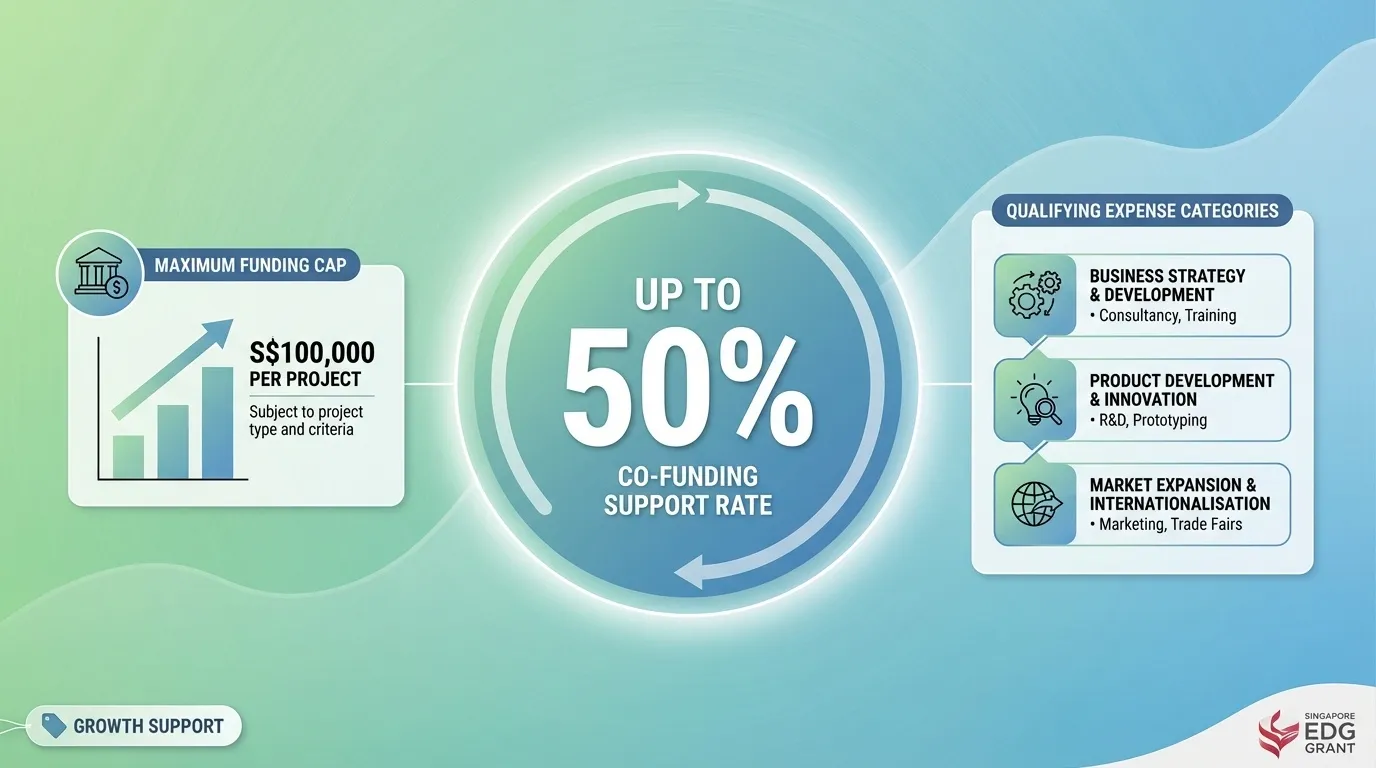
If you are budgeting for a serious branding project, this is the number you care about: According to Enterprise Singapore’s official guidelines, the Enterprise Development Grant supports up to 50 percent of qualifying project costs for small and medium-sized enterprises. Non-SMEs receive a lower level of support at up to 30 percent. But the exact percentage depends on your company profile and prevailing government policies at the time of application.
That “up to” is important. It means your approved support level is not automatic. It depends on your eligibility, financial health, and the extent to which your project aligns with EDG objectives.
What Does “Up to 50 Percent” Actually Mean?
EDG operates on a co-funding model. The government shares the risk, but you still invest alongside them. Here is what that looks like in practical terms:
Imagine you are investing in a structured brand transformation project with clear deliverables.
| Item | Cost (SGD) | EDG Support (50%) | Company Pays |
| Brand strategy consultancy | 80,000 | 40,000 | 40,000 |
| Internal manpower | 20,000 | 10,000 | 10,000 |
| Total | 100,000 | 50,000 | 50,000 |
In this scenario:
- Your total project cost is SGD 100,000.
- EDG supports SGD 50,000.
- You fund the remaining SGD 50,000.
The grant does not reduce your invoice at source. You pay vendors and staff first, complete the project, submit claims with documentation, and then receive reimbursement for the approved portion.
Cash Flow Planning Is Not Optional
This is where many SMEs underestimate the process. Because EDG reimburses after project completion and claim approval, you must:
- Have sufficient working capital to pay consultants upfront
- Carry internal manpower costs during the project period
- Absorb any non-qualifying expenses
If your branding project costs SGD 150,000 and you are approved for 50 percent support, you are still responsible for the full SGD 150,000 cash outlay before reimbursement. If cash flow is tight, that gap can strain operations.
What Factors Influence Your Final Funding Amount?
Although the headline figure is 50 percent, your approved quantum depends on several variables:
- Company size and SME status
- Financial viability and past performance
- Scope and strategic depth of the project
- Alignment with capability building rather than tactical marketing
Enterprise Singapore evaluates whether the project strengthens your long-term competitiveness. If your proposal reads like a short-term promotional exercise, the approved amount may be reduced or rejected entirely.
A Strategic Way to Think About the Numbers
Do not approach EDG as a discount. Approach it as leverage. If you were prepared to invest SGD 60,000 in branding, a well-structured EDG application might allow you to execute a SGD 120,000 transformation project for roughly the same net cost to your business.
That difference often translates into deeper research, more robust positioning, and stronger implementation frameworks. That is where the real value sits.
The Enterprise Development Grant is not designed to reduce project costs. It is designed to encourage you to think bigger, structure better, and build capabilities that compound over time.
How to Prepare a Strong Enterprise Development Grant (EDG) Application for Branding
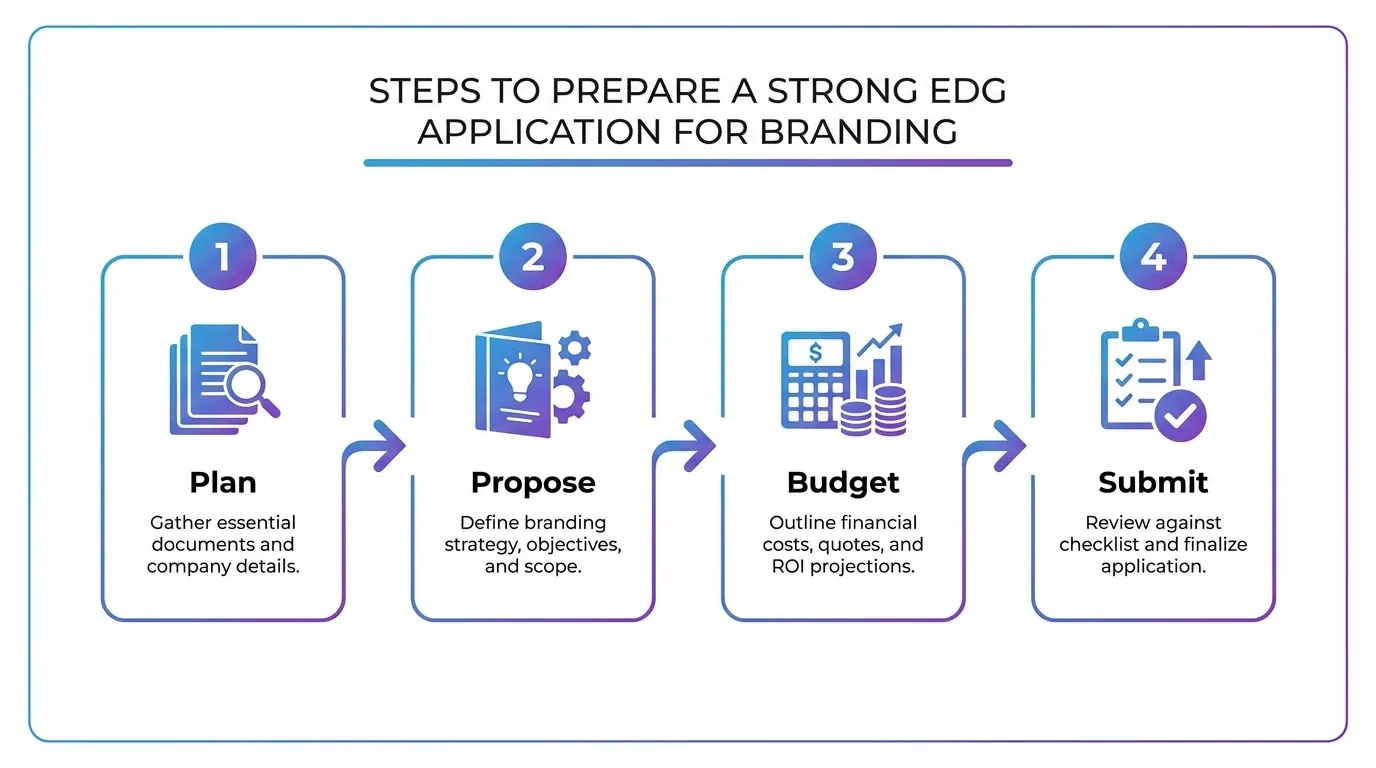
This section separates approved projects from rejected ones. Most applications fail for one simple reason: The branding work might be solid, the consultant credible, the budget reasonable. But the case is framed as a design refresh rather than a business transformation initiative.
Enterprise Singapore does not fund aesthetics. It funds capability development and measurable business outcomes. If your application does not reflect that, approval becomes difficult. Let us outline how to structure your case.
Define the Business Problem Clearly for Your Enterprise Development Grant (EDG) Case
If your proposal starts with “We need a new logo”, you are positioning the project as cosmetic. That is not what the Enterprise Development Grant (EDG) is designed to support. Instead, anchor your application around a strategic business issue.
For example:
- Revenue stagnation despite consistent marketing spend
- Margin compression due to price competition in mature districts such as Orchard or Tanjong Pagar
- Weak differentiation in a crowded sector
- Inability to command premium pricing
- Difficulty entering overseas markets because positioning lacks clarity
Now notice the shift. You are not asking for design work. You are solving a structural growth problem.
Spell out the data behind the issue. Show three years of flat revenue. Demonstrate declining margins. Highlight lost tenders. If your brand is underperforming, make that explicit. Connect branding to commercial outcomes such as pricing power, customer acquisition cost, or sales conversion rate.
When the problem is clear and quantifiable, the branding solution becomes justified.
Align Your Branding Strategy with Enterprise Development Grant (EDG) Objectives
Enterprise Singapore supports transformation and capability building. Your proposal must reflect both. That means your branding project should not just produce a new identity system. It should strengthen internal capabilities.
Here is how you demonstrate alignment:
1. Capability building
Explain how the project will strengthen internal systems, such as:
- Brand governance frameworks
- Standardised messaging guidelines for sales teams
- Customer journey alignment across departments
- Internal training on brand implementation
This signals that the transformation will endure beyond the consultant’s involvement.
2. Long-term competitive advantage
Describe how the repositioning allows you to:
- Move away from price-based competition
- Target higher-value customer segments
- Enter regional markets with a consistent brand narrative
Avoid vague statements like “increase brand awareness”. Instead, link strategy to structural advantage.
3. Measurable impact
Enterprise Singapore expects measurable outcomes.
Define KPIs such as:
- Pricing uplift of 5 to 10 percent due to repositioning
- Increase in qualified lead conversion rate
- Growth in average contract value
- Entry into at least one new overseas market within 12 to 24 months
Be specific. If your metrics are vague, reviewers cannot assess viability.
Show Financial Projections in Your Enterprise Development Grant (EDG) Proposal
A branding proposal without financial projections looks incomplete. You are required to demonstrate business impact.
Your projections should include:
- Revenue growth assumptions tied to repositioning
- Gross margin improvements from pricing strategy adjustments
- Market share expansion targets in specific segments
- The estimated payback period of the investment
However, credibility matters more than ambition. Do not inflate numbers. Do not assume revenue doubles in one year unless you can substantiate it. Use historical performance as your baseline. Reference industry benchmarks where possible. If your sector typically grows at 6 percent annually, projecting 40 percent without justification will trigger questions.
Explain your logic clearly:
- If repositioning enables premium pricing of 8 percent, show how that flows into gross margin.
- If targeting a new segment increases average deal size, show the calculation.
When projections are grounded and traceable, they become persuasive rather than speculative.
Select the Right Consultant for Your Enterprise Development Grant (EDG) Branding Project
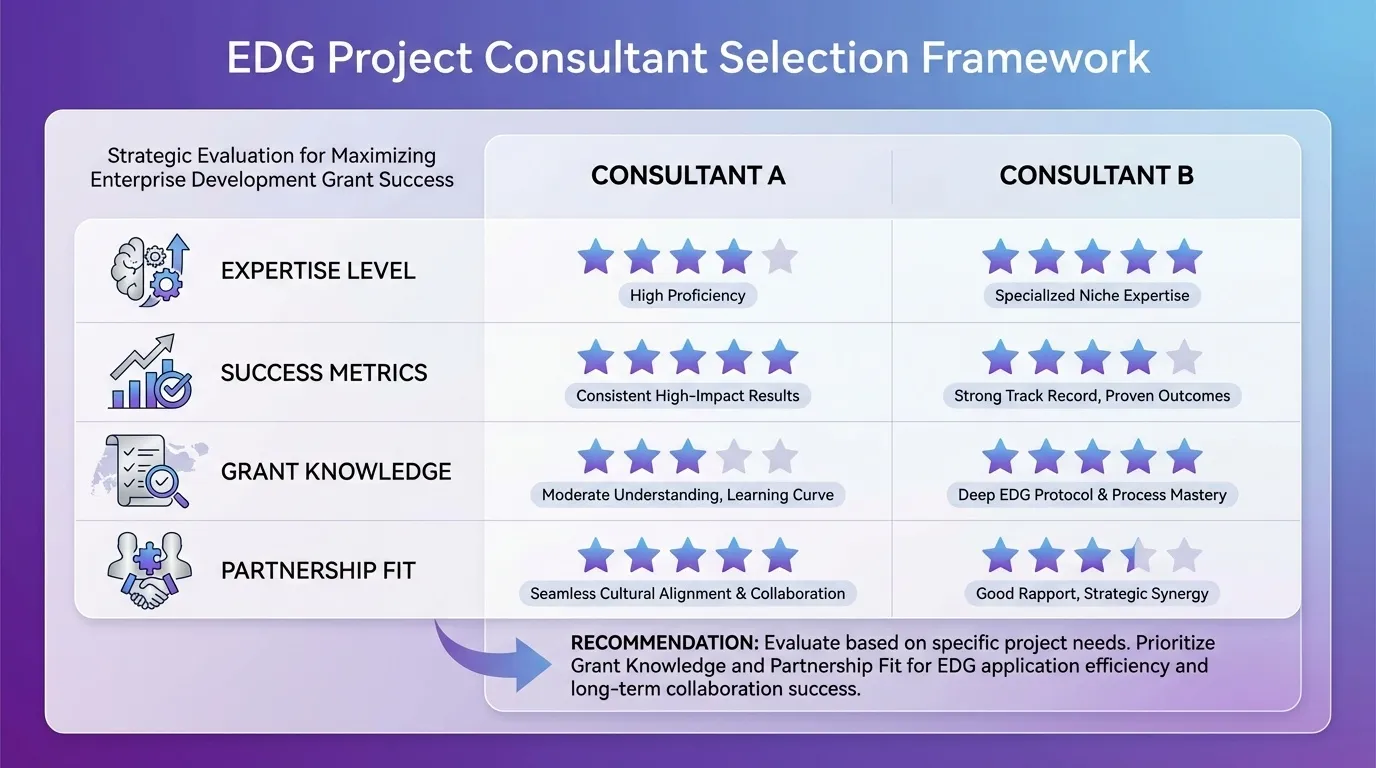
Your consultant plays a central role in the credibility of your application. Reviewers will evaluate whether the appointed firm has the capability to deliver the proposed outcomes.
Experience Matters
Choose a consultant with documented strategic branding projects, not only visually attractive portfolios.
Look for evidence of:
- Brand strategy frameworks
- Market research integration
- Structured implementation roadmaps
- Regional expansion support
A purely creative agency without strategic depth may struggle to position the project within EDG’s transformation mandate.
Track Record
Case studies should demonstrate measurable outcomes, not just visual transformation. Strong examples include:
- Revenue growth following repositioning
- Successful market entry into ASEAN markets
- Improved lead quality or conversion rates after messaging overhaul
If case studies only show before-and-after logos without business metrics, they weaken your case.
Proposal Clarity
The consultant’s proposal should read like a business plan, not a brochure. It must clearly outline:
- Scope of work
- Timeline and milestones
- Tangible deliverables
- Defined KPIs
- Budget breakdown by phase
Each component should connect back to the business problem you defined earlier. If the proposal feels generic or overly promotional, revise it. Enterprise Singapore expects structured, outcome-oriented documentation.
Documents Required for an Enterprise Development Grant (EDG) Branding Application
Documentation is where many applications slow down. Preparation reduces friction. You will typically need the following:
- ACRA Business Profile: This confirms registration details and shareholding structure. Ensure that local shareholding meets eligibility requirements.
- Financial Statements: Provide recent audited or management accounts. These demonstrate financial viability and establish baseline performance for impact projections.
- Detailed Project Proposal: This includes the strategic rationale, scope, deliverables, timeline, KPIs, and transformation outcomes.
- Consultant Quotation: The quotation must correspond exactly to the proposed scope. Any mismatch between proposal and budget invites questions.
- Business Impact Assessment: You must articulate projected revenue impact, productivity gains, or internationalisation outcomes. This is where your financial modelling supports the strategic narrative.
- Cash Flow Forecast: Because EDG operates on a reimbursement basis, you need to demonstrate sufficient cash flow to fund the project upfront before claiming.
Enterprise Singapore outlines documentation requirements within the Business Grants Portal and associated claim guidelines. Review them carefully before submission. Preparing a strong Enterprise Development Grant (EDG) branding application is not about mastering paperwork. It is about framing branding as a commercial lever.
When you clearly define the business problem, align your strategy with transformation objectives, present disciplined financial projections, appoint a credible consultant, and submit complete documentation, your proposal stops looking like a design refresh.
Timeline: How Long Does an Enterprise Development Grant (EDG) Branding Application Take?
Enterprise Singapore does not publish a guaranteed processing timeline. In practice, most businesses should plan for several months from preparation to reimbursement. Below is a realistic breakdown of what you can expect.
| Stage | What Happens | Typical Timeframe / Notes |
| Preparation Phase |
|
|
| Submission |
|
|
| Review and Clarification |
|
|
| Approval and Project Commencement |
|
|
| Claim Submission Process |
|
|
Practical planning advice: Even if preparation takes one month, the full journey from initial planning to reimbursement can extend across several months. Build this into your cash flow forecast to avoid pressure midway through the project.
Enterprise Development Grant (EDG) for Branding vs Other Government Grants in Singapore
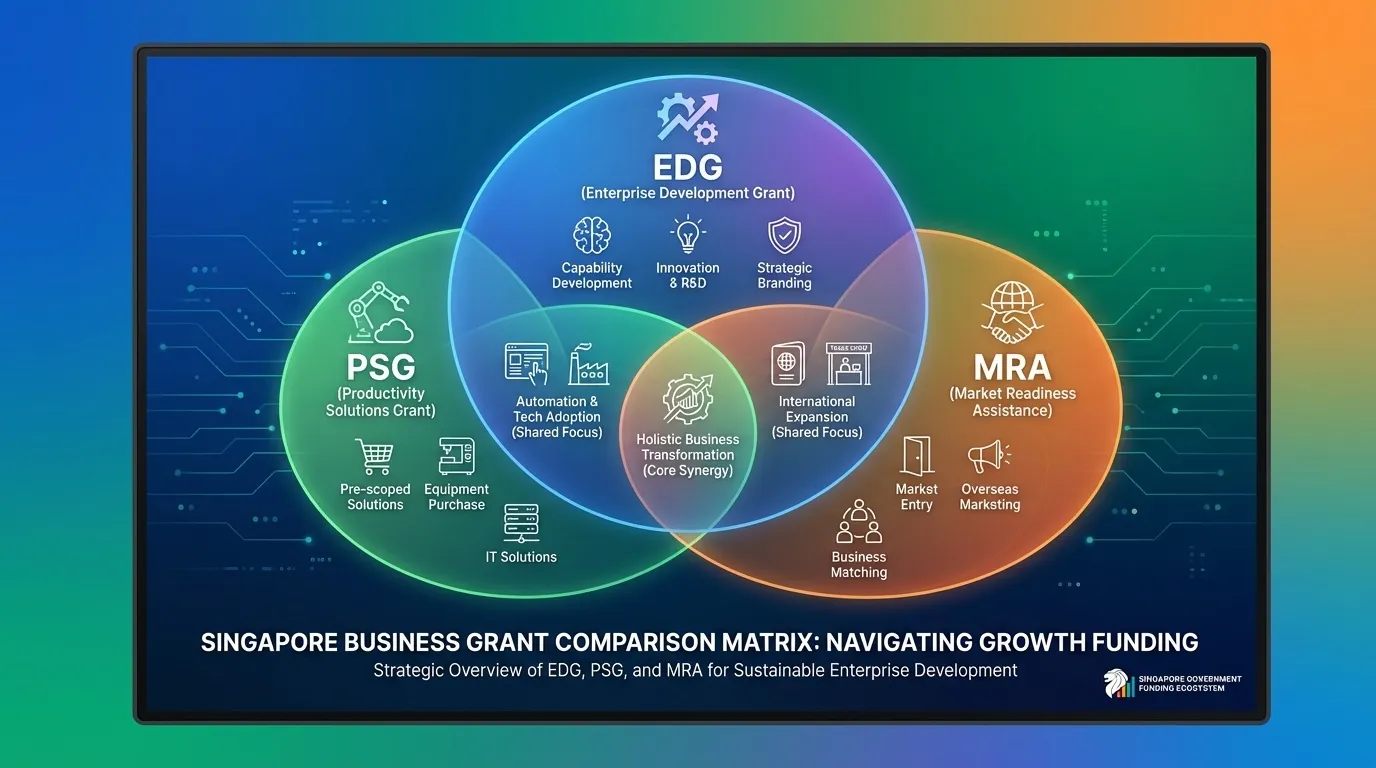
If you are evaluating funding support for a branding initiative, you need to choose the right instrument. Not all grants are built for strategy. Some are designed for tactical upgrades. Others are meant purely for overseas expansion. Selecting the wrong scheme does not just slow you down. It weakens your positioning during review. Below is a grounded comparison based on Enterprise Singapore’s published grant frameworks.
Brief Comparison
Before you apply, understand what each grant is fundamentally designed to do.
| Grant | Primary Focus | Suitable for Branding? |
| Enterprise Development Grant (EDG) | Business transformation and capability building | Yes, for strategic branding |
| Productivity Solutions Grant (PSG) | Pre-approved productivity solutions | Rarely |
| Market Readiness Assistance (MRA) | Overseas market entry | Only for international branding efforts |
Now let’s unpack what that actually means for you.
When the Enterprise Development Grant (EDG) Is More Suitable
The Enterprise Development Grant is built for transformation. That word matters. EDG supports projects that help companies upgrade capabilities, innovate, and grow. Branding qualifies when it is positioned as a strategic capability upgrade, not a cosmetic redesign.
EDG is more suitable when:
- You are investing in a comprehensive brand strategy, not just visual assets
- Your project includes positioning, architecture, governance, and an implementation roadmap
- You want to improve pricing power, differentiation, or long-term competitiveness
- The budget is substantial, often above SGD 50,000
- You can demonstrate measurable business impact, such as revenue growth or margin improvement
If your brand work involves rethinking your value proposition before entering new sectors or international markets, EDG is typically the strongest fit.
For example, if you are a manufacturing SME in Jurong repositioning yourself as a premium solutions provider for Southeast Asia, that strategic shift fits EDG’s transformation mandate. A logo refresh alone does not.
When EDG May Not Be Appropriate
You should not pursue EDG if your objectives are tactical or short-term. EDG is likely unsuitable if:
- You only want to run paid advertising campaigns
- You are refreshing a website without strategic repositioning
- You are redesigning packaging with no broader business transformation plan
- The total project cost is minimal
EDG requires a business case. If you cannot articulate how branding builds capability or drives measurable outcomes, the application becomes fragile.
Where the Productivity Solutions Grant (PSG) Fits And Where It Does Not
The Productivity Solutions Grant supports pre-approved IT solutions and equipment listed under the PSG framework. These are standardised tools, not custom strategic projects.
PSG supports sector-specific productivity solutions such as accounting software or CRM systems. PSG may be relevant if:
- You are adopting a pre-approved digital tool that supports marketing operations
- You need automation software to improve workflow
PSG is rarely suitable for branding strategy because branding is not a pre-approved, off-the-shelf solution. It is customised intellectual work. If your proposal involves deep research, positioning frameworks, and customer journey redesign, PSG is not the right vehicle.
Trying to squeeze a strategic branding project into PSG criteria will weaken your application.
When the Market Readiness Assistance (MRA) Grant Applies
The MRA Grant supports overseas expansion activities. MRA covers activities such as overseas market promotion, business matching, and market set-up.
Branding may qualify under MRA only if it is directly tied to international market entry. For example:
- Adapting brand messaging for Indonesia or Vietnam
- Overseas market-specific promotional materials
- International PR campaigns
MRA is not designed for domestic brand transformation. If your branding initiative is focused on strengthening your Singapore market position first, EDG remains the stronger match.
Tip: Avoid Overlapping Grants
Enterprise Singapore does not allow double claiming for the same scope of work. This is clearly stated in grant conditions across schemes.
You cannot:
- Claim consultancy fees under EDG and also claim related implementation under MRA for the same deliverables
- Split one strategic project artificially across multiple grants to maximise funding
If you are using multiple grants, scopes must be clearly delineated. For instance, you might use EDG for core brand strategy development, then later apply for MRA for overseas marketing execution. The deliverables must be distinct.
Clarity protects you. Overlapping claims create compliance risk and delay reimbursements. Choose the grant that matches the depth of your ambition.
Your Next Step with the Enterprise Development Grant (EDG) for Branding
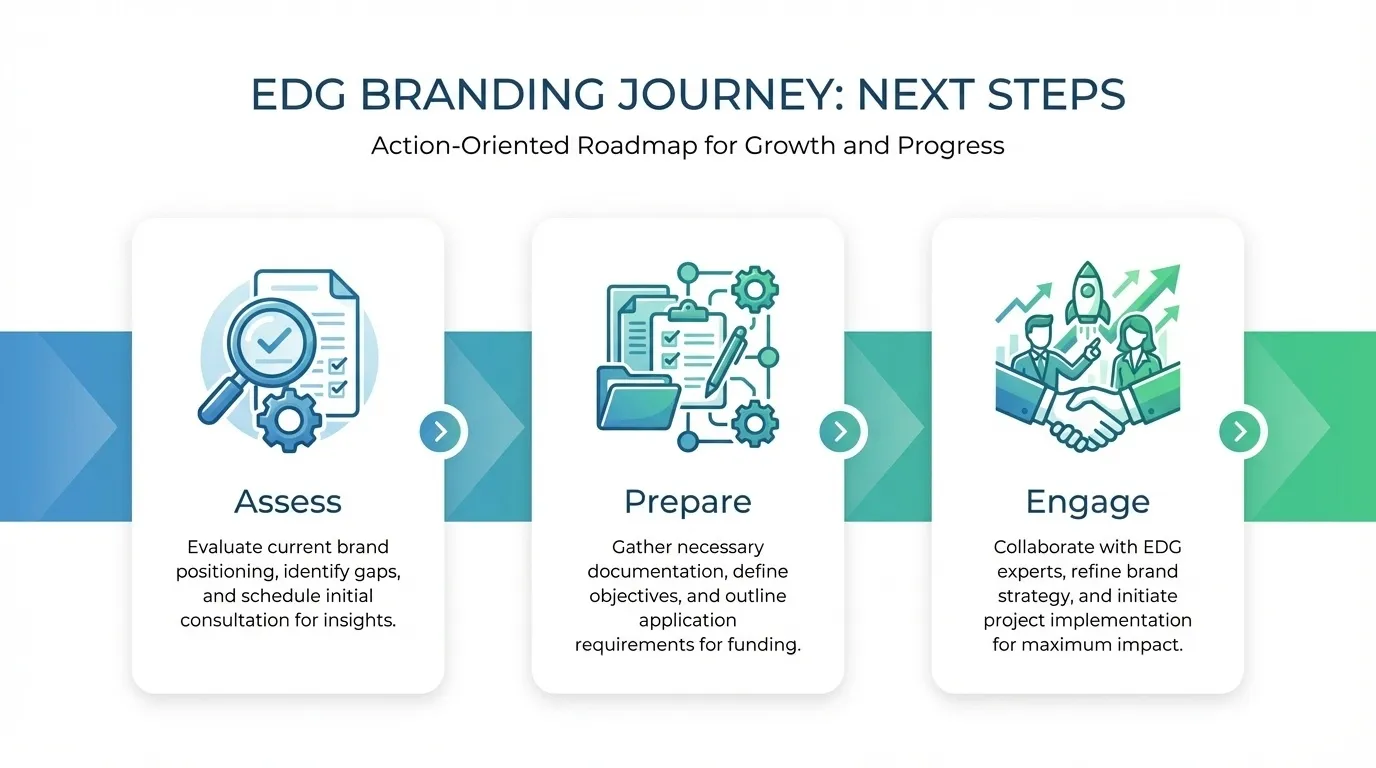
At this stage, the question is no longer whether branding matters. It is whether you are prepared to treat it as a strategic growth lever rather than a design exercise.
The Enterprise Development Grant is designed to support companies committed to upgrading their capabilities. If your brand is limiting your pricing power, weakening differentiation, or slowing expansion into new markets, that is not a marketing issue. It is a structural business constraint. And structural constraints require structured solutions.
Before you submit anything, pressure-test your thinking:
- Can you clearly define the business problem your brand must solve?
- Have you linked branding outcomes to revenue, margins, or market share?
- Is your scope strategic enough to qualify as a transformation rather than a promotion?
- Do your financial projections stand up to scrutiny?
If you cannot answer those confidently, refine the strategy first. The quality of your thinking will determine the strength of your case.
This is where experienced guidance matters. A well-prepared application does more than secure funding. It clarifies your positioning, aligns leadership, and creates measurable growth pathways. MediaOne works with business owners and marketing leaders who want branding that delivers commercial outcomes, not just creative assets. The focus is always on strategy, structure, and measurable impact.
If you are evaluating your eligibility or preparing to submit an enterprise development grant (EDG) branding proposal, speak to us directly. A focused discussion can help you assess feasibility, refine your transformation case, and move forward with confidence under the Enterprise Development Grant (EDG) framework.
Frequently Asked Questions
Can a company apply for multiple Enterprise Development Grant (EDG) projects at the same time?
Yes, a company may apply for multiple Enterprise Development Grant projects, but each application is assessed independently. You must demonstrate the capacity to manage and fund each project without overstretching financial or operational resources. Enterprise Singapore will evaluate overall risk exposure before approving concurrent initiatives.
Is there a minimum project cost to qualify for the Enterprise Development Grant (EDG)?
Enterprise Singapore does not publicly state a fixed minimum project cost. However, because EDG is intended for transformation projects, proposals that are too small in scale may struggle to justify capability upgrading. In practice, higher-value strategic initiatives are more aligned with the grant’s objectives.
Can consultants apply for the Enterprise Development Grant (EDG) on behalf of clients?
Applications must be submitted by the company seeking support through the Business Grants Portal. Consultants can assist in preparing documentation and structuring the proposal, but they cannot apply independently. The applicant company remains responsible for declarations, compliance, and claims.
Are there reporting requirements after an Enterprise Development Grant (EDG) project is completed?
Yes, companies are required to submit claims with supporting documentation upon project completion. Enterprise Singapore may also assess whether stated deliverables and outcomes were achieved. Proper documentation and measurable impact reporting are essential for successful reimbursement.
Does the Enterprise Development Grant (EDG) support branding for non-profit organisations?
The Enterprise Development Grant is generally targeted at registered business entities operating in Singapore. Non-profit organisations may not qualify unless they are structured as eligible commercial entities meeting shareholding and viability requirements. Applicants should review the eligibility criteria carefully before submission.