

According to the 2025 Sprout Social Index, nearly three-quarters (about 73%) of consumers expect brands to respond to them on social media within 24 hours, a figure that has remained consistent over multiple years. This shows that consumers increasingly view social channels as essential platforms for communication and engagement, not just broadcast outlets.

Trust does not form because you post frequently. It forms because you sound consistent, credible, and recognisable. Many brands invest heavily in design, advertising, and content production, yet overlook one critical asset: a clearly defined brand voice on social media.
When your brand sounds corporate on LinkedIn, casual on Instagram, and trend-driven on TikTok without alignment, you weaken recognition. Recognition builds familiarity. Familiarity builds trust.
This guide explains how a branding agency defines and scales a consistent brand voice across platforms without becoming robotic or overly polished.
Key Takeaways
- A defined brand voice on social media increases trust, recognition, and engagement. When communication is consistent in personality and structure, audiences can identify and recall your brand more easily across platforms.
- Voice reflects brand personality, while tone adapts to context and platform. Brand voice establishes the stable characteristics that define how your organisation communicates, whereas tone adjusts depending on the situation, audience, or channel.
- Documented frameworks prevent inconsistency across growing teams and agencies. As content contributors increase, undocumented voice guidelines lead to variability in vocabulary, emotional expression, and positioning.
What Is Brand Voice on Social Media?
Brand voice on social media is the consistent personality, communication style, and language a company uses across platforms to build recognition, trust, and alignment with its positioning.
It answers a simple question:
If your brand were speaking to someone directly, how would it sound?
Brand voice is not a slogan or campaign theme. It is expressed in:
- Captions
- Video scripts
- Comment replies
- Direct messages
- Crisis statements
- Paid advertisements
Brand Voice vs Brand Tone
These are often confused. Brand voice is stable. It reflects long-term personality traits. Brand tone changes depending on context.
For example:
- Voice: Structured, analytical, confident
- Tone in announcement: Optimistic
- Tone in complaint response: Calm and solution-focused
Without a defined voice, tone shifts become unintentional and inconsistent. On social media, where impressions are formed within seconds, inconsistency weakens memorability.
Why Brand Voice Consistency Drives Commercial Growth
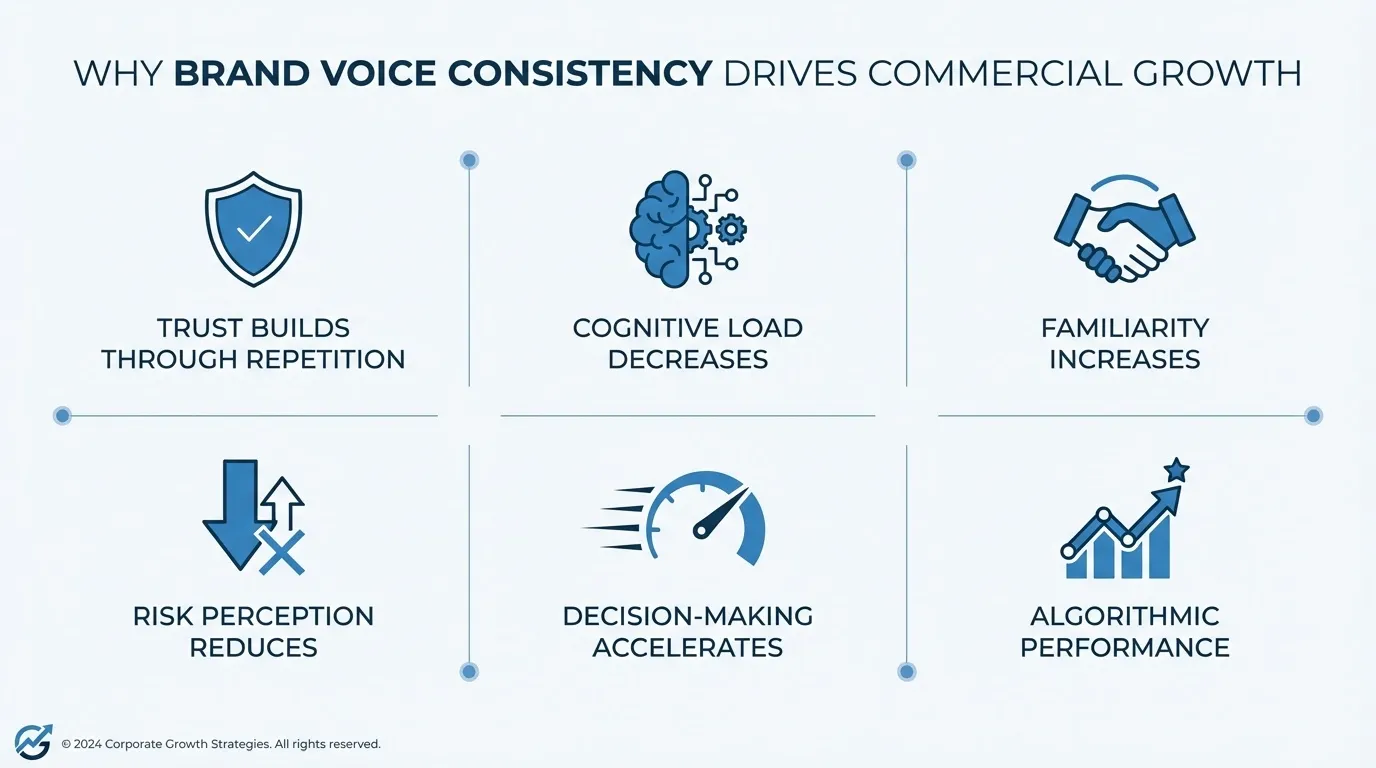
Trust remains one of the most important drivers of brand preference, particularly in digital-first industries. Trust builds through repetition and predictability. When audiences repeatedly encounter consistent messaging:
- Cognitive load decreases
- Familiarity increases
- Risk perception reduces
- Decision-making accelerates
Consistency also supports algorithmic performance. Social platforms reward engagement patterns. If your audience recognises your communication style, they are more likely to interact, increasing reach and visibility over time.
The 5 Core Elements of a Strong Brand Voice on Social Media
A strong brand voice on social media must be clearly defined, operationally structured, and consistently applied. Without structural clarity, voice becomes subjective and varies from one contributor to another.
The following five elements form the foundational architecture of a scalable brand voice. Each element addresses a specific dimension of communication control and alignment.
1. Personality Definition

Personality defines the stable characteristics that shape how a brand communicates across all social media platforms.
Effective personality traits are:
- Specific
- Measurable in execution
- Aligned with positioning
- Non-generic
Generic descriptors such as “professional” or “friendly” lack operational clarity and invite inconsistent interpretation.
Example of a weak trait: Professional
Example of structured traits:
- Structured
- Evidence-led
- Practical
- Direct
Each trait must be defined behaviourally.
For example:
Direct = Use concise sentences. Avoid unnecessary qualifiers. Remove filler phrases. Prioritise clarity over embellishment.
Evidence-led = Support claims with data, examples, or logical reasoning. Avoid unsupported assertions.
Operational definitions reduce ambiguity across teams and external partners.
2. Linguistic Framework
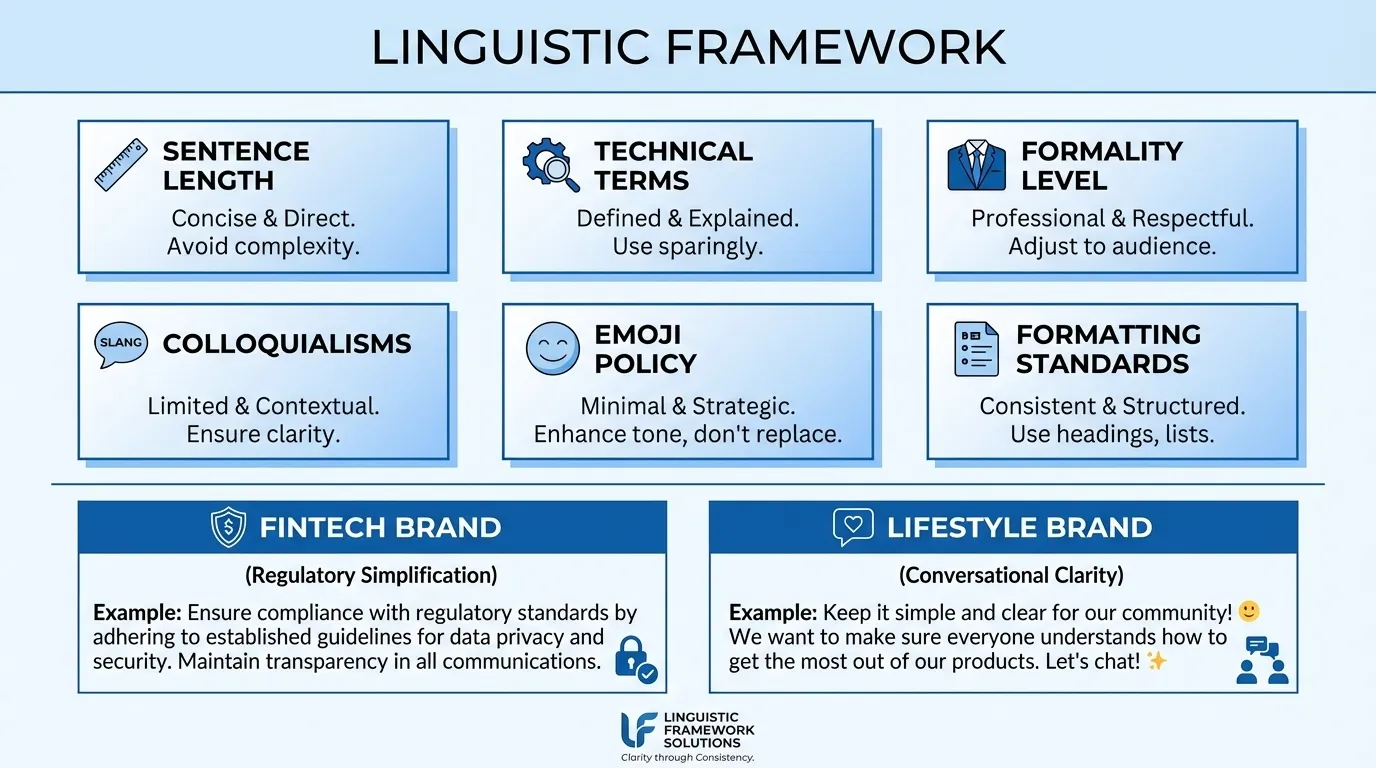
The linguistic framework governs how language is constructed and delivered. This element establishes consistency at the sentence and vocabulary level.
Define:
- Preferred sentence length range
- Use of technical terminology
- Degree of formality
- Acceptance or rejection of colloquialisms
- Emoji policy
- Formatting standards
For example:
- A fintech brand may simplify complex regulatory language while retaining technical precision.
- A lifestyle brand may permit conversational phrasing while maintaining structural clarity.
- A clearly defined linguistic framework ensures communication remains accessible without compromising credibility.
Without this structure, writing style shifts depending on the contributor’s background.
3. Emotional Calibration

Emotional calibration determines the acceptable emotional range within communication. Emotion influences perceived brand maturity and positioning.
Define:
- Emotional intensity scale
- Permissible use of humour
- Acceptable enthusiasm levels
- Expressiveness boundaries
For example:
- Luxury brands typically adopt a controlled, composed approach to reinforce exclusivity.
- Challenger brands may utilise bold, assertive language to signal differentiation.
- Community-oriented brands may incorporate warmth to encourage participation.
Emotional discipline prevents abrupt tonal fluctuations, particularly during campaigns or trending moments.
4. Perspective and Authority Positioning

Perspective defines the narrative viewpoint from which the brand communicates.
Options include:
- First-person plural voice representing collective authority
- Founder-led voice incorporating personal experience
- Institutional voice maintains formal objectivity.
Perspective directly influences perceived expertise, transparency, and authority.
For example:
- Founder-led technology brands may build credibility through personal insights and experience-based commentary.
- Healthcare institutions often maintain an institutional perspective to reinforce professionalism and regulatory compliance.
Once selected, perspective should remain consistent across posts, responses, and campaign materials.
5. Communication Boundaries and Governance

A strong brand voice includes defined limitations. This element establishes risk control and reputational safeguards.
Clarify:
- Topics outside brand scope
- Political neutrality or advocacy policy
- Crisis response tone principles
- Trend participation criteria
- Escalation procedures for sensitive content
In polarised digital environments, unclear boundaries increase reputational exposure.
Governance mechanisms ensure that voice consistency is maintained under pressure and across teams.
When these five elements are clearly documented and implemented, brand voice on social media becomes predictable, scalable, and strategically aligned with overall positioning.
How to Stay Consistent Across Different Social Media Platforms
Each social media platform operates within a distinct ecosystem. Content formats, audience behaviour, and engagement expectations differ significantly across LinkedIn, Instagram, TikTok, and Facebook.
Although execution varies, a consistent brand voice is essential for recognisability and positioning. To achieve this, organisations must separate three distinct communication layers:
- Core Voice: Fixed personality traits and positioning principles
- Platform Tone: Contextual adjustments appropriate to audience expectations
- Content Format: Native structural execution aligned with platform mechanics
When these layers are clearly defined and documented, cross-platform consistency becomes systematic rather than subjective.

Audience expectation: Insight, expertise, and professional credibility.
LinkedIn users typically prioritise informational value and strategic relevance. Communication must reflect intellectual clarity and structured reasoning.
Recommended execution:
- Structured thought leadership with defined arguments
- Evidence-based commentary supported by data or experience
- Clear articulation of value propositions
- Logical progression within posts
Language guidelines:
- Maintain professional clarity
- Avoid excessive colloquialisms
- Limit emoji usage
- Prioritise structured formatting for readability
If the defined brand voice includes traits such as analytical and confident, LinkedIn content should reinforce those traits through depth, precision, and clarity. Inconsistent casualisation on LinkedIn weakens perceptions of authority.

Audience expectation: Visual coherence and identity expression.
Instagram is a visually dominant platform, but caption structure remains important for voice alignment.
Recommended execution:
- Concise yet structured captions
- Clear narrative framing
- Emotionally aligned but controlled language
- Active and consistent comment responses
Tone may be slightly warmer than on LinkedIn, given the platform’s culture. However, personality traits must remain stable.
For example:
- If the brand voice is structured and practical, captions should remain clear and purposeful rather than abstract or overly emotive.
Over-adaptation to platform aesthetics often leads to personality dilution.
TikTok

Audience expectation: Directness, authenticity, and native delivery.
TikTok prioritises immediacy and attention capture. However, adaptation must not compromise core voice characteristics.
Recommended execution:
- Strong opening hook within the initial seconds
- Single clear message per video
- Structured scripting, even if delivery is conversational
- Controlled and confident presentation
Trend participation must undergo evaluation against voice alignment criteria.
For example:
- If a brand voice is strategic and data-driven, TikTok execution may focus on concise educational breakdowns or insight-driven commentary rather than purely humour-based formats.
Content format adapts. Personality does not.

Audience expectation: Dialogue, updates, and informational clarity.
Facebook allows more contextual explanation than TikTok or Instagram, but voice discipline remains essential.
Recommended execution:
- Slightly longer explanatory posts where appropriate
- Clear and accessible language
- Consistent tone within comment responses
- Structured community management protocols
Community replies are a common source of voice inconsistency. Response templates aligned with defined voice traits reduce variability.
Common Mistakes That Damage Brand Voice on Social Media
A strong brand voice on social media can take months to build and only weeks to dilute. Most inconsistencies are not intentional. They emerge from operational shortcuts, trend pressure or lack of governance. Below are the most common mistakes that erode brand voice consistency, and why they matter commercially.
1. Following Trends Without Strategic Evaluation
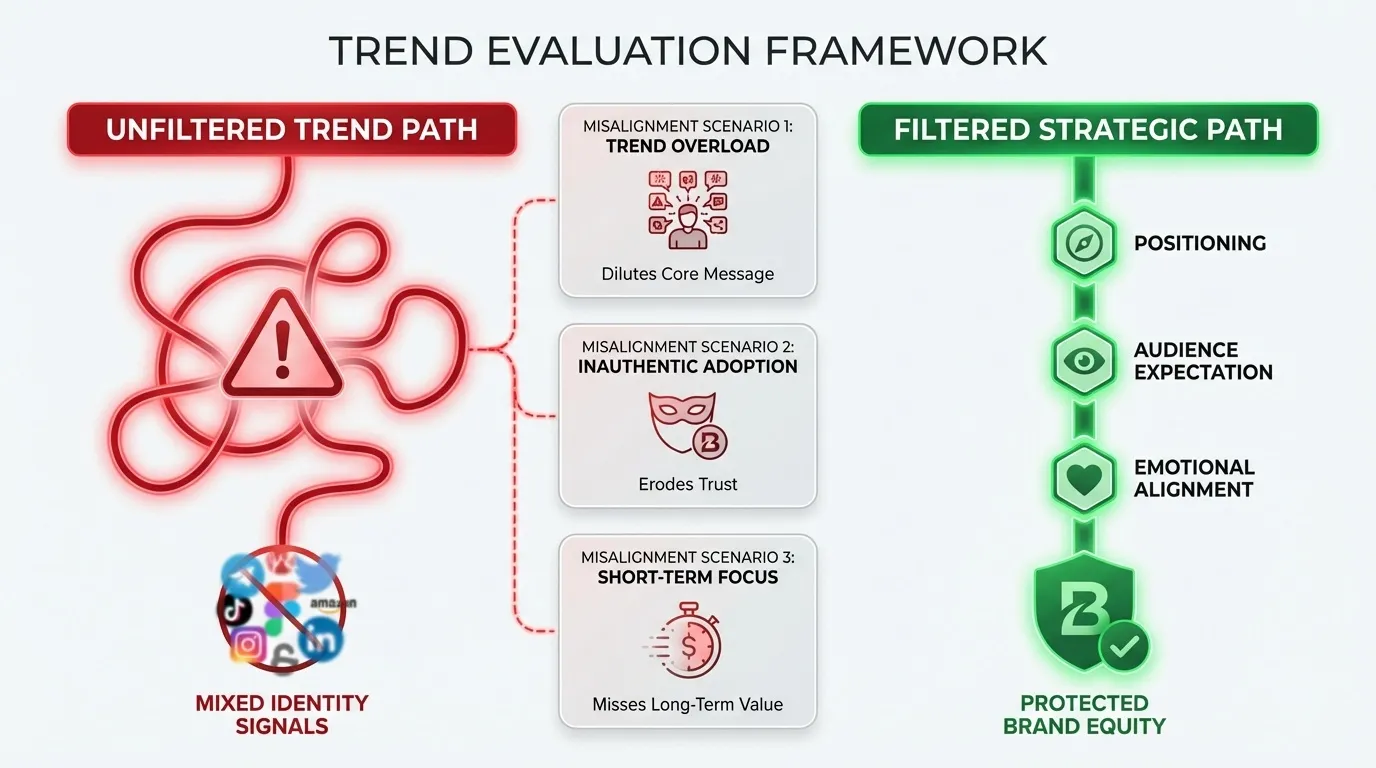
Trends create visibility opportunities. However, not every trend aligns with your brand personality or positioning.
The problem is not trend participation. The problem is unfiltered participation.
When brands adopt:
- Viral audio that contradicts their tone
- Humour that conflicts with their authority
- Cultural commentary outside their defined boundaries
They send mixed identity signals.
Ask before participating:
- Does this reinforce our positioning?
- Would our audience expect us to engage in this?
- Does this align with our defined emotional range?
Trend discipline protects long-term equity. Visibility without alignment creates confusion.
2. Allowing Multiple Contributors Without Documentation
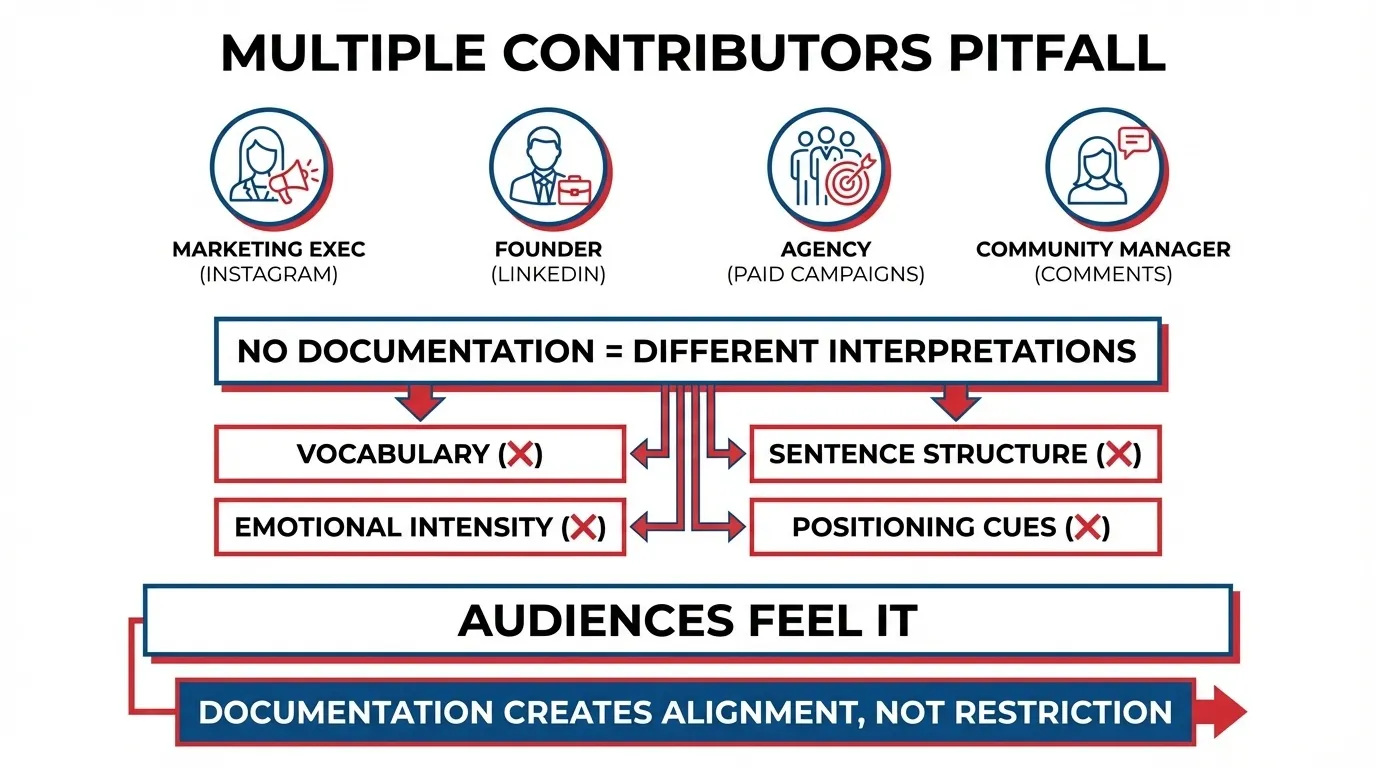
As teams grow, so does voice variability.
Common scenarios:
- Marketing executive posts on Instagram
- The founder posts on LinkedIn.
- The agency handles paid campaigns.
- Community manager replies to comments.
Without a documented voice framework, each contributor interprets personality differently.
This leads to:
- Inconsistent vocabulary
- Different sentence structure
- Varied emotional intensity
- Contradictory positioning cues
Audiences may not consciously identify the inconsistency, but they will feel it. Documentation does not restrict creativity. It creates alignment.
3. Copy-Pasting Identical Captions Across Platforms
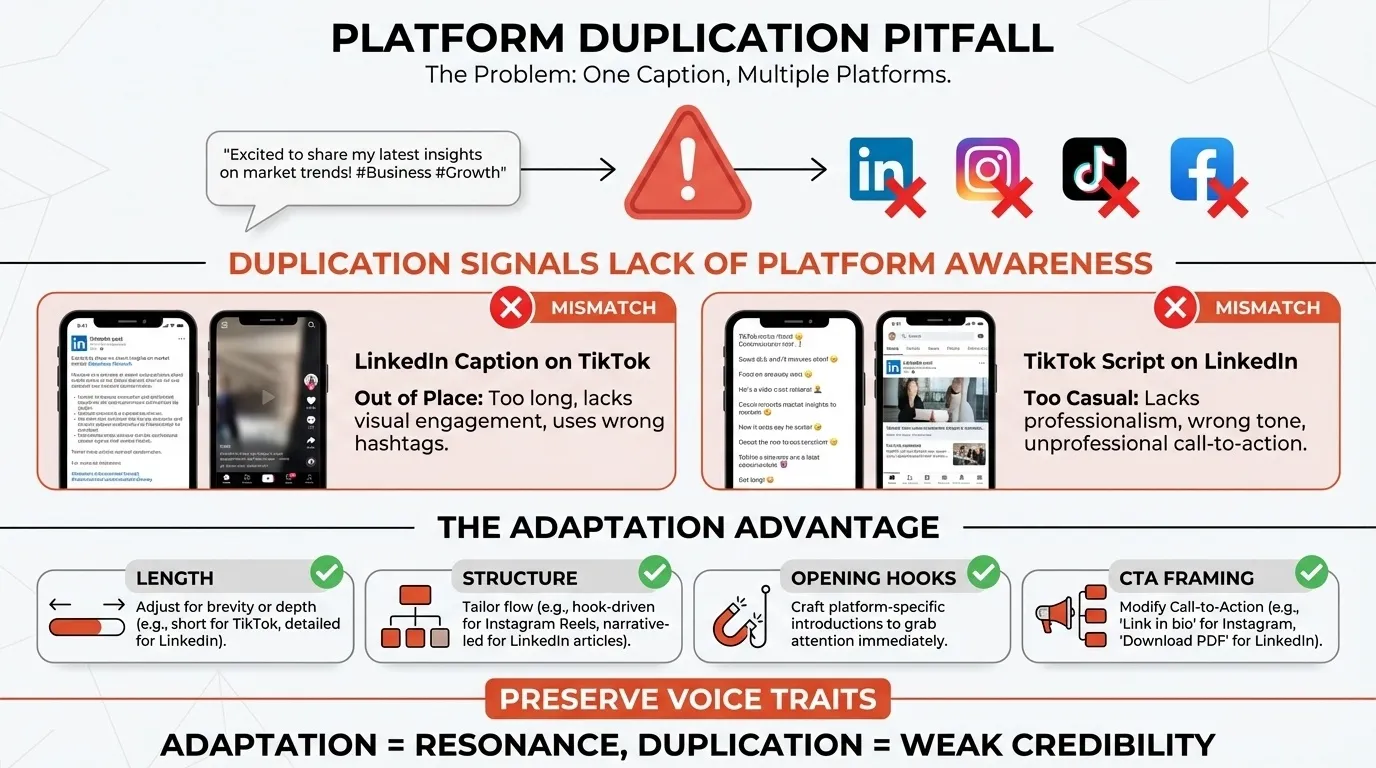
Efficiency often drives duplication. However, platforms differ in behavioural context and algorithmic structure.
A caption optimised for LinkedIn may feel out of place on TikTok. A TikTok script may come across as overly casual on LinkedIn.
More importantly, blind duplication signals a lack of platform awareness.
Effective brands adapt:
- Length
- Structure
- Opening hooks
- Call-to-action framing
While preserving voice traits.
Adaptation enhances resonance. Duplication weakens credibility.
4. Excessive Corporate Jargon

Corporate language often sounds safe. But safety frequently translates to forgettable.
Phrases such as:
- “Leveraging synergistic capabilities”
- “Driving holistic transformation”
- “Enhancing strategic alignment”
Create distance between the brand and the audience. Jargon reduces clarity. Reduced clarity reduces engagement. A professional does not require complexity. Authority often communicates through simplicity. Clear language signals confidence. Overly complex language signals insecurity.
5. Reactive Tonal Shifts During Negative Feedback

One of the most damaging voice fractures occurs during criticism.
Brands may:
- Become defensive
- Over-apologise
- Shift from confident to uncertain.
- Use dramatically different language.
While tone should adapt during sensitive situations, core voice traits must remain stable.
For example:
If your brand is structured and composed, your response to criticism should remain:
- Calm
- Clear
- Solution-focused
Abrupt tonal volatility undermines trust. Crisis consistency demonstrates maturity.
How to Create a Brand Voice Framework for Your Team
A brand voice framework translates abstract personality traits into enforceable communication standards. Without documentation, voice becomes dependent on individual interpretation, increasing the risk of inconsistency as teams scale.
An effective framework defines measurable traits, language parameters, and governance procedures. The following five-step process provides a structured approach to implementation.
Step 1: Conduct a Structured Content Audit

Begin with empirical analysis rather than assumptions.
Review:
- Top 20 posts ranked by engagement metrics
- Lowest-performing posts
- Crisis communication examples
- Major campaign announcements
Assess for:
- Vocabulary consistency
- Emotional stability
- Structural coherence
- Alignment with stated positioning
Identify tonal drift, language variability, and deviations from strategic messaging. The objective is to establish a baseline before redefining standards.
Step 2: Define Voice Traits with Operational Evidence
Traits must be behaviourally defined and supported with examples to eliminate subjectivity.
Create a trait matrix structured as follows:
| Trait | Definition | Example | Non-Example |
| Analytical | Uses data and logical reasoning to support claims | “Data shows a 34% increase in conversion rate.” | “We think it works well.” |
Each trait should answer:
- What does this mean in practical writing terms?
- How should it appear in captions or scripts?
- What language contradicts this trait?
Operational definitions ensure consistency across internal teams and external agencies.
Step 3: Build a Platform Tone Adaptation Guide
While voice remains constant, tone adapts based on platform context. This must be explicitly documented.
Create a structured reference table:
| Platform | Tone Adjustment | What Remains Constant |
| Formal clarity | Evidence-based messaging | |
| Moderately warmer phrasing | Structured thought | |
| TikTok | Conversational delivery | Direct, confident messaging |
| Accessible explanations | Clear positioning |
This guide prevents over-adaptation and personality dilution when adjusting to platform culture.
Step 4: Develop Caption Architecture
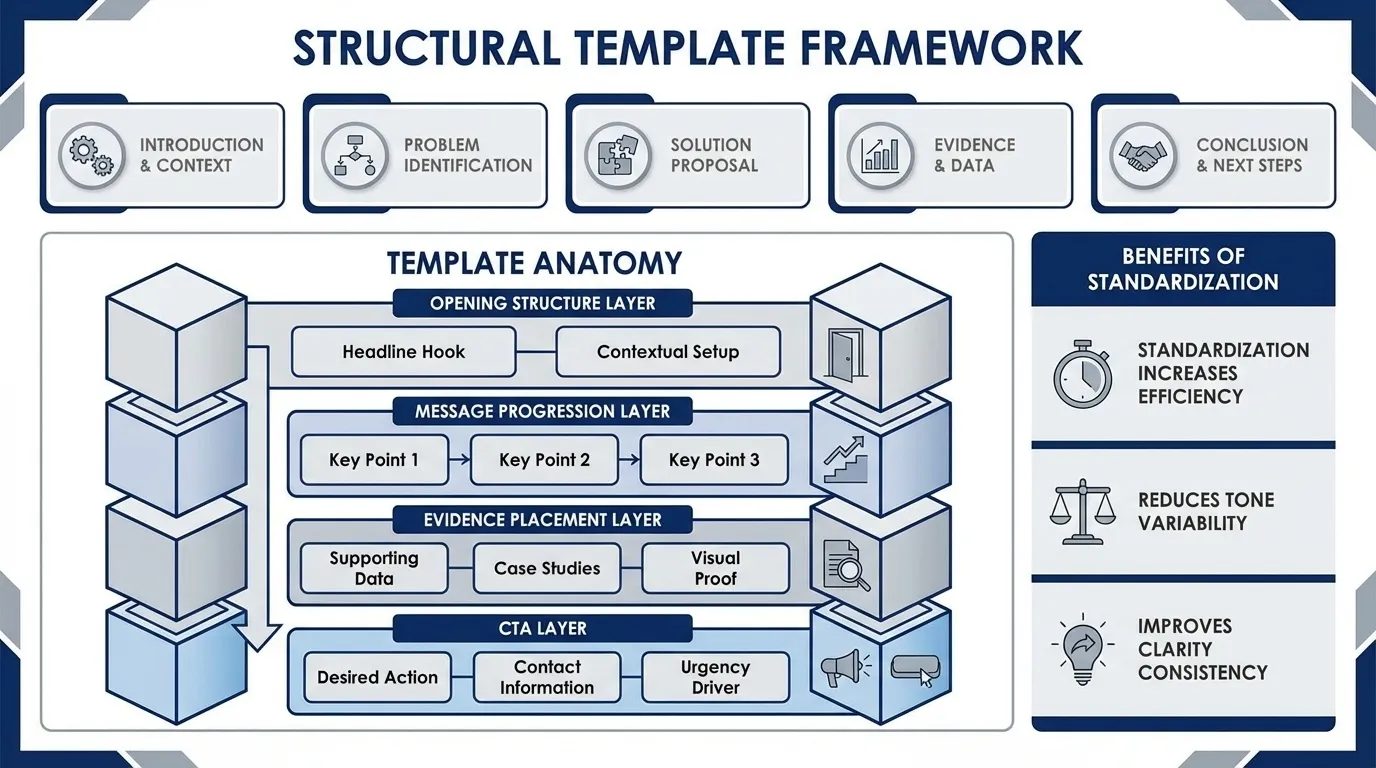
Define standardised structural templates for recurring content categories.
Examples include:
- Educational posts
- Promotional announcements
- Campaign launches
- Thought leadership commentary
- Crisis updates
Each template should specify:
- Opening structure
- Argument or message progression
- Evidence placement
- Closing call to action
Standardised architecture improves production efficiency and reduces variability in tone and clarity.
Step 5: Implement Governance and Review Mechanisms

Framework sustainability depends on governance.
Assign responsibility for:
- Brand voice oversight
- Quarterly alignment reviews
- New contributor onboarding
- Approval workflows for high-impact posts
Establish periodic audits to evaluate:
- Cross-platform consistency
- Comment response alignment
- Campaign-level coherence
Governance mechanisms ensure that voice standards are maintained as content volume and contributor count increase.
A structured brand voice framework reduces interpretative variability, improves operational efficiency, and strengthens cross-platform consistency.
Build a Brand Voice on Social Media That Scales
A consistent brand voice on social media is not a cosmetic exercise. It is a structural advantage. As organisations grow, communication complexity increases. More platforms. More campaigns. More contributors. Without a defined and enforceable voice framework, inconsistency becomes inevitable.
The brands that outperform on social media are not necessarily the loudest. They are the most consistent. If your organisation is experiencing fragmented messaging, uneven engagement, or unclear positioning across platforms, it may not be a content problem. It may be a voice alignment problem.
MediaOne works with growth-focused businesses to define, document, and implement scalable brand voice frameworks that align with strategic positioning and digital performance objectives. Contact us today!
Frequently Asked Questions

B2B brands often emphasise credibility, clarity, and industry insight, while B2C brands may adopt more emotionally expressive language. However, both require consistency and defined personality traits.
Can rebranding require a complete brand voice reset?
Yes. Significant repositioning, mergers, or target-market changes may require revisiting voice foundations to ensure alignment with the strategic direction.
How does brand voice affect employee advocacy programmes?
A clearly defined voice ensures employees represent the brand consistently when sharing content, strengthening overall credibility.
Should crisis communication follow the same brand voice?
Yes, but the tone must adjust. Voice remains consistent, while tone becomes more measured, empathetic, and solution-focused.
Does brand voice impact SEO performance?
Indirectly, yes. Consistent messaging strengthens user engagement metrics, such as time on page and interaction rate, which in turn influence search visibility over time.