A founder once told me he had spent eight months and $3,000 a month on Google Ads. The moment he paused the campaign, his leads stopped overnight. No organic fallback. Nothing to show for it.
That conversation is why the PPC vs SEO debate matters so much to me. It is not a channel preference. It is a business architecture decision, and getting it wrong is expensive.
Most guides give you a comparison table and leave you to figure out the rest. This one goes further. We cover when to use each channel, how to combine them, what the numbers actually look like in Singapore, and how AI search is reshaping both sides of the equation.
If you are already weighing up your SEO services options or want a clearer read on what a proper search strategy should cost and deliver, MediaOne is an SEO agency in Singapore worth speaking with.
Key Takeaways
- The PPC vs SEO decision is not a choice between two channels. Most Singapore businesses get better results by sequencing and integrating both based on their stage and commercial goals.
- Google’s AI Overviews have structurally reduced click-through rates for both paid and organic results, making content quality and brand authority more commercially important than ever.
- SEO takes significantly longer than most businesses expect. Only 1.74% of newly published pages reach the top 10 within a year, so starting earlier than you feel ready is the single most underrated advantage.
- In high-CPC sectors such as legal, finance, and B2B services, organic rankings translate directly into measurable cost savings per lead compared to running paid campaigns alone.
- The most effective approach uses PPC data to validate SEO content and SEO authority, thereby lowering paid costs, treating both channels as one integrated system rather than separate budget lines.
The New Search Reality (Why This Comparison Has Changed)
The old framing of this debate was simple enough. PPC for speed, SEO for the long game. That framing is no longer adequate.
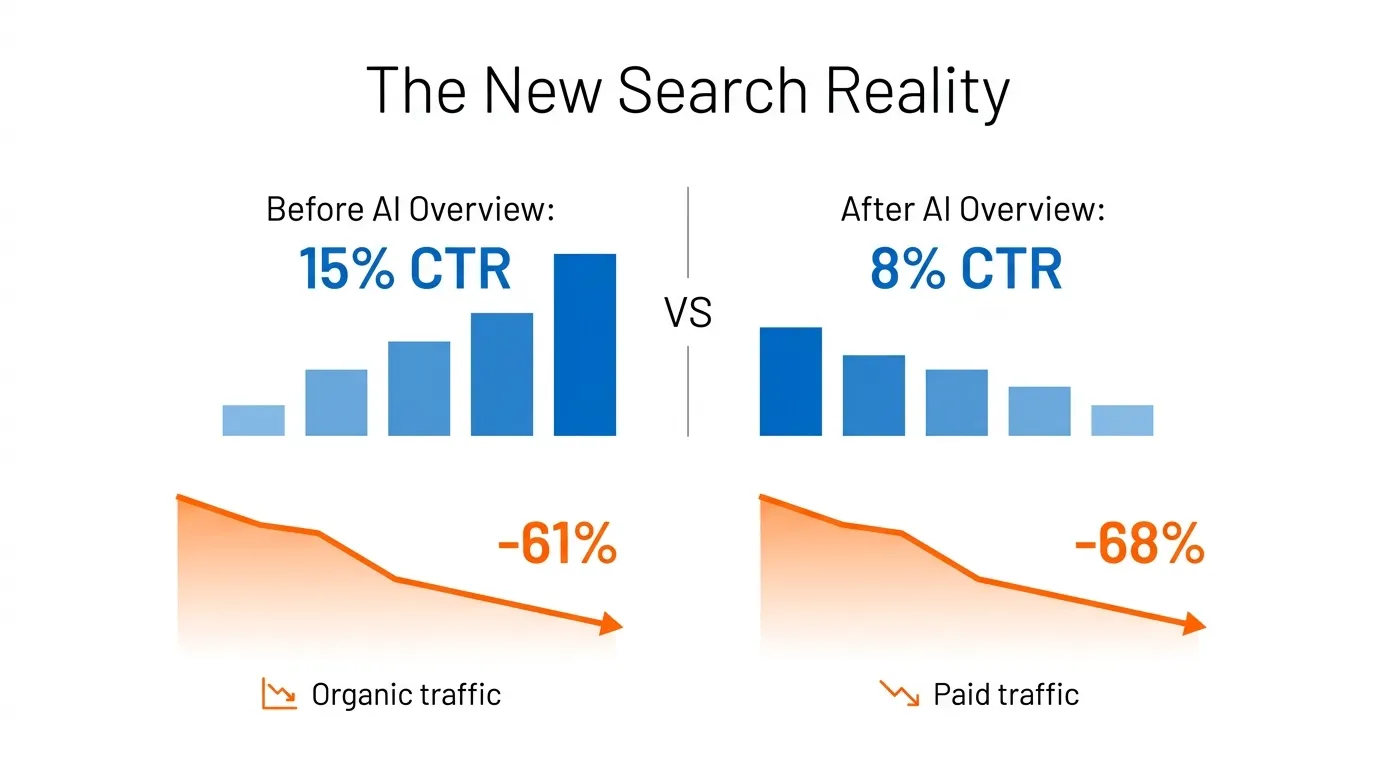
Google’s AI Overviews have changed what it means to appear on page one. A Pew Research study published in July 2025, analysing data from March 2025, found that users who encountered an AI-generated summary clicked on traditional search result links only 8% of the time.
Users who saw standard results without an AI summary clicked through at a 15% rate. That is a near halving of click-through intent, and it affects both paid and organic results simultaneously.
For queries where an AI Overview appears, organic click-through rates have dropped from 1.76% in June 2024 to 0.61% by September 2025, a decline of 61%. Paid CTR on the same queries has dropped from 19.70% to 6.34%, a 68% decline.
That is not a blip. That is a structural change in how search works.
By late 2025, 58% of Google searches were ending without a single click to any website. The implication for Singapore businesses is significant. Simply appearing in search, whether paid or organic, is no longer a guarantee of traffic.
The Rise of AI Search Platforms
Meanwhile, 37% of consumers now start their searches with AI tools rather than Google. ChatGPT hit 900 million weekly users in February 2026. Perplexity, Claude, and Google’s own Gemini are all competing for the role of first point of enquiry.
This matters because SEO is quietly becoming the entry point for AI visibility. The content that ranks well in Google is increasingly the content that AI models cite, summarise, and surface in conversational responses.
Investing in authoritative, well-structured content is no longer just about Google rankings. It is about becoming the source that AI systems trust.
What This Means for Startups and SMEs
The old advice needs updating. You cannot simply run ads for speed and treat SEO as a slower parallel track. Both channels are operating in a more competitive, lower-click environment. That means the quality of your content, your brand authority, and your ability to appear in AI-generated answers are now material factors in your ROI from both channels.
The businesses that will win search in the next two to three years are those that build something real, not just something ranked.
PPC vs SEO: Core Differences Explained
Before we get into strategy, it helps to be clear on what each channel actually does and where it breaks down.
What Is PPC?
Pay-per-click advertising means you pay every time someone clicks your ad. Google Ads is the dominant platform in Singapore, followed by Meta Ads for social targeting and LinkedIn Ads for B2B. You set a budget, bid on keywords, and your ad appears when conditions are met. The moment you stop paying, the traffic stops.
The strength of PPC is precision and immediacy. You can target specific search terms, locations, demographics, and intent signals. You can appear at the top of page one within hours of launching a campaign.
For testing, for time-sensitive offers, and for capturing demand that already exists, it is a powerful tool.
What Is SEO?
Search engine optimisation is the process of building your website’s authority, relevance, and trustworthiness so that Google ranks your content organically. It includes technical site health, on-page optimisation, content strategy, keyword research, and link building.
The strength of SEO is compounding value. A page that earns strong rankings can deliver traffic and leads for years with minimal ongoing investment. Unlike PPC, the traffic does not switch off when you pause your budget.
The challenge is time. Only 1.74% of newly published pages reach the top 10 within a year. And 72.9% of pages currently sitting in Google’s top 10 are more than three years old. The average number-one ranking page is now five years old.
That is the honest reality of what you are signing up for.
Side-by-Side Comparison
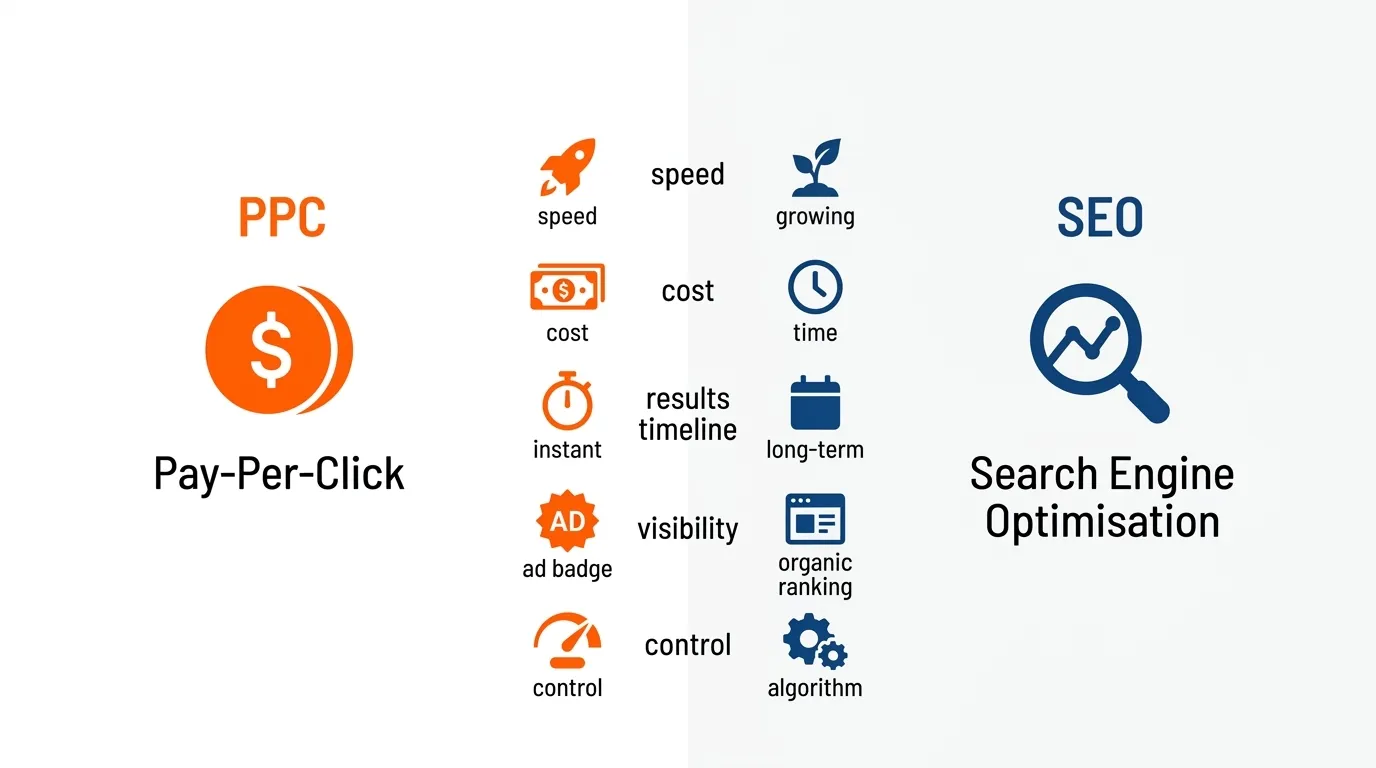
| Factor | PPC | SEO |
| Time to Results | Hours / Days | 6 to 12+ months |
| Cost Model | Pay per click | Upfront investment + maintenance |
| Traffic Sustainability | Stops when the budget stops | Compounds over time |
| AI Visibility | Limited currently | Foundation for LLM citation |
| Trust Signal | 94% of users skip ads | Top organic results earn significantly higher trust |
| Best For | Validation, launches, high-intent capture | Authority-building, long-term growth, and cost efficiency |
| Risk | Budget dependency | Time lag before ROI |
The Decision Matrix — When to Use Each
Choosing between PPC and SEO is rarely a philosophical debate. It comes down to where your business is right now, what you need it to do, and how much time you have before the decision costs you something.
By Business Stage
The channel you prioritise should reflect where your business actually is, not where you want it to be.
| Stage | Primary Channel | Secondary | Approx. Monthly Budget (SGD) | Rationale |
| Pre-seed / Idea Validation | PPC (80%) | SEO (20%) | $500 to $2,000 | Test messaging and validate demand before committing to content |
| Seed Stage | PPC (60%) | SEO (40%) | $2,000 to $5,000 | Optimise acquisition while laying content foundations |
| Growth Stage | SEO (60%) | PPC (40%) | $5,000 to $15,000 | Authority and retention become more cost-efficient at scale |
By Business Goal
Rather than choosing a channel philosophically, match it to the specific job it needs to do.
- Need leads this week: PPC is the answer. Build the campaign, target the intent, and test the landing page.
- Building category authority: SEO. You want to own the conversation, not just appear when someone already knows what they want.
- Launching a new product: Start with PPC to validate messaging, then build the SEO content around what converts.
- Keywords where Singapore CPC is above SGD $7: The economics usually point to SEO as the more defensible long-term position. Legal and finance firms paying $9 to $12 per click should be investing seriously in organic rankings.
- Local Singapore market: Both channels, used together. Google Business Profile optimisation, local SEO, and geo-targeted PPC work together, not separately.
By Industry Vertical
I see this pattern often in Singapore. The right channel mix is almost always industry-specific.
- eCommerce: PPC for product-level ads where purchase intent is immediate. SEO for category and informational pages where you want to capture research-phase traffic.
- B2B and SaaS: SEO for educational and problem-aware content that builds trust over a long sales cycle. PPC for bottom-funnel, ready-to-buy terms where speed matters.
- Professional Services (legal, finance, accounting): High CPCs make SEO essential. A law firm paying $7 to $9 per click on Google Ads that earns an organic ranking for the same keyword is saving thousands each month.
- Local Services (renovation, healthcare, home services): Google Business Profile, local SEO, and geo-targeted PPC working together. If you are not visible in the local pack, you are invisible to a significant share of your potential customers.
Cost Efficiency Breakdown (2025 to 2026 Benchmarks)
Numbers matter more than opinions when you are deciding where to put your budget. Here is what Singapore businesses are actually paying across both channels right now:
What Singapore Businesses Actually Pay for PPC
Based on current Singapore market data, here are realistic CPC ranges by sector.
| Industry | Google Search CPC (SGD) | Cost Per Lead (SGD) |
| Professional Services / Legal | $5.50 to $9.50 | $80 to $180 |
| Finance and Insurance | $4.50 to $12.00 | $100 to $250 |
| B2B Software and SaaS | $4.00 to $10.00 | $70 to $180 |
| Healthcare and Medical | $2.50 to $7.50 | $50 to $130 |
| Construction and Home Services | $4.00 to $9.00 | $70 to $160 |
| IT Services and Technology | $4.00 to $11.00 | $80 to $190 |
| Education and Enrichment | $2.50 to $6.00 | $35 to $80 |
| Real Estate and Property | $2.00 to $6.50 | $50 to $140 |
| Retail and eCommerce | $0.50 to $2.00 | $15 to $45 |
On top of ad spend, management fees typically range from SGD $1,000 to $3,000 per month for a competently managed campaign.
What SEO Actually Costs in Singapore
| Provider Type | Monthly Cost (SGD) | Who It Suits |
| Freelancer | $300 to $2,000 | Early-stage with a limited budget and lower competition |
| Entry-level agency | $500 to $1,500 | Small businesses in less competitive niches |
| Mid-range agency | $1,500 to $4,000 | SMEs targeting competitive local keywords |
| Competitive niche agency | $4,000 to $8,000+ | Legal, finance, healthcare, B2B services |
| Enterprise | $10,000+ | Large-scale, multi-location, or high-authority campaigns |
| One-time technical audit | $500 to $5,000 | Businesses wanting a diagnostic without ongoing commitment |
The Hidden Cost Most Businesses Miss
The real cost of SEO is not the agency fee. It is the opportunity cost of the waiting period.
Only 1.74% of newly published pages reach the top 10 within their first year. That means if you start your SEO programme today, you are realistically planning around a six to twelve-month lead time before meaningful organic traffic arrives.
For a business generating SGD $30,000 in monthly revenue that could be captured through SEO, every month of delay incurs a real commercial cost. This is not an argument against SEO. It is an argument for starting earlier than you think you need to.
The businesses I see get the best results from SEO are those that started building 12 months before they felt ready.
5 Ways to Use PPC and SEO Together
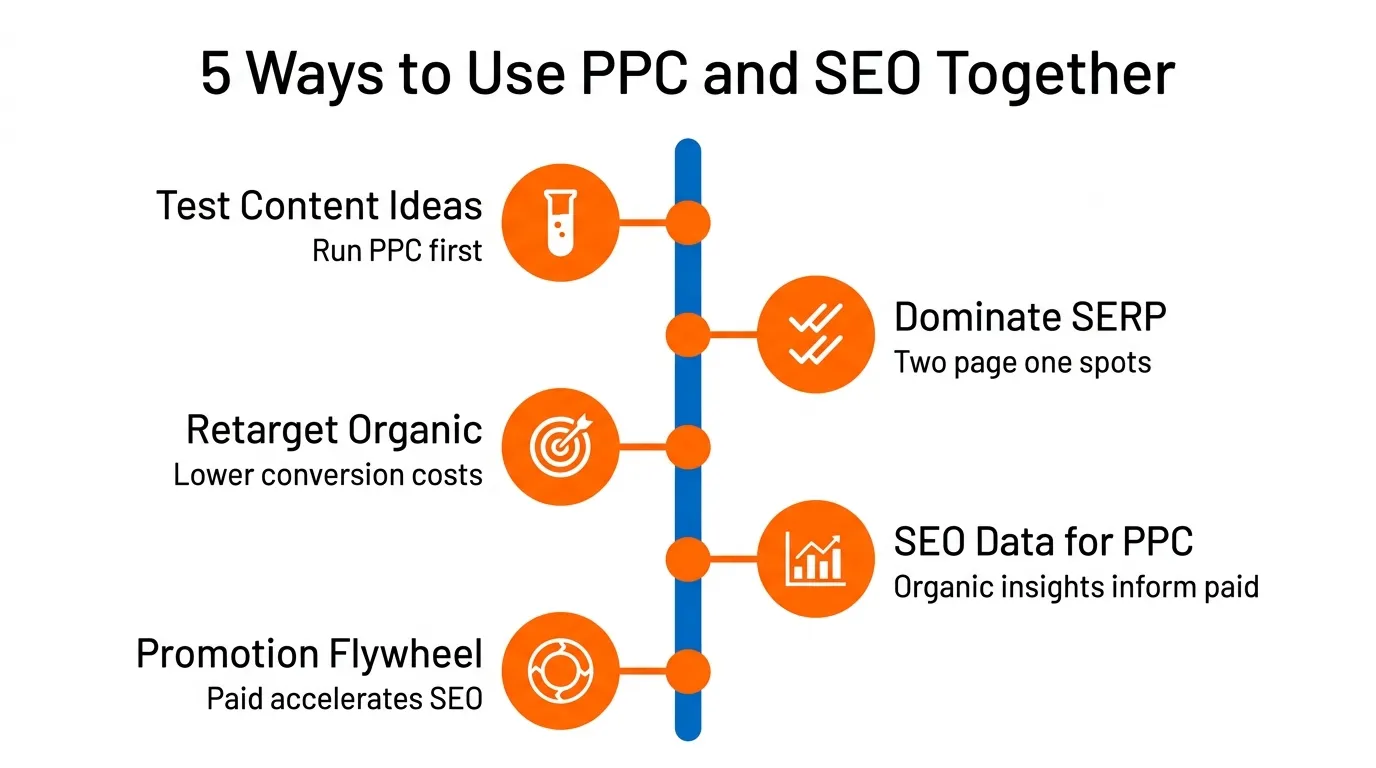
This is where most guides stop too early. The real competitive advantage comes from running these channels as a system, not as separate budget lines.
Strategy 1: Use PPC to Test SEO Content Ideas
Before investing three to six months into a content piece, run a PPC campaign targeting the keyword. If the ad does not convert, the SEO content probably will not either. If it converts well, you have validated the topic and can invest in organic content with confidence.
This approach saves months of trial and error and concentrates your SEO effort on angles that are already proven to resonate commercially.
Strategy 2: Dominate the SERP
When you rank organically for a keyword and also run a paid ad on the same query, you occupy two positions on page one. Your total click share increases, and your brand appears more authoritative by the simple frequency of presence.
For highly competitive terms where you rank positions four to seven, pairing a paid ad with your organic listing means you are visible regardless of which position the user notices first.
Paid click share doubled in major product categories through 2025 as AI Overviews compressed organic click share. The businesses that maintained both positions held ground while others retreated.
Strategy 3: Retarget Organic Visitors with PPC
Your SEO content will attract users who are curious but not yet ready to buy. A visitor who reads your article about renovation costs in Singapore is warmer than a cold audience, but they may not convert on their first visit.
Retargeting those organic visitors with paid ads is more cost-efficient than cold prospecting. The audience is already aware of you, and the cost-per-conversion typically improves significantly compared to running ads to people who have never encountered your brand.
Implementation is straightforward. Add your remarketing pixel to the site, build an audience segment for organic visitors, and serve them a targeted offer or case study via Google Display or Meta.
Strategy 4: Use SEO Data to Improve PPC Targeting
Google Search Console shows you which organic keywords are driving clicks and conversions. If you rank position eight to fifteen for a keyword that converts well organically, that is a strong signal to bid on it via PPC while your organic ranking improves.
You are essentially using free organic data to make smarter paid decisions. The landing pages you have already optimised for SEO often produce better Quality Scores in Google Ads, which reduces your CPC.
Strategy 5: The Content Promotion Flywheel
Publish a strong piece of SEO content, promote it via paid social to generate early traffic and engagement, and that attention often earns backlinks from people who discover the content. Those backlinks strengthen organic rankings, which drive more traffic, which in turn earns more links.
The paid spend at the start of this cycle is a catalyst, not a permanent cost. An SGD $500 to $1,000 paid social boost on a well-written content piece can accelerate organic traction that would otherwise take years to accumulate.
The AI Impact (Preparing for 2025 to 2026)
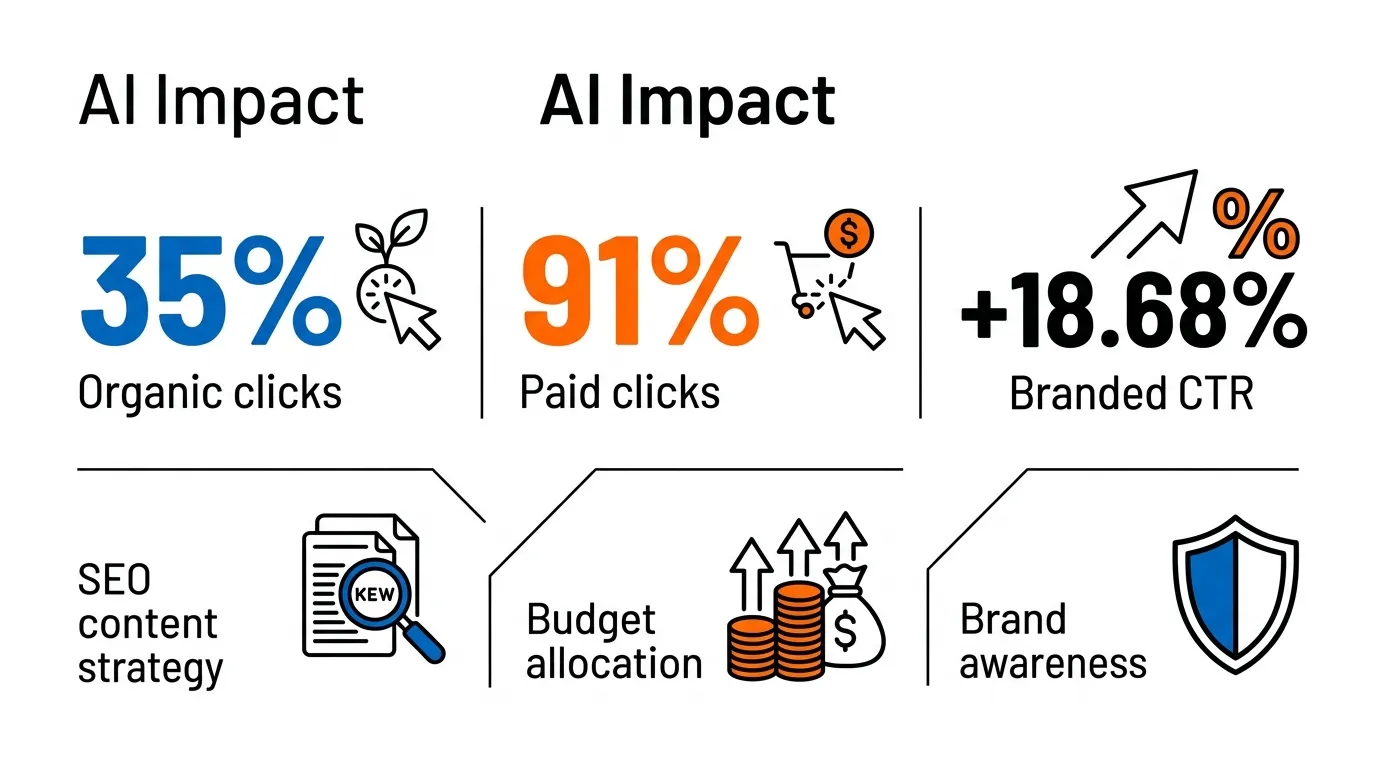
Being cited inside an AI Overview changes the picture considerably. Being cited delivers 35% more organic clicks and 91% more paid clicks compared to appearing on queries where you are not cited in the AI summary.
This is where SEO and content authority become strategically important beyond traditional rankings. The content Google’s AI cites is, by and large, well-ranked organically. Well-structured, authoritative, and clearly written content is both an SEO asset and an AI citation asset. The two objectives are no longer separable.
What This Means for Budget Allocation
Informational queries are increasingly being answered directly by AI. If your business relies on being found for questions like “what is the cost of renovation in Singapore” or “how does home insurance work,” you need to consider that these queries are seeing the steepest decline in clicks.
The practical response is twofold. Invest more in comprehensive SEO content that can earn AI citations, and shift the PPC budget toward transactional, high-intent queries where users are ready to act and AI summaries are less dominant.
Branded searches have held up better. Data from 2025 shows branded queries saw a +18.68% CTR improvement with AI Overviews, according to Amsive’s analysis of 700,000 keywords — suggesting that brand recognition is a genuine protective factor.
Building brand awareness, not just keyword rankings, is increasingly a commercial endeavour.
Future-Proofing Your Strategy
Structure your content with clear answers, well-defined headings, and specific facts. These are the characteristics that make content easy for AI systems to extract and cite.
Do not rely on a single channel for all your traffic. Organic traffic, paid traffic, email, referral, and direct visits all serve as hedges against algorithm changes that neither you nor your agency controls.
The businesses I advise to hold ground well are those with diversified traffic sources and genuine brand recognition. Not those chasing a single keyword position.
Getting Started: Practical Steps to Your PPC & SEO Strategy
Strategy without execution is just theory. Here is a practical starting point for running both channels properly, whether you are launching from scratch or tightening up what you already have.
PPC Quick-Start Checklist
- Define your three to five highest-intent keywords before touching the campaign
- Build dedicated landing pages for each campaign theme (not your homepage)
- Set a test budget of SGD $1,000 to $2,000 for initial validation over four weeks
- Track conversions, not clicks
- Review Quality Score and landing page relevance in the first two weeks
- Set negative keywords before spending a dollar
- Establish target cost-per-lead benchmarks based on your average deal value
SEO Quick-Start Checklist
- Conduct a full technical audit before creating new content
- Confirm your Google Business Profile is claimed, accurate, and regularly updated
- Identify 10 to 20 target keywords with a clear mix of high-intent and informational queries
- Audit existing pages before creating new ones
- Build internal linking between relevant pages from day one
- Register with Google Search Console and submit your sitemap
- Set a realistic 12-month content calendar, not a 30-day sprint
90-Day Launch Plan
Most businesses overcomplicate the start. Here is a simple three-month framework that gives you paid traction immediately while building the organic foundations that pay off later.
- Days 1 to 30: Launch PPC campaigns on your three to five highest-intent keywords. Simultaneously, complete the technical SEO audit and fix any blocking issues. Set up Search Console and begin keyword mapping.
- Days 31 to 60: Analyse PPC performance. Identify which keywords and ad copy are converting. Publish your first two to three SEO content pieces targeting informational and commercial investigation queries. Use PPC data to inform content angles.
- Days 61 to 90: Scale the PPC campaigns that are producing acceptable cost-per-lead. Promote SEO content with a modest paid social budget. Begin building your backlink strategy through outreach, partnerships, or digital PR.
By the end of 90 days, you should have validated your PPC economics and laid the structural foundations for organic growth.
Singapore-Specific Considerations
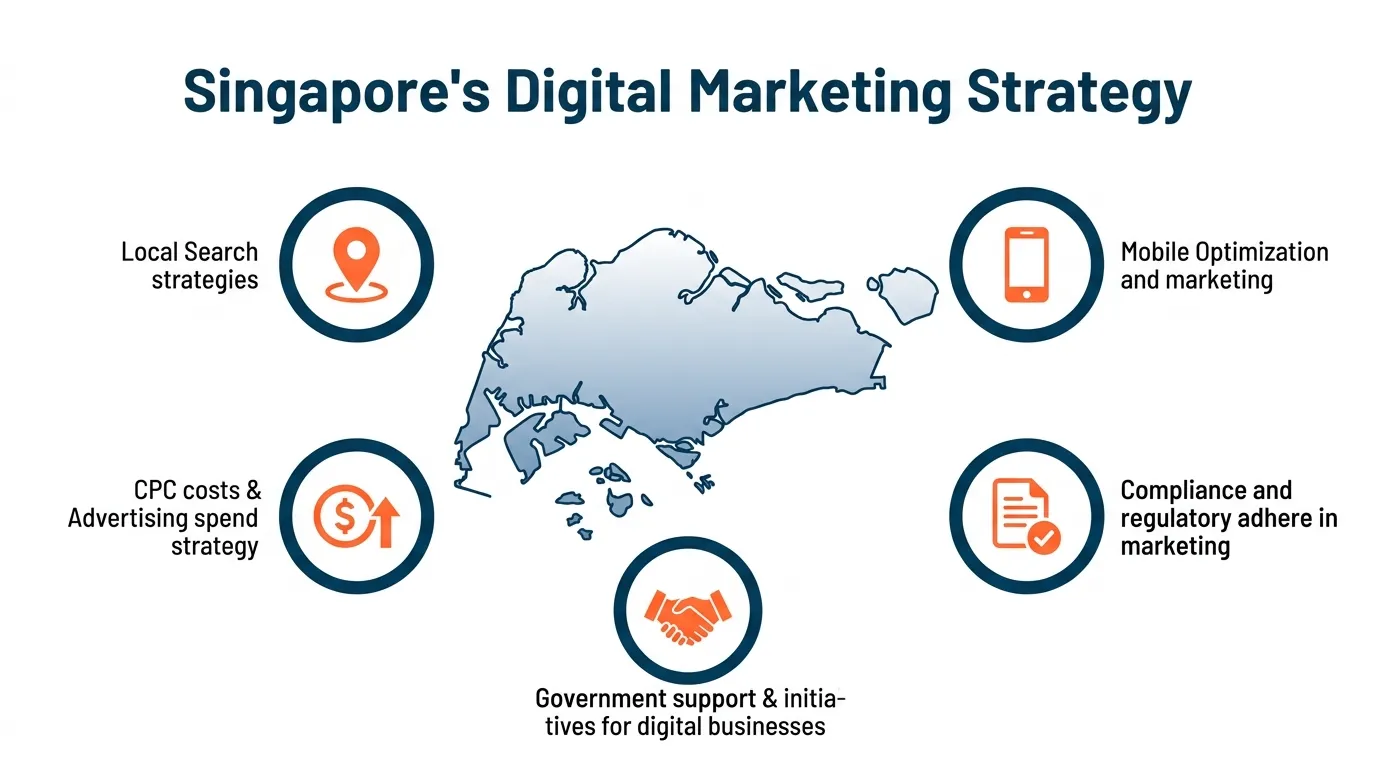
Singapore is a small market, but it is highly competitive. Search behaviour here has its own nuances, CPCs in key sectors are among the highest in Southeast Asia, and local intent signals matter more than most businesses account for.
If your strategy is built on global SEO advice without local calibration, you are likely leaving ground uncovered.
The Local Pack Matters More Than Most Businesses Realise
For any Singapore business serving customers in specific locations, the Google local pack is often more valuable than a page-one organic ranking. When someone searches “accountant in Tanjong Pagar” or “renovation contractor Bukit Timah,” the map pack appears before organic results.
Claiming and optimising your Google Business Profile is not optional if you operate locally. It is the most cost-effective SEO action available to most Singaporean SMEs and is frequently underutilised.
High CPCs Make SEO More Defensible
Singapore’s competitive sectors have some of the highest cost-per-click rates in Southeast Asia. Legal services, financial advisory, healthcare, and B2B technology services are all paying SGD $4 to $12 per click.
A law firm generating 50 leads a month from organic SEO effectively saves between $20,000 and $50,000 per month compared to acquiring those same leads through PPC.
This is the calculation I walk through with every professional services client. SEO is not a soft investment in brand building. In these sectors, it is a hard commercial decision with a quantifiable payback period.
Consumer Search Behaviour in Singapore
Singapore has one of the highest smartphone penetration rates in the world, and a significant proportion of local searches occur on mobile devices. This has two practical implications:
- Your site needs to load quickly and function well on mobile, both for user experience and for Google’s mobile-first ranking signals.
- And your Google Ads campaigns should account for mobile-specific bid adjustments and landing page behaviour.
PDPA and Remarketing
If you are running remarketing campaigns in Singapore, ensure your website’s cookie consent and data collection practices are compliant with the Personal Data Protection Act (PDPA). Remarketing that relies on tracking users without proper consent poses both legal and reputational risks. This is an operational detail that often gets missed in the excitement of campaign setup.
Government Grants and Support
Singapore SMEs may be eligible for government support schemes that subsidise digital marketing expenditure. The Productivity Solutions Grant (PSG) and Enterprise Development Grant (EDG) have historically covered digital marketing capabilities, including SEO services, for qualifying businesses.
It is worth checking with Enterprise Singapore or a qualified agency to confirm current eligibility before committing to a full programme budget.
The PPC VS SEO Debate Kills Your Time, Start Integrating Both
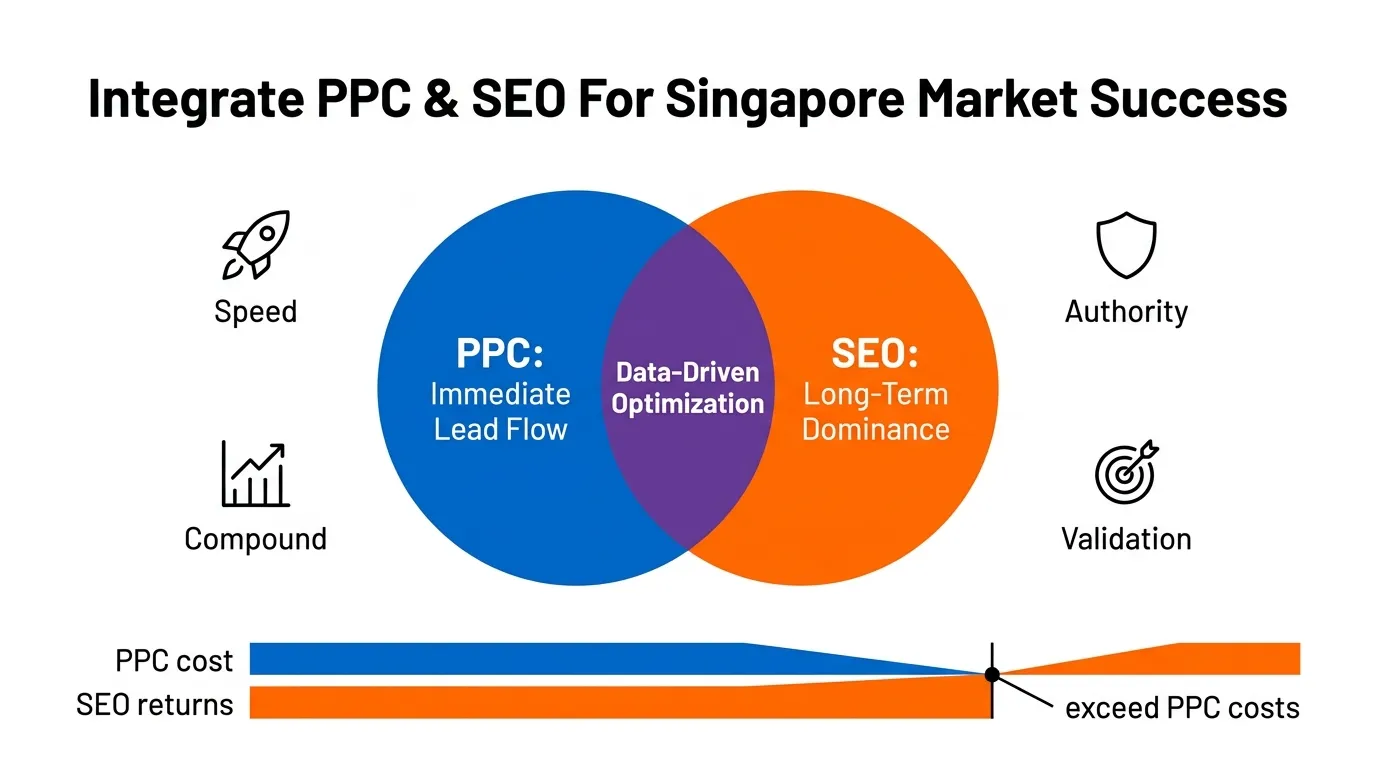
The PPC vs SEO debate is a false one for most Singapore businesses. The question is not which channel to choose. It is about sequencing and integrating them intelligently based on your stage, sector, competitive environment, and commercial goals.
PPC is rented visibility with immediate feedback. SEO is owned visibility with compounding returns. In a search environment where AI Overviews are compressing click rates across both channels, the businesses that hold their ground are those investing in content quality, brand authority, and a presence that AI systems are willing to cite.
The Singapore market adds specific urgency to this. High CPCs in professional services and B2B make SEO a commercially defensible long-term position. The local search pack is underutilised by most SMEs.
And the competitive density across sectors like legal, healthcare, and renovation means that the businesses starting their SEO programme today are the ones that will dominate organic search in two to three years.
Start PPC to validate and drive immediate lead flow. Build SEO to compound returns and achieve long-term cost efficiency. Use the data from each channel to sharpen the other. And do not wait until your ad budget runs out before considering the organic traffic you have to fall back on.
If you are working through this decision and want a clearer view of what a well-structured search strategy should look like for your specific business, a conversation with our team at MediaOne can help frame the options. We work with Singapore businesses across sectors on precisely this kind of strategic planning.
Frequently Asked Questions
How do AI Overviews affect my PPC and SEO investment?
Both channels are seeing lower click-through rates when AI Overviews appear. Being cited in an AI Overview significantly improves performance, making high-quality, authoritative content more commercially important than ever. For PPC, focus the budget on transactional queries where AI Overviews are less prevalent. For SEO, structure content so it can be easily cited by AI systems.
What is the minimum budget to test both PPC and SEO in Singapore?
For a credible test, budget SGD $1,500 to $2,500 per month for PPC to generate statistically meaningful data within 4 to 6 weeks. For SEO, a foundational programme from a reputable local SEO service typically starts at around SGD $1,500 per month. You can start both simultaneously, but understand that you are looking at different time horizons for results.
How do I know if my SEO agency in Singapore is actually performing?
Look beyond keyword position reports. Ask for organic traffic growth in Google Analytics, lead or conversion data from organic traffic specifically, Search Console performance trends, and the quality of content being produced. Poor SEO work is often characterised by lots of activity, keyword reports that show marginal movement, and no discernible change in leads or revenue. Good SEO shows up in your pipeline, not just your rank tracker.
Is PPC or SEO better for a new Singapore business?
For a brand-new business with no organic presence, PPC is the right starting point. It validates your offer, tests your messaging, and generates leads while you build your SEO foundations. The two should run in parallel, not in sequence. Starting SEO the same month you launch PPC means you are twelve months closer to organic traction when you eventually need it.
Does Google Ads performance affect SEO rankings?
Directly, no. Google has confirmed that paying for ads does not improve organic rankings. Indirectly, PPC campaigns can strengthen your SEO by generating data on converting keywords, improving brand search volume, and funding the content and link-building activities that drive rankings.