Ecommerce marketing is the set of activities that attract shoppers to an online store, persuade them to buy and keep them coming back. For Singapore businesses, it is no longer enough to run SEO, social, email and paid ads as separate jobs with separate budgets. The stores that grow connect these channels to one shared pool of customer data, so each channel learns from the others.
This guide explains how that loop works, gives you a scorecard to test whether your own channels feed it, and sets out a 90-day plan you can start this month.
Key Takeaways
- Treat ecommerce marketing as one customer-data loop, not as separate SEO, social, email and paid tactics that report in isolation.
- Score every channel on three questions: does it capture an identifier, does it feed a behavioural signal back, and does it measure revenue rather than clicks?
- Consolidate any channel that fails two or more of those questions before adding a new one.
- Email remains the cheapest revenue channel per dollar spent, returning roughly $36 to $42 for every $1.
- Roughly 70% of shopping carts are abandoned. Fix recovery before buying more traffic.
- Singapore’s market is marketplace-led — Shopee holds 48% of platform GMV — so decide early which platform owns the customer relationship.
What Ecommerce Marketing Is and Why It Matters Now
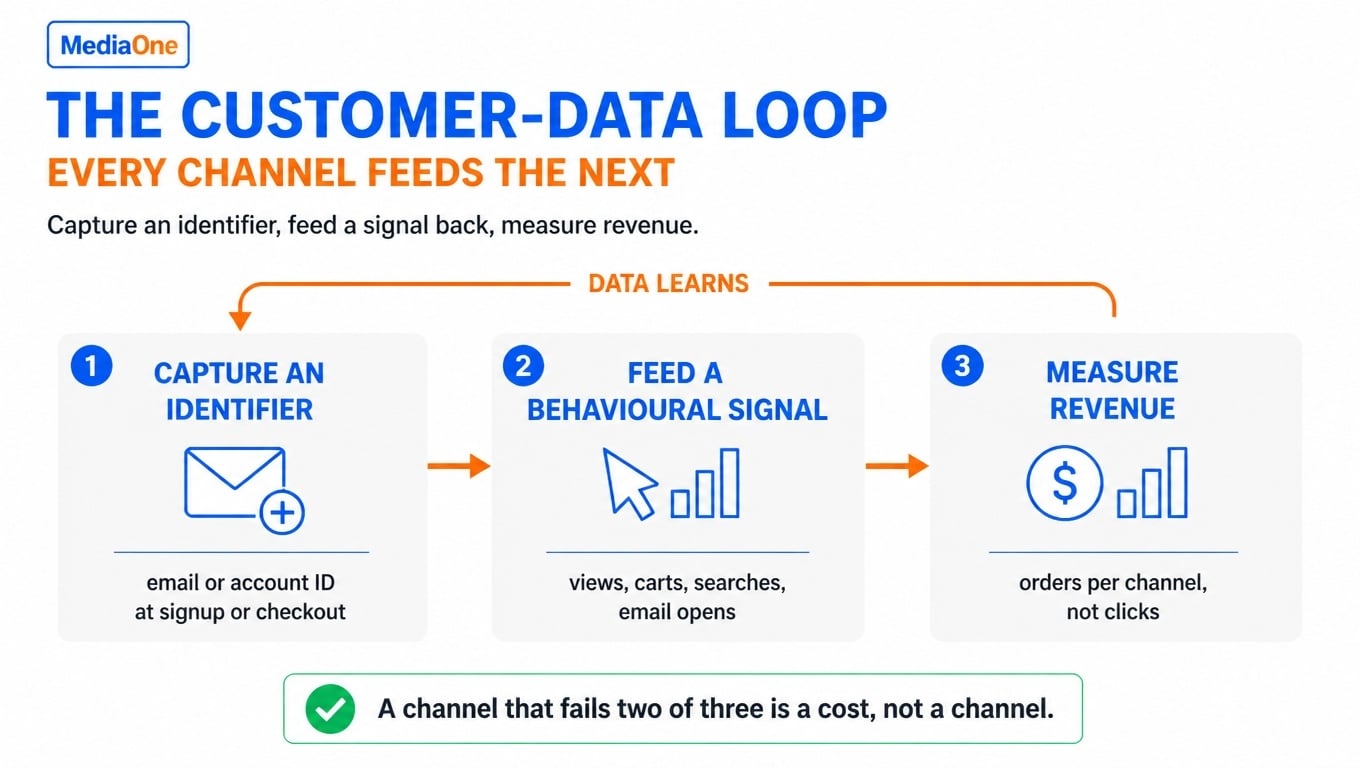
Ecommerce marketing covers search, content, social, email and paid ads. The usual mistake is to run each as a separate project with its own budget and its own reporting. A more useful view treats them as one customer-data loop, in which every channel captures a signal and passes it to the others.
Where Singapore sits in the market
Singapore’s ecommerce market is forecast to grow 17.7% in 2026 to around S$40.5 billion, according to GlobalData. But growth is not spread evenly across channels. Platform GMV is concentrated: Shopee held 48% of combined platform GMV in Singapore in FY2025, up from 45% the year before, per Cube Asia’s market data. WhiteBox’s 2026 Singapore statistics put Shopee at about 13.2 million monthly visits, ahead of Lazada at 6.2 million and Amazon at 5.0 million.
That concentration is why the platform decision comes before the channel decision. If your buyers transact on Shopee, your marketing job includes winning a marketplace listing.
What shoppers now expect
Shoppers expect the store to know them. Salesforce’s customer expectations research finds 73% of customers expect personalisation to improve as technology advances, and 88% say the experience a company provides matters as much as its products. Meeting that expectation requires data that links channels together — not more channels.
The Channel-to-Data Scorecard
This is the test the rest of the guide refers to. Score each channel you run from 0 to 2 on three questions, then read the total.
|
Question |
0 points |
1 point |
2 points |
|
Does it capture a customer identifier you own? |
No identifier at all |
Platform-owned only |
Email or account ID you can reuse |
|
Does it pass a behavioural signal to other channels? |
Nothing shared |
Manual export |
Automatic, near real time |
|
Does it report revenue, not just clicks? |
Clicks or impressions only |
Revenue with gaps |
Revenue per order, attributed |
|
Total |
Verdict |
|
5–6 |
Keep. This channel feeds the loop. |
|
3–4 |
Fix the weakest of the three questions within 30 days. |
|
0–2 |
Consolidate or cut. Do not add budget until it scores 3+. |
Run this before you read the channel sections below, and again after the 90-day plan. The score is the deliverable, not the reading.
The Main Channels, Judged by What They Feed
SEO and content marketing
Search brings in shoppers who already want what you sell, so product and category pages carry the weight. Our guide to optimising ecommerce category pages covers the pages that usually get neglected, and our ecommerce SEO complete guide covers the technical base. If you are on a hosted platform, Shopify SEO or WooCommerce marketing covers what you can and cannot control.
Scorecard note: search captures intent but rarely an identifier. It scores 2 on revenue, often 0 on identifier unless your site captures email before checkout.
Social media marketing
Social is strong for discovery and weak for capturing an identifier unless you direct people to an owned page. Treat social commerce forecasts as global projections rather than Singapore benchmarks — the local platform concentration described above matters more than any global percentage.
Scorecard note: typically 0 on identifier, 1 on signal, 0 on revenue. That is a 1 out of 6, which does not mean stop — it means social must route somewhere that does capture data.
Email marketing
Email has the lowest cost per sale of any channel here, returning an average of $36 to $42 for every $1 spent, per Omnisend’s 2026 ROI benchmarks, a range corroborated by Litmus’s 2025 email report. It only works if the list was built from shoppers who gave their details at checkout or on the site — see our EDM campaign planning guide and the email lifecycle stages that structure the sequence.
Scorecard note: the only channel that typically scores 6 out of 6. If your email platform is not receiving purchase data, that is the highest-value fix in this entire guide.
PPC and search ads
Paid search is standard practice: 92% of advertisers include search ads in their ecommerce plans, per Bridgewell’s ecommerce marketing guide. Its weakness is that it reports clicks well and revenue poorly unless the ad platform receives purchase data back from your store. Our ROAS guide shows how to read return on ad spend once that connection exists.
Scorecard note: scores 2 on revenue only after conversion tracking is wired back. Before that, it is an expensive click counter.
Ten Strategies, Ordered by Data Value
Each strategy below is judged on the same question: what does it add to the customer record?
1. Personalisation from your own data. The strongest lever, because it compounds. Start with browsing history and past orders, then tailor homepage banners, recommendations and email content. Salesforce’s 73% expectation figure above explains why it earns its cost.
2. Cart-abandonment recovery. Roughly 70% of shopping carts are abandoned before purchase, a rate that has held near that level for over a decade, according to Baymard Institute’s 2026 research. Send a reminder within hours, then retarget the same products on paid social. Our retargeting guide for Singapore covers the sequencing, and Klaviyo’s 2026 abandoned-cart benchmarks give realistic click rates for the flow itself. Measure recovered revenue separately so you know whether the sequence pays.
3. Reviews and social proof. Display reviews on product pages, not on a separate testimonials page. Our guide to the types of social proof that move Singapore buyers covers what to prioritise when you have few reviews.
4. Video and product demonstration. 62% of consumers favour video when learning about new products, reported by Marketing Dive. Short demonstrations of sizing, texture or setup are often the cheapest way to cut returns.
5. User-generated content. UGC adds proof on top of demonstration. Be careful with the conversion numbers circulating here — published lifts range from 29% to 161% depending on the study and category, so test on your own catalogue rather than budgeting against a headline figure. Our UGC marketing strategy guide sets out how to source and reuse it.
6. Affiliate and influencer partnerships. Pay on sales, not follower counts, and track each partner with a unique link or code. Our influencer campaign management guide covers tracking and payout structures.
7. Loyalty and bundles. Both raise average order value and repeat purchases. The retention economics are in our guide to keeping customers buying again.
8. Marketplace listings. Reach yes, customer data usually no. Route repeat buyers to your own site wherever the platform rules allow.
9. Conversion rate optimisation. Cheaper than more traffic when abandonment is the leak. Our CRO strategies guide and the CRO service page cover the testing sequence.
10. Measurement. Revenue per channel, not clicks. Our digital marketing KPI guide and customer acquisition cost formula give you the two numbers that decide whether a channel stays.
Customer Data: Transactional, Behavioural and Demographic
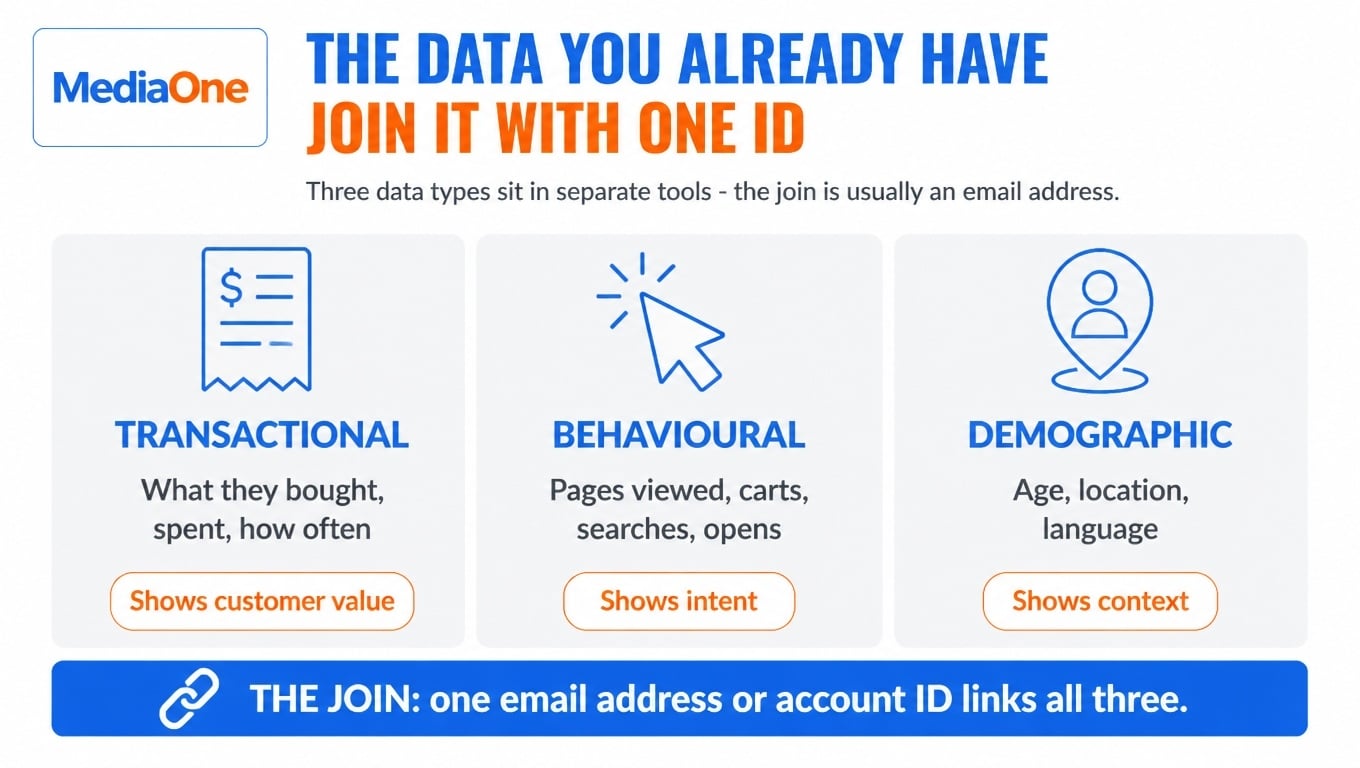
Most Singapore ecommerce businesses collect customer data without using it. The order system holds names and purchase histories, the website logs clicks, and ad platforms track engagement — yet the three sit in separate tools. Joining them to one identifier is where the gains are.
- Transactional data shows what a customer bought, how much they spent and how often. It is the most reliable signal of value and the basis for identifying repeat buyers.
- Behavioural data shows what a shopper did before buying or leaving: pages viewed, products added to cart, searches, email opens. It explains intent and is where abandonment becomes visible.
- Demographic data covers age, location and language preference. It is the least precise but helps with regional pricing, delivery messaging and bilingual content.
The join is usually an email address or account ID. Without it, a retargeting ad cannot know that the shopper has already bought.
Using customer data responsibly
Collect only what you need, say why you collect it, honour unsubscribe requests and keep the data secure. Under Singapore’s PDPA, consent and storage are a running cost of owning customer data, not a one-off check — see our digital marketing law guide for the obligations that apply.
AI and Emerging Trends
Where AI genuinely earns its place
Generative AI helps where it removes repetitive work: drafting product descriptions, producing first-pass ad variations, and structuring pages so search engines and AI answer engines can read them. The traffic signal is real and measurable: generative-AI referral traffic to US retail sites grew 4,700% year over year in July 2025, according to Adobe’s analysis. Adobe also found that AI-referred shoppers converted about 90% better than non-AI traffic — a quality signal worth more than the volume headline.
The risk sits in accuracy and brand voice. A model that invents a fabric, a battery life or a return policy creates a support problem and a trust problem at once. Use AI to draft, then check every specification against the supplier sheet before publishing.
Video and AI-driven discovery
The practical sequence for a Singapore seller is simple: film short demonstrations for your best sellers, invite buyers to post their own photos and reviews, and place both on the product page and in social placements. Track conversion rate by product, not overall, so you can see which formats earn sales.
Tools, Platforms and Getting Started
Most Singapore ecommerce teams do not need more tools. They need fewer tools that share customer data.
|
Function |
What to look for |
|
Storefront and checkout |
Native support for PayNow, cards and cash-on-delivery, since payment choice shapes abandonment |
|
Email and retargeting |
Automated abandoned-cart flows that log revenue back to the sender |
|
Analytics |
Revenue attribution by channel, not just sessions |
|
Reviews and UGC |
Collection and display of customer photos and ratings |
If you are still choosing a platform, our ecommerce website build guide and platform comparison cover the trade-offs, and our ecommerce web development service covers building it with tracking in place from day one.
The 90-day plan
|
Days |
Action |
Checkpoint to measure |
|
1–30 |
Score every live channel with the Channel-to-Data Scorecard. Stop or merge anything scoring 0–2. |
Number of channels scoring 3+ |
|
31–60 |
Connect store, email tool and analytics so one customer record carries purchases and browsing behaviour. |
Share of orders with a usable identifier |
|
61–90 |
Launch one abandoned-cart sequence, and measure recovered revenue against the 70% abandonment baseline. |
Recovered revenue, not open rate |
Measure one number at each checkpoint. Revenue per channel, not total clicks.
Grow Your Business Through Ecommerce Marketing
Ecommerce marketing is not a stack of separate tactics. The stores that grow treat every channel as a feed into one customer-data loop, where each SEO visit, email click, social engagement and paid-search conversion adds to a shared picture of the customer.
Start with the scorecard. List the channels you run, score each on identifier, signal and revenue, and consolidate anything that fails two or more. Then wire the data join, and only after that add budget.
If you want the loop audited against your own numbers, our ecommerce SEO team sets out what a managed engagement covers, or you can talk to us directly to discuss your business needs.
Frequently Asked Questions
What is the difference between ecommerce marketing and digital marketing?
Digital marketing covers all online promotion, including brand awareness and advertising for any business. Ecommerce marketing is narrower: it turns online visitors into paying customers on a store and measures success in orders and revenue. The two overlap heavily; the difference is the goal and the measurement.
Which channel should a small business start with?
Start with the channel that captures an identifier you can reuse, which for most small Singapore sellers means email. Set up a sign-up form and a welcome sequence before spending on ads. Then add search or social once you know which products convert. Score each channel before adding the next.
How much should a Singapore ecommerce business spend on marketing?
No benchmark applies to every seller, so set the budget from your margins. Work back from the customer acquisition cost you can afford, given average order value and gross margin. Test a small fixed amount per channel for four to six weeks, then shift spend toward channels that return revenue rather than clicks.
How do I know whether ecommerce marketing is working?
Track revenue, orders and return on ad spend by channel, not clicks or follower counts. Compare revenue against cost over the same period, and watch repeat purchase rate — a channel that brings back existing customers is often more profitable than one that only finds new ones. Where attribution is incomplete, compare periods with and without the campaign.
Is generative AI safe for ecommerce product content?
It can speed up descriptions, titles and image alt text, but its output needs human checking. Verify every specification, size, material and claim against supplier data — an error on a product page damages trust and causes returns. Keep a human editor in the approval step, and never publish AI-generated reviews or testimonials.