Shoppers often trust other shoppers more than brands. A UGC marketing strategy turns that trust into sales when it runs as an ongoing process rather than a one-off campaign. It works best when paired with the services that keep customer content flowing, and with reviews that give shoppers honest peer feedback, including on platforms such as TikTok.

Key Takeaways
- UGC works best as an always-on testing engine. Rotate creators and hooks on a fixed cadence instead of running one campaign and stopping.
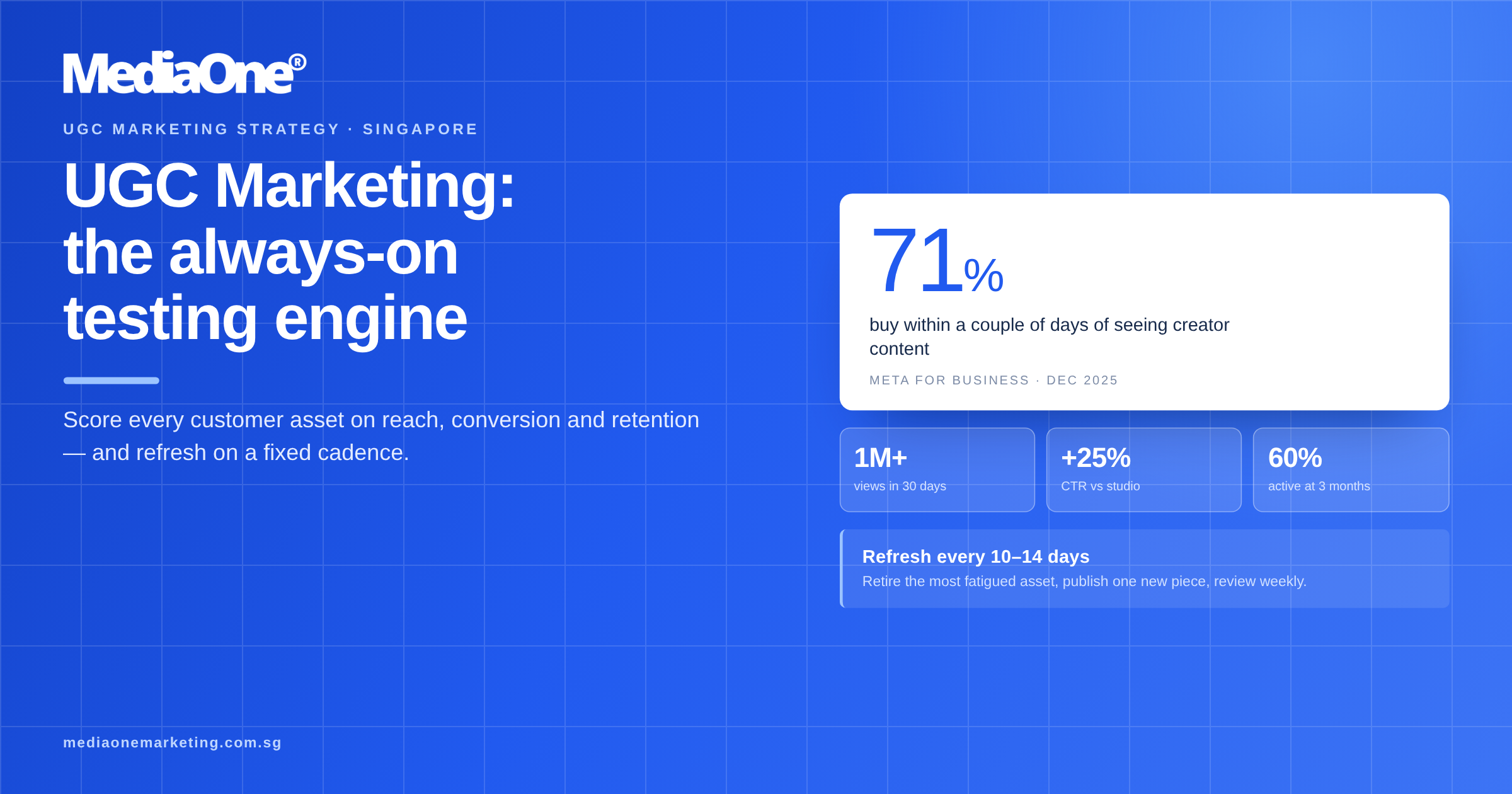
- Score every asset against three gates. Reach (1 million+ views in 30 days), Conversion (+25% CTR against studio creative) and Retention (at least 60% of participants active after three months).
- Refresh creative every 10 to 14 days. Retire the most fatigued piece and add one new one.
- Budget 10 to 15% of launch spend. That pool covers incentives, creator fees and amplification.
- Use micro-creators briefed on local use cases. HDB living, hawker dining, MRT commuting — specifics beat generic lifestyle shots.
- Measure in S$ per conversion. Review the scorecard weekly and move spend toward the creators earning it.
Why User-Generated Content Works Better Than Brand Content
User-generated content is any material about a brand that customers, followers or users create rather than the company. Its strength is credibility, and the newest numbers show how quickly it pays off.

Meta’s research found that 71% of consumers say they make a purchase within a couple of days of seeing creator content across its apps, and that 76% of Gen Z are open to hearing about brands from creators. BrightLocal’s 2025 consumer review survey found 96% of shoppers read online reviews at least sometimes, and only 4% never do. Shared across social media, those peer voices carry more weight than polished brand messaging.
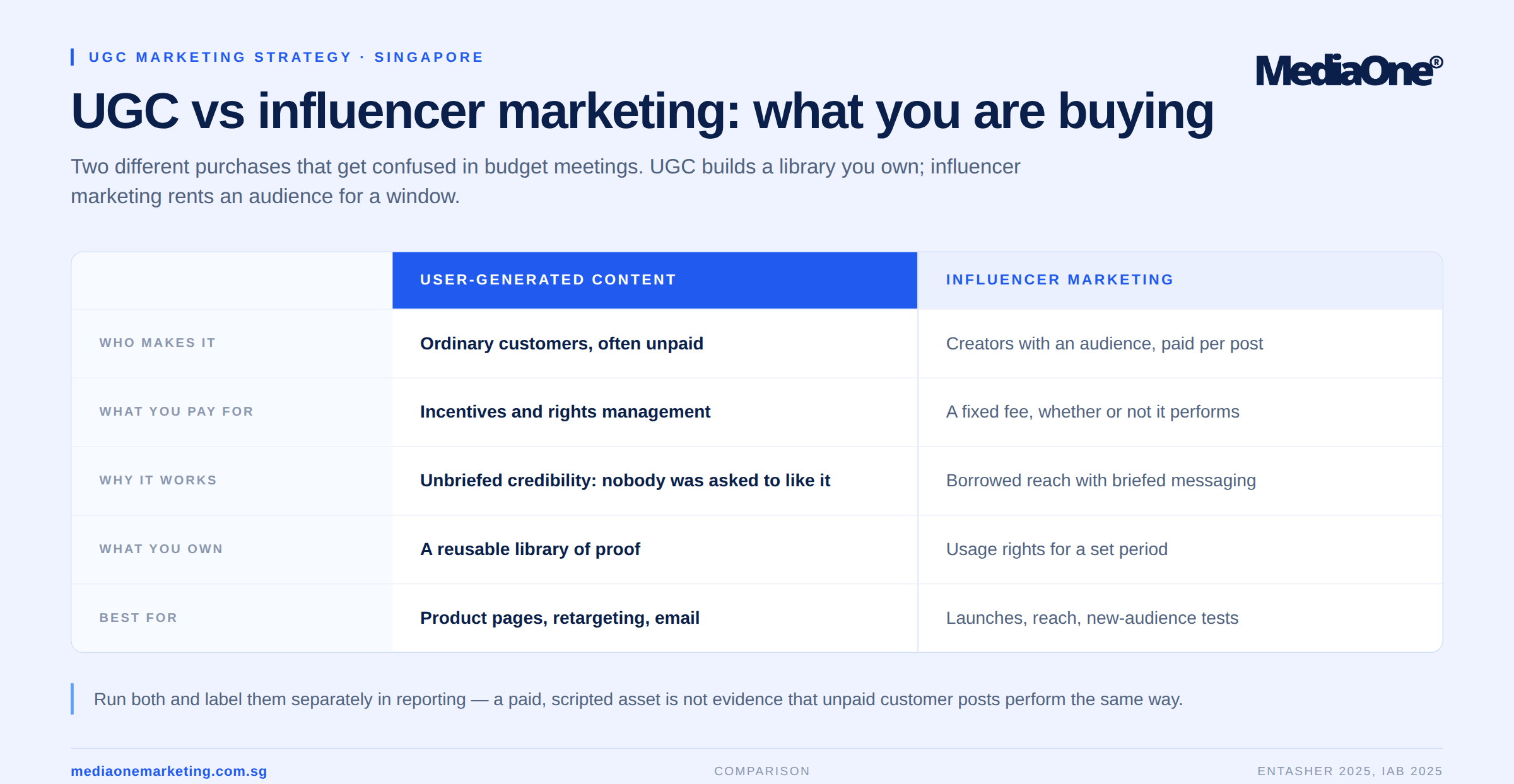
UGC is not the same as influencer marketing. Influencer content is paid and brief-driven; UGC comes from people who bought the product for their own reasons. Brands that run UGC well treat each submission as customer engagement, not just free content.
For a Singapore brand on a modest budget, run UGC as a testing engine. Judge each creator and hook on reach, conversion and retention, not on a single campaign result. A solid strategy turns each submission into a measurable test rather than a one-off asset.
Types of User-Generated Content and Where Each One Fits
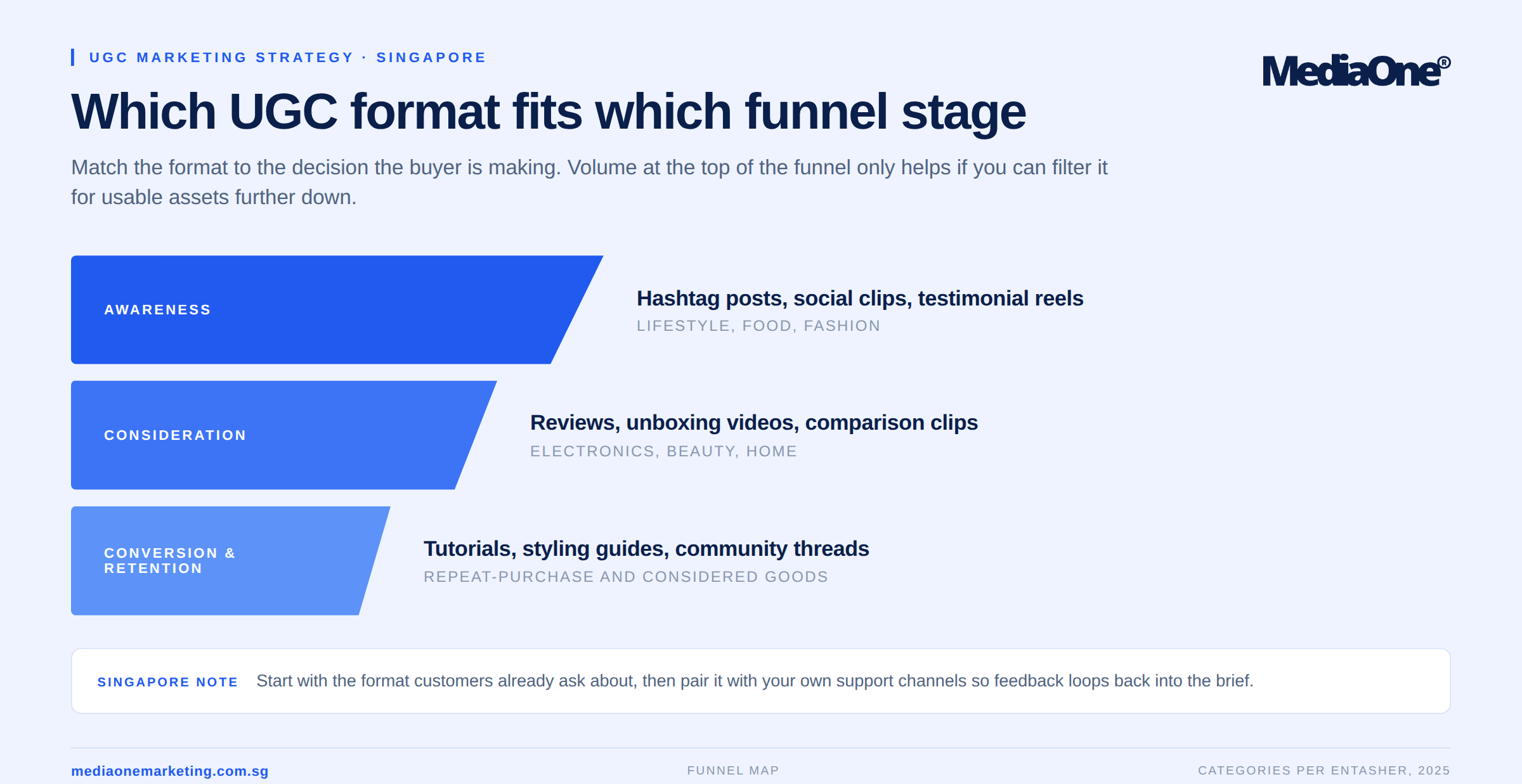
Reviews, photos and unboxing videos are the most direct proof of quality, and they work hardest near the point of purchase. BrightLocal’s 2025 survey found that over three-quarters of US consumers watch video when researching a business, and the format they watch most is video the business has posted itself. That is the gap a customer clip fills: a buyer’s own footage answers the question a brand video is least able to answer honestly.
There is a second reason the human voice still matters. Klaviyo’s 2026 consumer research found 32% of consumers say AI-generated marketing content makes them trust a brand less, with another 61% neutral. Customer content is the one asset in the mix that cannot be accused of being machine-made.
Social posts, hashtag campaigns and testimonials sit earlier in the funnel and build reach. Volume only helps if you can filter it for usable assets.
Tutorials, styling content and community discussion suit considered purchases and loyalty. Brands can also repurpose strong customer stories into case studies that show real results.
Table 1: UGC format by funnel stage
|
Funnel stage |
Best-fit formats |
Typical category |
|
Awareness |
Hashtag posts, social clips |
Lifestyle, food, fashion |
|
Consideration |
Reviews, unboxing videos |
Electronics, beauty, home |
|
Conversion and retention |
Tutorials, styling, community threads |
Repeat-purchase and considered goods |
For a Singapore brand on a modest budget, start with the format your customers ask about most. Many businesses pair this with their own support channels, so feedback loops back into the content. The channel-level view sits in this social media marketing guide for Singapore, and the collection and curation workflow is covered in how to leverage UGC for marketing.
Benefits of UGC Marketing for Brands
UGC offers three measurable benefits: stronger purchase intent, lower production costs and lasting customer trust.
Stronger purchase intent and conversion
71% of consumers say they make a purchase within a couple of days of seeing creator content, per Meta’s December 2025 research. The money follows the attention: IAB put US creator ad spend at $37 billion in 2025, up 26% year on year and growing about four times faster than the media industry overall, with 32% of brands naming online sales as the campaign goal and 40% of buyers ranking ROI as their top KPI. In Singapore, a review video set in a shared HDB kitchen often lands better than a generic studio shot, because buyers recognise their own homes.
Lower content production costs and faster creative refresh
Customers supply the raw material, so each asset costs less than a studio shoot. A steady flow lets you rotate hooks every two weeks instead of every quarter. Many marketing directors allocate 10 to 15% of launch spend to incentives, creator fees and amplification.
Here is how that split looks on a modest budget. A S$20,000 launch sets aside S$2,000 to S$3,000 at a 10 to 15% allocation, covering incentives, creator fees and amplification. Divide that pool by the conversions it produces, and you have your S$ per conversion. If the figure rises week on week, pause spend on the weakest creator before adding more.
Audience trust and community loyalty
Entasher’s loyalty benchmark is at least 60% of participants still active after three months. Retention like that happens when people feel their contribution is noticed and credited. It also strengthens the community and gives each new content effort an audience already inclined to take part.
Building a UGC Marketing Strategy, Step by Step
The most common planning error is treating UGC as a one-off campaign. For Singapore brands on modest budgets, the approach that holds up is an always-on testing engine built around awareness, conversion and loyalty.
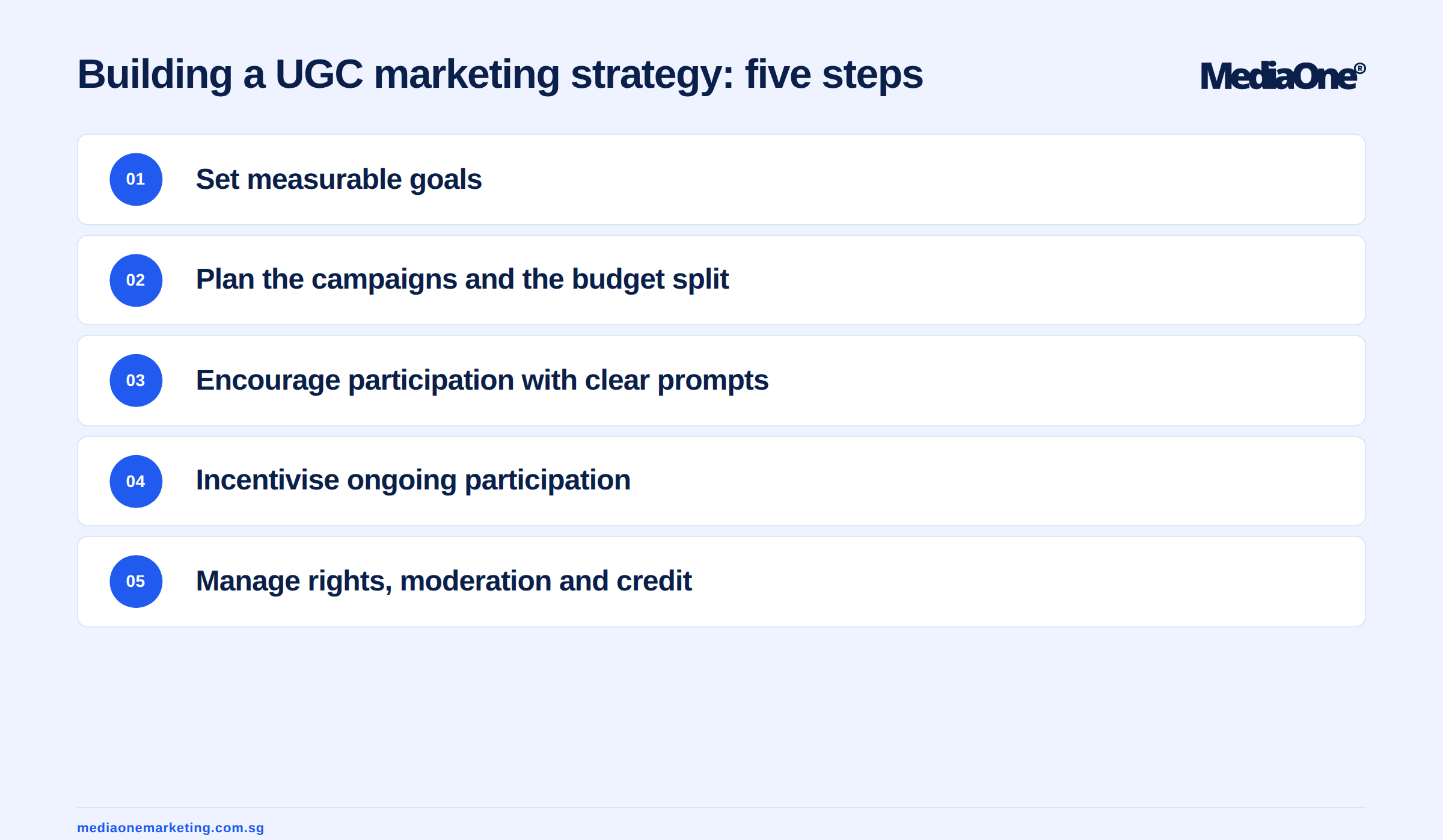
Step 1: Set measurable goals. Tie each goal to a benchmark you can track: 1 million or more views within 30 days for awareness, a click-through rate 25% above studio creative for conversion, and at least 60% of participants still active after three months for loyalty. These are planning targets from Entasher’s guide, not guaranteed results. Set your own baselines first.
Step 2: Plan the campaigns and the budget split. Reserve 10 to 15% of launch spend for incentives, creator fees and paid amplification, and keep part of that pool for promoting whatever wins.

Step 3: Encourage participation with clear prompts. Give users one specific task, such as a short demo set in an HDB kitchen or a hawker-centre meal. Vague briefs produce content you cannot use.
Step 4: Incentivise ongoing participation. Reward effort with product access or visibility rather than cash alone, so contributors still see what they share as genuine.
Step 5: Manage rights, moderation and credit. Get written usage rights before reposting, moderate comments, and credit each creator by handle so they are willing to share again.
Putting UGC to Work Across Your Channels
Customer content works best where buying decisions happen. That’s why retargeting it works better than posting it.
Using UGC in paid ads and rotating creative to beat fatigue
Ad fatigue sets in quickly in a small market. Rotate hooks every two weeks and shift 25 to 40% of weekly spend towards the creators whose assets are winning. When click-through drops week on week while frequency climbs, retire that asset.
Featuring customer content on product pages
Place two or three verified customer clips near the add-to-cart button. Keep a gallery page that sorts content by use case, such as HDB living or hawker-centre dining.
Building UGC email drip campaigns
After purchase, send a short sequence inviting customers to share a photo. Feature the best submissions in the next newsletter, and turn the strongest into case studies that show prospects real results.
Collaborating with micro-creators
Micro-creators — commonly defined as accounts with roughly 1,000 to 50,000 followers — often suit modest budgets better than national personalities. Brief each one on a single Singapore use case and judge results by S$ per conversion. The planning and pricing side is set out in this guide to Instagram influencer marketing in Singapore.
Inspiring customer content: incentives, prompts and formats
- Incentives: product access, early previews or featured placement. Keep the reward proportionate.
- Prompts: one specific task per post, such as “show how you cook with it in a small kitchen”.
- Formats: a branded hashtag with a single theme, or a monthly challenge with a featured winner.
Keep the ask under a minute, and reply to every submission.
Measuring Results and Avoiding Common Mistakes
For a Singapore brand on a modest budget, the test is simple: does each piece of content earn its keep? Score each asset and creator against three gates, reviewed weekly. Used well, the scorecard tells you where spend deserves more money, and which creators are worth returning to.
Reach. Aim for 1 million or more views within 30 days. Check what that reach costs: IAB’s November 2025 report shows creator ad spend rising 26% year on year, about four times the growth of the media industry overall.
Conversion. Target click-through at least 25% above studio creative, and treat refresh rate as part of the benchmark: TikTok’s January 2025 creative report found advertisers who refresh creatives weekly see 10 to 12% higher conversions, and campaigns running five to seven creatives carry a 1.5x performance advantage. Give each asset its own tracked link or promo code and record cost per conversion in S$.

Retention. Track the share of participants still active after three months against a 60% benchmark, then against your own baseline. Steady engagement over that period suggests you are building loyalty rather than producing one-off clicks.
Common pitfalls
- Creative fatigue. Rotate hooks fortnightly and shift 25 to 40% of spend towards winning creators each week.
- Unvetted content. Check every post for accuracy, safety and brand fit before it runs as an ad.
- Weak rights clearance. Get written permission to reuse each asset, with scope and duration stated.
Turning Customers into Your Content Engine
For a Singapore brand on a modest budget, user-generated content works best as ongoing testing, not a one-off campaign. Rotate creators and hooks on a fixed schedule, and score every asset on Reach, Conversion and Retention. Winners keep budget; losers get rebriefed or retired.
Start small with micro-creators on Singapore-relevant use cases such as HDB living, hawker-centre dining or MRT commuting. Review the scorecard weekly and shift 25 to 40% of spend towards winners. Every 10 to 14 days, retire the most fatigued content and add one new piece. If you would rather not run the loop in-house, a digital marketing agency in Singapore can hold content, paid media and measurement under one contract.
Frequently Asked Questions
What is the difference between UGC and influencer marketing?
UGC is content made by ordinary customers, usually shared without payment and often rights-cleared for reuse. Influencer marketing is paid promotion by creators with an audience, briefed and compensated per post. Many brands use both: UGC builds a library of proof, while micro-creators add reach. Influencer fees are a fixed cost per post, while UGC costs sit in incentives and rights management.

How much should a brand spend on a UGC campaign?
Many marketing directors allocate 10 to 15% of launch spend, covering incentives, creator fees and amplification, according to Entasher. On a S$20,000 launch, that is S$2,000 to S$3,000. Reserve part of it for paid promotion of assets that clear your Reach and Conversion gates.
Which UGC format converts best?
Product review videos tend to convert strongly, and reviews placed near the add-to-cart button are the most direct test. Pair review formats with retargeting, meaning ads shown to past buyers, and test them against studio creative with your own control group rather than relying on a borrowed benchmark.
How do I get customers to create content without paying them?
Make participation easy with a clear prompt, a single hashtag and a low-effort first step. Recognition, such as featuring the post on your product page, often works alongside a small perk. Keep the reward proportionate so the content still reads as genuine.
Do I need permission to reuse customer content in ads?
Yes. Obtain written rights before using a customer’s photo, video or review in paid ads. Record the scope — channels, duration, paid or organic use — and credit the creator. Rights clearance is one of the most common gaps in UGC programmes.
How long should a UGC campaign run?
Run it as an ongoing programme rather than a fixed window. Retire and replace creative every 10 to 14 days to limit fatigue, review the scorecard weekly, and track loyalty over three months. Entasher cites a benchmark of at least 60% of participants active after three months; treat it as a planning target and set your own baseline.