| AI Summary
Social media marketing helps Singapore businesses build brand awareness, engage target audiences, generate leads and increase sales through strategic content and targeted campaigns. This guide explores how to choose the right platforms, create engaging content, manage online communities, optimise paid advertising and measure return on investment (ROI). Learn how to develop a data-driven social media strategy that strengthens customer relationships, improves campaign performance and supports sustainable business growth. |
Social media marketing helps Singapore businesses build brand awareness, connect with customers, generate leads and increase sales. Yet simply posting regularly is not enough. Without a clear strategy, meaningful engagement and reliable measurement, businesses can spend hours creating content without seeing tangible results.


This guide explains how to develop a social media strategy for the Singapore market, choose the right platforms, create engaging content, manage paid campaigns and measure return on investment (ROI).
Whether you are launching your first campaign or refining an established social media presence, these practical steps can help you make better decisions and build a more sustainable marketing approach.

What Is Social Media Marketing and Why Does It Matter?
Moving beyond posting
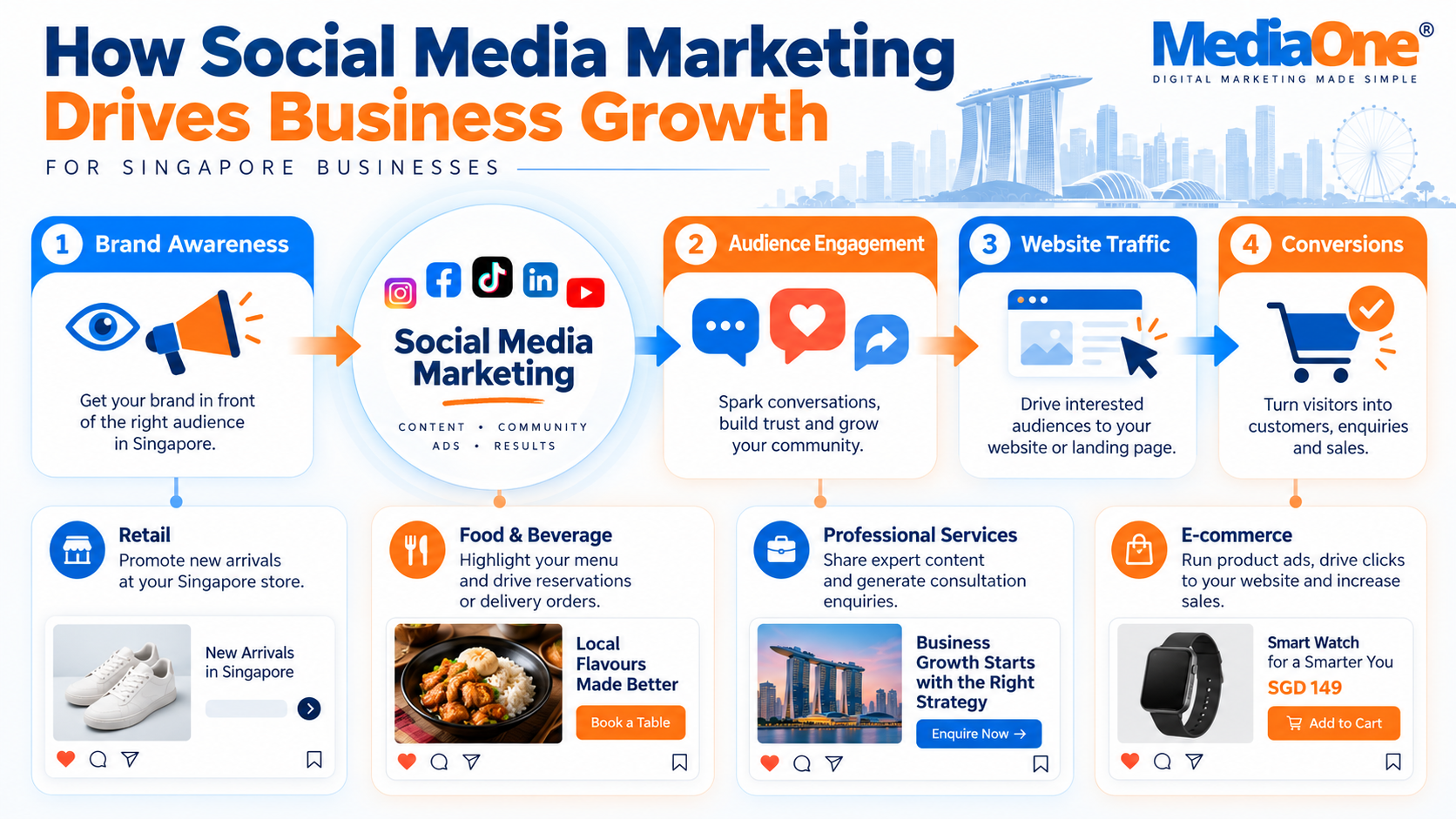
Social media marketing includes paid and organic activities on platforms such as Facebook, Instagram, TikTok and LinkedIn. These activities help businesses:
- Build brand awareness and credibility.
- Engage with existing and potential customers.
- Drive traffic to websites and online stores.
- Generate enquiries, leads and sales.
- Gather customer feedback and market insights.
- Strengthen customer relationships and retention.
Unlike traditional advertising, social media allows businesses to interact with customers directly and respond to feedback quickly. Comments, shares, direct messages and audience behaviour can reveal what people want and which messages resonate.
Why Singapore businesses should pay attention
Singapore’s digitally connected market creates opportunities for businesses to reach local audiences through social platforms. However, competition for attention is intense.
Businesses need more than a profile and occasional promotional posts. They need relevant content, consistent communication and a clear understanding of their target customers.
When implemented effectively, social media marketing can support three important business outcomes:
- Customer acquisition: Attract relevant prospects and turn them into customers.
- Customer retention: Maintain relationships through useful content, support and community engagement.
- Market insights: Use audience feedback to understand customer needs, objections and preferences.
Social media should therefore be treated as a business channel, not simply a place to publish updates.
Businesses looking for professional support can explore social media marketing services to develop a strategy aligned with their marketing goals.
Understanding Singapore’s Social Media Landscape
Which platforms should your business use?
You do not need to maintain an active presence on every platform. Focus on the channels where your target customers are most likely to discover, evaluate and purchase your products or services.
| Platform | Best suited for | Content to consider |
|---|---|---|
| Local businesses, community engagement and customer service | Community posts, videos, offers and customer updates | |
| Retail, lifestyle, beauty, food and visual brands | Reels, Stories, carousels and product demonstrations | |
| TikTok | Brands targeting audiences who enjoy short-form video | Tutorials, demonstrations, creator collaborations and entertaining videos |
| B2B companies, professional services and recruitment | Industry insights, case studies, expert commentary and business updates | |
| Customer communication and relationship management | Service updates, customer support and permission-based messages |
These are general use cases, not strict rules. The best platform depends on your audience, industry, resources and business objectives.
Understand local audience preferences
Singapore’s multicultural audience may respond differently to language, cultural references and content styles. According to the Infocomm Media Development Authority (IMDA), Singapore’s digital media landscape provides useful context for understanding how people engage with digital content. Businesses should use audience insights and campaign data to determine which languages, messages and content formats resonate with their specific customers.
Consider these factors when developing your strategy:
- Language: English may suit a broad audience, while Mandarin, Malay or Tamil content may be relevant to specific customer segments.
- Local relevance: Singapore-specific examples, seasonal promotions and familiar locations can make content more relatable.
- Trust: Customer testimonials, demonstrations and transparent responses to questions can help establish credibility.
- Convenience: Clear product information, responsive customer service and straightforward purchase journeys can reduce friction.
Rather than making assumptions about your audience, use platform analytics, customer feedback and campaign results to validate your decisions.
Developing a Social Media Strategy That Converts
A practical social media strategy starts with business goals and works backwards to the content, platforms and metrics that support them.

Step 1: Define measurable objectives
Set objectives that connect social media activity to a business outcome.
For example:
- Increase qualified website enquiries by 20% over three months.
- Generate 20 qualified B2B leads per month through LinkedIn.
- Increase online purchases attributed to Instagram campaigns.
- Reduce repetitive customer service enquiries by publishing helpful FAQs.
Avoid relying on vague objectives such as “get more followers” or “increase awareness” without defining how success will be measured.
Step 2: Audit your existing accounts
Review your current social media performance before investing in new campaigns.
Assess:
- Follower growth and audience demographics.
- Engagement, including comments, shares and saves.
- Website clicks and landing-page visits.
- Leads, purchases or other conversions.
- Posting frequency and content quality.
- Response times for comments and direct messages.
This audit establishes a baseline and helps identify which activities deserve more attention.
Step 3: Choose one to three priority platforms
Start with the channels that best match your audience and objectives.
For example, a fashion retailer might prioritise Instagram and TikTok, while a B2B consultancy may focus on LinkedIn.
Concentrating on fewer platforms allows your team to develop stronger content, maintain a consistent schedule and respond to customers more effectively.
Expand only when you have the resources to maintain the additional channels and evidence that they can contribute to your goals.
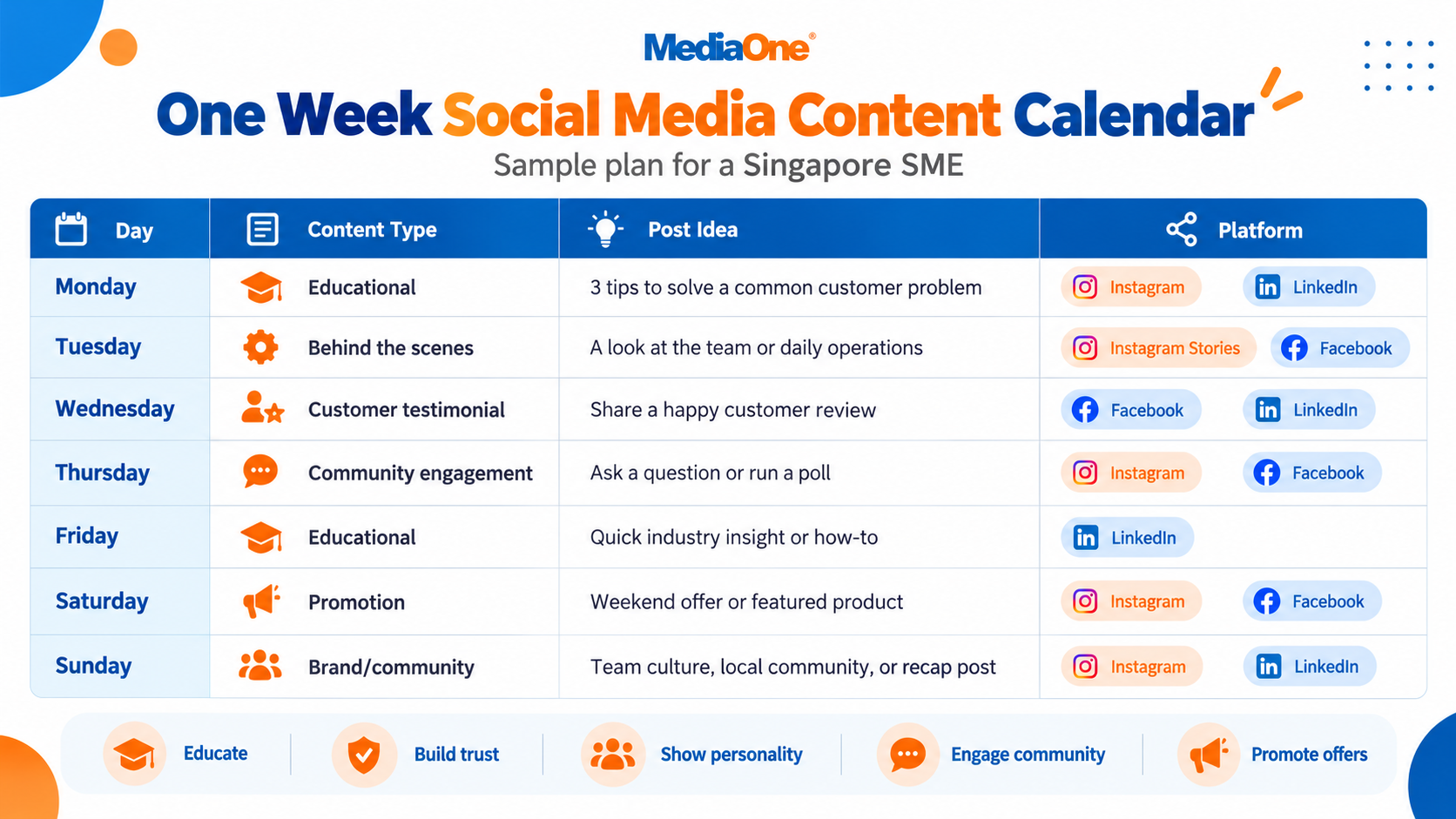
Step 4: Create a manageable content calendar
Plan content several weeks ahead rather than deciding what to post each morning.
A monthly calendar can include:
- Publishing date and platform.
- Topic and content format.
- Target audience and objective.
- Caption and call to action.
- Person responsible for approval.
- Performance notes after publication.
For many businesses, three to four quality posts per week is a reasonable starting point. Adjust this frequency according to your resources, audience response and platform requirements.
Scheduling tools can help, but leave room for timely updates and genuine conversations.
Step 5: Establish a measurement framework
Choose metrics that reflect your objectives.
| Objective | Useful metrics |
|---|---|
| Awareness | Reach, impressions and relevant audience growth |
| Engagement | Comments, shares, saves and video completion rate |
| Website traffic | Link clicks, landing-page sessions and click-through rate |
| Lead generation | Qualified enquiries, form submissions and cost per lead |
| Sales | Attributed revenue, customer acquisition cost and return on ad spend |
Review results regularly and use the findings to adjust your content and campaigns. Avoid changing your entire strategy because of one underperforming post.
Content Types That Encourage Engagement and Conversions
A strong content strategy balances useful information, community interaction, brand personality and promotional messages.
Educational content
Tutorials, practical tips, explainers and step-by-step demonstrations help audiences solve problems while establishing your business as a useful resource.
Examples include:
- A retailer demonstrating how to choose or use a product.
- A financial professional explaining a common budgeting question.
- A service provider answering frequently asked customer questions.
- A B2B company sharing lessons from a completed project.
Short-form videos and carousel posts can work well for educational content. Measure saves, shares, meaningful comments and subsequent website visits to assess whether the content is useful.
User-generated content and customer testimonials
Customer reviews, photographs and product demonstrations can provide social proof and show how people use your products or services.
Encourage customers to share their experiences, and obtain permission before reposting their content. Be transparent about incentives or paid partnerships where applicable.
User-generated content can also supplement your content calendar, although it should not replace a consistent, planned content strategy.
Behind-the-scenes content
Show the people, processes and decisions behind your business.
Ideas include:
- Introducing team members.
- Demonstrating how a product is made or prepared.
- Sharing the process behind a new launch.
- Explaining how your business addresses customer feedback.
Authentic content can help customers understand your brand and build a stronger connection with your team.
Trends and platform-specific formats
Trending sounds, challenges and popular formats may help a post reach new audiences, particularly on short-form video platforms.
However, trends should fit your brand and audience. Do not participate simply because a format is popular.
Test different approaches and use your own performance data to determine which formats work best.
Events and promotional campaigns
Product launches, webinars, seasonal offers and local events can support a coordinated series of posts.
A campaign might include:

- A teaser introducing the upcoming announcement.
- A launch post explaining the offer or event.
- Reminder posts before the deadline.
- Live updates or audience interaction.
- A recap featuring results, highlights or customer feedback.
Make the offer, deadline and next step clear. If the objective is a sale or registration, link directly to the relevant page.
Building an Engaged Social Media Community
Focus on meaningful engagement
Follower count alone does not show whether your audience is interested in your business.
An engaged audience may comment, share useful content, click through to your website, ask questions or make purchases. These actions provide more insight into content effectiveness than follower growth alone.
Track engagement alongside relevant business outcomes. Benchmarks vary by platform, industry, account size and audience, so establish a baseline using your own data before comparing performance with others.
Encourage genuine conversations
Ask specific questions that are easy for your audience to answer.
For example, a restaurant might ask, “Which local dish would you like to see on our next menu?” rather than simply asking, “What do you think of our brand?”
You can also encourage interaction through:
- Polls and quizzes.
- Question-and-answer sessions.
- Follow-up questions in comment threads.
- Customer stories and community features.
- Live sessions addressing common concerns.
Respond naturally instead of relying on generic replies. The aim is to build relationships, not to generate comments for their own sake.
Respond to feedback and complaints
Monitor comments and direct messages consistently, and set a realistic response-time target for your team.
When handling a complaint:
- Acknowledge the customer’s concern.
- Respond calmly and professionally.
- Explain the next step or offer a suitable solution.
- Move sensitive account or personal details to a private channel.
- Follow up and record recurring issues for internal review.
Do not automatically delete criticism simply because it is negative. Follow your moderation policy, remove abusive or inappropriate content where necessary, and address legitimate complaints constructively.
When developing moderation and response procedures, businesses should also consider Singapore’s online safety framework. As outlined in resources from IMDA, online safety is an important part of Singapore’s digital environment. Businesses should establish clear moderation guidelines, respond constructively to legitimate concerns and review applicable requirements when managing online interactions.
Collaborate with relevant creators and partners
Influencer partnerships can help a business reach an audience that already has an interest in its products or services.
Evaluate potential partners based on:
- Audience relevance and location.
- Quality of comments and interactions.
- Content style and brand suitability.
- Previous campaign performance.
- Deliverables, usage rights and fees.
- Clear reporting and agreed success metrics.
Smaller creators can be a good fit for niche campaigns, but follower count alone does not guarantee engagement or sales. Assess each partnership on its likely value to your business.
Paid Social Media Advertising: Where to Start
Organic content helps build a presence over time, while paid advertising can extend reach and test specific offers with selected audiences.
Paid campaigns are not automatically necessary for every business. Consider them when you have a clear objective, a suitable offer, a relevant landing page and a way to measure results.
Businesses seeking specialist help with paid campaign planning and optimisation can learn more about MediaOne’s social media marketing services.
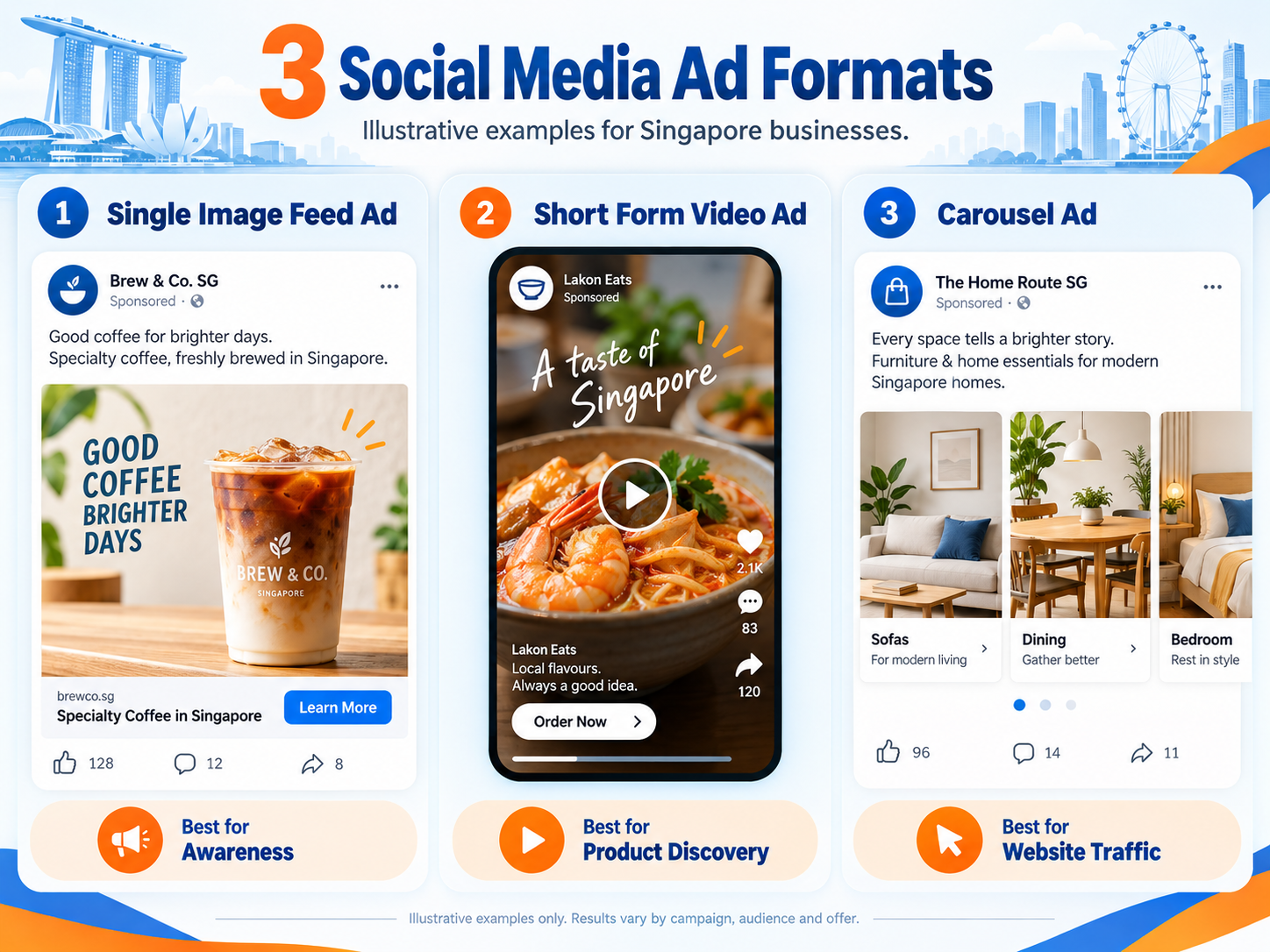
Image ads
Single-image ads can communicate an offer or product benefit quickly. They are often straightforward to produce and test.
Video ads
Video can demonstrate a product, introduce a service or feature a customer testimonial. The opening seconds should give viewers a reason to continue watching.
Carousel ads
Carousel ads display multiple cards, allowing businesses to showcase product options, explain a process or tell a story across several slides.
No format guarantees lower costs or higher conversions. Performance depends on the creative, audience, offer, campaign objective and placement.
Target audiences thoughtfully
Use the targeting options available on your chosen platform to reach relevant users.
- Facebook and Instagram: Consider location, interests, customer lists where permitted, and eligible audience-expansion features.
- TikTok: Test different creative concepts and available audience settings to determine which combinations perform best.
- LinkedIn: Consider professional attributes such as industry, job role, seniority and company size for B2B campaigns.
When using customer data for audience targeting, businesses should consider Singapore’s applicable data protection requirements. According to the Personal Data Protection Commission (PDPC), Singapore’s personal data protection framework governs how organisations handle personal data. Review the relevant requirements before collecting, using or disclosing personal data for marketing activities.
Set a controlled testing budget
Choose a budget you can afford to test without jeopardising other business needs.
For example, an SME might set aside S$300–S$500 for an initial campaign, depending on the platform, objective and expected cost of acquiring a customer. This is an illustrative starting point, not a guarantee that the budget will produce sufficient data or sales.
Before launching, decide:
- How much you are willing to spend.
- Which result you want to achieve.
- What cost per lead or acquisition is acceptable.
- How long the test will run.
- What evidence will justify increasing or reducing spend.
Avoid scaling a campaign simply because it receives clicks. Confirm that those clicks lead to relevant enquiries, purchases or another meaningful outcome.
Measure and optimise paid campaigns
Track the metrics most relevant to your campaign:
- Cost per click (CPC): Advertising spend divided by clicks.
- Click-through rate (CTR): Clicks divided by impressions.
- Cost per lead (CPL): Advertising spend divided by leads generated.
- Cost per acquisition (CPA): Advertising spend divided by acquired customers.
- Return on ad spend (ROAS): Attributed advertising revenue divided by advertising spend.
Test one major variable at a time, such as the creative, headline, audience or offer. Allow enough time and data for a meaningful comparison, taking the campaign objective and sales cycle into account.
Pause or revise campaigns that consistently miss your targets, but investigate tracking issues and conversion barriers before concluding that the advertising itself is the problem.
Tools and Systems for Managing Social Media
The right tools help your team plan content, understand performance and coordinate work without adding unnecessary complexity.
Content scheduling
Tools such as Buffer, Later and Hootsuite can help teams plan and schedule posts. Native scheduling options may be sufficient for businesses managing only a few accounts.
Choose a tool based on the platforms you use, approval requirements, reporting needs and budget.
Analytics and reporting
Start with the analytics tools provided by your social platforms. Review reach, engagement, clicks and conversions at regular intervals.
Where appropriate, use website analytics with properly configured campaign tracking to understand what happens after people click a social post or advertisement. According to Google Analytics’ guidance on campaign URL parameters, adding campaign parameters to destination URLs can help identify the sources and campaigns associated with website traffic.
A concise monthly report should explain:
- What content performed best.
- Which channels generated useful traffic or leads.
- Whether campaign objectives were achieved.
- What the team learned.
- What should change next month.
Social listening and audience insights
Review comments, customer questions, brand mentions and recurring feedback. These signals can reveal concerns and content opportunities.
Businesses with more complex monitoring needs may consider dedicated listening tools. Smaller teams can begin with native platform features and a simple record of customer feedback.
Team collaboration and approvals
A shared spreadsheet or project management tool can coordinate content production and approvals.
Document your brand voice, approval responsibilities, publishing schedule and response guidelines. This reduces inconsistencies when several people contribute to your social media accounts.
Measuring ROI and Connecting Social Media to Revenue
Social media metrics are most useful when they explain how marketing activity contributes to business results.
Use a three-layer measurement model
Layer 1: Awareness
Examples include reach, impressions and follower growth. These indicate whether content is being seen.
Layer 2: Engagement and traffic
Examples include comments, shares, saves, link clicks and website sessions. These help explain how people respond to content.
Layer 3: Business outcomes
Examples include qualified leads, sales, customer acquisition cost, attributed revenue and customer lifetime value.
Report business outcomes alongside awareness and engagement metrics. Use the earlier layers to investigate why results are improving or declining.
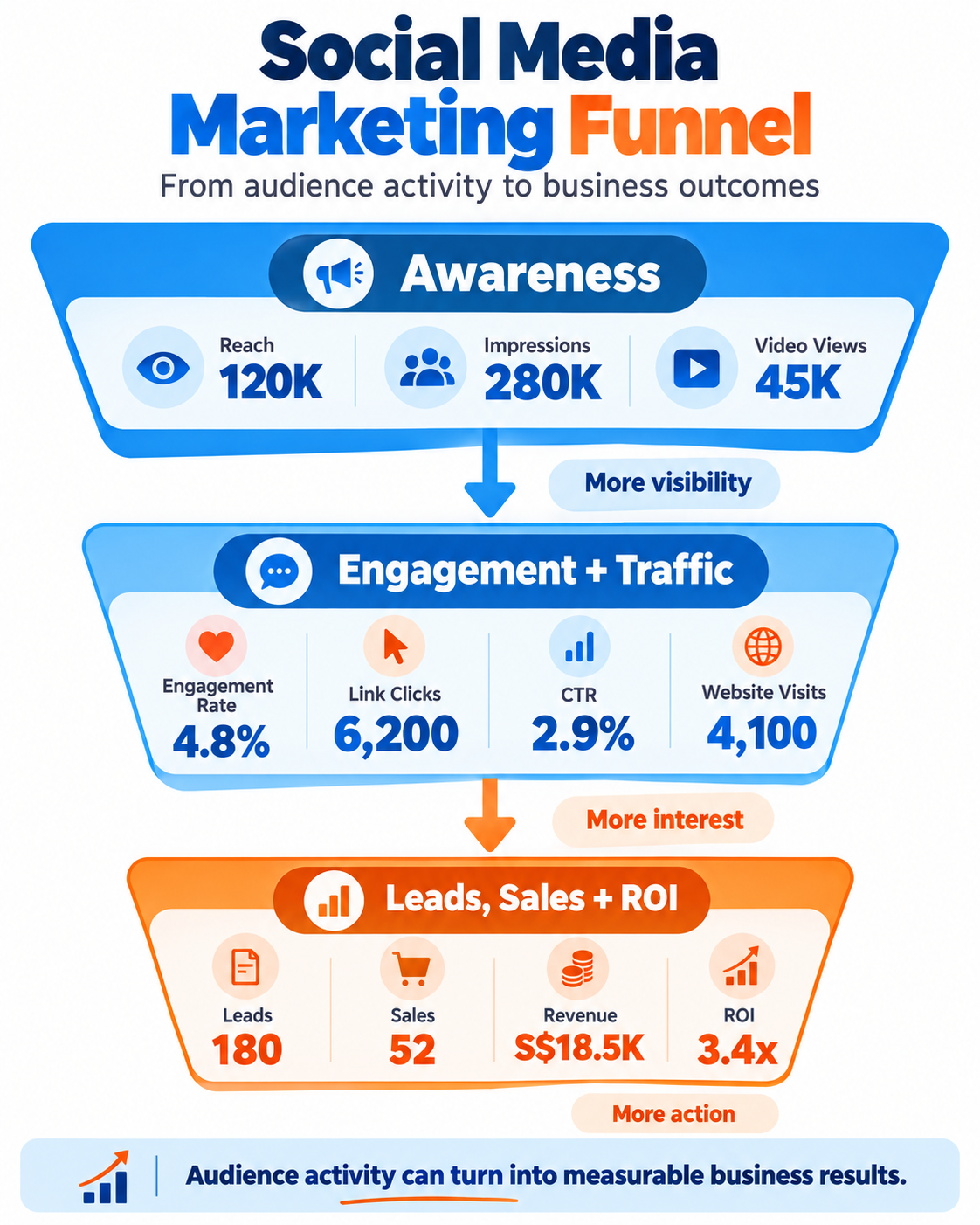
Suggested visual: A three-level funnel showing Awareness at the top, Engagement and Traffic in the middle, and Leads, Sales and ROI at the bottom. Include sample metrics at each level and arrows showing how audience activity can contribute to business outcomes.
Track traffic using campaign parameters
Use UTM parameters to identify the social platform and campaign associated with website visits. For example:
https://example.com/?utm_source=instagram&utm_medium=social&utm_campaign=october_sale
Replace the example domain and campaign name with your own. Apply a consistent naming convention across campaigns and review the results in your website analytics platform.
Where possible, connect website events and sales data to campaign reporting. Attribution can be imperfect, particularly when customers interact with several channels before converting, so interpret results in context.
Understand the key ROI calculations
Return on ad spend (ROAS)
ROAS = attributed advertising revenue ÷ advertising spend.
For example, S$5,000 in attributed revenue from S$1,000 in advertising spend produces a ROAS of 5:1.
This does not mean the campaign made S$4,000 in profit. Product costs, agency fees, fulfilment, discounts and other expenses must also be considered.
Customer acquisition cost (CAC)
CAC = relevant acquisition costs ÷ new customers acquired.
Define which costs are included and use a consistent period when comparing CAC with customer lifetime value.
Cost per lead (CPL)
CPL = campaign spend ÷ leads generated.
A low CPL is not necessarily good if the leads are unqualified or rarely become customers.
For campaigns running on Google Ads, businesses can also measure valuable actions such as purchases and enquiries. According to Google Ads’ conversion tracking guidance, conversion tracking helps advertisers understand which ad interactions lead to desired customer actions. Use this data alongside advertising spend and attributed revenue to evaluate campaign performance.
Set benchmarks that fit your business
Industry benchmarks can provide context, but results vary by sector, platform, audience, campaign objective and measurement method.
Start by recording your current performance. Set realistic improvement targets, then review trends over several weeks or months.
The most useful benchmark is one that helps you make a better decision about your own campaigns.
Common Social Media Marketing Mistakes
Mistake 1: Posting without a strategy
Why it happens: Teams publish whatever seems relevant that day, resulting in inconsistent messaging and unclear priorities.
How to improve: Set measurable objectives and maintain a monthly content calendar. Review performance before making significant changes.
Mistake 2: Ignoring comments and messages
Why it happens: Customer interaction becomes difficult to manage as the business grows.
How to improve: Assign responsibility for community management and set a response-time target. Track unresolved enquiries so they are not overlooked.
Mistake 3: Publishing too much promotional content
Why it happens: Businesses focus on selling rather than providing useful information or building relationships.
How to improve: Balance educational, entertaining, community-focused and promotional posts. Adjust the mix based on audience response and business objectives.
Mistake 4: Chasing every trend
Why it happens: Teams copy popular content without considering whether it suits their brand.
How to improve: Participate only when a trend is relevant to your audience and message. A consistent brand voice is more valuable than an occasional post that attracts attention for the wrong reasons.
Mistake 5: Failing to test and learn
Why it happens: Teams repeat familiar content without examining whether it is still effective.
How to improve: Test different formats, messages and calls to action. Record the results and apply what you learn to future campaigns.
Should You Manage Social Media In-House or Hire an Agency?
The right model depends on your budget, internal capabilities, workload and need for specialist expertise.
When in-house management makes sense
An in-house social media manager may be suitable when your business needs frequent publishing, fast customer responses and close coordination with internal teams.
Look for someone who can demonstrate:
- Strong writing and content planning skills.
- Experience with relevant social platforms.
- Community management and reporting ability.
- Understanding of your industry and customers.
- Evidence of learning from campaign performance.
Consider the full employment cost, including salary, training, software and content production.
When an agency may be suitable
An agency can provide access to specialist skills in strategy, creative production, paid advertising and analytics without requiring you to hire every capability internally.
Before engaging an agency, ask for:
- Relevant case studies and references.
- A clear scope of work and deliverables.
- Reporting methods and performance indicators.
- Details of advertising spend and management fees.
- Ownership arrangements for accounts and creative assets.
Be cautious of guarantees of specific follower counts, rankings or sales without clear assumptions and evidence.
Consider a hybrid model
Some businesses keep daily content and customer communication in-house while outsourcing paid advertising, campaign strategy or specialist creative work.
This approach can provide brand familiarity and responsive service while giving the business access to external expertise where it is most needed.
Staying Current with Social Media Changes in 2026
Social platforms regularly update their features, advertising tools and content recommendations. A format that performs well today may not produce the same results indefinitely.
Follow official platform guidance
Use official resources to verify changes and understand platform policies:
- Meta Business Help Centre for Facebook and Instagram.
- TikTok Business Help Centre for TikTok.
- LinkedIn Marketing Solutions for LinkedIn marketing.
- Infocomm Media Development Authority (IMDA) for Singapore’s digital media and technology context.
Industry reports can provide useful background, but important claims should be checked against authoritative sources. For guidance on Google Search, consult Google Search Central’s official documentation, which explains how Google Search works and provides recommendations for website owners. For social media platform features and advertising policies, consult the relevant platform’s own official documentation.
Adapt based on evidence
Rather than reacting to every algorithm rumour:
- Review your performance trends regularly.
- Check whether an official change affects your content or campaigns.
- Test relevant formats or features.
- Compare results against your existing baseline.
- Keep, revise or discontinue the change based on evidence.
Consistency, audience relevance and sound measurement are more reliable foundations than chasing every new feature.
Strengthen Your Social Media Marketing Strategy for Sustainable Growth

Social media marketing gives Singapore businesses an opportunity to build brand awareness, connect with their target audiences and drive measurable business results. However, lasting success requires more than frequent posting. It depends on choosing the right platforms, sharing valuable content, engaging with customers and measuring performance against clear business objectives.
To get started, define your goals, focus on the platforms your customers use most and develop a consistent content calendar. Monitor engagement, website traffic and conversions to understand what works, then refine your approach based on the results. With a clear strategy and ongoing optimisation, your business can turn social media activity into stronger customer relationships and sustainable growth.
Ready to grow your brand with a more effective social media marketing strategy? Explore MediaOne’s social media marketing services to discover how strategic content planning, audience engagement and targeted social media campaigns can help your business reach the right people, strengthen brand awareness and turn engagement into meaningful business results. Partner with us to build a social media presence that supports your business goals and drives sustainable growth.
Frequently Asked Questions
Social media marketing involves using platforms such as Facebook, Instagram, TikTok and LinkedIn to build brand awareness, engage audiences, drive website traffic and generate leads or sales. It includes organic content, community management, paid advertising and influencer partnerships.
Your budget depends on your objectives, resources and whether you need paid advertising, content creation or professional support. Start with an amount you can afford to test, set clear performance targets and measure qualified leads or sales before increasing your investment.
Choose platforms based on your target audience and business model. Instagram and TikTok may suit visually driven consumer brands, while LinkedIn is often useful for B2B companies and professional services. Facebook can support local businesses and community engagement. Use audience insights and campaign results to guide your decision.
Posting three to four times per week can be a practical starting point for a business focusing on one primary platform. The ideal frequency depends on your audience, platform and available resources. Prioritise consistent, useful content over frequent posts that lack a clear purpose.
Track metrics that align with your business goals. Reach and impressions help measure awareness, while engagement and website clicks indicate audience response. For business impact, monitor qualified leads, customer acquisition cost, conversions and attributed revenue. Review these metrics regularly to identify opportunities for improvement.