Instagram influencer marketing is when a brand pays or gifts an influencer to promote its products or services through feed or Stories content. Audience trust does most of the persuading, so brand fit matters more than follower count. For a Singapore brand, the key question is which influencers suit your goal, and the answer starts with audience fit.

Reach shows who saw a post, not whether they acted. Track engagement and conversions alongside it, and measure brand awareness rather than assuming it. Set clear goals and KPIs before you look for influencers, then score a shortlist on fit, cost and proof. This guide introduces the Fit-Cost-Proof Scorecard, a working framework (not an industry standard), and explains how to set KPIs first.
Key Takeaways
- Match creators to your audience, not follower counts. Audience fit predicts results better than reach.
- Score creators before outreach. Our working threshold is 12 or more out of 15 to move to the brief stage, a heuristic you can test against your results.
- Set your KPI before picking creators. Measurement should drive selection.
- Judge costs by engaged reach. Well-matched micro-influencers can deliver more relevant engagement per dollar.
- Check the Singapore audience location. Followers outside Singapore weaken local results.
- Reuse the framework for renewals. Compare results against the same scorecard.
What Is Instagram Influencer Marketing, and Why Does It Work in Singapore?
Instagram influencer marketing is a form of digital marketing in which a creator shares the brand’s message in their own voice on their feed or Stories. Paid ads buy placement, and the brand writes every word. Influencer marketing sits between the two. The creator’s audience follows them for reasons unrelated to the brand, and the endorsement carries that trust across. Instagram is one of the most common platforms for these campaigns because the creator’s feed and Stories make the endorsement feel personal, making it a strong channel for modern marketing.
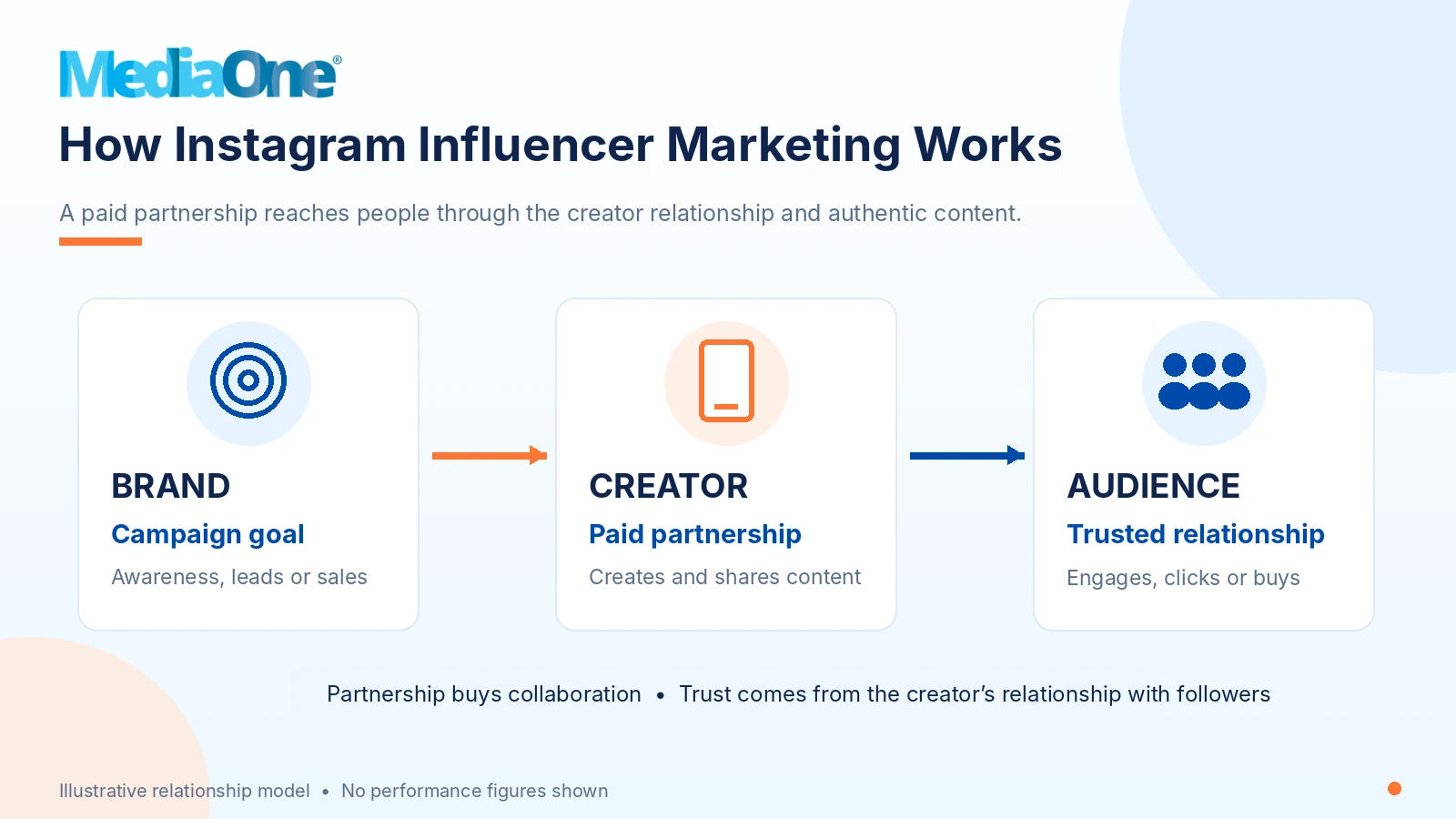
Singapore brands use this approach most in food and beverage, beauty, fashion, travel, property and fintech, where buyers decide quickly based on a trusted voice.
Our view is that the value lies in the audience relationship, not reach. A creator with 8,000 followers whose audience matches your customer will often outperform one with 200,000 followers who rarely reach your buyer. Judge influencers by engagement rates and audience fit. Set clear goals, such as brand awareness or sales, before you find influencers, and track performance across each campaign. Choose products or services that suit each creator’s audience so the endorsement feels credible.
Benefits of Instagram Influencer Marketing
- Trust transfer: Audiences often read a recommendation as a personal opinion.
- Niche access: A good fit reaches buyers that broad campaigns miss.
- Content reuse: Negotiate usage rights to repost creator content as part of your social media and marketing plan.
Trust is the main reason the strategy works, but it is also fragile. It erodes if a creator promotes everything they are offered, so limit partnerships to brands that fit their feed. Niche access depends on the creator’s audience matching your buyer, which is why fit matters more than size. Content reuse is only worthwhile if usage rights are included in the brief, so agree on repost and paid-ad rights before signing.
Risks and Limits to Plan For
Attribution is challenging. A purchase may follow a Story view, a friend’s recommendation and a search days later, so track performance across several channels. Brand safety is also a real risk: check a creator’s past controversies and competitor partnerships before signing.
Types of Instagram Influencers: Mega, Macro, Micro, Nano and UGC Creators
Most brands start by filtering on follower count, the wrong first question. A tier tells you how far a post can travel, not whether the people who see it will buy it. Please decide which tier fits the job before shortlisting anyone. Instagram influencer marketing works best when you match a tier to the brand awareness goal, budget, and products or services on offer and plan around a clearly defined target audience.
Follower-Tier Breakdown and Typical Engagement Patterns
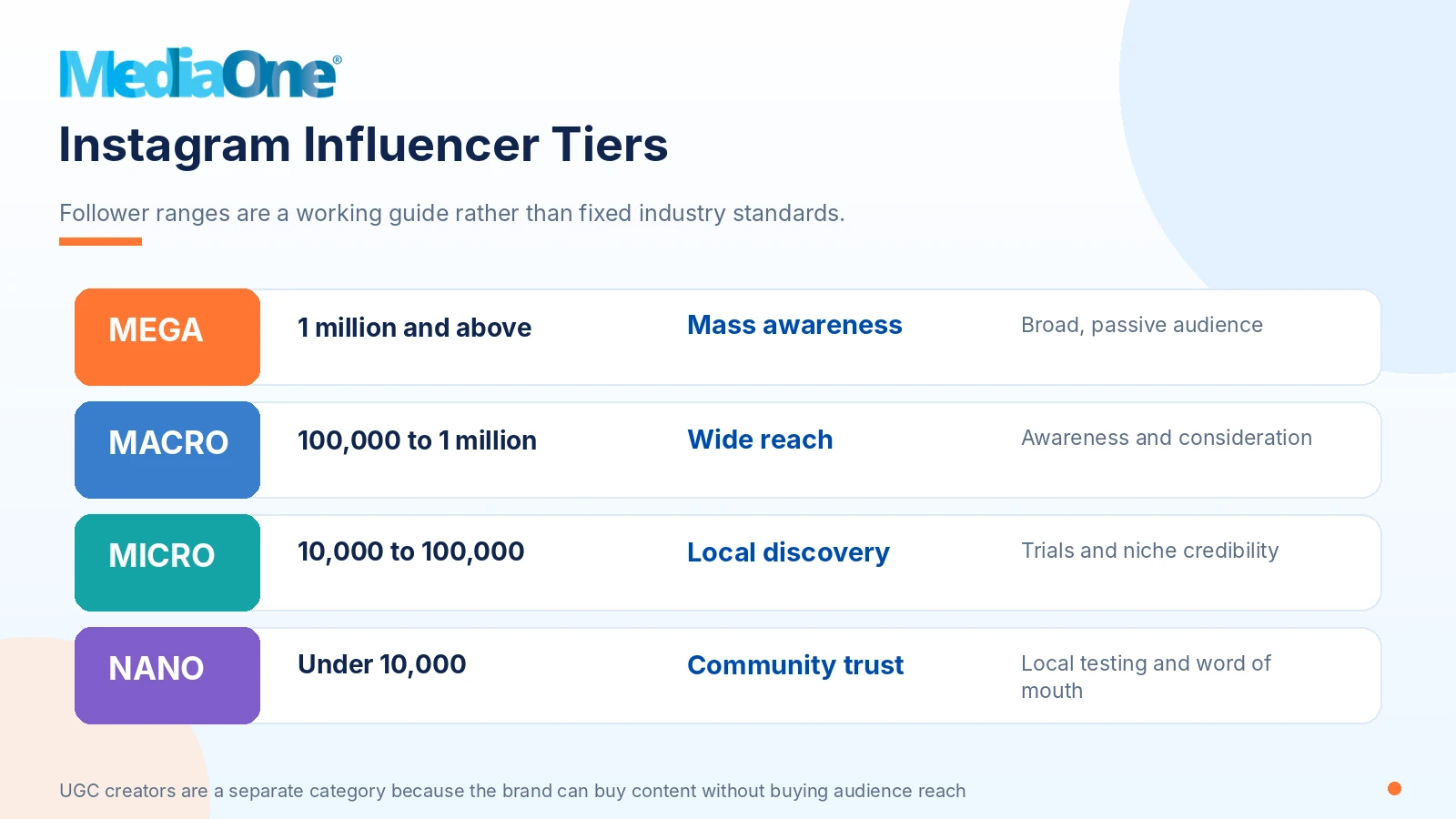
Each tier plays a different role in an influencer Instagram marketing strategy. The ranges below are a working guide, not fixed standards, since agencies draw the lines in different places.
| Tier | Typical follower range | Engagement behaviour | Cost band | Best use case |
|---|---|---|---|---|
| Mega | 1 million and above | Broad, passive audience; generic comments | Highest; usually agency-led | Mass awareness for a national launch |
| Macro | About 100,000 to 1 million | Strong reach, moderate engagement | High | Awareness with some consideration |
| Micro | About 10,000 to 100,000 | Closer community; more replies and saves | Mid | Consideration, trials, local targeting |
| Nano | Under 10,000 | Highly personal; often the highest engagement rate | Low | Niche communities, word of mouth, testing |
Engagement rate, meaning interactions divided by followers per post, often falls as follower count rises. Smaller tiers can deliver more engagement per dollar, though results depend on niche and audience quality. Shortsintel.com reported a 3.86% engagement rate for Instagram micro-influencers in its sample, roughly three times the 1.21% it recorded for mega-influencers. This figure comes from one source and one period, so check current data before relying on it.
Please read the comments before looking at the totals. Replies that ask questions or name a product are a stronger signal than a row of emojis.
UGC Creators and When to Use Them
User-generated content (UGC) creators make content for a brand to use, often without posting it to their own feed. You pay for the asset, then decide where it runs: your website, paid ads, email or your own Instagram. UGC differs from influencer marketing, which centres on a creator’s own audience.
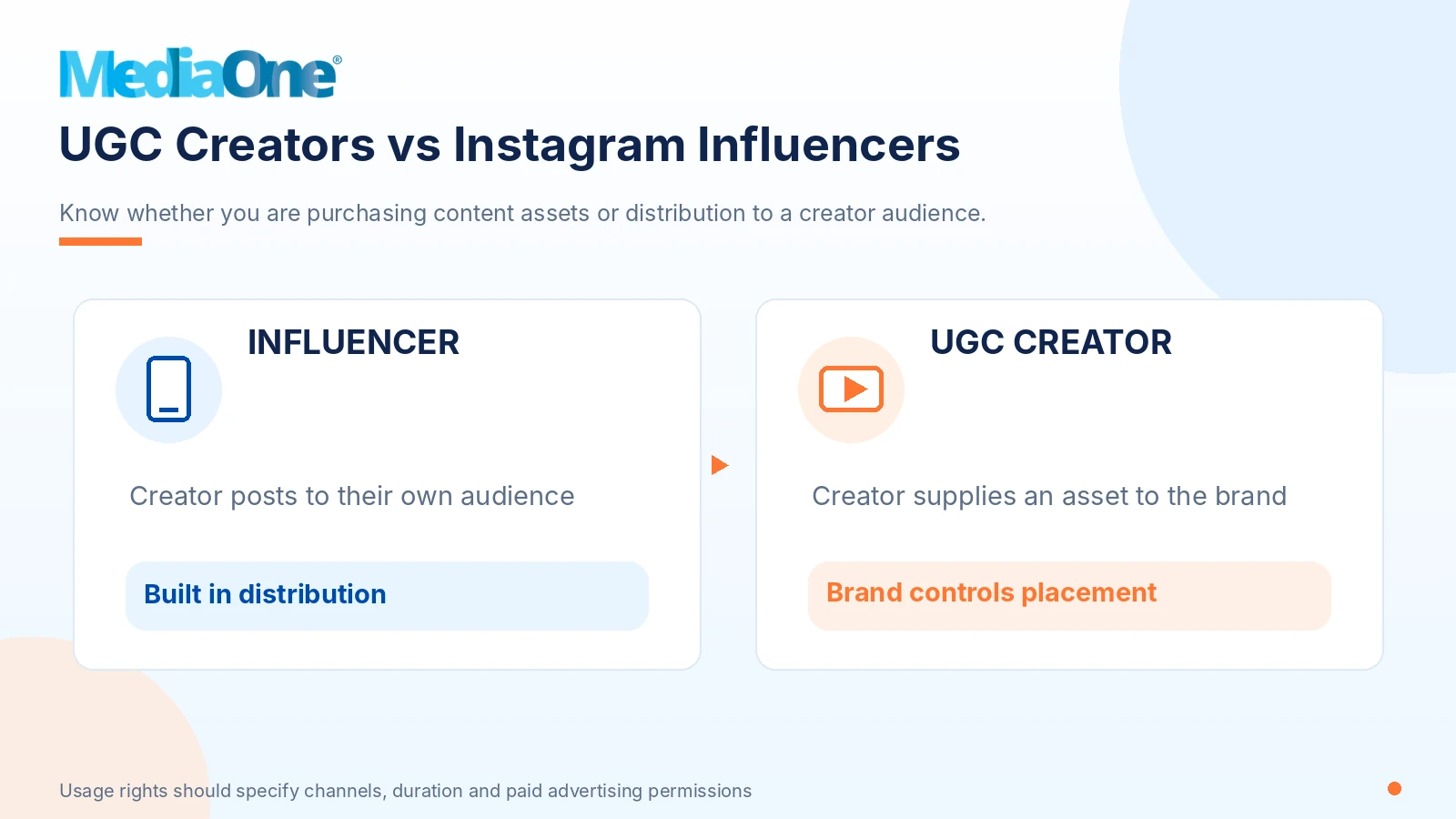

You gain creative control and a library of usable material, but the content carries little built-in reach. Negotiate usage rights carefully: how long you can use the content, which channels it can run on, and whether you can run it as a paid ad (whitelisting). Price usage rights as a separate line item, since they often cost more than the creation itself.

UGC works well when you already have an audience and need fresh creativity. It works poorly when you need people who have never heard of you to notice you.
Finding and Selecting Instagram Influencers
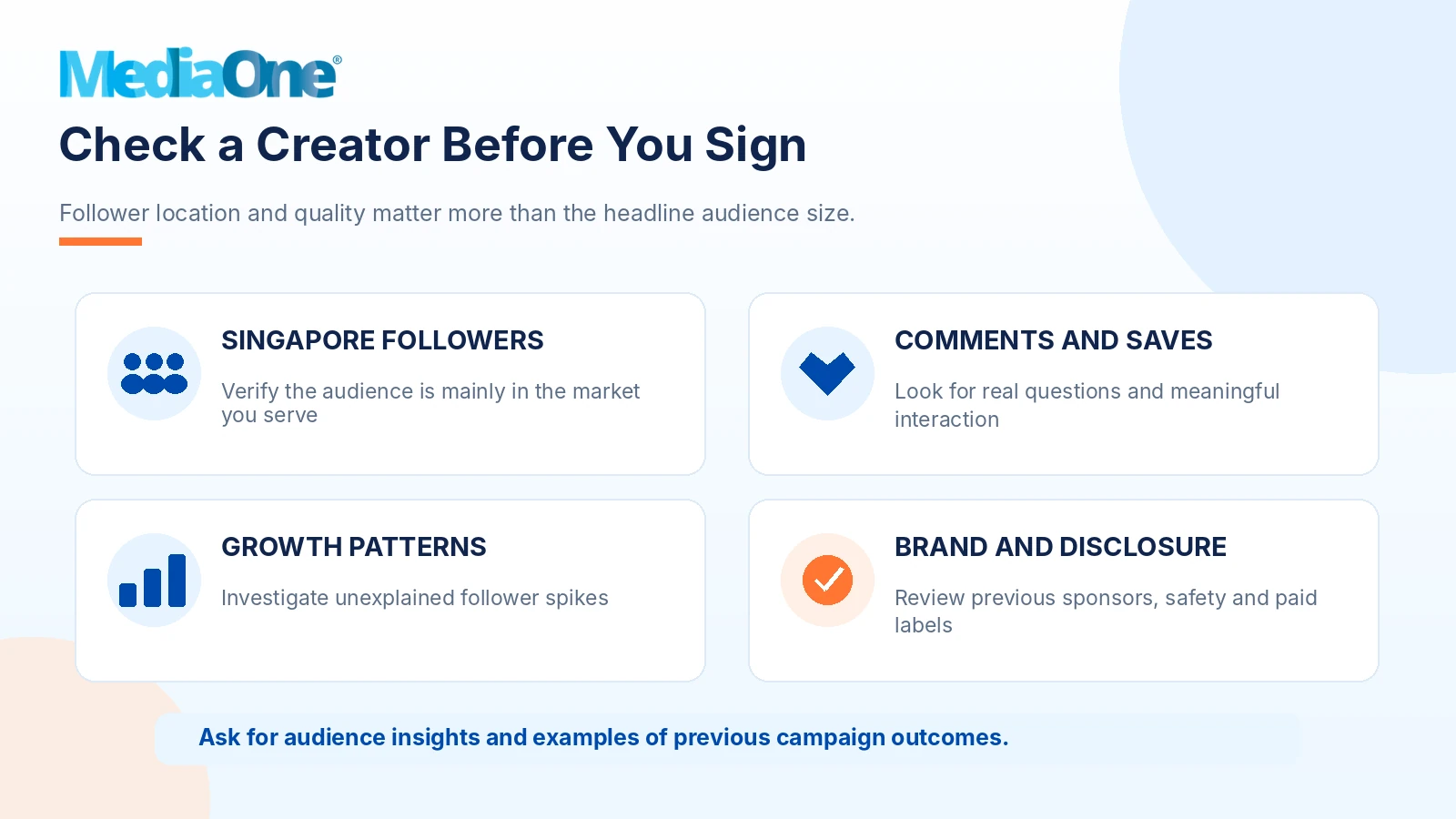
Follower count misleads brands more than any other metric. A creator with 300,000 followers can deliver fewer useful results than one with 12,000 if the bigger audience sits outside Singapore or doesn’t care about the product. Judge by audience fit first, measured against your target audience, not against total follower numbers.
Use the Fit-Cost-Proof Scorecard to choose based on evidence rather than size. It is a working framework we suggest for finding the right influencers, not an established industry standard. The 12-out-of-15 cut-off is a heuristic. It helps filter out weaker candidates from the shortlist without positioning itself as a benchmark, so adjust it to your risk tolerance.
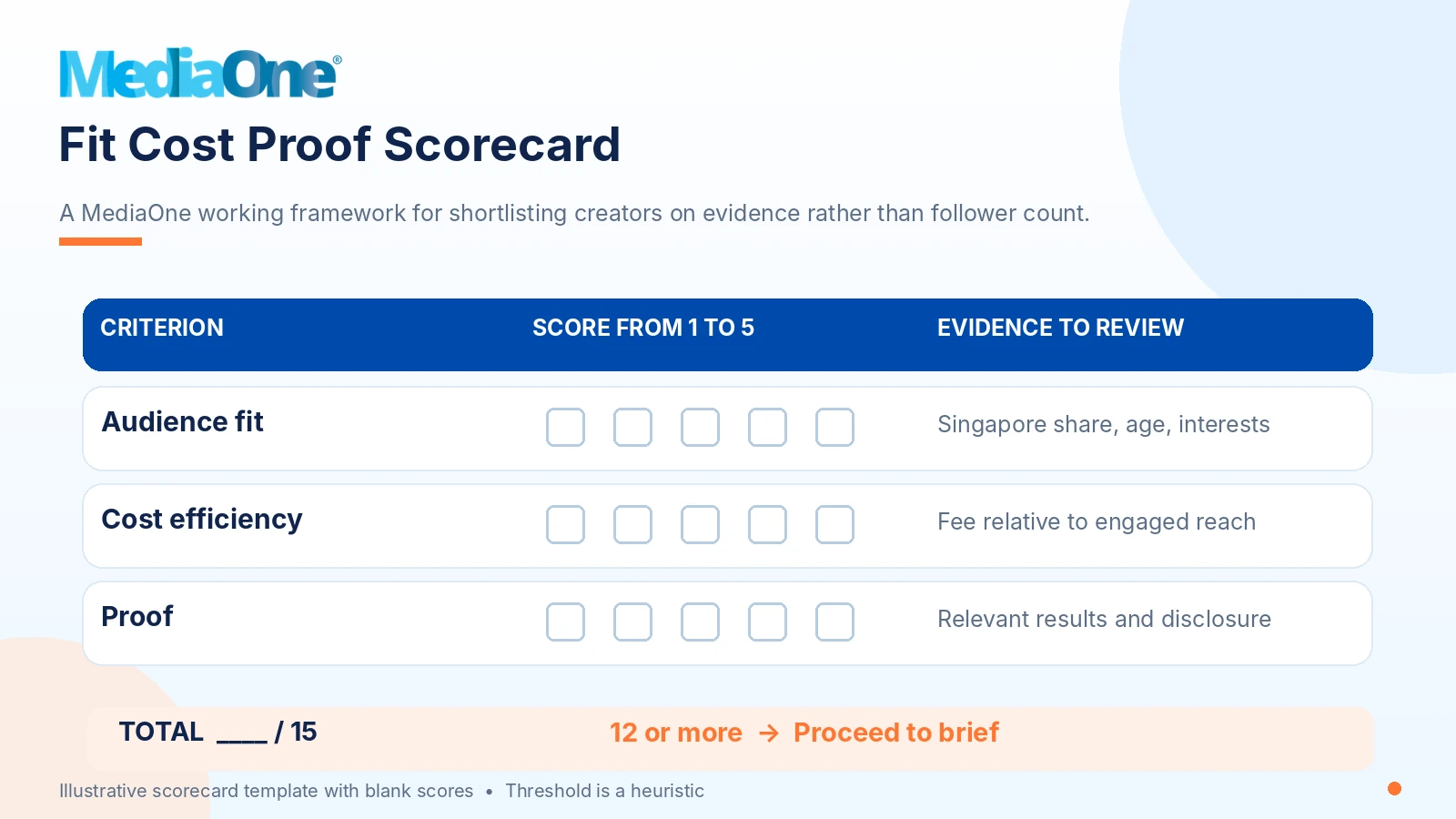
Score each shortlisted creator from 1 to 5 on three axes:
- Audience fit: Does the follower base match your buyer? Check the share of followers in Singapore, the age and gender split, and whether their interests line up with your product.
- Cost efficiency: Divide the fee by engaged reach, meaning likes, comments, saves and shares on recent posts, not raw followers.
- Proof: Review past campaign results, content quality, and whether they consistently disclose paid partnerships.
Only creators scoring 12 or more out of 15 move to the brief stage. Record the KPI each creator must meet before any outreach so measurement drives selection.
Substantive comments that ask questions or tag friends are a healthy sign. Emoji-only comments, sudden follower spikes, or a sharp drop after a growth burst can point to bought audiences. Also check follower overlap between creators, since two creators with near-identical audiences add little reach.
Factors to Consider When Engaging an Influencer
Fit gets a creator onto the shortlist. Four further factors decide whether the partnership works.
Professionalism and responsiveness. Note how quickly a creator replies during outreach and whether they respect timelines. Contractual slowness usually persists.
Content quality. Ask for examples in the format you need, such as Reels, carousels or Stories. Forced or scripted posts tend to earn less engagement.
Disclosure practices. Every sponsored post must make the commercial relationship clear. Write this into the brief as a condition. Instagram’s branded content policies set out how paid partnerships must be labelled on the platform.
Compliance with advertising rules. The Advertising Standards Authority of Singapore (ASAS) Code of Practice sets the general standards for advertising, including influencer content. Check the current Code and its influencer guidance directly on the ASAS website before briefing.
Put the key terms in a written contract: deliverables (number of posts, formats, dates, and whether Stories are included); usage rights (where and for how long you can reuse the content and whether you can run it as a paid ad); exclusivity (whether the creator can work with competing brands and for how long); approval rounds (how many revisions are included and who signs off each stage); and termination (what happens if a creator breaches the brief, misses deadlines or breaks brand-safety rules).
Set non-negotiables clearly (product claims, disclosure wording, brand-safety limits) and let the creator tell the story in their own voice.
Cost and Budgeting for Influencer Campaigns
Pricing Factors and Typical Cost Bands in Singapore
The fee is only the starting point. Five factors move the price: tier, niche (finance, property and B2B creators often charge more), production effort, usage rights (reuse in your ads is a separate licence) and exclusivity or frequency (blocking competitors raises the fee).
Rates in Singapore are negotiated case by case, and no public rate card is standard. The figures below are indicative planning ranges, not verified market rates. Use the follower ranges from the tier table above and treat the fees as working estimates. Please confirm each figure with live quotes before committing to a budget.
| Tier | Indicative fee per post (S$) | Best use |
|---|---|---|
| Nano | Starting at S$100, or product gifting | Community trust, local word of mouth |
| Micro | About S$500 to S$2,000 per feed post | Conversion and niche credibility |
| Macro | About S$5,000 to S$10,000 per post | Broad awareness with a defined audience |
| Mega | S$10,000 and above per post | Reach-led launches |
Partnrup.ai reports that a mega-influencer can charge between S$10,000 and S$50,000, depending on reputation and follower count. Marketingagency.sg puts micro-influencer feed posts at S$500 to S$2,000. Both are vendor figures, not primary rate data, so treat them as a starting point rather than a benchmark.
Budgets usually break on hidden costs. Plan explicitly for production, boosting posts, agency fees and product samples, which can be significant for beauty, F&B and fashion brands.
Building a Campaign Budget
Start with the outcome, not the fee. Most campaigns fail on budget because the target is vague:
- Define the target number of qualified actions. Examples include 500 saves, 300 link clicks or 80 promo-code redemptions. “More awareness” cannot be budgeted.
- Back-calculate the required reach. Assume a click-through rate and conversion rate for your category, then work backwards. For example, if 2% of viewers click and 10% of those clicks convert, then reaching 250,000 people would yield 500 clicks and 50 sales. Replace these with your baseline figures, since conversion rates vary widely by sector.
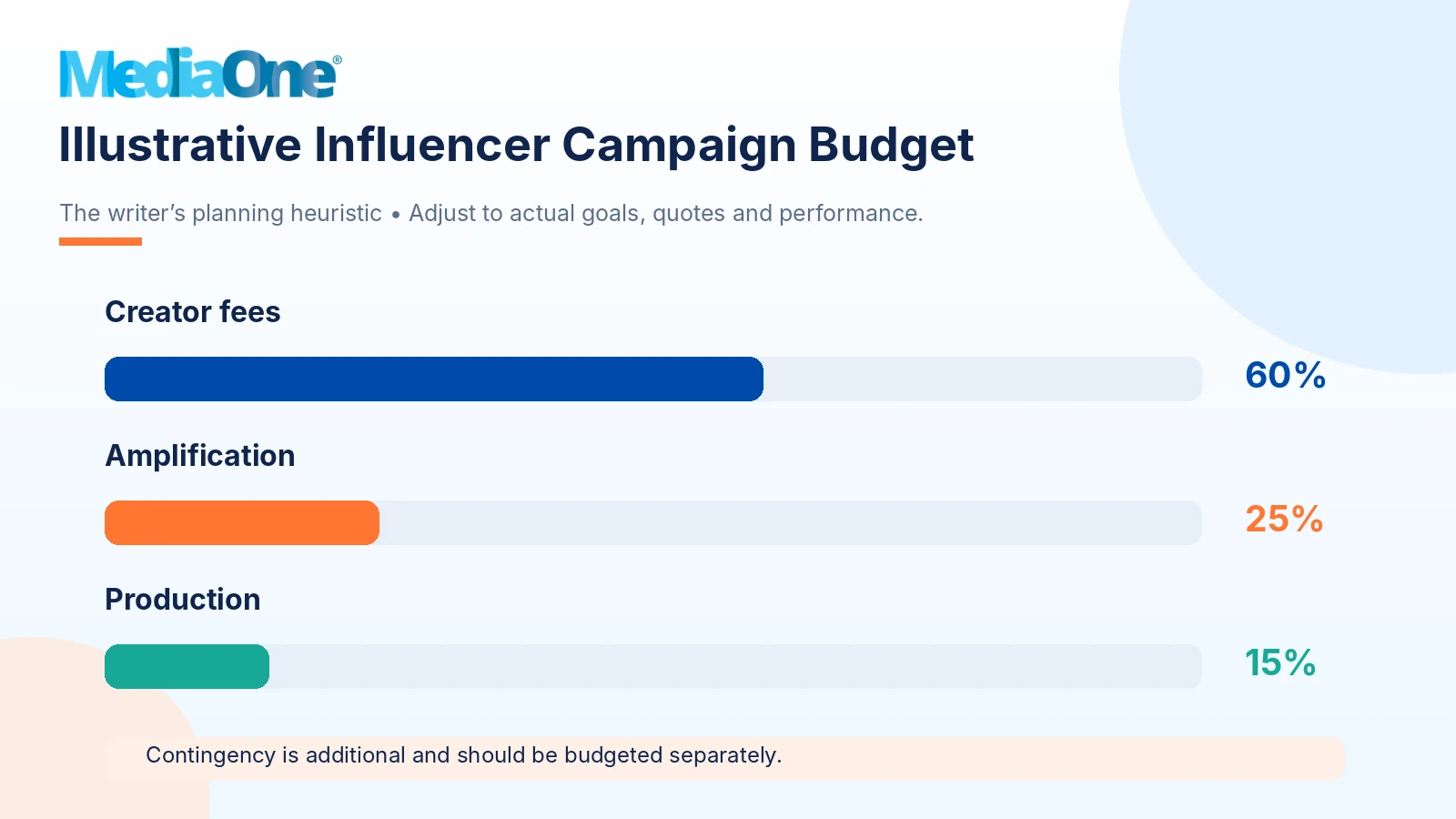
- Allocate across three buckets. A common starting split is about 60% creator fees, 25% amplification and 15% production. This is the writer’s own planning heuristic, not a figure drawn from an external source, so adjust it for your goal and your results.
- Hold contingency. Set aside a contingency line for revisions, a second creator or an extra boost if early data looks promising.
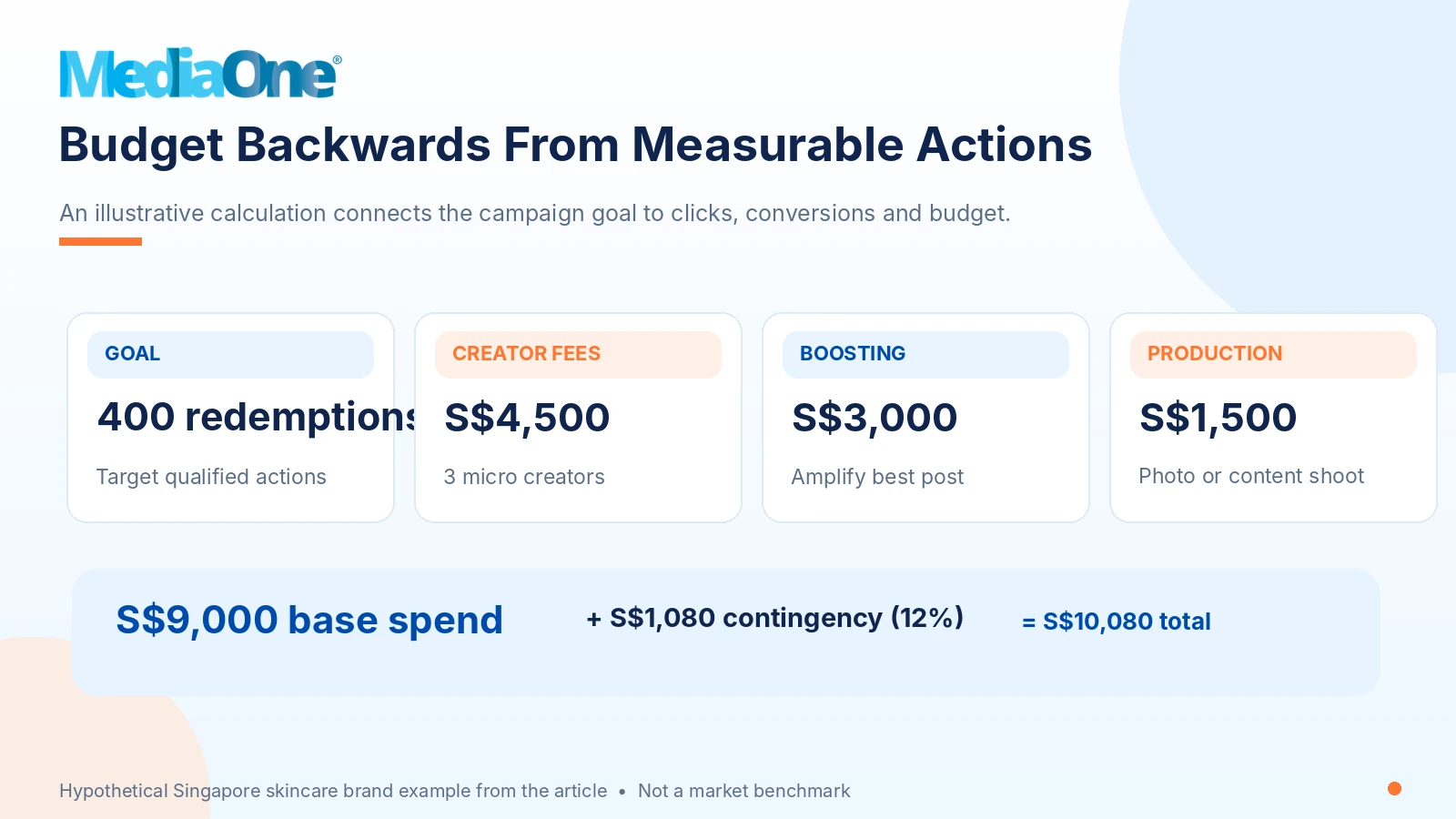
Worked example (hypothetical): A Singapore skincare brand targets 400 promo code redemptions in six weeks, assuming 1.5% conversion from reached audience to redemption. It books three micro creators at S$1,500 each (S$4,500), spends S$3,000 to boost the best-performing post, and allocates S$1,500 for a product shoot. Base spend is S$9,000, plus a 12% contingency of about S$1,080, for roughly S$10,080 in total. Replace the assumed conversion rate with your brand’s actual baseline before using this model.
Goal-to-KPI baseline (hypothetical):
| Metric | Target | Calculation | Ceiling |
|---|---|---|---|
| Promo-code redemptions | 400 | Booked campaign target | Fixed |
| Total spend | S$10,080 | Base plus contingency | Fixed |
| Target cost per redemption | Confirmed on enquiry | S$10,080 divided by 400 | Approve no higher than the agreed ceiling |
Present the budget to stakeholders in terms of cost per outcome rather than total spend. A target cost per redemption with a stated ceiling is easier to approve.
Collaboration Formats Compared
The format you choose affects what you pay, how much work it takes, and what results you can realistically expect.
| Format | Cost profile | Effort | Best objective |
|---|---|---|---|
| Sponsored feed post | Moderate, priced per post | Low to moderate | Awareness and saves |
| Stories | Lower per post, often bundled | Low | Short-term reach and link clicks |
| Reels | Moderate to high, needs production | Moderate to high | Discovery beyond the creator’s followers |
| Carousel | Moderate, more slides to produce | Moderate | Education and detailed product use |
| Live session | Low fee, high coordination | High | Direct questions and launches |
| Affiliate or discount code | Commission or fixed bonus, paid on results | Low upfront | Conversion and sales tracking |
| Ambassador programme | Retainer, multi-month | High to manage | Long-term advocacy |
| Takeover | Moderate, one-off | Moderate | Fresh content and audience crossover |
| Co-created product | Highest involves development | Very high | Differentiation and exclusive buzz |
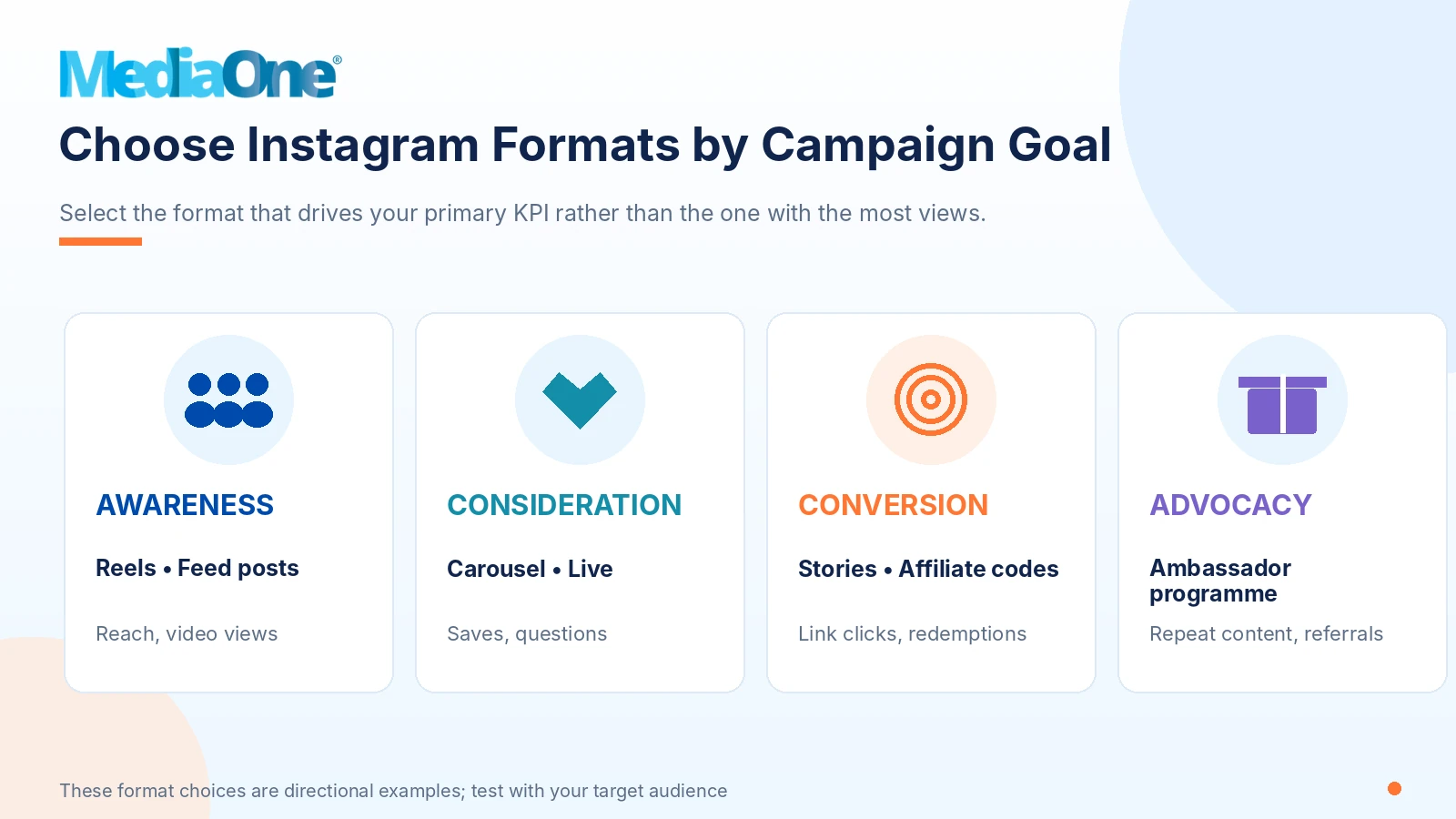
As a general guideline, if a format is expensive and its result is hard to attribute, it is rarely the right first test.
Choosing a Format for Your Goal
Start with one goal and one measurable outcome, then pick the format that moves it most cheaply. Awareness campaigns usually suit feed posts, Reels or takeovers. Conversion campaigns suit affiliate codes and Stories with link stickers. Long-term brand advocacy suits ambassador programmes best. Keep goal-setting in one place: one primary objective per campaign, with the KPI and target written down before any creator is briefed.
Conclusion and Summary
Plan Instagram influencer marketing around audience trust and measurable performance outcomes, not follower counts. A 500,000-follower creator with a loosely relevant audience can cost far more per genuinely interested buyer than a nano creator whose followers match your target audience. Use influencer marketing as part of your strategy, and find influencers whose followers match the people your campaigns are meant to reach.
Four decisions shape every campaign:
- Tier choice: match creator size to your goals, prioritising audience fit over headline numbers.
- Format: choose feed posts, Reels, Stories or affiliate deals by whether you need awareness, consideration or sales.
- Budget: start with the qualified actions you need.
- KPIs: set a baseline and target before outreach, and track engagement rates from the start.

Next step: build a shortlist template that scores each influencer on audience fit, cost efficiency and proof. Use the types of influencers that best suit your social media platform strategy, and keep the scoring simple enough that your team can apply it to every creator in a single sitting.
Frequently Asked Questions
How much does an Instagram influencer cost in Singapore?
Fees depend on tier, niche, production work, usage rights, exclusivity and post volume. Digital Marketing Singapore lists micro-influencer feed posts at S$400 to S$1,200 for the 10,000 to 50,000 follower tier. Request written quotes for your brief rather than relying on published rate cards alone.
How do I know if an influencer’s followers are real?
Look for substantive comments rather than emoji-only replies, and watch for sudden follower spikes that do not match post performance. Audience insights should show the location and age split.
Do I need to disclose a sponsored Instagram post in Singapore?
Yes. The ASAS Code of Practice governs advertising, including influencer content. Use an obvious label within the post, and follow Instagram’s branded content policy.
What is the difference between micro and macro influencers?
Macro influencers have larger audiences and broader reach, which suits awareness campaigns. Micro-influencers have smaller, focused audiences and often stronger engagement, which can make them better value for niche or local audiences.
How long should an influencer campaign run?
Most campaigns run for several weeks to a few months, as a single post rarely changes buying behaviour. Measure long enough to capture saves, link clicks and promo-code redemptions.