
Posting regularly can make a Singapore brand look active while leaving its commercial impact unclear. A social media marketing strategy is the set of decisions behind posting: which goals to pursue, who the content is for, which platforms justify the time, and how the content mix and schedule support those goals. Without those decisions, a team can produce activity that never becomes enquiries, sales or stronger customer relationships.

The Goal-Mix-Cadence matrix used in this article connects each goal to a measurable target, a manageable monthly content mix and a posting rhythm that suits local buyer behaviour. It is a planning framework developed for this article, not an established industry standard.
Start with what customers need to know before buying, then decide which channels can deliver that information consistently. Review results monthly so publishing time goes towards content that earns attention and prompts a useful next step.
Key Takeaways
- Set a measurable target before choosing platforms or creative. A 20% lift in average engagement rate over three months is an illustrative goal, not a benchmark.
- Fix a monthly content mix that supports your objectives. Mailchimp offers one illustrative split, not a prescribed industry formula.
- Schedule about 80% of posts in advance and keep 20% open for timely material.
- Test a sustainable posting frequency separately on each platform, starting slowly.
- Cut any channel that does not serve a goal or that your team cannot sustain.
- Verify Singapore audience habits with your own analytics before committing budget.
Why Strategies Fail Before the First Post
A Singapore team can have plenty of ideas and still struggle to explain what its posts achieved. Regular publishing alone does not show business impact. A posting habit is not a strategy. To help a brand create a social media marketing strategy that works within its wider digital marketing efforts, decide before the first post what success means, which audience matters, how content is split and how often it goes out.

The problem becomes visible at reporting time. Without a measurable outcome, teams cannot tell which posts to repeat or stop. Setting goals first makes later comparisons more useful.
Turning Vague Aims into Measurable Goals
‘Increase engagement’ is not a goal, because nothing in it tells you when you have succeeded. A usable target names a metric, a size of change and a deadline. Raising average post engagement rate by 20% over three months is one illustrative target, not a benchmark. A follower target can be set in the same way, using your own starting point.
Pair a reach goal with a lead goal, for example: ‘Grow average reach by 30% over one quarter, and drive 40 enquiries a month from Instagram profile links.’ These are illustrative targets that should be adjusted to your baseline. Teams can apply the same discipline to paid and organic channels alike. Brand awareness goals suit this pairing well, since reach is an early signal, not proof of sales.
Follower Goals Versus Engagement Goals
Follower count measures audience size, not how many accounts saw a post. Engagement rate measures interactions against a defined base, such as reach or followers, depending on the report. Followers can grow while engagement falls, which may reflect a different audience or a change in content distribution. Set a follower target as a growth check and an engagement target as a quality check, then review both together. An account that gains followers without relevant engagement may struggle to deliver business results.
Linking Social Goals to Revenue
Map every goal to one funnel stage: awareness, consideration or conversion. Awareness goals (reach, impressions) fill the top of the funnel. Consideration goals (saves, profile visits, link clicks) show interest. Conversion goals (bookings, orders, enquiries) connect directly to revenue.

When resources are tight, prioritise goals that serve a current funnel need, including awareness where appropriate. A goal stays only if it has a measurable target and a practical method of tracking progress. Where specialist support is needed, social media marketing services can connect planning, publishing and measurement.
Understanding Your Audience
Audience research stalls when teams treat it as a one-off survey rather than the input to later decisions. Your content mix, platform choice and posting cadence all depend on who you are talking to. This step sits upstream of the rest of your marketing plan.
Start with the data you already hold. Platform insights can show audience demographics and the content formats that earn responses. Support enquiries and sales conversations reveal the questions buyers ask before they purchase. Search data shows the problems people are trying to solve.
Then consider five to eight short customer interviews to test your assumptions. Those interviews can reveal the phrases customers use to describe a problem, which may make strong post hooks.
Building Practical Personas
A persona is only useful if it changes what you publish. Each persona should record five fields: role, main pain points, platforms used, preferred content formats and the buying trigger that moves them to act.
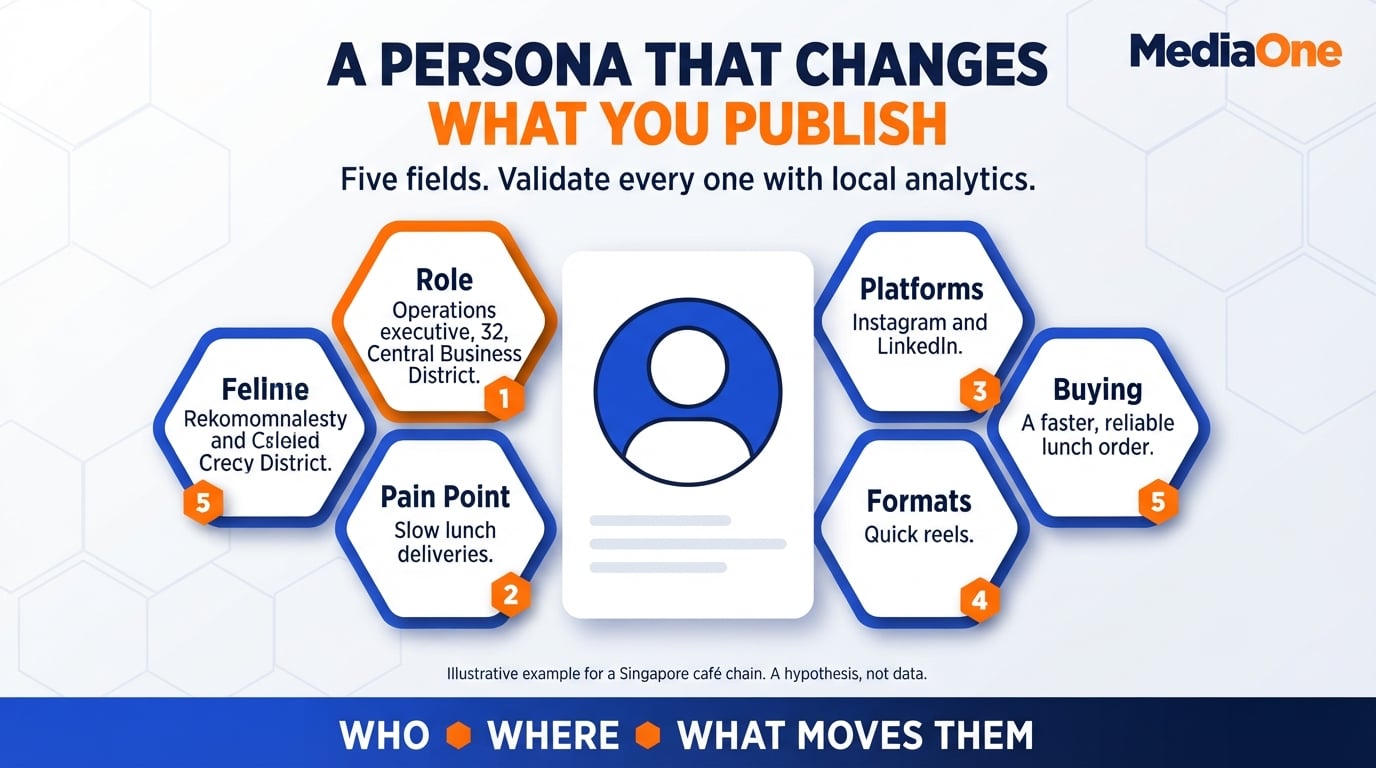
Consider a Singapore café chain targeting office workers who order lunch delivery. The persona might read: a 32-year-old operations executive in the Central Business District, frustrated by slow lunch deliveries, active on Instagram and LinkedIn, who responds to quick reels. These habits are a hypothesis. Validate them with local analytics before relying on them.
Using the Data to Pick What to Say
Match each persona pain point to one content theme, then check that theme against the real questions customers ask. Before writing any post, answer five questions:
- Who is this for?
- What problem does it address?
- What single action should the reader take?
- Which platform will they see it on?
- How will we know, within a set period, whether it worked?
If you cannot answer all five, the post is not ready. Teams that apply this check can turn social media insights into a repeatable strategy tied to real customer needs.
Choosing the Right Social Media Platforms
Platform choice is a comparison, not a popularity contest. Picking the biggest network is tempting, but a social media marketing strategy should rest on where your target audience spends time and which business goals each platform can serve.
DataReportal’s Digital 2026 Singapore report estimated 5.33 million social media user identities in October 2025, equivalent to 90.6% of the population, but these are not necessarily unique people. Check local platform usage in your own analytics before choosing where to invest. Treat each channel as part of a wider content marketing plan, so the platform supports what you can actually produce.
Platform Comparison Table

| Platform | Audience profile (verify locally) | Content formats | Typical use case | Effort required |
| Local and community groups (verify) | Posts, groups, events, short video | Local awareness, events | Medium | |
| Visual, product and creator content | Images, Reels, Stories, carousels | Product discovery | Medium to high | |
| Professionals and decision makers | Articles, documents, thought-leadership posts | B2B leads, recruitment | Medium | |
| TikTok | Short-video discovery (verify) | Short vertical video | Brand awareness | High |
| YouTube | Intent-driven, how-to searches | Long and short video | Tutorials, search visibility | High |
| X | News-driven, fast-moving | Short text, links, replies | Customer service, updates | Low to medium |
These profiles are working hypotheses, not measured Singapore audience shares. Check native audience reports and local account data before relying on them.
A Scoring Framework for Shortlisting
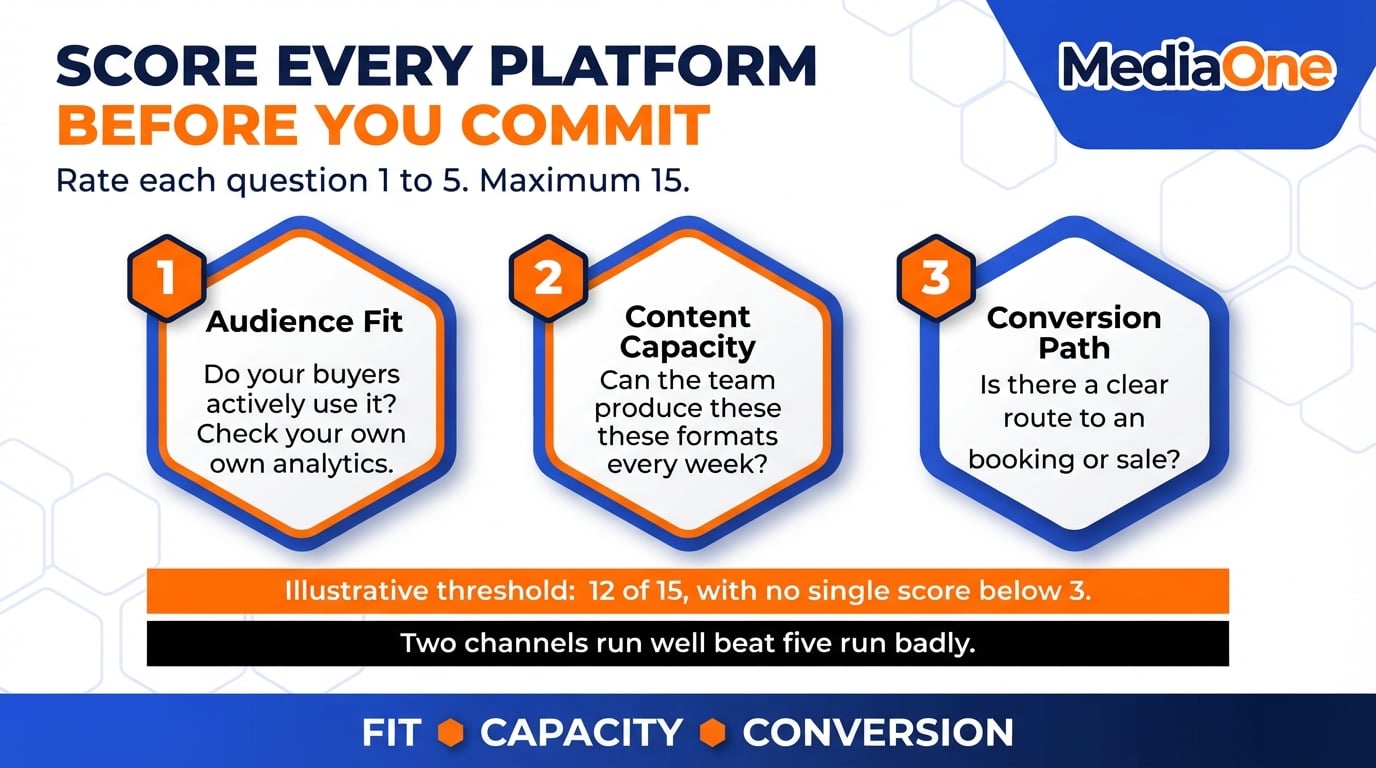
Score each platform from 1 to 5 on three questions:
- Audience fit: Do your target audience members actively use it? Verify with your own analytics, not a global average.
- Content capacity: Can your team produce the required formats every week?
- Conversion path: Is there a clear route from a post to an enquiry, booking or sale?
The 12-out-of-15 threshold is an illustrative editorial starting value, not an industry standard. In this illustration, a platform qualifies if it scores at least 12 out of 15 and no lower than 3 on any single criterion. Adjust the threshold to your context. Cap active channels at what the team can sustain: two channels run well beat five run badly.

When to Drop a Platform
Review a platform that misses its goal for two consecutive review cycles, then check whether content, tracking or resources explain the shortfall. If the cause cannot be fixed, redirect time and budget to a better-fitting channel. Build a leaner social media strategy around the channels that remain.
Developing and Curating Engaging Content
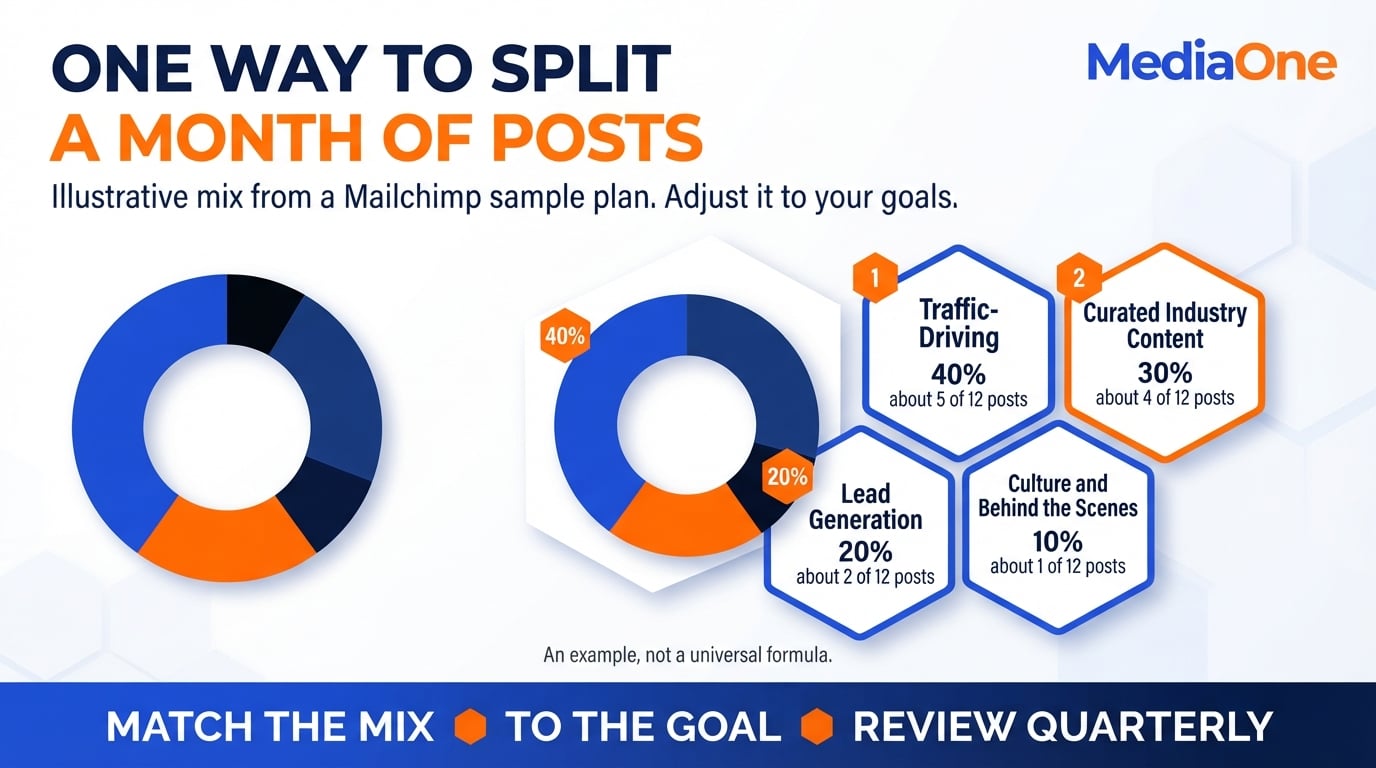
Content plans fail when teams have a stack of ideas but no decision about how those ideas fit together. A content mix can fix that. Mailchimp’s sample social media plan allocates 40% to traffic-driving material, 30% to curated industry content, 20% to lead-generation content and 10% to culture and behind-the-scenes posts. This is an example, not a universal formula. Every post should belong to a category with a job to do.
Building the Content Mix
Start from the goals you set earlier, since each goal implies a different split. A brand chasing website visits should lean towards traffic content. A brand building a launch waitlist should shift weight towards lead generation. Match the mix to your audience, since what that group engages with should guide which categories get the most weight. Revisit the split each quarter so your social marketing stays aligned with changing priorities.
For a small team, capacity sets the ceiling. For example, if you produce 12 posts a month, the illustrative 40/30/20/10 split works out to roughly 5 traffic posts, 4 curated posts, 2 lead-generation posts and 1 culture post. Drop any category you cannot staff, rather than quietly abandoning the split.
Decision rule: if a category’s goal metric is flat for two months, move one post from the weakest category to the one tied to your conversion number, and test again.
Curating Without Losing Your Voice
Curated posts earn their place when you add something. Credit the original source, add a sentence of your own view, and consider limiting shared posts to one for every two original posts as a starting experiment. Without an intentional balance, a feed can become a link aggregator.
Example: a Singapore accountancy firm shares a government budget update, credits the source, and adds one line on what it means for small employers, then checks whether those posts draw the enquiries its original posts do. Repurposing also stretches a small team further. For example, a single long-form article can become a LinkedIn carousel, three short Instagram captions, a short video and a Facebook discussion question. Rewrite each version for its platform rather than pasting it in unchanged, and keep each version consistent with the brand’s wider marketing message. Treat each platform as its own social channel with its own audience habits.
Content Calendars and Post Scheduling
A social media strategy becomes operational when it turns into a schedule someone can follow. The calendar is where the Goal-Mix-Cadence matrix turns into daily work. This is an editorial planning framework, not an industry standard. Each row is a planned post tied to a target, and any slot that serves no target gets cut.
Setting Cadence
Start with a cadence you can sustain, even if that means a post every few days on each active platform. Increase frequency only when the team has capacity and results justify it. Track each platform separately, and note which posts your target audience responds to. Keep every slot tied to a business goal, so frequency never outruns purpose.
A useful starting split is 80% planned posts and 20% flexible slots for timely material, as Mailchimp recommends for social content calendars. Treat this as a scheduling suggestion rather than a performance benchmark. Keep flexible slots for useful customer questions or genuine events.
Use this illustrative cadence table as a starting point, adjusting for team capacity and audience response:
| Platform type | Starting cadence | What to test |
| Professional network | 3 to 5 posts a week | Whether longer articles outperform short updates |
| Visual platform | 3 to 5 posts a week | Whether Reels or carousels lift reach |
| Short-form video | 3 to 5 posts a week | Whether a fixed posting time improves views |
| Community forum | 2 to 3 posts a week | Whether replies to questions drive more traffic |
Building the Calendar Step by Step
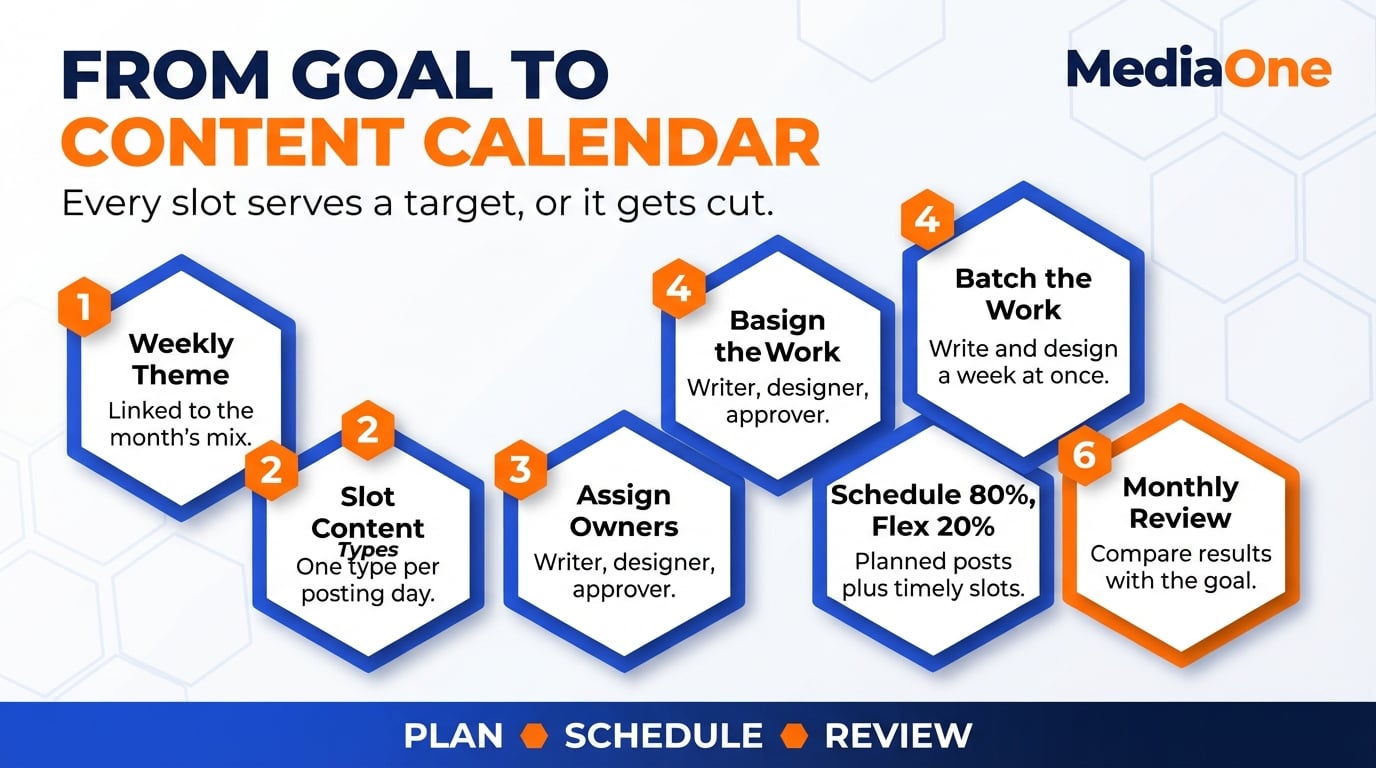
- Set a theme for each week, linked to the month’s content mix.
- Slot a content type into each posting day, using the chosen content mix as a guide.
- Assign an owner to each post, including who writes, designs and approves it.
- Batch the work. Write and design a week’s posts in one session, then schedule them.
- Add a review date at the end of each month to compare results against the goal.
- Schedule planned posts in advance and leave flexible slots for timely content.
Choose a scheduling tool based on your platforms and whether your team needs approval steps. Confirm it supports each platform you run, including Facebook if you use it. Scheduling tools built for social media can save hours each week once a calendar is in place.
A useful content calendar has these columns: date, platform, content type, goal served, owner, status and metric to check. A sample month for a Singapore café might show weekly menu posts (lead generation), two behind-the-scenes posts (culture), and one reservation-focused post per week (conversion).
Community Management and Engagement
Community management is where a social media strategy either earns trust or quietly loses it. Every reply, comment and direct message shapes how people judge your brand. Treat engagement as a workload you plan and staff, not a number you hope will rise. A clear marketing plan makes the workload easier to manage, and a well-maintained website should answer routine questions before customers need to ask.
Setting Response Standards
Write the rules down before the first complaint arrives. At minimum, define:
- Response-time targets for each channel, such as same business day for comments.
- Escalation rules: which enquiries (refunds, safety issues, press, legal threats) move to a named person within an hour.
- A tone guide with two or three example replies, covering formality and language on each platform.
- Approval thresholds: replies offering discounts, promises or pricing need a second sign-off.
Sample reply framework:
- Acknowledge: thank the customer and name their issue.
- Answer: give the specific fact or next step.
- Route: if a person must follow up, say who and when.
In a multilingual market such as Singapore, decide deliberately which of English, Mandarin, Malay and Tamil to use on each platform. Match the language your audience actually uses on each channel.
Outsourcing and Scaling Moderation
Consider outsourcing moderation once response volume exceeds the time your team can safely cover. A provider may extend response hours or language coverage, but the cost and benefit depend on your volume, approval requirements and escalation process. Compare those needs before accepting a vendor’s performance claims.
Before choosing a provider, ask:
- Can they follow your tone guide and escalation rules exactly?
- Who handles sensitive complaints, and how fast do they hand over?
- Do they report response times and sentiment, not just volume?
- What does the contract cost if your volume drops?
Analytics and Performance Tracking
Measurement shows whether the social media marketing strategy works. Without it, you cannot tell a strong post from a lucky one. A clear content plan gives each metric a purpose and links publishing decisions to customer outcomes.
Set one primary KPI and one diagnostic KPI for each goal:
- Traffic: primary is website visits from social; diagnostic is click-through rate.
- Leads: primary is sign-ups; diagnostic is landing page conversion rate.
- Community: primary is average response time; diagnostic is sentiment in replies.
Report monthly on goal metrics and review quarterly to decide whether to keep the mix. The same discipline is useful when tracking social media metrics in Singapore. Keep each report to one page showing the goal, the number and the change since last period.
Attribution helps estimate which posts contribute to conversions. Tag campaign links you control with Google Analytics UTM parameters, such as utm_source=linkedin, utm_medium=social and utm_campaign=spring-launch, and consider unique promo codes per platform. Check acquisition reports because missing or inconsistent tagging can misclassify traffic.
Choose tools that match your platforms and team skills. A small business can combine native platform analytics with a web analytics tool to spot trends without adding a complex reporting system.
Define engagement rate (interactions as a share of followers or reach) the same way each month so the trend stays comparable.
Adapting and Evolving the Strategy
A social media strategy is a set of hypotheses. Test them, then change what the data shows.
Review the strategy each quarter. Compare each goal’s KPI against its target, and note which content types and platforms moved the number. Use what you learn to refine the marketing strategy, and feed those lessons into the next content plan.
Turn each doubt into a test, such as ‘Carousels will lift saves more than single images.’ Run it for four weeks on comparable posts, then decide. Treat each test as a step toward measurable success rather than a one-off experiment. Results from a test may also show which posts are worth paid advertising.
Change the mix when a category underperforms for two review cycles, or when a goal changes. Move a platform only if it fails its goal across two cycles and the cause cannot be fixed.
Adjust one variable at a time so you can see what caused the result.
Conclusion
A social media marketing strategy is a chain of decisions, starting with goals. A target such as an illustrative 20% lift in average post engagement rate over three months shows what to measure and cut. Every calendar row should serve a target that helps your customer and drives business success.
Your next step: draft one measurable goal for next quarter, the metric it moves and the expected number, before planning a single content slot.
Frequently Asked Questions
Early signals may appear within weeks, but results depend on your audience, offer and buying cycle. Review reach and engagement alongside leads and sales over a period suitable for your business. If performance is flat after a quarter, recheck the goal, creative and channel fit before changing the plan.
Start with one or two channels that the team can support well, then expand only if results and capacity justify it. Score each platform against audience fit, content capacity and conversion path before adding another.
Start with a frequency you can sustain, then test whether additional posts improve results on each channel. Quality should not drop to hit a number. Leave some room in your calendar for timely material.
What is a good engagement rate to aim for?
There is no universal benchmark, since engagement varies by platform, industry and audience size. Set your own baseline from the last three months, then set an illustrative lift, such as 20% over the next quarter. Compare yourself with your past numbers, not a competitor’s.
Outsource when moderation or posting volume outgrows your team’s capacity. Before signing, ask any provider for response-time commitments, escalation rules, a tone guide and how they report results. Keep strategy and final approval in house.
Map each goal to one primary metric and one diagnostic metric, then review them monthly. Tag campaign links you control with UTM parameters and use platform-specific promo codes where suitable to help trace conversions. Compare platform-reported results with your own enquiries, orders and customer records before treating attributed conversions as final.