A five-star rating on a website means little if buyers cannot tell who left it or what they purchased. Singapore customers can compare Google reviews, case studies and independent sources before sending an enquiry. Unsupported testimonials may create doubt, especially for expensive services or lengthy contracts.
Social Proof helps buyers judge other people’s experiences. It becomes useful when evidence comes from a relevant customer, describes genuine work and can be checked. A renovation client explaining how a project was handled tells prospects more than a banner claiming ‘trusted by thousands’.
The practical task is to review what you already publish, collect stronger material and place it where visitors need reassurance. You will be able to audit existing proof, decide what to keep and test improvements without making unsupported promises.
Key Takeaways
- Specific, attributable customer evidence gives buyers more to assess than an unsupported popularity claim.
- Reviews, case studies, user-generated content and endorsements serve different purposes along the buying process.
- The Proof Strength Matrix checks both specificity and relevance before an element earns space on a page.
- Google prohibits incentives for reviews and selective requests for positive feedback.
- Singapore advertising guidance calls for clear disclosure of commercial relationships behind endorsements.
- Place proof beside the decision it supports, then evaluate qualified enquiries and sales instead of assuming an uplift.
Why Specificity Outweighs Volume
A large number can attract attention, but it does not explain a customer experience. ‘More than 1,000 happy clients’ leaves a reader asking how that number was counted and which customers faced a comparable problem. A review describing the actual service, approximate timing and outcome provides details that can be weighed against a buyer’s needs.
The principle has an experimental basis, although its effect is context-dependent. In a 2008 hotel towel study, researchers found that a message referring to other guests’ behaviour increased towel reuse compared with a general environmental appeal. A message about guests in the same room performed particularly well in one experiment.
A 2014 follow-up study found that descriptive-norm messages did not outperform a standard appeal, and its results on proximity were inconsistent. That limits any claim that a particular wording will reliably raise conversions. For marketers, the useful lesson is to make evidence relevant and test its effect on their own audience.
Specificity also has limits. A named person is not automatically credible, and an impressive percentage means little without a starting point, period and method. Make it easy to check the source of the claim, particularly when the result could influence a significant financial decision.
What Social Proof Is and Why It Works
Social proof describes the tendency to use other people’s actions or judgements as a cue when information is incomplete. Robert Cialdini popularised the concept through his work on persuasion, while research on social norms has examined how group behaviour can influence decisions. In marketing, the cue may be a customer review, an independent endorsement or a documented result.
Two motives help explain the effect. Informational influence occurs when people treat others’ experiences as evidence about a product or service. Normative influence concerns the desire to fit in with a group, which is less useful as a basis for responsible marketing claims.
A restaurant guest comparing nearby options may read recent comments about waiting times and service. A B2B buyer will usually need different evidence, such as implementation details, measurable outcomes and approval from a reference customer. Each person is looking for information that reduces a particular uncertainty.
Similarity helps make that information relevant. A tuition centre serving primary school pupils should prioritise authentic feedback about the right age group and programme. A software provider selling to finance teams should use examples with comparable workflows, so prospects can judge how closely the reported experience applies.
Trust also depends on where the evidence appears. A review displayed on the company’s own website is selected by that company, while a link to an external review profile offers readers another way to check the wider pattern of feedback. Neither source should be treated as infallible, but showing the basis of a claim improves transparency.
The Main Types of Social Proof
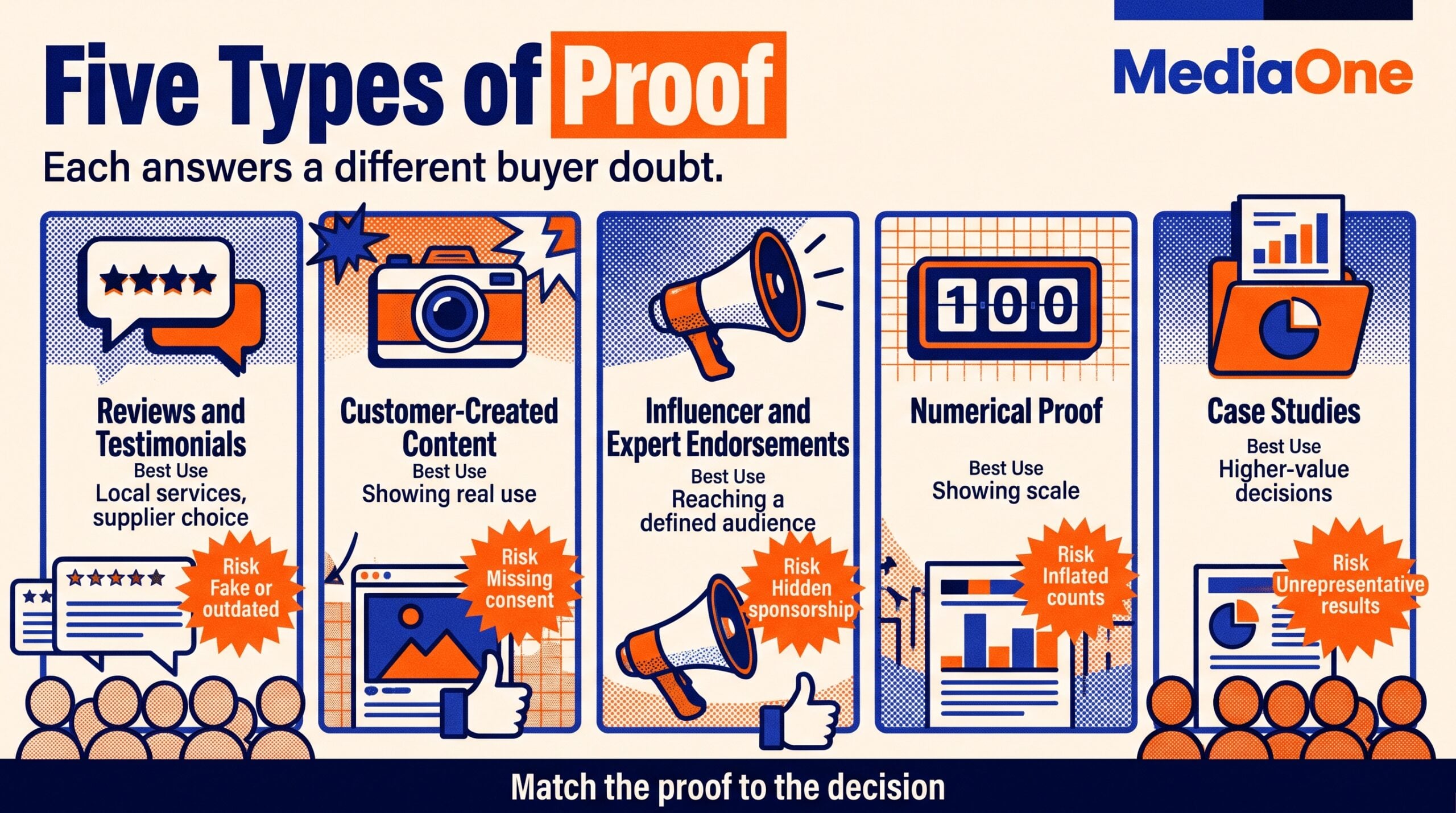
Different forms of proof answer different buyer concerns. Choose the type according to the decision being made, the evidence available and the degree of control your business has over the source.
Customer Reviews and Testimonials
Public reviews are useful for buyers comparing service quality, response times and recurring complaints. Testimonials selected for a website let a business highlight a particular experience, but they need context so readers can judge how representative the example is. Retain the customer’s meaning and any permission to publish personal details.
Identify a displayed rating’s platform, count and date. Never invent scores or imply that selected testimonials represent every customer. Link to the original feedback when permitted.
For a local business in Singapore, Google allows a review request link or QR code to be shared after a customer interaction. The request must remain neutral, with no reward for posting, changing or removing a review. Ask neutrally without prescribing a rating.
User-Generated Content and Endorsements
Customer-created posts can demonstrate actual use, such as a photograph of an installed product or a video of an event experience. Before reusing that material in an advertisement, check its authenticity and obtain appropriate permission from the creator. Public posting alone does not grant unrestricted reuse rights.
Influencer and expert endorsements can introduce a product to a relevant audience, but a large following is not proof of product quality. Ask what the endorser tested, how the opinion was formed and what relationship they have with the brand. Check that a claimed expert has relevant expertise.
Singapore’s ASAS social media advertising guidance addresses disclosure of commercial relationships in marketing communication. Paid appearances, gifted products and other arrangements that influence a recommendation need clear treatment under the applicable guidance. Make the connection clear where people see the endorsement.
Numerical and Descriptive Proof
Counts can signal usage or scale when they have a clear definition. ‘Projects completed’ may include work from several years, while ‘active customers’ should have a documented reporting period. State what was counted and when.
Descriptive proof can be just as helpful. A provider might explain the types of premises it has served, the process followed or the qualifications required for a particular task. Identify the issuer and current status of any certification or award.
Avoid live purchase notifications unless they reflect actual events and have an appropriate privacy basis. Unrecorded ‘someone booked just now’ alerts create false urgency. If a statistic cannot be reproduced from internal data, remove it until the supporting records are available.
Case Studies and Customer Outcomes
A case study connects a buyer’s initial problem with the work delivered and the result recorded. It should identify the business context, explain the measurement period and describe the limits of the result. A customer quote should not replace outcome records.
For a logistics project, explain the original approval process, the implementation and how processing time was measured. Name the client only with approval, and separate recorded outcomes from forecasts. Sensitive projects can be described at an agreed level of anonymity.
| Type | Best Use | Main Risk |
|---|---|---|
| Reviews and testimonials | Local services and supplier comparisons | Selective, fake or outdated feedback |
| Customer-created content | Showing product use or service delivery | Missing consent or misleading context |
| Influencer and expert endorsements | Reaching a defined audience | Hidden sponsorship or weak expertise |
| Numerical proof | Showing scale and adoption | Inflated counts or unclear definitions |
| Documented case studies | Supporting higher-value decisions | Unrepresentative outcomes or missing records |
How to Audit Your Social Proof
An audit identifies outdated quotes and claims without supporting records. Review these before investing in additional traffic.
Use the Proof Strength Matrix
The Proof Strength Matrix evaluates how specific the evidence is and how closely it relates to the intended buyer. Score each element on both axes before deciding where to place it. A strong result on one axis cannot fully compensate for a weak result on the other.
| Specificity | Relevance to Buyer | Recommended Action |
|---|---|---|
| High | High | Prioritise near the related claim or decision |
| High | Low | Move to a better-matched service or audience page |
| Low | High | Request a clearer example or supporting outcome |
| Low | Low | Remove or replace with stronger material |
Specific evidence identifies the source, the experience and any measured result. Relevant evidence reflects the reader’s service need, company type or buying concern. Check both dimensions before placing a prominent testimonial above a form.
Use the following ranking to make editorial decisions consistent: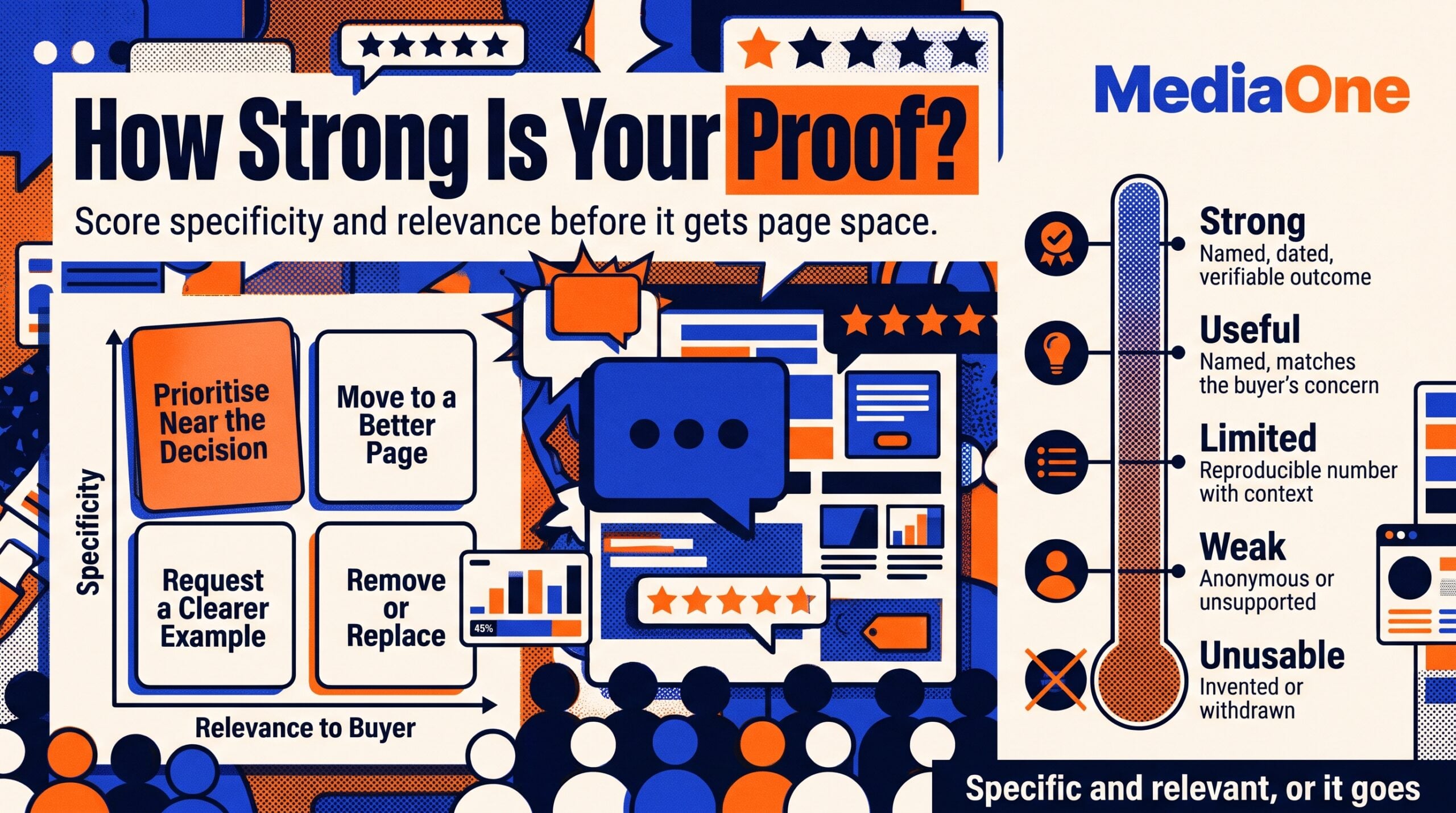
- Strong: A named, dated and approved customer account with a verifiable outcome relevant to the buyer.
- Useful: A named customer describing an experience that matches the buyer’s concern, even without a measurable result.
- Limited: A reproducible number or general review with enough context to assess its meaning.
- Weak: Anonymous praise, unsupported superlatives or a quote that cannot be traced to itssource.
- Unusable: Invented, misleading or withdrawn material that should be removed immediately.
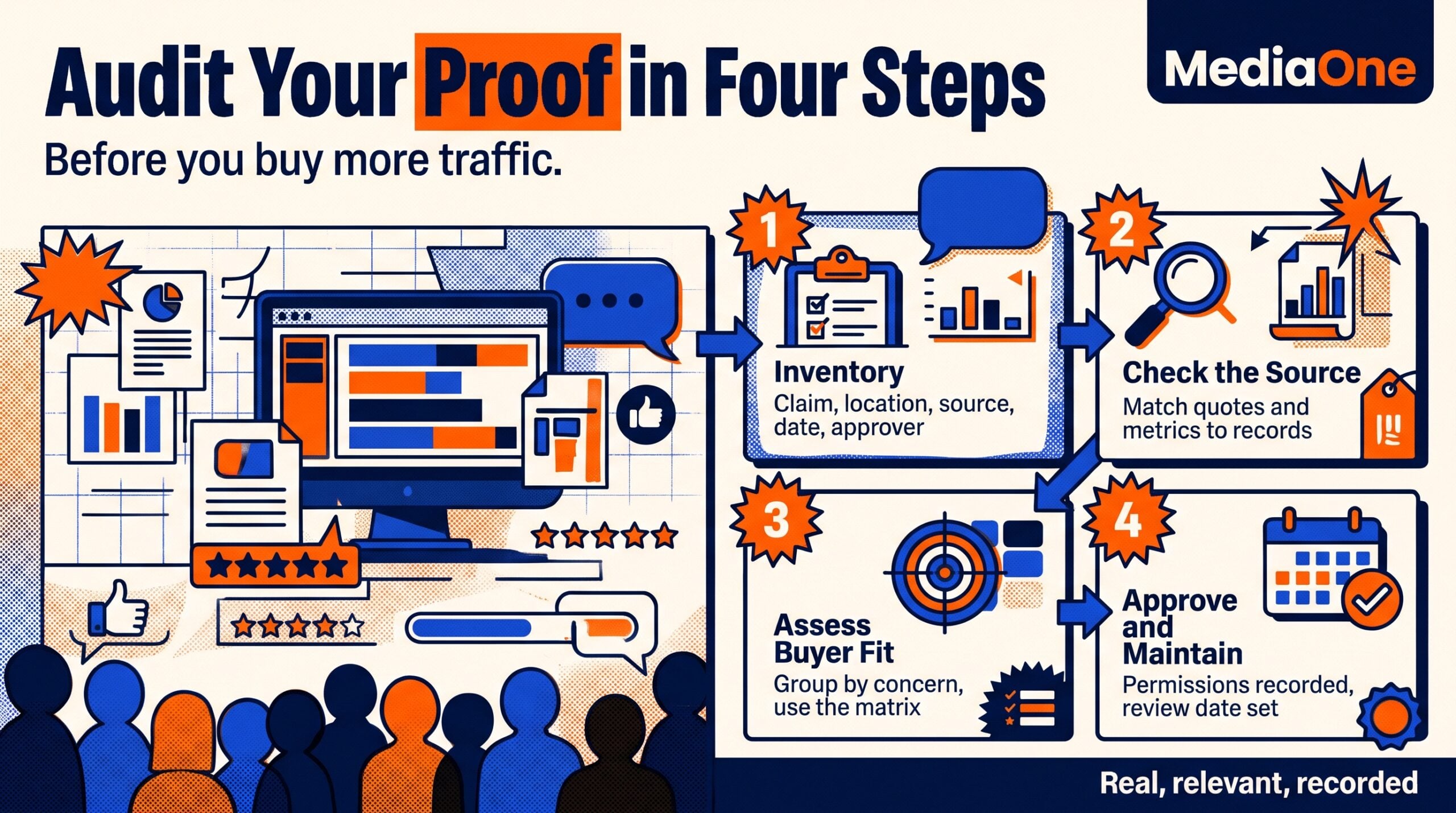
Follow a Four-Step Audit
Step 1: Inventory your proof. Review the homepage, key service pages, product pages, paid landing pages and testimonial sections. Record the exact claim, current location, original source, publication date and the person responsible for approving it.
Step 2: Check the source. Match each quotation to the original feedback and verify any metrics against project records. Confirm that the business still offers the relevant service and that any licence, award or certification remains valid.
Step 3: Assess buyer fit. Group proof by concern, such as delivery reliability, value, technical competence or after-sales support. Use the matrix to identify the strongest evidence for each concern, then revise or remove vague material without inserting made-up detail.
Step 4: Approve and maintain. Record permission to use names, logos and identifiable customer details before publishing. Assign a review date so older claims can be checked again, and keep the original evidence available if a customer asks how the claim was produced.
Applying Proof on a Page and in Ads
Evidence works best when it addresses the question a visitor is trying to resolve. Put a relevant review beside a service claim, an implementation story next to a complex offer or delivery feedback near a purchase decision. Test placement on each page.
Match Proof to Buyer Hesitation
On a homepage, a short explanation of who the business serves may need one independent review source. On a detailed service page, a testimonial describing the same work can answer a more specific concern. For checkout and enquiry forms, reassurance about response times or the next step may be more useful than another popularity statistic.
A Singapore renovation customer comparing quotations will want evidence of project handling and communication, while a software buyer may need assurance about onboarding and support. Keep enough context to make the experience meaningful. Our customer review placement guide explains how to match reputation evidence to buying questions.
Check mobile readability and access to the original source. Do not disguise selected testimonials as live system notifications.
Test Proof Without Guesswork
Compare one meaningful change at a time. For example, an A/B test can assess a service-specific testimonial beside an enquiry form against the current page, while keeping the offer and targeting unchanged. Record the start and end dates, traffic source, variant and outcome measure.
Measure qualified enquiries, booked consultations or completed orders alongside the headline conversion rate. A higher click rate on a testimonial is not commercial success if the extra enquiries are unsuitable. Small samples may be inconclusive, so use customer interviews to interpret them.
Avoid copying uplift percentages from unrelated vendor case studies. A vendor’s result may not transfer to another sector. Our ecommerce conversion guide covers how customer evidence can support product pages alongside clear buying information.
Use the Same Standard in Paid Ads
An advertisement can quote a genuine customer or reference a documented outcome if the source permits that use and the wording remains accurate. The landing page should support the claim with enough context for visitors to understand it. Avoid compressing a conditional case-study result into a guarantee simply to fit an ad headline.
Keep copies of campaign claims and permissions. Confirm that sponsored endorsements remain identifiable after reposting or adaptation.
Ethics, Pitfalls and Limits
Claims that cannot be traced to real experiences undermine trust. Build consent, review checks and disclosure into the publishing workflow.
Review Policies and False Claims
Google’s policy on fake engagement prohibits incentivised reviews, fabricated experiences and selective requests for positive ratings. Staff and non-customers should never pose as reviewers. Request feedback without controlling the score.
Singapore enforcement shows why the risk is practical. On 21 June 2024, the Competition and Consumer Commission of Singapore reported that Loft Home Furnishing posted fake five-star reviews. The case concerned reviews attributed to customers without their knowledge and led to undertakings and warnings.
Disclosing a reward does not make an incentivised Google review acceptable under Google’s platform rules. Apply the relevant platform rules separately from general advertising disclosure requirements. For review pages that you control, never present edited quotations as verbatim customer statements.
Privacy Consent and Endorsements
A customer’s name, photograph, job title or identifiable project details may involve personal data. Check the applicable consent and notification obligations under Singapore’s Personal Data Protection Act before republishing those details. Written approval also helps prevent disagreements about the intended use of a testimonial.
Obtain permission to reproduce customer logos or restricted project material. If someone withdraws consent, escalate the request promptly to the staff member responsible for privacy and content.
For sponsored posts, follow ASAS disclosure guidance and explain the commercial connection in language that a reader can understand. Gifts can create a commercial connection without cash payment. Review captions and the final published post.
Recognise When Proof Can Backfire
Outdated ratings, exaggerated results and anonymous endorsements can prompt visitors to question every other claim on the page. An entirely positive collection may look selectively edited, particularly if independent reviews differ.
Avoid aggressive countdowns, invented purchase notifications or unsupported rankings that pressure people to act. Google also restricts self-serving review stars in organic search results for businesses marking up reviews about themselves, as set out in its review structured data rules. Publishing genuine testimonials on a website does not guarantee star snippets in search.
When You Have Few or No Reviews
A young business can build trust without a long review history. Describe its service process and show verified qualifications or approved client feedback, even when the review count is small.
Build a simple post-service request into the customer experience. Ask for honest feedback after a job is completed, a booking has been fulfilled or a support case has closed. Use Google’s review link where appropriate, without promising a discount or filtering requests according to how satisfied a customer appears.
Treat early negative feedback as information to respond to and learn from. A calm explanation of what happened and what the business can do next may be more credible than a defensive argument. Never expose private details in a public reply.
For B2B clients bound by confidentiality, ask permission to publish a limited case description or a reference that can be shared privately during procurement. You can also explain your process without presenting it as a client result.
Your Next Step
Social proof should earn its place by giving buyers information they can check. Start with an audit of your three highest-value landing pages, rank each proof element for specificity and relevance, and take down material that cannot be substantiated.
Next, ask recent customers for neutral feedback, document permissions and select proof that addresses the doubts your sales team hears repeatedly. Test placement against qualified enquiries before using the same claims across more pages or campaigns. We can help connect customer evidence to content and campaign planning through our social media marketing services.
Frequently Asked Questions
What is social proof in simple terms?
Social proof is information about what other people have done or experienced that helps someone assess a decision. In marketing, it can include a customer review, testimonial, case study or credible endorsement. Its value depends on authenticity and relevance, so a detailed account of a comparable purchase may be more helpful than a broad popularity claim.
Does social proof work for B2B businesses?
It can help B2B buyers assess implementation risk and supplier reliability, particularly when a case study reflects their industry or workflow. A useful example explains the customer’s starting point, what was delivered and how the result was measured. Buying committees still need pricing, security information and direct evaluation, so treat customer evidence as one part of the decision.
How many reviews does a business need?
There is no universal review count that guarantees trust or conversions. Begin by collecting genuine feedback consistently and showing a clear source, date and service context where available. A small set of detailed reviews can answer specific concerns, while a large set of vague ratings may leave important questions unresolved. Review the pattern of comments as well as the average score.
Can a business reward customers for Google reviews?
No. Google’s policies prohibit offering payments, discounts, gifts or services in exchange for posting, changing or removing reviews. You may share a direct review link or QR code and ask customers for honest feedback without steering them towards positive ratings. Keep any separate testimonial arrangements distinct from Google reviews and check the relevant advertising disclosure requirements.
Can social proof make customers less trusting?
Yes. Buyers may question anonymous endorsements, unrealistic statistics or testimonials that do not match information found elsewhere. False reviews can also expose a business to platform restrictions and fair trading concerns. Check claims against records, retain the customer’s meaning when editing a quote and remove old evidence when it no longer describes the service accurately.
How should a small business start collecting proof?
Choose a natural point after a completed service to ask every eligible customer for honest feedback. Keep the request short, avoid rewards for platform reviews and record consent before using identifiable testimonials in marketing. Begin with the service pages that attract qualified enquiries, then place the strongest relevant quotes where they answer a real buying concern.