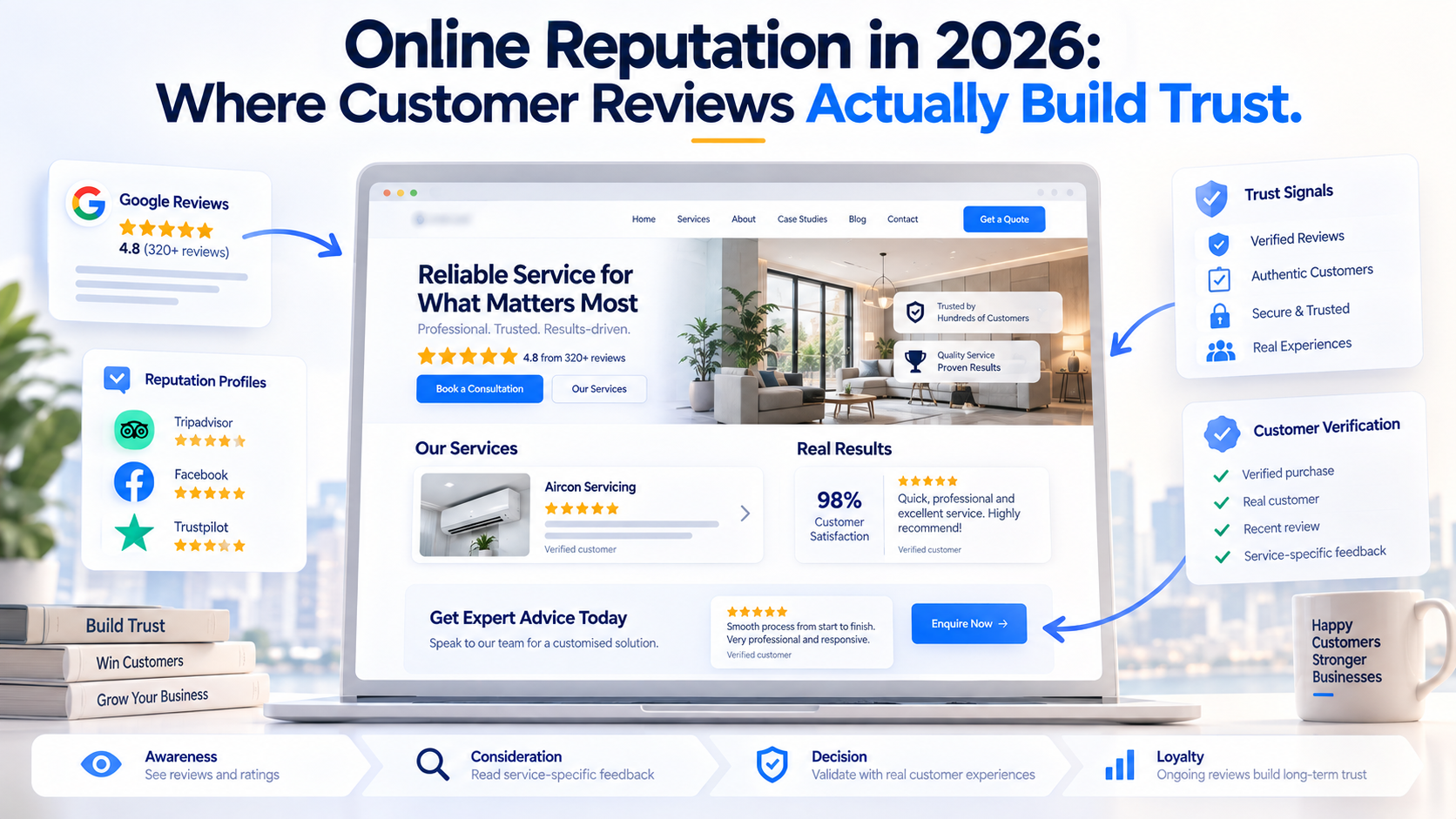
Online Reputation in 2026: Where Customer Reviews Actually Build Trust
Customer reviews can strengthen an online reputation, but only if prospects see relevant proof while deciding whether to trust the business. We tested where reviews work best across the buyer journey.

A business can have hundreds of excellent customer reviews and still make surprisingly little use of them. The Google rating may be strong and customers may repeatedly praise the same services, outcomes and staff, yet once a prospect reaches the website, that reputation can disappear behind a generic testimonials page few people visit.
That creates a gap between having a good reputation and making that reputation useful.
For this study, we focused on a practical question:
Where should customer reviews appear if the goal is to improve how prospective customers perceive and trust a business?
Instead of assuming more reviews are always better, we used the same underlying reputation evidence in different parts of a controlled service-business journey. We compared a testimonials page, a rating summary, a service-specific review, a review near the call to action and distributed proof across the page.
We tracked four ideas:
- Review Discoverability: whether prospects noticed meaningful review evidence
- Trust Lift: how much the treatment changed average trust relative to the weakest treatment
- Proof Match: how closely a review supported the claim beside it
- Reputation Conversion Gap: how much strong public reputation was being wasted because relevant evidence was absent from the buying journey
Quick Answer
The results strongly favoured distributed, relevant review proof over relying on a testimonials page alone.
Distributed proof achieved 88% Review Discoverability, a median 2.9-second time to first proof and an 8.1/10 trust score. The testimonials-only version reached just 24% discoverability, took 18.6 seconds before users encountered meaningful proof and scored 6.2/10 for trust.
A rating summary was the fastest individual format to notice at 3.2 seconds, but speed was not enough on its own. Combining a rating with one relevant written review produced the strongest overall response, reaching 8.0/10 trust, 78% review recall and 58% enquiry intent.
Placement also mattered near the decision point. An objection-handling review generated a 44% form-start rate, compared with 24% when no review evidence appeared near the CTA. A strong but balanced reputation presentation also appeared more authentic than showing only perfect praise.
The practical conclusion is not to delete the testimonials page. Keep it as an archive, then distribute genuine proof beside the questions and concerns it can actually answer.
Put reputation evidence beside the question it answers.
| Customer question | Best proof to use |
| Can I trust this company? | Rating, review count and third-party review profile |
| Can they actually do this service? | Service-specific customer review |
| Will I get the result they promise? | Outcome-focused review |
| Is this safe to buy or enquire about? | Reassurance or objection-handling review |
| Are these claims independently supported? | Third-party reviews and external corroboration |
What Is Online Reputation?
Online reputation is the collection of evidence a customer encounters when deciding what to believe about a business. That can include customer reviews, Google Business Profile information, website claims, social profiles, directories, media coverage, case studies, customer responses and other third-party references.
Reviews are one of the most visible parts of that picture, but they are not the entire reputation. A company can have an excellent Google rating while its own website makes weak or unsupported claims, while another can publish detailed testimonials but have almost no independent reputation footprint.
That wider reputation journey matters because positive reviews often trigger more research rather than ending the decision. BrightLocal’s 2026 consumer review research found that 85% of consumers are more likely to use a business after reading positive reviews, while 54% then visit the business’s website and 66% continue researching before making a purchase or booking.
A stronger reputation exists when these different surfaces tell a consistent and verifiable story. MediaOne’s Online Reputation Management services approach that as a broader brand-management problem rather than only a review-collection exercise.
Reviews Are Useful Only If Customers See Them
A good review hidden on a testimonials page still exists, but it may do little for a customer currently deciding whether to enquire.
We define Review Discoverability as:
People who noticed meaningful review evidence ÷ people who viewed the page
A business can therefore have exceptional public reviews but weak Review Discoverability if its website hides that proof several clicks away from the service or enquiry experience.
Review Discoverability Results
| Review placement | Review noticed | Median time to first proof | Trust score |
| Testimonials page only | 24% | 18.6 sec | 6.2/10 |
| Rating summary near top | 72% | 3.4 sec | 7.0/10 |
| Service-specific review | 68% | 7.8 sec | 7.5/10 |
| Review near CTA | 60% | 13.1 sec | 7.3/10 |
| Distributed review proof | 88% | 2.9 sec | 8.1/10 |
The distributed treatment did not rely on one oversized testimonial block. Its advantage came from giving users several relevant opportunities to encounter proof while moving through the page.
The rating summary was noticed quickly, but speed alone did not create the highest trust. The service-specific review took longer to process yet produced stronger trust because it gave context to the claim being evaluated.
How We Tested Customer Review Positioning
We recruited 250 Singapore-based participants, with 50 randomly assigned to each of five page variants. Participants were adults who had considered or purchased a local service within the previous 12 months, and mobile and desktop sessions were balanced across groups.
Every version used the same fictional service business, page copy, offer, CTA, displayed public rating, customer reviews, visual design and enquiry information. Only the positioning of reputation evidence changed.
Variant A: Testimonials Page Only
The main service page contained no meaningful review evidence. Participants had to visit a dedicated testimonials page to see detailed customer proof, making this the weak-positioning baseline.
Variant B: Rating Summary Near the Top
A visible reputation summary appeared near the start of the page:
4.7 ★ from 386 customer reviews
It also linked to the business’s third-party review profile.
Variant C: Service-Specific Review
A review directly related to the evaluated service appeared beside the relevant claim. For example, a same-day repair claim was supported by a customer review describing a genuine same-day repair experience.
Variant D: Review Near the Decision Point
Relevant customer proof appeared beside the enquiry form, quote request or primary CTA.
Variant E: Distributed Reputation Proof
Review evidence appeared at several points in the journey:
- rating summary near the top
- service-specific review beside a key claim
- outcome review near the service explanation
- reassurance review beside the CTA
- third-party review link near the final decision point
What We Measured
Review noticed meant the participant correctly identified or recalled review evidence without prompting. Time to first proof measured the median elapsed time before review evidence was first identified.
Trust score was the group’s mean response on a 0 to 10 post-task scale, while enquiry intent measured the share choosing 4 or 5 on a five-point likelihood-to-enquire question. Review recall required participants to correctly remember the rating or at least one specific review detail.
We also recorded form-start rate, meaning the share of participants who clicked into the prototype form. This was not a completed lead or real conversion rate.
Is a Testimonials Page Enough?
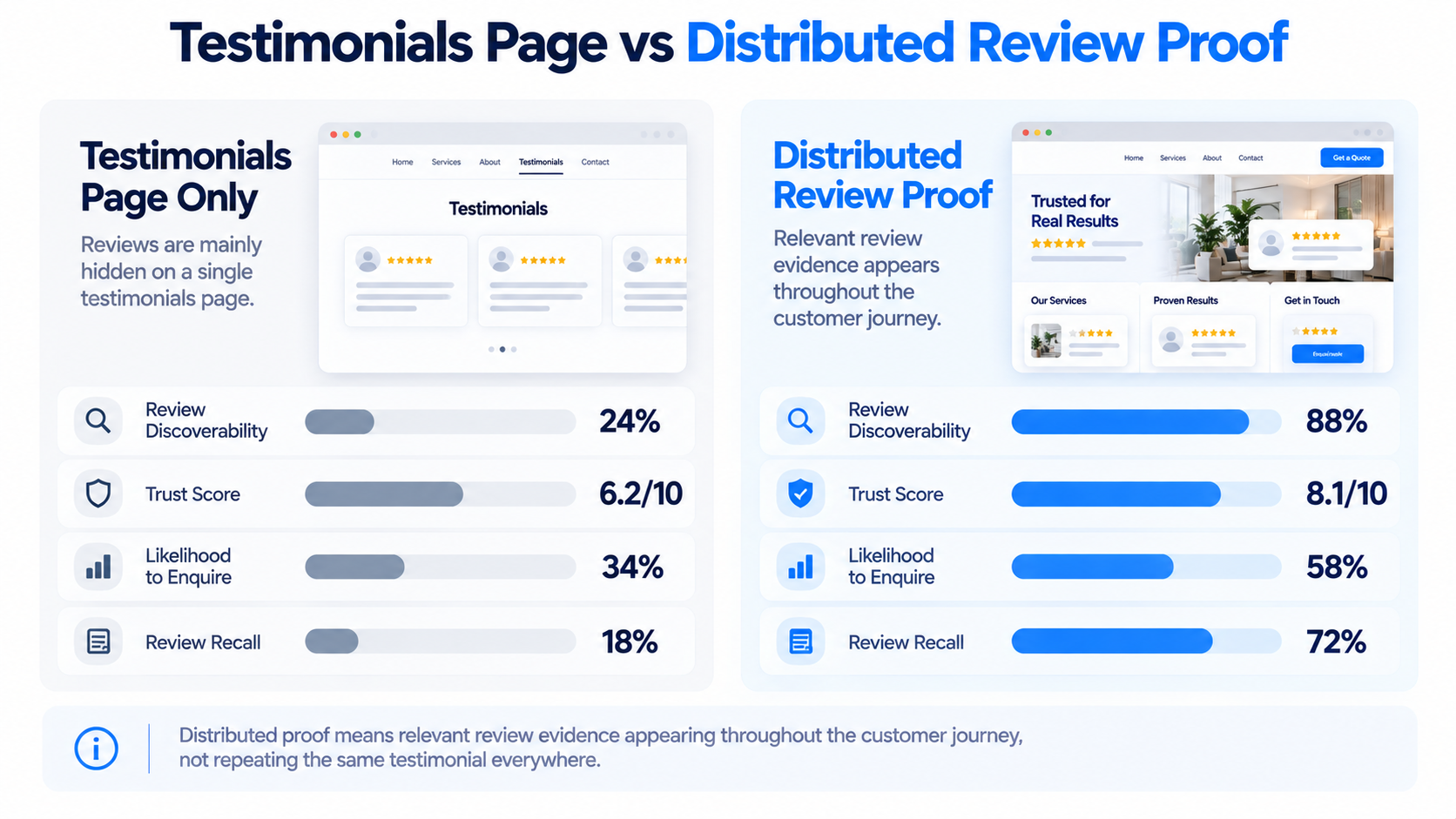
The results suggest a testimonials page works well as an archive, but poorly as the only source of customer proof.
Only 12 of 50 users in the testimonials-only group noticed meaningful review evidence. In the distributed group, 44 of 50 noticed it. Trust was 1.9 points higher and enquiry intent was 24 percentage points higher when proof was distributed throughout the buying journey.
Testimonials Page vs Distributed Proof
| Placement strategy | Review Discoverability | Trust score | Likelihood to enquire | Review recall |
| Testimonials page only | 24% | 6.2/10 | 34% | 18% |
| Distributed proof | 88% | 8.1/10 | 58% | 72% |
The lesson is not “delete the testimonials page.” Keep it as the central reputation archive, but do not require customers to leave the service journey before they can see evidence relevant to the decision they are already making.
MediaOne has previously covered how to get and manage positive online reviews. This study focuses on the next problem: what to do with that reputation once you already have it.
Rating Summary vs Written Review: Which Builds More Trust?
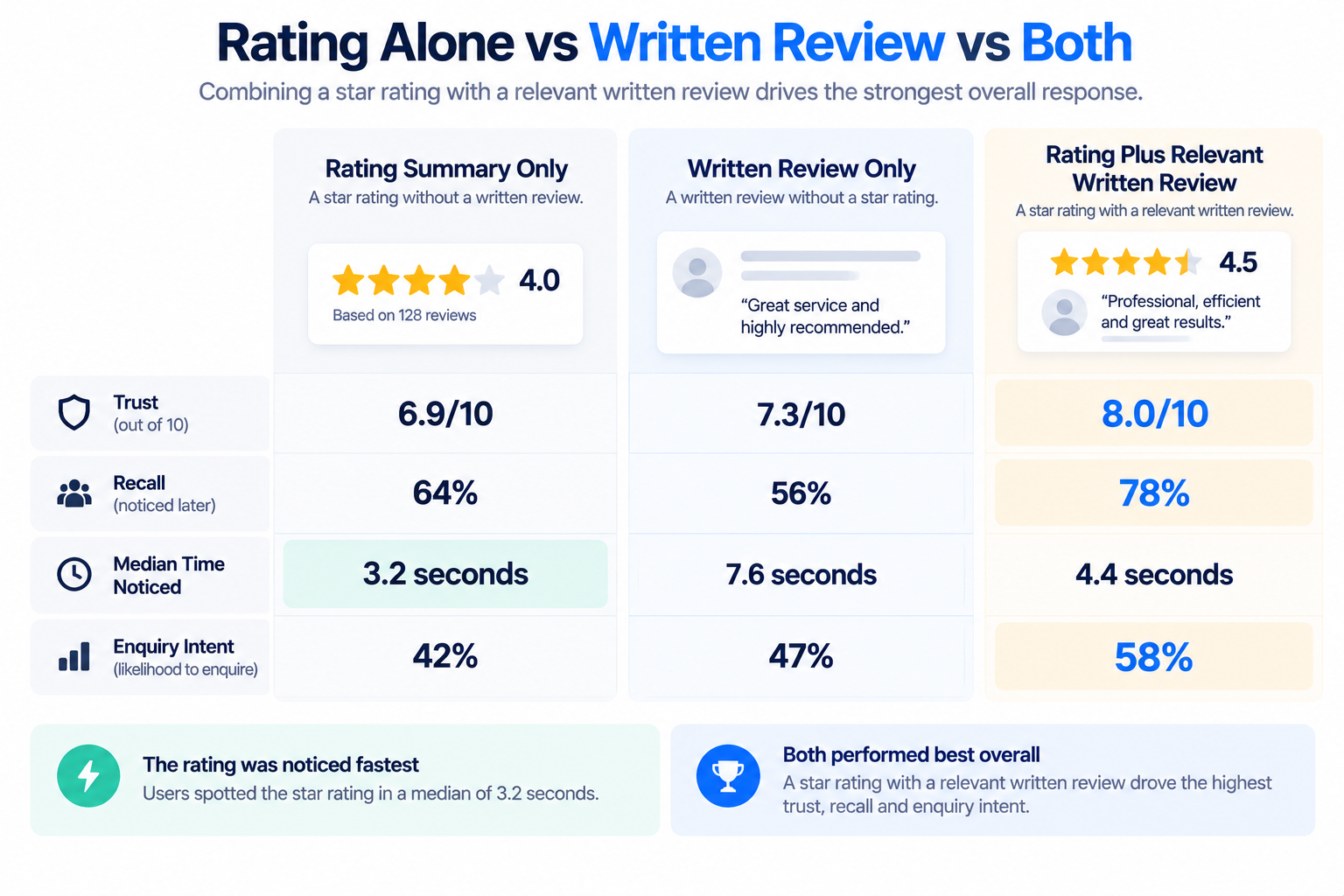
Ratings are easy to scan, while written reviews provide context. Our results suggest they solve related but different problems.
A rating such as 4.7 stars from 386 customers provides immediate social proof but tells prospects little about why those customers were satisfied. A detailed written review takes longer to process but can explain what happened, what problem was solved and why the customer trusted the business.
In a separate counterbalanced test, 250 participants viewed all three formats in randomised order.
Rating vs Written Review Results
| Review format | Trust score | Recall | Median time noticed | Enquiry intent |
| Rating summary only | 6.9/10 | 64% | 3.2 sec | 42% |
| Written review only | 7.3/10 | 56% | 7.6 sec | 47% |
| Rating + relevant written review | 8.0/10 | 78% | 4.4 sec | 58% |
The rating alone was fastest to notice, while the written review added stronger context. Combining both produced the strongest trust, recall and enquiry intent without requiring a large testimonial section.
That suggests the formats are better treated as complements rather than substitutes.
Generic Reviews vs Specific Reviews
Not every positive review does the same reputation work.
Compare:
“Great company. Highly recommended.”
with:
“They repaired our office aircon the same afternoon and explained exactly what had failed.”
Both are positive, but only the second provides evidence about the specific service.
We call the relationship between the claim and the supporting review Proof Match.
Proof Match Score
- 0: The review does not support the nearby claim
- 1: The review is broadly related
- 2: The review directly supports the claim
For example, if the claim is “Same-day commercial aircon repair,” a generic “Great service” review receives a weaker Proof Match than a review describing an office aircon being repaired that afternoon.
We tested four review types with 200 participants split evenly across treatments.
Proof Match Results
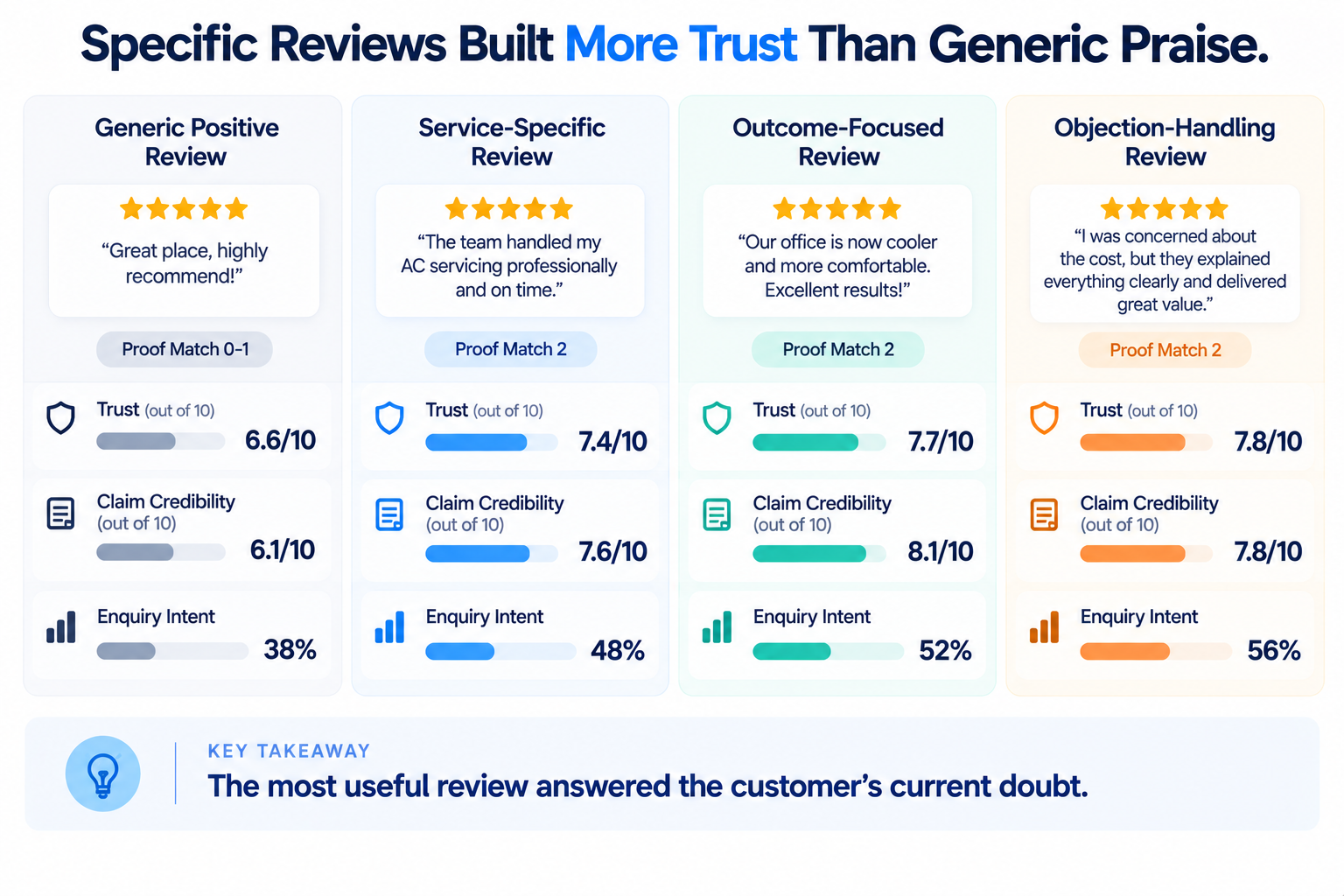
| Review type | Proof Match | Trust score | Claim credibility | Enquiry intent |
| Generic positive review | 0–1 | 6.6/10 | 6.1/10 | 38% |
| Service-specific review | 2 | 7.4/10 | 7.6/10 | 48% |
| Outcome-focused review | 2 | 7.7/10 | 8.1/10 | 52% |
| Objection-handling review | 2 | 7.8/10 | 7.8/10 | 56% |
The outcome-focused review gave the service claim its highest credibility score, while the objection-handling review produced the highest enquiry intent because it addressed the participant’s immediate concern.
The most valuable review was therefore not simply the most enthusiastic. It was the one that most directly resolved the customer’s current doubt.
Where Reviews Matter Across the Buyer Journey
Customer reviews do different jobs depending on where they appear.
1. Discovery: “Is This Business Worth Investigating?”
Customers may first encounter the company through Google, Maps, social media, a directory or an AI recommendation. At this point, broad signals such as average rating, review volume, recency and a recognised third-party profile help answer whether the business deserves further investigation.
The job of the review evidence here is not to prove every claim. It is to create enough confidence for the prospect to continue.
2. Verification: “Does the Website Match the Reputation?”
Once the customer reaches the website, they begin checking whether the company’s own claims align with what customers say elsewhere.
A rating summary, third-party review link and carefully selected customer evidence can connect the public reputation to the website experience. If the site repeatedly claims “fast response” while customers praise unrelated qualities, the proof is weaker than when both sources reinforce the same reputation.
3. Evaluation: “Can They Solve My Specific Problem?”
This is where service-specific reviews became more valuable.
Someone evaluating Invisalign does not only need a generic quote saying the clinic is friendly. Likewise, a prospect considering an SEO audit benefits more from a review discussing technical findings, reporting quality, communication or measurable outcomes.
The review should answer the question created by the surrounding page.
4. Risk Reduction: “Is It Safe to Take the Next Step?”
Near a quote, consultation or purchase CTA, customers may worry about price, contracts, reliability, responsiveness or hidden costs. Our CTA test suggests that an authentic review addressing the relevant objection can be substantially more useful than generic praise.
5. Reinforcement: “Can I Verify This Elsewhere?”
The final layer is independent confirmation. Third-party review profiles, consistent business information and external coverage allow customers to verify that the website is not presenting an isolated or selectively curated reputation.
Independent proof matters because customers do not automatically trust testimonials published by the company itself. Nielsen Norman Group’s usability research found that participants treated external reviews as more credible than company-controlled testimonials and often looked elsewhere online to verify what a business claimed about itself.
This connects with MediaOne’s guide to building a stronger online customer experience, where trust needs to remain consistent across the entire digital journey rather than one isolated page.
The Reputation Proof Map
The findings can be turned into a practical placement framework.
| Buyer question | Reputation evidence | Best placement |
| Can I trust this company? | Rating + review count + independent profile | Homepage or early service page |
| Can they perform this service? | Service-specific customer review | Relevant service section |
| Does this work for people like me? | Customer-type or industry review | Segment or service page |
| Will I get the promised outcome? | Outcome-specific review | Beside claim or case study |
| Is it safe to enquire or buy? | Reassurance or objection-handling review | Near CTA, form or pricing |
| Can I verify these claims? | Third-party reviews and independent proof | Review links or reputation section |
The principle is straightforward:
Position customer proof where doubt appears.
A review should not be placed on a page simply because the design has room for a testimonial card. It should resolve a specific uncertainty within the buyer journey.
The Reputation Conversion Gap
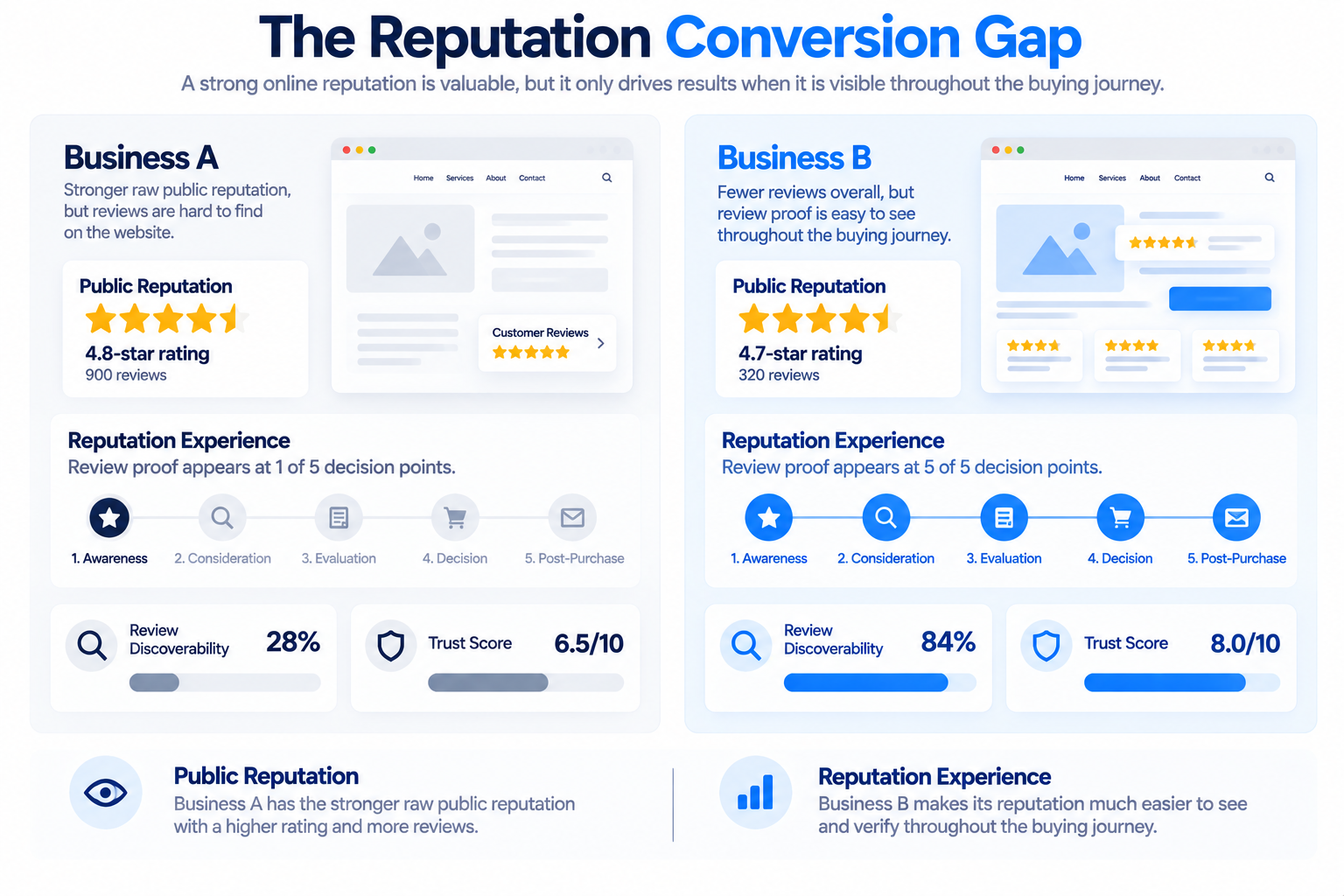
A business can have a strong public reputation and still make poor use of it on its own website.

We define the Reputation Conversion Gap as the difference between how strong the business’s public reputation is and how much relevant reputation evidence customers can actually see while making a buying decision.
To illustrate this, we compared two controlled business profiles.
Business A
- 4.8 Google rating
- 900 public reviews
- three generic quotes on a separate testimonials page
- no service-specific proof
- no third-party review links near conversion points
Business B
- 4.7 Google rating
- 320 reviews
- rating summary near the top
- service-specific reviews
- customer outcomes beside key claims
- linked third-party review profile
- reassurance proof near the enquiry form
Business A had the stronger raw reputation. Business B created the stronger reputation experience.
Reputation Conversion Gap Results
| Business | Public reputation | On-site proof coverage | Review Discoverability | Trust score |
| Business A | 4.8★ / 900 reviews | 1 of 5 decision points | 28% | 6.5/10 |
| Business B | 4.7★ / 320 reviews | 5 of 5 decision points | 84% | 8.0/10 |
The comparison deliberately gave Business A the higher rating and larger review count. Despite that advantage, Business B made its slightly weaker public profile much easier for customers to see, understand and verify.
The goal of review positioning is to reduce that gap without changing or manipulating what customers actually said.
Do Reviews Near a CTA Improve Trust?
One of the most commercially important findings came from the decision point.
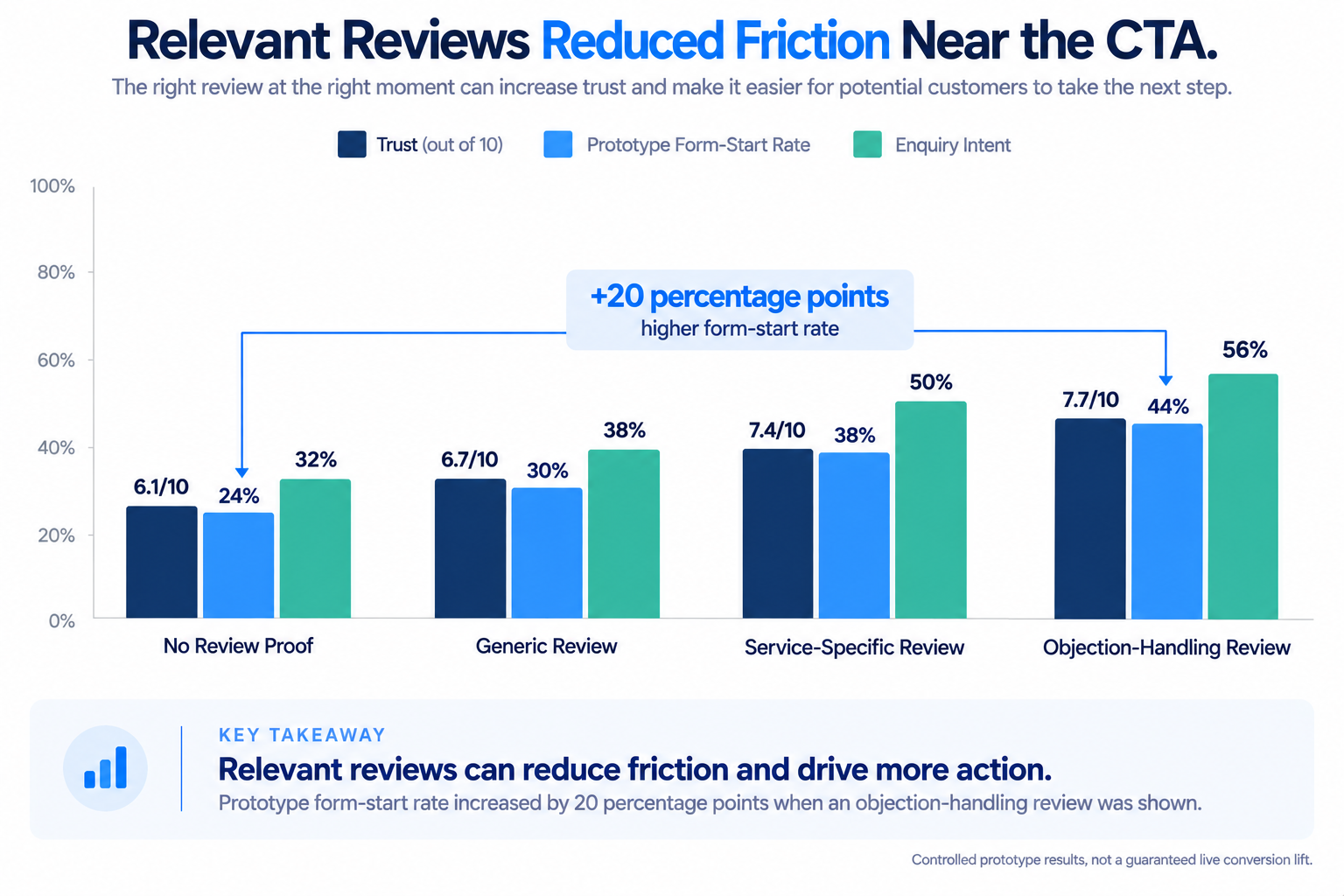
We assigned 200 participants evenly across four CTA treatments. The form, button, offer and page content remained identical, with only the surrounding review evidence changing.
CTA Results
| CTA treatment | Trust before CTA | Prototype form-start rate | Enquiry intent |
| No review proof | 6.1/10 | 24% | 32% |
| Generic review | 6.7/10 | 30% | 38% |
| Service-specific review | 7.4/10 | 38% | 50% |
| Objection-handling review | 7.7/10 | 44% | 56% |
The objection-handling treatment generated 20 percentage points more form starts than the version with no review proof.
That does not mean a live website should expect a guaranteed 20-point conversion increase. The experiment used a controlled prototype, while real performance can change with brand familiarity, traffic source, device, offer, page design and form friction.
The more defensible conclusion is that relevant proof becomes especially useful where customer uncertainty is highest. That does not require putting testimonials beside every button.
Do Perfect Reviews Look More Trustworthy?
Businesses naturally want to showcase their strongest customer feedback, but a reputation that appears unrealistically perfect can create a credibility problem of its own.
We tested two presentations with 120 participants, split evenly between groups.
The perfect-only version showed five glowing testimonials, no criticism, flawless ratings and no visible third-party context. The strong but balanced version showed a high overall rating, several positive reviews, one measured criticism, a professional business response and a link to the third-party review profile.
That credibility concern also matches guidance from Singapore’s Competition and Consumer Commission. CCCS advises consumers to look beyond average ratings, compare reviews across multiple platforms and be cautious when a business appears to have only perfect five-star feedback or unusually generic reviews.
Reputation Authenticity Results
| Reputation presentation | Trust score | Authenticity score | Credibility concern rate | Enquiry intent |
| Perfect-only presentation | 6.8/10 | 6.0/10 | 43% | 40% |
| Strong but balanced | 7.8/10 | 8.2/10 | 18% | 53% |
The balanced version was not designed to manufacture negativity. It simply presented a credible overall picture and demonstrated how the business responded when an experience was imperfect.
That reduced the share of participants who thought the reputation looked selective or “too perfect” from 43% to 18%.
Should Businesses Show Negative Reviews?
A negative review is not automatically useful social proof, and businesses do not need to promote every complaint on high-intent pages. However, unresolved criticism remains part of the online reputation whether the business displays it or not.
The better response is to acknowledge legitimate problems, respond professionally, move sensitive resolutions offline when appropriate and fix recurring operational issues. Businesses should also avoid public arguments or attempts to manipulate the review record.
Google permits businesses to ask customers for genuine feedback through review links and QR codes, but its policies prohibit fake engagement and incentives designed to influence, change or remove reviews. See Google’s tips for getting reviews and Maps user-generated content policy.
How to Ask for Reviews Without Manipulating Them
The strongest reputation strategy starts with genuine customer experiences.
Businesses can make reviewing easier by sending a review link after a completed service, including a QR code on receipts or printed materials, adding a request to a thank-you email or asking after a support interaction. The customer should still decide what rating and wording accurately reflects the experience.
Avoid asking specifically for five stars, offering discounts or gifts for positive feedback, telling customers which keywords to use or compensating someone to alter or remove criticism. Creating or purchasing fake reviews is also incompatible with a credible long-term reputation strategy.
Review manipulation is also an enforcement issue, not just a trust problem. In 2025, CCCS took action against a Singapore business after it admitted posting fake five-star customer reviews using customer information without their knowledge or consent. The case included reviews generated using AI, showing why businesses should treat authenticity and consent as part of reputation management itself.
If you need a broader acquisition workflow, MediaOne’s guide to getting and managing positive online reviews covers review requests, timing and ongoing management in more detail.
Reputation Consistency Matters Too
The website is only one reputation surface. A prospect may move from Google → website → social profile → review platform → directory → search result → website again before making a decision.
If every surface tells a different story, trust becomes harder to maintain. We therefore audited the same service business across six reputation surfaces.
Reputation Consistency Audit
| Surface | What customers see | Consistent? |
| Google Business Profile | 4.7★ from 320 reviews, current hours and core services | Yes |
| Main website | 4.7★ summary, matching contact details and third-party profile link | Yes |
| Service pages | Relevant reviews on three of five priority services | Partial |
| Social profiles | Correct name and phone number, but two older service descriptions | Partial |
| Review platforms | Ratings from 4.5★ to 4.8★, recurring praise themes agree | Yes |
| Industry directories | Two of six listings show outdated opening hours | No |
Only three of the six surfaces were fully consistent. The most immediate fixes were correcting outdated directory hours, updating the social descriptions and adding relevant proof to the two service pages that lacked it.
The broader point is that review positioning becomes much stronger when customer evidence and business information reinforce one another across the wider web.
Where Should Customer Reviews Appear?
Our results support a distributed approach rather than one universal review location.
Homepage
Use broad reputation evidence such as the overall rating, review volume, recognised review platform and one or two representative reviews. The homepage should establish trust quickly without becoming a wall of testimonials.
Service Pages
Use reviews that specifically support the service being sold. A technical SEO review belongs on the technical SEO page, while a review discussing Invisalign belongs with the Invisalign service.
Pricing and Quote Pages
Use evidence addressing value, pricing transparency, contracts and other concerns that commonly create hesitation.
Contact and Enquiry Areas
Short reassurance or objection-handling reviews can help reduce uncertainty, but they should not distract from the form itself.
Case Studies
Customer quotes should reinforce documented outcomes rather than function as decorative praise.
Testimonials Page
Keep it as the full reputation archive. Just do not make it the only place where customer proof appears.
What Should Businesses Fix First?
| Reputation problem | First action |
| Very few reviews | Improve legitimate review collection |
| Good reviews but customers rarely see them | Improve Review Discoverability |
| Generic testimonials | Select authentic service- and outcome-specific reviews |
| Strong Google reputation, weak website trust | Reduce the Reputation Conversion Gap |
| Website claims do not match review themes | Improve Proof Match |
| Strong testimonials but weak third-party proof | Link and maintain independent review profiles |
| Different information across platforms | Run a Reputation Consistency audit |
| Recurring negative themes | Fix the underlying customer-experience problem |
| Good traffic but weak enquiries | Test relevant proof at high-friction decision points |
Online reputation management becomes more useful when the business diagnoses the actual gap rather than assuming the answer is always “get more reviews.”

How to Measure Online Reputation
Avoid reducing reputation to a single star rating. A more useful dashboard combines reputation health, visibility, consistency and commercial impact.
Reputation Health
Track average rating, review volume, review recency, sentiment and the themes that repeatedly appear in both praise and complaints.
Review Visibility
Measure where customer proof appears, Review Discoverability, service-page proof coverage and whether important decision points contain relevant evidence.
Reputation Consistency
Check business-information accuracy, third-party profile consistency and alignment between what the website promises and what customers publicly describe.
Commercial Impact
Measure completed conversion rates alongside form starts, quote requests, assisted conversions and trust or perception scores from user testing. This helps separate a reputation treatment that simply attracts attention from one that actually improves business outcomes.
Final Verdict: Put Reputation Evidence Where Doubt Appears
A better online reputation is not created simply by collecting more positive reviews. Businesses also need to make genuine reputation evidence visible, relevant and easy to verify while customers are deciding what to believe.
Distributed proof was the strongest overall treatment in our study, reaching 88% Review Discoverability and an 8.1/10 trust score, compared with 24% discoverability and 6.2/10 trust for a testimonials-only setup. Combining a rating with a relevant written review produced the strongest balance of trust, recall and enquiry intent, while an objection-handling review performed best near the CTA.
The results also show why raw reputation size is not enough. A business with 900 reviews and a 4.8 rating produced weaker discoverability and trust when that proof was largely hidden than a business with 320 reviews and a 4.7 ratingwhose evidence appeared across all five decision points.
That changes the question businesses should ask.
Instead of:
Where can we put testimonials?
Ask:
What does the customer need proof of at this point in the journey?
Then match the evidence to that uncertainty.
Trust question → relevant customer evidence → right placement → easier verification
That is how customer reviews become more than reputation assets. They become useful proof throughout the buying journey.
Frequently Asked Questions
What Is Online Reputation?
Online reputation is the overall impression people form from information they can find and verify about a business online. That includes customer reviews, search results, website content, social profiles, directories, media coverage and the way the business responds publicly to customers.
Do Customer Reviews Improve Online Reputation?
Yes. Genuine customer reviews provide independent evidence about previous customer experiences, but collecting reviews and positioning them are different jobs.
Our test found that strong reputation evidence was much more likely to be noticed when it appeared throughout the relevant journey rather than only on a testimonials page.
Where Should Customer Reviews Be Placed on a Website?
The best placement depends on the question the review answers. Broad rating evidence works well early in the journey, service-specific reviews belong on relevant service pages, outcome reviews can support important claims and reassurance or objection-handling reviews can help around high-friction decision points.
Is a Testimonials Page Still Useful?
Yes, especially as a central archive of customer feedback.
However, distributed proof achieved 88% Review Discoverability, compared with 24% for a testimonials-only setup. The better strategy is to keep the testimonials page while also surfacing relevant evidence elsewhere.
Should I Put Reviews Near a Call to Action?
Potentially, especially when the review addresses the reason a customer may hesitate at that point.
Our objection-handling treatment achieved a 44% prototype form-start rate, compared with 24% with no review proof. That should be treated as evidence for live A/B testing rather than a guaranteed conversion lift.
Are Specific Reviews Better Than Generic Positive Reviews?
They were in our test.
The generic positive review scored 6.1/10 for claim credibility, compared with 7.6 for a service-specific review and 8.1 for an outcome-focused review. Specificity was most useful when the review genuinely supported the nearby claim.

Should Businesses Show Negative Reviews?
Businesses do not need to promote every negative review, but pretending criticism does not exist can undermine credibility when customers verify the company elsewhere.
Respond professionally, resolve legitimate issues and avoid manipulating the review record.
Can Businesses Offer Incentives for Google Reviews?
No. Google prohibits fake engagement and incentives that influence reviews, including payments, discounts or free goods offered in exchange for posting, changing or removing feedback.
How Often Should You Monitor Your Online Reputation?
The right cadence depends on the business’s review volume and reputational risk. High-volume consumer businesses may need daily monitoring, while lower-volume B2B companies can often work with a less frequent schedule.
What matters is having a consistent process for spotting new feedback, recurring complaints, outdated profile information and meaningful reputation changes before they become larger problems.