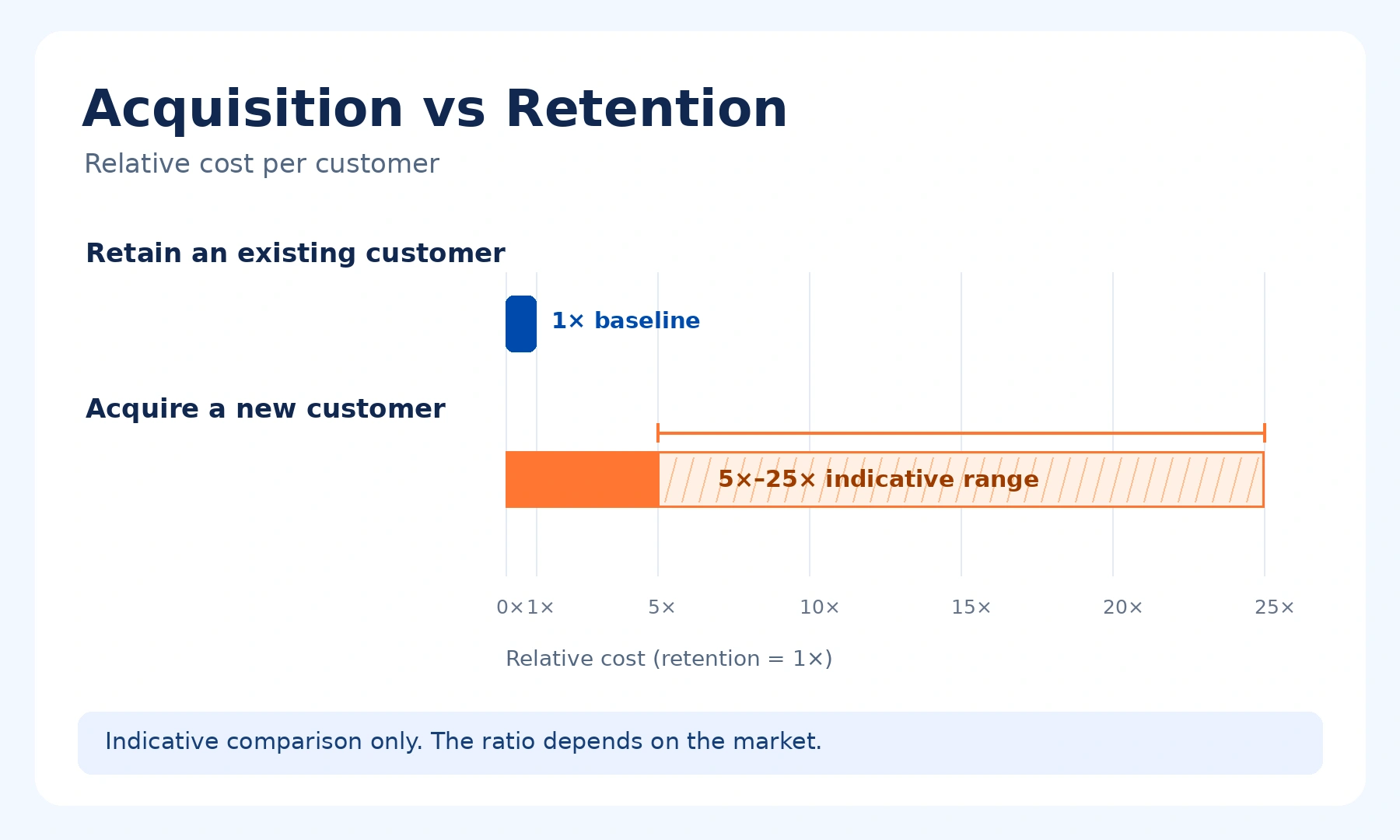
Customer retention is the rate at which customers continue to buy from you over time. For most businesses, it is also the cheaper source of growth. Acquisition often costs five to 25 times more than retention, a range Contentsquare cites, though the exact multiple depends on your market and model. This guide defines retention, shows how to calculate it, and explains how to find the stage of the customer journey where customers leave. We recommend a stage-by-stage diagnostic over a single company-wide retention percentage, because the single figure hides where the loss happens. Stage-level diagnosis also shows where support and product changes can help retain customers and raise customer lifetime value. A strong service experience at each stage is often what keeps customers coming back.
The retention rate formula is simple. Subtract new customers from your total at period-end, divide by the number you had at the start, and multiply by 100. If you started the quarter with 200 customers, gained 40 new ones, and finished with 220, your retained customers are 180 (220 minus 40), so your retention rate is 90 percent (180 divided by 200, times 100). The method is set out in Chase’s guide to customer retention.
Key Takeaways
- Retention often beats acquisition on cost. Existing customers are usually the cheaper growth lever.
- Averages hide where customers leave. Measure each lifecycle stage before running broad campaigns.
- Most unhappy customers stay silent. Pair surveys with behavioral signals such as usage drop-off.
- Benchmarks depend on your model. Compare yourself with businesses that buy at similar frequency.
- Rewards are not always profitable. Check whether a program adds margin or subsidizes loyal buyers.
- Fix the weakest stage first. Score each stage and direct the budget to the lowest score.
Customer retention is defined as the rate at which customers keep buying
Customer retention is the rate at which loyal customers keep purchasing goods or services from a business over time, according to Peel Insights. It is a behavior you can count. A retention rate shows what share of your starting customers stayed active over a defined period, making it the first number to check before deciding where to spend. Strong retention usually reflects customer satisfaction and a clear brand promise.
The math: why retention beats acquisition on cost
A retained customer adds revenue without the cost of a new sale. Each point of retention you add flows close to margin. Bill.com notes that the top growth companies generate most of their value from new revenue streams with loyal customers they already have, rather than from growing the base. Strong customer retention and support protect that margin over the full customer lifetime, and a smooth customer journey helps keep the brand top of mind.
Retention versus customer acquisition cost
Customer acquisition cost (CAC) is the total spend on marketing and sales divided by the number of new customers acquired. Suppose a campaign spends a fixed budget and wins 40 customers. If the same budget instead kept 40 existing customers who were about to leave, the margin difference shows up directly in the business numbers. Run this calculation with your own spend, using your product or service economics. The result is more useful than any published multiple.
Retention versus loyalty: what each measures
Retention measures whether customers continue to buy from you. Loyalty measures how strongly they prefer you and how willingly they recommend you. A customer can be retained through habit or switching cost without being loyal, so track the two separately. That distinction shapes which retention strategies you choose.
Core retention metrics
Retention rate
Most teams start with one number. Chase notes that while targets vary by industry, many small businesses aim for 70-80% or higher. Ecommerce sellers with regular buyers often see 30 to 40 percent, according to Peel Insights. These figures reflect different business models, so treat them as a starting point, not a verdict. Tracking how many customers you keep over each period shows whether your marketing and loyalty programs are working.
Churn rate
Churn is the mirror image of retention, and the earliest losses are the most expensive to ignore. Contentsquare reports that, on average, a mobile app loses 80 percent of its users after one session. That figure reflects one vendor’s observation for mobile apps and does not generalize to service businesses with monthly contracts. Separate voluntary churn (customers who choose to leave) from involuntary churn (failed payments or expired cards). Only the voluntary share responds to retention strategies, so customer feedback on the experience, mapped across each stage of the customer journey, is the fastest way to learn why people stop coming back.
Customer lifetime value and NPS
Lifetime value shows what a retained customer is worth over time, so it tells you how much a retention gain is worth in dollars. Pair it with Net Promoter Score (NPS), which asks customers how likely they are to recommend you on a scale from 0 to 10. A falling score often appears before churn does.
Cohort analysis: finding where and when customers leave
Averages hide the leak. Group customers by the month they joined and track each group’s retention at each lifecycle stage. The template below shows the calculation you should run on your data.
| Cohort (join month) | Onboarding complete | Active in month 3 | Renewed at due date |
|---|---|---|---|
| Your first cohort | Count completing setup ÷ cohort size | Count active ÷ cohort size | Count renewed ÷ count due |
| Your second cohort | Same calculation | Same calculation | Same calculation |
A cohort that holds steady for months but drops at renewal points to a renewal problem, not a general one.
Retention by lifecycle stage
Most retention reporting shows one company-wide percentage, and that number hides where customers leave. Split customers by lifecycle stage, and the loss usually sits in one place. Looking at each stage separately also shows the experience each group actually has, which a single blended rate cannot reveal. Strong customer retention depends on fixing the stage where each group actually drops off.
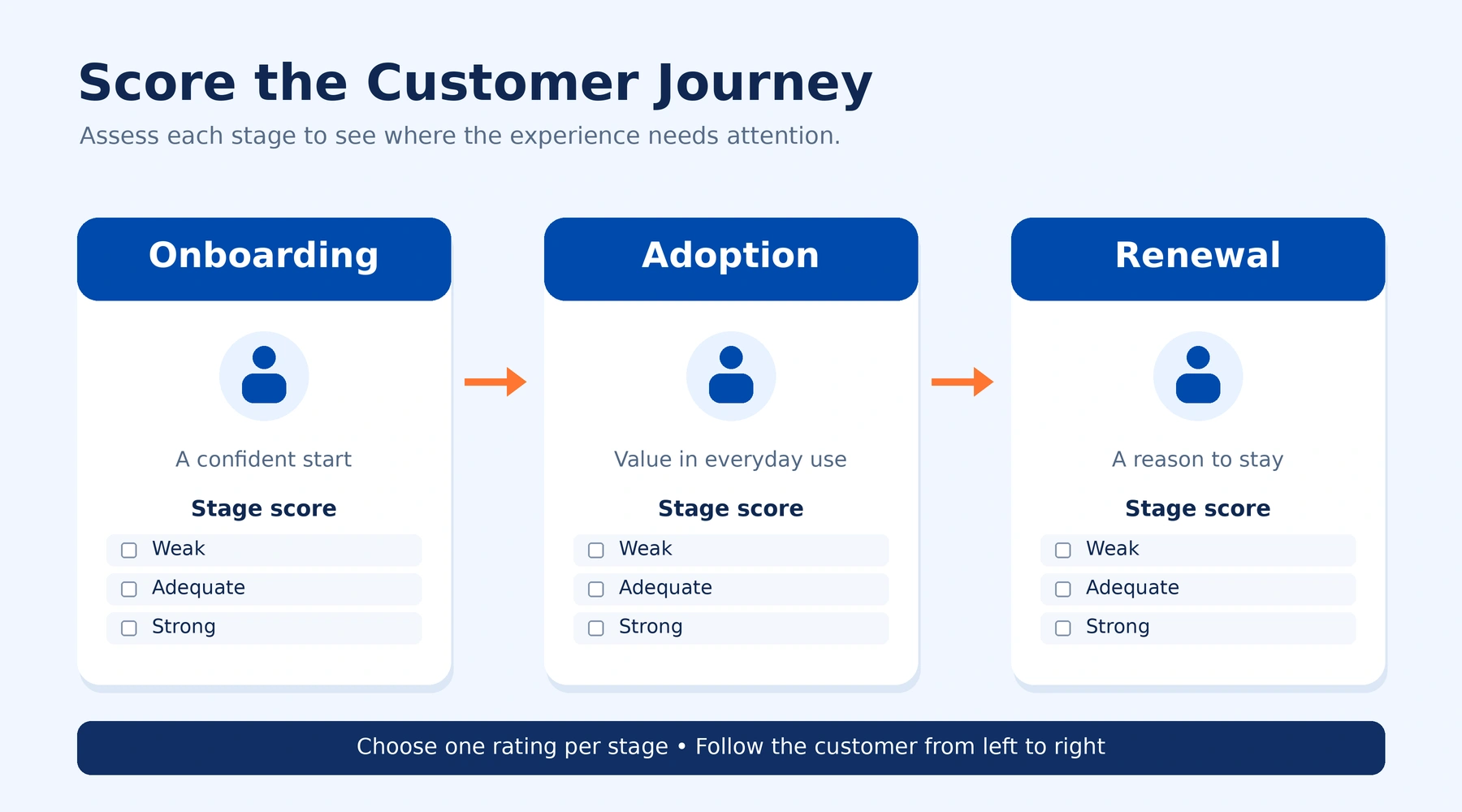
Onboarding: the first session decides the outcome
Early drop-off is severe. Contentsquare reports that, on average, a mobile app loses 80% of its users after one session. The lesson extends beyond apps: a customer who never reaches a first win rarely returns. Measure the share of new customers who complete one defined first action within the first week, and use early feedback from new users to identify where setup is stalling.
Adoption: product use and self-service resources
Customers who keep buying usually use more of what they have already bought. Track usage of your products and services per account, and flag accounts where usage falls off after the first month. Short guides, how-to videos and searchable help pages let customers recover without contacting support. Consistent guidance across channels, including social media, also reinforces your brand and supports retention marketing efforts.
Renewal: turning a satisfied customer into a repeat one
Renewal is the final checkpoint, where satisfaction must become a decision to buy again. Follow this sequence for a small team:
- Contact the account before its renewal date, not after it lapses.
- Review its usage with the customer.
- Record the outcome and update the cohort table accordingly.
Track customer satisfaction at each renewal conversation, since a high score alone does not guarantee the account stays.
Scoring the stages: a step-by-step checklist
- Build the cohorts. Group customers by the month they joined.
- Define one onboarding action. For example, the share of users who complete a setup step in week one.
- Track adoption. Flag accounts whose activity falls off after the first month.
- Measure renewals. Record the share of customers who renew at their due date.
- Score each stage. Rate each week as adequate or strong against your history, since external benchmarks vary by business model.
- Address the weakest stage first. Direct the budget there before broader campaigns.
Consider a worked example. A cohort’s onboarding completion rate sat at 30 percent in its first month, scored weak. After the team simplified the setup and added a guided first step, the rate rose to 60 percent, scored strongly, and the cohort’s six-month retention improved. Please compare the number of customers reaching each stage month over month to verify that the solution is effective.
Win-back campaigns for lapsed customers
Lapsed customers are those who stopped buying after a period of activity. A win-back campaign targets them with a specific reason to return, such as a feature they have not tried or a renewal reminder before their account closes. Use the churn data above to decide who qualifies: voluntary leavers respond to a new reason to return, while involuntary churn usually needs a payment adjustment first. Measure returning customers separately from new sign-ups so win-back results stay clear.
Loyalty rewards and referral programs that actually hold customers
Loyalty programs reward repeat behavior, and referral programs reward customers who bring in others. Both can increase customer retention, but only when the economics work.
When points help and when they don’t
Points help when they change what customers do, not when they simply pay people for behavior they would have shown anyway. Check whether redemption rates and repeat purchases rise after launch, compared with a group that did not join, and whether the program improves the overall brand experience at each stage of the customer journey.
Tiered programs versus points programs
Points programs are simple and easy to explain. Tiered programs reward your highest-value customers with better terms, which suits businesses where a small group drives most revenue. Choose based on which group you need to hold and how much support your team can give each tier, including the service they receive.
Designing a rewards program that pays for itself
Set the reward cost as a share of the margin a retained customer generates, then confirm that the program’s cost sits below the CAC you would otherwise pay to replace that customer. Track the net effect on retention for enrolled and non-enrolled customers over several months, and fold the results into your retention marketing plan. Review the number of customers enrolled in each tier to spot where value is concentrating.
Referral programs that turn customers into a channel
A referral program works best when the incentive is worth less than the acquisition cost it replaces, and the reward reaches both the referrer and the new customer. Worked example: if a new customer would cost you a fixed campaign spend, a referral reward at a fraction of that spend, paid only after the referred customer completes a first purchase, keeps the program profitable. Promote the program on social media, and track referral conversion and the retention rate of referred customers against other new customers, since referred customers often stay longer.
Conclusion and summary
Retention is a measurable rate, and it is usually the cheaper route to growth. Use one company-wide figure as a headline, but diagnose by stage: onboarding, adoption and renewal. Score each stage against your cohort history, fix the weakest one first, and use rewards and referrals only where they hold the customers you need to keep. Strong customer retention depends on the whole experience, not one touchpoint.
Frequently asked questions
What is a good customer retention rate?
It depends on how often your customers buy. Chase notes that many small businesses target 70-80% or higher, while ecommerce sellers with regular buyers often see 30 to 40 percent, per Peel Insights. Compare yourself with businesses that have a similar purchase frequency.
How do you calculate customer retention rate?
Subtract new customers from your total at period-end, divide by the number you had at the start, and multiply by 100. Chase’s guide shows the method.
What is the difference between customer retention and customer loyalty?
Retention is whether customers keep on buying. Loyalty is how strongly they prefer you and recommend you. A retained customer is not always a loyal one.
Why is customer retention cheaper than acquisition?
A retained customer needs no new sale, so keeping them usually costs less than winning a replacement. Contentsquare cites a range of five to 25 times, but the multiple depends on your market.
What is the difference between churn and retention?
They are opposites. Retention is the share of customers who stay. Churn is the share who leave. Separate voluntary churn from involuntary churn to see which losses your strategy can influence.
Do loyalty rewards programs actually improve retention?
Occasionally. They help when they change customer behavior and the reward cost stays below the cost of replacing the customer. Measure enrolled customers against non-enrolled customers before concluding they work.
Loyalty rewards and referral programs that actually hold customers
When points help and when they don’t
Points and tiers are not the same thing as loyalty. A rewards program measures transactions, while loyalty describes a customer’s preference for your brand over alternatives. A rewards scheme can increase repeat purchases among customers who already like your business. It rarely turns an unhappy buyer into a loyal one, so don’t rely on it to fix a weak customer journey or a low satisfaction score. Customers return to a brand because of the experience itself, not the points balance alone.
Points help most when customers buy regularly, and switching costs are low. They do little when the core product or service is weak, because the reward mainly subsidizes customers who would have stayed anyway. Before launching a program, check your cohort data. Please address any gaps at onboarding or renewal first. Rewards work best as a second-stage lever, and the right first step is to measure customer retention so you can see where customers actually leave.
Tiered programs versus points programs
A points program gives a fixed reward for each purchase or spending amount. It is simple to run and suits frequent, low-value purchases. A tiered program places customers in levels, such as bronze, silver and gold, with better benefits at higher levels. It suits businesses where a small group of high-value customers drives much of the revenue.
| Factor | Points program | Tiered program |
|---|---|---|
| How rewards are earned | A fixed amount per purchase or spend | Higher levels unlock better benefits |
| Best suited to | Frequent, low-value purchases | A smaller group of high-value customers |
| Main risk | Rewards become a discount on sales that would happen anyway | Lower tiers feel neglected and may stop buying |
| Ease of running | Simple to set up and explain | More rules to manage and communicate |
| Measurement | Track repeat purchases against a control group | Track movement between tiers and spend per tier |
Choose the model that matches your purchase pattern. Test either model against a control group before committing your budget.
Designing a rewards program that pays for itself
Build the program around margin, not generosity. Set the reward cost as a percentage of the purchase, then test whether repeat purchases in the rewarded group exceed a control group over a fixed window. If the uplift does not cover the reward cost, the program is a subsidy, not a retention tool.
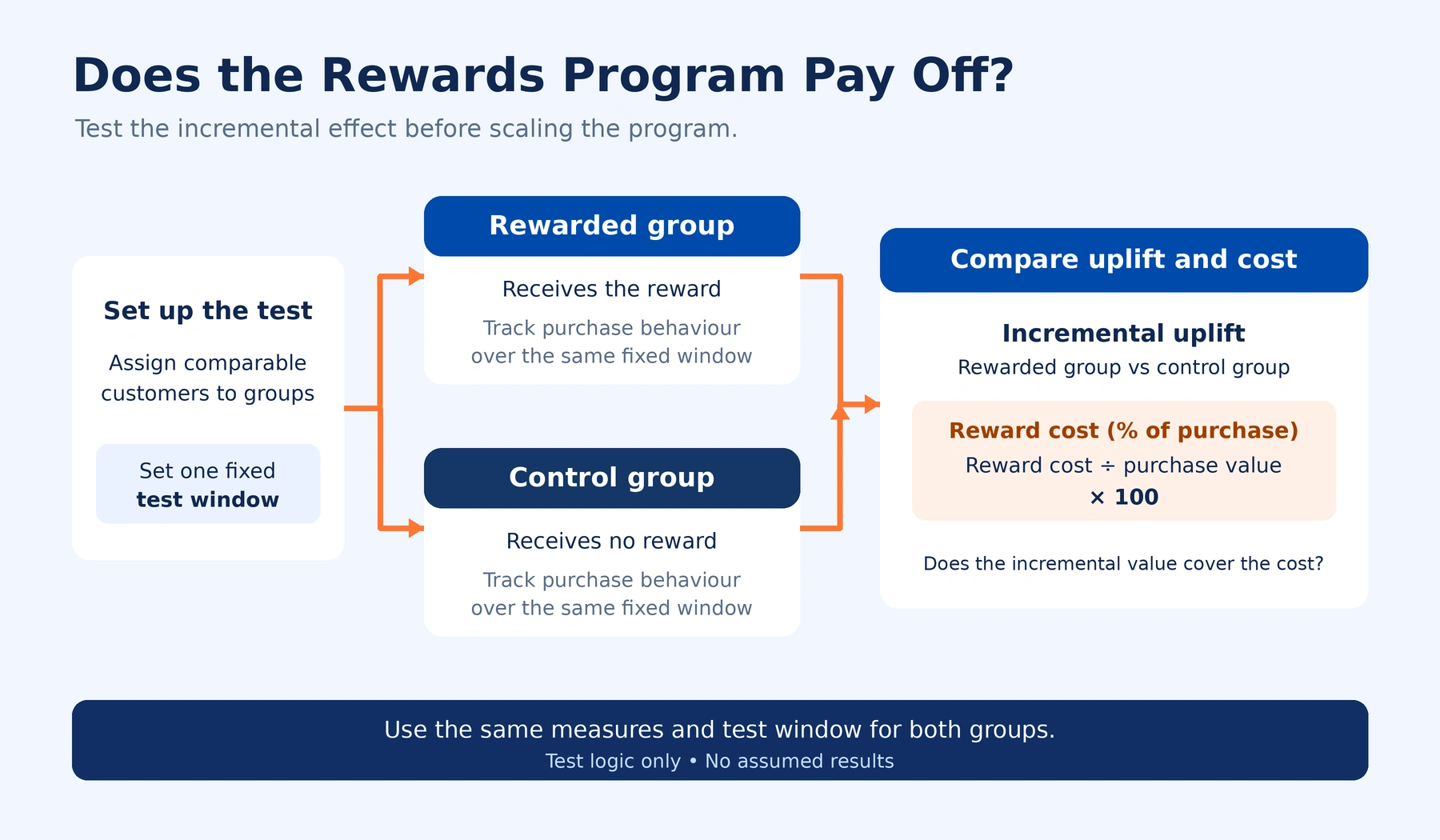
Keep the rules simple, reward the behavior you want (repeat use, not first-time discounts), and set an expiry to protect margin. Treat customer feedback as part of the design, since it shows which rewards customers value and which they ignore. A strong retention strategy depends on this kind of ongoing feedback, and a clear strategy helps you improve the program over time.
Referral programs that turn customers into a channel
Referrals work when an existing customer already advocates for you. Ask the question that reveals this: “On a scale from 0 to 10, how likely are you to recommend this product/company to a friend or colleague?” Contentsquare’s retention guide describes this single NPS question as a way to identify promoters worth inviting into a referral scheme. Invite promoters first, and reward both the referrer and the new customer so the incentive is visible to both sides. Promoters who share your products and services on social media extend your reach, and this kind of advocacy supports customer acquisition as well as retention. Referral marketing works best when your customer experience already earns the recommendation, and more customers make the referral channel easier to scale.
Conclusion and summary
Retention deserves more attention from growing businesses. A single company-wide rate obscures where customers leave, so measure it by stage and address the weakest stage first. Pair survey scores such as NPS with behavioral signals like logins and support contacts, since together they show how the customer experience is actually landing. Treat loyalty rewards as a test rather than a default, and keep them only where they change behavior.
Frequently asked questions
What is a good customer retention rate?
It depends on how often your customers buy. Chase notes that many small businesses target 70-80% or higher, while ecommerce sellers with regular buyers often see 30 to 40 percent, according to Peel Insights. Compare yourself with similar businesses and track your trend over time.
How do you calculate customer retention rate?
Subtract the number of new customers gained during the period from your total at the end of the period, divide by the number you had at the start, and multiply by 100. Chase’s guide explains the method.
What is the difference between customer retention and customer loyalty?
Retention measures whether customers keep buying from you. Loyalty measures how strongly they prefer your business and how willingly they recommend it. A retained customer is not always a loyal one.
Why is customer retention cheaper than acquisition?
A retained customer adds revenue without the cost of a new sale. Contentsquare says acquisition often costs five to 25 times more than retention, though the exact multiple depends on your market.
What is the difference between churn and retention?
Churn is the share of customers who stop buying during a period. Retention is the share of customers who stay. Together, they make up the full customer base, so a fall in churn is a rise in retention.
Do loyalty rewards programs actually improve retention?
They can, mainly among customers who already like your business and buy regularly. They may not fix a weak experience, and they can subsidize customers who would have stayed anyway. Test a program against a control group before committing to a budget.