Influencer campaign management is the process of planning, coordinating and measuring creator partnerships, from initial outreach to final payment. It covers creator selection, contracting, briefing, content approvals, compliance, publishing, performance tracking and payouts.

The challenge is not simply finding the right creators. Campaigns can lose momentum when briefs are unclear, approvals stall, tracking is missing or payments do not match delivered work. A repeatable management process helps brands reduce these problems, protect their budgets and learn from every campaign.
This guide is for in-house marketers, agency teams and SME owners managing influencer marketing in Singapore. It introduces a practical six-stage workflow and a Creator Handover Scorecard to help identify operational weaknesses before increasing campaign volume.
Key Takeaways
- Manage the handovers. Assign an owner, deadline and documented output to every campaign stage.
- Check creator fit before committing. Evaluate audience relevance, engagement quality, content history and commercial suitability rather than relying on follower counts.
- Set approval and disclosure rules in advance. Put deliverables, usage rights, turnaround times and sponsored-content requirements in writing.
- Plan for demand before launch. Coordinate creator posting schedules with inventory, fulfilment and customer support.
- Measure business outcomes. Agree on tracking methods and success criteria before content goes live.
- Choose tools based on operational needs. A spreadsheet may suit a small programme; a dedicated platform becomes valuable when manual coordination creates recurring problems.
Influencer Campaign Management Fundamentals
What is influencer campaign management?
Influencer campaign management is the operational process that turns an influencer marketing strategy into a completed, measurable campaign.
It includes:
- Finding and evaluating suitable creators.
- Negotiating deliverables, fees and usage rights.
- Preparing briefs and approving content.
- Checking advertising disclosures and brand safety.
- Coordinating publication, inventory and paid amplification.
- Measuring performance, reconciling invoices and paying creators.
Influencer marketing defines the campaign’s purpose, target audience and messaging. Campaign management ensures the agreed work is delivered correctly, on time and within budget.
Even a strong creative strategy can underperform when its execution is poorly coordinated.
What does an influencer marketing manager do?
An influencer marketing manager oversees the campaign workflow and makes sure responsibilities are clear. Depending on the team, the role may include:
- Shortlisting creators and evaluating audience fit.
- Managing contracts, deliverables and usage permissions.
- Maintaining the approved brief and product-claims list.
- Coordinating revisions and content approvals.
- Checking disclosure requirements before publication.
- Monitoring live posts and campaign deadlines.
- Tracking performance and reconciling payments.
One person should own the overall campaign record, even when an agency or specialist handles individual tasks. Each stage should also have a named person responsible for completing and approving its work.
Aligning influencer strategy with business goals
Choose creators and performance metrics according to the outcome you want to achieve.
Choose creators and performance metrics according to the outcome you want to achieve. For a broader framework covering audience targeting, channel selection and measurement, see our guide to social media strategies for Singapore businesses.
| Objective | Potential creator fit | Primary metrics |
|---|---|---|
| Awareness | Creators with relevant reach and broad audience appeal | Reach, impressions, video views |
| Consideration | Creators with strong niche relevance and audience trust | Saves, shares, profile visits, link clicks |
| Sales | Creators whose audiences match your buyers | Tracked conversions, code redemptions, revenue |
| Loyalty | Long-term ambassadors and existing customers | Repeat purchases, retention, customer engagement |
These are starting points, not fixed rules. A smaller creator with a highly relevant Singapore audience may generate more sales than a larger creator with broader but less relevant reach.
Select metrics that match the objective. Views alone do not demonstrate sales impact, and attributed sales alone do not capture every awareness benefit.
Setting success criteria before launch
Agree on the minimum acceptable result, target and conditions for changing the campaign before the brief is issued.
For example, an ecommerce brand might set a target for tracked purchases and calculate whether the resulting contribution margin covers creator fees and campaign costs.
Avoid treating a revenue multiple as profit. If a campaign generates twice its creator fees in sales, that does not necessarily mean it is profitable: product costs, discounts, fulfilment, agency fees and paid media must also be considered.
Document the attribution method, reporting window and assumptions so the team can assess results consistently.
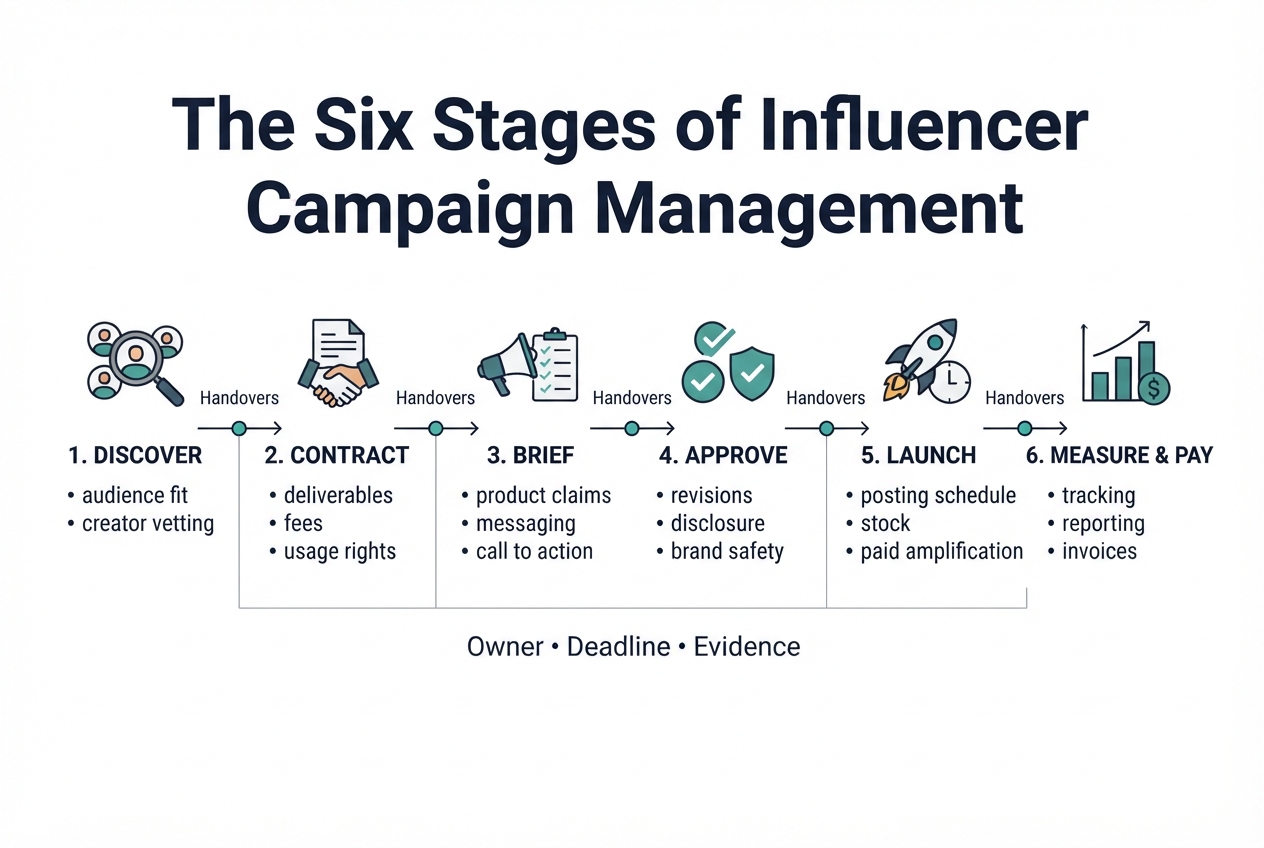
The Six-Step Influencer Management Guide
Step 1: Discover and evaluate creators
Start with audience fit rather than follower count. Check whether a creator’s audience, content and location match your target customers.
For a more detailed approach, explore our guide to influencer marketing strategies, including creator selection, audience vetting and partnership planning.
Review recent posts across several weeks to assess:
- Content quality and consistency.
- Meaningful engagement, including relevant comments and shares where available.
- Audience geography and demographic fit, using available analytics.
- Previous sponsored content and potential category conflicts.
- Alignment with your brand values and product claims.
Look for creators who can demonstrate your product naturally without making unsupported claims.
Screen for suspicious activity
No single metric proves that a creator has fake followers. Look for patterns such as abrupt follower increases without a plausible explanation, repetitive or irrelevant comments, unusual engagement patterns and a mismatch between audience location and target market.
A frequently cited Juniper Research estimate found that global online advertising lost approximately US$84 billion to ad fraud in 2023. This is a broad digital advertising estimate, not a measurement of influencer fraud. It provides context for the wider problem but should not be used to calculate an influencer campaign’s expected fraud losses.
Record the evidence behind your creator selection so you can review the decision later.
Step 2: Recruit creators and agree on terms
Contact a shortlist that is larger than the number of creators you ultimately need. The appropriate buffer depends on your budget, campaign complexity and expected response rate; there is no universal outreach ratio.
Before sending products or commissioning content, agree on the following in writing:
- Deliverables, formats and publication dates.
- Fees, expenses and payment milestones.
- Number of revision rounds and approval deadlines.
- Content ownership, licensing, usage channels and duration.
- Exclusivity, if needed, including the relevant product category and period.
- Cancellation, rescheduling and termination conditions.
- Sponsored-content disclosure requirements.
- Tracking links, discount codes and reporting obligations.
Consider exclusivity carefully
Singapore’s relatively compact market can make category conflicts commercially important, but exclusivity is not automatically necessary for every collaboration.

Define which competitors are covered, how long the restriction lasts and whether it applies before or after publication. Keep the restriction proportionate to the creator’s compensation and the value of the campaign.
A clear agreement protects both the brand and the creator from misunderstandings.
Step 3: Write a clear creative brief
A strong brief establishes the campaign’s non-negotiable requirements without scripting every detail.
Lock down:
- Product names and factual information.
- Approved claims and supporting evidence.
- Campaign objective and call to action.
- Links, discount codes and required tags.
- Disclosure wording and placement.
- Deliverables, deadlines and technical specifications.
Leave room for:
- The opening hook.
- Storytelling and personal perspective.
- Setting, presentation and creative format.
- The creator’s established tone of voice.
Provide one master brief and maintain version control. If the product claims or campaign message changes, update the source document and notify every affected creator.
Before approving a draft, check five things:
- Is the product represented accurately?
- Are all claims supported and within the approved scope?
- Are the call to action and tracking details correct?
- Is the sponsorship disclosure clear?
- Does the content meet the agreed deliverables and publication requirements?
Consistency should come from shared facts and clear objectives, not identical scripts.
Step 4: Manage approvals, compliance and brand safety
Separate content approval before publication from monitoring after publication.
Pre-publication checks confirm that the draft meets the brief and disclosure requirements. Post-publication checks confirm that the live content is accessible, accurate and consistent with the agreement.

Set practical service levels, such as two working days for brand feedback and one working day for a creator revision, if those timings suit your team. Include them in the campaign schedule and allow additional time for complex or regulated products.
Assign clear decision-making authority:
- Who approves the content?
- Who handles a missed deadline?
- Who can request an edit or pause publication?
- Who decides whether a post must be removed?
- Who communicates with the creator if a problem occurs?
Sponsored-content disclosure in Singapore
Singapore brands should refer to the Advertising Standards Authority of Singapore’s guidance on interactive marketing and social media, alongside the Singapore Code of Advertising Practice.

The guidance addresses disclosure of commercial relationships, including paid promotions and certain product-seeding arrangements. Disclosures should be clear and prominent enough for audiences to understand the commercial relationship.
Include disclosure instructions in the contract and brief, but do not rely on the creator’s memory alone. Check the actual post before publication and monitor live content where appropriate.
The US Federal Trade Commission’s Endorsement Guides are also useful background for campaigns involving US audiences. They are not a substitute for Singapore-specific guidance or applicable legal advice.
Step 5: Coordinate launch, inventory and paid amplification
Put creator publication dates, product availability, fulfilment and paid media on one shared calendar.
Put creator publication dates, product availability, fulfilment and paid media on one shared calendar. For inspiration on applying these principles across different campaign types, review these social media marketing campaign examples.
Before launch, confirm:
- Stock levels and replenishment lead times.
- Delivery capacity and expected demand.
- Tracking links and discount codes.
- Landing-page functionality.
- Customer-service readiness.
- Paid-media permissions and campaign settings.
A useful example is Graza, the olive oil brand whose early product-seeding activity helped generate substantial attention. Shopify’s case study reports that the brand sold out in its first week. The example illustrates why brands should prepare for demand, although it does not establish that influencer activity alone caused the sellout.
If inventory is limited, coordinate publication waves, prepare a waitlist or adjust the promotion to avoid disappointing customers.
Obtain permission for paid use
Whitelisting generally involves advertising through a creator’s account or identity, while boosting promotes existing content through paid media. The exact setup depends on the platform.
Organic publication permission does not automatically establish permission for every paid usage. Agree on the permitted platforms, duration, territory, editing rights, spend arrangements and any applicable creator authorisations before running ads.
Step 6: Measure performance and manage payouts
Decide how performance will be measured before launch.
Decide how performance will be measured before launch. Our guide to social media metrics that drive business results explains how to evaluate engagement, traffic, conversions and campaign profitability.
For sales-led campaigns, give creators trackable links and, where suitable, individual discount codes. Record the attribution window and explain how coupon use, repeat purchases and cross-channel conversions will be handled.
Report results against the original objective.
| Metric | What it helps assess |
|---|---|
| Reach and impressions | Exposure |
| Video views and completion | Content consumption |
| Saves, shares and comments | Audience response |
| Link clicks and landing-page visits | Traffic and intent |
| Tracked orders and conversions | Attributed action |
| Revenue and contribution margin | Commercial performance |
| Repeat purchases | Longer-term customer value |
Use a consistent reporting template across creators. Where possible, separate attributed revenue from incremental impact: tracking can show which sales were credited to a creator without proving that every sale would not otherwise have occurred.
Settle payments against agreed deliverables
Payment arrangements should reflect the contract. Depending on the agreement, milestones may include signing, content approval and publication.
Before releasing the final payment, confirm that the agreed deliverables were completed, links are live where required, and invoices match the contract. Resolve discrepancies promptly and retain payment records.
The Creator Handover Scorecard
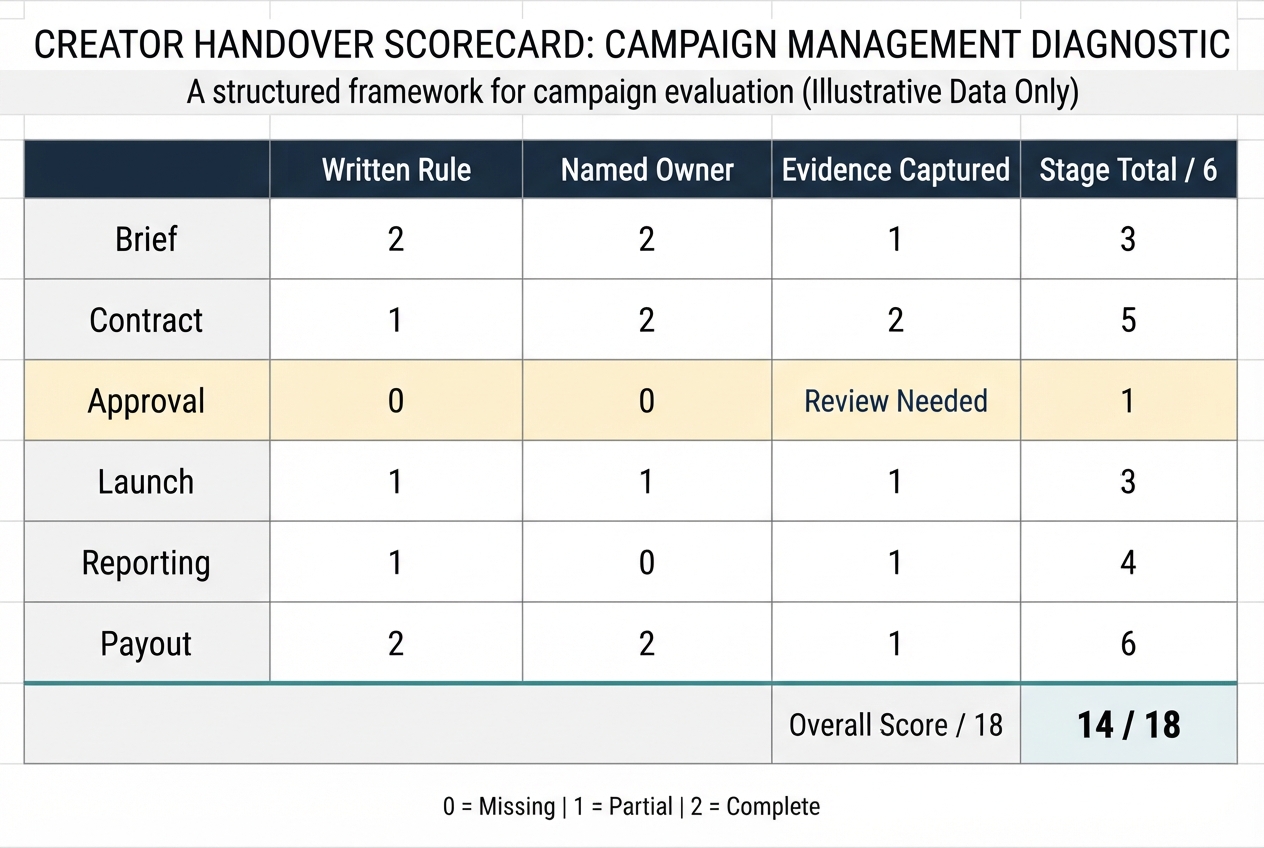
The Creator Handover Scorecard is a proposed internal diagnostic tool. It is not an externally validated industry benchmark.
Use it to check six stages: briefing, contracting, approval, launch, reporting and payout. Each stage has three checks:
- Written rule: Is the process documented?
- Named owner: Is someone accountable?
- Evidence captured: Is there a record that the task was completed?
Score each check from 0 to 2:
- 0: Missing.
- 1: Partly in place.
- 2: Fully in place.
The maximum score is 18.
| Stage | Written rule | Named owner | Evidence captured |
|---|---|---|---|
| Brief | Approved claims and disclosure instructions documented | Brief owner assigned | Dated brief version saved |
| Contract | Deliverables, rights and exclusivity documented where applicable | Contract approver assigned | Signed agreement stored |
| Approval | Review deadlines and revision rules defined | Approver assigned | Feedback and sign-off logged |
| Launch | Publication schedule and stock plan confirmed | Launch or fulfilment owner assigned | Live links and publication dates recorded |
| Reporting | Metrics, attribution and reporting window defined | Reporting owner assigned | Links, codes and results recorded |
| Payout | Payment milestones and invoice requirements defined | Payment approver assigned | Invoice reconciled against deliverables |
How to interpret the score
A total below 8 out of 18 can serve as a suggested trigger for reviewing the process, but it is not a validated pass/fail threshold.
More importantly, examine the individual stages. A low approval score may indicate missing deadlines or unclear sign-off authority. A low reporting score may point to missing tracking links or an undefined attribution window.
Fix the weakest process before increasing creator volume. Reassess after the next campaign to determine whether the change improved execution.
Common Challenges and How to Solve Them
Many campaign problems become easier to diagnose when you distinguish the symptom from its likely operational cause.
| Symptom | Possible cause | What to check first |
|---|---|---|
| Low engagement | Weak audience fit or overly restrictive creative direction | Audience analysis and brief |
| Few conversions | Poor offer, weak call to action or missing tracking | Landing page, offer and attribution |
| Late content | Unrealistic deadlines or delayed approvals | Campaign calendar and approval queue |
| Inconsistent messaging | Unclear claims or outdated brief versions | Master brief and version control |
| Disclosure issues | Unclear instructions or insufficient review | Contract, brief and live-post checks |
| Unexpected reach patterns | Audience mismatch or suspicious activity | Creator analytics and screening records |
| Payment disputes | Ambiguous milestones or incomplete delivery records | Contract, live links and invoice |
Investigate disclosure and suspected fraud concerns promptly. For other issues, prioritise the cause most likely to affect campaign outcomes rather than making broad changes based on a single post.
Keep content consistent without removing creator authenticity
Maintain a short list of mandatory requirements: factual claims, product name, call to action, disclosure and campaign objective. Allow creators to choose how they communicate those points.
Review every draft against the same criteria. Record the reason for each revision so repeated problems can be addressed in the brief rather than corrected individually every time.
Improve timelines and communication
Use one shared schedule and one primary contact for each creator. Record the brief date, draft deadline, feedback date, publication date and payment date.
When feedback is given verbally, summarise the agreed changes in writing. If a deadline becomes unrealistic, renegotiate it before it affects the rest of the campaign.

Choosing an Influencer Management Tool
A dedicated platform is not automatically better than a spreadsheet. The right choice depends on campaign volume, team size, reporting needs and the cost of manual work.
Spreadsheet versus dedicated platform
| Option | Best suited to | Main limitation |
|---|---|---|
| Spreadsheet and shared folders | Small campaigns managed by one owner | Manual updates, version conflicts and missed handovers |
| Affiliate-tracking tool | Sales-led campaigns using links and codes | May not manage creative approvals or contracts |
| Influencer management platform | Teams coordinating multiple creators and campaigns | Subscription costs, onboarding and feature limits |
| Agency-managed service | Teams needing external execution capacity | Management fees and potentially less direct control |
A spreadsheet can be sufficient for a small roster. Consider a platform when several people need to coordinate creators, approval deadlines are repeatedly missed, reporting requires extensive manual work or invoice reconciliation becomes difficult.
Businesses that need additional support with creator coordination, paid amplification and performance reporting can also explore our social media marketing services in Singapore.
Software will not fix an unclear brief, weak contract or poorly defined objective. Improve the underlying process first.
Evaluate platforms against your workflow
Before buying, assess whether the tool supports the functions you actually need.
Discovery: Can you assess audience geography, relevance and engagement quality?
Contracting: Can you store agreements, deliverables, usage rights and renewal dates?
Approvals: Can you track versions, feedback and sign-off deadlines?
Tracking: Can you manage creator-specific links, discount codes and conversions?
Payouts: Can you reconcile payments against completed deliverables?
Reporting: Can you export performance data across relevant channels?
Pricing: Are fees based on users, creators, campaigns, conversions or other limits?
A platform that improves discovery but leaves approvals and payouts entirely manual may simply move the bottleneck.
Understand total cost of ownership
Compare subscription costs with the staff time and operational risk the platform may save.
For example, Tapfiliate’s published pricing lists its Launch plan at US$89 per month on monthly billing, or US$74 per month when billed annually. The published plan includes one affiliate programme, up to 50 affiliates, 5,000 clicks and 500 conversions per month, with applicable overage fees. It is an affiliate-tracking product, not a complete influencer campaign management solution.
Confirm current prices, limits, currency and suitability directly with the vendor before making a purchasing decision.
Questions to ask vendors
- Which features are native, and which require integrations?
- Can we export contracts, content approvals, tracking data and payment records?
- What methods are available to assess audience authenticity?
- How does pricing change if our creator roster doubles?
- Can the system support our actual social platforms and reporting requirements?
- What support, onboarding and data-protection arrangements are included?
Ask the vendor to demonstrate a real workflow using representative campaign requirements before signing.
Building a More Effective Influencer Campaign Management Process
Effective influencer campaign management involves more than selecting popular creators. It requires clear responsibilities, documented agreements, reliable approval processes, appropriate disclosure, accurate tracking and consistent reporting.
For Singapore brands, this means assigning a campaign owner, documenting briefs and deliverables, screening creators for audience fit and suspicious engagement patterns, and establishing clear terms for disclosure, content usage rights and payment. Brands should also coordinate posting schedules with stock availability and fulfilment, measure results against agreed business objectives, and use the Creator Handover Scorecard to identify gaps and strengthen weak processes.
The best approach is to start with a repeatable workflow that keeps campaigns organised and accountable. As campaign complexity grows, brands can invest in additional software or agency support when the improvements in efficiency and control justify the cost.
Frequently Asked Questions
How much does influencer campaign management cost?
Costs depend on creator fees, campaign complexity, agency involvement and software requirements. A basic affiliate-tracking tool such as Tapfiliate’s Launch plan is listed at US$89 per month on monthly billing, but it does not replace a full campaign management service. Agency fees and creator rates vary by scope and should be quoted against specific deliverables.
Budget for screening, content reviews, tracking, fulfilment and reporting as well as creator compensation.
How long does an influencer campaign take?
There is no universal timeline. The schedule depends on the number of creators, contract negotiations, product shipping, content complexity, approval rounds and publication dates.
Allow enough time for briefing, contracting and revisions before launch. Set deadlines for each stage and agree on how delays will be handled.
How can I check whether sponsored content is disclosed correctly?
Include disclosure requirements in the contract and creative brief. Check each post before publication and monitor live content where appropriate.
For Singapore campaigns, consult the ASAS guidance on interactive marketing and social media and the applicable Singapore Code of Advertising Practice. Requirements depend on the circumstances and the relevant rules.
What is the difference between an influencer campaign and an always-on creator programme?
A campaign is usually time-bound, with a defined objective, deliverables and end date. An always-on programme maintains ongoing relationships with selected creators who produce recurring content or fulfil ambassador roles.
Campaigns can suit product launches and seasonal promotions. Always-on programmes can support continuous brand visibility and longer-term relationships.
Should I use a management tool or a spreadsheet?
A spreadsheet may be enough when one person manages a small roster and can reliably track briefs, approvals, publication and payment.
Consider a dedicated tool when multiple people share responsibilities, reporting is labour-intensive or important records are repeatedly lost. A useful test is whether you can quickly identify who approved a creator’s latest post, when it went live and whether the payment matches the agreed deliverables.
If you cannot, improve the workflow first and then assess whether software can address the gap.