| AI Summary
Effective social media strategies help Singapore businesses reach the right audiences, generate qualified leads and drive measurable growth. This guide covers goal-setting, platform selection, content planning, organic and paid campaigns, performance tracking and a practical 90-day implementation plan. |
Effective social media strategies begin with a business outcome, a defined audience and a practical way to measure progress. Posting matters consistently, but publishing without a clear purpose can consume time without generating enquiries or sales. For Singapore businesses, we recommend choosing platforms based on customer behaviour, creating content that supports the buying journey and reviewing results before increasing investment.


This guide explains how to set goals, assess your existing accounts, select channels, plan content and connect social activity to commercial results. It is designed for small and medium-sized enterprises (SMEs) and marketing teams working with limited resources.
Key Takeaways
- Set a business goal first. Choose a measurable outcome, deadline and primary key performance indicator (KPI) before planning posts.
- Prioritise audience fit. Facebook and Instagram can work well, but LinkedIn, TikTok or YouTube may serve your customers better.
- Build content around customer needs. Combine useful explanations, proof and relevant offers instead of relying on promotional posts.
- Measure the journey. Track reach and engagement as diagnostic signals, then assess qualified leads, sales and acquisition costs.
- Review and adapt. Start with a manageable number of channels and a sustainable schedule. Expand only when evidence and capacity justify it.
Why Social Media Strategies Matter in Singapore
Singapore is highly connected, but a large online audience does not guarantee that a particular business will reach suitable customers. DataReportal’s Digital 2026 Singapore report, published in November 2025 using predominantly late-2025 data, estimated 5.78 million internet users and 98.4% internet penetration. It also reported 5.33 million social media user identities, equivalent to 90.6% of the population.
The distinction matters: social media user identities are not necessarily unique people. Likewise, advertising reach estimates do not automatically represent monthly active users or customers ready to buy. We use these figures to understand market scale, not to predict campaign results.
A local skincare retailer might use short videos to demonstrate products. An accounting firm may be better served by LinkedIn posts that answer business owners’ questions. A neighbourhood restaurant could generate enquiries through food content, reviews and location information. These businesses need different social media strategies because their customers make decisions differently.
Why Activity Alone Is Not a Strategy
Common problems appear when teams equate output with progress. They post on every platform, copy competitors’ formats and celebrate follower growth without checking business impact. Others run paid campaigns before confirming that their website or enquiry process works.
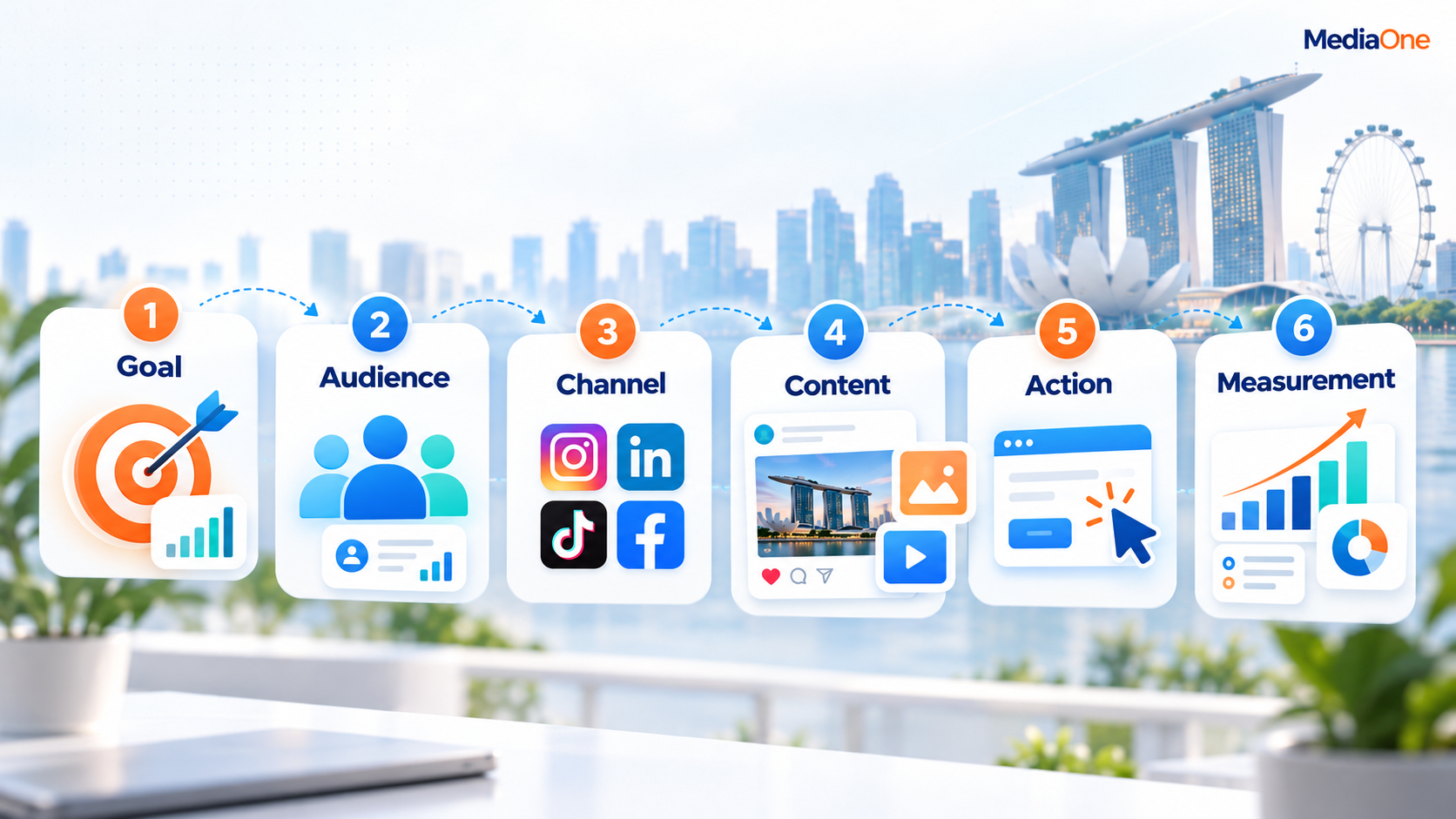
We recommend establishing a simple chain: business objective → target customer → channel → content → action → measurement. If one link is weak, additional posting rarely fixes the underlying problem. The first task is therefore to decide what a successful quarter should produce.
Set Measurable Goals and Choose the Right KPIs
A useful goal states what should change, for whom, by how much and by when. “Improve engagement” is difficult to evaluate. “Increase qualified enquiries originating from LinkedIn from 12 to 18 per month by 31 December 2026” gives the team a baseline, target and deadline.
This follows the SMART approach: specific, measurable, achievable, relevant and time-bound. Targets should be informed by historical performance, available budget and sales capacity. Avoid borrowing percentage targets from unrelated businesses.
Match Goals to the Customer Journey
Different stages require different measures. We recommend one primary business outcome for each campaign, supported by a small number of diagnostic metrics. A business may pursue several objectives overall; it does not need to force every platform into a single permanent purpose.

| Objective | Primary KPI | Supporting signal |
| Build awareness | Reach within a relevant audience | Video views or branded search interest |
| Encourage consideration | Qualified website visits or enquiries | Saves, shares and link clicks |
| Generate leads | Qualified leads | Landing-page conversion rate |
| Drive sales | Purchases or attributable revenue | Cost per acquisition |
| Retain customers | Repeat orders or renewals | Responses and returning visitors |
A KPI, or key performance indicator, shows whether an important outcome is improving. Reach and engagement can help diagnose content performance. They should not substitute for lead quality or revenue when the goal is commercial.
Set a Baseline and Decision Rules
Before launching a campaign, record the previous 30 to 90 days where reliable data exists. Note enquiries, conversion rates, spend and the time required to produce content. Seasonal businesses should compare relevant periods rather than treating every month as equivalent.
For example, a hypothetical Singapore beauty brand could aim to increase qualified Instagram enquiries from 20 to 26 per month during the final quarter of 2026. At each monthly review, it might apply these rules:
- Continue: Enquiries are moving towards the target and lead quality remains acceptable.
- Improve: Reach rises but enquiries do not. Check the offer, audience, call to action and landing page.
- Reallocate: The channel repeatedly produces expensive or unsuitable enquiries despite reasonable tests.
Do not abandon a channel after one weak week. Small samples, campaign learning periods and buying cycles can distort short-term results. We prefer decisions based on sufficient data and a documented reason.
Understand Your Audience and Audit Existing Accounts
Social media strategies become stronger when teams replace assumptions with customer evidence. Start by identifying the people who influence or make a purchase, then document the problems they are trying to solve.
Build an Audience Profile That Guides Content
We use three practical dimensions: customer characteristics, platform behaviour and purchase intent. A profile might describe a Singapore-based operations manager comparing software vendors, rather than simply “professionals aged 25–45”. That description suggests useful content: implementation questions, cost considerations and credible case examples.
Review customer enquiries, sales conversations, website analytics and frequently asked questions. Ask existing customers where they encountered your business and what helped them decide. Use platform analytics to test whether your followers resemble those customers.
For example, LinkedIn’s Page analytics offer information on content performance, visitors and follower demographics. Available breakdowns and reporting thresholds vary, so do not assume every account can access the same data.
In Singapore, language and context can influence content choices. Decide whether English is enough for your target segment, whether translated versions are worthwhile and which local concerns deserve attention. Do not assume that every multilingual customer wants the same message in a different language.
Conduct a 90-Day Social Media Audit
Audit active accounts before opening new ones. Compare each channel using the same business objectives, while respecting differences between platform metrics. For each account, review:
- Audience relevance: Are followers and engaged users likely to become customers or recommend the business?
- Content performance: Which topics, formats and calls to action produce useful responses?
- Commercial outcomes: How many attributable enquiries, bookings or purchases result?
- Resource cost: How much staff time, creative production and advertising spend does the channel require?
- Operational issues: Are profiles accurate, links functional and messages answered promptly?
Review the strongest and weakest posts, but do not treat one viral video as a repeatable strategy. Check whether results came from organic activity, advertising or a seasonal promotion.
We classify accounts as maintain, improve or deprioritise. A low-volume channel with valuable leads may deserve continued investment. A high-reach account with no suitable audience might not. This audit should end with a clear allocation of time and budget.
Choose Social Media Platforms Based on Business Fit
The right platform depends on your audience, offer and production capacity. We do not recommend Facebook and Instagram automatically for every Singapore SME. Their suitability must be demonstrated against alternatives.
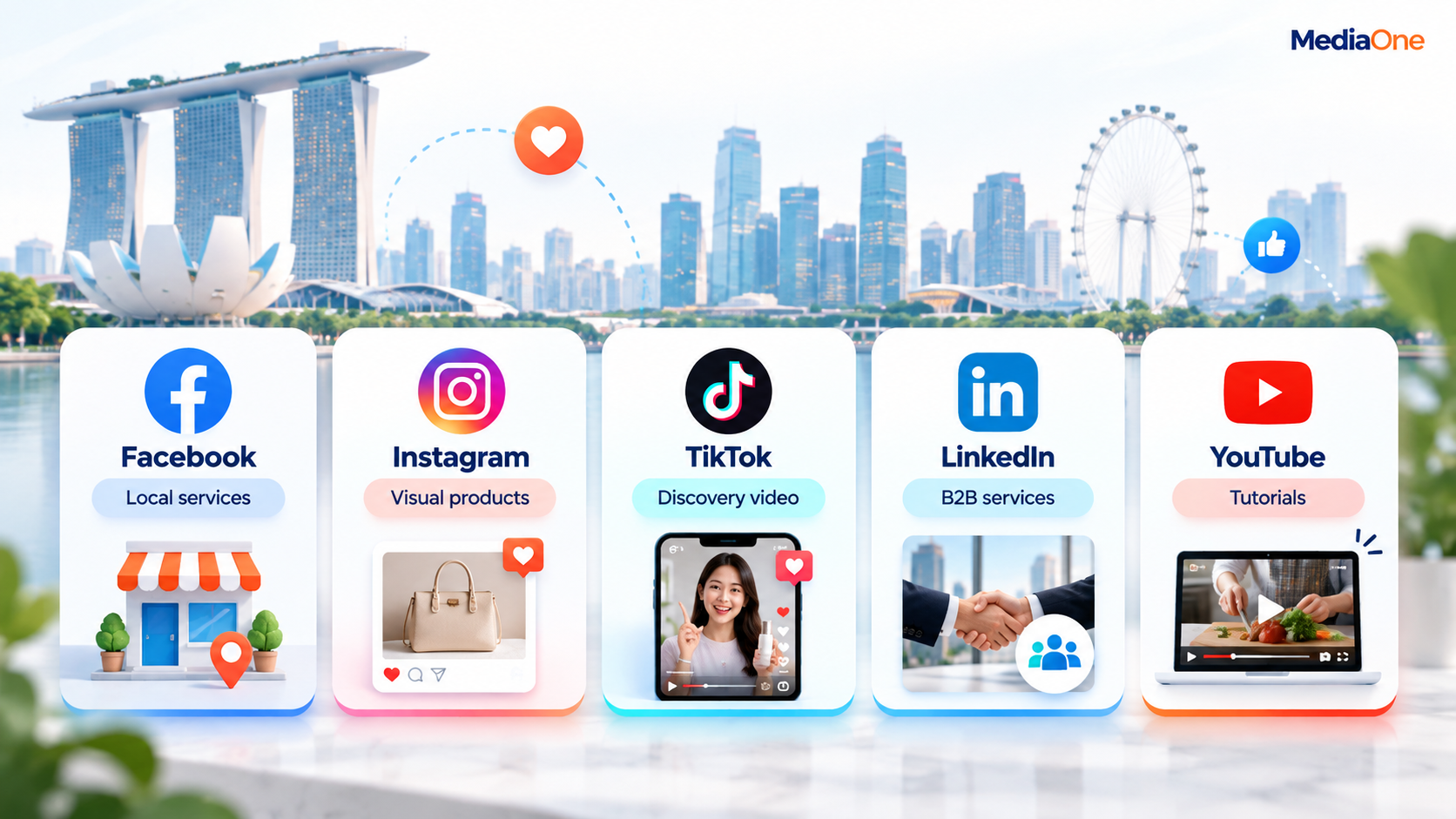
DataReportal’s Singapore platform estimates provide useful context. In late 2025, potential advertising reach was 3.80 million for Facebook, 3.35 million for Instagram and 5.33 million for YouTube. TikTok’s tools reported 3.80 million users aged 18 and above available for advertising. LinkedIn reported 5.10 million registered members, a different measure from active use. These figures are not directly comparable and should not be added together.
| Platform | Where it may fit | Content worth testing |
| Local services, communities and broad consumer segments | Customer stories, short videos, events and lead ads | |
| Visual products, hospitality, beauty and lifestyle | Reels, carousels, Stories and product demonstrations | |
| TikTok | Discovery-led brands with capacity for native video | Tutorials, demonstrations, creator content and behind-the-scenes clips |
| Business-to-business (B2B) services and professional audiences | Expert analysis, case examples, documents and staff insights | |
| YouTube | Products requiring explanation or long-term educational content | Tutorials, comparisons, interviews and demonstrations |
Messaging services such as WhatsApp can support customer enquiries and follow-up, but they should not be treated as interchangeable with public discovery platforms. The same applies to specialist communities, where participation norms may discourage direct promotion.
Make the Choice With a Scorecard
Score candidate channels from one to five for audience fit, purchase intent, content capability and measurement readiness. Give audience fit and purchase intent the greatest weight. If your team can sustain only one channel, a well-managed single-channel approach is preferable to two neglected accounts.
For many small teams, one or two priority platforms is a sensible starting point, not a universal rule. A retailer might pair Instagram with TikTok. A consultancy could focus on LinkedIn and use YouTube selectively for in-depth explanations. Test the mix for a defined period and expand only when the results warrant it.
Build Content Pillars That Support Customer Decisions
Content pillars are recurring subjects that give your social media marketing a recognisable purpose. We usually recommend starting with three or four. They should reflect real audience questions rather than broad labels such as “inspiration” or “news”.

A Singapore skincare brand, for example, could use the following pillars:
- Education: How to interpret ingredients and use products correctly.
- Product proof: Demonstrations, customer feedback and realistic usage examples.
- Brand trust: Manufacturing information, team expertise and service standards.
- Purchase support: Product comparisons, delivery details and timely offers.
Each pillar should guide the next action. An educational post may invite viewers to read a guide. A comparison post might lead to a relevant product page. Promotional content should make the offer and conditions easy to understand.
Match Formats to the Message
Short videos can show a process quickly. Carousels are useful for sequential explanations. Live sessions suit questions that benefit from real-time answers. Written posts can communicate professional judgement without unnecessary production.
Avoid assuming that a single format always wins. Test different openings, lengths and calls to action against your own audience. Retain the ideas that produce meaningful outcomes, even if another format receives more views.
Repurposing can reduce workload. Turn a customer webinar into short answer clips, a summary carousel and a follow-up article. Adapt the opening, dimensions, captions and level of detail for each platform. Reposting an identical file everywhere may save time but can weaken relevance.
Use Customer Proof Responsibly
Reviews, testimonials and user-generated content (UGC) can help prospective customers assess an offer. Seek appropriate permission before reusing identifiable customer material, particularly photographs, personal details or sensitive experiences. Make it clear when a testimonial reflects an individual result rather than a typical outcome.
Influencer partnerships also require judgement. We recommend evaluating audience relevance, authentic engagement, content quality and commercial terms before follower count. Set deliverables and reporting expectations in writing. Singapore’s Advertising Standards Authority guidelines for social media call for transparent marketing practices, including clear disclosure of sponsored relationships.
Create a Sustainable Content Calendar and Workflow
Posting frequency should follow available capacity and evidence. Publishing daily on every channel can overstretch a small team without improving results. A team that can reliably produce two or three useful posts per week may outperform one rushing out daily material.
Build a rolling four-week calendar containing the audience segment, content pillar, format, owner, call to action, publication date and measurement method. Leave room for timely customer questions and relevant developments.
A workable production process has four stages: brief → create → review → publish. Assign one approver and agree on turnaround times. Record source links for statistics, confirm product claims and check captions for accuracy before scheduling.
We recommend reviewing the calendar weekly and assessing overall performance monthly. Adjust frequency only after checking whether extra posts improve total outcomes and justify their production cost. A higher volume may increase reach without improving leads or sales.
Combine Organic Content, Paid Social and Community Management
Organic social media helps a business explain its expertise, respond to questions and build familiarity. Paid advertising can extend distribution to selected audiences or support a time-sensitive offer. The two approaches are complementary, but they have different costs and measurement challenges.
Before investing in ads, make sure the landing page matches the message. A promotion directing people to a confusing homepage may waste budget even if the creative attracts clicks. Check mobile usability, enquiry forms, stock availability and response procedures first.
Start paid campaigns with one defined objective and a budget the business can afford to test. Compare creative approaches while keeping other major variables stable where possible. Assess lead quality and acquisition cost, not only the platform’s reported clicks or impressions.
Community management matters too. Assign responsibility for comments, direct messages and complaints. Maintain a response process for misinformation, refund requests and sensitive questions. Public replies should be professional, while account-specific issues often belong in a private support channel.
Address Singapore Privacy and Advertising Requirements
Social media lead generation involves personal information. Singapore’s Personal Data Protection Commission explains the applicable consent principles in its PDPA advisory guidelines. Do not assume that collecting an enquiry automatically gives permission to send unrelated marketing messages.
If a campaign involves marketing messages to Singapore telephone numbers, review the Do Not Call requirements, including relevant consent and exception rules. Use clear privacy notices and appropriate consent practices. Ask for specialist advice when handling regulated products or uncertain cases.
Measure Performance Beyond Likes and Follower Counts
One of the most useful social media strategies is to connect platform reports with website and sales data. Otherwise, a team may optimise for posts that attract attention but do not help the business.
Use Consistent Campaign Tracking
Add Urchin Tracking Module (UTM) parameters to links where appropriate. These identify the traffic source, marketing medium and campaign in analytics reporting. Google’s GA4 URL guidance recommends consistent campaign naming so performance is not fragmented across different labels.
For example, an Instagram link might use utm_source=instagram, utm_medium=organic_social and utm_campaign=q4_skincare_guide. Keep a shared naming convention across the team. Test that links resolve properly and retain tracking parameters.
In Google Analytics 4 (GA4), configure meaningful actions such as completed enquiries or purchases as key events. Google’s key event guidance explains how these actions can be reported across marketing channels. Match these records with a customer relationship management (CRM) system when practical, because a form submission is not necessarily a qualified lead.
Calculate the True Cost of Results
Include advertising spend, creative production, tools and staff time when evaluating a campaign. A low cost per lead can still be poor value if those leads rarely become customers.
Consider a hypothetical campaign costing SGD 2,000. If it generates 20 qualified leads, the cost per qualified lead is SGD 100. If those leads generate SGD 3,000 in attributable gross profit, the illustrative return on investment (ROI) is 50%, calculated as (3,000 − 2,000) ÷ 2,000 × 100.

These numbers are examples, not MediaOne campaign results. Real calculations require reliable sales attribution, appropriate time windows and a consistent definition of profit. A platform’s reported conversions may differ from GA4 or CRM figures because their attribution methods and reporting rules vary.
Review the Entire Funnel
Use a monthly scorecard that combines reach → engaged visits → qualified enquiries → customers → revenue. Not every customer journey will follow this sequence, but it helps locate where performance is weakening.
- High reach, few clicks: Reassess the audience, message and call to action.
- Many clicks, few enquiries: Review page relevance, speed, usability and offer clarity.
- Many enquiries, few customers: Check lead qualification, pricing and sales follow-up.
- Healthy conversions, rising costs: Evaluate creative fatigue, targeting and profitability.
Treat these as diagnostic possibilities rather than automatic explanations. We recommend documenting one improvement hypothesis at a time and checking the outcome at the next review.
A 90-Day Social Media Strategy Implementation Plan
A quarter gives most small teams enough structure to establish a baseline, publish consistently and make informed adjustments. It does not guarantee statistically reliable results for every business, particularly those with long sales cycles.
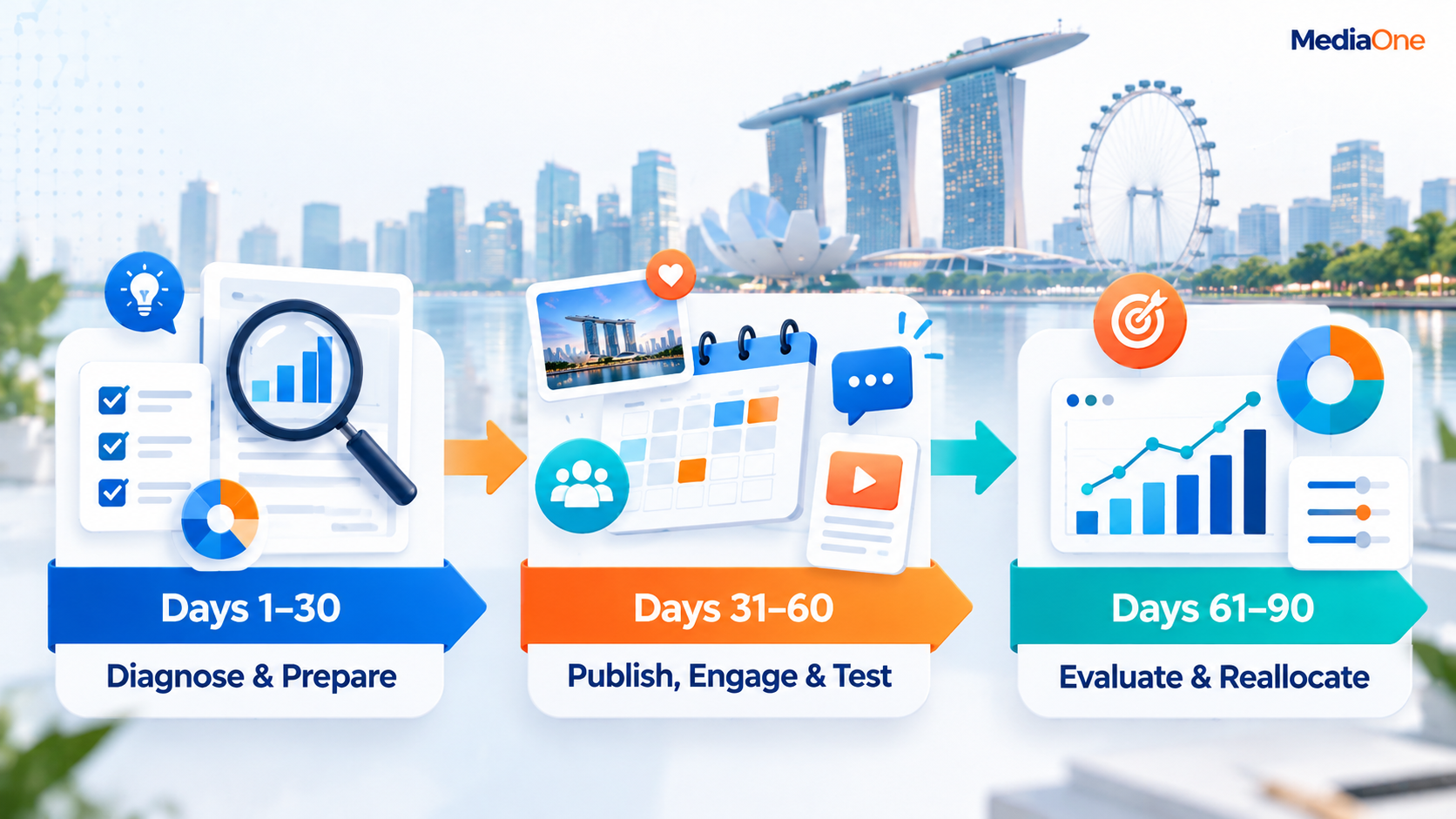
Days 1–30: Diagnose and Prepare
Confirm the business objective and primary KPI. Review customer research, current account performance and competitor positioning. Choose priority platforms, audit profile information and verify tracking. Then develop content pillars, a four-week calendar and a workable approval process.
At the end of the first month, the deliverables should be a documented strategy, accurate baseline and clear responsibilities. Do not judge the entire programme solely by early follower changes.
Days 31–60: Publish, Engage and Test

Publish to a consistent schedule and answer customer enquiries. Test a small number of meaningful variations, such as an educational video against a carousel addressing the same customer problem. If using paid ads, maintain clear campaign objectives and record the full costs.
Review performance regularly without reacting to every short-term fluctuation. Keep a record of audience feedback, lead quality and production effort.
Days 61–90: Evaluate and Reallocate
Compare performance with the original baseline and goal. Identify which topics, formats and platforms produced useful results. Retain effective activity, revise weak campaigns and redirect resources from channels with persistently poor fit.
Our recommendation is to finish the quarter with a decision for each priority channel: scale, improve or reduce investment. Set the next quarter’s targets using what the data actually supports.
Frequently Asked Questions
Social media strategies are structured plans that connect business goals with target audiences, platform choices, content and measurement. They explain what to publish, why it matters and how success will be evaluated.
There is no single best platform for every business. Choose based on where your customers research and buy, the content your team can produce and the results you can measure.
We recommend starting with one or two priority channels when resources are limited. Add another only when your existing activity is sustainable and the audience opportunity is supported by evidence.
There is no universal daily posting requirement. Start with a realistic schedule, monitor response and increase or reduce frequency according to results and production capacity.
Select KPIs that match your objective, such as qualified leads, purchases, cost per acquisition or relevant audience reach. Engagement and views are helpful supporting signals, but they cannot establish profitability by themselves.
Paid campaigns can help when the business has a defined audience, clear offer and functional conversion process. Begin with a controlled test and expand only when lead quality and economics justify additional spending.
Some enquiries may arrive quickly, while brand familiarity and complex purchases can take longer. We recommend monthly reviews and a structured 90-day assessment, adjusted for the business’s sales cycle.
Turn Your Social Media Strategy Into Measurable Business Growth
Effective social media strategies help Singapore businesses reach the right audiences and achieve measurable commercial outcomes. Start with customer insights and clear goals. Build a sustainable content plan, track qualified leads and sales, and refine your approach based on performance. A well-structured lead generation strategy can also help turn social media engagement into genuine business opportunities.
At MediaOne, we recommend prioritising measurable results over follower counts. If your current channels generate activity without clear business outcomes, our social media marketing services can help improve platform selection, campaign tracking and conversions. Start with a 90-day audit and action plan to identify where your next investment can deliver the greatest value.