
A Singapore company can spend S$5,000 generating enquiries and still have no clear answer about what it costs to win a paying customer. Advertising dashboards count clicks and leads, while sales teams record signed deals. The figures need to connect before a marketing budget can be judged properly.
Customer Acquisition Cost (CAC) puts a price on each new customer by dividing acquisition spending by the number won. Yet the headline figure can mislead when salaries, software or delayed sales are missing. A cheaper channel can also bring customers who leave quickly or buy very little.
A useful comparison combines a fully loaded CAC with gross margin, customer lifetime value and the time taken to recover spending. You will be able to calculate CAC, test each channel against the CAC Decision Ladder and decide where to invest next.
Key Takeaways
- CAC divides the total cost of acquiring customers by the number of new paying customers won over a defined measurement period.
- Include advertising, acquisition-related salaries, agency fees, technology and shared production costs without counting an expense twice.
- A lower CAC only helps when the customers acquired contribute enough margin and remain profitable over time.
- The SaaS 3:1 lifetime value to CAC ratio is a reference point, not a universal threshold for Singapore businesses.
- Calculate payback from monthly gross profit contribution per customer, then test it against your cash requirements.
- Assess paid search, paid social, content and referrals separately before shifting budgets based on the blended average.
What Customer Acquisition Cost Means
Customer acquisition cost measures the average amount a business spends to gain one new paying customer. It turns marketing and sales activity into a figure that owners and finance teams can compare with the money each customer contributes. A free trial, newsletter subscription or unqualified enquiry does not count as a paying customer.
Define ‘new’ before reporting starts. An ecommerce retailer might count a person’s first completed order, while a B2B firm may count the first paid contract for a new account. Repeat purchases belong in retention reporting unless the company separately measures reacquisition. GA4 acquisition reports describe users and sessions, so use billing records to confirm paying customers.
Why CAC Shapes Growth Decisions
A company often pays for acquisition before the new customer has generated enough gross profit to recover the investment. That delay affects working capital, particularly when advertising and sales salaries must be paid every month. CAC helps estimate how much cash growth will consume before it contributes to the business.
Suppose two channels each have a CAC of S$200. Customers from the first channel contribute S$50 a month after direct service costs, while those from the second contribute only S$20. The first group repays acquisition spending faster, even though the reported CAC is identical.
How to Calculate Customer Acquisition Cost
Start with a fixed reporting period, an agreed new-customer definition and acquisition costs reconciled against finance records.
The CAC Formula and Customer Count
CAC = Total sales and marketing acquisition costs ÷ New paying customers acquired
Count the costs and new customers for the same month or quarter. A firm spending S$5,000 and winning 25 new paying customers records a CAC of S$200.
Which Acquisition Costs Belong in CAC
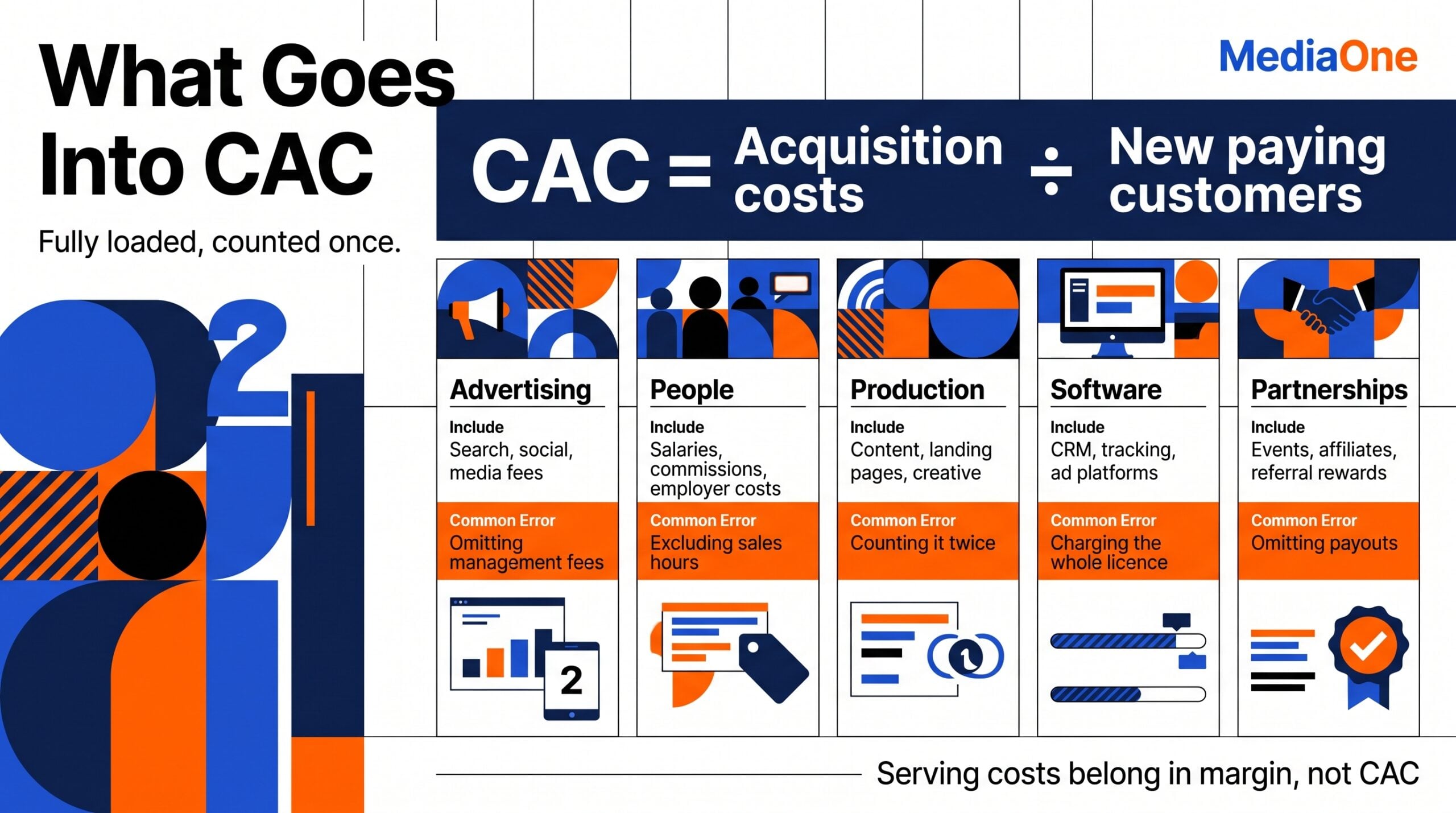
A fully loaded CAC should include the resources used to win new business. Assign shared expenses using a documented rule, such as recorded hours or a consistent proportion of work dedicated to acquisition.
| Cost Category | Include in Acquisition Spending | Common Reporting Error |
|---|---|---|
| Advertising | Paid search, paid social and media fees | Counting media cost but omitting management fees |
| People | Acquisition-related marketing and sales salaries, commissions and employer costs | Excluding internal sales hours |
| Production | Campaign content, landing pages and creative work | Counting production again inside an agency retainer |
| Software | Relevant CRM, tracking and marketing platform costs | Charging the entire company licence to one channel |
| Partnerships | Events, affiliate fees and referral rewards for new buyers | Omitting incentive payouts |
Separate the cost of serving customers from the cost of acquiring them. Delivery, hosting, payment processing and routine support generally belong in the gross margin or contribution calculation, unless a specific portion of staff time was spent securing the sale. The same expense should not reduce margin and increase CAC without a clear accounting reason.
First-order discounts deserve particular care. Record them consistently either through net revenue and customer contribution or as an acquisition incentive where that policy is appropriate. Counting a discount in both places understates the economics of the customer twice.
Singapore companies should also use consistent GST treatment in their cost records. IRAS guidance on input tax claims explains that GST-registered businesses may claim input tax only when the relevant conditions are met. Ask finance which tax amounts are recoverable before comparing departmental CAC reports.
Worked SaaS Example Using Singapore Dollars
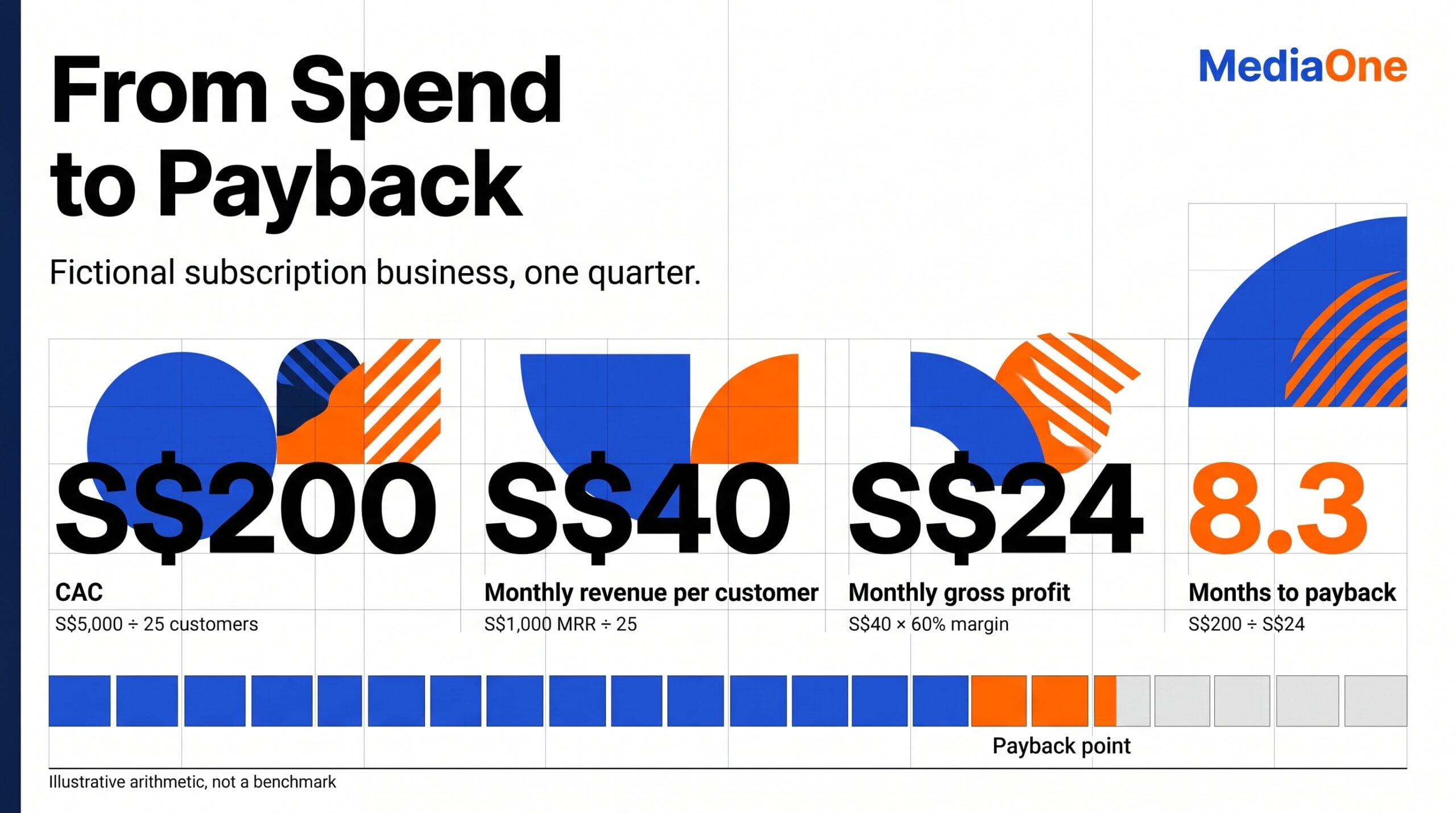
Consider a fictional subscription business that spends S$5,000 on sales and marketing in one quarter. It wins 25 new paying accounts, which together contribute S$1,000 in new monthly recurring revenue (MRR). The example assumes every account has the same revenue and gross margin.
| Calculation | Formula | Result |
|---|---|---|
| Customer acquisition cost | S$5,000 ÷ 25 customers | S$200 |
| Monthly revenue per customer | S$1,000 ÷ 25 customers | S$40 |
| Monthly gross profit at 60% margin | S$40 × 60% | S$24 |
| Simple CAC payback | S$200 ÷ S$24 | 8.3 months |
A S$200 CAC looks reasonable only when the customer relationship lasts long enough to repay it. Payback in this example assumes the S$24 monthly gross profit stays stable and excludes financing costs. It is illustrative arithmetic, not a performance promise or market average.
Measure CAC by Period and Cohort
Cohort reporting answers a different question. Group customers by when they first bought, then track their margin, repeat purchases and cancellations. A quarterly cohort view may reveal that one cheaper channel attracted buyers who stopped paying soon after the initial sale.
For longer B2B pipelines, also record the lead creation date, opportunity date and first payment date. This makes it possible to explain why marketing spend rose before the associated new-customer count appeared. Do not shift transactions between periods merely to make the reported CAC look better.
Factors That Affect Acquisition Costs
CAC changes with customer expectations and the effort needed to close a sale. A Singapore business should compare channels and periods with these operating conditions in view.
Price Point and Sales Cycle
A S$12 retail purchase supports different acquisition economics from a S$1,000 monthly business subscription. Higher-priced sales may justify consultation time or specialist demonstrations, provided the expected gross profit covers those costs. The sales cycle also affects how much cash remains tied up before revenue arrives.
Conversion Rates and Channel Mix
A campaign can acquire cheaper clicks without improving customer acquisition. If the traffic does not become qualified leads or completed purchases, CAC may rise despite a falling cost per click. Track the progression from visit to enquiry, qualified lead and paying customer.
Suppose one campaign spends S$1,000 to generate 50 enquiries and closes five customers. Its media-only cost per customer is S$200. A second campaign spends the same amount for 25 enquiries but wins eight customers, giving S$125 in media cost per customer. The second campaign has a higher cost per lead and a lower acquisition cost because more prospects buy.
Organic CAC Versus Paid CAC
Organic channels do not charge for each click, but they still consume resources. Content research, technical SEO, copywriting and staff implementation are acquisition costs when the work aims to bring in new customers. Referrals also have costs, including programme tools, administration and rewards.
Paid activity usually has a clearly recorded media budget. Organic work may create benefits across several months, so document how you allocate its production and maintenance spending. Compare a mature organic programme with paid campaigns only after using sensible time windows and full cost definitions.
Our Singapore SEO budgeting breakdown explains the work that can sit behind an SEO retainer. Use those categories to check your own cost records, without assuming that organic acquisition always has the lowest CAC.
CAC by Marketing Channel
Blended CAC divides total acquisition spending by all new customers won. It gives leadership a business-wide view but may hide expensive channels supported by cheaper ones. Channel-level analysis is needed before a budget is increased or cut.
Compare Search Social Content and Referrals
Choose a consistent attribution rule and assign shared costs only once. If one customer interacted with paid search and a referral partner, do not count the same customer as a complete acquisition for both channels while also adding the channel figures together.
| Channel | Typical Acquisition Costs | What to Review |
|---|---|---|
| Paid search | Click spend, management and landing pages | Qualified leads, first purchases and margin |
| Paid social | Media, creative production and testing | Lead quality, sales lag and repeat value |
| Organic content | Publishing, SEO tools and staff time | New customers over a suitable longer window |
| Referrals and partners | Rewards, commissions and administration | Incremental customers and total incentive cost |
Use one attribution method when a customer visits through several channels. Our lead generation funnel framework connects enquiries to closed sales.
The Limits of Referral Benchmarks
Referral programmes may reduce the amount of paid promotion needed, but the size of any saving depends on the reward, eligibility rules and quality of the referred buyer. A strong referral programme can also attract customers who would have purchased without an incentive. Measure newly acquired customers against the full cost of the programme.
Avoid quoting fixed referral savings or churn differences as forecasts. Use your own referral cohort to compare acquisition cost, retention and lifetime contribution.
Reallocate Budgets Using Customer Value
Do not move spending simply because one channel has the lowest reported CAC. Compare the amount of gross profit the acquired customers produce and how quickly they repay acquisition spending. A channel that wins cheap first purchases may still be weaker if discounts, returns or cancellations absorb the margin.
Increase a channel’s budget in controlled stages after confirming the numbers hold beyond a small sample. Review changes in lead quality and marginal CAC as spend increases. A successful small campaign may become less efficient when it reaches audiences with weaker purchase intent.
For a practical paid-media comparison, our Google Ads budget planning article connects acquisition targets with lead close rates and advertising budgets.
Customer Lifetime Value and CAC Payback
CAC describes the upfront cost of winning a customer. Customer lifetime value (LTV) estimates the value that customer contributes during the relationship, while payback shows how soon the business recovers the acquisition investment. Stripe’s explanation of CAC payback uses the monthly contribution from each customer to assess recovery time.
Calculate LTV Using Margin and Retention
A simple recurring-revenue estimate is monthly revenue per customer × gross margin × expected customer lifetime in months. For a subscription firm, expected lifetime can be approximated as one divided by monthly customer churn, assuming churn remains constant. The estimate is less dependable when customers have very different contracts or cancellation patterns.
Return to the fictional SaaS example. Monthly revenue is S$40, gross margin is 60%, and assumed monthly churn is 5%. The simplified expected lifetime is 20 months, so estimated gross-profit LTV is S$40 × 60% × 20, or S$480.
This calculation omits changes in pricing, expansions, future servicing costs beyond the stated margin and discounting of future cash flows. A more mature business should use observed cohort contribution and retention curves where available. For project-based services, model repeat work and net project margin without forcing a monthly subscription formula onto one-off purchases.
Read the LTV to CAC Ratio
Divide estimated LTV by CAC using matching customer definitions and a consistent margin basis. In the example, S$480 ÷ S$200 gives an LTV:CAC ratio of 2.4:1. That means estimated lifetime gross profit is 2.4 times the cost of acquiring the account, before other operating overheads.
A 3:1 ratio appears frequently in SaaS guidance, including Stripe’s SaaS unit-economics discussion. Treat it as a reference point for recurring-revenue businesses. A retail firm with irregular repeat purchases or a service business with substantial working-capital needs should choose its threshold from observed margin and cash requirements.
Calculate Payback and Test Cash Flow
CAC payback in months = CAC ÷ Monthly gross profit per customer. For the example, S$200 ÷ S$24 gives approximately 8.3 months. Actual recovery may differ if revenue is collected annually, invoices are paid late or customer support costs vary over time.
Compare payback with the time the company can finance acquisition spending. A business paying salaries today but collecting customer invoices in several months may face a cash constraint even when expected lifetime value is attractive. Keep a separate cash-flow forecast alongside the profit-based payback calculation.
Benchmarks and Ways to Reduce CAC
What Counts as a Good CAC
A good CAC fits the gross profit a customer generates and the time the business can afford to wait for recovery. Set the acceptable ceiling from your own unit economics, then review it when prices, fulfilment costs or retention change. Keep the benchmark specific to the customer segment being acquired.
Google Ads offers a customer acquisition cost reporting metric for eligible customer lifecycle reporting. Its platform calculation uses allocated advertising spend and identified new customers. That is a useful campaign diagnostic, but it should not be labelled fully loaded business CAC without adding the other acquisition costs.
Apply the CAC Decision Ladder
Use the four-stage CAC Decision Ladder to judge each channel. Agree the passing conditions before reviewing performance, and record the reason if a channel needs more observation.
- Fully Loaded CAC: Reconcile all relevant acquisition expenses, allocate shared work once and check the result against the agreed S$ ceiling.
- Payback: Estimate when gross profit will recover the acquisition investment, then compare that period with available cash and the sales cycle.
- LTV:CAC: Calculate lifetime value from your own margin and retention data, and test the ratio against a business-specific minimum.
- Channel Split: Review paid and organic channels separately, checking sample size, attribution rules and the quality of customers acquired.
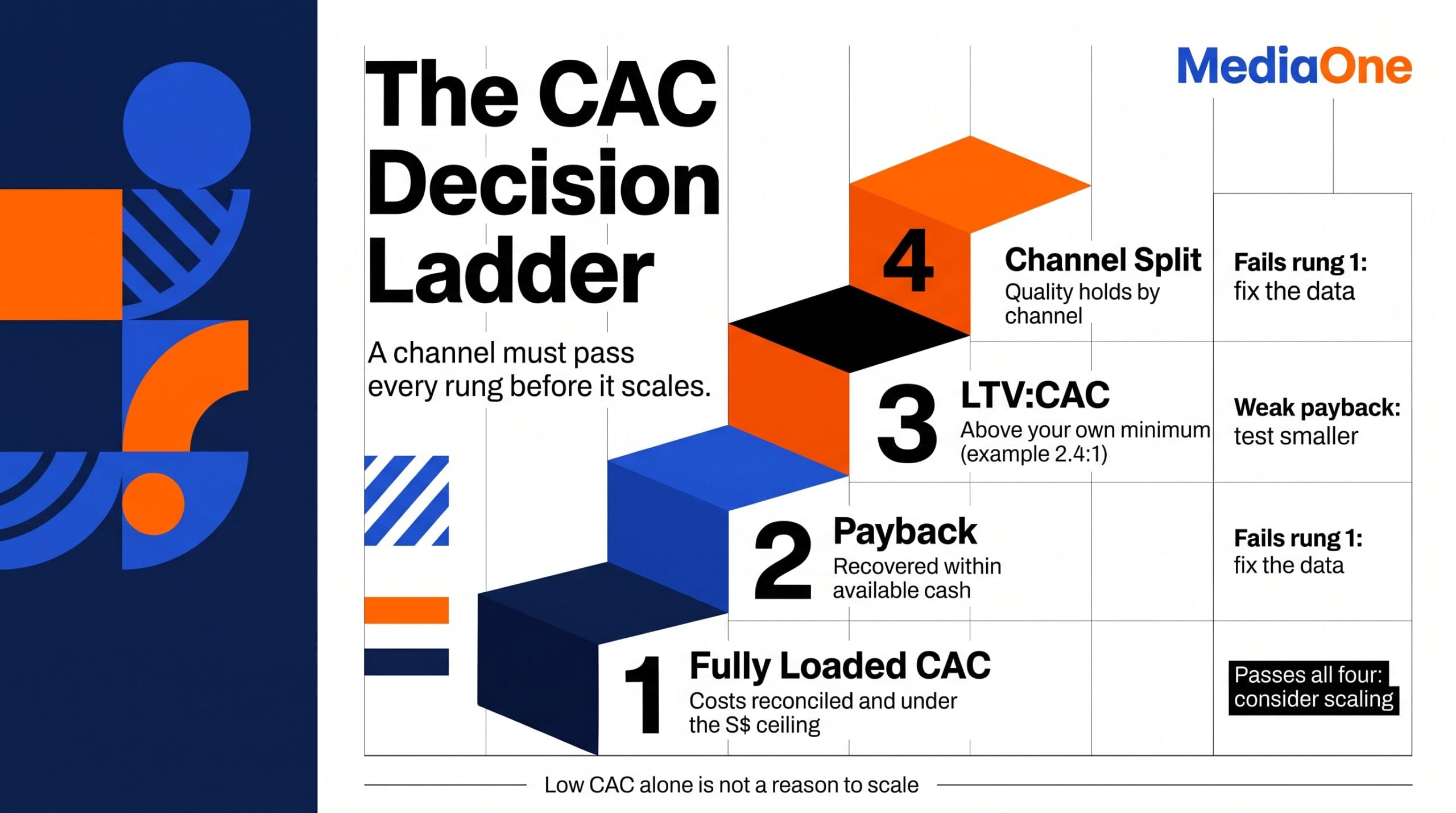
A channel that fails the cost reconciliation should be fixed before any profitability decision is made. A channel with reliable numbers but weak payback may need a better offer, improved conversion or a smaller test budget. A channel that passes all four checks can be considered for further spending, subject to capacity and cash limits.
Practical Ways to Lower Acquisition Costs
Begin with the part of the funnel that loses the highest share of qualified prospects. Improve landing-page clarity, form completion and sales follow-up before buying more traffic. Our conversion rate optimisation services focus on testing on-site changes against actual visitor behaviour.
Review audience and keyword targeting so paid campaigns attract customers the business can serve profitably. Compare creative messages with customer objections recorded by sales staff. Better targeting can reduce wasted acquisition effort, although there is no guaranteed percentage saving.
Run a Monthly CAC Review
- Reconcile the month’s acquisition expenses, including salary allocations and invoices.
- Count new paying customers from sales or billing records, removing duplicates and renewals.
- Calculate blended CAC, then channel CAC using an agreed attribution policy.
- Update gross margin, churn and payback using the latest customer cohorts.
- Flag channels with missing data or a sample too small for a confident decision.
- Record which budget or conversion changes will be tested and when they will be reviewed.
If marketing systems receive identifiable customer information, check the relevant requirements under Singapore’s PDPC guidance on marketing messages. The appropriate notification, consent and Do Not Call checks depend on how the data is collected and used.
Conclusion Use CAC to Guide Growth Spending
Customer acquisition cost becomes useful when the calculation includes the real cost of winning paying customers. Pair it with customer contribution, retention and payback, and keep the channel-level assumptions visible. A low figure alone is not a reason to scale a campaign.
Start with one reporting period, reconcile costs against new paying customers and apply the four stages of the CAC Decision Ladder. At MediaOne, we recommend fixing measurement gaps before changing budgets, then testing the strongest opportunities against actual customer profitability.
Frequently Asked Questions
How is customer acquisition cost calculated?
Divide total acquisition-related sales and marketing spending by the number of new paying customers won in the same reporting period. Include relevant staff time, media, software and external fees. For example, S$5,000 spent to acquire 25 customers gives a CAC of S$200. Long sales cycles may also need cohort reporting to explain the delay between spending and completed sales.
What is a good CAC for a Singapore business?
There is no reliable universal S$ amount. A good CAC allows the business to recover acquisition spending through gross profit within its acceptable payback period and leaves enough lifetime value to support overheads. Compare similar customer segments and cost definitions. A low CAC can still be poor if customers buy little or leave quickly.
What is the difference between CAC and LTV?
CAC is the upfront average cost of gaining a new paying customer. Customer lifetime value estimates the gross profit that customer will contribute during the relationship, based on retention and margin assumptions. Comparing the two helps assess long-term acquisition economics. Keep the calculation’s margin basis consistent and label any estimated customer lifetime clearly.
How do you calculate the CAC payback period?
For a subscription business, divide CAC by the average monthly gross profit contribution per new customer. A S$200 CAC and S$24 monthly contribution give a simple payback of about 8.3 months. Actual cash recovery may differ because of billing schedules and late payments. For project-based services, use the timing of expected project contribution instead.
How can a company reduce customer acquisition cost?
Start by identifying where qualified prospects stop progressing towards a sale. Test landing pages, targeting, offer clarity and sales follow-up, then compare actual customers won instead of clicks alone. Include referral rewards and content costs when evaluating alternative channels. Recalculate CAC after each change and check that the lower figure has not reduced customer quality.
Is organic CAC lower than paid CAC?
It depends on the total costs and customers attributed to each channel. Organic search and referrals have no per-click media fee, but content, staff time and incentive costs still belong in the calculation. Paid channels can also generate customers who buy again. Compare fully loaded channel costs, gross profit and payback over suitable reporting periods before making a budget decision.