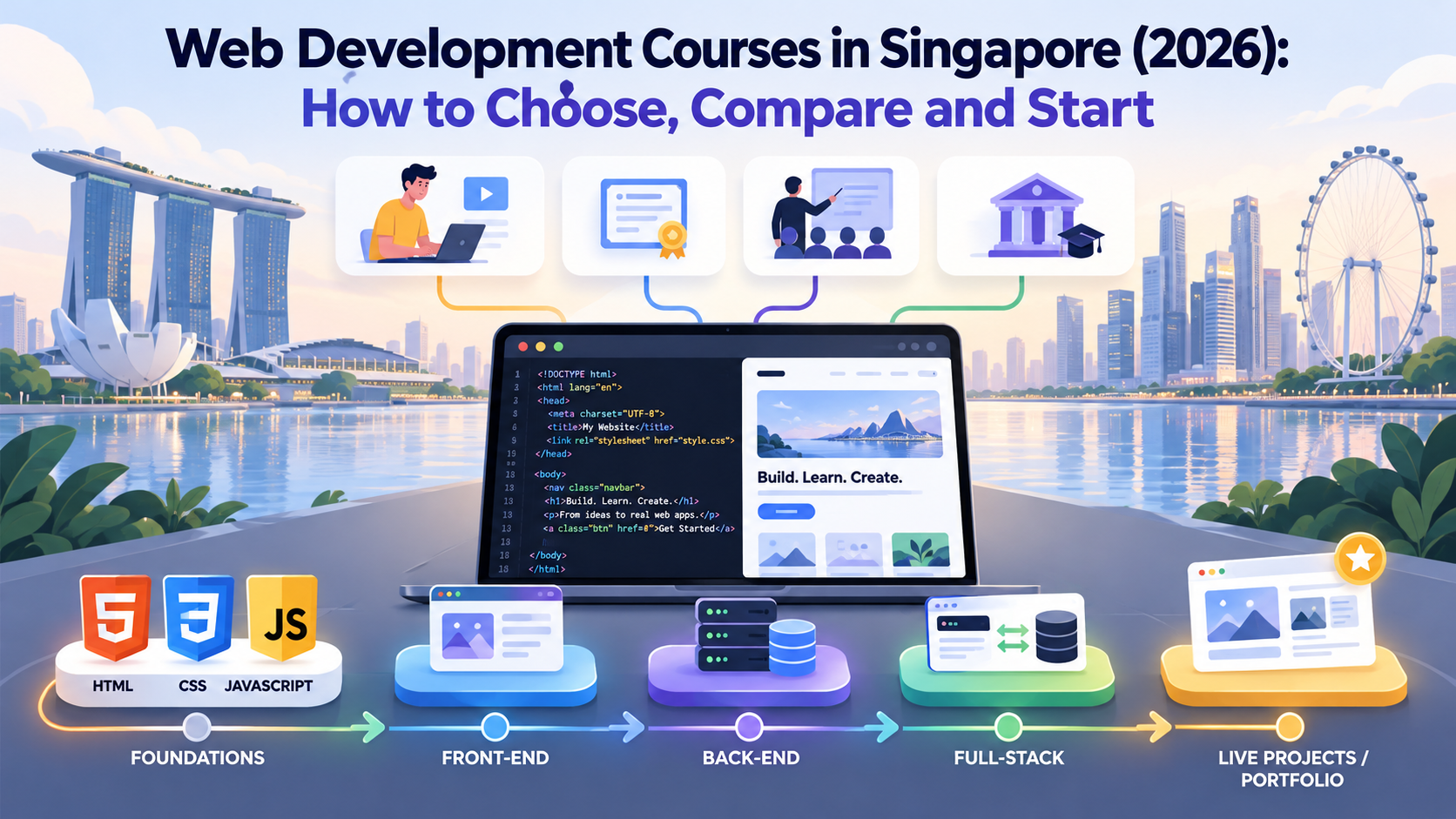
| AI Summary Choosing the right web development course in Singapore depends on your career goals, experience, budget and schedule. Beginners can start with free resources such as MDN, Microsoft’s Web Dev for Beginners and The Odin Project. Paid courses offer structured learning, instructor feedback and practical projects. Before enrolling, compare the curriculum, portfolio requirements, course fees and SkillsFuture eligibility. Prioritise courses that develop job-relevant skills and help you build working applications. |
The right web development course depends on your career goal, coding experience and available study time. In Singapore, you can learn through free tutorials, online certificates, intensive bootcamps or part-time institutional programmes. Each offers a different balance of structure, feedback and cost.
We recommend starting with the fundamentals before paying for advanced training. Then compare courses by the projects you will build, the support you receive and the skills required for your target role. This guide covers credible learning options, SkillsFuture funding, essential technologies and a practical route from your first webpage to a portfolio.
Key Takeaways
- Start with HTML, CSS and JavaScript. They form the foundation of browser-based development.
- Match the course to your goal. Front-end, back-end and full-stack roles require different depth.
- Look for feedback and finished projects. Certificates alone cannot demonstrate practical ability.
- Compare the full cost. Check schedules, assessment fees, funding eligibility and refund terms.
- Verify current availability. A course page does not necessarily mean enrolment is open.
- Build while learning. A working portfolio helps demonstrate your judgement and technical skills.
What Does a Web Development Course Teach?
Web development involves building and maintaining websites and web applications. A browser displays the interface, while server-side software can process requests, enforce rules and retrieve stored information. Not every website needs a database or a complex server application.
Courses generally follow three specialisations:
- Front-end development: Building the interface users see and interact with, including responsive layouts and accessible forms.
- Back-end development: Creating server-side services, authentication, application logic and database connections.
- Full-stack development: Working across the interface, server and data layers to deliver a complete application.
We suggest beginners learn front-end fundamentals first. You can immediately see whether your code works, which makes debugging easier. Once you understand how a webpage behaves, server-side concepts become easier to follow.
Start with HTML, CSS and JavaScript
HyperText Markup Language (HTML) describes a page’s structure. Cascading Style Sheets (CSS) control its appearance. JavaScript adds behaviour, such as form validation, interactive menus and updates without a full page reload. HTML and CSS are not programming languages in the same sense as JavaScript.
A suitable introductory module should cover semantic HTML, forms, CSS Flexbox and Grid, responsive design, JavaScript functions and Document Object Model (DOM) manipulation. It should also introduce browser developer tools, basic debugging and version control with Git.
The free MDN Learn web development curriculum is a reliable starting point. It teaches foundational front-end skills through structured lessons and exercises. MDN describes its goal as helping learners become comfortable with the subject, not instant experts.
Compare Web Development Course Formats Before Enrolling
Format affects your budget, pace and access to support. A free course can offer excellent teaching material, while a paid programme may provide deadlines, instructor feedback and career guidance. Neither route guarantees employment.
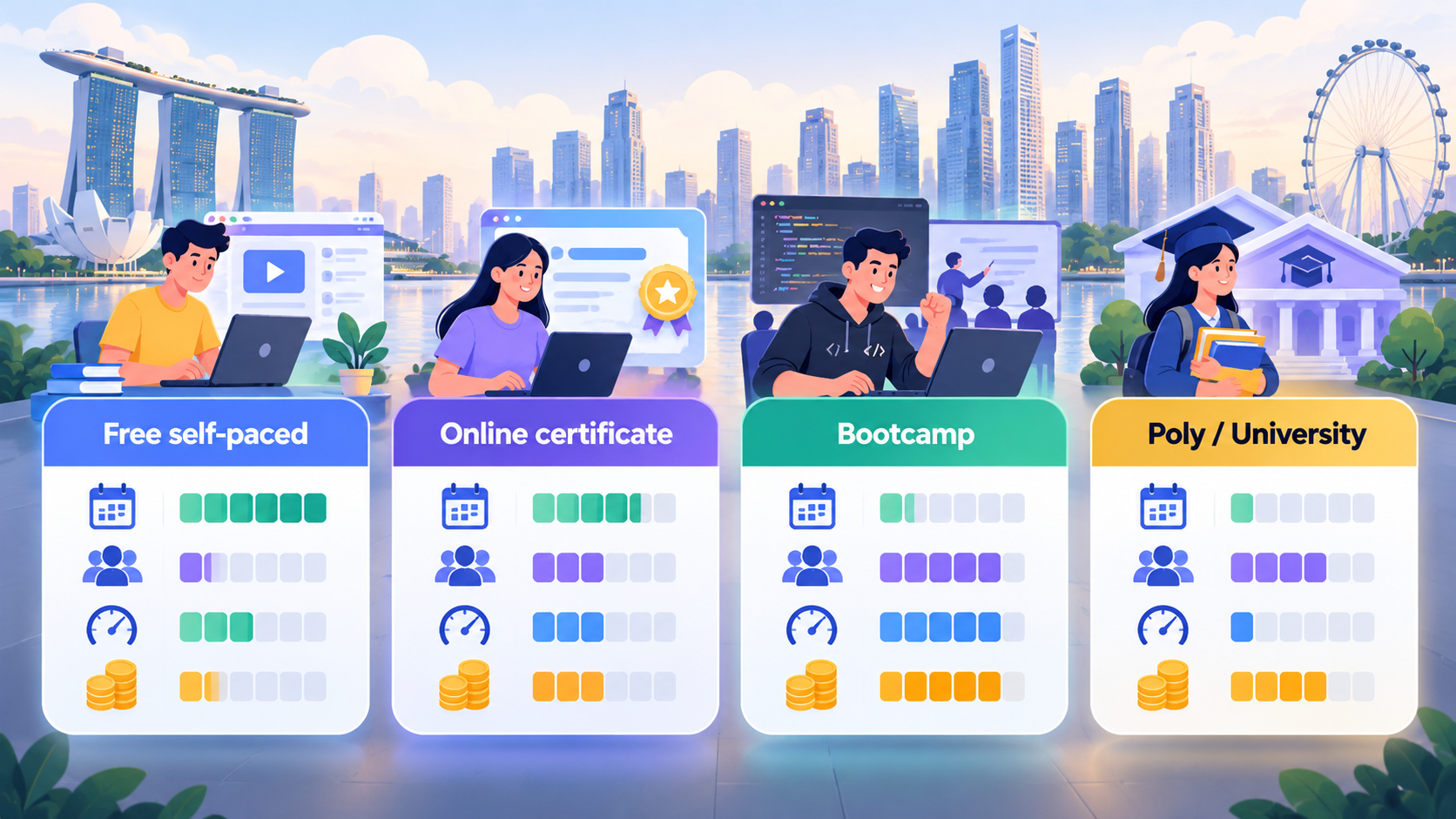
| Course format | Typical commitment | Main advantage | Main limitation |
|---|---|---|---|
| Free self-paced learning | Flexible | No tuition fee | Limited individual feedback |
| Online professional certificate | Flexible, often several months | Defined syllabus and credential | Subscription or assessment costs may apply |
| Live bootcamp | Intensive or scheduled part-time | Instructor access and group projects | Greater workload and potentially high fees |
| Polytechnic or university programme | Fixed timetable | Formal assessment and structured progression | Entry requirements and longer commitments |
These are format comparisons, not fixed price bands. Actual fees vary by provider, intake and funding status. We would request an itemised quotation before committing to any paid web development course.
Free courses for independent beginners
Microsoft’s Web Dev for Beginners presents a 12-week curriculum built around HTML, CSS, JavaScript and practical projects. Its repository includes lessons, assignments and exercises. The suggested timetable is a curriculum plan, not proof that everyone can finish in 12 weeks.
The Odin Project’s Full Stack JavaScript path progresses through front-end development, React, databases, Node.js and career preparation. It suits learners willing to solve problems independently and maintain a regular study routine.
We would choose MDN for clear explanations, Microsoft’s curriculum for guided beginner exercises and The Odin Project for a longer project-based path. Use one as your main syllabus rather than switching between resources whenever a lesson becomes difficult.
Online certificates for structured progression
The Meta Front-End Developer Professional Certificate on Coursera covers HTML, CSS, JavaScript, React, version control and interview preparation. Its published estimate is seven months at six hours weekly, but completion time depends on your pace.
This is a front-end programme, not comprehensive full-stack training. Check current subscription charges, assessment conditions and the projects included. We would choose it when a defined learning sequence and shareable credential are useful, while building additional independent work alongside the coursework.
Singapore bootcamps and institutional options
General Assembly Singapore’s Software Engineering Bootcamp advertises full-time and part-time paths, portfolio projects and career support. However, its course page currently states that the programme is unavailable. Treat the advertised formats as programme information, not confirmed upcoming intakes.
Singapore Polytechnic’s Diploma (Conversion) in AI-assisted Web Development & Programming combines front-end, back-end and AI-assisted development. Its listed October 2026 intake runs for one year, with evening classes; the published registration period has already closed. Check for a subsequent intake directly with the polytechnic.
For learners with existing development knowledge, NUS Computing’s Modern Full Stack Development is a three-day course. Its stated prerequisites include a diploma and knowledge of front-end and back-end development. We would not recommend it as a complete beginner’s first course.
These examples serve different learners. Compare their entry requirements, teaching hours, assessments and enrolment status rather than treating every programme as a substitute for the others.
What Skills Should a Good Web Development Course Cover?
After the basics, the curriculum should progress towards complete, testable applications. We recommend judging each advanced topic by whether you actually use it in an assignment.
Front-end frameworks and responsive interfaces
A framework or library such as React helps organise interactive interfaces into reusable components. Learn plain JavaScript first so you understand events, state changes and browser behaviour instead of relying on copied patterns.
Courses should also teach mobile layouts, keyboard navigation, labelled forms and meaningful error messages. The World Wide Web Consortium’s accessibility guidance provides a recognised reference for building interfaces that work for a wider range of users.
Asynchronous JavaScript and APIs
Web applications frequently request information without reloading the whole page. JavaScript promises and async/await help organise these asynchronous operations. Importantly, await pauses the surrounding asynchronous function’s progress; it does not ordinarily freeze the entire browser interface.
Look for exercises using fetch, response-status checks and error handling. An application programming interface (API) module should also explain common Hypertext Transfer Protocol (HTTP) methods such as GET, POST, PUT and DELETE, alongside the status codes returned by servers.
Back-end development, databases and security
For JavaScript-based full-stack study, Node.js and Express are one possible server-side combination. Python and Java are also viable routes. Choose a stack aligned with relevant job descriptions rather than trying every language simultaneously.
Structured Query Language (SQL) is used to work with relational databases such as PostgreSQL. Document databases such as MongoDB use different data models. Neither approach is automatically superior: relationships, query requirements and operational needs determine the choice.
A credible course should address password handling, authorisation, input validation and secure deployment. Singapore learners building applications that handle personal information should also understand the Personal Data Protection Commission’s guidance on protecting personal data. For portfolio work, use fictional customer records. This demonstrates responsible development without exposing private information or creating unnecessary security risks.
TypeScript, testing and deployment
TypeScript adds static type checking to JavaScript. It can identify certain mistakes before execution, although it does not replace runtime validation. The official TypeScript handbook recommends learning JavaScript fundamentals first if you are new to programming.
Courses should introduce automated tests, Git collaboration, environment variables and deployment. Students need to know how to diagnose an application that works locally but fails after publication.
Score Any Web Development Course Before You Pay
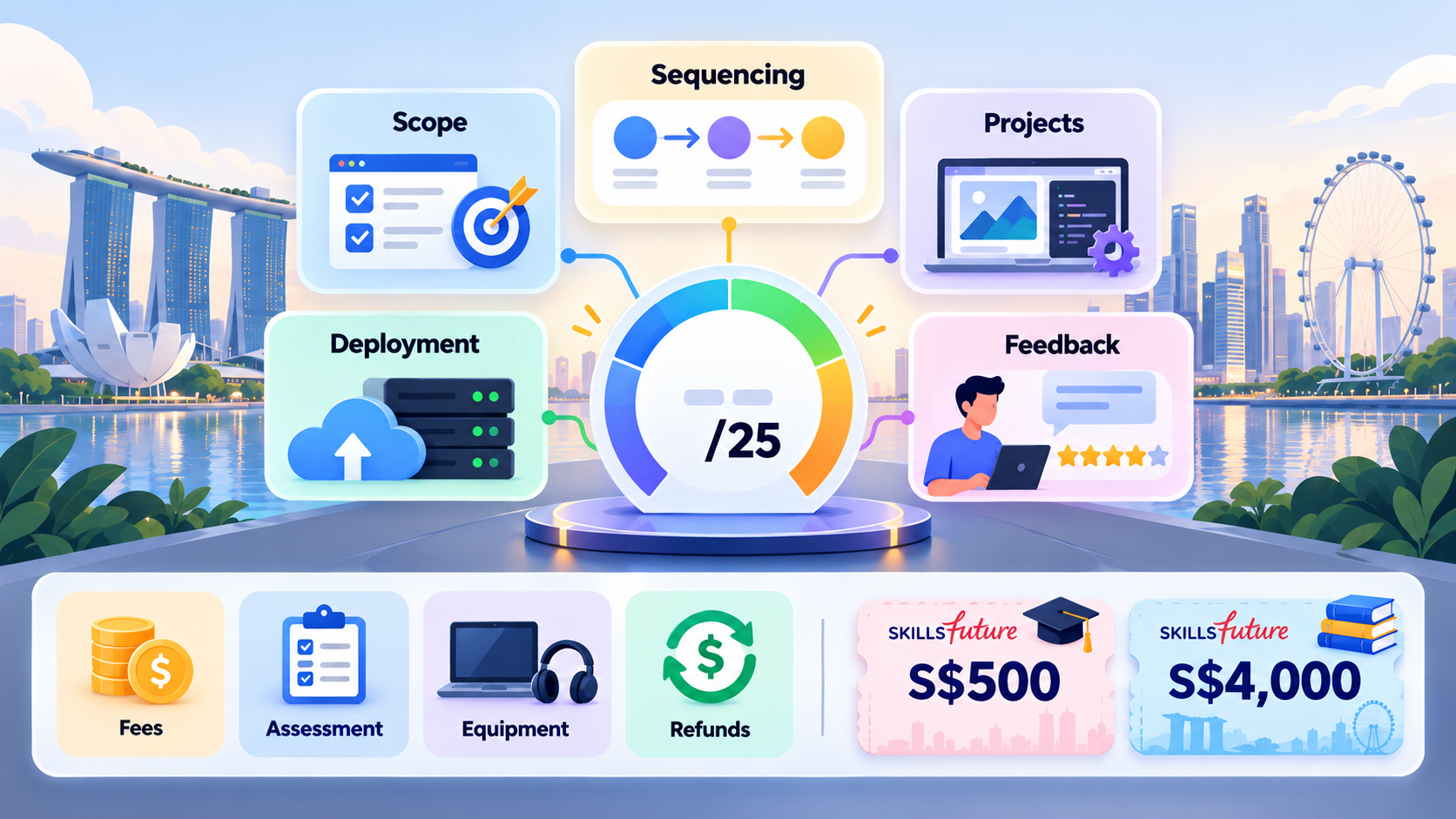
We use the following Course Output Scorecard as a practical comparison tool. Give each category zero to five points: zero means absent, three means partly covered and five means clearly demonstrated with evidence.
| Criterion | What to verify | Maximum |
|---|---|---|
| Relevant scope | Skills match your intended role | 5 |
| Logical sequencing | Foundations precede advanced frameworks | 5 |
| Completed builds | Independent assignments and a substantial project | 5 |
| Deployment and quality | Live applications, tests and documentation | 5 |
| Feedback and support | Code reviews, instructor access or active peer review | 5 |
| Total | Your comparison score | 25 |
A score of 20–25 suggests a strong fit on these criteria. Scores of 15–19 warrant closer inspection, while anything below 15 signals gaps you may need to address independently. These are our editorial thresholds, not a validated measure of hiring success or course accreditation.
Check the evidence behind each point. A provider promising a capstone should explain whether students deploy their own applications. For feedback, ask who reviews code, how frequently reviews happen and whether support continues after the final class.
Also request examples of graduate work where permission has been granted. A polished demonstration built entirely by the instructor is not equivalent to an independently completed student project.
Web Development Course Fees and SkillsFuture Funding in Singapore
Course pricing can change between intakes. An advertised fee may exclude taxes, materials, examinations or optional services. Subscription-based platforms may also become expensive if you need additional months to complete your certificate.
Singapore Citizens aged 25 and above have access to the S$500 opening SkillsFuture Credit. Eligible citizens aged 40 and above also have a S$4,000 mid-career tier for selected programmes. The official MySkillsFuture explanation sets out the distinctions and qualifying course categories.
Credit is not a blanket discount on every web development course. Search the relevant listing through MySkillsFuture, check which credit tier applies and confirm the payable amount with the training provider. Permanent Residents and international learners should not assume they qualify for SkillsFuture Credit.
Before paying, calculate the total personal cost after any confirmed subsidy. Include travel, required equipment and the income you may forgo during full-time study. Ask whether refunds remain possible after lessons begin and what happens if an advertised intake is postponed.
A Practical Roadmap From Beginner to Portfolio
Your learning schedule should reflect available hours, not an advertised job-ready deadline. The following 12-week plan is an illustrative starting framework, not a guarantee of professional readiness.
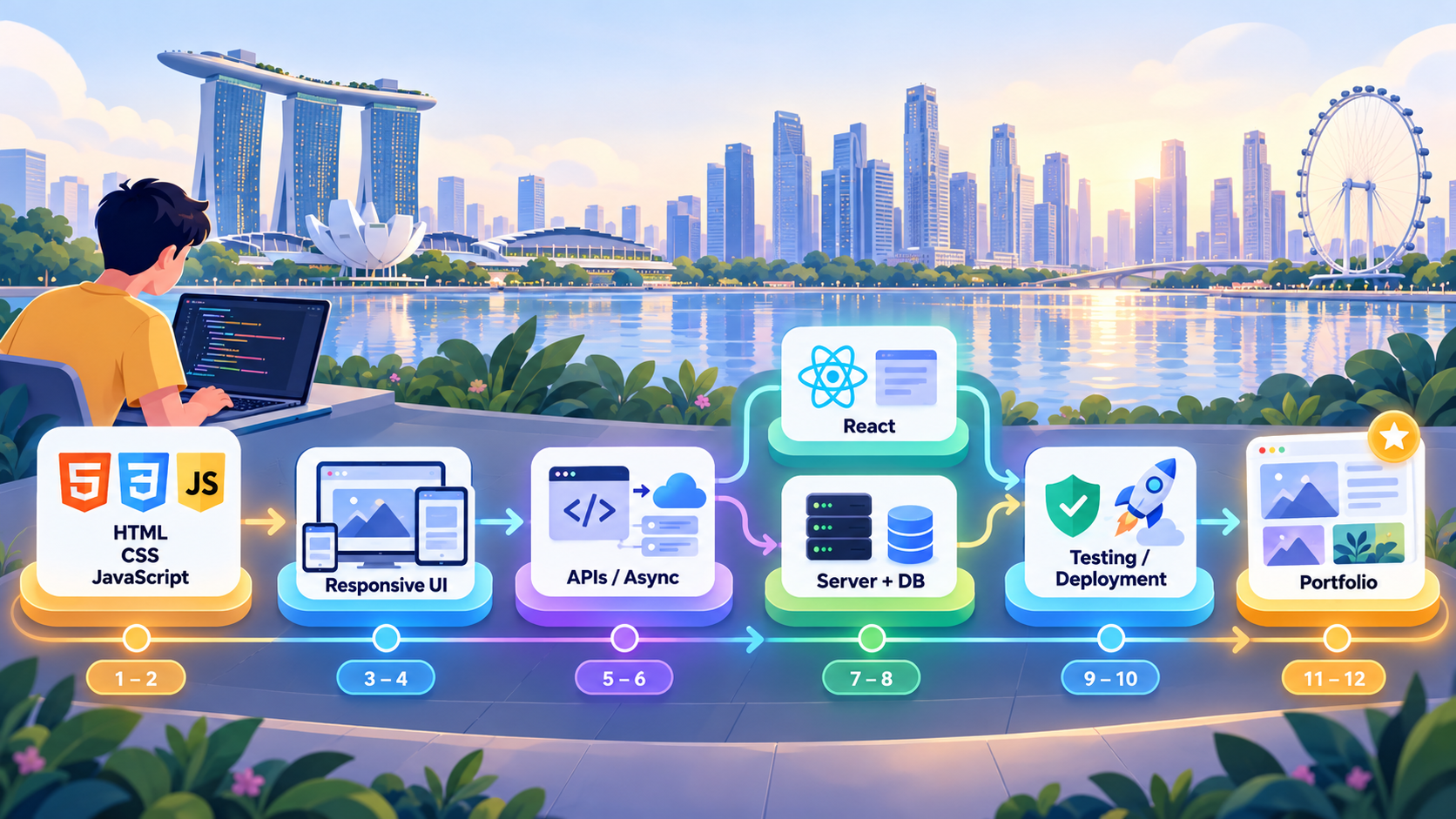
- Weeks 1–2: Build your first pages. Learn HTML structure, links, images and forms. Publish a simple profile page, then improve its semantic markup.
- Weeks 3–4: Make layouts responsive. Practise CSS Flexbox, Grid and mobile layouts. Rebuild one page without copying the lesson’s final code.
- Weeks 5–6: Add interaction. Learn JavaScript functions, arrays, events and DOM updates. Create a to-do list or interactive calculator.
- Weeks 7–8: Connect to data. Practise asynchronous requests and API error handling. Build a search interface using appropriate public test data.
- Weeks 9–10: Choose your specialisation. Front-end learners can explore React. Full-stack learners can start a server and database project.
- Weeks 11–12: Publish and review. Deploy a finished application, fix mobile and accessibility issues, and document your decisions.
A working adult may spread these milestones over several months. If a topic remains unclear, repeat the exercise with different requirements. Independent practice reveals gaps that watching another tutorial may conceal.
Build portfolio projects that show real decisions
Aim for two or three distinct projects rather than many unfinished demonstrations. Choose problems you can explain and test:
- Responsive business website: Accessible navigation, service pages, enquiry form and mobile-friendly layouts.
- Task or booking application: User interactions, validation, stored data and clear error states.
- Full-stack dashboard: Authentication, protected routes, database operations and a deployed server.
For each project, include a live link, source repository and short README describing the purpose, technology, setup and limitations. Explain what you built independently and acknowledge any starter templates or AI assistance.
MDN’s website publishing guide explains basic deployment options, including GitHub Pages for suitable static sites. Full-stack applications may need separate hosting for server-side code and databases.
How to Choose the Right Course for Your Career Goal
For a first technical job, prioritise coding fundamentals, regular review, substantial projects and interview preparation. Compare target job advertisements with the syllabus. A full-stack course may be unnecessary if your intended role is strictly front-end.
For freelancing, prioritise responsive websites, content management systems (CMS), forms, hosting and client handover. Learn to estimate scope and maintain a site after launch. Customers usually need dependable outcomes, not proof that you know several frameworks.
For upskilling, choose targeted modules that solve an existing work problem. A marketer improving website performance may benefit from HTML, CSS and technical search engine optimisation (SEO), while a developer moving into back-end work needs APIs, databases and security.
For exploration, begin with free lessons and one small project. We would avoid paying a large deposit until you know that coding, debugging and ongoing technical learning suit you.
Ask each provider when the curriculum was updated, who teaches it, how assignments are assessed and which costs are refundable. Request a sample timetable before comparing providers with different schedules. Also check class size, equipment requirements, access to recordings and the availability of instructors outside class. These details can determine whether a demanding programme fits around your existing responsibilities.
Frequently Asked Questions
How long does it take to learn web development?
You can begin building simple pages within weeks, but proficiency depends on your starting point and practice. Reaching interview readiness may require several additional months of projects, debugging and technical preparation.
Can a free web development course help me get hired?
Yes, free resources can teach valuable skills, but completion alone does not secure employment. Build independent projects, practise interviews and compare your abilities against actual job requirements.
Do I need a degree to become a web developer?
Not every employer requires one. Some positions specify formal qualifications, while others consider practical experience, portfolios and technical assessments, so check individual vacancies.
Is JavaScript the best language for beginners?
JavaScript is a practical starting language for browser development, alongside HTML and CSS. For server-side specialisation, Python, Java and other languages may also fit your goals.
Is a web development certificate worth paying for?
It can provide structure and evidence of course completion. We would assess its curriculum, instructor feedback and portfolio outcomes before paying, rather than assuming the credential guarantees employment.
Can I use SkillsFuture Credit for online coding courses?
Only where the relevant course or approved subscription is eligible under SkillsFuture rules. Check the current listing and your available credit through MySkillsFuture before purchasing.
Choose a Web Development Course That Helps You Build With Confidence
The best web development course for you is one you can complete consistently and apply to real work. Beginners can start with MDN or Microsoft, independent learners can progress through The Odin Project, and those needing structured support can compare verified certificates and Singapore programmes.
Before enrolling, use our 25-point scorecard, confirm fees and funding, and inspect the projects you will produce. A clear learning path, thoughtful feedback and practical experience will help you build confidence and develop job-ready skills.
To understand how these skills apply to real business projects, explore our website design and development services. If your business needs professional website development, contact our team to discuss your requirements.