| AI Summary
Project management software helps teams organise tasks, assign responsibilities and track deadlines. The right choice depends on the work involved, the people using it and the full cost of running it. Trello supports visual task tracking, Jira supports software development, and platforms such as Asana, ClickUp and monday.com cover broader team workflows. Singapore businesses should compare plan limits, integrations and permissions, then test shortlisted tools on a real project before buying. |

Many Singapore business owners buy marketing help on instinct, then struggle to judge whether it solved a real problem or simply produced more activity. A consultant’s presentation may sound convincing while leaving basic questions unanswered: who will do the work, what will it cost and how will the business judge the result?
Marketing management consulting addresses those decisions. Its value depends on whether the advice changes how the business spends money and serves customers. This guide explains the service, compares common arrangements and shows how to choose support your team can put into practice.
Key Takeaways
- A defined business decision gives a consulting project a purpose and an endpoint.
- Missing evidence can justify research or an audit; missing delivery capacity may require an agency or employee.
- A proposal should separate consulting fees from advertising, software, production and implementation costs.
- Relevant examples should explain the consultant’s contribution, starting conditions and measured results.
- An effective handover includes editable files, named task owners and agreed review dates.
What Is Marketing Management Consulting?
Marketing management consulting is outside advice on how a business plans, funds, organises and evaluates marketing. The consultant examines the current situation, identifies problems and recommends actions. Implementation support may form part of the agreement, but it should appear in the scope.
The work goes beyond choosing an advertising platform. A consultant may examine whether the company targets the appropriate customers, whether its offer makes sense and whether its team has the time and skills to deliver it.
For example, a furniture retailer might attract online enquiries while its showroom team struggles to explain delivery charges. A review could uncover a communication problem between marketing and sales. Additional advertising would bring more people into the same frustrating experience.
What does the service cover?
A project may address several connected areas:
- Customer understanding: Who buys, why they buy and what delays their decision.
- Brand and offer: What the business promises and how its products or services support that promise.
- Spending: How money is divided across campaigns, people, suppliers and tools.
- Responsibilities: Who approves, produces, follows up and reports.
- Measurement: Which results justify continuing, changing or stopping an activity.
Customer interviews, sales records and marketing research can help explain the gap between what a business offers and what buyers expect. The US Small Business Administration’s market research guidance similarly distinguishes existing market information from direct research with customers.
For Singapore businesses selling to other businesses, SingStat’s enterprise data provides context on ownership, SME classification and revenue size. Those categories describe the market; they do not establish demand for a particular company’s offer.
Marketing Management vs Consulting: Who Does What?
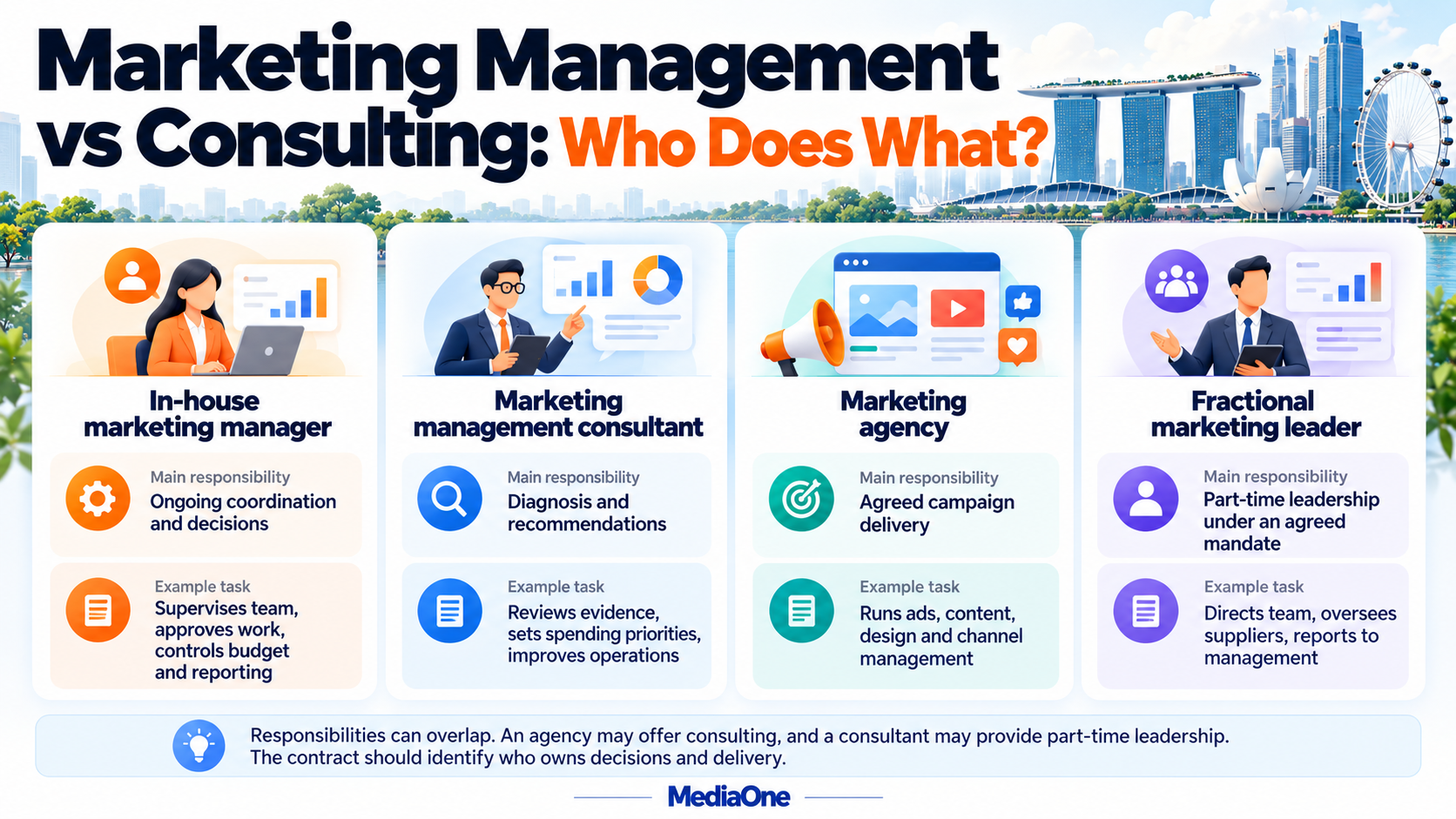
Marketing management is an ongoing responsibility. Someone owns the plan, allocates resources, coordinates delivery and answers for results. Consulting provides outside analysis and advice on a defined problem or decision.

The distinction concerns responsibility. A consultant may recommend a campaign, while the marketing manager decides how the team will carry it out within the approved budget.
| Role | Main responsibility | Typical work |
| In-house marketing manager | Ongoing coordination and decisions | Team supervision, approvals, budget control and reporting |
| Marketing management consultant | Diagnosis and recommendations | Evidence review, spending priorities and operating improvements |
| Marketing agency | Agreed campaign delivery | Advertising, content, design and channel management |
| Fractional marketing leader | Part-time leadership under an agreed mandate | Team direction, supplier oversight and management reporting |
These arrangements can overlap. An agency may offer consulting, and a consultant may provide part-time leadership. The contract should identify the responsibilities being purchased.
A digital marketing consultant concentrates on online performance. Marketing management consulting can also connect store promotions, sales teams, events, distributors and other activity with the overall marketing budget.
A business that already knows what to do but lacks production capacity may need to outsource marketing. Another business may have several suppliers producing work without shared priorities. That business may need management advice before commissioning more campaigns.
Types of Marketing Consulting Services
Marketing consulting can take several forms. The appropriate arrangement depends on what the buyer needs to understand or decide.
| Service | Suitable situation | Expected output |
| Focused audit | The cause of a marketing problem is uncertain | Findings, evidence gaps and ranked actions |
| Strategy project | The business needs to choose customers, offers or spending priorities | Decisions, assumptions, budget options and an implementation plan |
| Advisory retainer | An internal team needs continuing outside review | Scheduled advice, decision records and progress reviews |
| Focused consultation | A capable team needs help with one question | An agreed recommendation and next steps |
Focused audit
An audit examines an agreed area, such as weak enquiries, inconsistent reporting or duplicated supplier work. Its purpose is to establish what is happening and where further investigation is needed.
A worthwhile audit connects findings to evidence. “Improve the website” leaves too much unexplained. “Customers cannot find delivery charges before requesting a quote” identifies a specific problem the team can investigate.
Strategy project
A strategy project helps management choose between options. Its output might specify which customer group to prioritise, how the offer should be presented and which activities deserve funding.
A review of branding strategies may sit within that work when customers struggle to understand the business’s promise. A complete rebrand should have its own scope and cost.
A strategy also needs trade-offs. A small retailer may have enough staff to improve one customer group’s experience, but insufficient capacity to serve several new groups at once. The consultant should explain what receives priority, what waits and which evidence could change that choice. A list covering every available channel leaves that management decision unfinished.
A distributor provides another example. Its sales team may want more enquiries while warehouse staff already struggle to fulfil orders. The consultant needs to consider that constraint before recommending higher spending. The project might prioritise customers who order predictable quantities or products the business can supply reliably.
The resulting plan should connect marketing promises with operational capacity. A promotional offer for next-day delivery needs agreement from the people arranging deliveries. A discount needs someone to check its effect on margins. These checks keep recommendations connected to the business that must deliver them. They also give management a practical basis for approving campaigns.

Advisory retainer or focused consultation
A retainer supports recurring decisions, such as reviewing test results or supervising several suppliers. Its agreement should define meeting frequency, preparation, response times and included work.

A focused consultation suits a narrower decision, such as whether to commission customer interviews before changing a service package. A single session works best when the consultant receives relevant information beforehand.
When Does a Business Need Marketing Management Consulting?
Outside advice becomes relevant when an unresolved marketing decision has a meaningful cost and the team needs help examining it. A deadline can create urgency, but a launch date alone does not establish the need for consulting.
Common triggers include rising acquisition costs, conflicting reports, unclear supplier responsibilities or disagreement over which customers to prioritise. A business entering a new market may also need an independent assessment of its assumptions.
Four checks before approaching a consultant
The following questions support a buying decision. They form a preparation checklist, with no numerical score or automatic hiring rule.
- Decision: What needs to be decided, and what happens if it remains unresolved?
- Internal capability: Which knowledge, time or authority does the team lack?
- Evidence: What information exists, and what research or tracking is missing?
- Implementation: Who can approve and carry out the recommendations?
Missing data does not rule out consulting. Research design or measurement repair may be the first assignment. The proposal should identify that work before promising performance improvements.
A team with an agreed plan and no time to deliver it faces a different problem. Additional production support or a role defined through relevant digital marketing job responsibilities may address that gap.
Example: a Singapore cafe with quiet weekday mornings
A hypothetical cafe owner wants more weekday breakfast sales. Point-of-sale records show when people buy, but the owner does not know whether nearby workers want faster service, different prices or a different menu.
A focused research and audit project could examine those questions before the owner funds a promotion. Any resulting campaign would also need staff capacity, stock and a way to record purchases. The consultant’s first contribution is a better buying decision, with a promotion following only if the evidence supports it.


What Should a Marketing Consulting Brief Include?
A consulting brief explains the problem, boundaries and expected output before proposals arrive. A short document can be enough when it gives each provider the same starting information.
A practical brief includes:
- Business context: Products, customer groups, locations and sales process.
- Problem: The observed issue and its commercial effect.
- Decision required: What management needs to decide after the work.
- Evidence available: Sales records, customer feedback, campaign reports and previous research.
- Scope: Included markets, channels, teams and suppliers.
- Deliverables: Specific files, analysis, workshops or recommendations.
- Timing and budget: Decision dates, spending limits and approval arrangements.
- Exclusions: Work requiring a separate quote.
A brief saying “improve marketing” gives providers too much room to interpret the assignment. A stronger version might say: “Review why qualified enquiries fell while advertising spend remained stable, and recommend which issues to address first.”
The brief should also identify constraints. A retailer may have no developer available for three months. A recommendation requiring an immediate website rebuild would need an alternative the team can deliver sooner.
Existing marketing communications can reveal whether sales emails, advertisements and store messages describe the same offer. Those examples help the consultant understand the customer experience before recommending changes.
One named business contact should coordinate questions and approvals. Access to sales or operations staff may still be necessary, especially when marketing results depend on what happens after an enquiry.
How to Choose a Marketing Consultancy in Singapore
A suitable consultancy can explain how its work will support the decision in the brief. Its process, relevant experience and delivery arrangements deserve closer attention than a long service list.
Evidence from comparable projects
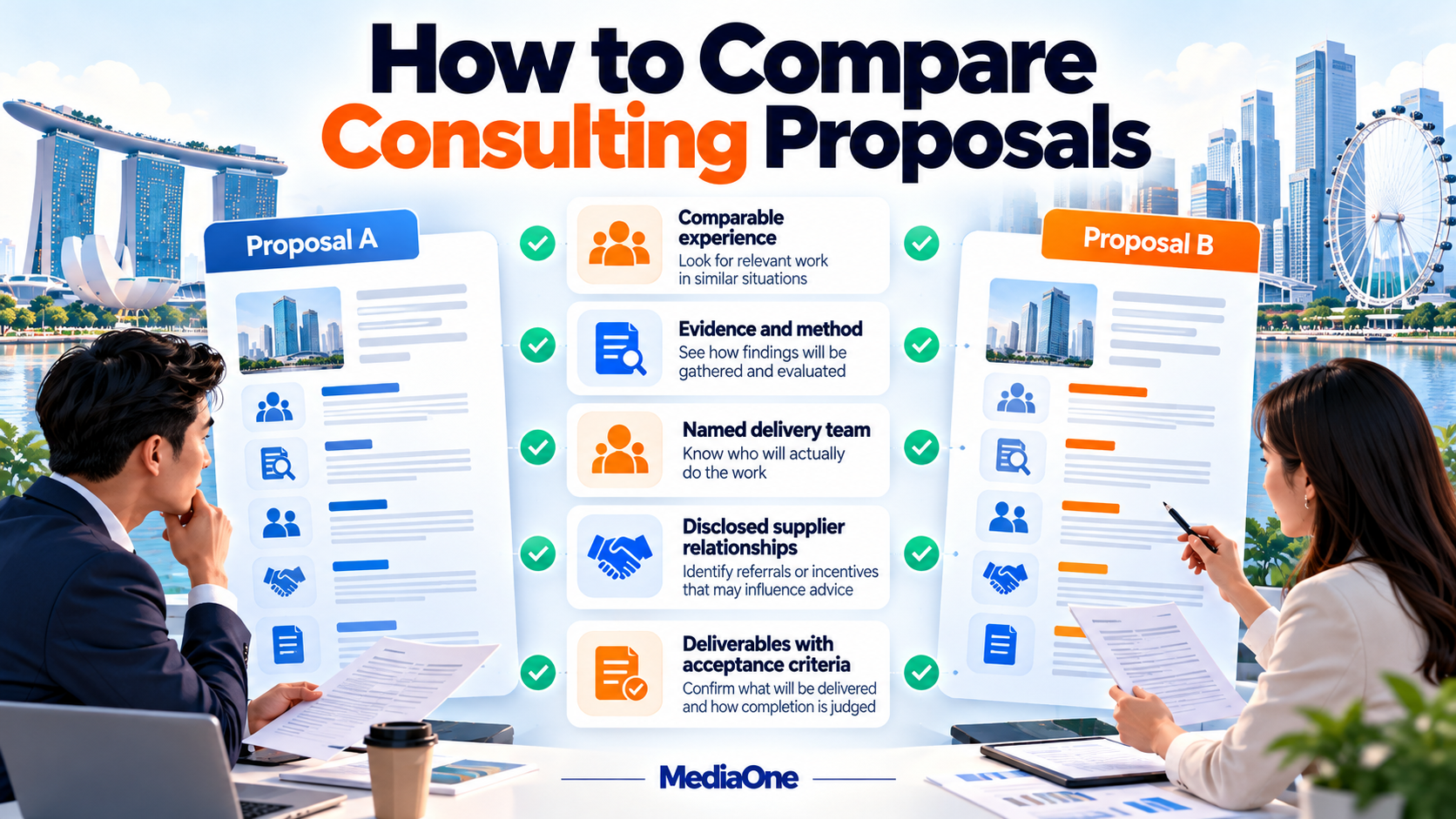
Relevant experience concerns similar customers, sales cycles and resource limits. A consumer campaign with immediate online purchases offers limited evidence for a supplier whose customers take months to approve contracts.
A case example should explain the starting problem, work completed, reporting period and result. The consultant’s contribution should be identifiable, including any campaign delivery performed by another team.
A percentage increase without a starting number tells only part of the story. A rise from two enquiries to four needs different interpretation from a rise from 200 to 400.
A method that connects findings to decisions
A provider should describe which information it will review, how it will involve staff and how it will compare options. The explanation should make sense without specialist language.
The buyer can also ask how the provider handles contradictory evidence. Sales staff may report that price causes lost orders, while customer interviews point to delivery delays. A disciplined investigation checks both explanations. A provider who accepts the first account without testing it risks recommending a discount that leaves the service problem unresolved.
A sample deliverable can help establish the expected depth. A useful recommendation states the evidence, proposed action, responsible person, required resources and next review date.
Singapore’s advertising code sets expectations that advertisements should be legal, decent, honest and truthful. Recommendations about claims and promotional messages should respect those principles.
The people doing the work
A senior presenter may not be the person conducting the analysis. The proposal should name the project lead, explain specialist involvement and describe how the team handles staff changes.
The consultancy should also disclose supplier relationships or referral payments that could influence recommendations. A buyer needs to understand why a particular platform or agency appears in the proposed plan.
Business identity and warning signs
ACRA’s Bizfile entity search allows checks of basic registered information, including live status and address. Registration establishes business identity; it does not prove marketing competence.
Warning signs include guaranteed commercial results without examining the business, recommendations made before reviewing evidence and reluctance to define deliverables. A proposal centred on purchasing a particular tool also deserves questions about the underlying need.
How to Compare Consulting Fees and Total Costs
Marketing management consulting fees depend on the assignment, research requirements, seniority and level of implementation support. A meaningful comparison starts with equivalent scope.
A fixed project fee can make the cost of defined deliverables easier to assess. Hourly or daily work needs an agreed limit and an approval process for additional time. A retainer needs defined access, activities and review dates.
The total budget may include:
- Consulting and research fees.
- Advertising and media purchases.
- Creative production or website changes.
- Software subscriptions and tracking work.
- Internal staff time and training.
For illustration, a proposal could charge S6,000foranalysiswhilerequiringS4,000 for approved implementation. The initial commitment would be S$10,000 before any separately quoted advertising, software or applicable tax. These figures illustrate cost comparison and are not Singapore market benchmarks.
A lower consulting fee can still produce a higher total bill if interviews, workshops or revisions sit outside the quoted scope. Each proposal should show what triggers additional charges.
The company’s digital marketing budget also needs enough capacity to act on the findings. A plan that consumes the available funds before implementation leaves the business with recommendations it cannot test.
Payment milestones can correspond to accepted outputs, such as completed research, agreed recommendations and handover. Acceptance criteria describe what the consultant must deliver; commercial targets describe the improvements the business hopes to achieve.
A staged agreement can limit the initial commitment when the cause of the problem remains uncertain. The first stage might end with a diagnosis and costed options. Management can then approve the next stage based on those findings. Each stage still needs an output; repeated discovery meetings without a decision can consume the budget.
Cancellation terms, notice periods and ownership of completed work also affect the total commitment. A comparison should include these conditions alongside the quoted fee, particularly when a retainer renews automatically or a supplier proposes a minimum contract period.
How to Measure a Marketing Consulting Engagement
Measurement should distinguish the quality of the consulting work from the business results that follow. A consultant can deliver sound analysis while implementation stalls. Sales can also rise because of seasonality or a price change unrelated to the advice.
Baseline and agreed measures
A baseline records the position before the work begins. Comparable reporting periods and consistent definitions help the business assess subsequent changes.
| Consulting objective | Possible measure | Evidence required |
| Improve enquiry quality | Share of enquiries meeting agreed criteria | Sales qualification records |
| Improve spending decisions | Cost per acquired customer | Defined acquisition costs and new customer counts |
| Reduce duplicated work | Repeated tasks removed and time saved | Supplier scopes and staff records |
| Improve team delivery | Agreed actions completed and overdue tasks | Task ownership and progress records |
| Improve repeat business | Repeat purchases within a defined period | Customer purchase records |
The measures should reflect the assignment. A project about team responsibilities does not need a promise of immediate sales growth. Relevant marketing objectives explain which result the work is intended to support.
Google Analytics records key events for actions important to a business. A recorded enquiry still needs sales records to establish whether it became a qualified prospect or customer. That connection supports meaningful online lead generation reporting.
Revenue and costs need separate attention
Additional revenue does not equal profit. In a hypothetical example, SGD 20,000 in additional sales with SGD 12,000 in direct delivery costs leaves SGD 8,000 before marketing costs and overheads. Combined consulting and implementation costs of SGD 5,000 would leave SGD 3,000 before overheads, tax and other costs.
That calculation assumes the sales are additional and the stated costs are complete. Existing customers buying earlier than usual or moving from another company channel can complicate the comparison. The business should record these limits before describing the result as a return from consulting.
Testing recommendations and interpreting results
A manageable test helps assess a recommendation before broader spending. Google Ads’ custom experiments allow eligible campaign changes to be compared with original campaigns. Other recommendations may need operational trials, customer interviews or longer observation periods.
The test should record what changed, when it changed and which result will guide the next decision. Multiple changes introduced together can make their individual effects difficult to separate.
Google Analytics’ attribution model comparison also shows how different models assign credit across channels. Attribution describes assigned credit; a report alone does not establish that every credited sale resulted from the consulting engagement.
Small samples require restraint. A handful of purchases may suggest a question worth investigating, while providing too little evidence for a large spending commitment. The consultant should explain the limits alongside the findings.
What Should Happen Before the Consultant Leaves?
A handover turns recommendations into work the business can continue. The agreement should identify the files, access arrangements and training included at completion.
The handover package should contain:
- Research findings and their limitations.
- Editable plans, reporting templates and calculations.
- Actions ranked by urgency, cost and dependency.
- Named owners and required approvals.
- Test records and outstanding questions.
- Review dates and completion criteria.
A short working session can reveal whether staff understand the plan. Someone on the team should be able to explain the next action, update the report and identify when a result needs attention.
Customer information also needs controlled handling. The business should limit access to what the assignment requires and agree how the consultant will return or delete working copies. Named account access helps the business manage permissions without sharing individual passwords.
A replacement employee should also be able to follow the documentation. A report that only its creator understands creates another dependency. Plain definitions, dated decisions and accessible working files help the business preserve what it learned when staff or suppliers change.
The final review should record accepted deliverables, unresolved issues and any proposed additional work. A retainer extension deserves a specific reason, such as reviewing an agreed test after enough results become available.
Choosing Marketing Management Consulting for Your Business
Marketing management consulting starts with a decision the business needs help making. A focused assignment gives the consultant a defined purpose and gives management something concrete to assess.
The next step depends on the problem. Uncertain causes may justify an audit. A choice between customer groups may require research and strategy. An agreed plan with no delivery capacity may call for campaign support or additional staff.
A marketing consultation with MediaOne can begin with the problem, evidence available and decision required. Those details give both sides a basis for discussing scope, cost and the work the business needs next.
Frequently Asked Questions
Can a business hire a marketing consultant before launching?
A pre-launch business can commission research into customer needs, competing offers and willingness to buy. The consultant should label forecasts as assumptions and distinguish interview feedback from purchase evidence. The first assignment may be a small demand test before the company commits to a full launch.
Can one consulting project cover several countries?
A regional project can share an overall approach while examining each market separately. Language, buying habits, distribution and local competition may require different recommendations. The proposal should specify the countries covered and how the consultant will obtain evidence in each one.
Can a franchise business use its own marketing consultant?
A franchisee can seek advice within the permissions set by its franchise agreement. Brand rules, approved suppliers and promotional restrictions may limit available changes. A consulting brief should identify those boundaries before the provider recommends local offers, creative work or changes to customer communications.
What happens if the consultant disagrees with the founder?
A disagreement should lead to a review of evidence and assumptions. Both sides can document their reasoning and identify what information would resolve the difference. Where practical, a limited test can compare the options. The founder or authorised business leader retains the final decision.