| AI Summary
A digital marketing consultant helps Singapore businesses improve online visibility, lead generation, conversions and marketing performance. Hiring one makes sense when growth stalls, advertising costs rise or internal teams lack specialised expertise. Consultants typically provide audits, strategies and performance recommendations, while agencies focus on campaign execution. Before hiring, businesses should compare fees, assess relevant experience and establish clear deliverables. The right consultant should address measurable business problems and help improve marketing return on investment (ROI). |
A digital marketing consultant helps a business identify why its online marketing is underperforming and decide what to improve. We recommend hiring one when you have a costly problem, limited in-house expertise or an important growth decision that needs independent analysis. The right consultant gives you clear priorities, measurable targets and an implementation plan—not a generic list of marketing tactics.

For Singapore small and medium-sized enterprises (SMEs), the decision often comes down to capability and accountability. This guide explains what consultants actually do, when to engage one, how their fees compare with other hiring models and how to assess whether the investment makes commercial sense.
Key Takeaways
- Start with a business problem. Identify whether weak demand, poor conversion, rising acquisition costs or unreliable tracking is limiting growth.
- Match the provider to the work. Consultants typically diagnose and guide; agencies usually supply ongoing execution; employees provide day-to-day ownership.
- Insist on useful deliverables. An audit should lead to ranked recommendations, accountable owners, realistic deadlines and measurable outcomes.
- Compare total costs. Consider project fees, implementation costs and staff time rather than comparing a consultancy quote with salary alone.
- Retain control. Your business should own its advertising accounts, analytics properties, customer data and marketing assets.
What Does a Digital Marketing Consultant Actually Do?
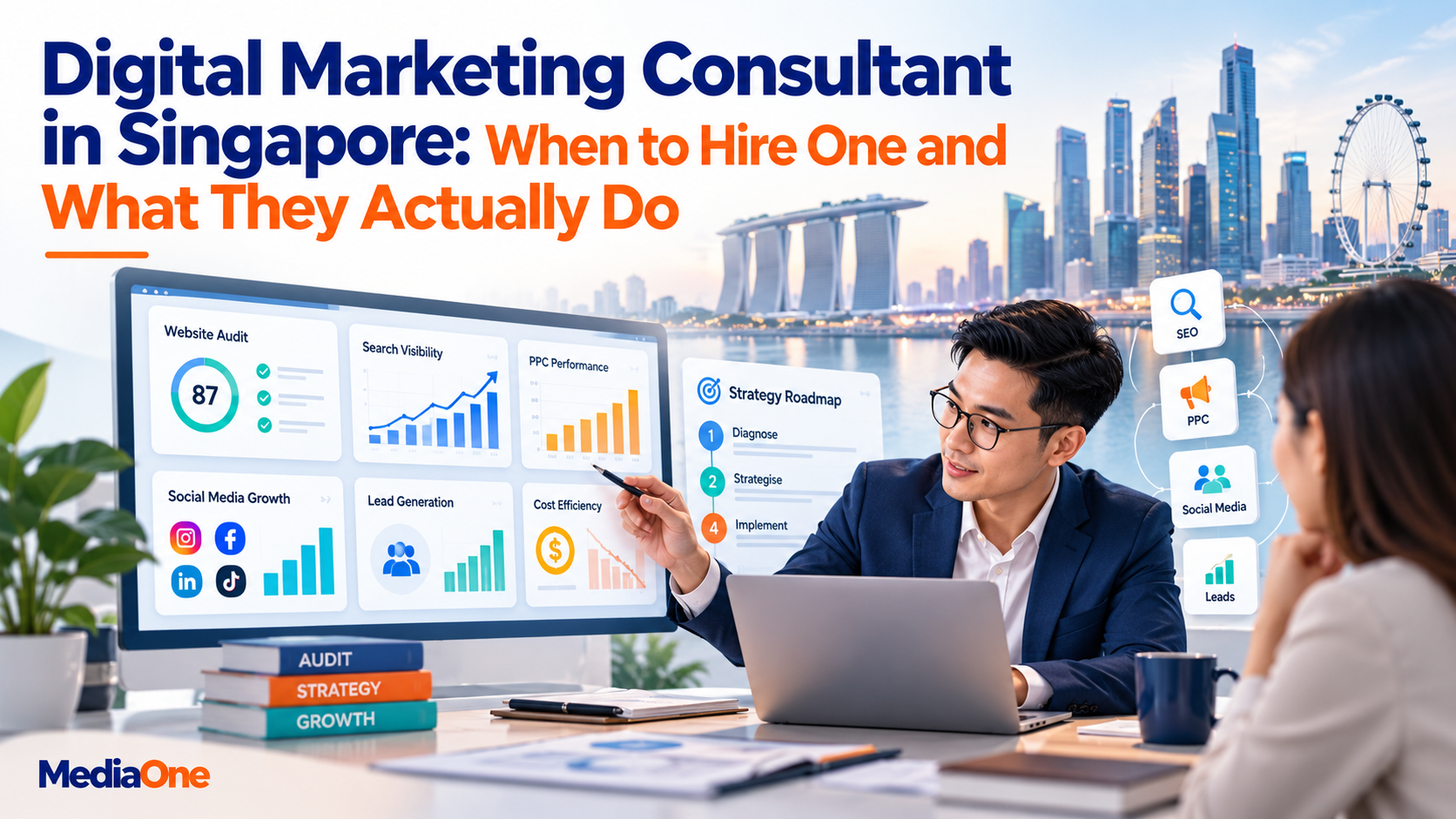
A digital marketing consultant reviews your business objectives, target customers and existing online channels. They identify barriers to acquiring or converting customers, recommend improvements and help the team determine which actions deserve funding first. Some consultants also supervise implementation or manage specialist suppliers.
Audit your website, search visibility and customer journey
An audit examines how prospective customers discover your business and what happens after they arrive. The consultant may review search queries, landing pages, mobile usability, enquiry forms, website speed and sales follow-up. They should separate observations from confirmed causes instead of assuming every traffic decline is an SEO failure.
Google Search Console shows search impressions, clicks, queries and indexing information. Google Analytics and Search Console guidance explains how combining the tools helps businesses understand both search discovery and on-site behaviour. We would review these alongside customer relationship management (CRM) records before recommending more advertising.
Build a prioritised digital marketing strategy
A credible strategy specifies the audience, offer, channel mix, resources and expected business outcome. A consultant might recommend improving an existing service page before investing in additional search traffic. Alternatively, strong conversion performance could justify expanding a profitable paid campaign.
Improve campaigns and measurement
Consultants may assess search engine optimisation (SEO), pay-per-click (PPC) advertising, social media, email and content marketing. Their role is to establish how each channel supports customer acquisition, retention or revenue. They may also help sales teams define a qualified lead so campaign reports reflect commercially valuable enquiries.
Signs Your Singapore Business May Need a Digital Marketing Consultant
A consultant is useful when a problem is significant but its cause is uncertain. These indicators justify an investigation, although none automatically proves that outside help is necessary.

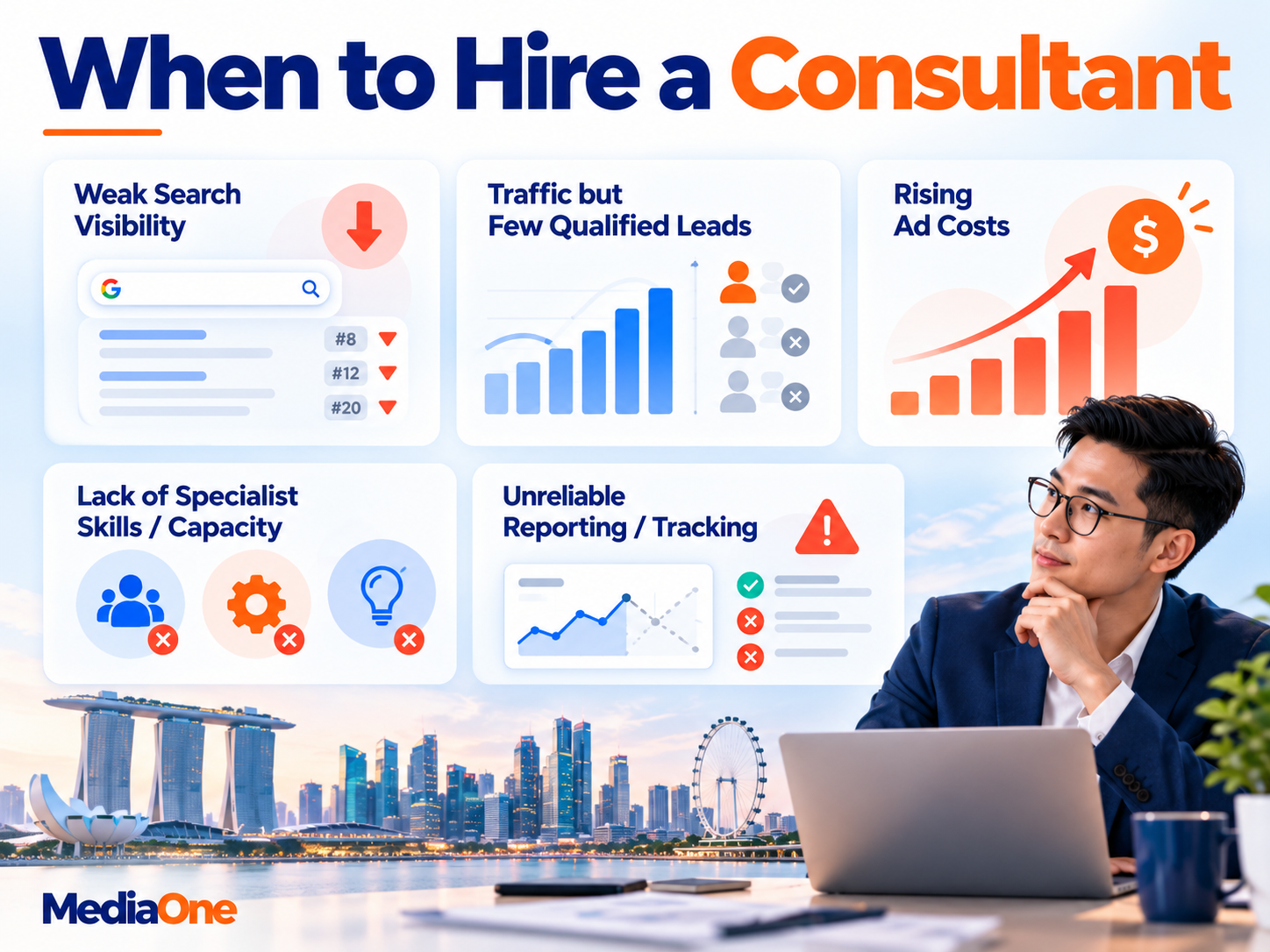
Your search visibility is weak or declining
If important product or service pages attract few relevant visitors, investigate which queries generate impressions and clicks. Compare periods of similar seasonality, identify affected pages and check for technical changes. Searching manually can illustrate the competitive landscape, but personalised results make it an unreliable ranking audit.
Traffic grows but qualified leads do not
Increasing visits without additional enquiries can indicate a mismatch between search intent and the offer. Other possibilities include confusing landing pages, weak calls to action or an enquiry process that fails on mobile. The consultant should test these possibilities rather than immediately recommend a redesign.

Advertising costs increase without a clear return
Rising cost per lead deserves attention when it affects margins or customer acquisition targets. Check changes in competition, targeting, creative performance and lead quality before shifting the budget. A consultant should connect advertising results with sales outcomes wherever reliable data exists. That includes reviewing the definition of a conversion, lead qualification standards and the time customers typically need to purchase.
Your team lacks specialist skills or capacity
A small marketing team may be competent at daily campaigns but unable to audit analytics, plan a complex migration or diagnose a conversion problem. A consultant can provide temporary expertise and train employees without requiring a permanent senior hire. The deliverables should include documentation that remains useful after the engagement ends.
Marketing reports cannot explain business performance
A dashboard showing clicks and impressions is useful, but it cannot by itself establish profitability. If marketing and sales use different definitions of an enquiry, reported lead growth can disguise weak commercial results. Missing or duplicated tracking events can create further confusion.
We would review the measurement setup before making major budget decisions. The purpose is not perfect attribution, which may be impossible, but sufficiently reliable evidence to guide action.
Benefits of Hiring an Outside Digital Marketing Consultant
An outside specialist brings a fresh assessment of assumptions that internal teams may no longer question. They may challenge an unproductive channel, identify friction in an existing customer journey or uncover a measurement issue that makes successful activity look ineffective. Independent scrutiny is most valuable when it changes a business decision.
Consultants also provide focused access to experience that would be costly to maintain full-time. A business preparing to launch a new website may need technical SEO guidance for several weeks, not a permanent migration specialist. We would make knowledge transfer an explicit deliverable so the business is not dependent on the same adviser indefinitely.
Digital Marketing Consultant vs Agency vs In-House Marketer
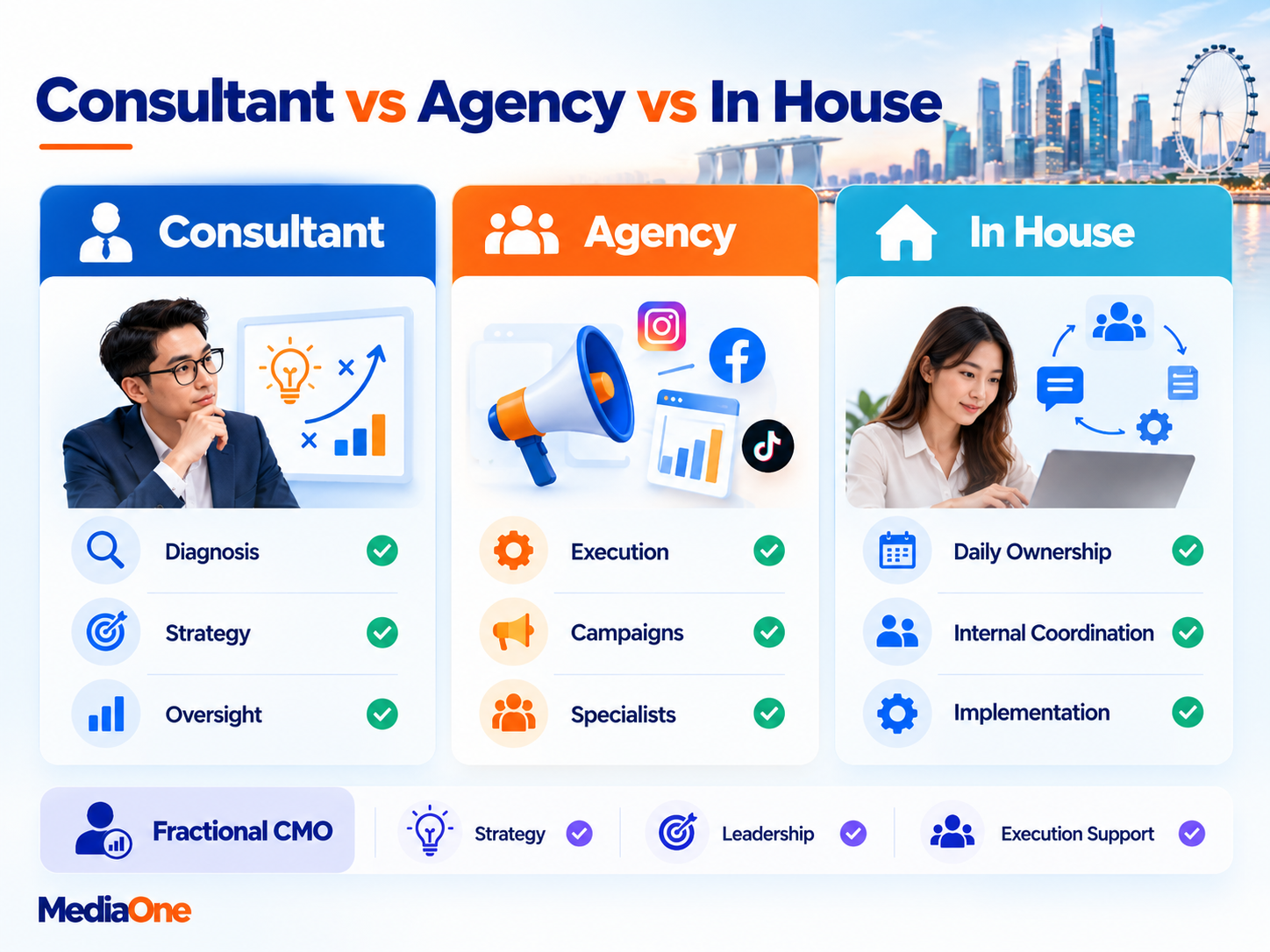
The correct hiring model depends on whether you need advice, execution or permanent ownership. These roles can overlap, so assess what each provider will actually deliver rather than relying on job titles.
| Option | Main responsibility | Typical arrangement | Best suited to |
| Digital marketing consultant | Diagnosis, strategy and expert oversight | Project fee or advisory retainer | A defined problem or major decision |
| Digital marketing agency | Campaign production and channel management | Monthly retainer or project | Regular multi-specialist execution |
| In-house marketer | Daily coordination, implementation and learning | Employee compensation | Continuous workload and internal ownership |
| Fractional chief marketing officer (CMO) | Part-time senior leadership and budget direction | Ongoing leadership retainer | Businesses lacking senior marketing leadership |
We would choose a consultant for an independent audit, an agency for sustained campaign delivery and an employee when day-to-day marketing work justifies a permanent role. Hybrid models are often sensible: an internal marketing lead coordinates specialist external support.
How Much Does a Digital Marketing Consultant Cost in Singapore?
There is no reliable single market fee for every digital marketing consultant in Singapore. Pricing depends on expertise, the amount of research, access to data, implementation responsibilities and contract duration. Ask providers to quote against the same written brief so differences in scope are visible.
Common consultancy pricing arrangements
- Fixed-project fee: Suitable for a defined audit, market-entry assessment, tracking review or strategy roadmap.
- Hourly or daily fee: Appropriate for troubleshooting, workshops and limited specialist advice when work hours are controlled.
- Monthly advisory retainer: Useful when the business needs recurring reviews, senior input and accountability across several initiatives.
- Implementation plus advisory: Suitable when the provider both recommends changes and completes agreed execution tasks.
Compare consultancy fees with the full cost of employment
As of 12 October 2026, Indeed Singapore reported an average base salary of S$42,089 per year for a digital marketing executive, based on 707 reported salaries. This is a market snapshot, not a guaranteed salary or a benchmark for an experienced consultant. Senior strategists and executives have different responsibilities.
A simple cost-versus-value example
Consider a hypothetical Singapore service business spending S$6,000 monthly on advertising and generating 60 enquiries. Its cost per enquiry is S$100, excluding agency fees and other expenses. If six enquiries become paying customers, the lead-to-customer conversion rate is 10%.

A consultant who improves lead qualification or follow-up may create value without increasing enquiry volume. Equally, lower acquisition costs may not help if customers produce insufficient margin. We would evaluate the project against additional gross profit and sustained operational improvements, not merely cheaper clicks.
Our Gap-to-Scope Matrix: Decide What to Outsource
We use a simple decision framework to turn vague marketing concerns into a manageable shortlist. The Gap-to-Scope Matrix below is a proposed planning tool, not an externally validated industry scoring standard. It helps managers decide which issues deserve specialist investigation.
Score each marketing activity from one to three on these criteria:
- Performance gap: 1 means broadly meeting agreed targets; 3 means substantially underperforming.
- In-house capability gap: 1 means your team can solve it confidently; 3 means essential expertise is unavailable.
- Business impact: 1 means limited expected effect; 3 means potentially material effect on revenue, margin or risk.
| Activity in a hypothetical SME | Performance gap | Capability gap | Business impact | Suggested action |
| Website enquiry conversion | 3 | 3 | 3 | Commission a focused diagnosis |
| Routine social posts | 2 | 1 | 1 | Keep in-house and simplify workflow |
| Paid-search lead quality | 2 | 2 | 3 | Review internally, then seek specialist input if needed |
| Analytics event tracking | 3 | 3 | 3 | Prioritise a measurement audit |
These scores are illustrative and are not results from a MediaOne client. To apply the framework, replace them with your own evidence, including conversion records, customer feedback, channel costs and available staff skills.
What Should a Consultant Deliver in the First 90 Days?
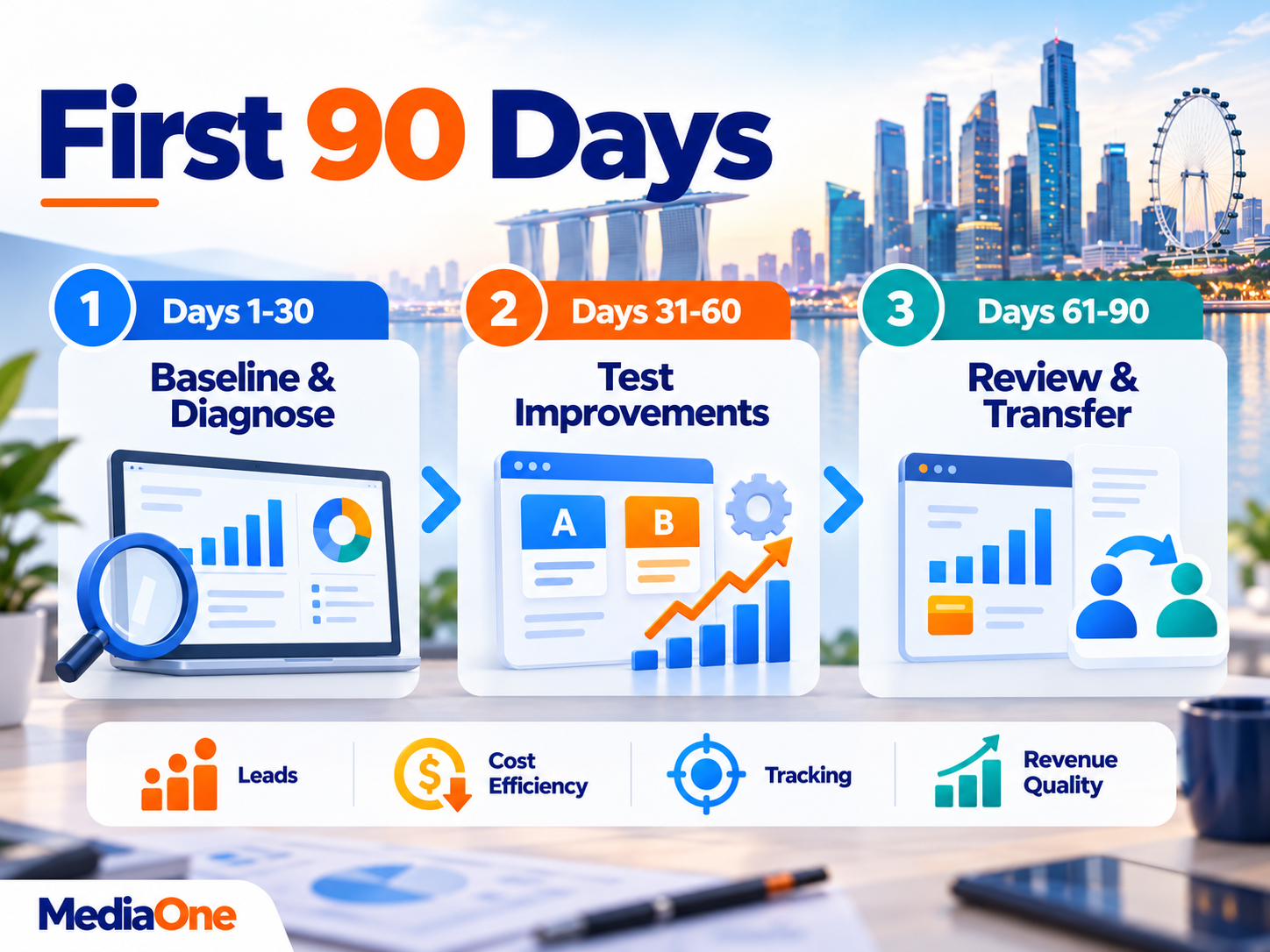
A defined engagement reduces misunderstandings and gives management useful checkpoints. The following sequence is an example for a consulting project, not a guarantee that every recommendation will produce results within 90 days.
Days 1–30: Establish the baseline and diagnose problems
Start with stakeholder interviews, analytics access, channel audits and an assessment of commercial goals. Record existing enquiries, qualified leads, sales outcomes and marketing costs where the information is available. By the end of this stage, request a written problem statement and a ranked list of opportunities. Each recommendation should have supporting evidence and an explanation of what remains uncertain.
Days 31–60: Test the most promising improvements
Select a small number of actions that are feasible within your budget. Examples include clarifying a landing-page offer, repairing broken tracking or improving paid-search qualification. Agree on who implements each change and how the result will be evaluated.
Days 61–90: Review findings and transfer ownership
Compare performance with the initial baseline while accounting for seasonal changes, campaign spend and incomplete attribution. Separate early indicators from realised sales outcomes, especially when customers take months to make a decision.
How to Measure Whether the Consultancy Is Worthwhile
Different businesses need different indicators. A retailer may focus on purchase revenue and gross margin, while a professional-services company values qualified enquiries and completed sales consultations. We recommend selecting a small set of outcomes before the project begins.
| Business objective | Primary measurement | Supporting diagnostic |
| Generate suitable enquiries | Sales-qualified leads | Form completion and lead sources |
| Improve acquisition efficiency | Customer acquisition cost | Cost per lead and lead-to-sale rate |
| Increase ecommerce value | Revenue and gross profit | Checkout completion and average order value |
| Improve organic discovery | Relevant organic enquiries | Search Console clicks and search queries |
| Strengthen customer retention | Repeat purchases or retained revenue | Email engagement and return visits |
Measurement is only useful when definitions are consistent. Google Ads’ conversion measurement guide recommends tracking actions valuable to the business. We would also reconcile online events with CRM or sales records where practicable.
Avoid universal thresholds such as “hire a consultant if conversion falls below 1%”. Conversion rates vary with industry, traffic quality, the action measured and customer intent. Compare your business with its own history, economics and realistically comparable segments before deciding that performance is weak.
Choosing a Digital Marketing Consultant: A Practical Checklist
The strongest proposal demonstrates an understanding of your situation before prescribing tools or channels. Ask shortlisted candidates to explain the problem they believe they can solve, what data they require and which decisions their work will help you make.
Before signing, check the following:

- Relevant experience: Can they explain work involving a comparable customer journey or business model without disclosing confidential client details?
- Named responsibility: Who performs the analysis, attends meetings and approves recommendations?
- Defined deliverables: Will you receive a usable audit, prioritised roadmap, training or documented implementation plan?
- Commercial focus: How will they connect marketing activity with qualified leads, purchases or other business outcomes?
- Transparent fees: Which tasks, revisions, software costs and third-party services are excluded?
- Account ownership: Will your company retain administrator control over its website, analytics, advertising and creative assets?
- Exit arrangements: Can the work and supporting documentation be transferred cleanly when the engagement ends?
We would also ask for a redacted sample report. A persuasive sales presentation is not a substitute for clear analysis, realistic recommendations and an explanation of the assumptions involved.
Warning signs that deserve closer scrutiny
Be cautious of guaranteed first-place Google rankings, fixed revenue promises without a baseline or recommendations that always lead to the consultant’s own paid services. These claims can indicate unrealistic expectations or a conflict of interest. A good adviser should explain risks and circumstances in which their preferred approach may fail.
Singapore-Specific Considerations: Data Protection and Digital Readiness
A consultant may need access to customer records, contact forms, tracking systems and marketing lists. The Personal Data Protection Commission’s guidance explains organisations’ obligations under Singapore’s Personal Data Protection Act (PDPA), including rules concerning purposes, notification, consent and safeguarding personal data. Contracting out marketing work does not automatically remove the organisation’s responsibilities.
We recommend limiting access to what the project requires, documenting authorised uses of data and checking procedures for retaining or deleting records. Businesses planning marketing messages should also review the Do Not Call provisions where applicable. Legal compliance should be assessed against the actual activities and circumstances.
Smaller businesses can explore the Infocomm Media Development Authority’s (IMDA) SMEs Go Digital programme. It offers digital adoption guidance, industry-specific roadmaps and information on pre-approved solutions with potential grant support. Funding depends on eligibility and does not automatically cover independent digital marketing consultancy fees.
Should You Hire a Digital Marketing Consultant? Make the Decision With Evidence
Hire a digital marketing consultant when the commercial problem is clear, your team lacks the skills to solve it and a defined project can produce decisions or improvements worth paying for. If the work mainly involves routine campaign execution, an agency or in-house marketer may be a better fit. If your data is unreliable, begin with measurement before committing to larger budgets.
At MediaOne, we recommend starting with a focused brief: identify the business outcome, establish the available baseline, prioritise the capability gap and agree on the deliverables. Our approach to digital marketing services is to connect the work selected with the result the business needs. A well-scoped decision today makes future marketing investment easier to assess.
Frequently Asked Questions
What is the main role of a digital marketing consultant?
A digital marketing consultant diagnoses marketing problems and develops evidence-based recommendations. Depending on the agreement, they may also oversee campaigns, train staff, or coordinate implementation.
When should a small business hire a digital marketing consultant?
Consider hiring one when an important marketing problem exceeds your team’s expertise and the expected business impact justifies outside advice. Define the problem and review your available data before requesting proposals.
Is a digital marketing consultant better than an agency?
Neither is inherently better. Choose a consultant for focused diagnosis or expert direction, and consider an agency when you need ongoing delivery across several specialist functions.
How much should I budget for a consultant in Singapore?
Request itemised quotes based on the same scope because fees vary substantially with seniority and responsibilities. Include implementation expenses, advertising spend and internal staff time when comparing costs.
Can a digital marketing consultant guarantee more sales?
No consultant can credibly guarantee a particular sales result without controlling all relevant commercial factors. Ask for measurable deliverables, transparent assumptions and a practical method of evaluating improvement.
How quickly can I expect results?
Technical repairs and paid-campaign changes can sometimes produce observable effects relatively quickly, while content, SEO and longer sales cycles need additional time. Agree on evaluation dates that reflect the project and avoid treating early activity as guaranteed revenue.