| AI Summary
Marketing objectives help Singapore businesses translate broad business goals into specific, measurable targets that guide campaigns, budgets, and team priorities. Frameworks such as SMART, OKRs, and the Balanced Scorecard help businesses set clear objectives aligned with their overall strategy. By using historical data, industry benchmarks, and available resources, marketing teams can establish realistic targets and track performance with relevant metrics and analytics tools. Regular reviews and data-driven adjustments help businesses optimise campaigns, allocate resources effectively, and achieve measurable, sustainable growth. |
You can spend S$10,000 on advertising and still struggle to answer two basic questions: Did we acquire customers? Did revenue increase?

Marketing objectives help answer those questions by turning broad business ambitions into specific, measurable targets that guide campaigns, budgets, and team priorities.
For Singapore businesses, this matters because marketing teams often manage several channels with limited time and budget. A statement such as “increase brand awareness” gives a team little guidance. A target such as “increase qualified website enquiries by 20% by 31 March 2027” gives the team a defined outcome and deadline.
What Are Marketing Objectives and Why Do They Matter
Marketing objectives are specific targets that define what marketing should achieve within a stated period.
They sit between broad business priorities and individual marketing activities.
For example:
- Business goal: Grow revenue.
- Marketing objective: Generate 500 qualified sales opportunities by 30 June 2027.
- Campaign activity: Run paid search and email campaigns targeting high-intent prospects.
A marketing objective should answer four basic questions:
- What are we trying to achieve?
- How will we measure it?
- Is the target realistic with our current resources?
- When must we achieve it?
Clear objectives also make reporting easier. Instead of reporting only impressions, clicks or website visits, the team can explain how those metrics contribute to a defined business outcome.

Goals, Objectives and Tactics: Three Levels of Planning
These terms are related but not interchangeable.
| Level | What it is | Example |
| Goal | A broad, strategic outcome the business wants to achieve. | Become a leading provider of financial technology services in Singapore. |
| Objective | A specific, measurable target that contributes to the goal. | Generate 300 qualified enterprise opportunities by 30 September 2027. |
| Tactic | The specific activities used to achieve the objective. | Run account-based advertising and LinkedIn outreach to selected enterprise accounts. |
The important point is that tactics should follow objectives. Choosing a channel first and then trying to justify it with a target can lead to wasted budget.
How to Set Marketing Objectives Using the SMART Framework
The SMART framework is a useful way to test whether an objective is clear.
SMART stands for:
- Specific
- Measurable
- Achievable
- Relevant
- Time-bound
It should be treated as a practical checklist, not a guarantee that an objective is correct.
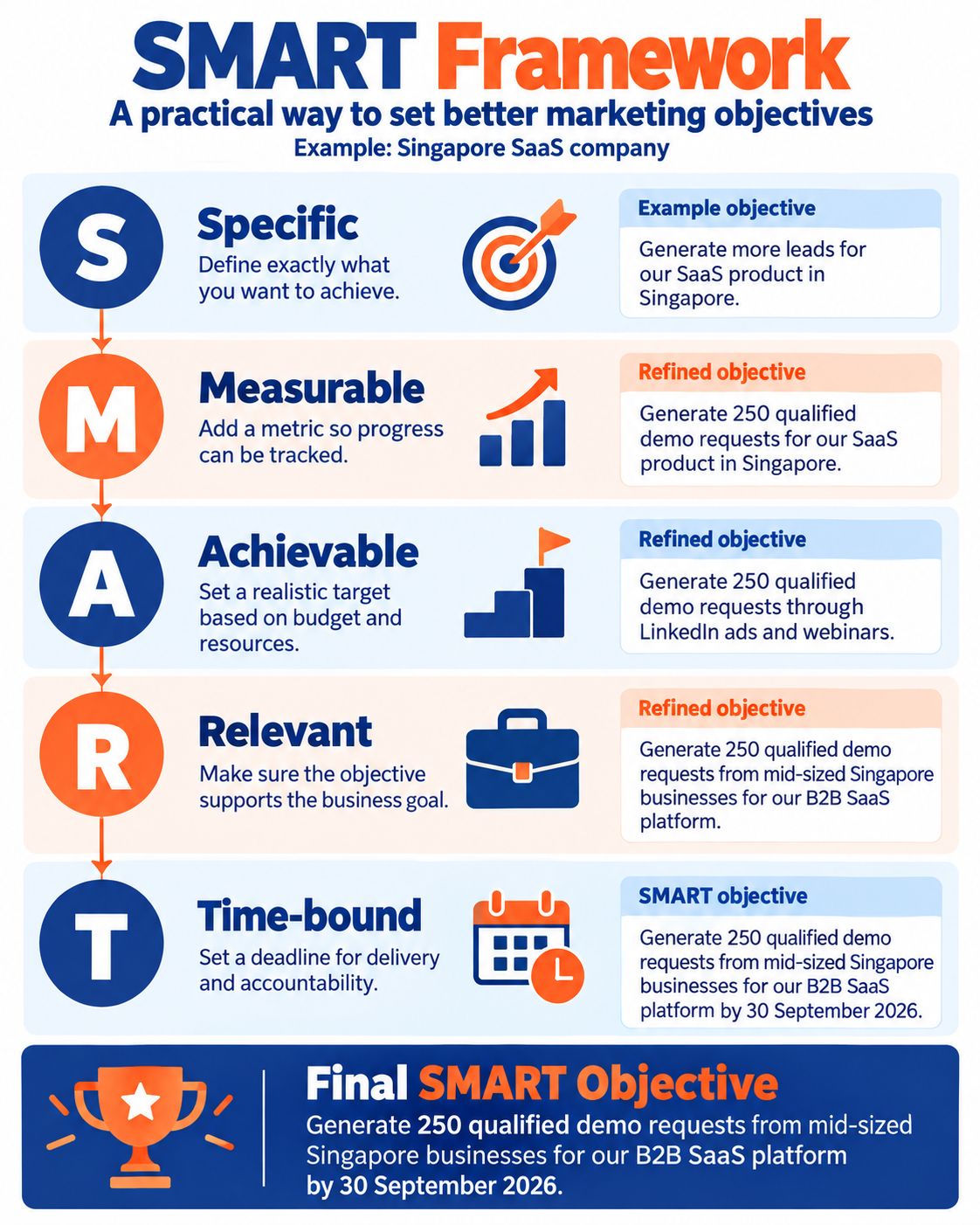
Specific: State exactly what you want to achieve, not a direction.
- Poor: Improve online presence
- Strong: Increase organic search visibility for 15 target keywords in the payments technology category, using relevant guidance from Google’s SEO Starter Guide.
Measurable: Choose a metric you can actually track. If you cannot measure it, you cannot manage it. Use tools such as Google Analytics 4, Shopify dashboards, or HubSpot to establish baselines and monitor meaningful actions, such as completed registrations, lead submissions, and purchases.
Achievable: Base targets on historical data, industry benchmarks and resource constraints. A 400% uplift in three months with a static budget is not achievable. Fifteen per cent might be.
Relevant: Ensure the objective supports your business strategy. A surge in website traffic is irrelevant if those visitors never convert.
Time-bound: Set a fixed end date, such as 31 December 2027 or within Q2 2027.
SMART Objective Examples for Singapore-Based Businesses
The following are illustrative examples, not industry benchmarks or performance guarantees.
- E-commerce: Increase online revenue from S2.1 million to S2.8 million by 31 December 2027 through conversion rate optimisation, targeted advertising, and email marketing.
- SaaS: Increase the number of paying customers by 25% by 30 June 2027 by improving free-trial onboarding, optimising conversion emails, and refining product-led acquisition campaigns.
- Fintech: Generate 3,000 qualified leads by 30 September 2027 through targeted search campaigns, educational content, and relevant lead-generation initiatives, while maintaining the agreed cost-per-lead target.
The important part is not the number itself. It is the connection between the baseline, target, activity, resources and deadline.
Common Types of Marketing Objectives
Different businesses need different objectives. The right choice depends on the stage of the customer journey and the current business priority.
| Objective type | Focus | Possible measures | Example |
| Awareness | Reach the target audience and build brand recognition. | Reach, impressions, branded search activity, brand recall, share of voice | Increase reach among Singapore-based marketing decision-makers by 30 September 2027. |
| Consideration | Encourage potential customers to evaluate the business or its offerings. | Qualified website visits, content downloads, webinar registrations, demo requests, email signups, product-page engagement | Generate 300 qualified webinar registrations from the target HR technology audience by 31 May 2027. |
| Conversion | Turn prospects into customers through measurable actions. | Purchases, subscriptions, account openings, applications, signed contracts | Acquire 150 new enterprise customers by 31 December 2027 while maintaining customer acquisition cost (CAC) within the approved target. |
| Retention and loyalty | Keep existing customers and strengthen ongoing relationships. | Repeat-purchase rate, customer retention rate, churn, net revenue retention (NRR), customer lifetime value (CLV) | Reduce monthly customer churn to the approved target by 30 September 2027. |
| Advocacy | Encourage customers to recommend the business to others. | Referral rate, referral-generated customers, customer reviews, review ratings, customer advocacy participation | Generate 200 qualified customer referrals by 31 December 2027. |
How to Align Marketing Objectives with Business Strategy

Marketing does not exist in isolation. Your objectives must ladder up to company goals or they risk consuming budget without moving the needle on what truly matters. Start with your business strategy. If your company is prioritising international expansion, a 10% boost to domestic market share is misaligned. If your focus is profitability, a low-margin customer acquisition objective wastes resources.
Marketing objectives should support business priorities.
If the company is focused on profitability, for example, increasing traffic alone may not be enough. If the company is entering a new market, market awareness and qualified demand may be more important.
The Alignment Chain
Effective alignment follows this chain:
- Business priority: Increase recurring revenue.
- Marketing objective: Generate qualified enterprise opportunities.
- Campaign objective: Generate qualified opportunities from selected target accounts.
- Tactics: Use paid search, LinkedIn advertising, content and sales outreach.
The numbers in the following example are illustrative:
Business objective: Achieve S$50 million in annual recurring revenue by the end of 2027.
Marketing objective: Support the acquisition of 200 net-new enterprise customers.
Campaign objective: Generate qualified opportunities from priority APAC accounts.
Tactics: Account-based advertising, LinkedIn outreach and executive content.
The exact targets should come from the organisation’s actual commercial plan.
Conducting a Stakeholder Alignment Workshop
Before finalising objectives, involve the teams that influence or depend on the result.
Useful participants include:
- marketing
- sales
- finance
- product
- operations
- leadership
Ask:
- Does this objective support the business priority?
- Do we have the resources to pursue it?
- Can sales handle the expected demand?
- Are there product or operational dependencies?
- What trade-offs are we accepting?
- How will success be measured?
Document the decisions so the team knows which objective takes priority when resources become constrained.
Setting Realistic Targets Based on Data
Your objectives must be grounded in reality: historical performance, industry benchmarks, competitive landscape and available resources.
Mining Your Own Data
Start with what you have already done.
Historical conversion funnels: If your email-to-signup rate has been 2% for the past six quarters, a jump to 6% in the next quarter signals either a major change in targeting or channel, or an unrealistic target.
Cost-per-acquisition trends: Plot what you have paid to acquire a customer over time. If CAC is trending up, a target that assumes it will trend down needs explanation.
Seasonal patterns: Many Singapore-based retailers see peaks around Chinese New Year and year-end shopping. Plan objectives with seasonality in mind.
Use Google Analytics 4, your CRM, your ad-platform dashboards and financial records to build a clear baseline.
For businesses focused on sustainable organic traffic growth, SEO services can be relevant when planning search visibility and qualified website traffic objectives.
Benchmarking Against Industry Standards
Singapore-specific benchmarks are limited, but regional and global data give you a starting point. Benchmarks vary widely. Use these as reference points only.
- Email marketing: HubSpot’s industry benchmarks report an average email open rate of 42.35% and a click-through rate of 2.3% across industries, based on 2025 data. These figures vary by industry, and open rates may be inflated by email privacy features.
- Paid search: Google Ads benchmarks report an overall average click-through rate (CTR) of 6.64%, with industry-level rates varying considerably. Actual performance depends on the industry, keywords, and campaign strategy.
- Social media advertising: Facebook Ads benchmarks report an average click-through rate of 1.93% for traffic campaigns. CTR and conversion rates vary by campaign objective and industry.
- SaaS free-to-paid: ChartMogul’s 2026 conversion report indicates that a 3–5% free-to-paid conversion rate is a good benchmark for freemium SaaS products with regular signup. Rates vary by business model, product, and customer segment.
Use these as sanity checks. If your objective is a 50% conversion rate on paid search when the sector average is 2%, dig deeper. Are you targeting an unusually warm audience? Have you optimised landing pages? Or is the target simply too high?
Factoring in Resource Constraints
Objectives must fit the resources available. For example, imagine a team with:
- two marketing staff
- a quarterly budget of S$50,000
- several possible marketing channels
Trying to acquire customers through five channels at once may spread the team too thin. A more focused plan could prioritise one or two channels and measure their contribution before expanding.
| Objective | Primary channels | Team hours/week | Budget | Feasibility |
| 500 signups | Email and paid search | 25 | S$30,000 | Higher |
| 500 signups | Email, paid search, organic and events | 25 | S$30,000 | Lower |
Singapore SMEs reviewing their digital capabilities can also explore IMDA’s SMEs Go Digital programme for resources on adopting digital solutions and improving business productivity. Check the programme’s current eligibility criteria and available support before making funding assumptions.
Marketing Objectives for Different Business Models
The type of business you run shapes which objectives matter most. A SaaS company cannot copy an e-commerce retailer’s playbook.
Objectives for E-Commerce Retailers
Common priorities include:
- revenue
- conversion rate
- average order value (AOV)
- repeat purchases
- customer retention
Illustrative example:
Increase online revenue from S2.1million to S2.8 million by 31 December 2027, subject to the approved budget and commercial plan.
Supporting objectives might include increasing AOV or repeat-purchase rate. Do not assume a fixed percentage of budget should go to conversion, retention or awareness without evidence from your own business.
Objectives for SaaS Companies
SaaS businesses may focus on:
- qualified leads
- sales-qualified leads (SQLs)
- trial starts
- trial-to-paid conversion
- customer acquisition cost
- expansion revenue
- net revenue retention (NRR)
Illustrative example:
Generate 1,200 sales-qualified leads by 31 December 2027 while maintaining the approved acquisition-cost target.
The supporting objectives should reflect the company’s actual funnel and sales capacity.
Objectives for B2B Services
Consultancies, agencies and recruitment businesses may focus on:
- qualified pipeline
- proposal-to-close rate
- revenue
- referrals
- partnerships
- sales cycle length
Illustrative example:
Build S$5 million in qualified sales pipeline by 31 December 2027, based on the organisation’s agreed pipeline methodology.
Objectives for Consumer Packaged Goods (CPG)
CPG businesses may focus on:
- distribution
- trial
- repeat purchase
- retail visibility
- promotional performance
Illustrative example:
Increase distribution across an agreed number of Singapore retail outlets by 30 June 2027.
The objective should be based on the actual distribution strategy and commercial capacity.
The Role of Marketing Objectives in Campaign Planning
Once company-level marketing objectives have been approved, translate them into campaign-level targets. Each campaign should have a clear purpose, a defined timeframe, and measurable outcomes that contribute to the broader marketing objective.
Campaigns are typically time-bound initiatives lasting several weeks or months, depending on the marketing channel, sales cycle, and business model.
Cascading Objectives Into Campaigns
Consider this annual marketing objective:
Annual marketing objective: Acquire 500 new customers by 31 December 2027, while keeping customer acquisition cost (CAC) below S$250.
This objective can be broken down into smaller targets across campaigns and quarters. Each campaign should address a specific stage of the customer journey, such as awareness, consideration, conversion, or retention.
| Quarter | Campaign priority | New customers targeted | Cumulative total |
| Q1 2027 | Build awareness, attract relevant audiences, and generate leads | 75 | 75 |
| Q2 2027 | Qualify leads, nurture prospects, and improve consideration | 100 | 175 |
| Q3 2027 | Increase conversions through targeted campaigns and retargeting | 150 | 325 |
| Q4 2027 | Convert high-intent prospects and close the remaining acquisition gap | 175 | 500 |
| Total | 500 | 500 |
For businesses targeting high-intent searchers, search engine marketing services can support paid search campaigns designed around qualified enquiries, conversions, and acquisition costs.
These campaigns should work together towards the annual objective. Their individual targets should be based on historical performance, conversion rates, available budget, and realistic forecasts rather than arbitrary numbers.
For example, if the business acquires 500 new customers by the end of Q3, the team needs to acquire another 200 in Q4 to reach the annual target. The required campaign volume should then be calculated using expected conversion rates and the remaining budget.
Retention campaigns may support the broader marketing strategy by encouraging repeat purchases and reducing churn. However, retention outcomes should be tracked separately from new customer acquisitions unless the business has explicitly defined a broader customer growth objective.

Setting Success Metrics Per Campaign
Every campaign needs one primary outcome metric and two or three supporting metrics. The primary metric measures the campaign’s main intended result, while supporting metrics help explain performance and identify opportunities for improvement.
Each campaign should also have:
- A specific target and measurement period.
- A clearly assigned owner.
- A defined budget or cost constraint.
- A baseline for comparison, where available.
- A reporting method and data source.
For example, a product-launch campaign for a fintech app might use the following metrics:
| Metric | Type | Target | Owner |
| Completed app registrations | Primary outcome | 5,000 | Growth marketing |
| Cost per completed registration | Cost guardrail | S$5 maximum | Paid acquisition |
| Day-1 retention rate | Supporting metric | 40% | Product analytics |
| In-app signup completion rate | Supporting metric | 65% | Product |
The exact targets should be validated against historical performance, the available budget, and business requirements.
Campaign metrics should reflect meaningful outcomes rather than activity alone. A campaign may generate thousands of clicks or app installs but still fail to deliver qualified leads, completed registrations, or paying customers.
The following table illustrates how metrics can differ by campaign type:
| Campaign | Primary outcome | Supporting metrics |
| Webinar nurture | Qualified leads generated | Email clicks, attendance rate, landing-page conversion |
| Paid search | Qualified enquiries | Click-through rate (CTR), conversion rate, cost per enquiry |
| Retention email | Repeat purchases | Email clicks, repeat-purchase rate, revenue per recipient |
Use supporting metrics to understand why a campaign is succeeding or underperforming. For example, high traffic with low conversion may indicate a problem with audience targeting, landing-page relevance, or the offer itself.
For campaigns involving marketing calls or text messages to Singapore telephone numbers, review the applicable Do Not Call Registry requirements before launching. Requirements depend on the type of communication and applicable exemptions.
How to Measure and Improve Marketing Objectives
Setting objectives is only the beginning. Marketing teams need a consistent process for monitoring results, identifying performance gaps, and making evidence-based adjustments.
Establishing a Reporting Cadence
Define how often campaign performance and broader marketing objectives will be reviewed. The appropriate cadence depends on campaign duration, sales cycles, budget, and the speed at which results become available.
| Review frequency | Purpose |
| Weekly | Review campaign activity, spend, traffic, and conversions. Identify problems that require immediate attention. |
| Monthly | Compare actual results against targets, analyse trends, and assess progress towards marketing objectives. |
| Quarterly | Review business outcomes, update forecasts, and consider reallocating resources or revising campaign plans. |
Weekly reviews should focus on tactical performance, such as changes in conversion rates, rising costs, or campaigns that are not generating expected results. Monthly reviews should assess whether performance is sufficient to achieve the wider objective. Quarterly reviews should examine longer-term trends and determine whether the overall strategy remains appropriate.
For example, a paid search campaign with rising acquisition costs may require immediate investigation, while a gradual decline in customer retention may require a broader strategic review.
Use a consistent source of truth for reporting. Marketing, sales, finance, and product teams should work from aligned definitions and reliable data sources. Otherwise, differences in how leads, conversions, and acquisition costs are calculated can undermine decision-making.
Identifying and Acting on Performance Gaps
When actual performance falls behind the target, investigate the underlying cause before changing the plan.
For example, if the team has achieved 60% of its quarterly target with only 50% of the quarter remaining, it needs to assess whether the remaining target is achievable at the current rate.
Consider the following questions:
- Baseline: Were the original assumptions and historical benchmarks accurate?
- Market conditions: Have customer behaviour, competition, or demand changed?
- Channel performance: Are advertising costs rising or conversion rates falling?
- Audience and creative: Is the campaign reaching the right people with a relevant message?
- Resources: Does the team need additional budget, capacity, or specialist support?
Use a structured process to respond to these gaps.
- Diagnose the root cause. Identify whether the problem relates to the channel, audience, creative, offer, conversion process, or external conditions.
- Develop a hypothesis. Form a testable explanation for the underperformance rather than making assumptions.
- Run a controlled test. Test a change on a manageable portion of the campaign before committing additional resources.
- Evaluate the results. Compare the test results against the baseline and the original success criteria.
- Adjust the campaign and forecast. Apply effective changes, reallocate resources where justified, and update expected outcomes if the evidence indicates that the original forecast is no longer realistic.
If the data points to landing-page usability or website conversion issues, reviewing website design services may be one option to consider alongside testing changes to the audience, offer, and campaign creative.
For example, suppose an email campaign has a click-through rate of 1.5%, below the target of 2.5%. The team hypothesises that the subject line and message positioning are not compelling enough. It tests alternative subject lines on a portion of the audience and finds that the best-performing version achieves a 2.3% click-through rate.
The team can then roll out the stronger version, monitor the results, and revise the expected performance based on the evidence. The original 2.5% target should not automatically be abandoned simply because the first test falls short.
The objective is to improve performance while maintaining realistic expectations. Do not ignore gaps and hope they disappear, but do not reset targets prematurely when a campaign still has a credible path to recovery.
Reforecasting and Mid-Year Resets
Marketing objectives are based on assumptions about budgets, market conditions, customer demand, and business priorities. These assumptions can change during the year.

An objective set in January 2027 may need to be reviewed by June or July if circumstances change because of:
- A competitor launching a similar product.
- A product launch or delivery delay.
- A significant budget reduction or increase.
- A change in company strategy or leadership.
- New regulatory requirements.
- A major shift in customer demand or market conditions.
Schedule a formal mid-year review to assess year-to-date performance, revisit assumptions, and determine whether the remaining targets are still achievable. Additional reviews may be necessary following major business changes.
For example, if a product launch is delayed by two months, the original customer acquisition forecast may no longer be realistic. The team should estimate the effect of the delay on lead generation, conversion opportunities, and sales timing before deciding whether to adjust the campaign plan or annual objective.
Document every material revision, including the reason for the change, the evidence supporting it, the impact on expected results, and the approval received. This creates accountability and makes it easier to distinguish evidence-based planning adjustments from attempts to lower targets simply because performance is weak.
Common Marketing Objective-Setting Mistakes and How to Avoid Them
Even well-planned marketing strategies can fall short when objectives are unclear, unrealistic, or disconnected from business priorities. Avoiding these common mistakes helps businesses set targets that are measurable, achievable, and useful for decision-making.
| Common mistake | Why it matters | How to avoid it |
| Setting vague objectives | Goals such as “increase brand awareness” provide no clear measure of success. | Define specific outcomes, such as increasing branded search traffic by 20% within six months. |
| Focusing on vanity metrics | High impressions, page views, or follower counts may not translate into business results. | Connect marketing metrics to meaningful outcomes, such as qualified leads, conversion rates, customer acquisition cost, and revenue. |
| Setting unrealistic targets | Targets that exceed available budgets, resources, or market opportunities can demotivate teams and undermine planning. | Use historical performance, industry benchmarks, budget constraints, and team capacity to establish realistic targets. |
| Working without a baseline | Without current performance data, teams cannot reliably measure progress or determine whether an objective is achievable. | Record baseline metrics before launching a campaign and use them to set improvement targets. |
| Misaligning marketing and business goals | Marketing activity may generate engagement without supporting wider priorities such as revenue growth or customer retention. | Agree on objectives with key stakeholders and link each marketing target to a clear business outcome. |
| Failing to assign ownership | Objectives can be overlooked when no one is accountable for delivering or monitoring them. | Assign an owner, define responsibilities, and establish regular reporting and review schedules. |
| Setting targets and never reviewing them | Changing market conditions, campaign performance, and customer behaviour can make original assumptions outdated. | Review progress regularly and adjust tactics, budgets, or timelines when the evidence supports a change. |
The key is to treat marketing objectives as working targets rather than fixed statements. Clear measures, realistic expectations, assigned ownership, and regular reviews help teams stay accountable while adapting to changing business conditions.
Tools and Frameworks for Objective Setting
Frameworks help organisations define, structure, and align their objectives. Tools help teams execute campaigns, measure performance, and report results.
They serve different purposes but work best together. A framework provides the structure for deciding what success looks like, while the right tools help teams track whether they are achieving it. Neither replaces sound judgement, clear ownership, or alignment with business strategy.
-
SMART Framework
The SMART framework helps teams write clear, actionable objectives. SMART stands for Specific, Measurable, Achievable, Relevant, and Time-bound.
Best for: Writing individual objectives that are clear, realistic, and easy to evaluate.
Strengths:
- Makes objectives easier to understand and communicate.
- Establishes measurable criteria for success.
- Creates a clear timeframe for evaluating progress.
Limitations: SMART helps structure individual objectives, but it does not automatically ensure that they align with wider business priorities, available resources, or other teams’ goals.
For example, instead of setting a vague objective such as “Improve customer acquisition,” a SMART objective would be:
Acquire 500 new customers by 31 December 2027 through a coordinated marketing strategy that combines awareness campaigns, lead generation, lead nurturing, and conversion-focused activities.
This version defines the desired outcome, provides a measurable target, and establishes a deadline and cost constraint.
-
OKRs (Objectives and Key Results)
Objectives and Key Results (OKRs) combine a qualitative objective describing what an organisation wants to achieve with measurable key results that define how success will be evaluated.
Best for: Organisations that need to align teams around shared priorities while tracking measurable outcomes.
For example:
Objective: Become a trusted financial partner for gig-economy workers in Southeast Asia.
Key results:
- Acquire 5,000 active users by 31 December 2027.
- Achieve a customer satisfaction score of at least 85%.
- Maintain monthly active-user retention above 60%.
The objective describes the intended direction, while the key results establish measurable evidence of progress.
Strengths:
- Connects company-wide priorities with team-level objectives.
- Encourages focus on outcomes rather than activities.
- Makes progress and accountability easier to communicate.
- Can encourage ambitious goals when targets are appropriately designed.
Limitations:
- Requires clear ownership, regular reviews, and organisational discipline.
- Poorly designed OKRs can encourage teams to prioritise metrics over meaningful outcomes.
- If targets are tied too rigidly to performance evaluations or rewards, teams may set artificially easy targets or manipulate results.
To implement OKRs, start with a small number of company-wide priorities, then develop supporting objectives for marketing and other teams. Each team should understand how its key results contribute to the broader business goals.
For example, if the company wants to increase customer acquisition, marketing might focus on qualified demand and conversion, while sales focuses on lead conversion and closing new customers. The teams should share compatible definitions and targets so their efforts work together.
-
Balanced Scorecard
The Balanced Scorecard helps organisations evaluate performance across four dimensions rather than focusing exclusively on financial results.
- Financial: Revenue growth, profitability, marketing expenditure, and customer acquisition cost.
- Customer: Customer satisfaction, acquisition, retention, and loyalty.
- Internal processes: Campaign efficiency, conversion processes, delivery time, and operational quality.
- Learning and growth: Employee skills, technology adoption, innovation, and market insight.
Best for: Larger or more mature organisations that need a broader view of strategic performance across multiple teams and business functions.
Strengths:
- Balances short-term financial results with customer and operational outcomes.
- Helps identify trade-offs between different business priorities.
- Connects strategic goals with measurable performance indicators.
Limitations: A Balanced Scorecard can require more data, coordination, and management effort than simpler frameworks. It can also become unnecessarily complex if too many objectives and indicators are included.
For example, a marketing team might increase short-term revenue by aggressively promoting discounts. However, if those promotions reduce profitability or customer loyalty, the financial results alone may give a misleading picture of performance.
A Balanced Scorecard makes these trade-offs more visible by considering financial results alongside customer outcomes, internal processes, and longer-term organisational capabilities.
4. Marketing-Specific Planning and Measurement Tools
Once objectives and key results have been established, marketing teams need tools to manage campaigns, measure performance, and communicate results.
The following are examples of commonly used tools, not endorsements or recommendations.
| Tool | Best for | Cost |
| HubSpot | CRM, marketing automation, email campaigns, and reporting | Free and paid options; pricing varies by plan |
| Google Analytics 4 | Website and app behaviour, user journeys, and conversion measurement | Core product available without a licence fee |
| Mixpanel | Event-based product analytics and user behaviour | Free and paid plans available |
| Amplitude | Product analytics, behavioural analysis, and user journeys | Free and paid plans available |
| Tableau | Business intelligence, data visualisation, and dashboards | Paid plans; pricing varies |
| Looker | Business intelligence, reporting, and analysis across data sources | Pricing varies by product and deployment |
Objective-Setting Framework Comparison
Different objective-setting frameworks serve different organisational needs, from defining clear individual targets to aligning teams with broader strategic priorities. The table below compares four common frameworks, highlighting their ideal applications, measurement approaches, key strengths, and limitations to help you choose the most suitable approach for your organisation.
| Framework | Best for | Measurement style | Key strength | Key limitation |
| SMART | Individual or team objectives | Specific measurable target with deadline | Simple and clear | Can become rigid if used without review |
| OKR | Cross-team alignment | Objective plus measurable key results | Connects teams to strategic priorities | Requires organisational discipline |
| Balanced Scorecard | Strategic management | Multiple business dimensions | Provides a broader view | More complex to maintain |
| Performance Pyramid | Organisations with structured operations | Objectives cascade through levels | Connects strategy and execution | Can become bureaucratic |
Turning Marketing Objectives into Measurable Business Growth
Setting marketing objectives is only the first step. The real challenge is turning them into a strategy that delivers measurable results. Businesses need clear priorities, the right marketing channels, effective campaigns, and reliable performance data to make every marketing dollar count.
Effective marketing objectives align with business goals, reflect available resources, and rely on data rather than assumptions. Frameworks such as SMART and OKRs provide a strong foundation, while consistent performance tracking helps identify gaps, refine campaigns, and support smarter investment decisions.
At MediaOne, we help businesses develop data-driven digital marketing strategies that connect marketing objectives with measurable outcomes. Explore MediaOne’s digital marketing services to discover how we can help you make informed marketing decisions and achieve sustainable business growth.
Frequently Asked Questions
What is the difference between a marketing objective and a business objective?
A business objective defines a broader company goal, such as increasing annual revenue by 25%. A marketing objective specifies the measurable marketing outcome that supports that goal, such as acquiring 500 new customers by year-end while maintaining a customer acquisition cost (CAC) below S$250. Marketing objectives translate business priorities into actionable targets for campaigns, budgets, and teams.
How do I set effective marketing objectives?
Start by identifying your business priorities and determining how marketing can contribute to them. Use the SMART framework to make objectives Specific, Measurable, Achievable, Relevant, and Time-bound. Base your targets on historical performance, market benchmarks, available resources, and budget constraints. Assign clear ownership and establish a process for monitoring progress.
How often should marketing objectives be reviewed?
Review campaign performance weekly to identify immediate issues, assess progress against objectives monthly, and conduct broader strategic reviews quarterly. Revisit your objectives sooner if significant changes occur, such as a product delay, budget reduction, competitive shift, or change in business strategy. Regular reviews help teams respond to problems before they significantly affect results.
What should I do if my marketing team misses its objectives?
Investigate the underlying cause before deciding on corrective action. Examine factors such as audience targeting, channel performance, conversion rates, budget, and changing market conditions. Test potential improvements, reallocate resources where justified, and update forecasts when the evidence indicates that the original assumptions are no longer realistic. Missing a target can provide valuable lessons if the team responds transparently and takes corrective action.
How do I balance ambitious marketing objectives with realistic expectations?
Use historical performance, industry benchmarks, market conditions, and available resources to establish a credible baseline. Set targets that challenge the team without depending on unsupported assumptions. Consider the budget required, expected conversion rates, team capacity, and potential market changes. Review progress regularly and adjust tactics or forecasts when new evidence warrants it, while maintaining accountability for the intended business outcomes.