

SMART objectives are the difference between an SEO campaign that drifts and one that consistently drives measurable traffic. Many businesses set vague goals such as “more organic traffic” or “better rankings,” but without clearly defined SMART objectives, these ambitions are difficult to execute. Structured SMART objectives turn broad SEO goals into actionable targets that guide keyword research, content planning, technical optimisation, and reporting.

In a competitive search landscape, traffic growth does not happen by chance. Achieving sustainable results requires alignment between strategy, execution, and measurement. When SMART objectives are properly defined, they provide a roadmap that connects daily SEO tasks to long-term business growth.
For businesses seeking expert guidance, partnering with a professional SEO agency in Singapore can simplify the process. An experienced agency can translate business targets into SEO-focused SMART objectives and develop a campaign designed to deliver consistent, high-quality traffic while supporting broader marketing goals.
Key Takeaways:
- SMART objectives provide structure and clarity, turning vague SEO goals into measurable traffic and conversion targets.
- Effective SMART objectives define traffic source, page type, audience segment, and timeframe.
- Data such as baseline traffic, keyword difficulty, and conversion performance ensure SMART objectives remain realistic and achievable.
- Tracking and reporting must mirror SMART objectives to support continuous optimisation and sustainable growth.
What Are SMART Objectives in SEO?
SMART objectives are structured goals built around five criteria:
- Specific
- Measurable
- Achievable
- Relevant
- Time-bound
In SEO, SMART objectives define exactly what traffic growth looks like, how it will be measured, and when it should be achieved.
The Difference Between Having SEO Goals and SMART Objectives
Many businesses believe they have a strategy simply because they have SEO goals. In reality, most SEO goals are directional rather than specific. They express intent, but they do not define execution. SMART objectives, on the other hand, turn intent into a structured plan with measurable accountability.
Understanding this distinction changes how campaigns are built, prioritised, and evaluated.
An SEO goal might be: “Increase website traffic.”
But a SMART objective would be something like: “Increase non-branded organic traffic to blog content by 30 percent within six months by publishing two optimised articles per week targeting mid-funnel keyword clusters.”
The second example is actionable. It defines the traffic source, scope, timeline, and strategy. That clarity enables better execution and accountability.
Why SMART Objectives Drive More Organic Traffic
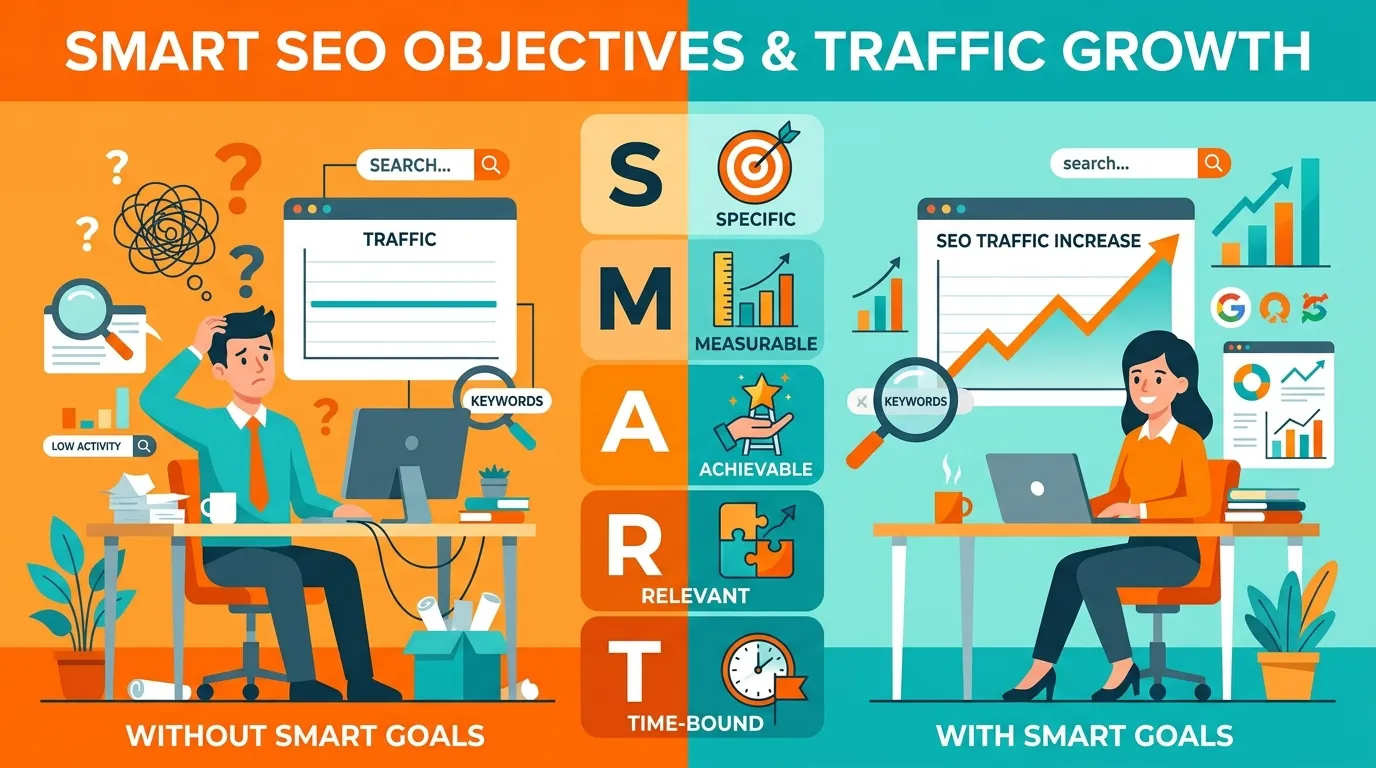
SMART objectives improve SEO performance by reducing ambiguity and increasing focus.
- They Clarify Keyword Priorities: Instead of targeting hundreds of random keywords, SMART objectives narrow efforts to clusters aligned with traffic growth targets.
- They Improve Content Planning: Content production becomes strategic rather than reactive. Each article supports a measurable outcome tied to organic growth.
- They Strengthen Technical SEO Focus: If a SMART objective includes improving click-through rate or page speed for high-traffic pages, technical work becomes prioritised around impact.
- They Improve Reporting and Accountability: SMART objectives create clear benchmarks. Progress is measured against defined numbers rather than subjective impressions.
How to Write Specific SMART Objectives for SEO Campaigns

Writing SMART SEO objectives is not a box-ticking exercise. It is a strategic process that blends performance data, keyword intelligence, business priorities, and operational reality.
When done properly, SMART objectives become the backbone of your SEO roadmap. They guide content production, technical improvements, internal linking, reporting cadence, and stakeholder expectations.
Below is a structured, expert-level approach to building SMART objectives that drive meaningful organic growth rather than vanity metrics:
Step 1: Make SMART Objectives Specific for SEO
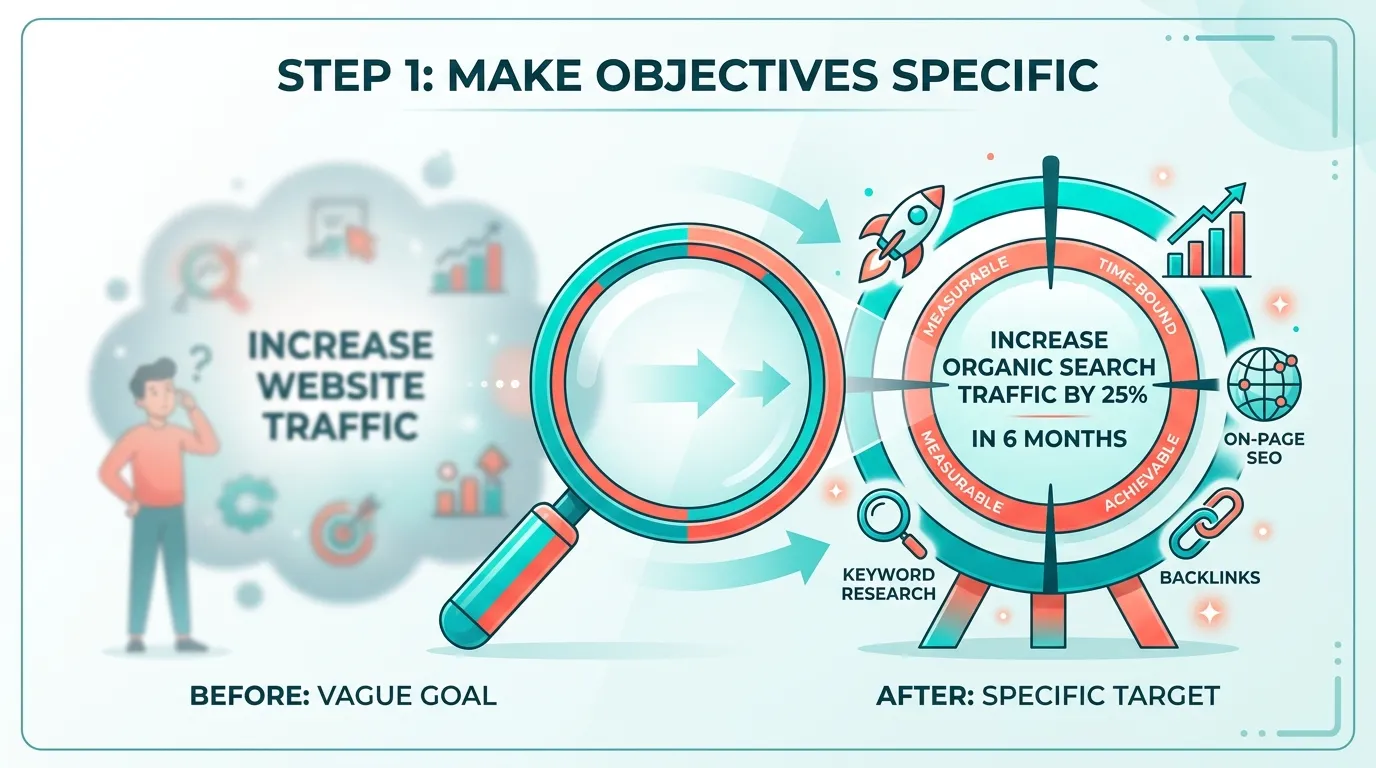
Specificity removes ambiguity. In SEO, ambiguity is expensive because it leads to scattered effort and diluted impact.
When defining SMART objectives, clarify four essential dimensions:
Traffic Source
Not all traffic behaves the same. Define whether your objective focuses on:
- Total organic traffic
- Non-branded organic traffic
- Branded organic traffic
- Local organic traffic
- International search visibility
Non-branded traffic often reflects new customer acquisition, while branded traffic may indicate brand awareness. Mixing them can distort performance insights.
Page Type
SEO impact varies by page category. Specify which pages you are targeting:
- Blog articles
- Service or solution pages
- Category pages
- Product pages
- Landing pages
- Location pages
A blog-focused objective will require content expansion and topic clusters. A service-page objective may require on-page optimisation and improvements to internal linking.
Audience Segment
Define who the traffic is for:
- B2B decision-makers
- Local customers
- eCommerce buyers
- Enterprise prospects
- Early-stage researchers
Different segments search differently. An SEO objective targeting procurement managers will look very different from one targeting consumers comparing products.
Geographic Focus
Clarify location targeting:
- Global
- National
- Regional
- City-level
Local search behaviour and search intent differ significantly from global search patterns. A city-focused objective may require local landing pages, structured data, and local link building.
Example: Weak vs Specific
Weak objective: “Improve search rankings.”
Specific SMART objective: “Increase non-branded organic sessions to service pages targeting ‘enterprise SEO solutions’ keywords by 30 percent within six months.”
The second example defines traffic type, page type, keyword focus, and timeline. There is no room for interpretation. The team knows what to execute.
Step 2: Make SMART Objectives Measurable Using SEO Metrics
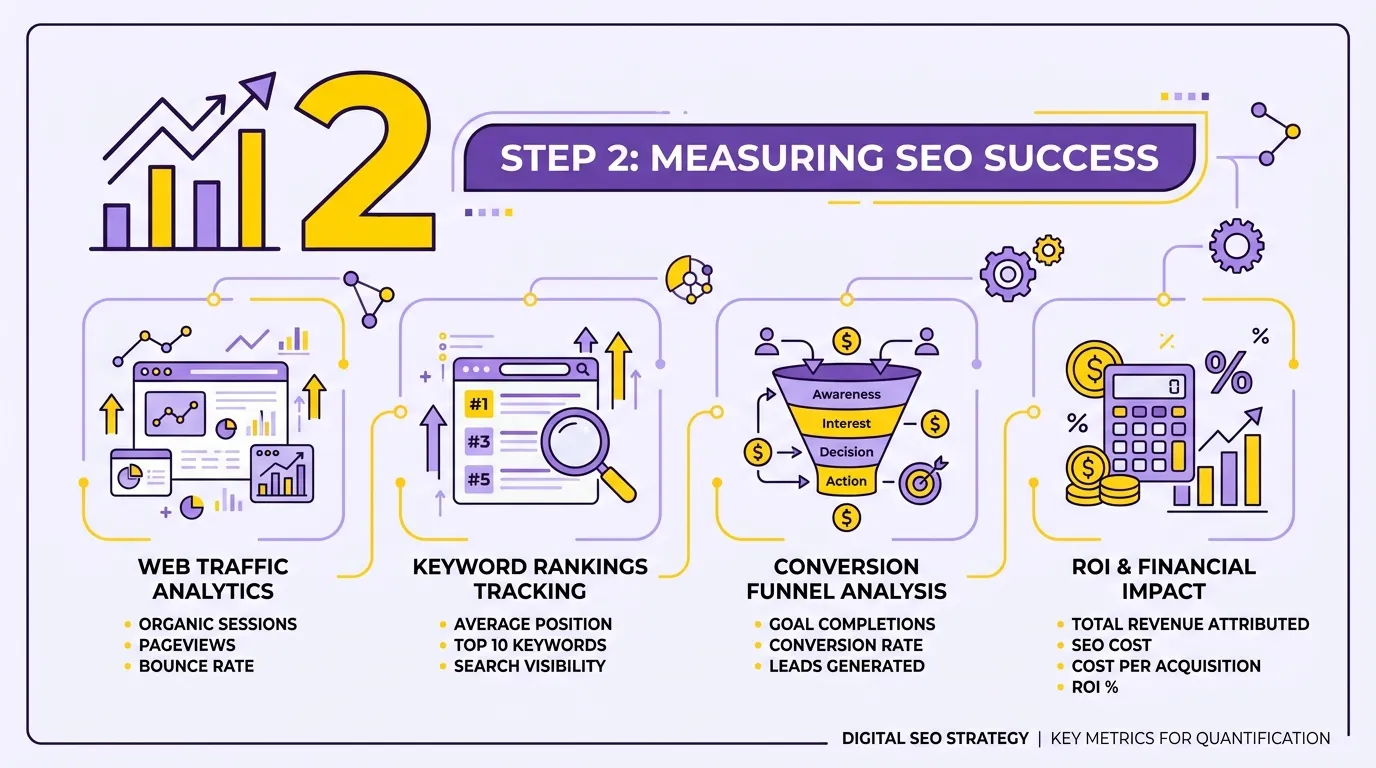
If performance cannot be quantified, it cannot be managed. Measurability is where many SEO campaigns fail, as objectives are expressed in abstract language rather than in data-driven targets.
Core Metrics to Use in SMART Objectives
Select metrics aligned with your campaign type:

- Organic sessions
- Impressions
- Click-through rate
- Keyword rankings for defined clusters
- Conversions from organic traffic
- Revenue from organic search
- Assisted conversions
- Organic share of total traffic
Be careful not to rely solely on rankings. Rankings are leading indicators, not business outcomes.
Tools for Measurement
Accurate measurement requires reliable tracking systems:
- Google Analytics for session and conversion tracking
- Google Search Console for impressions, queries, and click-through rate
- Rank tracking platforms for keyword visibility
- SEO auditing tools for technical performance
Each SMART objective should clearly state the baseline and the target.
Example of Measurable Objective
“Increase organic sessions to blog content from 15,000 to 22,000 per month within six months.”
There is a starting point. There is a target. There is a timeline. The gap is visible. Progress can be tracked weekly or monthly.
When numbers are missing, the objective is incomplete.
Step 3: Make SMART Objectives Achievable Based on Data

Achievable does not mean conservative. It means grounded in reality. Unrealistic objectives damage morale and distort strategy. On the other hand, overly modest objectives fail to drive meaningful growth.
To assess whether SMART objectives are achievable, evaluate:
- Historical traffic growth trends
- Keyword difficulty scores
- Domain authority and backlink profile
- Content depth compared to competitors
- Internal resource capacity
- Technical SEO health

If a site generates 5,000 monthly organic visits, aiming for 100,000 visits in three months is unlikely to be realistic unless there is a dramatic shift in investment and strategy.
A phased approach is often more effective.
Example: “Increase organic traffic by 25 percent over six months based on current growth trends and expanded content cluster development.”
This objective is ambitious yet plausible. It reflects trajectory rather than fantasy.
Step 4: Make SMART Objectives Relevant to Business Outcomes

Traffic is not the end goal. Revenue, leads, and customer acquisition are. SMART objectives should support broader commercial objectives. Otherwise, SEO risks becoming a siloed activity that generates traffic without impact.
Before finalising a SMART objective, ask:
- Does this traffic convert into leads or sales?
- Does this align with priority services or products?
- Does this support quarterly or annual revenue targets?
- Does this reduce customer acquisition cost?
For example: “Increase organic demo requests by 20 percent within six months by ranking in the top five for high-intent comparison keywords.”
This objective connects traffic growth with conversion behaviour. It also prioritises bottom-of-funnel keywords that are more likely to produce revenue.
Relevance ensures SEO contributes to measurable business outcomes, not just visibility.
Step 5: Make SMART Objectives Time-Bound for SEO Campaigns

SEO requires patience, but it still needs deadlines. Without defined timelines, objectives drift. Teams lose urgency. Reporting becomes inconsistent.
Timeframes should reflect competitive reality:
- Three-month targets for technical improvements
- Six-month targets for content-driven traffic growth
- Nine to twelve-month targets for competitive keyword dominance
Examples:
- “Increase non-branded organic traffic by 35 percent within nine months through content cluster development.”
- “Improve click-through rate on top 20 pages from 3 percent to 4.5 percent within four months through meta optimisation and structured data updates.”
Timelines create accountability. They also allow structured performance reviews and recalibration.
Examples of SMART Objectives for Different SEO Campaign Types
Different campaign types require different SMART objectives. Below are strategic examples tailored to common SEO models.
SMART Objectives for Blog SEO
Blog-driven SEO often targets informational and mid-funnel keywords.
Examples:
- Increase organic blog traffic by 40 percent within six months by publishing two cluster-based articles per week.
- Rank in the top three positions for five core keyword clusters within eight months.
- Improve click-through rate from 2.5 percent to 4 percent on the top 20 blog posts within five months.
These objectives combine content velocity, keyword strategy, and performance optimisation.
SMART Objectives for Local SEO
Local SEO focuses on geographic intent and proximity-based searches.
Examples:
- Increase organic traffic from target city searches by 30 percent within four months.
- Rank in the top three local results for ten service-related keywords within six months.
- Increase calls from organic search by 25 percent within five months through local landing page optimisation.
Local objectives often combine on-page SEO, local citations, Google Business optimisation, and review strategy.
SMART Objectives for eCommerce SEO
eCommerce SEO must balance traffic and conversion efficiency.
Examples:
- Increase organic traffic to category pages by 20 percent within 6 months through internal linking and content expansion.
- Increase the product page conversion rate from 1.8 percent to 2.5 percent within 5 months through UX and content optimisation.
- Grow organic revenue by 15 percent within nine months by targeting high-intent transactional keywords.
Here, revenue and conversion rate matter as much as traffic growth.
SMART Objectives for B2B Lead Generation SEO
B2B campaigns typically involve longer sales cycles and high-intent queries.
Examples:
- Increase form submissions from organic traffic by 25 percent within six months.
- Rank on page one for ten high-intent commercial keywords within eight months.
- Increase organic landing page conversion rate by 0.8 percentage points within five months through messaging and CRO testing.
These objectives align SEO with pipeline generation rather than surface-level visibility.
Well-crafted SMART objectives create clarity across strategy, execution, and reporting. They allow teams to prioritise work intelligently, allocate resources effectively, and defend decisions with data.
When SMART objectives are specific, measurable, achievable, relevant, and time-bound, SEO shifts from experimental activity to a structured growth engine. That shift is what ultimately drives sustainable traffic, qualified leads, and measurable revenue impact.
Common Mistakes When Writing SMART Objectives for SEO

Even a well-known framework like SMART objectives can fall apart when applied without rigour. The structure alone does not guarantee clarity or performance. What matters is how carefully each element is defined and grounded in data.
Below are the most common mistakes that weaken SEO SMART objectives, along with how to avoid them.
Mistake #1: No Baseline Data
Setting a target without knowing your starting point makes measurement impossible. If you do not know your current organic sessions, conversion rate, keyword visibility, or revenue contribution, you cannot define meaningful improvement.
For example, saying “increase organic traffic by 30 percent” is incomplete if current traffic levels are unclear or seasonal fluctuations have not been considered. Always document:
- Current monthly organic sessions
- Current conversion rate from organic
- Existing keyword rankings for priority terms
- Revenue generated from organic search
A SMART objective without a baseline is simply a guess.
Mistake #2: Overemphasis on Rankings
Rankings are visible and easy to track, which makes them tempting to prioritise. However, ranking first for a keyword with minimal search volume or weak commercial intent will not significantly impact traffic or revenue.
SEO SMART objectives should prioritise outcomes, not vanity metrics. Instead of focusing solely on “ranking number one,” consider objectives tied to:
- Organic sessions from high-intent keywords
- Click-through rate improvements
- Leads or revenue from organic traffic
Rankings are a means to an end, not the end itself.
Mistake #3: Too Many SMART Objectives
It is common for teams to create long lists of objectives to cover every opportunity. The result is diluted focus and fragmented execution.
Effective SEO campaigns typically concentrate on a small number of high-impact SMART objectives. When priorities are clear, resources can be allocated strategically across content creation, technical optimisation, and link acquisition.
If everything is a priority, nothing truly is.
Mistake #4: Ignoring Search Intent
Traffic volume alone does not guarantee results. If your SMART objectives target keywords that don’t align with user intent, the traffic you gain may not convert.
For instance, informational keywords may generate large volumes of visitors but few sales. Commercial or transactional keywords, although lower in volume, may produce a stronger revenue impact.
Before finalising SMART objectives, assess:
- What the user is trying to achieve
- Whether your page satisfies that intent
- Whether the keyword aligns with your business model
Alignment between intent and content determines whether traffic translates into outcomes.
Mistake #5: Unrealistic Timelines
SEO growth compounds over time. Content needs to be indexed, ranked, tested, and refined. Technical improvements require crawling and reassessment. Link authority builds gradually.
Setting aggressive timelines, such as doubling traffic in two months for a competitive industry, often leads to disappointment and reactive decision-making.
Ambitious objectives are healthy. Unrealistic ones undermine credibility. Define timelines that reflect competition level, site authority, and available resources.
When SMART objectives are built on accurate data, focused priorities, and realistic timelines, they become powerful drivers of SEO performance rather than aspirational statements.
How to Align SMART Objectives With Keyword Strategy
SMART objectives should never exist in isolation from keyword research. If your targets are not grounded in real search demand, competition levels, and intent patterns, they risk becoming arbitrary numbers. A strong keyword strategy gives SMART objectives direction, scale, and realism.
Below is a practical way to connect the two without overcomplicating the process:
Identify Keyword Clusters
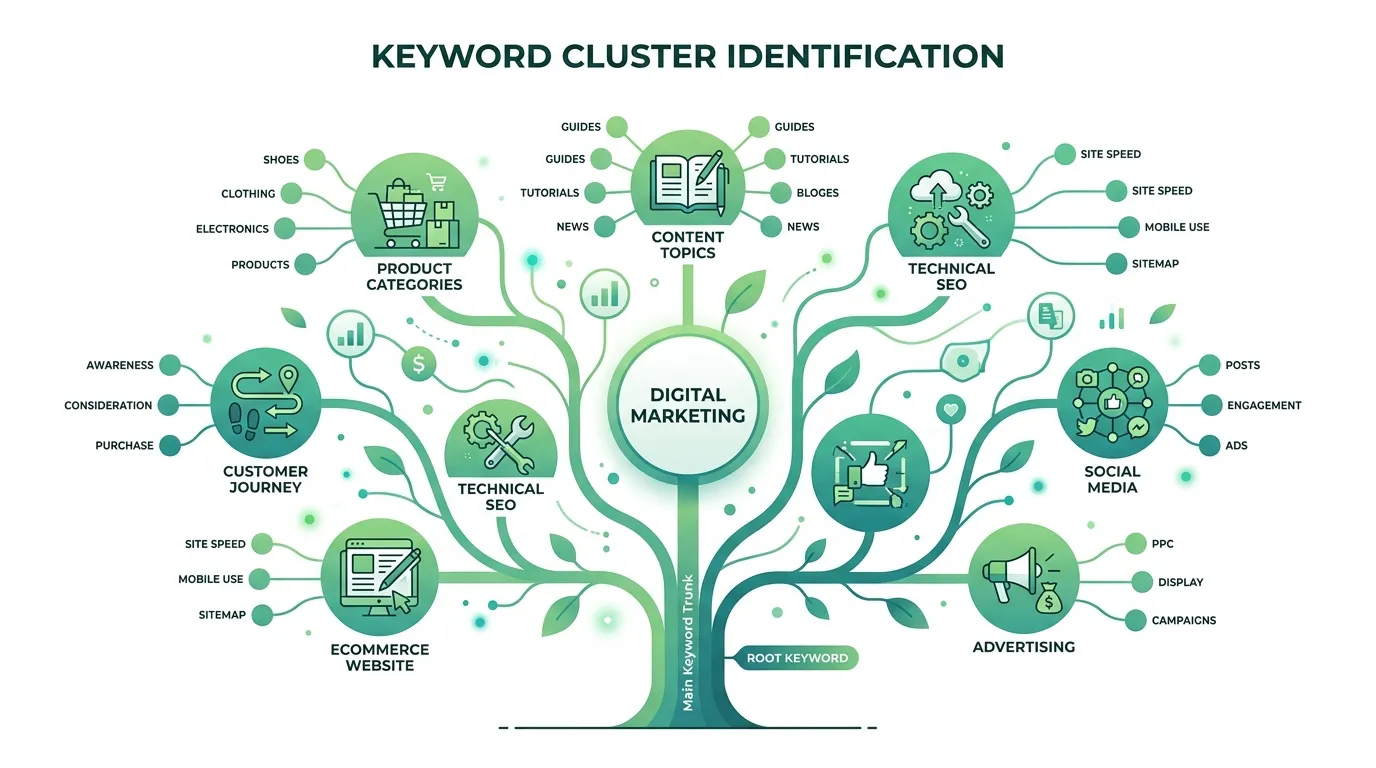
Start by grouping related keywords into logical clusters rather than treating each term separately. Modern search engines evaluate topical authority, not isolated keywords.
For example, if your business offers enterprise SEO services, one cluster might include:
- enterprise SEO solutions
- enterprise search strategy
- large-scale SEO management
- SEO for multi-location businesses
These terms share intent and can often be addressed within a pillar page supported by related content.
When clusters align directly with your core services, SMART objectives become more commercially meaningful. Instead of aiming to rank for random traffic-driving terms, you are building visibility around revenue-generating themes.
Analyse Volume and Difficulty

Not every keyword cluster deserves equal priority. Before attaching a SMART objective to a cluster, assess:
- Monthly search volume
- Keyword difficulty or competition level
- Search intent
- Current ranking position
High-volume keywords may look attractive, but if competition is dominated by established domains, your objective may become unrealistic within a short timeframe.
A balanced strategy often combines:
- Mid-volume, mid-difficulty keywords that offer achievable gains
- Select high-impact competitive terms for longer-term growth
This balance ensures your SMART objectives are ambitious yet data-backed.
Map Keywords to Specific Content

Once clusters are prioritised, assign them to clearly defined pages. Avoid internal competition where multiple pages target the same cluster.
For each page, define:
- Primary keyword cluster
- Supporting secondary keywords
- Expected traffic contribution based on volume and ranking potential
This step transforms keyword research into an execution plan. It also makes it easier to forecast traffic increases, which strengthens the “measurable” and “achievable” components of SMART objectives.
Translate Keyword Data Into SMART Objectives

Now convert insight into structure. Instead of saying, “We want to rank for these keywords,” quantify the expected impact.
For example: “Generate 3,000 additional monthly organic sessions by ranking in the top five for 15 identified mid-funnel keyword clusters within six months.”
This objective ties traffic growth directly to keyword clusters, ranking targets, and a defined timeframe. It reflects demand data, competitive analysis, and content mapping.
When SMART objectives are built on keyword intelligence rather than guesswork, SEO becomes predictable, scalable, and strategically aligned with business outcomes.
How to Track and Report SMART Objectives in SEO

Tracking should directly reflect the structure of your SMART objectives. If your objective is tied to non-branded organic traffic to service pages within six months, your reporting must isolate that exact segment. Broad, generic dashboards dilute insight and make it harder to evaluate real progress.
The closer your reporting aligns with your SMART objectives, the easier it is to identify what is working, what is underperforming, and where adjustments are required.
Build Dashboards Around Key Metrics
Start by designing dashboards that align with the measurable component of your SMART objectives. Avoid vanity metrics that look impressive but do not tie back to defined outcomes.
Include metrics such as:
- Organic sessions, segmented by page type or keyword theme
- Conversions from organic traffic, including form submissions or purchases
- Revenue generated from organic channels, where applicable
- Keyword visibility, especially for predefined clusters
- Engagement metrics, such as average engagement time or bounce rate
If your SMART objective targets blog growth, isolate blog performance. If it focuses on local traffic, filter by geography. Precision in tracking prevents misleading conclusions.
Monitor Leading Indicators
Not all progress shows up immediately in traffic or revenue. Strong SEO reporting also monitors leading indicators that signal future gains.
Pay attention to:
- Content production velocity, including the number of optimised pages published
- Indexation rates, ensuring new content is properly discovered and indexed
- Click-through rate improvements, especially after meta and title optimisation
- Internal linking coverage across priority pages
These signals often move before traffic does. Tracking them helps explain performance trends and justifies ongoing investment.
Review Monthly, Evaluate Quarterly
Monthly reporting keeps execution on track. Quarterly evaluation provides a strategic perspective.
Each month, review progress against your SMART objectives and identify tactical adjustments. After each quarter, assess whether the objective remains realistic, whether timelines need recalibration, or whether the strategy should pivot.
If objectives are not on track, refine the approach. You may need to adjust keyword targeting, increase content depth, strengthen internal linking, or address technical barriers. Abandoning targets too quickly weakens long-term growth discipline.
SMART objectives are not static commitments carved in stone. They should evolve based on performance data, competitive shifts, and new opportunities. When tracking and reporting are structured correctly, those adjustments become informed decisions rather than reactive guesses.
Turning SMART Objectives Into Sustainable Traffic Growth

SEO delivers meaningful results when strategy, execution, and measurement are aligned. That alignment begins with clarity. When your targets are specific, measurable, achievable, relevant, and time-bound, every optimisation effort serves a defined purpose. Content production becomes intentional. Technical improvements become prioritised. Reporting becomes evidence-based rather than interpretive.

Sustainable traffic growth does not come from chasing trends or reacting solely to algorithm updates. It comes from disciplined planning, continuous analysis, and structured performance management. This is where many organisations struggle. They invest in content and optimisation but lack a cohesive framework that connects activities to outcomes.
A well-designed strategy anchored in SMART objectives transforms SEO from a series of tasks into a growth system. It provides accountability across teams and creates visibility for leadership. More importantly, it ensures that traffic growth supports revenue, lead generation, and long-term brand equity.
If your organisation is looking to formalise its SEO strategy and implement performance-driven SMART objectives, MediaOne provides professional digital marketing services built around measurable impact. To explore how a structured framework can strengthen your organic growth, call us today for a strategic discussion tailored to your business goals.
Frequently Asked Questions
How do SMART objectives improve team accountability in SEO?
SMART objectives clarify ownership, timelines, and measurable outcomes. When each objective includes defined metrics and deadlines, teams understand what they are responsible for delivering. This reduces ambiguity and improves collaboration between content, technical, and marketing stakeholders. Clear objectives also make performance reviews more transparent and data-driven.
Can SMART objectives be applied to small business SEO campaigns?
Yes, SMART objectives are particularly valuable for small businesses because resources are often limited. By setting focused and measurable targets, smaller teams can prioritise high-impact activities rather than spreading effort too thinly. SMART objectives help small businesses concentrate on keywords and pages that directly support revenue goals. This ensures time and budget are allocated strategically.
How often should SMART objectives be revised in an SEO strategy?
SMART objectives should be reviewed monthly for tactical progress and reassessed quarterly for strategic alignment. Search trends, algorithm updates, and competitive shifts may require adjustments. Revising objectives does not mean abandoning them. It means refining them based on performance data and market conditions.
What is the difference between SMART objectives and KPIs in SEO?
SMART objectives define what you aim to achieve within a specific timeframe, while KPIs measure performance indicators along the way. For example, increasing non-branded organic traffic by 30 percent in six months is a SMART objective. Metrics such as sessions, click-through rate, and rankings act as KPIs that track progress towards that objective. Both work together to guide and evaluate SEO performance.
Are SMART objectives suitable for long-term SEO strategies?
SMART objectives can support both short-term and long-term SEO planning. Long-term strategies often include phased SMART objectives that build towards broader growth targets. Each phase contributes measurable progress while allowing room for optimisation. This structured approach makes long-term SEO more predictable and easier to manage.