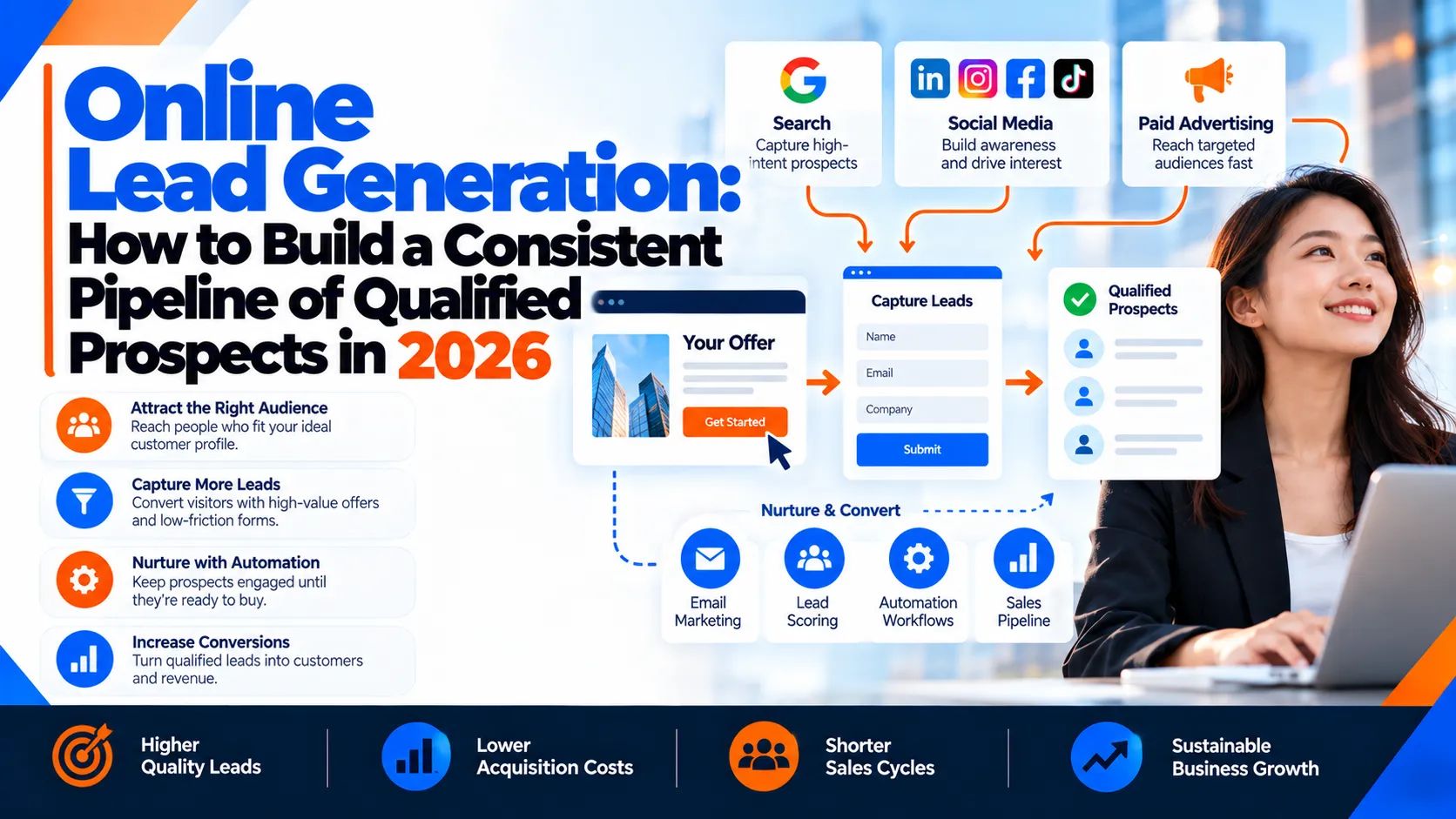
Lead generation is not about volume. It is about having a steady stream of people who fit your ideal customer profile, trust you enough to engage, and are ready to solve the problem you solve.

Most businesses either chase every inquiry that comes through the door, or they give up on lead generation entirely after their first campaign underperforms. Neither approach works. What works is a system: clear criteria for who counts as a lead, channels where your prospects already spend time, a capture mechanism that removes friction, and a follow-up process that keeps interested people moving forward without pestering them.
This article walks through how to build that system. You will learn which channels actually convert for different business models, what metrics reveal whether a lead is worth your time, common traps that tank lead quality, and the tools your team needs to execute without drowning in manual work. By the end, you will have a framework to audit your current efforts and a roadmap to fix what is broken.
Key Takeaways
- Online lead generation has shifted from volume tactics to permission-based systems: businesses now compete on lead quality and nurture speed, not raw volume.
- A sustainable lead pipeline requires at least three channels to work together (organic search, paid channels, owned audiences). Single-channel dependence creates revenue risk.
- High-converting lead systems reduce friction at every step: landing pages, forms, and automation workflows that respect prospect intent rather than interrupt it.
- Lead qualification scoring bridges marketing and sales. Teams that invest in defining what makes a lead “qualified” see 2-3x higher conversion rates than those without scoring.
- Attribution and ROI measurement are non-negotiable in 2026. Tracking cost per qualified lead and lead-to-opportunity conversion rate reveals which channels actually drive revenue, not just clicks.
- Compliance with privacy regulations (PDPA in Singapore, GDPR in the EU, CCPA in California) is now a business requirement, not a checkbox. Non-compliant capture methods create legal and reputational risk.
What Is Online Lead Generation, and Why Does It Matter in 2026
Online lead generation is the practice of attracting and capturing contact information from prospective customers through digital channels, converting anonymous website visitors into known prospects. A lead is anyone who has shown interest in your product or service by exchanging personal details (usually name, email, phone number, or company) in response to an offer.
The exchange is intentional. A visitor downloads an ebook, registers for a webinar, requests a demo, or fills out a form. In return, your business gains permission to reach out. This two-way transaction distinguishes lead generation from simple audience building: a social media follower is not yet a lead; someone who submits their email to hear from you is.
What makes a lead valuable depends on context. In a B2B software company, a lead is someone with buying authority at a target company. In e-commerce, a lead could be an email subscriber who has abandoned a cart. In professional lead generation services, it is often someone in active research mode who sought you out. The definition sharpens as you clarify who you actually want to reach and at what stage of their buying journey.
Why Businesses Need Continuous Lead Pipelines
A full lead pipeline is an insurance policy against revenue slumps. Most sales cycles do not move at the speed a business needs. B2B enterprise buyers take 3 to 6 months (or longer) to decide. SaaS users often research for weeks before a trial. Even a local service provider benefits from leads arriving steadily before they are actively needed.
Without continuous generation, you face a feast-and-famine cycle. When deals close, teams celebrate. When the pipeline drains, sales teams scramble to source new conversations, often less efficiently and at a higher cost.
Consistent lead flow also reduces desperation pricing and selling. With options, you can be selective. Your sales team closes higher-quality deals and spends less time chasing poor fits. Your cost per acquisition falls because you are not burning budget on low-probability prospects.
Lead generation also creates leverage in pricing and contract negotiations. A buyer knows your team has other conversations happening; you do not sound (or act) like you need the deal. This shifts negotiating power in your favour.
The Shift from Interruption to Permission-Based Acquisition
For decades, traditional marketing was built on interruption: TV ads, cold calls, banner ads, and billboards. The marketer grabbed attention; the prospect did not ask for it. Modern online lead generation flips this model.
Today’s buyer avoids interruption. Ad blockers are widespread. Spam filters catch unwanted email. Younger audiences skip YouTube ads within seconds. Trust in unsolicited outreach has eroded.
Permission-based acquisition works because the prospect volunteered. They chose to give you their email or attend your event. They clicked your ad because it matched what they were already searching for. This self-selection means they are far more likely to respond to follow-up contact, open your emails, and convert into a customer.
Permission also builds defensibility against regulation. GDPR, CCPA, and Singapore’s PDPA all impose strict rules on how you collect and use contact data. A lead that came from a clear opt-in, with transparent terms about how you will use their information, is legally safer and less likely to unsubscribe or mark you as spam.
The shift isn’t ideological; it is practical. Interruption-based channels still exist and occasionally work, but permission-based channels deliver better conversion rates, lower customer acquisition cost, and longer customer lifetime value. Most businesses now blend both (for example, paid search ads alongside email nurture), but the trend is clear: prospects control the first touch, and your job is to be findable when they seek you out.
Core Lead Generation Channels: Where Prospects Actually Respond
Not all lead sources perform equally. The channels that work depend on where your prospects spend time, what problems they are actively solving, and how ready they are to buy. This section walks through the five most reliable channels and where to focus first based on your business model.
Search Engine Marketing (Organic and Paid)
Search captures high-intent prospects. People typing “how to solve X” or “software for Y” are already looking. Unlike social media, where you interrupt a conversation, search works because the person initiated the query.
Organic search (SEO): A prospect finds your content unpaid in Google results after weeks or months of effort. The payoff is real: organic leads cost 50-60% less than paid traffic once established. But the time horizon is long. If you are starting from zero domain authority, expect to wait 3-6 months before seeing meaningful volume. Organic works best for businesses with repeatable questions prospects ask year-round: “best accounting software”, “how to fix a leaky faucet”, and “contract template for freelancers”.
Paid search (Google Ads, Bing): You bid on keywords and appear at the top instantly. Cost per click ranges from $1 for low-competition terms to $50+ for competitive vertical searches (legal services, finance). Paid search excels when your sales margin supports the cost. A B2B software company spending $15 per click and converting 10% of click traffic can afford that. A local plumber spending $10 per click cannot. If you have immediate revenue pressure, test paid search first; then switch to organic once you have validated which keywords actually convert.
A practical starting point: if your average customer lifetime value exceeds $5,000, paid search usually works. Below $1,000, focus first on organic and earned channels.
Content Marketing and Owned Channels
Content marketing moves slower than paid but builds a sustainable advantage. You create resources prospects want to find: blog posts, guides, webinars, and tools. When done right, content becomes a lead engine that works for years.
Blog content: A well-ranked post that answers a real question generates leads passively. The post sits on your domain, accumulates backlinks, and appears in Google results. A management consulting firm published a guide on surviving a board transition. Eighteen months later, it drives 200+ qualified inbound leads monthly without further investment. The post cost $2,000 to research and write.
Lead magnets: Offer something readers want enough to trade contact information for. Common examples: checklists, templates, calculators, case studies, free audits. A SaaS company offering a “marketing automation audit” generates 300 leads monthly; 15% convert to conversations. A personal trainer offering a “metabolic type quiz” gets 100+ entries weekly. The best lead magnets solve one specific problem in 5-10 minutes.
Webinars and online events: Hosting a live or on-demand webinar on a topic your prospects care about (not a product pitch) captures intent-rich leads. Attendees have already self-qualified by showing up. Conversion from webinar attendee to qualified lead runs 20-30% when the content delivers on the promise.
Owned channels (your website, email list, community) have one advantage: no algorithm changes eliminate them. A paid platform update can halve your reach overnight. Your email list cannot be taken away.
Social Media Lead Capture (LinkedIn, TikTok, Instagram)

Social media’s strength is reach and relationships. Prospects spend 2-3 hours a day on these platforms. But social leads often come from awareness campaigns, not high-intent searches, so your funnel must be longer.
LinkedIn for B2B: LinkedIn remains the dominant platform for business-to-business lead generation. Effective strategies include publishing thought leadership articles, running targeted ads by job title or company size, and using LinkedIn Sales Navigator for direct outreach. Cost per lead ranges from $20 to $60, depending on the industry and audience. LinkedIn ads perform best when you are targeting a specific role (for example, “VP of Marketing at companies with 50-500 employees”) because the platform’s data is accurate at the job-title level.
Instagram and TikTok for consumer brands: These platforms excel at building awareness and moving viewers into your owned channels (email list, SMS). A fitness brand uses Instagram Reels to demonstrate workouts and links to an email signup for a 7-day meal plan and converts subscribers at 8%. The lead cost is $3-5 because signup is frictionless.
A clear distinction: Instagram and TikTok excel at volume and awareness. LinkedIn excels at selectivity and intent. Don’t expect TikTok to generate B2B enterprise sales leads; use it for brand building and to drive traffic to your email funnel.
Direct message and community tactics: Engaging one-to-one in comments and DMs builds trust and surfaces conversations. A commercial real estate agency responds to local business hashtags, builds relationships, and generates qualified leads through conversation. This is slow and labour-intensive but has near-zero customer acquisition cost once a person is assigned the work.
Email and Nurture Sequences
Email is the conversion engine of lead generation. A prospect may visit your site, see your ad, or attend a webinar. Email keeps them engaged until they are ready to move forward.

Lead capture to first email: The moment someone gives you their email, send a confirmation or welcome message within 2 hours. This immediate reply validates the signup, confirms expectations, and captures interest at its peak. A SaaS company’s first email is “Thanks for downloading our guide. Here’s the link. Here’s our most common question about the topic. Reply anytime.” Open rates on first emails run 40-50%.
Nurture sequences: A sequence is a series of 3-8 emails sent over 2-4 weeks with no hard sell. Each email educates or provides value. A financial advisory firm’s sequence covers: (1) the most common retirement planning mistake, (2) how to calculate your number, (3) what a second opinion costs, (4) the risk most people miss. By email 4, prospects either reply with interest or stop engaging. Those who engage become sales conversations.
Segmentation: Not all leads are the same. A prospect who attended your webinar is further along than someone who downloaded a whitepaper. Send different emails based on what they did. Prospects who attend webinars can move to a sales conversation sequence. Whitepaper downloaders get educational content first.
Email conversion rates vary by industry. B2B SaaS sees 15-25% of qualified leads move to sales from a 4-email nurture sequence. Consumer services may see 5-10%. The key is tracking: measure how many emails in, at what point, and prospects engage enough to accept a call.

Referral and Affiliate Partnerships
Referrals are the highest-converting lead source across nearly every industry. A referred prospect has a trusted implicit endorsement; they close at 2-3x the rate of cold leads and have longer lifetime value.
Formal referral programs: Incentivise your existing customers to refer. Offer $500 cash, a service discount, or account credit for each referred customer who closes. A B2B consulting firm pays $2,000 per qualified referral (not per close, per qualified lead). They get 10-15 referrals monthly, convert 40%, and close customers worth $50,000+. The math: $2,000 per referral, 40% conversion = $5,000 customer acquisition cost for a $50,000 customer. Profitable.
Strategic partnerships: Affiliate with complementary services. A web designer partners with a copywriter. When the designer finishes a site, they introduce the copywriter to the client. Leads flow both ways. Cost to you: either a commission (10-20% of the deal) or formal partnership terms.
Affiliate networks: Platforms like ShareASale or CJ Affiliate let you recruit affiliates who promote your product for commission. This approach works best for SaaS, e-commerce, and digital products with a clear commission structure. Affiliate quality varies; manage these relationships as you would sales partners.
The single highest-leverage move: ask your best customers to refer. A phone call from your customer to their peer carries more weight than your outreach.
Where to Start: A Simple Decision Matrix
| Your Situation | Best First Channel | Why |
|---|---|---|
| B2B, long sales cycle ($50k+), selling to enterprises | LinkedIn ads + Sales Navigator | Precise targeting by role and company; intent-rich leads. |
| SaaS, subscription-based, $500-5,000 ACV | Organic SEO + webinars | Low CAC long-term; webinars move leads to trial. |
| Professional services (legal, accounting, tax), geographic market | Google Ads (local) + SEO content | High commercial intent; local targeting works. |
| E-commerce, consumer products, tight margins ($20-100 AOV) | Email + organic/social | Paid acquisition CAC often exceeds margin; earn through owned channels. |
| Established business with strong customer base | Referrals + partner affiliates | Lowest CAC, highest conversion rate; leverage existing credibility. |
Choose one channel, validate it for 3-4 weeks, then add a second. Spreading budget across all five simultaneously while learning each one dilutes results.
Building a High-Converting Lead Capture System
The difference between lead generation that feels effortless and lead generation that drains your team comes down to your capture system. A high-converting system does three things at once: it removes friction from the prospect’s journey, qualifies leads automatically, and nurtures them without human intervention. This section walks through how to build each layer.
Landing Page Fundamentals (Design, Copy, Trust Signals)
Your landing page is where interest converts to data. The best ones share a specific structure: a single, clear value proposition above the fold; proof that the offer works; and a form that asks only what you need.
The value proposition should answer one question in under eight words: “What will I get if I fill this form?” For a B2B software trial, that might be “Run payroll in 15 minutes, not three hours.” For a professional services lead magnet, “See your tax savings in under 5 minutes.” Vague headlines like “Learn More About Our Solutions” convert at half the rate of specific ones.
Trust signals matter more than design polish. Visitors scan landing pages for reasons not to trust you. Use real logos of clients you have worked with, customer testimonials with names and job titles (not initials), security badges if you handle sensitive data, and publication logos if you have been covered by credible media. A single specific statistic (“97% of finance directors saw an audit reduction in year one”) outperforms generic claims (“Industry-leading results”).
Copy should follow a problem-solution-proof-action sequence. Start with the prospect’s pain, not your solution. “Your team spends 40% of their time on manual expense reports” lands harder than “Our automation software saves time.” Then show how you solve it in one sentence. Then prove it with a case study snippet, a metric, or a customer quote. The call-to-action should match the offer: “Get Free Trial” for a product, “Download Guide” for an ebook, and “Schedule Demo” for a consultation.
White space is functional, not decorative. Form fields and copy should have enough space. A cluttered landing page signals a cluttered product.
Form Design That Reduces Friction and Abandonment
Every additional form field reduces conversion rates by 3-5%. This isn’t an opinion; platforms like Unbounce and Optimizely measure it across thousands of landing pages.
Start with the minimum viable form. If you only need an email address and company name to qualify a lead, ask for those two things. You can ask for the phone number, job title, budget, and timeline after they have engaged with one email. Progressive profiling (building a customer record across multiple touches instead of all at once) converts 20-30% higher than asking for everything on the first form.
For the fields you do ask for, use input types that match the question. Dropdown menus for job title or company size are faster than text fields. Date pickers are faster than typing a date. A phone field that auto-formats for your country saves the prospect a step.
Placeholder text (“name@company.com”) should show the format, not replace the label. Labels must stay visible; placeholders disappear when the field is active.
Required versus optional fields matter. Mark only truly required fields as such. A form that marks “Phone” as optional when it is optional feels less aggressive. Conversely, a form that marks everything as required when most fields are negotiable signals that you do not respect the prospect’s time.

Test single-column layouts against multi-column layouts. Single-column almost always wins on mobile and performs comparably on desktop. Your form should stack on a phone screen without horizontal scrolling.
Submit button text should be specific: “Get My Free Audit” instead of “Submit”. A strong button can increase form completion rates by 5-10%.
Lead Qualification Scoring: Separating Signal from Noise
Not all leads are equal. A form fill from your target buyer is worth 100 times more than a form fill from a competitor or a student doing research. Lead scoring separates signal from noise so your sales team works the right leads first.
Build a scoring model on two axes: fit and intent. Fit measures whether the prospect matches your ideal customer profile. Intent measures whether they are actively evaluating a solution.
Fit scoring uses profile data. If your ideal customer is a finance director at a company with 50-500 employees, you score based on those attributes. Gather the information from the form (job title, company size) and from data enrichment services like ZoomInfo or Apollo (industry, revenue, employee count). A prospect at the right company size and role gets +10 points. A prospect in a non-target industry gets 0 or -5.
Intent scoring tracks behavioural signals. Did the prospect download your highest-intent asset (a pricing guide or product demo) or a low-intent one (a general market report)? Did they visit your pricing page? Did they spend more than two minutes on your site? Each signal gets a weight. Visiting pricing page: +15. Viewing product demo video: +10. Viewing blog article: +1.
Create tiered definitions based on total score. Leads scoring 50+ are marketing-qualified leads (MQLs) ready for sales contact. Leads scoring 20-49 stay in nurture sequences. Leads scoring below 20 are pooled for occasional re-engagement campaigns.
Without scoring, your sales team wastes time pursuing leads that will never convert. With scoring, your sales team can focus on the 30% of leads that actually fit and are actively interested.
Automation Workflows to Nurture Without Manual Effort
Once you capture a lead, automation keeps them warm until they are ready to buy. A basic nurture workflow has four stages: welcome, education, social proof, and ask.
The welcome email goes out within 5 minutes of form submission. It thanks them, confirms what they signed up for, and sets a clear expectation (“You will hear from us Thursday with…”). A 5-minute delay prevents bounces from form submissions and still feels immediate.
Education emails arrive 3-5 days later. These deliver on the promise: the ebook they requested, the first lesson in a course, or a curated collection of your best resources on their topic. Each email should stand alone and have a soft call to action (“Reply with your greatest challenge, and I will point you to the right resource”).
Social proof emails arrive 7-10 days later. These feature a customer case study, a press mention, or a user testimonial. One story per email, with context (“We worked with a similar company in your industry…”). The goal is to build confidence without being salesy.
The ask email comes 14-21 days in. This is a soft qualification call: “Are you actively exploring solutions this quarter?” or “Would a 15-minute call help me understand your constraints?” Please segment your list here: send those who click through to a calendar link to the sales team. Those who do not click stay in the nurture loop.
Automation rules should address bounces and unsubscribes promptly. Sending emails to unengaged addresses damages your sender reputation. If someone does not open any of three consecutive emails, pause them for 30 days, then try a re-engagement campaign (“We noticed you have not opened our last few emails…”).
Use conditional logic to branch workflows based on behaviour. If a lead visits your pricing page after receiving education email #2, skip straight to the ask email. If they view a product demo, trigger a sales rep alert. Conditional logic turns a static email sequence into a responsive system that respects where each prospect is in the decision process.
Track the metrics that matter: open rate, click-through rate, and conversion to sales-ready (bookings or demo requests). Aim for 20-30% open rates on nurture emails. If your open rates are below 15%, consider testing new subject lines. If your click rates are below 3%, tighten the copy and clarify the ask.
Lead Generation Tactics for Different Industries and Business Models
A lead-generation approach that works for a SaaS company will often fail for a legal practice. Industry dynamics shape where prospects live, how they buy, and what signals indicate buying intent. This section covers the specific channels, timing, and qualification criteria that drive results in five distinct business models.
B2B Enterprise (Long Sales Cycles, Multiple Decision-Makers)
Enterprise deals move slowly and involve many stakeholders. Procurement managers, budget holders, and end-users often disagree on timing or priority. Your lead gen system must therefore account for longer nurture windows and multiple contact points.
Account-based marketing (ABM) outperforms broad lead capture here. Instead of running ads to “decision-makers”, you identify target companies, research their structure, and contact the specific individuals involved. LinkedIn Sales Navigator is the default tool for this. You build a list of 50-100 high-fit accounts, then run paid campaigns, send personalised emails, and create content that speaks directly to their stated challenges.
Content that works: competitive comparisons, ROI calculators, executive briefings, and case studies from similar-sized companies. A healthcare IT company will not engage with a guide written for startups. The copy must speak to their scale.
Lead qualification is stricter. An enterprise sales-qualified lead (SQL) requires budget confirmation, identified stakeholder alignment, and a timeline. A marketing-qualified lead (MQL) is earlier in the conversation. Many enterprises require 6-12 months of nurturing before an SQL emerges. Build email sequences that drip educational content every two weeks, not daily. Longer gaps respect their buying cycle.
Attribution is complex: enterprise deals almost never come from a single source. A prospect might discover you via an industry conference, read your content for three months, and convert after a direct sales outreach. Use a CRM that records all touches. Multi-touch attribution (not last-click) reflects reality.
SaaS and Subscription Services
SaaS companies need volume and speed. Customers onboard quickly, so your lead qualification bar is lower than enterprise. You want to maximise trials and freemium signups, then measure who activates, upgrades, and stays.
The conversion funnel is compressed. Awareness to trial often takes days, not months. Paid search (Google Ads on product-related keywords) and SEO on comparison pages (“Slack alternative”, “Asana vs. Monday”) drive immediate signups. Freemium models work here because the product is the best sales tool. A prospect tries Notion, finds it valuable, and converts to paid without ever speaking to sales.
Email sequences must be short and fast. Send a welcome email on day one, a feature highlight on day three, and a “you are about to lose access” message before the trial ends. Drip campaigns that last months kill SaaS conversion because adoption happens fast or not at all.
Referral programmes are highly effective. If your product is exceptional, happy customers will invite colleagues. Offer account credits or premium features for successful referrals. Dropbox, Slack, and Notion all built significant user bases partly through referral loops.
Activation is the real metric. Many SaaS companies focus on lead volume but neglect whether those leads actually used the product. Track free-to-paid conversion, not just signups. A platform with 1,000 trial signups and 2% conversion (20 paid customers) is outperforming one with 100 signups and 5% conversion (5 paid customers).
Professional Services (Legal, Consulting, Accounting)
Professional services rely on trust and perceived expertise. Prospects hire you based on your reputation and your understanding of their specific situation. Mass lead capture does not work here.
Authority and content are primary engines. Blogs, whitepapers, webinars, and speaking engagements attract inbound enquiries. A tax firm posting quarterly updates on IRAS regulations and recent court rulings builds trust. A management consulting firm publishing a study on industry consolidation demonstrates profound knowledge.
LinkedIn is essential but used differently than in enterprise B2B. Rather than buying ads, partners and senior consultants post regularly. Share a relevant case (anonymised), ask a thoughtful question, and join the discussion. This builds your personal brand and establishes you as the expert people want to hire.
Lead qualification is subjective. A prospect emailing to ask a basic question might become a multi-year client if you respond thoughtfully. Even a “no, that’s not my area” response, with a referral, plants goodwill. Many professional service leads come from warm referrals and repeat business, not first-time prospecting.
Because pricing and services are often custom, forms cannot automatically qualify leads. Create low-friction discovery mechanisms: a 30-minute consultation call, a questionnaire, or a brief email conversation. Your sales process is transparent consultation, not traditional sales.
E-Commerce and Direct-to-Consumer
E-commerce lead generation focuses on email capture and repeat purchases. The goal is not a single transaction but a lifetime customer. Recovery emails (abandoned cart, browse abandonment) often outperform paid ads in terms of ROI.
Email lists are the asset. Capture email on your site with discounts (10% off if you subscribe to our newsletter), gated content (shipping guides, style lookbooks), or free shipping on first orders. A clean email list of 10,000 engaged subscribers is worth more than 50,000 inactive ones.
Segmentation drives results. Customers who bought dresses should see dress promotions, not shoes. Customers who have not purchased in six months need a reactivation campaign, not your standard weekly newsletter. Shopify, Klaviyo, and similar platforms make segmented email cheap and scalable.
Retargeting (Google Ads and Facebook pixel-based ads) is highly effective for e-commerce. Someone who viewed your product page but didn’t buy sees your ad again while browsing Instagram. This reminder often converts.
Affiliate and influencer partnerships work well if your product fits the audience. A skincare brand partnering with micro-influencers in beauty communities drives qualified traffic and lower CAC than paid ads to cold audiences.
Lead scoring is simpler: browsing activity (frequency and recency), email opens, and past purchase value. A customer who bought last month and opened your last email is a higher priority than someone who browsed once and deleted emails.
Local Services and Geographic Targeting
Local service businesses (plumbing, electricians, dental practices, lawn care) win leads based on proximity and urgency. Someone searching “plumber near me” needs help today, not next month.
Google Business Profile is non-negotiable. Ensure your listing is complete, verified, and updated. Reviews are the primary qualification signal. A service business with 4.8 stars and 200 reviews beats a 5-star business with only 5 reviews. Encourage satisfied customers to leave reviews immediately after service.
Local search ads (Google Ads with location targeting) and map ads convert well. So do local directories specific to your trade (Yelp for restaurants and services, Thumbtack for home services, and Zocdoc for healthcare). Each has a lead cost, but customers arriving through them are hot.
Social proof matters more in local services. Before hiring a plumber, prospects check reviews, ask neighbours, or scroll through photos of past work. Video testimonials and before-after galleries are stronger than written case studies.
Phone calls are still the primary conversion. A local service lead is useless if you cannot answer the phone or call back within two hours. Many leads are lost because of slow response times. Ensure your team has capacity and a system to log and follow up on enquiries the same day.
Seasonal lead flow is sharp in many local services. A lawn-care company sees a demand spike in spring and fall. In summer and winter, an HVAC company sees a demand spike. Plan your marketing spend to match peaks, not constant monthly spend.
Comparison of Tactics by Industry
| Dimension | B2B Enterprise | SaaS | Professional Services | E-Commerce | Local Services |
|---|---|---|---|---|---|
| Primary Channel | ABM, LinkedIn, Direct Outreach | Organic Search, Paid Search, Freemium | Content, Speaking, Referral | Email, Retargeting, Affiliates | Google Business, Local Directories, Reviews |
| Sales Cycle | 6-12 months | Days to weeks | Weeks to months | Minutes to days | Hours to 1 day |
| Key Metric | Multi-touch attribution, SQL rate | Free-to-paid conversion, Activation | Deal size, Win rate, Referral rate | Email list size, LTV, Repeat rate | Response time, Review score, Booking rate |
| Lead Volume Needed | Low (high selectivity) | High (many convert fast) | Medium (high deal value) | Very high (thin margins) | Medium (local saturation) |
| Lead Qualification | Strict (budget, timeline, stakeholders) | Loose (free trial enough) | Subjective (trust-based) | Behavioural (browsing, purchase history) | Immediate (urgency implicit) |
| Content Focus | ROI case studies, competitive comparisons | Feature demos, activation guides | Thought leadership, deep expertise | Product benefits, lifestyle fit | Social proof, before-and-after work |
This table helps you see where your business model sits and which tactics deserve investment first. An enterprise company spending heavily on SEO content for broad terms will waste money. A SaaS company betting on ABM when it has not nailed free-to-paid conversion is premature.
Metrics That Actually Predict Revenue: Beyond Vanity Numbers
Most lead generation teams measure the wrong things. They celebrate high lead volume, low cost-per-lead, and fast form submissions. Then they wonder why revenue does not follow.
The disconnect is real. A hundred cheap leads worth $2 each do not predict revenue if they convert to customers at 0.5% and churn in three months. A single qualified lead worth $50 that converts at 40% and stays for two years does.
This section covers the metrics that correlate with actual revenue outcomes, not just activity. These five numbers are what you need in your dashboard, how to calculate them, and the decision thresholds that tell you when something is broken.
Cost Per Qualified Lead vs. Cost Per Lead
The difference between CPL and CPQL accounts for most failed lead generation programmes.
Cost Per Lead (CPL) divides your total campaign spend by the number of leads captured. If you spent $5,000 and got 500 leads, your CPL is $10. Simple, but meaningless on its own. Half of those leads may be tyre-kickers who never intended to buy.
Cost Per Qualified Lead (CPQL) divides your total campaign spend by leads that meet your definition of qualified. If only 150 of those 500 leads passed qualification (fit the right company size, budget, timeline, and authority), your CPQL is $33. That is three times higher, and it is the honest number.
The tension is real. Paid channels that deliver low CPL often produce high-cost qualified leads because they reach a broad audience. Organic channels and referrals often show higher CPL but lower CPQL because the traffic is warmer.
Calculate your qualification criteria first. This is a conversation between sales and marketing. Sales must define what “qualified” means: industry fit, company size, decision-maker title, stated budget, or timeline. Without this agreement, you are measuring different things.
Then segment your campaign data by qualification status. Run both metrics. Track them monthly. If CPL drops but CPQL rises, you have optimised for the wrong signal.
Benchmark depends on your business model. B2B SaaS companies targeting mid-market often see CPQL between $30 and $100. Professional services firms tracking legal or consulting prospects see CPQL between $150 and $400. E-commerce and local services operate at lower thresholds because conversion velocity is faster.
The key insight: if you measure only CPL, you optimise your campaigns to capture anyone who clicks. If you measure CPQL, you optimise to attract the right people.
Lead-to-Opportunity Conversion Rate
This metric bridges lead generation and sales. It answers: Of all the qualified leads we hand to sales, how many become real sales opportunities?
Calculate it simply. Count qualified leads in month one. In month three, count how many became opportunities (a sales rep opened a deal in your CRM for that contact). Divide opportunities by leads. If you had 40 qualified leads and 12 became opportunities, your conversion rate is 30%.
This number reveals misalignment between teams. If marketing delivers 40 qualified leads monthly but only 3-5 typically advance to opportunity, one of three things is happening:
- Sales is not following up. Leads decay rapidly if you don’t contact them within hours. HubSpot data shows response rates drop 10x if you wait more than an hour to reach a lead.
- Marketing’s definition of “qualified” does not match sales’ definition of “viable”. Sales sees the leads and judges them unfit despite passing the filter. Go back and reset the qualification criteria together.
- The lead nurture sequence is not working. Leads enter your nurture flow but never reach sales-ready status because the messaging, timing, or content is missing.
Healthy conversion rates from qualified leads to opportunities sit between 20% and 40% depending on sales maturity and the sales cycle length. Anything below 10% signals a process problem, not a lead quality problem.
Track this monthly. If the rate drops, please investigate sales velocity first (are follow-ups happening?) before attributing the issue to lead quality.
Customer Acquisition Cost (CAC) and Payback Period
CAC connects lead generation to profitability.
CAC measures the full cost of acquiring one customer. Add all marketing spend, sales salaries, tools, and overhead in a period, then divide by the number of new customers acquired. If marketing spent $40,000, sales spent $30,000 on salaries and commissions, tools cost $5,000, and you acquired 50 customers, your CAC is $3,000 per customer.
This metric includes lead generation, but it is broader. It accounts for the entire customer acquisition machine.
CAC Payback Period answers: how long until that customer’s revenue covers their acquisition cost? If CAC is $3,000 and the customer pays $500 monthly, payback is 6 months. If they pay $2,500 monthly, payback is 1.2 months.
The payback period predicts survival. Venture-backed SaaS companies target a payback period of 12 months or less. Enterprise software with longer sales cycles often tolerates a payback period of 18-24 months. Direct-to-consumer and e-commerce businesses need to hit a payback period of 3-6 months to stay profitable.
If your payback period exceeds 24 months, your lead generation efficiency is too low, or your pricing is too low. You cannot afford to acquire customers at that rate without exhausting your capital.
Calculate this quarterly. Break it down by lead source. You may find that LinkedIn ads have a 9-month payback while organic search is 6 months. That insight guides budget reallocation.
One practical note: SaaS companies sometimes calculate CAC payback using gross margin, not total revenue, since you subtract delivery and payment-processing costs. If your monthly revenue is $2,500 but the gross margin is 65%, use $1,625 for payback math.
Lead Source Attribution and Multichannel ROI
Single-touch attribution is dead. Most B2B purchases involve five to seven touchpoints across channels. A prospect sees your ad, reads a blog post, clicks an email, watches a webinar, then talks to sales.
Track this with a simple rule: assign revenue credit to all channels that touched the customer, not just the last click.
Use your CRM’s attribution reporting if available. HubSpot, Salesforce, and Pipedrive all offer first-touch, last-touch, linear, and time-decay attribution models. Linear attribution, which gives equal credit to each touchpoint, works well for most teams. Time-decay attribution, which gives more credit to later interactions, makes sense when sales conversations are long and later-stage touchpoints have greater influence.
The goal is not perfect attribution. The goal is to understand which channels consistently contribute to qualified leads, opportunities, and revenue, so you can invest more in what works and cut spending on what does not.
Frequently Asked Questions
What is online lead generation?
Online lead generation is the process of attracting potential customers through digital channels and converting anonymous visitors into known prospects. This usually happens when someone submits contact details in exchange for something valuable, such as a guide, webinar, demo, consultation or free trial.
Which online lead generation channels work best in 2026?
The strongest channels depend on your business model and buying cycle. Search works well for high-intent prospects, social media helps with reach and awareness, content builds authority, email nurtures leads over time, and referrals often produce the highest conversion rates. Most businesses benefit from using several channels together rather than relying on one.
What is the difference between a lead and a qualified lead?
A lead is someone who has shown interest and provided contact information. A qualified lead also matches your ideal customer profile and shows signs of genuine buying intent. Qualification can include factors such as job role, company size, budget, behaviour, timing or the pages and content they engage with.
How can I improve lead quality instead of just generating more leads?
Define what a good lead looks like before launching campaigns. Use lead scoring based on both fit and intent, improve targeting, tighten landing-page messaging and track cost per qualified lead rather than cost per lead alone. More leads aren’t useful if they don’t progress into real sales opportunities.
How quickly should I follow up with a new lead?
Follow up as quickly as practical while the prospect’s interest is still high. Automated confirmation or welcome emails can be sent within minutes of a form submission, while high-intent leads such as demo requests or pricing enquiries should be routed to sales immediately.
What metrics should I use to measure lead generation performance?
Focus on metrics tied to revenue rather than activity alone. Useful measures include cost per qualified lead, lead-to-opportunity conversion rate, customer acquisition cost, payback period, sales-qualified lead rate and revenue by lead source. Lead volume and cost per lead are useful only when viewed alongside lead quality.
How does lead scoring work?
Lead scoring assigns points to prospects based on their profile fit and behavioural intent. For example, a decision-maker at a target company might receive points for fit, while visiting a pricing page or requesting a demo adds intent points. Sales can follow up with higher-scoring leads, while lower-scoring prospects stay in nurture sequences.
How does privacy compliance affect online lead generation?
Lead capture must comply with applicable privacy laws such as Singapore’s PDPA, the EU’s GDPR and California’s CCPA. Businesses should collect only the information they need, explain how they will use it, obtain consent, and make it easy for people to unsubscribe or withdraw consent.