Lead nurturing is the process of building relationships with prospects across the buyer journey, delivering the right information at the right time to move them from awareness toward purchase. It is not a single email or one sales call. It is a coordinated sequence of interactions, content and touchpoints designed to address specific objections, build trust and remove friction at each stage of the buying process.

In competitive B2B markets, most prospects are not ready to buy on first contact. Gartner research shows the average B2B buyer completes 57% of their research before engaging a sales representative. Lead nurturing closes this gap by providing educational content, social proof and strategic touchpoints that move prospects toward a buying decision while they are still evaluating options. The result is shorter sales cycles, higher conversion rates and stronger deal quality when leads finally reach the sales team.
This guide covers the full lead-nurturing operating model: why it matters, how to structure it, which tactics drive results, and how to measure success with real numbers.
What Is Lead Nurturing?
Lead nurturing is the process of building relationships with prospects through targeted, relevant communication across multiple touchpoints until they are ready to buy. It is not a single email or phone call: it is a series of deliberate, staged interactions designed to move a prospect from one stage of the buyer journey to the next, removing specific objections and barriers at each step.
In modern B2B sales, the average buyer conducts research for weeks or months before speaking to a salesperson. During that time, competitors are also competing for attention. Lead nurturing keeps your organisation visible and relevant during this exploration phase. More importantly, it positions your solution as the answer to the prospect’s evolving needs, not a random vendor pushing a product.
The core value of nurturing is measurable. Organisations that nurture leads achieve higher close rates, shorter sales cycles and stronger customer relationships. A 2023 HubSpot report found that companies prioritising lead nurturing achieve 50% higher conversion rates from lead to customer than organisations that do not. For teams in Singapore and the Asia-Pacific region, where sales cycles often run longer and relationship-building carries cultural weight, this structured approach is particularly critical.
Nurturing works because it addresses a fundamental mismatch: most prospects are not ready to buy when they first encounter your brand. Your job is not to force a purchase. Your job is to educate, demonstrate value and remove friction so that when they are ready, buying from you is the obvious choice.
Lead Generation vs Lead Nurturing
Lead generation and lead nurturing are often conflated, but they serve distinct purposes.
Lead generation is the work of acquiring new contacts: running ads, hosting webinars, creating lead magnets, and launching outbound campaigns. It brings prospects into your funnel. Success is measured by volume: how many new leads can you capture?
Lead nurturing assumes you already have leads. It moves those leads toward purchase by delivering the right message at the right time. Success is measured by conversion: how many of those leads become customers?
A common mistake is assuming lead generation and sales are adjacent activities. They are not. In between sits nurturing. A prospect who downloads your ebook is not ready to talk to sales. A prospect who has opened four emails from you, clicked through to two product pages and attended a webinar is getting closer. Your nurturing activities determine when that handoff to sales happens.
In practice, this means your lead generation team’s job ends at the moment a contact opts in. Your nurturing team’s job then begins. If you treat nurturing as optional, you leave money on the table: captured leads decay in value every week they sit unattended.
How Extended Sales Cycles Benefit From Strategic Nurturing
Lead nurturing does not shorten sales cycles arbitrarily. Instead, it extends them strategically by investing in education and relationship-building at each stage so that when a prospect is ready to engage with sales, they arrive pre-educated, less risk-averse and more likely to close.
B2B sales cycles in Singapore and across Asia-Pacific tend to be longer than in other markets, particularly in regulated industries like finance, healthcare and professional services. A software purchase that might take 3 months in a fast-moving startup could take 6 to 9 months in a large enterprise with multiple stakeholders and compliance requirements.
Nurturing removes friction across this extended timeline. Early in the cycle, you educate on industry trends and business challenges. In the middle, you position your specific solution. Late in the cycle, you address implementation concerns, security questions and financial considerations. Without this staged approach, prospects lose momentum, competing vendors capture mindshare, and deals stall.
A clear framework for extending your sales cycle through nurturing follows these stages:
Awareness stage (Weeks 1-4): Deliver educational content. The prospect knows they have a problem but does not yet know your solution exists.
Consideration stage (Weeks 5-12): Share solution-specific resources: case studies, product overviews, and ROI calculators. The prospect is evaluating options.
Decision stage (Weeks 13+): Remove final objections. Provide customer testimonials, detailed pricing scenarios, implementation timelines and security documentation.
Each stage has a clear exit criterion. A prospect moves from awareness to consideration only when they have engaged with enough educational content to warrant solution-level messaging. They move from consideration to decision only when they have demonstrated buying intent (requested a demo, asked specific implementation questions or engaged with sales-owned collateral).
This disciplined approach ensures your sales team isn’t wasting time chasing unqualified leads and prospects aren’t receiving irrelevant messages. Both sides benefit from the structure.
Why Lead Nurturing Is Critical for B2B Conversion
The Research Gap: When Prospects Buy Without You
Most B2B buying committees don’t make a purchase decision at first contact. Research from the Harvard Business Review found that B2B buyers spend only 17% of their decision journey actively meeting with potential vendors. The other 83% happens when your prospect does independent research, compares options with colleagues, and wrestles with internal alignment.
This gap is what job lead nurturing solves.
A prospect who downloads your whitepaper on day one may not be ready to talk to sales for weeks or months. They may still be exploring the problem, building a business case, securing budget approval, or waiting for their renewal date. Generic follow-up (“just checking in”) wastes that window. Targeted nurturing bridges the gap by delivering the right information when they are ready to move forward.
Without nurturing, you lose deals to competitors who stay present. With it, you remain top-of-mind while your prospect moves through their own timeline, not yours.
How Nurturing Removes Sales Friction
Friction in B2B sales comes from uncertainty. Does the prospect understand the problem deeply enough? Do they believe your solution actually solves it? Have they addressed the real objection their finance team will raise? Is this a budget priority now or later?
Lead nurturing removes friction by answering these questions before the sales conversation.
A well-designed nurture sequence introduces proof points in the right sequence. Early touches might focus on validating the problem: case studies showing that peers face the same challenge and data on the cost of inaction. Middle-stage touches shift to positioning: competitor comparisons, implementation approaches, and ROI calculators. Late-stage touches address the final objections your sales team hears repeatedly: security certifications, customer references in the prospect’s industry, terms and pricing clarity.
When a prospect enters a sales call having already consumed this content, they arrive pre-educated. Objections don’t disappear, but they shift from “Why should I care?” to “How does this work?” and “What does it cost?” These are far easier to convert.
This is why organisations with structured nurture campaigns see shorter sales cycles. Salespeople spend less time educating and more time closing.
Measurable Impact on Deal Velocity and Close Rates
The numbers justify the investment.
Research from the Kenshoo Institute found that organisations using lead nurturing convert 45% more prospects into customers compared to those without it. More importantly for pipeline health, nurtured leads show a 27% faster sales cycle than non-nurtured leads.
That velocity compounds. If your typical B2B sales cycle is 90 days and nurturing compresses it to 66 days, you are closing 27% more deals each year from the same prospect pool, without spending more on lead generation.
Close rates improve too. HubSpot’s “State of Inbound” research shows that companies with lead nurturing programmes see conversion rates of 27% or higher from prospect to customer, compared to 8-10% without nurturing. The difference isn’t luck. It is preparation.
Consider the financial impact: if your average deal value is SGD 50,000 and you nurture 100 prospects, converting 27 instead of 10 generates an extra SGD 850,000 in revenue. The cost of a marketing automation platform and the time to build sequences typically range from SGD 200 to400 per month. The ROI is unmissable.
Beyond revenue, nurturing also improves unit economics. Because nurtured deals close faster and hit sales with fewer objections, your cost-per-acquisition drops even as your conversion rate rises. Sales teams spend less time on each opportunity, which frees capacity to pursue new prospects.
Marketing automation platforms track this across thousands of organisations. When companies implement lead scoring alongside nurturing, they see even steeper gains: sales productivity increases by an average of 14% in the first six months, according to Aberdeen Group research.
The Lead Nurturing Funnel: Awareness Through Decision
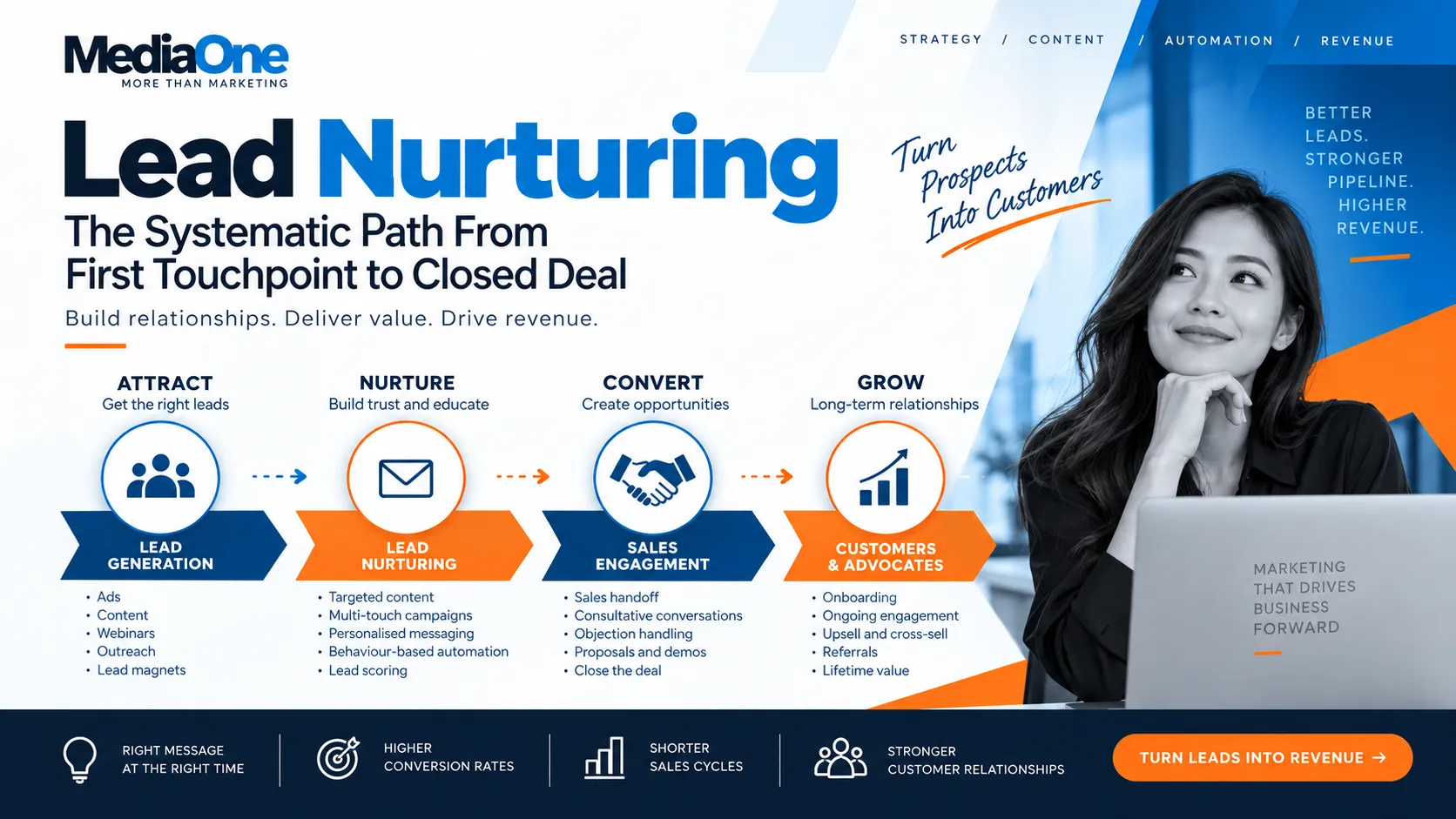
Lead nurturing follows a predictable path: a prospect moves from knowing you exist to understanding how you solve their problem, to deciding to buy, and finally to becoming a repeat customer or referral source.
The funnel has four distinct stages. Each stage has a different job. Each requires different content, messaging cadence and success metrics. A prospect stuck at Stage 2 (Consideration) needs education about how your solution works; pushing them a sales pitch will backfire. Moving them forward requires precision, not volume.
Understanding this progression lets you stop treating all leads the same way. Instead, you route prospects to the content and touchpoints they actually need.
Stage 1: Awareness and Building Initial Trust
A prospect in the Awareness stage has a problem. They do not yet know you have a solution.
Your job at this stage is two-fold: earn trust and confirm relevance. A prospect who lands on your website from a search, LinkedIn ad or industry event is evaluating whether you understand their world. Generic welcome messages and immediate sales calls fail here.
Awareness-stage nurturing is about demonstrating knowledge without asking for commitment.
Content and approach: Educational content is your primary tool. A prospect who downloaded a guide on “Common Errors in Your Current Process” is signalling that problem recognition exists. Your follow-up should validate that problem, acknowledge the cost of ignoring it and introduce relevant frameworks or benchmarks they can use.
Tone matters at this stage. You are a peer and educator, not a vendor. Language that shows you have helped others in their industry (without naming clients, for confidentiality) builds trust faster than product features.
Cadence: Send one or two emails in the first week, then space them out to every 10-14 days. Prospects in Awareness are not sales-ready. Over-mailing here breeds unsubscribes or worse, a “not interested” label that damages your sender reputation.
Practical next step: Map the three to five most common entry points to your nurturing programme (e.g., webinar signup, guide download, career page visit). Create a three-email sequence for each that positions your expertise and introduces one key insight. Do not mention your product. Set the send schedule in advance.
Stage 2: Consideration and Solution Education
A prospect reaches Consideration when they have defined their problem and begun researching solutions.
At this stage, they are comparing approaches. They might weigh build versus buy or evaluate competing vendors. Your role shifts from problem validation to solution education.
Consideration-stage content is more specific. A prospect who is now asking “How do we solve this?” needs to understand your methodology, how your approach differs from alternatives and what success looks like when it works.
Content and approach: Deliver comparison frameworks, case studies showing clear before-and-after metrics and in-depth product walkthroughs (recorded demos, feature guides, workflows). These are not generic assets. They should address the specific solution path this prospect is likely to take.
Example: If a prospect in your database works in logistics, send a case study featuring a logistics company, not a generic “here is how a client improved efficiency”. Personalisation at this stage drives measurable lift in click-through and engagement rates.
Engagement signals matter here. A prospect who has opened three emails, visited your pricing page and watched a product demo is moving toward sales-readiness. Track these behaviours so sales can time their outreach.
Cadence: Move to weekly touchpoints. A prospect in consideration is actively searching for solutions. They expect regular communication from vendors they are seriously evaluating. Your sequence should last 4-6 weeks, ending with a low-friction conversation offer (a brief consultation call, not a pressure sales pitch).
Practical next step: Create a segment-specific nurture sequence for your top two buyer personas. Include at least one case study, one comparison framework and one product-focused asset. Set up a lead score trigger that alerts sales when a prospect has engaged with 70% of the sequence.
Stage 3: Decision and Removing Final Objections
A prospect in the decision stage is ready to commit. They have narrowed their options. What remains are objections: price concerns, implementation risk, internal alignment or uncertainty about ROI.
Your job at this stage is surgical. You are not educating. You are unblocking.
The most common objections at this stage are predictable. A procurement team needs budget justification. A technical lead needs assurance that integration will not disrupt operations. Finance needs to understand total cost of ownership. Decision makers need stakeholder buy-in frameworks.
Your nurturing here should address these objections directly, not make the prospect ask for answers.
Content and approach: Develop decision-stage assets that tackle objections head-on. An ROI calculator lets a prospect model savings in their own numbers. A risk mitigation checklist reassures the technical lead. A stakeholder alignment template helps their champion build internal support.
Video testimonials from similar companies, especially those the prospect recognises, carry weight. Written case studies pale in comparison to hearing a peer say, “This investment is worth it.”
At this stage, a single email containing multiple pathways forward (book a call, download the ROI calculator, watch customer testimonials, read FAQs) is more effective than a series of separate emails. The prospect is moving quickly. Friction kills deals.
Cadence: Two high-value touchpoints per week, each offering a clear next step. This is no longer a sequence. This is active, sales-led engagement. Marketing’s role is to provide the assets sales uses to move the deal forward.
Practical next step: Audit your lost deals from the past year. Identify the three most common reasons prospects said no. Create a one-page rebuttal for each (pricing objection: ROI calculator; implementation risk: customer timeline comparison; internal alignment: stakeholder briefing template). When sales flags a prospect facing one of these objections, send the corresponding asset within one business day.
Stage 4: Advocacy and Customer Retention
The funnel does not end at purchase. Advocacy-stage nurturing has two goals: maximise customer success and turn them into referral sources.
A new customer is still absorbing how to use what they have bought. They are evaluating whether it met their expectations. If this handoff is sloppy, buyer’s remorse sets in, and they churn.

Post-purchase nurturing keeps them engaged, accelerates time-to-value and primes them to refer.
Content and approach: Onboarding sequences should be outcome-focused, not process-focused. Instead of “Here is how to log in,” send “Here is the quick win you should achieve in Week 1, and here is how.” Milestone-based touchpoints (first week, first month, 90 days) that celebrate progress and introduce the next phase build momentum.
Later, referral nurturing takes over. Customers who have achieved measurable results are the best referral sources. An email that says “Based on the savings you achieved, here are three peers I think would benefit from a conversation” is far more effective than a generic “refer a friend” appeal.
Case study invitations should come when a customer is at peak satisfaction, not months later. A customer who hit their target in 90 days is excited to share. A customer fighting to see ROI will decline politely.
Cadence: Fortnightly touchpoints for the first three months, then monthly. Focus on success milestones, not product updates. Introduce your customer success team as a partner, not just as a support function.
Practical next step: Design a post-sale nurture calendar for your first 90 days. Include at least one congratulatory milestone email, one “here is your biggest opportunity next” email and one early case study or referral conversation email. Test this with your next five customers and track net promoter score before and after implementation.
Stage-to-Stage Progression Framework
The table below shows what each stage is testing for and how you know it is working.
| Stage | Primary Goal | Key Content Types | Success Signal | Typical Duration |
|---|---|---|---|---|
| Awareness | Build trust and confirm relevance | Educational guides, frameworks, benchmarks | Opens, downloads, return visits | 2-3 weeks |
| Consideration | Educate on solutions and differentiation | Case studies, demos, comparisons, walkthroughs | Engagement with product content, pricing page visits | 4-6 weeks |
| Decision | Remove objections and unblock buy-in | ROI tools, testimonials, risk frameworks, FAQs | Lead score threshold reached, sales conversation scheduled | 1-2 weeks |
| Advocacy | Maximise success and activate referrals | Milestone emails, case study invites, customer spotlights | Retention, case study completion, referral generation | Ongoing |
The transition between stages should not be binary. A prospect does not wake up “in consideration”. Instead, behavioural signals (content viewed, time on page, frequency of engagement) are your transition markers. Map these into your lead scoring model so sales knows which prospects are ready for a conversation and which still need nurturing.
Core Lead Nurturing Tactics That Work
The difference between a lead nurturing programme that stalls and one that converts comes down to execution. Theory matters, but the tactics you deploy across each funnel stage determine whether prospects move forward or drop away.
These five tactics form the backbone of modern lead nurturing. Used together and measured rigorously, they remove friction at every step of the buyer journey.
Email Sequencing and Multi-Touch Campaigns
Email remains the highest-ROI channel in lead nurturing. Not because everyone loves email, but because it is the only channel where you own both the list and the message. No algorithm decides who sees your content.
An effective email sequence follows a clear logic: each email answers a specific objection or builds on the previous one. It doesn’t repeat the same ask five times in different words.
A three-email starter sequence might follow this structure:
Email 1 (Day 0): Establishes relevance to their stated pain point. References what they downloaded or which content they engaged with. No immediate ask. Goal: open trust and permission to continue.
Email 2 (Day 3): Introduces a framework, case example or third-party validation that addresses the problem. Moves from problem acknowledgement to solution thinking. Soft call to action: watch a video, read a guide, not “book a demo”.
Email 3 (Day 7): Removes a specific objection (cost, time to implement, team adoption). Shows how peers solved it. Stronger call-to-action: webinar, consultation or product walkthrough.
Each email assumes the reader deleted the previous one. It stands alone. Subject lines shift from curiosity (Email 1) to benefit (Email 2) to urgency (Email 3).
Multi-touch campaigns layer email with other channels. The same prospect receives an email on Tuesday, sees a retargeted ad on Wednesday and gets a LinkedIn message on Friday. Not the same message across channels: different angles, different evidence. The cumulative effect is a reminder without bombardment.
Track open rate (baseline: 20-35% for B2B), click rate (2-5%) and progression to next stage (the only metric that matters). A high-open, low-click sequence tells you the subject line works but the copy does not.
Personalised Content Based on Behaviour and Engagement
Generic nurture fails because it assumes all leads face the same obstacles. They don’t.
A software lead who downloaded a pricing guide has different intent than one who read a case study. A prospect who opened three emails but never clicked needs a different nudge than one who engaged deeply but went silent.
Behavioural personalisation means your nurture content changes based on what the prospect actually did.
Build this into your automation platform (HubSpot, Marketo, Pardot, or Klaviyo) using conditional logic:
- If the prospect downloaded the pricing guide: Next email addresses ROI questions and cost justification frameworks, not education on the problem.
- If the prospect attended the webinar but didn’t download follow-up: Send a summary email with the three key takeaways in text form (not a link). Lower friction to consume value.
- If the prospect opened 4+ emails but never clicked: Switch to a different medium (SMS, LinkedIn, or webinar invite). Email fatigue is real. Change the format.
- If the prospect is engaged, then silent for 14 days: Trigger a re-engagement sequence with a time-limited offer or new content angle. Don’t assume they bought elsewhere.
This requires integration between your email platform and your CRM. The platform must track not just opens and clicks, but page views on your website, content downloads, event attendance and support requests.
Segment your nurture list into at least 3-5 cohorts based on engagement level and behaviour. Run each segment through a tailored sequence. You will see 15-25% higher conversion rates than a single one-size-fits-all stream.
Account-Based Marketing for High-Value Prospects
ABM inverts the funnel. Instead of broad lead generation that feeds a nurture programme, you identify high-value accounts first, then build personalised nurture around each one.
This tactic applies when deal values are significant (typically GBP 50,000+), and sales cycles are long (6-12 months). It is not practical for low-ticket, high-volume businesses.
The ABM nurturing playbook follows these steps:
- Identify target accounts (usually 20-100 depending on your market and team size). These are organisations that fit your ideal customer profile: size, industry, revenue, and technology stack.
- Research stakeholders: Who are the decision makers, influencers and end users? Build a contact list. Learn what they care about: Q2 earnings pressure, M&A activity, compliance deadlines, and product roadmaps.
- Build account-level content: Create emails, landing pages and assets that speak directly to their business situation, not generic vertical messaging. Name specific competitors they might be evaluating. Reference their public filings or recent news if relevant.
- Coordinate multi-stakeholder outreach: Don’t send the same sequence to the CFO and the VP of Operations. The CFO cares about ROI and risk. The VP cares about adoption and team impact. Nurture them in parallel with aligned but distinct messaging.
- Track account-level engagement: Not just lead-level metrics. Measure how many stakeholders from the account are engaged, which content assets drive the most activity and when engagement reaches a threshold that suggests readiness for a sales conversation.
ABM nurturing is more labour-intensive than broad campaigns. But it converts at 2-3x the rate of traditional lead nurturing because the relevance is surgical.
Tools like Demandbase, 6sense and LinkedIn Account Insights identify firmographic data and buying signals at account level. Your marketing automation platform then delivers personalised content to each contact within the target account.
Lead Scoring to Identify Sales-Ready Opportunities
Nurturing only works if you know when to stop nurturing and hand a lead to sales.
Lead scoring assigns points based on behaviour and profile fit. When a lead hits a threshold, it is sales-ready.
Build your scoring model in three parts:
Explicit score (profile fit):
- Company size: 5 points if 50-500 employees, 10 points if 501-2000, etc.
- Industry: 10 points if in target verticals, 0 if not.
- Revenue: Adjust points based on typical deal size.
- Geography: 5 points if in your primary market (e.g., UK, Europe, APAC).
This total rarely changes. It reflects whether the account is worth your sales time.
Implicit score (engagement and intent):
- Email open: 1 point.
- Email click: 5 points.
- Landing page visit: 3 points.
- Demo request: 20 points.
- Asset download: 2 points.
- Webinar attendance: 10 points.
- Return visit within 7 days: 3 points.
- Time spent on website (more than 3 minutes): 5 points.
Points decay over time. An action from 2 weeks ago counts less than one from 2 days ago. This keeps the score dynamic and relevant.
Negative score (friction signals):
- Unsubscribe: -20 points (remove from nurture immediately).
- Hard bounce: -10 points.
- Spam complaint: -15 points.
- Title/company mismatch (wrong stakeholder type): -5 points.
Set a threshold: when a lead reaches, say, 50 points, it is sales-ready. Transfer it to your CRM with a flag and alert your sales team.
The threshold varies by business. A long-cycle enterprise deal might require 75 points; a 12-month mid-market deal might trigger at 50. Test your threshold over 3-6 months and adjust based on conversion rate and sales feedback.
Document this model. Without it, you risk sending leads to sales too early (wasted sales time on unripe prospects) or too late (by then they have bought elsewhere).
Strategic Touchpoints Across Owned, Earned and Paid Channels
The most effective nurture programmes do not live in email alone. They orchestrate touchpoints across three channels:
Owned channels (email, website, content hub, community, SMS): Full control over message and timing. Highest permission and trust, but lowest reach. Use for the primary nurture sequence and personalised follow-up.
Earned channels (PR, thought leadership, partner coverage, referrals, reviews): Third-party validation. When a prospect sees your name in an industry publication or hears your name from a peer, it carries weight. Plan to seed case studies, research reports or executive commentary into industry media at key moments in your sales cycle. Earned channels often close deals after owned and paid have warmed the prospect.
Paid channels (display advertising, LinkedIn ads, retargeting, SEM): Reach prospects who haven’t given you permission yet. Reinforce messaging across the web. If a prospect sees your value prop in email and again on a LinkedIn ad, the message sticks. Use paid to top-of-funnel awareness, then nurture through owned channels.
An example nurture calendar across channels:
- Week 1: The email sequence starts after the lead signs up.
- Weeks 1-4: Retargeting banner ads run on industry publication sites and LinkedIn.
- Week 2: A third-party case study in a trade publication is published, courtesy of PR.
- Week 3: LinkedIn Sponsored InMail reaches the prospect with a different angle on the same problem.
- Week 4: The second email sequence builds on the credibility earned in Week 2.
- Week 6: Promote a webinar co-hosted with a well-known analyst firm via paid ads.
Each touchpoint serves a specific function. Email educates and asks for action. Paid reminders and reach. Earned validates. Together, they reduce the perceived risk of buying from you.
Measure the pipeline influenced by each channel, not just attributed conversions. A display ad might not drive a click, but if a prospect saw it the day before opening an email, it supported the conversion. Attribution models like multi-touch or time-decay credit support that.
Action checklist:
- [ ] Audit your current nurture emails. Can each stand alone? Do they follow the problem-solution-objection-ask framework?
- [ ] Map your current lead behaviour data in your CRM: opens, clicks, page views, and downloads. Are you tracking these in your marketing automation platform?
- [ ] Identify 5-10 high-value accounts where ABM might apply. Brief your sales team on the accounts you have chosen.
- [ ] Build an explicit and implicit lead-scoring model. Test it against your last 50 conversions. Does it predict which ones moved to sales-ready?
- [ ] Plot your nurture touchpoints across owned, earned and paid channels for the next 30 days. Do they reinforce each other or contradict?
Technology Stack for Effective Lead Nurturing
Building a lead-nurturing programme without the right tools is like trying to manage a multi-stage sales process using spreadsheets and memory. The wrong stack creates bottlenecks, data silos and lost opportunities. The right one automates repetitive touchpoints, surfaces sales-ready leads and gives you visibility into which campaigns actually drive pipeline.
Marketing Automation Platforms
A marketing automation platform (MAP) powers lead nurturing. It lets you build workflows that trigger emails, update lead scores and alert sales based on prospect behaviour, all without manual intervention.
The main contenders serve different team sizes and budgets:
| Platform | Ideal for | Key Strength | Pricing Model |
|---|---|---|---|
| HubSpot | Mid-market, revenue-focused teams | Tight CRM integration; free tier available | Free to ~SGD 4,500/month (pay-as-you-grow) |
| Marketo (Adobe) | Large enterprises with complex workflows | Advanced segmentation and multi-touch attribution | ~SGD 1,750+/month (enterprise) |
| Klaviyo | E-commerce and subscription businesses | Behaviour-triggered campaigns; strong analytics | Pay-per-contact (~SGD 25-400/month) |
| ActiveCampaign | SMBs, agencies | Automation builder; good CRM features | ~SGD 20-300/month (contact-based) |
| Pardot (Salesforce) | Salesforce-native B2B teams | Native SFDC sync; account-based marketing | ~SGD 1,750+/month (enterprise) |
| ConvertKit | Creator/solopreneur nurture | Simple sequences; subscriber focus | ~SGD 40-110/month (flat) |
What matters most isn’t the tool itself, but whether it connects cleanly to your CRM, supports the complexity of your workflows, and integrates with the channels you actually use. A more expensive platform won’t save you if your sales and marketing teams never talk.
For Singapore-based teams, HubSpot and ActiveCampaign have strong Asia-Pacific support. Marketo and Pardot require enterprise licensing, which is rarely cost-effective for early-stage programmes. Evaluate local data residency options if you work with PDPA-regulated customer data.
CRM Integration and Data Hygiene
Your MAP and CRM must sync bidirectionally and in real time. Without this, you nurture incomplete or stale records and sales never sees the engagement data that matters.
Critical data flows:
- A lead created in CRM is automatically added to the nurture workflow in MAP.
- Prospect opens email and lead score increases in CRM.
- The prospect downloads a resource, and the sales team receives a notification that the lead is warm.
- Sales adds a note, and MAP respects it and pauses further nurturing.
Data hygiene checklist:
- Define a single source of truth for each field (e.g., is industry stored in CRM or MAP?). Duplication creates conflict and confusion.
- Implement validation rules that prevent bad data at entry (e.g., reject emails without a domain, require a company name before a lead is marketable).
- Run monthly audits on bounced email addresses, duplicate records and fields that are blank more often than filled. Junk data degrades lead scores and wastes send volume.
- Set up a “data refresh” workflow that re-engages dormant leads with a single, high-value offer before removing them. Don’t just let dead records sit.
Asia-Pacific data regulations: Singapore’s PDPC enforces the Personal Data Protection Act, which requires explicit consent before nurturing. Ensure your MAP tracks consent status per contact and respects opt-out requests within 30 days. If you nurture across regions, check whether GDPR (EU) or similar rules apply to any contacts.
Analytics and Attribution Tracking
You need to know which nurture touchpoints, channels and messages actually drive deals. Without attribution, you cannot optimise, justify budget or align sales and marketing.
Three attribution models that work for nurturing:
- First-touch credits the initial campaign that brought in the lead. Useful for understanding which demand-generation channels fuel your pipeline.
- Last-touch credits the final touchpoint before conversion. Simplistic, but highlights which messages close the gap.
- Multi-touch (weighted) distributes credit across all touchpoints a contact experienced. More accurate for long sales cycles, where nurturing truly does move the needle.
Most maps and CRMs default to last-touch, which often misfires in B2B. A contact might open 12 nurture emails and then close because sales made a strong pitch. Assigning 100% credit to “salesperson” ignores the 12 weeks of education and trust-building that enabled the conversation.
Metrics to track at minimum:
- Nurture engagement rate: Percentage of recipients who open, click or download within a sequence.
- Time to conversion: Average days from first touch to SQL (sales-qualified lead) or deal close.
- Pipeline influence: Revenue attributed to prospects who were in a nurture workflow, even if they convert through another channel.
- Cost per qualified opportunity: Total MAP + content + labour divided by number of SQLs generated by nurturing.
Set baselines after four weeks of data. Most B2B nurture campaigns see open rates between 25% and 45%, depending on list quality and relevance.
Data Privacy and Compliance for Singapore and Beyond
Singapore’s Personal Data Protection Act governs how you collect, store and nurture prospect data. Non-compliance carries fines and legal liability.
Key requirements affecting your nurture stack:
- Consent: You must have explicit consent (tick-box, not pre-ticked) before adding someone to a nurture sequence. A form submission or website visit is not consent.
- Opt-out: Provide a clear, functional unsubscribe link in every email. Process opt-outs within 30 days. Nurturing expired contacts damages sender reputation and violates the law.
- Data minimisation: Collect only the data you actually need to nurture effectively. Name, email and company are usually enough. Don’t ask for personal data fields if you won’t use them.
- Security: Your MAP must encrypt data in transit and at rest. If you use a third-party platform, ensure it has signed a data processing agreement (DPA) or data protection addendum (DPA).
- Cross-border transfers: If you nurture contacts in the EU, GDPR applies. If you nurture in Australia, the Privacy Act applies. Different rules require different consent mechanics. Choose a MAP with built-in compliance for your regions.
Many marketing platforms now include consent management tools. HubSpot, ActiveCampaign and Klaviyo all have PDPA, GDPR and CCPA compliance features built in. Verify that your chosen platform provides audit trails and consent records that you can provide to regulators if asked.
Measuring and Optimising Lead Nurturing Performance
Key Performance Indicators for Lead Nurturing
Not all metrics matter equally. Vanity metrics like email opens feel good but don’t predict revenue. The metrics below do.
Stage progression rate: What percentage of leads move from Awareness to Consideration, Consideration to Decision, and Decision to close? This is your most important metric. If 40% move from Awareness to Consideration but only 10% move from Consideration to Decision, the bottleneck is obvious: your Consideration-stage content is weak.
Track this in your CRM or MAP using custom fields or lead statuses. Set a target: typically 25-40% stage-to-stage progression is healthy in B2B.
Conversion rate by stage: Measure the percentage of prospects in each funnel stage who become customers within 6 months. This reveals where nurturing is strongest and where it breaks down.
Example benchmark:
- Awareness to customer (within 6 months): 5-8%
- Consideration to customer (within 6 months): 15-25%
- Decision to customer (within 6 months): 40-60%
If your consideration-to-customer rate is 10% (below benchmark), test new case studies or product walkthroughs in that stage. If your decision rate is 30%, your objection-handling content needs work.
Lead velocity: Days from lead generation to qualified opportunity (SQL). Shorter is better. If your average is 90 days and the industry benchmark is 60, your nurturing is too slow. Increase email frequency, add webinars or shift content earlier in the sequence.
Track this monthly. You should see incremental improvement as you optimise sequences.
Pipeline influence: Revenue attributed to nurtured leads divided by total pipeline revenue. This shows how much of your growth is driven by nurturing versus other sources (direct sales, partnerships, inbound).
Example: If you generated SGD 5 million in pipeline and nurtured leads influenced SGD 2 million of that, nurturing’s pipeline influence is 40%. That’s typically in the healthy range for most B2B businesses.
Customer acquisition cost (CAC) for nurtured vs non-nurtured: Calculate total marketing spend divided by customers acquired. Compare CAC for leads that went through nurturing versus those that went straight to sales.

In most cases, nurtured leads have lower CAC because they convert at higher rates, so the cost per sale is lower even though you invested in more touchpoints.
Email metrics that matter:
- Open rate by segment (not aggregate): A 20% aggregate open rate masks the fact that your Consideration segment opens at 35% while Awareness opens at 12%. This suggests front-loading your best content in the Awareness stage.
- Click-to-open rate (CTR/OR): Emails that people open but don’t click reveal copy or CTA problems, not subject line problems.
- Unsubscribe rate: More than 0.5% per send suggests your content is irrelevant or your cadence is too aggressive. Reduce frequency or improve relevance.
- Spam complaints: More than 0.1% per send signals bad list quality or content that feels “salesy”. Clean your list and soften messaging.
A/B Testing Framework for Continuous Improvement
The highest-performing nurture programmes test continuously. Not every sequence works perfectly from day one. A/B testing reveals what actually resonates with your audience versus what you think should work.
What to test and when:
Subject lines (earliest win): Test two subject lines against 10-20% of your list. Send the winner to the remaining 80%. This is the fastest way to lift open rates. Run a new test every week for the first month, then monthly thereafter.
Example test:
- A: “How to reduce costs by 40% in 90 days”
- B: “Cost reduction: a 3-step framework”
- Winner: Usually the benefit-driven subject line (A) wins. But test yours.
Email copy and CTA (second priority): Test call-to-action text (“Book a demo” vs “See a 5-minute demo”), offer type (free resource vs scheduled call) or content tone (educational vs benefit-driven).

Example test:
- A: [Email with “Book a 30-minute demo” CTA]
- B: [Same email with “See how we solved this for [Company]” + link to case study]
- Measure: Which CTA drives more clicks? Which sends more leads to sales? (They may differ.)
Send time and day: Test Tuesday 9am vs Thursday 2pm. Different industries and geographies respond differently. What works for your Singapore financial services audience may not work for your US tech audience.
Content type and asset (lower priority): Test a case study versus a webinar invitation versus an ROI calculator in the same position in your sequence. This is labour-intensive, so run fewer of these tests. Run one per quarter.
How to run tests reliably:
- Sample size: 1,000+ leads per variant. Small sample sizes (100 leads) show high variance. Your “winner” may just be statistical noise.
- Duration: Run for at least one week. Some opens happen days after you send the email. If you cut off the test too early, you’ll miss engagement.
- Control variable: Change only one thing per test. If you test both the subject line and CTA, you won’t know which drove the lift.
- Statistical significance: Aim for 90-95% confidence. Most email platforms calculate this automatically.
- Document winners and apply them**: Keep a test log. Note the winning variant and why it won. Use insights in future sequences.
Quarterly Business Review Framework
Every quarter, sit down with your sales and marketing leadership and review nurturing performance end to end. Don’t bury nuance in reports. Use these meetings to ask, “What changed? What worked? What should we stop doing?”
Standard QBR agenda:
- Pipeline generated by nurturing (past quarter, YTD, last year): Position nurturing as a pipeline engine, not a cost centre. Quantify contribution.
- Stage progression trends: Are leads moving faster through the funnel? Which stages are bottlenecks?
- Top-performing sequences and assets: Which emails, case studies or webinars are driving engagement? What made them work?
- Sales feedback: Ask sales what the best-nurtured leads look like. Are they more prepared? Do they have fewer objections? Are they more likely to close?
- Competitive loss analysis: In deals you lost, how often did the prospect come from nurturing? Did nurturing falter, or did a competitor simply win on product fit?
- Budget allocation for next quarter: Based on performance, should you increase content investment? Shift spend to high-performing channels? Expand to new segments?
- Roadmap for next quarter: Commit to specific tests, new sequences or content pieces. Hold yourselves accountable.
Use templates and dashboards, not raw data. Executives need insight, not noise. Show charts, not tables. Highlight changes quarter-over-quarter, not absolute numbers.
Common Lead Nurturing Mistakes and How to Avoid Them
Most lead nurturing programmes fail not because of technology or strategy, but because of easily avoided mistakes. Learning from others’ missteps can save you months and thousands in wasted spend.
Mistake 1: Treating All Leads the Same
A lead that came from a webinar on “Implementing Enterprise Software” is not in the same place as a lead that came from a “What Is SaaS?” blog post.
The first is likely in consideration. Send them case studies and product demos. The second is in Awareness. Send them educational content and problem frameworks.
Sending the Awareness lead a demo request email wastes both their time and yours. They unsubscribe. Your sender reputation suffers.
Fix: Create an entry-level nurture sequence (3-5 emails) that moves leads from Awareness to Consideration. Only after they engage with that sequence do they move into your
nurture programme for solution-specific content.
The key is progression. Do not ask every lead to take the same next step. Match the message to what they already know and what they need to understand next.
Mistake 2: Sending Too Much, Too Quickly
More communication does not automatically create more conversions.
A prospect who downloads one guide does not need five emails, two LinkedIn messages and a sales call within 48 hours. That feels less like nurturing and more like pursuit.
Over-communication creates three problems:
- Prospects unsubscribe before they become sales-ready.
- Your brand starts to feel aggressive rather than helpful.
- Genuine buying signals become harder to identify because you are generating engagement artificially through excessive contact.
Cadence should reflect intent.
A prospect who has downloaded an introductory guide might receive one email every 7-14 days. Someone repeatedly visiting your pricing page, attending a webinar and reviewing case studies can tolerate and often benefit from more frequent communication.
The more buying intent a prospect demonstrates, the more closely you can engage.
Fix: Build different cadence rules for different stages.
For example:
- Awareness: One useful touchpoint every 7-14 days.
- Consideration: Approximately one touchpoint per week.
- Decision: One or two targeted interactions per week, coordinated with sales.
- Inactive lead: Reduce frequency or enter a long-term nurture programme.
Do not increase frequency simply because a prospect has failed to respond. Silence is not necessarily an invitation to send more emails.
Mistake 3: Making Every Touchpoint a Sales Pitch
A nurture programme fails quickly when every email asks the prospect to book a demo, speak to sales or buy something.
Nurturing works because value comes before the transaction.
Someone in the early stages of research may not yet understand:
- The full extent of their problem.
- What solving it is worth.
- Which approaches are available.
- How different solutions compare.
- What internal changes are required.
- How they will justify the purchase internally.
Your content should help them answer those questions.
A prospect who receives useful frameworks, benchmarks, checklists and case studies has a reason to continue opening your emails even when they are not ready to buy.
A prospect who receives five versions of “Would you like a demo?” does not.
A useful guideline is to ask yourself one question before every nurture touchpoint:
Would this still be valuable if the prospect never bought from us?
If the answer is yes, the content is probably useful.
If the answer is no, it may simply be another sales message disguised as nurturing.
Fix: Create a value-to-promotion ratio. For every direct sales request, provide several touchpoints that educate, demonstrate expertise or solve a small part of the prospect’s problem.
You are earning the right to ask for the meeting.
Mistake 4: Failing to Respond to Behaviour
Many nurture programmes are designed as rigid sequences.
Email 1 goes out on Day 1.
Email 2 goes out on Day 4.

Email 3 goes out on Day 8.
Email 4 goes out on Day 15.
The prospect’s behaviour changes nothing.
This wastes one of marketing automation’s biggest advantages.
Suppose a prospect receives your second nurture email and immediately:
- Visits your website.
- Reads two case studies.
- Visits the pricing page.
- Returns the following morning.
- Requests an implementation guide.
That prospect should not have to wait six days for Email 3.
Their behaviour indicates that they have accelerated through the buying journey.
Likewise, someone who hasn’t opened emails for six weeks shouldn’t keep receiving the same high-frequency sequence.
Modern nurturing should be behaviour-triggered, not calendar-controlled.
Fix: Create automation branches around meaningful behaviours.
Examples:
- Pricing-page visit → send ROI or pricing-related content.
- Case-study engagement → send a closely related customer example.
- Webinar attendance → send implementation or solution content.
- Demo request → immediately exit marketing nurture and alert sales.
- No engagement for 30 days → move to low-frequency nurture.
- Repeated website visits → increase lead score.
- Unsubscribe → suppress all promotional communication immediately.
The sequence should adapt to the prospect, not force the prospect to adapt to the sequence.
Mistake 5: Using Lead Scores Without Sales Feedback
A lead scoring model can look sophisticated while being completely wrong.
Marketing may decide that 50 points means a prospect is sales-ready.
The sales team receives those leads and discovers that half are students downloading research reports, junior employees without buying authority, or companies far outside the target customer profile.
The scoring system is technically working. It is simply measuring the wrong things.
Lead scoring should never exist independently from actual closed deals.
If prospects with a score of 80 rarely convert while prospects scoring 45 repeatedly become customers, your scoring model is not predictive.
The purpose of scoring is not to produce a number.
The purpose is to identify prospects worth sales attention.
Fix: Review scoring performance with sales every month.
Take leads passed to sales and divide them into:
- Accepted opportunities.
- Rejected leads.
- Opportunities created.
- Deals won.
- Deals lost.
Then examine which attributes and behaviours were common among the prospects that progressed.
Increase the weighting of signals that correlate with real revenue.
Reduce or remove signals that look impressive but do not predict buying.
For example, an email open may deserve one point. A pricing-page visit might deserve five. A request for a proposal might deserve 20.
The weighting should reflect actual buying behaviour, not marketing intuition.
Mistake 6: Ignoring Lead Decay
Interest has a shelf life.
A prospect who visited your pricing page three times this week is not the same as someone who did the same thing six months ago.
Yet many lead scoring models treat those behaviours identically.
This creates inflated scores from historical activity.
A lead may appear highly engaged because they accumulated 60 points over the past year even though they have done nothing for the last three months.
Lead scores should therefore decay.
Recent activity should carry more weight than old activity.
For example:
- Activity within 7 days: 100% of assigned points.
- Activity 8-30 days old: 75%.
- Activity 31-60 days old: 50%.
- Activity 61-90 days old: 25%.
- Activity older than 90 days: remove or heavily discount.
You do not need this exact model. The principle matters more than the percentages.
Fix: Add time decay to your scoring rules and create reactivation campaigns for dormant high-fit leads.
Someone who matched your Ideal Customer Profile six months ago may still be valuable. They simply should not be treated as if they demonstrated purchase intent yesterday.
Mistake 7: Poor Marketing-to-Sales Handoff
A nurturing programme can perform perfectly and still fail at the final step.
Marketing identifies a sales-ready prospect.
The CRM assigns it to a representative.
Nothing happens for three days.
By then, the prospect has spoken to two competitors.
This is not a nurturing problem. It is an operational problem.
The handoff between marketing and sales must be defined as clearly as the nurture journey itself.
Sales needs to know:
- Why the lead was passed.
- Which content they consumed.
- Which pages they visited.
- What problem they appear interested in solving.
- Their lead score.
- Their company profile.
- Which action triggered the handoff.
Without this context, the salesperson starts the conversation from zero.
Instead of saying:
“We saw you downloaded something from our website. Would you like a demo?”
They should be able to say:
“I noticed you’ve been looking at our material around reducing implementation time and recently viewed the case study on enterprise deployment. Is implementation speed something you’re currently evaluating?”
That conversation begins several steps further ahead.
Fix: Establish a service-level agreement between marketing and sales.
For example:
- Marketing passes leads once they cross the agreed scoring threshold.
- The CRM includes engagement history and qualification context.
- Sales makes the first attempt within one business day.
- Sales records whether the lead was accepted or rejected.
- Rejected leads return to an appropriate nurture stream with a reason code.
The feedback loop is essential. Without it, marketing cannot improve qualification.
How to Build a Lead Nurturing Programme From Scratch
You do not need dozens of workflows to begin.
A relatively simple system can produce meaningful results if the fundamentals are correct.
Step 1: Define Your Buyer Stages
Start with the major stages a prospect moves through.
For most B2B organisations:
Awareness → Consideration → Decision → Customer
Do not create ten stages unless your sales process genuinely requires them.
For each stage, document:
- What the prospect probably knows.
- What they are trying to understand.
- The questions they are likely asking.
- The objections preventing them from progressing.
- The behaviour that indicates they’re ready for the next stage.
This becomes the foundation of your nurturing system.
Step 2: Map Existing Content to Each Stage
Audit what you already have.
You may discover that your organisation has 40 blog posts for awareness and almost nothing for decision.
Create a simple content matrix.
Awareness
- Educational articles.
- Industry reports.
- Checklists.
- Introductory webinars.
- Problem-diagnosis guides.
Consideration
- Case studies.
- Solution comparisons.
- Product walkthroughs.
- Methodology guides.
- Webinars demonstrating approaches.
Decision
- ROI calculators.
- Customer testimonials.
- Pricing information.
- Implementation plans.
- Security or compliance documentation.
- Procurement FAQs.
Do not automatically create new content.
First determine whether existing assets can be repurposed.
A 20-page report might become three emails, a short video, a LinkedIn post and an infographic.
Step 3: Create One Core Sequence
Do not start with 25 automated workflows.
Build one sequence for your most important lead source.
For example:
Day 0: Deliver the requested content.
Day 3: Send a useful insight connected to the original topic.
Day 7: Share a relevant case study or framework.
Day 14: Introduce how the problem can be solved.
Day 21: Offer a low-friction next step.
Run it.
Measure it.
Improve it.
Then create variations for other segments.
Complexity should follow evidence, not precede it.
Step 4: Add Basic Lead Scoring
Start with a small number of meaningful signals.
For example:
Fit signals
- Target industry.
- Relevant company size.
- Geographic fit.
- Appropriate job role.
Intent signals
- Multiple website visits.
- Pricing-page visit.
- Case-study download.
- Webinar attendance.
- Demo request.
- Reply to an email.
Assign simple weights.
You can improve the model after collecting real conversion data.
A basic scoring model that everyone understands is more useful than an advanced model nobody trusts.
Step 5: Define the Sales Handoff
Agree on exactly what makes a lead sales-ready.
Do not leave this to interpretation.
For example:
A lead becomes sales-ready when:
- It fits the core ICP.
- Lead score exceeds 50.
- At least one meaningful intent action occurred within 30 days.
The CRM then:
- Removes the lead from general nurture.
- Assigns the appropriate sales representative.
- Sends an alert.
- Displays engagement history.
- Starts the sales response SLA.
If sales rejects the lead, require a reason.
Those rejection reasons improve the system.
Step 6: Measure Revenue Outcomes
Do not optimise purely for open rates.
Track the entire journey.
At minimum, measure:
- Leads entering nurture.
- Leads progressing between stages.
- Leads becoming sales-qualified.
- Opportunities created.
- Deals won.
- Revenue influenced.
- Average time from lead to opportunity.
- Average time from opportunity to close.
- Cost per qualified opportunity.
Your nurture programme is successful when it produces better commercial outcomes, not merely more email engagement.
A 30-Day Lead Nurturing Implementation Plan
You can build the foundation of a functioning nurture programme within one month.
Week 1: Understand the Journey
Document:
- Your ICP.
- Primary buyer personas.
- Major lead sources.
- Typical buying stages.
- Common sales objections.
- Current conversion rates.
- Average sales cycle.
Interview sales representatives.
Ask them:
- Which leads convert fastest?
- Which leads waste the most time?
- What questions appear repeatedly?
- Why do qualified opportunities stall?
- What objections kill deals?
These answers tell you what your nurture content needs to accomplish.
Week 2: Build the Content Map
Place your existing assets into Awareness, Consideration and Decision.
Identify gaps.
Prioritise assets that remove bottlenecks.
If prospects regularly stall because they cannot justify the investment internally, an ROI tool may be more valuable than five additional blog articles.
If buyers repeatedly question implementation difficulty, produce an implementation roadmap.
Build content around sales friction, not around a publishing calendar.
Week 3: Build Automation and Scoring
Configure:
- Your initial nurture workflow.
- Stage progression rules.
- Basic lead scoring.
- CRM integration.
- Sales alerts.
- Suppression rules.
- Unsubscribe handling.
- Dormant-lead rules.
Test every workflow yourself.
Use test contacts and deliberately trigger every pathway.
Check what happens when someone:
- Opens nothing.
- Clicks everything.
- Requests a demo.
- Unsubscribes.
- Revisits pricing.
- Becomes a customer.
Automation errors at this stage can create embarrassing customer experiences later.
Week 4: Launch and Establish Baselines
Launch to a controlled segment first.
Measure:
- Deliverability.
- Opens.
- Clicks.
- Website engagement.
- Stage movement.
- Sales-qualified leads.
- Sales acceptance rate.
Do not immediately change the programme because one email performs poorly.
Collect enough data to establish a baseline.
Then begin testing one variable at a time.
Within three months, you should have enough behavioural information to make evidence-based decisions about cadence, content and scoring.
Lead Nurturing Checklist
Before launching or reviewing your nurture programme, verify the following:
Every lead is assigned to an identifiable buyer stage.
Different stages receive different content.
Marketing and sales agree on the definition of a sales-ready lead.
Lead scoring includes both fit and behavioural intent.
Older engagement loses scoring weight over time.
High-intent behaviour can move a prospect through the sequence faster.
Low-engagement prospects receive reduced communication.
Sales receives context when a lead is handed over.
Rejected sales leads return to nurturing with a reason.
Unsubscribes and consent preferences are respected.
Email engagement is measured by segment, not just in aggregate.
Performance is tied to opportunities, revenue and sales-cycle velocity.
Sequences are reviewed regularly, and outdated material is removed.
Sales feedback influences future nurturing rules.
If several of these are missing, adding more technology is unlikely to solve the problem. Fix the operating model first.
Frequently Asked Questions
What is lead nurturing?
Lead nurturing is the process of building relationships with prospects over time through relevant content, emails and other touchpoints. The goal is to educate prospects, address objections and move them gradually from initial awareness toward a purchase decision.
What is the difference between lead generation and lead nurturing?
Lead generation focuses on attracting and capturing new prospects. Lead nurturing begins after you acquire a lead and focuses on moving that prospect closer to becoming a customer. Lead generation creates opportunities, while lead nurturing helps convert those opportunities into sales.
How long should a lead nurturing campaign last?
The ideal length depends on the buying cycle. Simple purchases may require several days or weeks of nurturing, while complex B2B purchases can require several months. Continue nurturing until the prospect becomes sales-ready, disengages or moves into a longer-term nurture programme.
What content works best for lead nurturing?
The most effective content depends on the buyer’s stage. Educational guides work well during Awareness. Case studies, comparisons and demonstrations support consideration. ROI tools, testimonials, pricing information and implementation resources are particularly useful during the decision stage.
When should a nurtured lead be passed to sales?
Normally, pass a lead to sales when it shows both sufficient customer fit and meaningful buying intent. Signals can include repeated website visits, pricing-page engagement, webinar attendance, demo requests or reaching an agreed lead-scoring threshold.
How do you measure whether lead nurturing is working?
Focus on metrics connected to pipeline and revenue. Important measures include stage progression rate, lead-to-customer conversion rate, time to sales qualification, sales-cycle length, cost per qualified opportunity and revenue influenced by nurtured prospects.
Conclusion: Nurture for Progress, Not Activity
Lead nurturing is not about sending more emails.
It is about helping the right prospect take the right next step.
The best programmes combine several disciplines: accurate segmentation, useful content, behavioural data, lead scoring, automation and close coordination between sales and marketing.
Each interaction should reduce uncertainty.
Awareness content helps prospects understand the problem.
Consideration content helps them understand possible solutions.
Decision content removes the final barriers to purchase.
Lead scoring tells you when behaviour has changed.
Sales takes over when a human conversation becomes more valuable than another automated touchpoint.
The technology matters, but the operating principle is simple: pay attention to what prospects are telling you through their behaviour and respond with information relevant to where they are now.
Do that consistently, and nurturing becomes more than an email programme.
It becomes the system connecting lead generation to revenue.