SEO ROI is the profit your organic search programme earns, minus what you spend on it, divided by what you spend. The basic formula is (Gain from SEO − SEO investment) ÷ SEO investment × 100. For many Singapore firms, the real question is not how much traffic rankings will bring in but whether the website converts that traffic well enough to make it worth buying.

This guide sets out a three-gate check you can run on your own numbers. Gate 1 tests your conversion rate. Gate 2 estimates how many clicks a realistic ranking will earn. Gate 3 turns those clicks into profit and compares the result with what you spend. Each gate is a pass or a fail, so you will know exactly where the return breaks down, and what to fix first. Many firms find that their services pages convert too few visitors into paying customers, which makes the whole calculation look weak even when rankings improve. Where you want the wider frame, this breakdown of SEO versus SEM returns sets the two search channels side by side.
Key Takeaways
- Check conversion before traffic. If your site converts below 2%, fix the page before buying more visits. A rule of thumb puts a good conversion rate in e-commerce at 2% to 5%, though this varies by industry, device and shopper intent. The Submerge Digital SEO ROI calculator uses the same 2% threshold to flag pages for optimisation.
- Use the three-gate check. Test conversion, ranking reach and economics in turn, and note exactly where the return breaks down.
- Ranking position changes the answer. Backlinko’s study of four million search results gives a first-place organic result around 27.6% of clicks against 6.3% for fifth place, so the gap in leads can be large.
- Price the investment honestly. Include agency fees, staff time, content production and technical fixes, not just the retainer.
- Report a payback period. SEO gains take months to appear, so a single-month ROI figure understates the return.
What SEO ROI Is and Why It Matters
Most SEO reporting starts with traffic. The more useful starting point is whether the site can turn visits into money at all. An SEO programme only pays back when the ranking gains land on pages that convert, so conversion quality comes before traffic volume. This is the contrarian position this guide takes: for most Singapore SMEs, conversion fixes should precede spend on more traffic, because extra visits to a page that converts poorly simply buy more unconverted clicks.
Why the measurement matters
Search engine traffic is a large channel for most businesses. BrightEdge’s channel research puts organic search at 53.3% of trackable website traffic – the most-cited industry benchmark for the channel’s size, though fielded before AI Overviews reshaped result pages. A business that does not measure its SEO return is guessing whether that share is worth funding, and budgets get cut for the wrong reasons.
Measurement also protects against a common trap: celebrating rankings that bring visitors who never buy. Tracking SEO ROI forces the question of what each visit is worth to the business.
Why it is harder to prove than paid search
Paid search, such as Google Ads, shows cost and clicks on the same day. Organic gains arrive slowly, depend on rankings you do not control, and are often credited to the wrong channel in analytics. A paid campaign can be switched off and its return observed within a week. SEO needs a reporting period long enough to show a payback, and that period should be stated up front so leadership judges it fairly. The two channels’ measurement differences are set out in this Google Ads versus SEO comparison.
The Three-Gate ROI Check
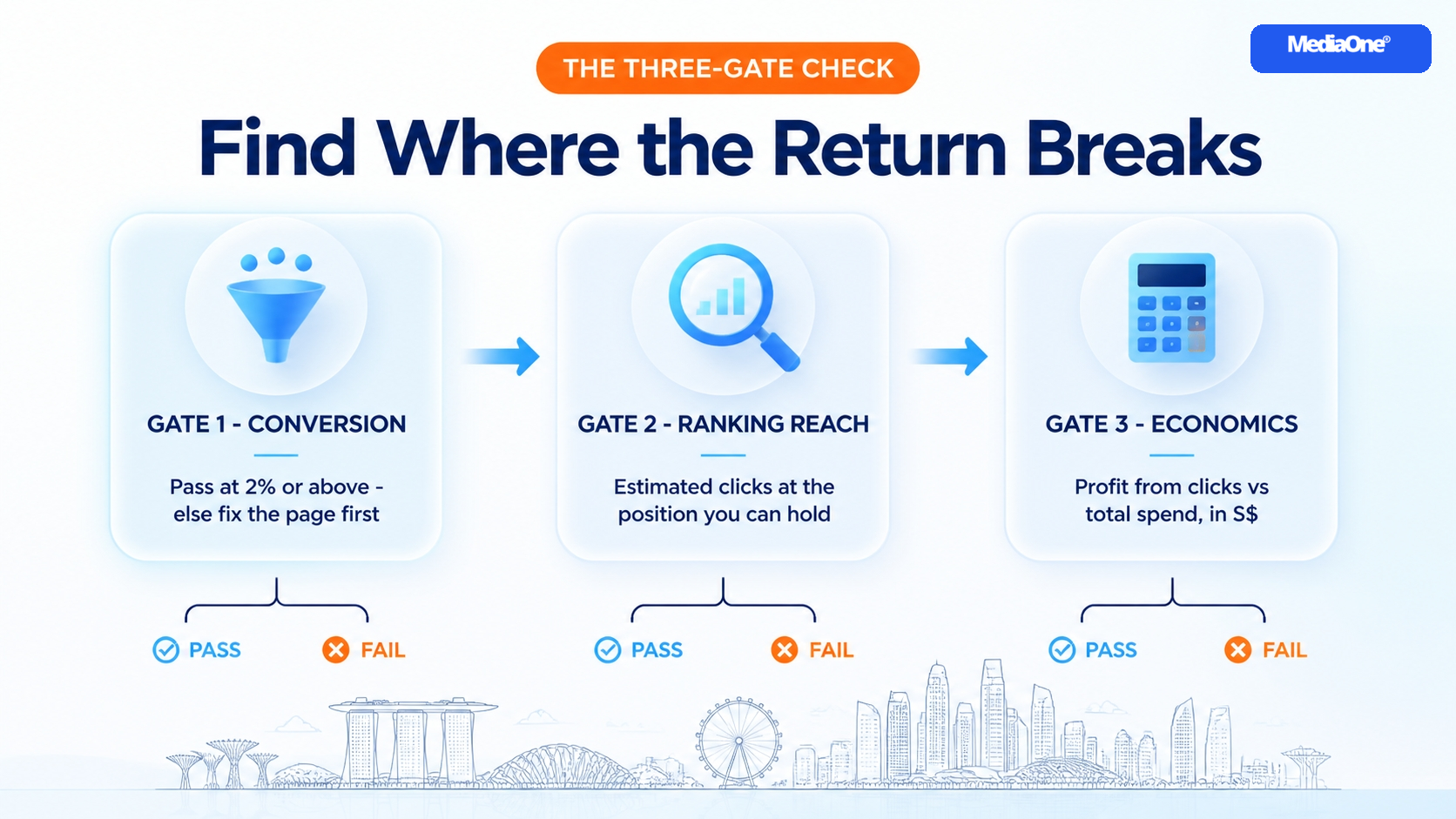
Before you calculate a return, check three things in order. Each gate is a pass or a fail.
Gate 1: Conversion. Does your website convert visitors well? Pass if your conversion rate is at or above 2%. Fail if it is below 2%, which means you should fix the page before buying more traffic.
Gate 2: Ranking reach. Can you realistically reach a position on Google that earns meaningful clicks? Pass if your target keyword’s estimated clicks at the position you can credibly hold justify the work. Fail if the search volume is too small or the position is out of reach.
Gate 3: Economics. Does the profit from those clicks exceed the SEO services investment from your digital marketing budget? Pass if the SEO ROI is positive over your reporting period. Fail if the gain does not cover the spend.
A formula applied to a site that fails Gate 1 will usually show a weak or negative return. Work through the gates in order, and fix the first one that fails. Use a business-specific ROI calculator only after the gates pass, since the results it produces are only as sound as the inputs behind them. A data-driven SEO framework keeps those inputs honest.
The SEO ROI Formula, Step by Step
The core formula
The standard calculation is:
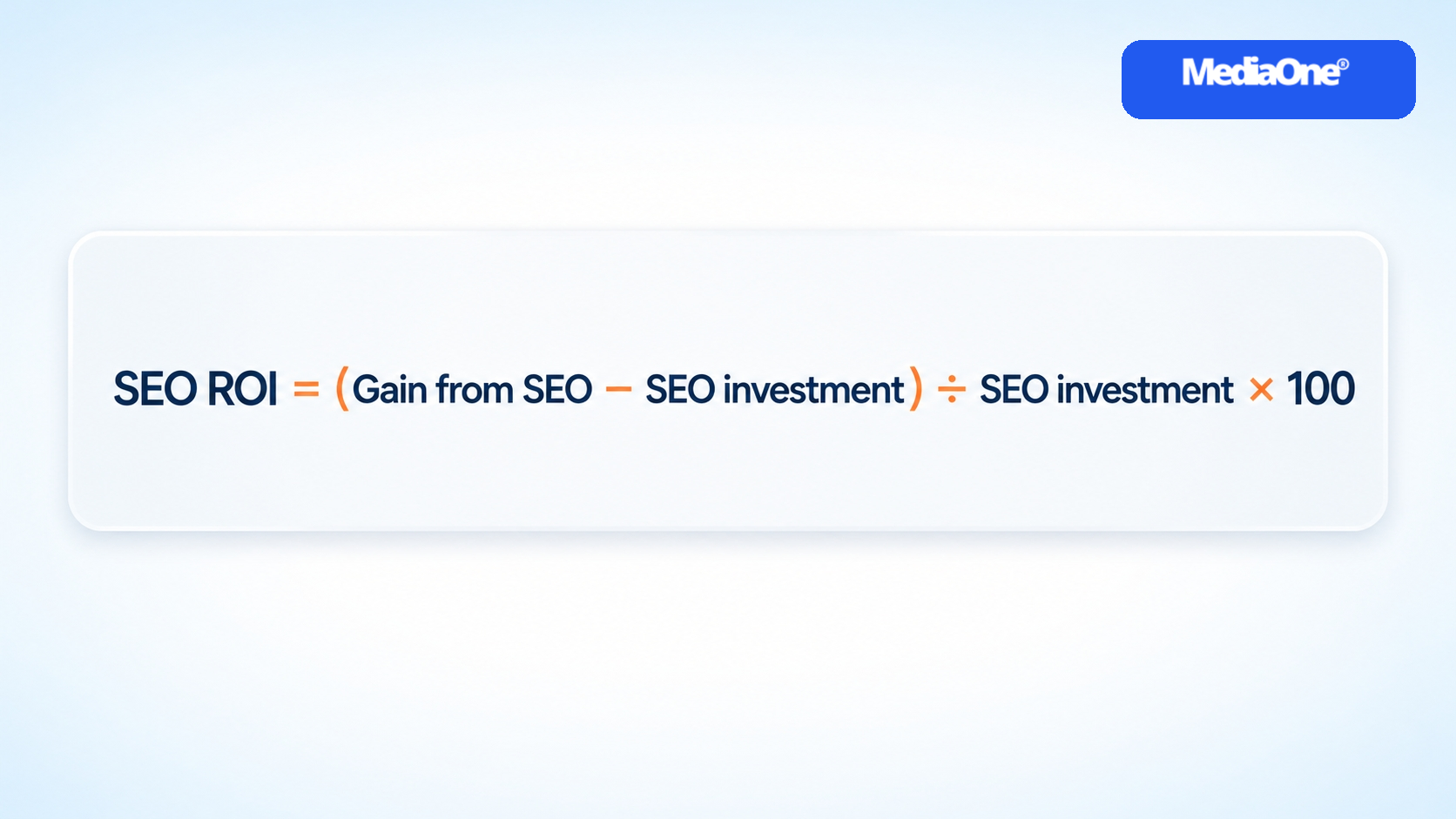
The gain is the profit from organic sales or leads, not the revenue. Multiply the revenue by your profit margin before you subtract the investment. A business earning S$10,000 at a 10% margin keeps S$1,000, but at a 40% margin keeps S$4,000, so the same traffic gain produces very different returns – the same margin example the Submerge Digital calculator guide uses. Take the margin figure from your own accounts. Judge the return on this profit figure, since a search ranking alone does not show what it earns, and judge it on the value of your services and each customer, not on ranking alone.
Worked example: a S$100,000 programme returning S$275,000
This example is illustrative and is not a benchmark for any business. Take a S$100,000 SEO programme that generates S$275,000 in attributable gross profit. The gain minus the investment is S$175,000. Divide by S$100,000, and the result is 1.75, or an illustrative 175% SEO ROI. Always state the gain and the spend in the same currency.
Using an SEO ROI calculator and what its inputs mean
A calculator asks for five inputs: expected new visitors from SEO, conversion rate, customer lifetime value, profit margin and monthly SEO investment – the same five the Submerge Digital calculator walks through. Treat each one as a claim you must defend. If your 5,000 monthly organic visitors are expected to rise 40%, you are entering 2,000 new visits, and that figure is only as good as the keyword research behind it. Run the Gate 1 conversion check first. If your conversion rate sits below 2%, the calculator will tend to overstate the return, so fix the page before you trust the output. Where the traffic comes from a blog or web design work, include the cost of that content in the investment, and where it comes from Google Ads, keep that spend out of organic results. Include content marketing and link building costs in the investment, and check that your website converts the visitors they bring.
A copyable calculation template
Copy the table below into a spreadsheet and enter your own figures in the blank input cells. The formulas are the same as those above.
|
Line |
Input/calculation |
Your figure |
|
1 |
Current monthly organic visitors |
|
|
2 |
Expected uplift (%) |
|
|
3 |
New monthly visitors = line 1 × line 2 |
|
|
4 |
Conversion rate (%) (Gate 1: pass at 2% or above) |
|
|
5 |
Monthly conversions = line 3 × line 4 |
|
|
6 |
Value per conversion, S$ (lead value or customer LTV) |
|
|
7 |
Monthly revenue, S$ = line 5 × line 6 |
|
|
8 |
Profit margin (%) |
|
|
9 |
Monthly profit, S$ = line 7 × line 8 |
|
|
10 |
Annual gain, S$ = line 9 × 12 |
|
|
11 |
Annual SEO investment, S$ (full cost log, Section 5) |
|
|
12 |
SEO ROI (%) = (line 10 − line 11) ÷ line 11 × 100 |
The calculator is built as a simple chain. You start with your current monthly organic visitors and the uplift you expect from SEO work, which gives you the new monthly visitor count. Multiplying that count by your conversion rate gives monthly conversions, and multiplying those conversions by the average value of each sale or lead gives the revenue they produce. Apply your profit margin to turn that revenue into profit. Multiply the monthly figure by 12 to get the annual gain, then compare it with your total annual SEO investment using the ROI formula: (annual gain − investment) ÷ investment × 100. Every input comes from your own data, so the result is only as reliable as the figures you enter.
Tracking SEO Conversions and Valuing a Conversion
A return can only be proven if you can see which conversions came from organic search. Set this up before you start the programme, not after.
Tracking SEO conversions in analytics

Use your analytics platform, such as Google Analytics, to tag each goal (form submission, purchase, call or enquiry) and attribute it to the organic search channel. Check the attribution model, because some platforms credit the last click and others spread credit across the journey – the channel definitions are explained in this Google Analytics channels walkthrough. Record the baseline before the programme begins so the uplift can be measured against it. Deeper setup guidance is in these Google Analytics strategies for Singapore teams.
Valuing a conversion
A conversion is worth what it earns after cost. For a lead, estimate the share that becomes a customer and the average profit from that customer. For an online sale, use the margin on the order. Once you have that value, multiply it by the number of organic conversions to get the monthly gain used in the formula above. Treat the figure as a marketing estimate, and keep the same method across every month so trends remain comparable – the measurement choices are worked through in MediaOne’s guide to content marketing ROI.
Calculating SEO Investment Costs Accurately
Before you can prove a return, you need an honest denominator. Most businesses undercount what SEO actually costs, which inflates the return on investment figure and makes the programme look better than it is. Measure the full cost of your website’s search visibility, not just the visible invoices. A strategy that looks profitable on agency invoices alone can turn negative once internal effort, tools and development time are included.

Direct costs: staff, agency fees and tools
Direct costs are the easiest to record: salaries or time allocated to the SEO function, monthly agency retainers, and software subscriptions for rank tracking, crawling and keyword research. Add them up for the full year, not just the month you happen to be measuring. Convert any invoices billed in other currencies, including S$ and foreign-currency tools, at the rate used in your finance reports and keep that rate consistent. Where a digital marketing agency is involved, request an itemised invoice so retainers and one-off project fees can be separated.

Hidden costs: content production, development and technical fixes
These costs quietly distort results. Writing and editing pages, commissioning designers, developer hours for site speed or schema, and redirect work all count toward the return you are trying to earn. Content such as each new blog post and its editing time belongs in this count too, as do case studies and the time spent promoting them on social media. If a page only ranks because your developer rebuilt the template, that cost belongs in the SEO investment. Track it in a simple log so it is visible to finance. Costs of services bought from outside providers belong in this log too, alongside your in-house effort. Include the time spent on link building outreach, since it is a real cost even when no invoice is raised.
Benchmarks help you sanity-check the number. Gartner’s 2025 CMO Spend Survey puts marketing budgets at 7.7% of overall company revenue, and the 2026 survey at 7.8% – effectively flat for a second year. Treat those as cross-industry averages, not guidance for your business. For a Singapore SME, the question is less what the benchmark says and more whether the spend clears its own payback test. If your SEO spend sits far outside the benchmark, you need a clear reason, and that reason should appear in your report. Use Google Analytics to track how much revenue each channel brings in, so the spend is measured against real results.
Deciding whether to continue, scale or stop
Set the decision rule before the first report. If the SEO ROI over your reporting period is positive and the payback falls within the period you agreed with leadership, continue. If it is strongly positive and Gates 1 and 2 pass, scale the investment. If the gain does not cover the spend after the agreed period, and the conversion gate has been fixed, stop or reduce the programme and reassess the keyword targets. Agree this strategy with leadership in writing before the first report – the reporting structure in this guide to SEO reports that prove ROI gives the format – and confirm how each customer enquiry from search will be counted.

Estimating Traffic and Revenue from Search Volume
Before you can calculate a return on investment, you need a traffic forecast. The model starts with keyword search volume, the number of times people search a term each month, and works down to the visits and enquiries you could realistically win. Google remains the main source of organic visits for most local businesses, so the forecast should be built on Google search data rather than on general web traffic.
Using keyword search volume and expected click-through rate
Take a keyword with 200 monthly searches, such as a service term a Singapore B2B buyer would type before enquiring. Search volume alone tells you nothing about clicks. You must apply the share of searchers who click through to your page. Multiply the volume by the expected click-through rate (CTR) for the position you can realistically hold, and you have a monthly visit estimate. Content marketing and case studies, published on a company blog or shared on social media, can lift the page’s appeal, but the forecast still rests on that CTR calculation.
Click-through rates by ranking position
Position changes the answer more than almost any other input. Backlinko’s study of four million search results puts the first organic result at around 27.6% of clicks and fifth place at about 6.3%. Treat the figures as indicative and check them against current data: CTR measurement varies sharply by source, and First Page Sage’s 2026 benchmarks report a far lower blended position-one share now that AI Overviews and other SERP features absorb clicks. On the 200-search keyword, first place yields roughly 55 visits a month and fifth place roughly 13 on Backlinko’s curve. Forecast against the position you can credibly reach, not the top spot you hope for. Link building to the target page is often what moves a result from fifth towards the top three.
[Suggested image – replace or delete: A bar chart comparing estimated organic click-through rates for ranking positions one to ten, illustrating how share of clicks falls steeply after the top three results. Labels should state that the figures are indicative CTR benchmarks and that the reader should substitute their own data.]
Projecting organic traffic growth
For a website already ranking on Google, project growth from current traffic. Submerge Digital’s SEO ROI calculator gives a simple example: 5,000 current monthly organic visitors with an expected 40% uplift adds 2,000 visitors. Apply the same logic to keyword volume, and always state how long the uplift takes to arrive, because a forecast without a timeline will overstate the first year. Any business weighing these services, including a professional web design project, should compare the projected gain against its own costs. Where Google Ads runs alongside SEO, keep the two channels’ traffic separate so the organic forecast is not inflated by paid clicks.
Conclusion
SEO ROI is a conversion problem before it is a traffic problem. Before you buy more rankings, run the Three-Gate ROI Check on your own numbers, because strong digital marketing services depend on a sound strategy.
Gate 1 (Conversion): Record your current conversion rate. A good conversion rate in e-commerce typically falls between 2% and 5%, but this varies by industry, device and shopper intent. Below 2%, Submerge Digital’s calculator suggests optimising the page before you pay for more traffic.
Gate 2 (Ranking reach): Estimate realistic click-through for your target position. Backlinko’s CTR figures are 27.6% for first place and 6.3% for fifth, from its four-million-result study – and remember that newer 2026 benchmarks read lower in the AI-Overview era. Position changes the answer more than most reports admit, and results also depend on how well your content and Google Ads or social media efforts support the same goal.
Gate 3 (Economics): Multiply the leads or sales by the value of a conversion and your margin, then divide the gain by SEO spend. Using the illustrative example above, a S$100,000 programme returning S$275,000 produces a 175% SEO ROI.
If any gate fails, fix that gate first. Report your return as a payback period, not a single month, because SEO gains take time to appear.
Frequently Asked Questions
How is SEO ROI different from SEO performance metrics?
Performance metrics such as rankings, impressions and organic sessions show how the search campaign is moving. SEO ROI asks whether the money spent on search produced more profit than it cost. A page can reach the first position on Google and still lose money if its website converts poorly, so the two should be read together. Rankings show the activity is working; ROI shows whether it is worth continuing.
What is a good SEO ROI?
Any figure above 0% means the programme returned more than it cost, but the useful test is your own payback target. Using the illustrative example above, a S$100,000 programme returning S$275,000 gives 175%. Check that the website converts at a healthy rate first, because a high percentage on a weak conversion rate is rarely sustainable.
How long does it take to see a return from SEO?
Most programmes need several months before gains show up in revenue, so report a payback period rather than a single month’s figure. Measure the lag between when search rankings improve and when enquiries or sales follow, then compare cumulative gains with cumulative spend over the period.
What conversion rate should I expect from organic traffic?
According to the SEO ROI calculator from Submerge Digital, a typical website conversion rate falls between 2% and 5%, varying by industry. This is a rule of thumb, not a fixed target, and it also depends on shopper intent. Below 2%, the page needs optimising before you buy more traffic.
Can I calculate SEO ROI without a calculator?
Yes. Multiply your monthly organic visits by your conversion rate, then by the value of a conversion and your profit margin. Subtract the SEO spend from that gain and divide by the spend. A spreadsheet with these inputs does the same job as an online calculator.