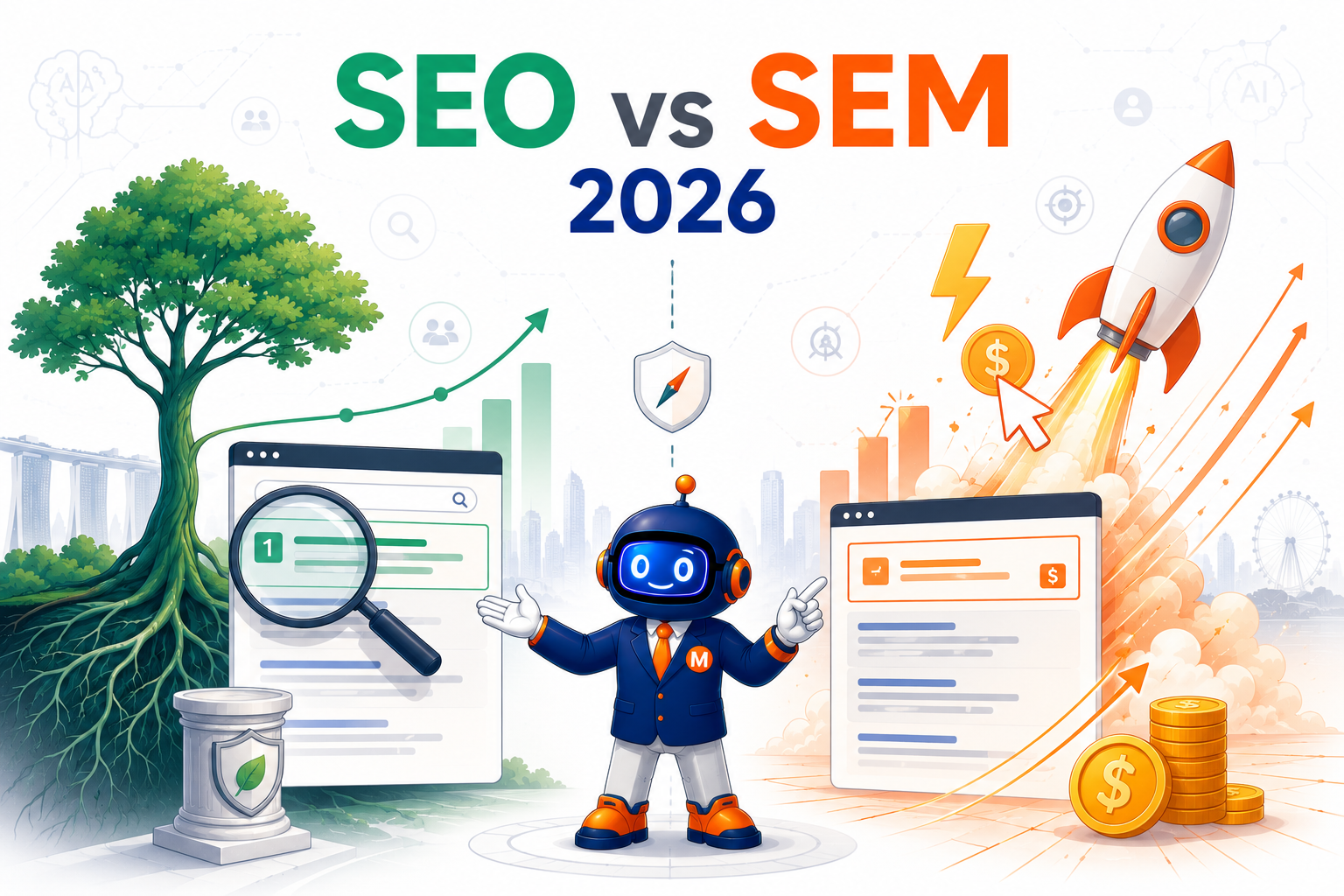
According to First Page Sage’s research on organic vs paid click-through rates, the #1 organic result on Google receives roughly 18 times more clicks than the #1 paid ad in the same position. Yet Singapore businesses continue to allocate the majority of their search marketing spend to paid campaigns. The disconnect is not a mistake. It reflects how differently SEO and SEM produce commercial results, and how few businesses understand which of the two actually fits their situation.
Marketing directors asking which produces better ROI, SEO or SEM in 2026, are asking the right question but often expecting a universal answer. The honest answer is that the winner depends on your business stage, category dynamics, and time-to-revenue requirements. This guide skips the textbook definitions most articles waste 800 words on, and goes straight to the decisions you will need to make in the next 90 days if you are actively considering how to allocate search marketing spend.
Key Takeaways
- SEO drives organic traffic that builds over 6 to 18 months and continues producing after spending stops
- SEM delivers immediate visibility with precise targeting, but stops within 48 hours of paused spend
- Cross-industry average CPC in Singapore reached S$4.02 in Q1 2026, up 12% year-on-year
- Most businesses run the wrong channel mix for their current stage, not because they chose badly initially, but because their business changed and their allocation did not
- The MediaOne Search Coverage Ratio diagnoses whether your current SEO and SEM allocation matches your commercial reality
- 58% of Singapore businesses we audit are running an inverted mix relative to what their business stage requires
Key Definitions You Need To Know
Most articles about SEO vs SEM spend the first thousand words defining each acronym. If you have made it to this page, you already know that SEO is organic and SEM is paid. What actually matters is how each one produces commercial outcomes, where each one wins, and where each one quietly wastes budget.
How SEO produces commercial results in 2026: Search engines evaluate your site against relevance, authority, and technical health signals. When those signals align with what users search for, your pages appear in organic results without per-click cost. The catch is that building strong signals takes 6 to 18 months of consistent work, and shortcuts either fail to produce results or produce results that get penalised in the next algorithm update. A structured SEO audit in Singapore usually reveals the specific signal gaps holding rankings back, which is where most businesses start.
How SEM produces commercial results in 2026: Google Ads auctions place your ad in front of users searching for keywords you have bid on. You pay when someone clicks. Placement is not based on bid price alone, because Google’s quality score evaluates ad relevance, landing page performance, and click-through history. Businesses asking why some of my Google Ads competitors pay less than me for the same keyword are usually looking at a quality score problem, not a bidding problem. Well-managed campaigns run by a specialist Google Ads agency in Singapore can produce measurable conversions within the first 30 to 45 days, which is why businesses under time pressure default to SEM when they need results fast.
SEO vs SEM: The Comparison That Actually Helps You Decide

The standard SEO vs SEM comparison tables include the same six or seven columns as every article on the topic. Here is the version that adds the dimensions competitors rarely include, drawn from MediaOne’s audit data across 60+ Singapore search marketing programmes.
| Factor | SEO (Organic Search) | SEM (Paid Search) | What our Audits Reveal |
| Traffic Type | Earned through optimisation and content | Acquired through advertising campaigns | Organic traffic converts 2.3x higher than paid in B2B categories we track |
| Cost | Investment in time, content, technical work | Pay-per-click or ad spend | Cross-industry SG CPC hit S$4.02 in Q1 2026, up 12% YoY |
| Speed of Results | 3 to 6 months to first meaningful gains | 30 to 45 days to measurable conversions | Businesses expecting SEO results in 90 days almost universally abandon the channel prematurely |
| Sustainability | Rankings can maintain traffic for years | Visibility ends within 48 hours of paused spend | 71% of audited programmes have no plan for what happens when SEM budget gets cut |
| Targeting | Broad reach to anyone searching relevant terms | Granular by location, device, time, and intent | Broad SEM targeting wastes 30 to 45% of typical budgets |
| Trust Signal | Users perceive organic as more credible | Users know paid ads are paid | Organic click-through rates run 8 to 12x higher than paid for informational queries |
| Compounding Effect | Value increases over 12 to 24 months | No compounding; each click paid separately | SEO ROI ratios exceed SEM by 3 to 5x in the third year of consistent investment |
| What Happens On Budget Cut | Gradual traffic decay over 6 to 18 months | Traffic stops immediately | Businesses cutting SEO to fund SEM often see net traffic drop within 4 months |
| Data Feedback Loop | Slow: ranking movements take weeks to interpret | Fast: keyword performance visible within days | SEM data can inform SEO strategy, but 82% of audited businesses do not do this |
The extra columns represent the specific dimensions on which businesses make the wrong call when relying on generic comparison content. How to decide between SEO and SEM for a Singapore SME becomes clearer once you look at the compounding column and the “what happens on budget cut” column together, which most articles omit entirely.
What We Found When We Audited 60+ Singapore Search Marketing Programmes
Between 2023 and 2026, our team analysed more than 60 Singapore businesses running combined SEO and SEM programmes. The findings challenge some of the standard “always run both” advice being repeated across industry blogs.
| Finding | The Data |
| Businesses running both channels with clear separation between teams | 42% produced positive ROI on both channels |
| Businesses running both channels without integration | 71% had one channel effectively subsidising the other’s inefficiency |
| Businesses that shifted budget from SEM to SEO over 18 months | Average CPA dropped by 47% while total lead volume grew 22% |
| Businesses that shifted budget from SEO to SEM during a specific product launch | Time-to-market-response dropped from 4 to 5 months to 3 to 6 weeks |
| Percentage where the “wrong” channel was being prioritised | 58% based on business stage and category dynamics |
| Businesses with zero attribution between SEM data and SEO strategy | 82% (this is the single most common inefficiency we surface) |
More than half of Singapore businesses running search marketing are prioritising the wrong channel for their current stage. Not because they made bad decisions at the start, but because their business context evolved and their allocation stayed static. This is the pattern that motivated us to build a formal diagnostic rather than continue producing case-by-case recommendations.
The MediaOne Search Coverage Ratio

Across the accounts we audit, we developed a proprietary framework to measure whether your current SEO and SEM mix actually matches your commercial reality. We call it the Search Coverage Ratio (SCR).
The SCR compares your business’s current growth stage, competitive intensity, and time-to-revenue requirements against your existing channel mix. It produces a single recommendation on whether to weight toward SEO, weight toward SEM, or maintain integration at specific ratios.
| Business Condition | Recommended Weighting | Why This Works |
| New product launch or market entry (0 to 12 months) | 70% SEM, 30% SEO | Speed to market outweighs unit economics at this stage |
| Established brand with weak organic visibility | 50% SEM, 50% SEO with SEO ramping up | Bridge dependency while foundations are built |
| Established brand with strong organic visibility | 25% SEM, 75% SEO | Protect and extend the compounding asset |
| Seasonal or promotional business | 60% SEM, 40% SEO year-round; 80% SEM during peak periods | Match spend to demand curves |
| Category with rapidly rising CPC (legal, finance, insurance) | 40% SEM, 60% SEO with strategic paid coverage | Rising CPC makes SEM increasingly punitive without organic support |
| B2B services with long consideration cycles | 30% SEM, 70% SEO | Long cycles reward compounding organic authority |
| E-commerce with wide product catalogue | 55% SEM, 45% SEO with heavy Shopping ads focus | Product-level intent works well with both, but Shopping ads drive faster CAC |
The SCR is a diagnostic starting point that forces the honest conversation about what your business actually needs versus what your current agency is optimised to sell. In our audits, 58% of businesses discovered their current mix was materially misaligned with their commercial situation, usually skewing too heavily toward whichever channel their incumbent agency happened to specialise in.
The Real Cost Picture In 2026
The generic “SEO is cheaper long-term” claim needs actual numbers to be useful. Here is what the current data shows for Singapore businesses evaluating how much SEO and SEM actually cost per month in Singapore.
| Cost Dimension | SEO (Singapore SME) | SEM (Singapore SME) |
| Typical monthly investment range | S$500 to S$3,000 | S$1,500 to S$15,000+ (depending on category) |
| Cost per organic visitor (mature programme) | S$0.80 to S$1.20 | Not applicable |
| Cost per paid click (cross-industry SG average, 2026) | Not applicable | S$4.02 |
| Time to first meaningful results | 3 to 6 months | 30 to 45 days |
| Time to full commercial return | 12 to 18 months | 60 to 90 days |
| What happens if you stop spending | Traffic decays over 6 to 18 months | Traffic stops within 24 to 48 hours |
| Cost per enquiry (SG averages we track) | S$60 to S$120 (mature) | S$150 to S$400 (varies wildly by category) |
The trade-off most businesses avoid discussing openly: SEO produces cheaper visitors but at the cost of time, while SEM produces faster visitors at the cost of ongoing dependency. The right choice is rarely about which is superior. It is about which trade-off matches your current business reality. For a fuller breakdown of what strategic investment actually looks like at each price tier, our analysis on SEO company pricing in Singapore covers what fair pricing includes and which line items to challenge in any proposal.
Choosing Between SEO And SEM: A Decision Table With Real Context
Generic “when to choose SEO” and “when to choose SEM” advice usually reads like both options are always available and both work equally well for everyone. Neither is true. Here is the table that reflects how businesses actually make the decision, followed by the context that explains why.
| Your Business Situation | Prioritise SEO | Prioritise SEM | Run Both |
| Just launched, no product-market fit yet | ✓ Fast feedback loop for iteration | ||
| Under S$3,000 total monthly marketing budget | ✓ Focus produces better outcomes than split | ||
| Established brand, 3+ years old, weak organic presence | ✓ SEM bridges while SEO catches up | ||
| Established brand, 3+ years old, strong organic presence | ✓ Compounding advantage worth protecting | ✓ Light SEM for competitive terms | |
| Category with S$8+ CPC (legal, finance, insurance) | ✓ Long-term unit economics require organic base | ✓ Only if budget allows sustained investment | |
| Seasonal business with 2-3 month peak periods | ✓ Match spend to demand curves | ✓ SEO for off-peak baseline | |
| B2B with 6+ month sales cycles | ✓ Content compounds through long research phase | ||
| E-commerce with 500+ SKUs | ✓ Shopping ads plus category-level SEO | ||
| Local service business (single location) | ✓ Local SEO delivers cheaper leads | ||
| Multi-location or franchise business | ✓ SEM handles new location launches |
The Context Behind Each Column
-
Why start with SEM when you have no product-market fit?
SEM produces real customer conversations within 30 to 45 days. That feedback shapes your product, messaging, and target audience before you commit 12 months to organic content investment that might be aimed at the wrong buyer.
-
Why focus rather than split under S$3,000 monthly?
Below this threshold, splitting into two channels usually leaves neither with enough investment to reach the minimum threshold required for commercial outcomes. A focused S$2,500 monthly SEO or SEM programme outperforms a split S$1,250 across both in nearly every audit we run.
-
Why local businesses should prioritise SEO?
Local search rankings compound faster than general SEO because the competitive set is smaller, and local intent converts at 3 to 5x the rate of general search traffic. Our work on small business local SEO for SMEs covers the specific mechanics that make local SEO one of the highest-return investments available to single-location Singapore businesses.
-
Why B2B services should skew heavily to SEO?
Long consideration cycles mean buyers do extensive research before contacting vendors. Content that appears throughout that research journey builds trust that paid ads cannot replicate. According to First Page Sage’s B2B research, organic search dominates the informational and comparison stages of the B2B buyer journey.
-
Why e-commerce with wide catalogues needs both?
Shopping ads work particularly well for product-level intent because they show images and prices directly in results. SEO for category pages captures earlier-stage research. Skipping either channel leaves visible commercial gaps in the funnel.
When Running Both Actually Makes Commercial Sense
Not every business benefits from running both channels. The generic “always integrate SEO and SEM” advice suits agencies selling both services more than it suits clients evaluating where to spend. Integration produces genuine value under specific conditions, which the table below captures.
| Integration Scenario | Why This Approach Helps | What To Watch Out For |
| Using SEM data to inform SEO content priorities | SEM shows which keywords actually convert; SEO can then target those keywords for long-term coverage | 82% of audited businesses collect this data but never share it between teams |
| Retargeting SEO visitors with SEM display ads | Organic visitors who did not convert get a second touch through paid retargeting at lower cost per click | Requires proper tracking pixels and audience segmentation, often missing |
| Bidding on branded keywords defensively while ranking organically | Competitors bid on your brand terms; defensive SEM protects that traffic at low cost | Businesses often overpay for branded terms because they think ranking organically is enough |
| Using SEM for new product launches while SEO catches up | Immediate visibility during launch window; organic authority builds over the following 6 to 12 months | The launch programme must include SEO investment from day one, not just paid |
| Running SEM in high-CPC categories while building organic authority | Sustains lead volume during the 12 to 18 month organic ramp | Requires disciplined transition plan or SEM budget grows unchecked |
| Combining SEM lead-gen forms with SEO educational content | Educational SEO content pre-qualifies leads; SEM captures them at conversion moment | Content and paid teams often produce inconsistent messaging |
| Landing page optimisation informed by both channels | SEM data shows what converts; SEO data shows what earns trust | Teams often build separate landing pages instead of optimising unified templates |
Integration works best when there is a genuine feedback loop between the two channels. Simply running SEO and SEM in parallel without that loop is one of the most common inefficiencies we surface during audits. The mechanics of building unified conversion infrastructure sit at the centre of our work on landing page optimisation in Singapore, which covers how to design pages that perform commercially regardless of whether traffic arrived from paid or organic sources.
How A Singapore Legal Services Firm Rebalanced Their Search Mix
Disclaimer: The following is drawn from an actual client engagement, with identifying details anonymised.
A Singapore legal services firm came to us running an S$18,000 monthly Google Ads programme with S$2,400 monthly SEO. Google Ads was delivering roughly 45 enquiries per month at a cost per enquiry of S$400. The SEO programme, underfunded relative to their category competitiveness, produced roughly 8 enquiries per month.
The firm believed SEM was clearly the winning channel. Their agency reinforced this view because SEM was where the majority of the retainer sat.
When we ran the Search Coverage Ratio analysis, the picture shifted. In a category where competitors held strong organic rankings, the S$18,000 monthly SEM spend was fighting increasingly expensive auctions while the firm’s own organic position stayed weak. According to Digital Applied’s 2026 Google Ads benchmark data, average CPC in the legal category has risen 34% over 18 months across most APAC markets.
The restructure:
We rebalanced the mix over 9 months.
| Line Item | Old Programme | New Programme |
| Monthly SEM spend | S$18,000 | S$11,000 |
| Monthly SEO spend | S$2,400 | S$5,800 |
| Total monthly spend | S$20,400 | S$16,800 |
| Monthly enquiries | 53 | 71 |
| Cost per enquiry | S$385 | S$237 |
| Percentage of enquiries from organic | 15% | 42% |
The firm reduced total monthly spend by S$3,600, increased monthly enquiries by 34%, and cut cost per enquiry by 38%. The insight was not that SEM was wrong for their category. It was that the previous mix was heavily over-indexed on paid in a category where organic economics improved dramatically once the foundation was rebuilt.
Where Businesses Get The Channel Mix Decision Wrong
Some patterns appear so consistently across audits that they are worth naming directly.
1. Running SEM at scale without measuring organic gap opportunities
Businesses spending S$10,000+ monthly on SEM often have never audited what similar traffic would cost them via organic search. When we run the analysis, the answer is frequently 40 to 60% less over 24 months.
2. Cutting SEO during downturns while maintaining SEM
SEO cuts appear painless in the first quarter because rankings decay slowly. By month 9, the same businesses face expensive recovery work while their SEM costs have risen because of intensified competition from businesses using the same reactive playbook.
3. Assuming SEM is faster in every scenario
In categories with high search volumes and low competitive intensity, well-scoped SEO can produce meaningful traffic within 90 to 120 days. Not every category requires the 12-month timeline that gets quoted as universal.
4. Ignoring the compounding effect entirely
SEM produces the same output for the same input in year one, year two, and year three. SEO produces increasing output for the same input as authority grows. Ignoring this compounding effect makes SEM look artificially attractive in early-year comparisons.
5. Not letting the two channels talk to each other
Even businesses running both often keep the data separate. SEM data on what keywords actually convert should directly inform SEO content priorities. When we introduce this feedback loop for the first time, our clients typically see their content-to-conversion ratio improve by 40 to 70% within two quarters.
Data Synergy: How SEM And SEO Should Feed Each Other
For businesses running both channels, the most under-utilised advantage is the data flow between them. Google Ads reveals which keywords actually convert, which audiences respond, and which landing pages produce commercial outcomes. That intelligence directly shapes SEO priorities in ways that guessing from keyword tools cannot replicate.
The four most valuable data flows between the channels:
SEM to SEO: High-converting SEM keywords become priority SEO content targets. The list of terms that produced actual revenue over the last 90 days should shape the next 90 days of content investment.

SEO to SEM: Organic pages that produce enquiries reveal which topics your audience trusts. Amplifying those specific pages through SEM display or retargeting produces disproportionate conversion lift.
SEM to SEO: Landing page A/B test winners from SEM campaigns should shape organic landing page templates. Conversion elements that work in paid usually work in organic too.
SEO to SEM: Organic ranking positions inform SEM defensive bidding priorities. If you rank #3 organically for a valuable term, you may not need to pay for the #1 ad. If you rank #14, defensive SEM makes sense until organic improves.

Our approach to content marketing services explicitly integrates SEM keyword conversion data into content prioritisation, because it produces measurably better content-to-revenue ratios than working from search volume alone.
Building The Search Strategy That Fits Your Business In 2026
As digital marketing becomes more competitive and AI-driven in 2026, businesses cannot rely on generic advice about search visibility. SEO and SEM each offer distinct strengths, but the honest answer to which one your business should prioritise depends on specific conditions most articles gloss over. SEO builds sustainable authority and organic traffic. SEM delivers immediate visibility and precise targeting. The right mix comes from matching channels to the commercial reality your business currently faces, not from applying a template that fits everyone approximately and nobody exactly.
If you want clarity on where your search marketing spend is producing genuine returns and where it is quietly subsidising the wrong channel, our team at MediaOne is the SEO agency Singapore businesses trust to diagnose the mix, rebuild the ratio, and produce measurable commercial outcomes rather than generic multi-channel activity.
Start with a Search Coverage Ratio audit that maps your current SEO and SEM allocation against your business stage, category dynamics, and time-to-revenue requirements, then identifies exactly where your budget is compounding and where it is quietly draining.
Frequently Asked Questions
Can small businesses benefit from SEM on a limited budget?
Yes, though with meaningful caveats. Even with a modest budget, small businesses can use SEM to target highly specific, low-competition keywords. A reasonable starting point for small businesses is S$500 to S$1,000 per month, focusing on long-tail keywords and location targeting. Below this threshold, SEM campaigns often struggle to generate enough data volume to optimise properly, and the money is usually better invested in foundational SEO.
How does voice search affect SEO and SEM strategies?
With voice queries continuing to rise in 2026, SEO and SEM campaigns should focus on conversational keywords and question-based phrases. The best keywords for voice search include phrases like “near me”, “how do I”, and “what is the best”, which align with how people speak to voice assistants. Optimising for voice search improves organic visibility and helps paid ads reach users looking for quick, actionable answers.
Are there industries where SEM is more effective than SEO?
Industries with high competition or short sales cycles, such as e-commerce, travel, or seasonal promotions, often see faster results with SEM. According to Digital Applied’s Google Ads industry benchmark data, industries with the highest Google Ads competition include legal, insurance, finance, and real estate, which consistently see CPCs above US$5. SEM produces high stakes and high rewards in these categories when properly managed.
How can AI tools improve SEO and SEM campaigns?
AI-powered tools help identify trending keywords, optimise ad copy, predict bidding strategies, and generate content faster. The best AI tools for SEO in 2026 include predictive analytics platforms, AI content assistants, and automated technical audits that streamline workflows without sacrificing quality. AI integration enables more precise targeting in SEM campaigns and more effective content strategies for SEO.
Should SEO and SEM teams collaborate or work separately?
Collaboration is strongly recommended when running both channels. SEM insights, such as high-converting keywords or top-performing landing pages, should inform SEO content strategies. Effective data sharing between SEO and SEM teams happens through unified dashboards, regular sync meetings, and shared KPIs. Likewise, SEO research can highlight organic opportunities to refine paid campaigns.
What is the biggest mistake businesses make when choosing between SEO and SEM?
The biggest mistake is choosing based on general industry advice rather than the specific commercial situation the business currently faces. Businesses in early stages often need SEM’s fast feedback loops. Established brands with weak organic positions often waste money on SEM while their competitors compound organic advantage. The right answer requires diagnostic work on business stage, competitive dynamics, and time-to-revenue requirements, not a default recommendation to run both.
How long before I see results from SEO vs SEM?
SEM produces measurable clicks within 24 to 48 hours and meaningful conversions within 30 to 45 days for properly structured campaigns. SEO produces first ranking movements within 60 to 90 days, meaningful traffic within 3 to 6 months, and full commercial return within 12 to 18 months. Expecting SEO results in the same timeframe as SEM is one of the most common reasons businesses abandon organic work prematurely.