| AI SUMMARY
Email scheduling is three connected decisions: timing, cadence and sequencing. This guide explains how to approach each for Singapore businesses in 2026. It gives starting send windows for B2B and B2C audiences, suggested frequency by email type, and a comparison of scheduling tools. It also explains why open rates are unreliable because of Apple Mail Privacy Protection, and why click rate and revenue per recipient are better measures. Singapore senders must also meet the PDPA on consent and the Spam Control Act on bulk sending. The guide closes with the Time, List, Law check to run before every send. |
Most businesses treat email scheduling as an afterthought. They write the email, then send it whenever the marketing calendar says a campaign is due. The list grows, the send button gets pressed, and the results are whatever they are.
This approach wastes a channel that still delivers strong returns. Businesses that treat scheduling as a strategic decision often see better opens, more clicks, and fewer unsubscribes from the same list and content.
In this guide, we explain how we approach email scheduling for Singapore businesses in 2026. We cover data-backed send times, practical email frequency, and reliable scheduling tools.
We also cover two Singapore-specific rules most generic guides skip. These are the Personal Data Protection Act (PDPA) and the Spam Control Act 2007. We explain why a rising open rate might not mean what you think it means.
Key Takeaways
- Send time affects results, but less than most guides suggest. Content quality, list health and subject lines usually decide more of your outcome than the exact hour you press send.
- Open rate is no longer reliable on its own. Apple’s Mail Privacy Protection counts an email as opened even when nobody reads it, so click rate and revenue per recipient tell a more honest story.
- Business-to-business (B2B) and business-to-consumer (B2C) audiences respond to different windows. A B2B list checks email during work hours, while a B2C list often responds better in the evening.
- Sending in Singapore carries two separate legal obligations. The PDPA covers your right to hold an email address, and the Spam Control Act covers how you send commercial messages in bulk.
- Automated, behaviour-triggered emails outperform one-off campaigns by a wide margin, according to Klaviyo’s 2026 benchmark data on ecommerce sends.
- A small, well-tested schedule beats a large, untested one. Two or three send-time tests across a few weeks tell you more than any industry benchmark.
What Email Scheduling Really Means for a Business
Email scheduling gets reduced to a single decision: the date and time an email goes out. That is only the visible part.
A proper email schedule covers three decisions working together, not one. Each pulls in a different direction, and a business rarely gets all three right by accident.
- Timing. The hour and day that suit your audience’s habits.
- Cadence. How often you send to the same list without wearing people down.
- Sequencing. The order in which different emails reach a subscriber after they join your list or make a purchase.
Get one of these right and ignore the other two, and results usually stay flat. A well-timed promotional email sent to a list that already gets five emails a week competes with its own history of being ignored.
Our email marketing team treats timing, cadence and sequencing as one connected system. This is because a client’s choices on all three land in the same inbox.
Why Send Time Still Affects Results in 2026
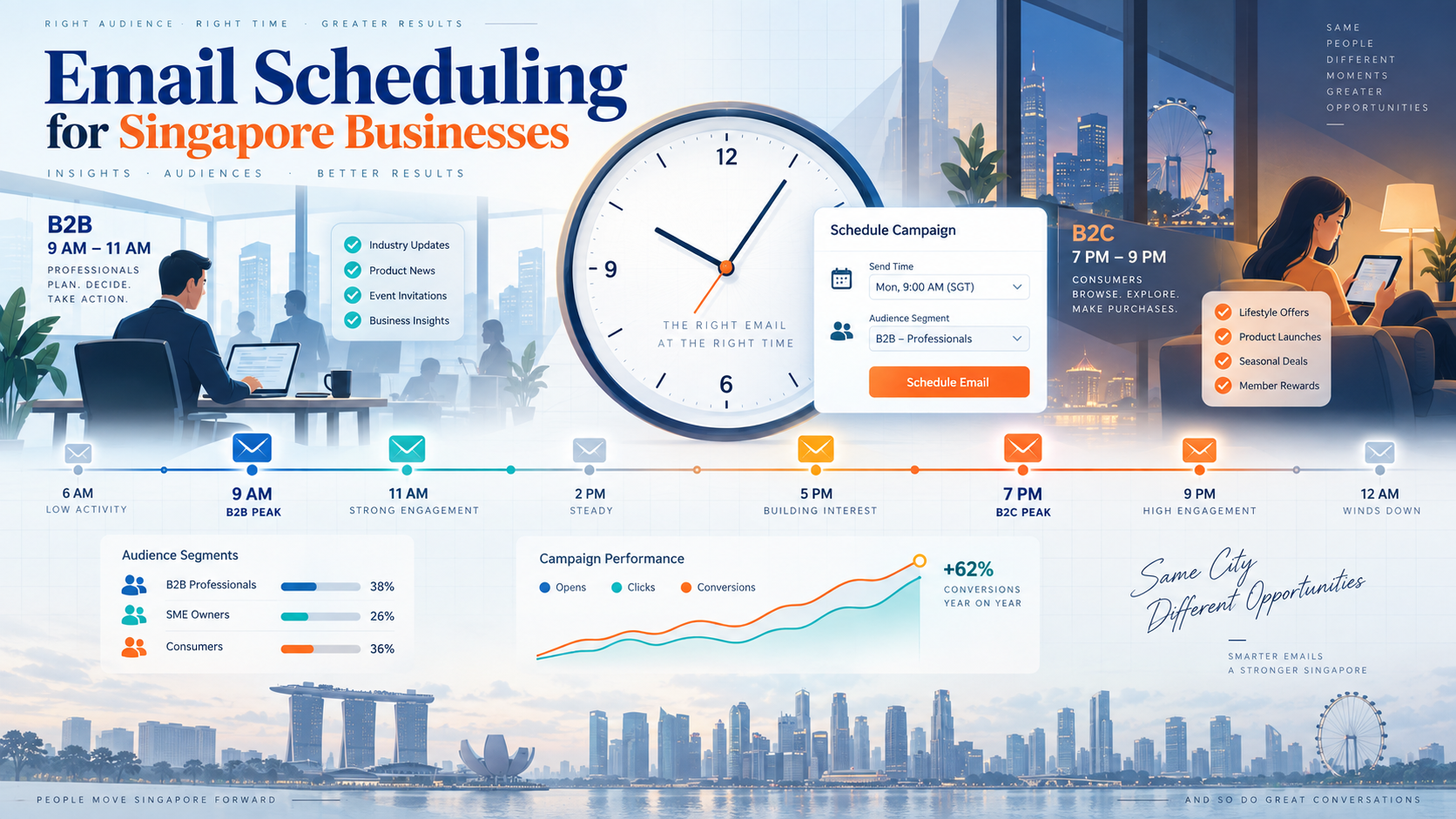
Global data still shows consistent patterns. Several 2026 benchmark studies, including Omnisend’s analysis of roughly 26 billion ecommerce emails, put Tuesday and Thursday mid-morning sends ahead for opens and clicks (Omnisend, 2026).

B2B inboxes get triaged early, so a 9 AM to 11 AM send lands while someone still clears overnight email. B2C lists simply respond better outside work hours (SaaS Scored, 2026).
None of these figures are Singapore-specific. We would treat any claim of a “Singapore average open rate” with caution unless it names its sample and source.
Singapore’s own numbers support the general pattern. With 98.4 percent of the population online as of late 2025 (DataReportal, Digital 2026 Singapore report), almost every recipient on a local business list checks a phone throughout the day.
Why Open Rate Alone Can Mislead You
Open rate used to be the first number anyone checked. It no longer tells the full story.
Apple’s Mail Privacy Protection (MPP) pre-loads a tracking pixel on Apple devices. This registers as an “open” even when nobody reads the email.
Apple’s share of tracked email opens has run close to half of all opens through 2026 (Litmus Email Client Market Share). A large part of most Singapore lists now shows an inflated open rate by default.
Klaviyo’s 2026 benchmark report recommends click rate and revenue per recipient instead. Both need an actual human action, not just a loaded pixel (Klaviyo, 2026 Email Marketing Benchmarks). A rising open rate paired with a flat click rate usually just means more of your list opened on an Apple device.
Best Times to Send Email for B2B and B2C Audiences
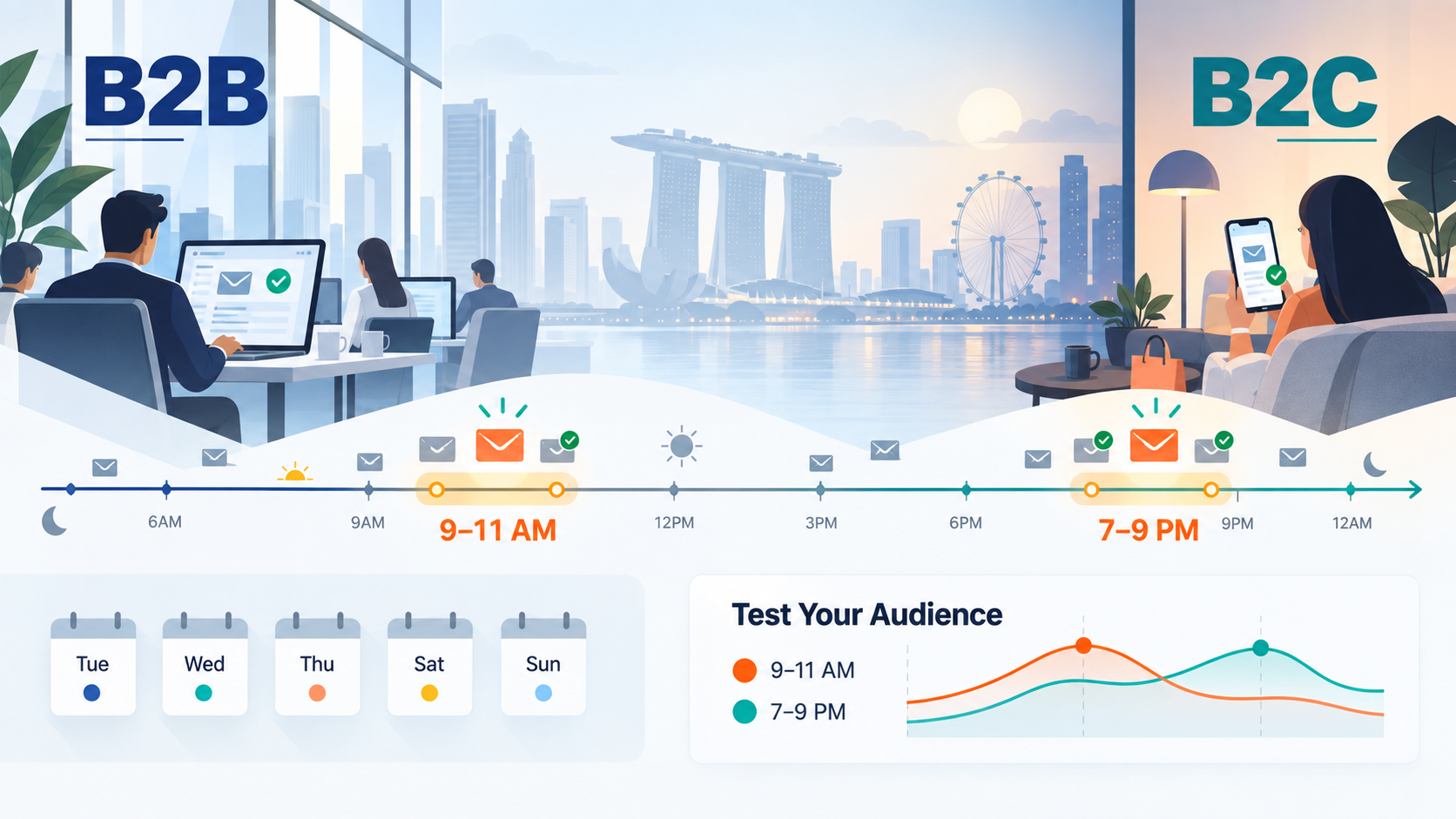
The table below sets out a starting point built from several 2026 benchmark studies. Treat it as a first guess to test, not a fixed rule.
| Audience | Best Days | Best Send Window | Why It Works |
|---|---|---|---|
| Business-to-business (B2B) | Tuesday to Thursday | 9 AM to 11 AM | Matches the morning inbox triage before meetings start |
| Business-to-consumer (B2C) | Thursday, Saturday, Sunday | 7 PM to 9 PM, or weekend mornings | Reaches people once they are off work and browsing for themselves |
Reading the Table for Your Own Business
B2B inboxes fill up overnight with automated reports and other companies’ campaigns. A 9 AM to 11 AM send tends to land after that backlog clears but before lunch (SaaS Scored, 2026). Avoid Monday mornings, when inboxes are fullest, and Friday afternoons, when most professionals have checked out for the weekend.
B2C lists behave in the opposite direction, since consumers check personal email once the workday ends. A food delivery business or a consumer retail brand should test a Thursday evening send against a Sunday morning send. A single best time rarely holds across an entire consumer list.
How Often to Email Without Losing Subscribers
Frequency decisions depend on the email’s purpose, not one rule for every list. The table below sets out a starting point for four common types.
| Email Type | Typical Cadence | Reason |
|---|---|---|
| Newsletter | Weekly to fortnightly | Keeps a brand visible without becoming background noise |
| Promotional campaign | Two to three emails per offer | Covers launch, reminder and last call without repetition fatigue |
| Welcome series | Frontloaded in the first week | Builds trust while interest in the brand is at its highest |
| B2B updates | Monthly or quarterly | Matches longer B2B decision cycles, where frequent contact reads as noise |
A promotional sequence of a launch email, a reminder and a last-call email covers most offers without repetition. Adding a fourth or fifth email to the same offer rarely improves results and often increases unsubscribes instead.
Welcome emails deserve more attention than most businesses give them. A new subscriber is at their most curious about a brand in the first few days after signing up. Thus, frontloading useful content in that window builds trust before the first sales pitch arrives.
Watch two numbers to know when cadence needs a change. An unsubscribe rate climbing past roughly 0.3 percent per campaign suggests a list starting to tune out (Klaviyo, 2026 Benchmark Report). Cutting frequency for a few weeks and watching for a recovery tests the theory before you make a permanent change.
Choosing an Email Scheduling Tool for Your Business
Every major email platform can schedule a send. The differences that count show up in send-time optimisation, segmentation and pricing as your list grows.
| Tool | Entry Price (Approx) | Best For | Notable Scheduling Feature |
|---|---|---|---|
| Mailchimp | From US$20 a month, about S$26, at 500 contacts | Small teams starting out | Basic send-time optimisation on paid plans |
| Klaviyo | From US$20 a month, about S$26, at 500 profiles | Ecommerce stores on Shopify or similar platforms | Smart Send Time, based on individual subscriber behaviour |
| ActiveCampaign | From US$15 a month, about S$19, at 1,000 contacts | B2B and service businesses wanting CRM features included | Automation-based send timing tied to lead scoring |
| GetResponse | From US$19 a month, about S$25, at 1,000 contacts | Lead generation funnels with webinars attached | Time-zone-based delivery across regional lists |
Prices above are entry-tier rates converted at roughly US$1 to S$1.29 as of September 2026. They change often, so check each vendor’s own pricing page before you commit.

What to Check Before You Commit to a Platform
Price alone tells you little. A platform charging less per month can still cost more overall if it lacks the features your list needs.
Look for behaviour-based automation. A triggered welcome or cart-abandonment email consistently earns a higher click rate than a campaign sent to a whole list at once (Klaviyo, 2026 Benchmark Report). Our review of HubSpot’s CRM is worth reading if your email tool needs to sit next to a sales pipeline.
Scheduling Across Time Zones and Audience Segments
A Singapore business selling only within Singapore can schedule around one time zone and stop there. Many businesses cannot.
A company selling into Malaysia, Indonesia or Australia needs a different approach. It can schedule every region around Singapore Standard Time, or let the platform adjust delivery to each subscriber’s own local time.
A fixed time zone lands at the wrong hour for anyone overseas. Most established platforms offer the local-time option instead, and it consistently wins once a list spans more than one country.
Beyond geography, behaviour is the segmentation factor most businesses under-use. A subscriber who opens emails at night behaves differently from one who opens at lunch. A platform with behavioural data can schedule around each pattern instead of guessing at one average time, the same logic behind remarketing and retargeting.
PDPA and the Spam Control Act Requirements for Singapore Senders
Two separate Singapore laws govern a marketing email. Most generic scheduling guides mention neither of them.
The Personal Data Protection Act (PDPA) covers the right to collect and use an email address. A business needs an individual’s consent, or a documented exception, before adding their email to a marketing list. It must also let that person withdraw consent and stop sending on request.
Buying a list of addresses from a third party carries real risk here. The PDPA requires proof that each person actually agreed to have their data passed on for marketing.
The Spam Control Act 2007 (SCA) governs a separate question, “how a business sends bulk commercial messages once it holds the address.” Sending unsolicited commercial email in bulk requires clear sender identification and a working unsubscribe method. Unsubscribe requests must also be honoured within 10 working days. The fines are up to S$25 per message, capped at S$1 million.
These two laws work alongside each other, and neither replaces the other. The Personal Data Protection Commission (PDPC) has confirmed that spam complaints fall under the Spam Control Act, not the PDPC itself. A business can meet its PDPA obligations on consent and still fall foul of the SCA on labelling or unsubscribe timing.
Confirm both before any bulk send. It takes minutes and costs far less than fixing a complaint after the fact.
Common Email Scheduling Mistakes We See in Singapore Accounts
A handful of patterns show up often enough to be worth naming directly. Each one is easy to fix once you know to check for it.
- Sending around public holidays without checking the calendar. Singapore observes 11 gazetted public holidays in 2026, including two-day breaks for Chinese New Year and Deepavali (Ministry of Manpower, 2026 Public Holidays). A campaign sent through one of these competes with a market that has largely switched off.
- Trusting open rate as the main measure of success. Apple’s Mail Privacy Protection inflates this number for many Singapore lists, so optimising only for open rate is often optimising for the wrong signal.
- Fragmenting a small list across too many segments. Splitting a modest subscriber base into five or six micro-segments often leaves each one too small for a reliable test.
- Copying a competitor’s send time without checking the fit. A time that works for one company’s audience and list size will not automatically work for another, even within the same industry.
- Treating the welcome email as an afterthought. A generic or delayed welcome email wastes the highest-attention moment a new subscriber will ever give a brand.
Measuring Your Email Schedule’s Real Performance
A schedule is only as good as the way you measure it. Four figures cover most of what a business needs here.
- Click rate, not open rate, as the primary signal. Klaviyo’s 2026 data across more than 183,000 ecommerce brands puts average campaign click rates around 1.7 percent, with automated flows reaching roughly 5.6 percent.
- Unsubscribe rate, watched per campaign instead of as a running average, since a spike after one send tells you more than a slowly rising monthly figure.
- Revenue per recipient, for any business selling directly through email. This figure cannot be inflated by a tracking pixel, so it stays honest even on a list heavy with Apple device users.
- Bounce rate, kept under roughly 2 per cent. A rising figure usually signals a stale list, but it can also flag a send that landed in spam filters.
None of these benchmarks are Singapore-specific, and we would treat any source that claims otherwise with scepticism unless it publishes its actual sample. Comparing your own numbers over time tells you more than any external benchmark.
A performance marketing specialist routinely builds this kind of baseline before recommending a change in timing, and the same approach applies to email. Note that email bounce rate and website bounce rate for SEO are unrelated figures that share only a name.
The Time, List, Law Check Before You Hit Schedule
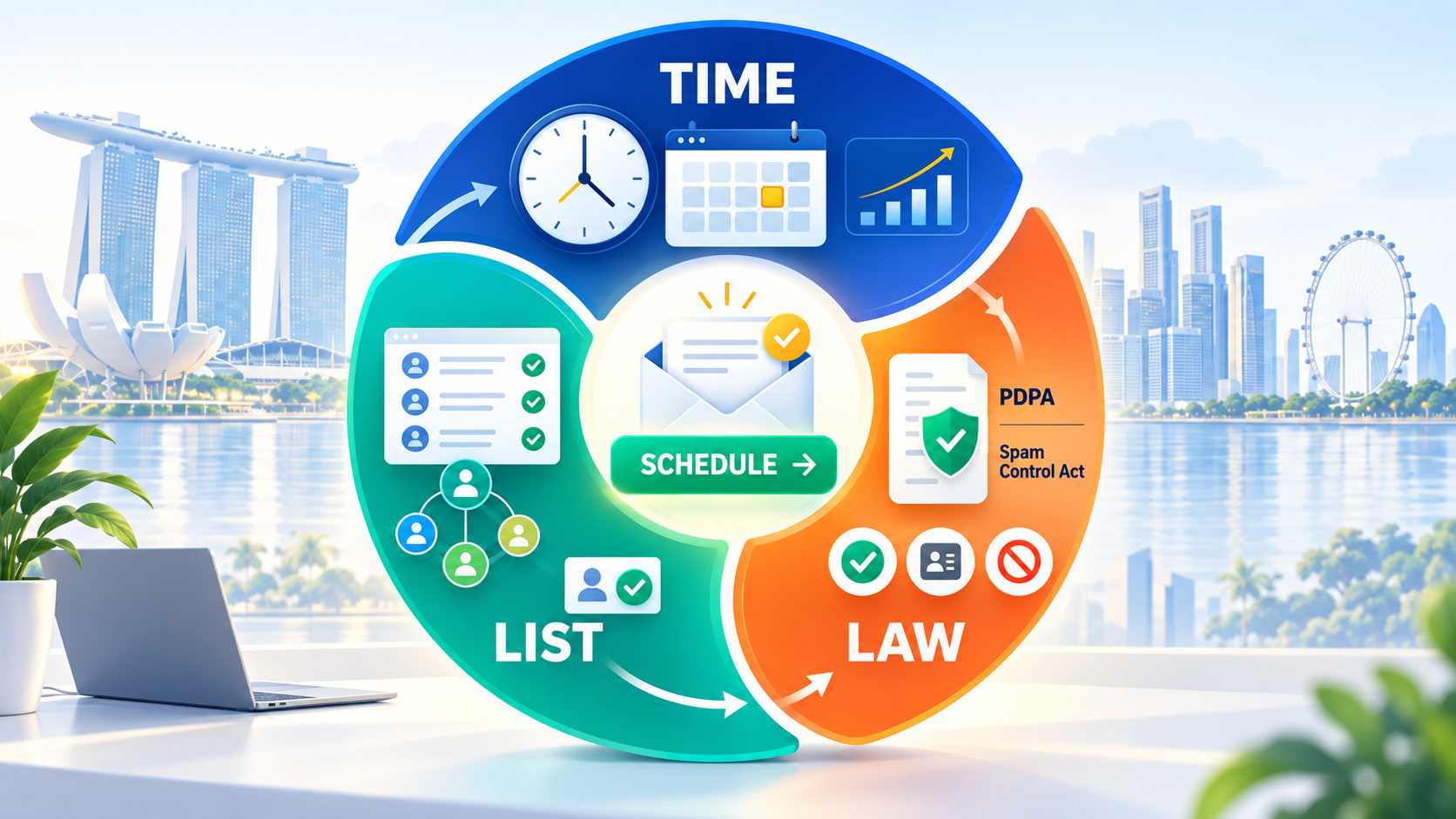
Before we schedule a campaign for a client, we run through three checks in a fixed order. We call it the Time, List, Law check.
- Time. The send window itself, checked against the audience type and, where possible, against results from a previous test on the same list.
- List. Segmentation and list health, confirming the send goes to a properly segmented group with addresses checked recently enough to keep the bounce rate low.
- Law. The PDPA and Spam Control Act checks above are confirmed before the send goes out instead of after a complaint arrives.

Skipping any one of the three is the most common reason a send underperforms or creates a compliance problem later. Most of the scheduling issues we come across trace back to one of these three, not to some more complicated failure most guides focus on.
Where This Leaves Your Email Schedule
A working email schedule comes down to a short list of decisions made in the right order. Pick a send window that suits your audience type, and test it against your own list instead of assuming a global benchmark applies.
Set cadence by email type, not a fixed weekly habit copied from another business. Confirm the PDPA and Spam Control Act checks before every bulk send. Measure success through click rate and revenue per recipient, not a number a phone’s privacy settings can quietly inflate.
None of this needs to be complicated, but it does need someone checking it consistently. If you would like a second opinion on your current schedule, our email marketing team reviews send times, cadence and list compliance for Singapore businesses on a regular basis. You can see our full range of services on our services page.
Frequently Asked Questions
What is the best time to schedule a business email in Singapore?
For B2B audiences, mid-morning on a Tuesday, Wednesday or Thursday tends to perform best. For B2C audiences, evenings or weekends usually work better, though testing both against your own list is the only sure way to know.
How often should a business send marketing emails?
It depends on the email type more than on one fixed rule. A newsletter can run weekly or fortnightly, while a promotional offer usually needs no more than two or three emails.
Do I need consent before emailing a purchased contact list in Singapore?
Yes. Under the PDPA, you need proof that each person actually consented to their data being passed on for marketing, not just that they once did business with someone else.
What is the difference between the PDPA and the Spam Control Act?
The PDPA covers the right to collect and hold someone’s personal data. The Spam Control Act 2007 separately covers how a business sends bulk commercial email, including sender identification and unsubscribe rules.
Why did my email open rate go up without any change in results?
Apple’s Mail Privacy Protection now marks many emails as opened automatically on devices where nobody reads the message. Check click rate and revenue per recipient before assuming a real improvement has happened.
Can automation replace a manual send schedule completely?
Not entirely, for most Singapore businesses. Automated, behaviour-triggered emails outperform one-off campaigns on click rate and revenue, but launches still need a scheduled campaign.